
A survey of student motivation : Key
motivating factors for pro-active learners
journal or
publication title
Ex : エクス : 言語文化論集
number
7
page range
47-73
year
2011-03-25
URL
http://hdl.handle.net/10236/7593
Key motivating factors for pro-active learners
Elizabeth Yoshikawa*
AbstractJapanese students have frequently had the English language presented to them as a cold abstract. In this situation, it is very likely that students would have low motivation to learn English. Language learning must not be static, it must be dynamic enabling students to build upon the knowledge they already have acquired. This would allow students to become proactive learners and their motivation to learn English would increase. This project in development on motivation draws upon survey results and has developed on previous research to include the relationships between intrinsic and extrinsic motivations of both first and second year students in their English learning experiences. It discusses important causes linked to non-English majors’ low motivation. Specific examples of how text materials can be made dynamic, enabling students to find intrinsic motivations for learning English as they realize how the language presented in their textbook can come to life are introduced. This continuation of research has found that the more students are able to make a link to their own personal situation, the higher their intrinsic motivation. Effective utilization of course personalization can increase the relevance of student’s learning situations, enabling them to find intrinsic links for learning English. As a result, in the classroom situation, students are able to increase their confidence in using English in a safe and structured environment. Key words: extrinsic/ intrinsic motivation, classroom materials
Introduction
Recently, in Japan, student attitude and motivation have been gaining more attention from instructors and researchers with regards to improving foreign language instruction (Brown, 2004; Da Silva, 2005; Donnery, 2009; Moritoshi, 2009). This is certainly true with any English as a foreign language class (Dornyei, 2001; Moritoshi, 2009; Noels et al., 2003). The attention to student attitude and motivations is consequent to the recognition that only the students can accurately articulate 1) the perceived and actual accomplishments of the course, 2) the degree of interaction between the instructor and themselves, and 3) the quality of the course in terms of both instruction and situation and how these elements combined in turn motivate them. Attention to student motivation is of particular concern and importance. This concern manifests itself in terms of how students differ from each other in the ways they value and interpret their learning goals which influence their motivation, and this in turn has implications in improving both the quality of the course and general instruction.
This paper is a part of an on-going project which attempts to understand issues of motivation among non-English majors learning English as a foreign language (EFL) at a Japanese university in order to improve classroom instruction. It serves as a follow up to the previous study presented at the Asian EFL Journal International Conference in Taiwan in 2010 (Stimulating classroom discussions: Going beyond the textbook. Conference Preceding: Asian EFL Journal International Conference. Providence University, Taiwan). While the previous study focused solely on second year students’ motivations, this paper expands upon the previous results by including first year students’ results and explores the similarities
and differences between first year and second year students’ extrinsic and intrinsic motivations. It also discusses how EFL learning in relation to differences in student’s motivation affects their involvement in learning. As students are learning EFL and do not have regular access to fluent English speakers, it is important that the instructor provides them with both the communicative tools and the opportunities to make use of the language that they will need for possible future EFL communication, therefore suggestions on how to create a positive learning situation for non-English majors are presented.
Motivation in Literature
Since Gardner and Lambert’s (1959) pioneering study on the relationship between motivation measures combined with the cognitive factor of language aptitude in second language learning, research in the field of motivation has developed in many directions. While the research may vary, the common theme of how language acquisition can be promoted through motivation is constant. Accordingly, the research has led to suggestions and practices of instructional changes in second language learning.
Nuttin (1976) describes motivation as a part of a continuous relationship of interaction between the learner and their environment. Here motivation is recognized and promoted as the principle factor bridging the method of study such as tasks and projects and the student’s interest to achieve the objective or goal.
More recently, taking further the notion of integrative motivation (Gardner 1985), Gardner (2002) addresses the salience of a second language
in a specific environment in terms of how the first language’s society values it. From this stance, attention is directed to 1) how a second language (L2) learner identifies with the L2’s culture, 2) how this is combined with the learner’s attitudes toward the learning situation, and ultimately 3) how these elements are translated into learning practices to influence both the learner’s motivation and subsequent language achievement. In a similar vein, Reid (1987) and later McGroarty (2002) suggest that learner environment is influential in how students both experience and regard their L2 instruction. Here, understanding of the overall social and cultural background as well as of the specific institutional environment in which the L2 is being taught becomes crucial in motivating students and enhancing their language competence and use.
Of particular interest in research on learner environment in the Japanese context is the research focused on the students’ attitudes towards their English instructors. In her survey of Japanese college students, Shimizu (1995) concludes that students typically view the native speaker of English teacher as less qualified and less capable language instructors than their Japanese English language teachers. She also found that these classes are perceived as an entertaining interlude from their other more serious classes. Moritoshi (2009) confers with this stance, stating that research has yet to dispel this seemly unilaterally held viewpoint among university students. Consequently, it is likely that students’ perception of their language instructors, especially foreign instructors, is an important factor in their leaning experience, affecting their motivation for learning English. While Moritoshi does give examples of how to dispel this attitude, neither of these researchers offers suggestions how non-Japanese instructors can take advantage of this particular situation to help students improve their English
learning.
In sum, the outcome of the research on motivation over the decades is similar in that it aims to achieve a better instructional environment for the students, while in Japan there is the added factor of student’s perception of their foreign language instructors.
Intrinsic Motivations and Extrinsic Motivations Operational Terms
One of the most useful treatments of the term motivation, especially in the context of EFL learning in the Japanese university classroom, is to divide it into terms of intrinsic and extrinsic values. This paper incorporates intrinsic and extrinsic motivations as core operational terms.
Intrinsic motivation is defined by Dornyei (2001) as “the learners’ interest in and anticipated enjoyment of the language learning activity” (p. 53). Intrinsic motivation varies according to each individual student. It follows that students must be presented with activities that are not only challenging, but also enable them to initiate the direction of the task to maximize their own pleasure in the task (Dornyei, 2001; Moritoshi, 2009; Noels et al., 2003). If these conditions are met, then the students’ intrinsic motivation to complete the task/ activity, to explore new ideas and knowledge, and ultimately to learn the new language or deal with new language enhancing situations, both increase and will lead to a greater sense of accomplishment.
It would follow then that activities for students must be at a level which they can rise to the challenge similar to Krashen’s (1982) classic i+1. However, it would also imply that within the activity there must be the freedom of choice enabling students to choose the option that is most
appealing and therefore interesting to them. Therefore, the instructor, in the design of their English as a foreign language class must carefully consider which tasks will stimulate their students and in turn maximize the student’s motivation to learn.
In contrast, Dornyei (2001) describes extrinsic motivation as a controlled form of motivation which “involves performing a behaviour as a means to an end, that is, to receive some extrinsic reward (e.g. good grades)” (p. 11). External regulators would therefore force the students to perform in a certain way enabling them to either avoid punishment or to achieve desired goals. In Japan, many non-English majors taking English classes at university are doing so solely to satisfy graduation requirements. In this situation the students’ need to regularly attend English classes is based on extrinsic motivation. The external regulator that students face is that they must attend a certain percentage of classes or they will fail the course and failure would hamper their eventual graduation. While these students regularly attend class and participate in tasks, they do so without desire, primarily to attain a passing grade. For many students, without this external pressure, the reason for learning EFL would cease and as Noels et al. (2003) suggest there would be no “incentive” (p. 39) for them to continue learning English.
Thus, while past research suggests that motivation is linked to successful L2 learning, it is crucial to pay attention to the distinction between intrinsic and extrinsic motivations. Moreover, it is also important to pay attention to that which appeals to the students’ intrinsic motivation rather than to their extrinsic motivation as it is this that is more likely to help the student achieve a greater sense of accomplishment and enhance their overall EFL competence and use, which then in turn increases their
overall desire to learn English.
In the following these two points will be discussed with survey data, and suggestions for creating a positive classroom atmosphere will be provided.
Method Survey Design
The overall purpose of this on-going project is to understand issues of motivation among non-English majors learning English as a foreign language (EFL) at a Japanese university in order to improve classroom instruction. As a component of the project, the survey was designed and conducted 1) to delineate the general motivational attributes of these non-English major Japanese students as well as their extrinsic and intrinsic motivations, and 2) to find out which motivational attributes, intrinsic or extrinsic, are stronger. The survey questionnaire consists of three parts and it was provided in both Japanese and English to ensure student comprehension of the survey questions. The translation of the survey questionnaire into Japanese was completed by a native speaker of Japanese. The first part of the questionnaire assesses student’s backgrounds by asking of age, gender, and year of study at university. The second part focuses on students’ anxiety when studying English. The third part of the survey questionnaire focuses on students’ intrinsic and extrinsic motivations to study English. Since this paper is primarily concerned with student motivation to study English, only the first and third parts of the survey questionnaire are mainly discussed in the following.
The third part of the survey consists of 13 questions. The questions were first drawn from Gardner’s (2004) Attitude/ Motivation Test Battery
(AMTB) and Cao & Philp’s (2006) survey which developed from MacIntyre et al. (1998) Willingness To Communicate (WTC) survey. The questions in this survey were then modified and translated into Japanese for the students’ level of English and situation1). Justification for the incorporation
of these translated questions is that 1) to ensure that the questions were fully understood by the Japanese participants and 2) to take the information garnered from the survey to create an intrinsically motivating pedagogical atmosphere for students to increase their English knowledge. All the questions were positively worded and presented in a random order, and used a five-point Likert scale.
As this survey is concerned with both students’ extrinsic and intrinsic motivations to study English, several questions were included specifically to delineate intrinsic motivations and others extrinsic motivations. For example, the questions inquiring about future employment or asking students whether learning English enables them to gain new ideas are questions designed for intrinsic motivations. On other hand, the questions asking whether they need English to fulfill the university requirement for graduation is concerned with extrinsic motivation.
The results obtained through the survey are a general indicator of intrinsic and extrinsic motivations and attitudes towards English learning of a group of first and second year non-English major students in a university context. It should be noted that the students may experience change in their English education from the first year to the second year, both in terms of instructors and their expectations for the course, and also in terms 1) As the translation of questions from one language to another in itself can be problematic in terms of research validity and reliability, all wording was discussed with the translator to guard against possible cultural misunderstanding and inaccuracies as per Griffee (1998).
of coursework. It should also be noted that the questions in this survey questionnaire are not constructed to reflect these differences between the first and second year education. Thus, while differences in the results between first year and second year students should be expected, it is not feasible to discuss these differences based solely upon the survey results. Instead, any discussion on differences between the two should include external reference to the educational experiences of first year and second year students in terms of course work and instructors.
Survey Procedure
The survey was conducted during a regular class hour at the end of the first term. The survey questionnaire was distributed and students were asked to answer it during the last 20 minutes of class time. Students were informed that their responses would be confidential, and that their participation was voluntary.
Participants
Students registered in first and second year comprehensive English classes in the Department of Economics at a Japanese university were asked to participate in the survey2). All students had studied English since
junior high school, therefore had had six years of accuracy based English instruction prior to entering university. The second year students had also 2) All the students participating in the survey were enrolled in either their first year of comprehensive English class or in their second and final year of comprehensive English class. However, as some students had previously failed this specific course, they may be in either class but actually be in their third or fourth year of university study.
completed first year comprehensive English classes at university.
The first year students
Their age ranged from 18 to 21 years old. Males composed of 73% of the sample. Three of the 102 students who participated in the survey, were disregarded as they did not complete the survey. Thus, 99 first year students are included in this study. One student who was taking the first year English class was actually in his or her second year of university study.
The second year students
Their age ranged from 19 to 23 years old. Males composed of 83% of the sample. Six of the 75 students who participated in the survey, were disregarded as they did not complete the survey. Accordingly, 69 second year students are included in this study. Of these 69 students two were in their third year of university study, and five were in their fourth year of university study.
Survey Results
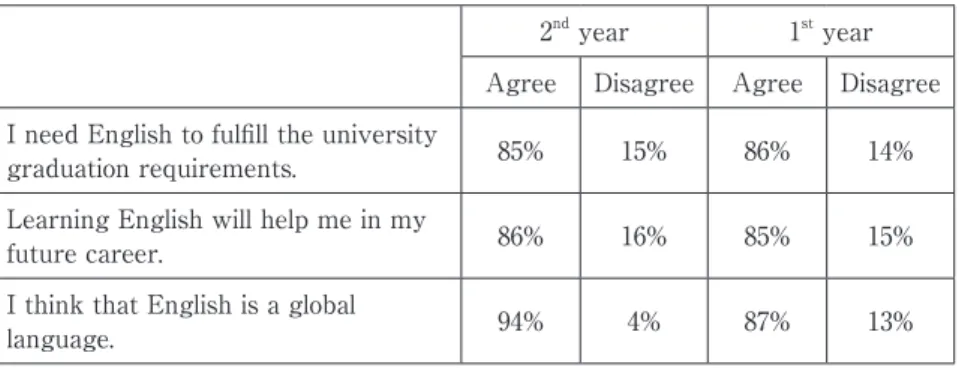
Table 1 shows the breakdown of student responses to the survey questions, which were designed to illicit information on the extrinsic motivations for studying English. The questions ask to what extent the students are aware of or see these external factors implicated in the questions as relevant to their learning of English, as per Dornyei’s (2001) definition, above. In contrast, Table 2 depicts student’s responses to the
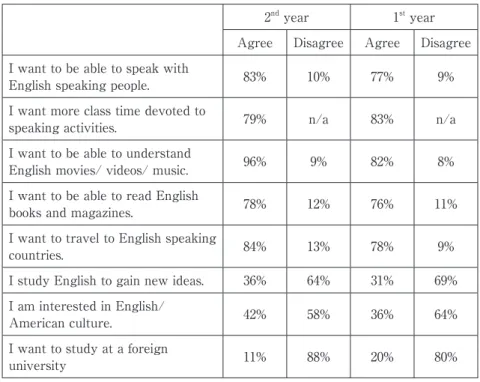
survey questions which were designed to illicit information on intrinsic motivations. These questions ask to what extent these students see the views and activities stated in the questions as relevant to their personal interest and personal enjoyment as per Dornyei’s (2001) definition. Each table shows results of both first year and second year students. Finally Table 2 also depicts the students’ intrinsic academic values of English, so as to make clear the intrinsic reasons for studying English. For the sake of simplification and discussion of the survey results, the results obtained under the “agree” and “somewhat agree” Likert scales are collapsed together under “Agree” in the tables presented here. Similarly, the results obtained under the “disagree” and “somewhat disagree” are collapsed together under “Disagree” in the tables.
Table 1: Extrinsic motivations for learning English
2nd year 1st year
Agree Disagree Agree Disagree
I need English to fulfill the university
graduation requirements. 85% 15% 86% 14%
Learning English will help me in my
future career. 86% 16% 85% 15%
I think that English is a global
language. 94% 4% 87% 13%
From the survey results shown in Table 1, it can be argued that extrinsic motivations are strong among the students in the survey. The students are well aware of and see English as a graduation requirement, a possible tool for their future employment, and a global language. The results
are certainly reflective of the university’s educational requirement and, to an extent, the MEXT’s institutional changes in making comprehensive English courses mandatory for first and second year university education (2003). They are also consistent with the general perception of English as a global language. MEXT (2003) states that it is essential that Japanese learn English to promote both “international understanding and cooperation” (p. 1) so that Japan is able to compete on an equal footing economically internationally. It is important to bring up two observations from the survey. First of all, somewhat surprisingly, 15% of the second year students and 14% of the first year students are unaware that they must successfully complete English to graduate. Although these numbers themselves do not allow any further discussion, they remind us of the obvious: discussion of extrinsic motivations requires the person in the question to clearly recognize what extrinsic factors are. Secondly, while there are no significant percentage differences between the first and second year students with regard to the first and second questions, a noticeable difference does exist between the first and second year students with regard to the last question. Of the second year students 94% agree that “English is a universal language”, while 87% of the first year students agree with this statement. This difference could be attributed to the year of study and the amount of discipline related knowledge the second year students have been exposed to, as well as to the fact that many second year students have already started to job hunt, and have experienced first hand the demand of a working knowledge of English as a universal language from potential employers.
Table 2: Students’ Intrinsic value for studying English.
2nd year 1st year
Agree Disagree Agree Disagree
I want to be able to speak with
English speaking people. 83% 10% 77% 9%
I want more class time devoted to
speaking activities. 79% n/a 83% n/a
I want to be able to understand
English movies/ videos/ music. 96% 9% 82% 8%
I want to be able to read English
books and magazines. 78% 12% 76% 11%
I want to travel to English speaking
countries. 84% 13% 78% 9%
I study English to gain new ideas. 36% 64% 31% 69%
I am interested in English/
American culture. 42% 58% 36% 64%
I want to study at a foreign
university 11% 88% 20% 80%
From the survey results shown in Table 2, it can be argued that while the students show high intrinsic motivations in improving English speaking, listening, and reading skills, they also show considerably low percentages in their intrinsic motivation of learning English to “gain new ideas” or in being interested in English/American culture. The differences between the two as well as the differences between the second and first year students beg interpretations and explanations.
Eighty-three percent of the second year students and 77% of the first year students want to be able to speak with English speaking people. These high percentages are also reflected in their answer to the second question
where high percentages of both first and second year students express a desire that they want class time devoted to speaking practice. These results are also consistent with suggestions and comments provided by students in the last section of the survey where students in both years expressed a desire for more class time devoted to conversation. In observation however, students when given class time to have discussions or conversations, were unlikely to speak in English. This would indicate that conversations centered on a specific activity to complete are required.
As discussed above, the difference between the second and first year students can be attributed to the fact that students in the second year have had greater exposure to English instruction practices at the university level as well as to the job market demands.
Ninety-six percent of the second year students and 82% of the first year students want to be able to understand English movies, videos, or music. These percentages are the highest for the first year and second year students. That is, the students are more interested in improving their listening skills than speaking and reading skills. It is noteworthy that watching movies, videos or listening to music is more likely to constitute a leisure activity than any other activity such as academic activities. Furthermore many more students are easily able to partake in these activities than traveling.
The second year students had a stronger desire to understand English movies, videos and music than the first year students. This could be explained in part by the fact that second year students have been exposed to English movies, videos, and music along with additional background information about them through university education. This could also be due in part to the fact that many more second year students have part-time jobs,
therefore have more disposable income available to them than first year students.
Seventy-eight percent of the second year students and 76% of the first year students want to be able to read English books and magazines. Though not statistically significant, these percentages are lowest nonetheless among the questions asking students’ desire to improve English speaking, listening, and reading skills. This may implicate that the students do not regard reading skills as highly or desirable as speaking and listening skills. The question however did not make a distinction between reading English for discipline related information and reading for leisure activities. The results could very well differ if a distinction between the two types of reading had been made.
Compared with these results in Table 2 discussed above, the remaining results show lower percentages. Only 36% of the second year students and 31% of first year students are in agreement with that they need to study English to gain new ideas. That is, more than half of the students in both years do not see English as a means to gain new ideas or information. This seems to be in contrast to the results shown in Table 1 where the students see English as a universal language and a possible tool for their future employment. The discrepancies here are likely to be due to the fact that the students are unable to see the distinct link between language and generation of ideas and information. Particularly, it appears that the students fail to recognize the very probable possibility that they will be communicating with other people in the technology or information market using English as a common language, or using English written materials to gain ideas and information pertinent to their work.
first year students are interested in English/ American culture. These low percentages may also be reflected in that only 11% of the second year students and 20% of the first year students are interested in using English to study at a foreign university. These low percentages are in contrast with the result in Table 1 that suggest many students want to be able to understand English movies, videos, or music, which can be regarded as representatives of English/ American culture. Considering the importance of how a second language (L2) learner identifies with the L2’s culture in second language acquisition (Gardner 2002), it can be argued that English videos, movies, or music are regarded by the students just as “leisure activities” doable in the confined context of their own Japanese culture, but not necessarily as a stimulating window to English speaking worlds.
The difference in percentage between the second and first year students in terms of interest in English/ American culture can be explained by the fact that the second year students have been exposed to the university English education where the link between language and English/ American culture are made by native English speaking teachers.
The difference between the second year and first year students in terms of interest in studying at a foreign university may be due to the fact that by the time students have reached their second year, they become more realistic in the possibility of studying abroad.
From the discussion above, it would be necessary for the instructor to help the students make connections between English language skills and the acquisition of new information and ideas. It would also necessitate that students make a link between English and its cultural background should these low intrinsic motivations be improved. Furthermore, it is also important for the instructor to help the students to recognize the possibility
that, in their future employment or other fields of activities, the students may use English as a universal language to communicate with non-native speakers of English like themselves. If these students are aware of these links and possibilities, then their perception of English would change. Furthermore, as most non-English major students lack confidence, it is imperative that the instructor assists students in a low-stress situation to recognize these links and possibilities and to improve their language competence.
Positive classroom situation
The above survey was necessary in order to assess factors regarding student motivation. This information was then used to design a class that is more appealing to the students’ motivations to learn English. Students who are highly motivated to learn EFL typically express positive feelings towards the learning of the English language and value it intellectually. The results of this survey suggests that these non-English majors typically view English only as relevant for their graduation requirements with a few students viewing it as important for their future careers; while their extrinsic motivation is high, their intrinsic motivation however is centered on leisure activities. This is a significant point. Therefore, in the designing of a university level non-major English class, there are several points that should be considered.
In the structure of a language class there are six points to consider. First, it goes without saying that in any class the instructor would want to create a positive learning atmosphere. Students who have positive feelings towards English will be more motivated to learn English. However, this
motivation would increase if students had a sense of value for English, both culturally and intellectually (Dornyei 2003; Gardner 2002). Secondly, classes which consist of a variety of topics and activities that are interesting to students will create the desire to practice, and thereby intrinsically motivate students. Intrinsic motivation then leads to the third point, student autonomy. Students need to feel they have some control in their learning process, they need to be involved (Dornyei 2001). This can be achieved in non-English major classes by allowing students choices within a framework allowing them to link linguistic items, cultural knowledge and discipline related skills to the topic at hand. While allowing students autonomy, it is also imperative that students know what is expected of them, the fourth point. Student need to know the framework of the task and to be fully aware of what they must do. Depending of the students’ level of EFL, the number of stages that instructions are given will vary. Next, time is very important, and can be interpreted in two ways. First do students have adequate time to a complete task within class, or if for homework, adequate notice of when the task/ project is due. Secondly, do students have enough time for discussions? Discussions between students allow them to make use of their specific technical knowledge or discipline related linguistic items, with the instructor in role of the facilitator. To create a situation where students are brought out of the limitations of their texts and intrinsically motivated to utilize their linguistic knowledge in group discussions and project work, visual aids are beneficial. Lastly, students are often not motivated to participate in class because they lack involvement in the topic. Many topics in their textbooks seemingly do not apply to their lives. Therefore as the survey results indicate, it is necessary to personalize the course content to the students’ lives or culture. The more students see the relevance of the
course or course materials to their own lives, the more wholly they will participate in class. The language and topics presented in textbooks offer the ideas. However it is key, that as instructors, we make links between the concepts from the textbooks and the students’ realities.
Language must not remain static for students. For university students to achieve their goal of becoming more proficient English communicators, they must actively utilize the topic they are studying. This should transform into discussions related to the issues on the topic at hand. It is important to remember that student interest in a topic is not enough. The studying of syntax is essential as students may be reluctant or unable to discuss a specific topic in English simply due to their lack of linguistic resources to do so (Rob & Nolasco, 1996). Therefore, students must have adequate time to work with the new language presented in class. Exercises in the target language through listening and speaking tasks, including practicing new vocabulary are necessary to give students an opportunity to absorb the language.
Students often express a desire to watch a movie in class. While instructors may be hesitant to loose a whole class to the viewing of a movie, which students might take as an opportunity to sleep in, YouTube clips can be utilized with an intrinsic motivation effect. After students have had an opportunity to work with the new syntax, YouTube clips allow students a chance to look up and out of their textbooks and a chance to ponder over the lesson’s topic while being required to practice and further develop their linguistic abilities. Students are exposed to variety of situations in which English is used in YouTube clips, and they can improve their listening abilities. The visual of YouTube clips allow students to see the English they are studying used in authentic realistic situations which are culturally
loaded. Showing several clips with different points of view on the same topic can offer students a chance to think creatively, while encouraging them to take advantage of most of their English skills in the follow-up activities. Furthermore, while Japan is typically criticized for being an insular culture with an island mentality, exposing students to YouTube clips in juxtaposition to mainstream Japanese cultural values allows students to connect with other values or as Dornyei (2003) and Gardner (2002) state, to emotionally identify with other cultures. This would thereby spark the motivation to be curious about other cultures and how other cultures view Japan. With this emotional connection, students are better able to create links between other cultures and their own cultural understanding which would lead to a greater understanding of the L2.
Teaching practices can be angled towards the student’s specific programs through additional exercises. How can this be done? A key component which many researchers suggest to improving motivation is the personalization of the course (Dornyei, 2001; Moritoshi, 2009; Noels et al., 2003). The more students see the relevance of the course or course materials to their own situation, the more likely students are willing to participate in the class, as the personalization of the course work becomes more appealing to them, it in turn is more intrinsically motivating. The personalization of the course should take note of the survey’s results of the students’ strong desire for English usage for leisure activities. From this stance, it should be possible to link any unit from the students’ text to their personal situations, although this sometimes requires creativity on the part of the instructor. Both the first and second year courses the classes were structured into a two session cycle. In the first session, the topic was introduced, related issues to the topic were discussed, and exercises using the target language
through writing and speaking tasks were completed. In the second session students viewed YouTube clips which had been chosen so as to make a link between the topic and Japan, giving it meaning to the students, and then were required to do small group assignments. In this second session, the role of the instructor was to reinforce new vocabulary, and check grammar and student comprehension, as well as answer students’ queries. However, students do not only want to be reading and writing in class. Although they dread doing so, many students want to practice giving speeches in English. In order to create a motivating interaction situation, after two or three complete unit cycles, depending on the topics covered, students then were required to choose the assignment they felt most confident with and give a presentation to the class. While students would have had some class time to complete their presentations, most would need to complete the presentation preparation as a homework activity. Presentations encourage students to use their linguistic and communicative abilities, as well as their creative abilities. At this time the instructor can correct common mistakes and handle pragmatic issues with the class. Students were also required to hand in their speech, which allows the instructor to check for grammatical problems. By following this method, students gain the confidence to use English in a safe and structured setting, allowing opportunities for intrinsic motivation to increase.
A sample project
The point and shoot style of teaching is ineffective. It is necessary for students to have time to become familiar with the topic to gain both an English knowledge of the topic and confidence to use that knowledge.
It is then essential that students have the time to develop this knowledge autonomously.
Once the students have been familiarized with the topic through the textbook, it is necessary to make it dynamic. If the students have completed a unit on Environmentalism, and learnt about the concept of being “Green”, YouTube clips can be utilized to jump the students into reality, allowing them to make connections between the language learnt from the unit and how they can use it in their specific situations. As the instructor, working with student in prior lessons allows us an opportunity to gain an idea of students’ beliefs which can then be used to choose some of the YouTube clips.
Before showing any YouTube clip schema building activities should be completed. For this unit on Environmentalism, as a brainstorming exercise, students were asked: “What is Green?”, “In what ways are Japanese Green?”, “How could you encourage more people to practice Green methods?”, “In your life, how could you increase your eco-friendliness?”, “Do you think it is easy to be Green?” and “What do you think is the most important environmental issue facing Japan now?” Students work in pairs and write down their responses to these questions, and then view the YouTube clips. Foreigners often think of Japan as a very crowded country, but also as a nature loving, environmentally friendly country. YouTube clips which depict these values allow students to compare and contrast what they think foreigners images of being Green are, and their own images of being Green. Showing clips that reinforce this ideal in tandem with clips which depict a contrary idea, such as a community of Freegans3) allows students to
3) Freegans are eco-extremists. They employ alternative strategies for living, based on limited participation in the consumer market. They are also known as Dumpster divers.
gain insight and understanding of another aspect of culture.
Once students have watched the YouTube clips, they then discuss with partners or in small groups what was intriguing, surprising, or disinteresting about what they had viewed. This also allows students to gain a greater understanding of the topic and possible implications for them as well as fluency in their English use.
Then the assignment is passed out. The assignment is set within the parameters of the vocabulary of the unit, and also the grammar point. Students should be given at least two choices for any project, with the option of creating their own additional choice. For the unit on Environmentalism students could choose from the following:
1) The university has problem with parking. With your group suggest ways to solve the issue of parking for bikes, motorbikes and cars. You need to consider space, cost, and the feasibility of your suggestions.
2) The university is like a small town and everyday produces a lot of garbage. What could you do to reduce the amount of garbage produced? What other plans could you implement to make the university more “Green”?
There is an element of challenge to the project as the first choice requires that students work with a realistic budget. Money is an issue and they would have to consider realistic and feasible solutions to the parking problem. For the second topic students would have to consider the details of their eco-friendly suggestions, particularly in terms of ease for the university population to recycle or reduce waste, as well as the cost of being environmentally friendly. Given that students would have to do some research, they were required to hand-in their Environmentalism assignments
at the beginning of the following class.
Once students have completed several cycles of classes, they then choose the topic that is most appealing to them, or that they feel the most confident with, and give a presentation to the class. Students have the option of doing group or solo presentations. The process of breaking the class into cycles allows students time to develop their EFL knowledge in a way that is relevant to them.
Summary
This continuing survey sought to identify the stronger motivation intrinsic or extrinsic in studying English among first and second year university students taking compulsory English classes. A perfunctory glance at the results suggests that students in both years of study are currently more extrinsically motivated. This extrinsic motivation is also compounded by the fact that English is a compulsory requirement for graduation. Students are intrinsically interested in English; however this interest is primarily in English for its entertainment value or for making friends. Development of teaching practices, which effectively transform these negative experiences into positive ones, is in order. Instructors must be aware of students’ present desires for learning English as well as lay the foundation for possible language usage in their future careers. When the instructor has awareness of the class situation, they are more receiving of the needs that students may have, and are able to adjust the course materials according to these needs. This also enables the instructor to improve the course work for the students so that they overcome any potential syntax problems thereby avoiding de-motivating situations.
Effective utilization of course materials improves the learning situation for students as the relevance of what is being learnt is both understood and appreciated. Students may feel reluctant to take part in a conversation if they are unable to link a value to it. This is of importance to EFL teaching as it furthers the argument for the personalization of course materials. As both the first and second year students indicated a strong desire for English use in their leisure activities, it is necessary to personalize the language learnt. In order to increase students’ intrinsic motivation, students must be able to make a link between the language learnt in the EFL classroom to either their personal lives or to their specific disciple to be able to effectively utilize this new language. The instructor can achieve this in part through the process of breaking the class into three cycles: first by presenting the new information, secondly by making connections with the new material and the students’ personal situations by watching YouTube clips and working as a class with it, and thirdly encouraging students to autonomously work with the material through presentations. This would allow students greater opportunities to connect with the linguistic data either with their specific disciplines or with their cultural knowledge.
If intrinsic motivation increases, students would then be more willing to take the knowledge that they already possess and build upon it. Intrinsic motivation then becomes a circular continuum, where by in a positive intrinsic motivation situation students’ confidence in their EFL skills increase which will in turn influence the students’ general EFL performance and enhance their overall EFL ability.
References
Students. Information &Communication Studies, 31, 1-12. Chigasaki, Japan: Bunkyo University, Department of Information Sciences.
Cao, Y. & Philp, J. (2006). Interactional context and willingness to communicate: A comparison of behavior in whole class, group and dyadic interaction. System, 34:4, 480-493.
Da Silva, D. (2005). Are Japanese Students Really Unmotivated? Retrieved from www.aare.edu.au/05pap/das05381.pdf
Donnery, E. (2009). Testing the waters: Drama in the Japanese university EFL classroom. Scenario, 1. Retrieved from http://publish.ucc.ie/scenario/current Dornyei, Z. (2003). Attitudes, orientations, and motivations in language learning:
Advances in theory, research, and applications. In Z. Dornyei & A. Cumming (Eds.), Attitudes, orientations, and motivations in language learning. (pp. 3-32). Malden: Blackwell Publishing.
Dornyei, Z. (2001). Motivational strategies in the language classroom. Cambridge: University Press.
Gardner, R. C. (2004). Attitude/ Motivation Test Battery: International AMTB
Research project. Retrieved from http://publish.uwo.ca/~gardner/docs/ englishamtb.pdf
Gardner, R. C. (2002). Integrative motivation and second language acquisition. In Z. Dornyei & R. Schmidt (Eds.), Motivation and second language acquisition. (pp. 1-19). Honolulu: University of Hawai’i Press.
Gardner, R. C. (1985). Social psychology and second language learning: The role of
attitudes and motivation. London: Edward Arnold.
Gardner, R. C. & Lambert, W. (1959). Motivational variables in second language learning: Assumptions, findings and issues. Language Learning, 13, 226-272. Griffee, D. (1998). Can we validly translate questionnaire items from English to
Japanese? Retrieved from http://jalt.org/test/gri_1.htm).
Krashen, S. D. (1982). Principles and Practice in Second Language Acquisition. New Jersey: Prentice Hall.
McGroarty, M. (2002). Situating second language motivation. . In Z. Dornyei & R. Schmidt (Eds.), Motivation and second language acquisition. (pp. 69-91). Honolulu: University of Hawai’i Press.
MacIntyre, P.D., Clément, R., Dornyei, Z., & Noels, K.A. (1998). Conceptualizing willingness to communicate in a L2: A situational model of L2 confidence and affiliation. The Modern Language Journal, 82 (4), 545-562.
MEXT. (2003). Regarding the establishment of an action plan to cultivate “Japanese with English Abilities.” Retrieved from: www.mext.go.jp/english/
topics/03072801.htm
Moritoshi, P. (2009). Motivating non-English majors in English classes. In A. M. Stoke (Ed.), JALT2008 Conference Proceedings. Tokyo: JALT.
Noels, K. A, Pelletier, L. G., Clement, R. and Vallerand, R. J. (2003). Why are you learning a second language? Motivational orientations and self-determination theory. In Z. Dornyei & A. Cumming (Eds.), Attitudes, orientations, and
motivations in language learning. (pp. 33-63). Malden: Blackwell Publishing. Nuttin, J. R. (1976). Motivation and reward in human learning: A cognitive approach.
In W. K. Estes (Ed.), Handbook of learning and cognitive processes, Vol 3:
Approaches to human learning and motivation (pp. 247-281). Hillsdale, NJ: Erlbaum.
Reid, J. M. (1987). The learning style preferences of ESL students. TESOL
Quarterly, 21, 87-109.
Rob, A. & Nolasco, L. (1996). Resource books for teachers: Conversation. Oxford: University Press.
Shimizu, K. (1995). Japanese college student attitudes towards English teachers: A survey. The Language Teacher 19, 5-8.
Yoshikawa, E. (2010). Stimulating classroom discussions: Going beyond the textbook.
Conference Preceding: Asian EFL Journal International Conference. Providence University, Taiwan.
![For copies of the original instructions see [7]](data:image/gif;base64,R0lGODlhAQABAIAAAP///wAAACH5BAEAAAAALAAAAAABAAEAAAICRAEAOw==)