94
エネルギー散逸を伴う遷音速流に対する二次元固有値問題
阪大レーザー研、 村上匡且 (Masakatsu Murakami)
Institute
of
Laser Engineering, Osaka UniversitySelf-similar solutions play
a
crucial role in many branches of physics, in particular, forsuch fields
as
hydrodynamic phenomena in astrophysics. For example, the Larson-Penston(LP)solution facilitates qualitative analysis of complex hydrodynamic flows ofgravitational
collapse of
an
isothermalgaseous
sphere,3,4 which is proposed to explain the qualitativedynamicsinthe earlystage ofstar formation.However, the effectof radiative heat conduction
is expectedtoplay
an
importantroleinsucha
temporal domain that substantial dissociation andionization of molecules and atoms proceed with contraction of the system and that the
isothermal assumption isnotappropriate any
more.
Still,among a large variety ofself-similarsolutions ofthe hydrodynamic equations, those which include heat conduction
are
relatively$\mathrm{f}\mathrm{e}\mathrm{w}.5\cdot 7$
Still more, to the best of
our
knowledge, there has beenno
otherpublicationson
theself-similarsolution, which simultaneously treatsboth the self-gravity and the non-linear heat
conductivity. A striking differencebetween the outputs of the LP model,for example,and the
presentmodel isfound in the physical picture of the
core
formation. The former and the latterrespectively describe adecreasing and increasing
core
mass
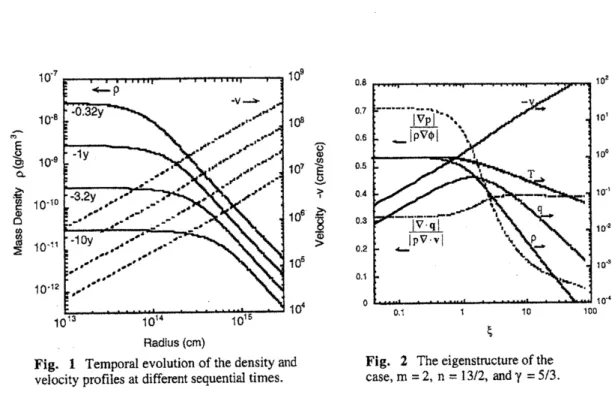
withtime. Figure 1 highlights theoutputof thepresentwork showing thetemporal evolution of the density and velocity profiles
at sequential times. As
can
beseen
in Fig. 1 thecore
shrinks with time, where $\mathrm{t}=0$correspondsto thecollapse time. Thecentral density increasesin proportion to
t-2,
thatis theuniversalscaling regardless of the degree of theheatconductivity. Atthe
same
time, thecore
mass
also increases due tomass
accretion.Onemore
important feature of the present model,whichis essentially different from the conventionalones obtained under the isothermal
or
theadiabatic assumptions, is thatall the scalesof the physical quantities
are
uniquely determinedas
a
function oftimeonly.The one-dimensional spherical gas-dynamical equations with both self-gravity and heat
conductivity
are
$\frac{\partial \mathrm{p}}{\partial \mathrm{t}}+\frac{1\partial}{\mathrm{r}^{2}\partial \mathrm{r}}(\mathrm{r}^{\mathrm{z}_{\mathrm{P}^{\mathfrak{U})=0}}},$
$(1)$
$\frac{\partial \mathrm{u}}{\partial \mathrm{t}}+\mathrm{u}\frac{\partial \mathrm{u}}{\partial \mathrm{r}}=-\frac{1}{\mathrm{p}}\frac{\partial \mathrm{p}}{\partial \mathrm{r}}-\frac{\partial\phi}{\partial \mathrm{r}}$
, (2)
$\frac{1\partial}{\mathrm{r}^{2}\partial \mathrm{r}}(\mathrm{r}^{2}\frac{\partial\phi}{\partial \mathrm{r}})=4\pi \mathrm{G}\mathrm{p}$
, (3)
$\mathrm{p}(\frac{\partial\epsilon}{\partial \mathrm{t}}+\mathrm{u}\frac{\partial\epsilon}{\partial \mathrm{r}})+\frac{\mathrm{p}}{\mathrm{r}^{2}}\frac{\partial}{\partial \mathrm{r}}(\mathrm{r}^{2}\mathrm{u})=\frac{1\partial}{\mathrm{r}^{2}\partial \mathrm{r}}(\mathrm{r}^{2}1\mathrm{C}\frac{\partial \mathrm{T}}{\partial \mathrm{r}})$
(4)
where$\mathrm{p}$is the
pressure,
$\mathrm{r}$themass
density, $\mathrm{e}$the specific internal energy, $\mathrm{u}$ theflow velocity,$\phi$thegravity potential, and $\mathrm{G}$ the gravity constant.We
assume
the idealgas
equation ofstate
(EOS) intheform,
$\mathrm{T}=\mathrm{p}/\mathrm{p}=(\gamma-1)\epsilon$, (5)
where $\gamma$ is the specific heats ratio. Equation (4), described by the one-temperature model,
includes the non-linear heat conduction term
on
the right hand side, wherewe
assume
a
power-law dependence for the conductioncoefficient,
$\theta 5$ $\hat{\varpi_{\tilde{\Phi}}\mathrm{g}}$ $\dot{\alpha}$ $\hat{\xi u.)\Phi 00>}$ $\mathrm{o}’ \mathrm{g}\mathrm{c}0\}n$ $\frac{\frac{>}{\overline{8}}}{>\Phi}\backslash$ $\Xi\alpha u\mathrm{s}\emptyset 1$ $\xi$ Radius(cm)
Fig. 1 Temporal evolution ofthedensityand Fig. 2 The eigenstructure of the
velocityprofilesatdifferent sequential times. case,$\mathrm{r}\mathrm{n}=2$, $\mathrm{n}=13/2$, and$\gamma=5/3$
.
$\kappa=\kappa_{0}\mathrm{T}^{\mathrm{n}}/\mathrm{p}^{\mathrm{m}}$, (6)
with$\kappa_{0}$, $\mathrm{m}$, and$\mathrm{n}$beingconstants. For normal physical values,
$\mathrm{n}>0$and$\mathrm{m}>0$
are
assumed.Inthe numerical calculations given below,
we
keepthe generality in terms ofthe parameters,$\mathrm{m}$, $\mathrm{n}$, and $\gamma$,but also show specific forms using the values of the reference set,
$\mathrm{m}=2$and$\mathrm{n}=$
$13/2$, which describing theopacity due toinverse bremsstrahlung in
a
fully ionized hydrogenplasma together with$\gamma=5/3$
.
Weintroducethe following similarity ansatz,
$\xi=\mathrm{r}/\mathrm{R}(\mathrm{t})$, $\mathrm{R}(\mathrm{t})=\mathrm{A}|\mathrm{t}|^{1/\mathrm{a}}$, (7) $\mathrm{u}=\frac{\mathrm{A}}{\mathrm{a}}|\mathrm{t}|^{\mathrm{b}/\mathrm{a}}\mathrm{v}(\xi)$, $\mathrm{p}=\mathrm{B}|\mathrm{t}|^{-2}\mathrm{g}(\xi)$, $\mathrm{T}=(\frac{\mathrm{A}}{\mathrm{a}})^{2}|\iota|^{\mathrm{c}/\mathrm{a}}\tau(\xi)$, (8) $\frac{\partial\phi}{\partial \mathrm{r}}=\frac{\mathrm{A}\mathrm{B}\mathrm{G}}{\xi^{2}}|\mathrm{t}|^{(\mathrm{e}-1)/\mathrm{a}}\Omega(\xi)$, $\Omega(\xi)=4\pi\int_{0}^{\xi}\xi^{2}\mathrm{g}(\xi)\mathrm{d}\xi$ , (9)
where $1-\mathrm{a}=\mathrm{b}=\mathrm{c}/2=1+\mathrm{d}/2=\mathrm{e}/2=(1+2\mathrm{m})/(3+2\mathrm{m}-2\mathrm{n})$, and $\mathrm{R}(\mathrm{t})$ is the temporal
characteristic scale length of the system; A and $\mathrm{B}$
are
positiveconstants defining the scales ofthe radius and the
mass
density, respectively. Then, Eqs. (1), (2), and (4)are
reducedrespectivelytothe followingordinary differential equations,
$-(\pm\xi-\mathrm{v})\mathrm{g}’+(\pm \mathrm{d}+\mathrm{v}’+2\mathrm{v}/\xi)\mathrm{g}=0$, (10)
$\pm \mathrm{b}\mathrm{v}-(\pm\xi-\mathrm{v})\mathrm{v}’+(\mathrm{g}\tau)’/\mathrm{g}+\mathrm{K}_{1}\Omega/\xi^{2}=0$, (11)
$\frac{\pm \mathrm{c}\tau-(\pm\xi-\mathrm{v})\tau’}{\gamma-1}+(\mathrm{v}’+2\mathrm{v}/\xi)\tau=\mathrm{K}_{2}\frac{(\xi^{2}\mathrm{g}^{-\mathfrak{n}1}\tau^{\mathrm{n}}\tau’)’}{\mathrm{g}\xi^{2}}$
, (12)
where theprimedenotes thederivativewith respectto$\mathrm{x}$, and concerningthedouble signs,
$\pm$ ,
the
upper
and lowersign correspondto$\mathrm{t}>0$and$\mathrm{t}<0$, respectively.In the following analysis,we
focuson
thetime domain, $\mathrm{t}<0$, and therefore $|\mathrm{t}|=-\mathrm{t}$.
Since Eq. (3) is automaticallysatisfied, its reduced form does not
appear
in the above setof equations. Ascan
beseen
inEqs. (11) and (12), the present systemis characterized by thetwo dimensionless parameters,
88
Normalized Core Mass $\mathrm{M}_{\mathrm{c}\mathrm{o}oe}/\mathrm{M}$
.
4 6 810 20 30 40
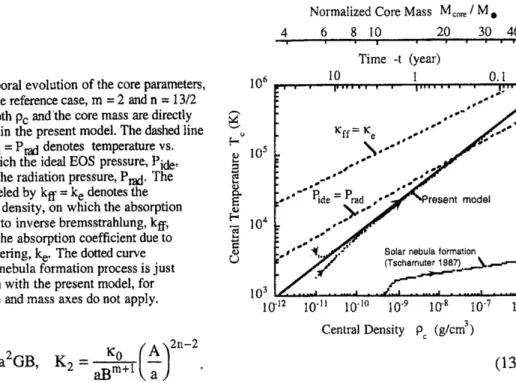
Fig. 3 Temporal evolution ofthecoreparameters,
$\mathrm{r}_{\mathrm{C}}$vsTc, for the referencecase,
$\mathrm{m}=2$and$\mathrm{n}=13/2$
(solid line).Both$\mathrm{P}\mathrm{c}$and thecoremassaredirectly
related totimein the present model. The dashed line
labeled by
Pide
$=\mathrm{P}_{\mathrm{f}\mathrm{f}1]}$denotes temperature $\mathrm{v}\mathrm{s}$.density,onwhich the idealEOSpressure,Pi&,
balances with theradiationpressure,$\mathrm{P}_{\mathrm{I}\mathrm{f}\mathrm{f}\mathrm{i}}$
.
Thedashed line labeled by$\mathrm{k}\mathrm{f}\mathrm{f}$$=\mathrm{k}_{\mathrm{e}}$denotes the
temperaturevsdensity,onwhichtheabsorption coefficientdue toinverse bremsstrahlung,$\mathrm{k}\mathrm{f}\mathrm{f}$,
balanceswiththe absorption coefficient dueto
Thomson scattering,$\mathrm{k}_{\mathrm{e}}$
.
The dottedcurveshowing solar nebula formationprocessis just
for comparison with the presentmodel,for
which the timeandmass axesdonotapply.
CentralDensity $\mathrm{p}_{\mathrm{c}}\langle \mathrm{g}/\mathrm{c}\mathrm{m}^{3})$
$\mathrm{K}_{\mathrm{I}}=\mathrm{a}^{2}\mathrm{G}\mathrm{B}$, $\mathrm{K}_{2}=\frac{\kappa_{0}}{\mathrm{a}\mathrm{B}^{\mathrm{m}+1}}(\frac{\mathrm{A}}{\mathrm{a}})^{2\mathrm{n}-2}$
(13)
Todetennine
a
uniqueset of parameters, $\mathrm{K}_{1}$ and $\mathrm{K}_{2}$,we
needtwomore
physical conditions.The first
one
is quitean
orthodox prescriptionthat the right integrationcurve
smoothlypasses
through thesingular pointwhichislocatedsomewhereat
a
finite distance from thecenter.NotethattheLP solution does notneed energy equation (4) underthe isothermal assumption, and
thesystem is describedin terms of only
a
single unknown constant, $\mathrm{K}_{1}$, which is determinedby this first condition. The second
one
issomewhat lessobvious compared with the first one,butstill
seems
enough natural, namely, thatboth the density and the temperature converge tozero
simultaneously with increasing the radius. Thus, the system under consideration isreducedto
a
two-dimensional eigenvalueproblem.Figure2 shows the eigenstructure for thetemperature, $\tau$$\propto \mathrm{T}$, the density, $\mathrm{g}\propto \mathrm{p}$, the
velocity, $\mathrm{v}\propto \mathrm{u}$, and the heat flux, $\mathrm{q}=-\kappa\nabla \mathrm{T}$, of the system under the eigenvalues thus
obtained, where the
curves are
assigned with labels corresponding to the original physicalquantities just for simplicity. Also two otherdimensionlessquantities ofinterest
are
shown inFig. 2. Thefirst
one
is theratiooftheplasmapressure
tothegravity, $\Psi$$\equiv|\nabla \mathrm{p}|/|\mathrm{p}\nabla\phi|$, whichisgiven in theform,
$\Psi$
$\equiv\frac{|\nabla \mathrm{p}|}{|\mathrm{p}\nabla\phi|}=$
l-$(\mathrm{n}-1)^{}$ $/6\pi(\mathrm{n}-\mathrm{m} -3/2)^{2}\mathrm{K}_{1}$ $(\xi<<1)$
(14)
$\mathrm{K}_{\mathrm{I}}\xi^{-2(\mathrm{n}-1)(2+3\mathrm{m}-\mathrm{n})/\mathrm{n}(1+2\mathrm{m})}$ $(\xi>>1)$
The second
one
is the Peclet number mentionedintheintroduction,i.e., theratioof the heatingto themechanical compression $(\mathrm{p}\mathrm{d}\mathrm{V})$work, whichis given intheform, $\mathrm{P}\mathrm{e}\equiv|\frac{\mathrm{p}\nabla.\cdot \mathrm{u}}{\nabla \mathrm{q}}|=\{\begin{array}{l}4(\mathrm{n}-\mathrm{l})/(4\mathrm{n}-6\mathfrak{m}-7)(\xi<<1)\{1-(\mathrm{m}+2/3)/(\gamma-1)\mathrm{n}\}^{-1}(\xi>>\mathrm{l})\end{array}$
(15)
97
$\{\begin{array}{l}\mathrm{P}\mathrm{e}arrow 3.1,\Psiarrow 0.71(\xi<<1)\mathrm{P}\mathrm{e}arrow 2.6,\Psiarrow 0.62\xi^{-0.5\mathrm{l}}(\xi>>\mathrm{l})\end{array}$ (16)
For the LPsolution, $\Psi$ –
0.6
$(\xi<<1)$, which is closeto that derived above. In the outerregion for$\xi>>1$, however, $\Psi$ for the LP solution remains constant – 0.2, which contrasts
with $\Psi$$arrow 0$ in Eq. (16). The constancy of Pe tells that the entropy is persistently emitted
outward in the entire
space.
For sucha
non-adiabatic implosions, the self-similar solutionpredicts that the flow pattern should approach
an
asymptotical regimein which itceases
todepend
on
the initial entropy, in otherwords, the system will “forget” certain aspects of theinitial state. In thatsense, the radiativeheatconductivity isexpectedto substantially affect the
self-organization
process
of thecore
formation.Figure 3shows thetemporal evolutionof the
core
parameters, $\mathrm{P}\mathrm{c}$versus
$\mathrm{T}_{\mathrm{C}}$,
as
the solidline,which
are
both expressedas a
function oftime. Here it shouldbenotedthatthecore
mass
is also uniquely measured
as a
functionoftime,whichappears
as
the uppermostaxis inFig. 3.At temperatures of fewthousands $\mathrm{K}$ and densities of about 10 $\mathrm{g}/\mathrm{c}\mathrm{m}^{3}$, hydrogen atoms
are
expectedto be enoughionized. Thus, we can roughly fix theapplicable parameter domain of
thepresent solutionfromFig. 3:$\mathrm{T}=\mathrm{a}$few 10 -
a
few 10 $\mathrm{K}$,Pc
$=10^{-11}- 10^{-9}\mathrm{g}/\mathrm{c}\mathrm{m}^{3}$, $|\mathrm{t}|=\mathrm{a}$few -
a
few tens of years, and thecore
mass
of about ten times the solarmass.
Thecore
evolves at rather high temperatures compared, for example, with the solar nebula formation
$\mathrm{p}\mathrm{r}\mathrm{o}\mathrm{c}\mathrm{e}\mathrm{s}\mathrm{s}.8$Notethat,
as
isclear from the model description, thepresent analysisis notlimitedto such
a
special combination of physical effects as the ideal EOS and the inversebremsstrahlungopacity,but
more
extensively appliestoother physicalsituations, under whichone
will obtainadifferent solution andscalings correspondingly.In
summary,
taking both the gravity and the radiative heat conductivity into accountsimultaneously,
a
new
class of self-similar solution for spherical implosions ofgaseous
masses
has beenfound. The solution has beeninvestigated in detailin termsoftheconstants,$\mathrm{m}$ id $\mathrm{n}$, which characterize theradiative heat conductivity. Under the appropriate similarity
ansatz and variable transformations, the hydrodynarnic system is reduced to the novel
two-dimensional
eigenvalue problem. The physical implication is thata
unique quantitativerelations between thegravity and the heat conductivity indwells in the self-similar dynamics.
Also,ithastunedout thatthe present system has
no
freeparameterto controlthe systemas
inthe
cases
under adiabaticor
isothermal assumptions. Furthermore, in contrast to the LPsolution, the
core
mass
increases with time due tomass
accretion, which results from thepersistententropyemission viaradiation.
REFERENCES
lLarson, $\mathrm{R}.\mathrm{B}.$, 1969, M.N.R.A.S., 145, 271.
$2\mathrm{P}\mathrm{e}\mathrm{n}\mathrm{s}\mathrm{t}\mathrm{o}\mathrm{n}$, $\mathrm{M}.\mathrm{V}.$, 1969, M.N.R.A.S., 144, 425.
$3\mathrm{S}\mathrm{h}\mathrm{u}$
, $\mathrm{F}.\mathrm{H}.$, 1977, $\mathrm{A}\mathrm{p}\mathrm{J}$, 214, 488.
$4\mathrm{F}\mathrm{o}\mathrm{s}\mathrm{t}\mathrm{e}\mathrm{r}$, $\mathrm{P}.\mathrm{N}.$,
&
Shevalier,R.A., 1993, $\mathrm{A}\mathrm{p}\mathrm{J}$, 416, 303. $5\mathrm{P}\mathrm{a}\mathrm{k}\mathrm{u}\mathrm{l}\mathrm{a}$, R.,&
Sigel,R., 1985, Phys.Fluids, 28, 232,$6\mathrm{C}\mathrm{o}\mathrm{g}\mathrm{g}\mathrm{e}\mathrm{s}\mathrm{h}\mathrm{a}\mathrm{l}\mathrm{l}$, $\mathrm{S}.\mathrm{V}.$,
&
Axford,R.A., 1986, Phys. Fluids,29 2398.
$7\mathrm{M}\mathrm{u}\mathrm{r}\mathrm{a}\mathrm{k}\mathrm{a}\mathrm{m}\mathrm{i}$,M., Shimoide, M.,