Population Change and Economic Revitalization in Japan:
Satisfying Labor Demand in an Age of Population Decline
by
FRIEDL Andreas (51108005)
September 2011
Thesis Presented to the Higher Degree Committee
of Ritsumeikan Asia Pacific University
in Partial Fulfillment of the Requirements for the Degree of
Master of Science in Asia Pacific Studies
Table of Contents
List of Tables iv
List of Figures v
List of Appendices vi
Statement of Authorship viii
Acknowledgments ix
Abstract x
Chapter 1. Introduction 1
1.0 Introduction 1
1.1 Increase of old age life expectancy and the welfare system 7 1.2 The declining birth rate and costs of children 13
1.3 Rural depopulation 19
1.4 The problem of government expenditure 20
1.5 Labor force and immigration 21
1.6 Competition from other regions 23
1.7 Japan as a model for other countries with similar aging problems 23 1.8 Research questions and the remainder of the thesis 24
Chapter 2. The impact of population decline 26
2.0 Introduction 26
2.1 Population decline in Japan 27
2.2 Rural depopulation 31
2.4 Labor markets and immigration 42
2.5 Summary 45
Chapter 3. Patterns of migration 47
3.0 Introduction 47
3.1 The Edo Period 47
3.2 Migration from the Meiji period 48
3.3 The Japanese empire: Migration to and from Korea and China 52
3.4 The Postwar Period 54
3.5 Present day minorities in Japan 56
3.6 Summary 73
Chapter 4. Government response to population change 75
4.0. Introduction 75
4.1 Formal local government initiatives 75
4.2 Informal initiatives 85
4.3 Summary 92
Chapter 5. Conclusion 94
5.0 Introduction 94
5.1 Future scenarios and options 99
References 108
List of Tables
Table 1. Projected future population, proportion by the major 2 three age groups (under 15, 15-64 and 65 and over) and
age structure coefficient: [Medium-variant fertility (with Medium-variant mortality)]
Table 2. Vital Statistics 8
List of Figures
Figure 1. Relationship of main variable in theoretical model 6 Figure 2. Population pyramid: Medium fertility 11
(with Medium mortality) variant
Figure 3. Proportion of sexlessness among married couples 12 by age group
Figure 4. Number of births and total fertility rate (1947-2005) 14 Figure 5. Contraceptive use among married women 15
List of Appendices
Appendix 1. Pregnancy rates, by age group (1955-2005) 119 Appendix 2. Proportion of married couples who have had 120
concerns about infertility
Appendix 3. Proportion of sexlessness among married couples 121 by age group
Appendix 4. Actual and projected population of Japan – Medium, 122 high and low fertility (with medium mortality) variants – Appendix 5. Trends in the number of major three age groups 123
– Medium fertility (with medium mortality) variant –
Appendix 6. Trends in the proportion of major three age groups 124 – Medium fertility (with medium mortality) variant –
Appendix 7. Projected Total Population by Prefecture 125 Appendix 8. Index of Projected Total Population by Prefecture 126 Appendix 9. Projected Population Growth Rate by Prefecture 127 Appendix 10. Projected Young Population by Prefecture 128 Appendix 11. Rate of Age-specific Population to Total 129
by Prefecture: Young Population
Appendix 12. Projected Working Age Population by Prefecture 130 Appendix 13. Rate of Age-specific Population to Total 131
by Prefecture: Working Age Population
Appendix 15. Rate of Age-specific Population to Total 133 by Prefecture: Elderly Population
Appendix 16. Population Indicators For Japan By Period 134 Of Each Scenario
Appendix 17. Trends in the proportion of elderly – Medium, high 135 and low fertility (with medium mortality) variants –
Appendix18. Number of foreign nationals entering Japan 136 by gender and age (2009)
Appendix 19. Changes in the number of new arrivals by 137 the status of residence for employment
Appendix 20. Changes in the number of registered foreign nationals 138 and its percentage of the total population in Japan
Appendix 21. Changes in the number of registered foreign nationals 139 by major nationality (place of origin)
Appendix 22. Changes in the estimated number of overstayers 140 by major nationality (place of origin)
Appendix 23. Changes in the estimated number of overstayers 141 by major nationality (place of origin)
Appendix 24. Changes in the number of cases of illegal work 142 by nationality (place of origin)
Statement of Authorship
Author: FRIEDL Andreas (51108005)
Title: Population Change and Economic Revitalization in Japan: Satisfying Labor Demand in an Age of Population Decline
Degree: Master of Science in Asia Pacific Studies Date of submission: July 20th, 2011
Hereby I certify that the thesis has been written by me. Any help that I have received in the process of conducting my research and writing this thesis has been clearly acknowledged. I certify that I have not used any additional sources and literature except those I cited in the thesis.
Acknowledgments
For their immeasurable input and support I would like to thank the following persons: My supervisor, Professor Eades, Professor Mani, an
anonymous examiner and Prof. Yamagami for their comments and suggestions, and the staff of the Academic Office, especially Emiko-san, for their continued support over the period of my study.
I would also like to thank Professor Kee and Cooper, whose lectures
provided many of the ideas and material for the present study. Finally I would like to thank my parents for all their support and unwavering trust in me during my time in Japan.
Abstract
This thesis discusses the present trends of population change in Japan, and the government’s reactions to it in terms of policy. Theoretically and
methodologically, the thesis brings together a number of different types of
material: demographic statistics on Japan’s current aging and declining population and its history; social science discussions of the effects of aging on rural
communities; the current situation in relation to immigration, and how far this can make up for the decline in population; and policy documents on the response of the Japanese government and society over the years.
The first chapter presents the theoretical model, and deals with the increase in old age life expectancy and the welfare system; the declining birth rate and its relation to costs of children; the problems of depopulation and the declining labor force, and the problems of government expenditure limiting policy options.
The second chapter deals in greater details with the dynamics of population decline, including the problems of the rural areas, the responses of the family to aging and population decline, and the possibility of immigration.
Chapter 3 concentrates on the history and present patterns of immigration in Japan, from the Edo period to the present, and the distribution and characteristics of the immigrant population at present: groups discussed include the Koreans, Chinese, Filipinos and Nikkeijin from Latin America.
Chapter 4 discusses government and citizen responses to population change, including both local and central government initiatives, and informal initiatives from citizens’ groups and Non-Governmental Organizations.
The conclusion in chapter 5 notes that none of the government policies to deal with the problems of population decline and aging have fully produced the desired results, and suggests that future solutions may lie in more open borders and greater regionalization.
Chapter 1. Introduction
“Human Capital will soon rival – and may even surpass financial capital as the critical economic engine of the future” (World Economic Forum 2010: 7)
“Japan must create an environment where foreigners can actively participate in economic and social activities. […] The government must open Japan's doors to
people from around the globe so that they can display their ability in this country” (Nippon Keidanren 2003: 7)
1.0 Introduction
Demographic change is a global issue. Every country is only as great as its people. Demographic development and changes in age composition of a society arise from a variety of factors, including armed conflict, changing birth rates and advances in medical technology and distribution. Japan’s population is among the oldest and most rapidly aging in the world, and the birth rate among the lowest. This has produced a crisis in the taxation, welfare and pension systems: there are an increasing number of people in need of care and a decreasing number of workers earning the money to pay for it.
Japan's National Institute of Population and Social Security Research says that one in five Japanese is already over 65, and by 2035, one in three will belong to this age cohort (see Table 1). As Japan’s population began to decline around 2007 after a prolonged period of diminished fertility and increasing longevity, it
undergoes an unprecedented qualitative change in its composition.
Table 1. Projected future population, proportion by the major three age groups (under 15, 15-64 and 65 and over) and age structure coefficient: [Medium-variant fertility (with Medium-variant mortality)]
Source: Kaneko et al. (2008: 84).
proportion of elderly citizens and subsequent challenges related to the long-term financial sustainability of its pension and healthcare system threaten the future of Japan. However, the looming change stretches beyond the lack of bodies.
Companies face losing significant numbers of their most experienced workers in retirement or to other businesses, their special – even unique – skills, training and qualifications. Talent shortages and a substantial loss of knowledge and
experience in more and more sectors may be the result. Against this background, companies are facing tight labor markets on the one hand and having to consider what kinds of people to employ in the future on the other.
Immigrants, who could partly compensate for the lack of national reproduction, do not come to Japan in large numbers, partly because of the country’s restrictive immigration laws. Immigration has a rejuvenating effect on the population as people moving here are generally younger than those going abroad. However, since 2008 Japan’s immigration balance has been negative (OECD 2011: 294-95). More people are leaving the country than entering it. The government blames the economic crisis for this, and the lack of domestic jobs. Compared with similar developed countries, relatively few qualified people have come to Japan during this period: a small number of foreigners have been allowed to settle permanently in the last few years, nowhere near enough to offset the estimated shortage of people with sought after educational qualifications such as engineers and geriatric nurses. The dearth of semi-skilled workers is also hardly encouraging. People suspect that the decline in the number of foreigners coming into Japan is not just a temporary setback, and after Fukushima, many
highly-skilled people – Japanese and resident foreigners alike – have begun looking for jobs in neighboring countries (cf. Hayashi and Maeji 2011). Sakanaka Hidenori (2005) – a former director of Tokyo's Immigration Bureau – fears that the
demographic decline and the subsequent inability or unwillingness of the national government to cope could irreversibly reduce its vitality and (economic)
prosperity.
According to estimates in a much-quoted report on replacement migration published by the United Nations (United Nations Population Division 2001), between 2000 and 2050, Japan would need 647,000 immigrants per annum, a total of 32.3 million, to stabilize its quantitative labor force at the current height, or to maintain an elderly support rate of 3.0, it would need an additional immigrant stock of almost 95 million (1.9 million per annum)1. As the primary baby boom
generation born between 1947 and 1949 retires, more people are leaving than entering the domestic labor market. In March 2011, the potential labor force stood at around 62 million, of which 59.28 million people were employed (Statistical Bureau 2011).
Despite the prerequisites set by the immigration law and the position of the government that only skilled workers should be allowed in, there has still been a flow of undocumented migrants, working in the construction sector and similar industries, often organized by the local yakuza.
However, as traditional migration theories suggest, people migrate in the face of push/pull factors. If conditions deteriorate in a limited area or on a national
1 In the former case its total population would increase to 150.7 million, while in the latter case it would increase to 229 million, almost double the current size. But as will be argued in this thesis, even today’s Japan has difficulties to attract more foreign labor.
level, people try to improve their livelihood by moving away in large numbers, and they often congregate as minorities in a particular destination. Historically, foreigners in Japan were not only unwelcome as supplementary labor, but also often object of political calculation and target of ethnic and racial discrimination. Some fear that social tension will rise if Japan does not manage this process of integration quickly and solve the problems, despite the costs.
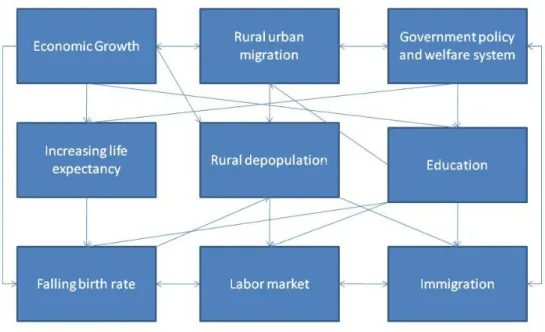
Theoretically, therefore, this thesis tries to bring together a number of bodies of literature which are usually considered separately, from history, demography, sociology and anthropology, to discuss the reasons for Japan’s population decline and aging society, the effects throughout Japan in different prefectures, and in the rural and urban areas, and the policies adopted by national and local governments in response to this. The variables I will discuss are:
• The increase in life expectancy
• The welfare system
• The birth rate
• The cost of education and upbringing
• Rural depopulation
• Government expenditure
• Immigration
• Competition from outside
Figure 1. Relationship of main variables in theoretical model
The relations between these elements are discussed in the following section, after a brief discussion of literature and methodology. As will be seen below, this thesis is based mainly on library sources and publications available on line. The problem with dealing with the Japanese economy is that there are several different bodies of literature relevant to the problem. First, there is a large amount of
demographic work on the Japanese population and its decline, as represented in the studies by Kaneko et al. Many of the key diagrams of population pyramids and the populations of regions and prefectures are taken from this work, and key tables have been included in the appendices. Second, there is a large body of historical work dealing with movements of migrants in and out of Japan,
1993). Thirdly, there is a developing literature on the population and migration policies of the Japanese government, represented both by the official sources from Ministries in Tokyo, and commentary (often critical) by sociologists including Nagy, Pak and others. Fourth, there is now a considerable literature on
depopulation of the rural areas and its social effects, by anthropologists such as Traphagen (2003), Thompson (2003), Knight (2003), Burgess (2008), Faier (2009) and others. Finally, there is now a very large body of information from anthropologists on the increasing number of migrant minorities within Japan, which are becoming very well documented. This includes the outstanding work on the Chinese by Liu-Farrer (2010), the Koreans by Ryang (1996) and Fukuoka (2000), the Nikkeijin by Tsuda (2003), and the Filipinos by Faier (2009). In this thesis I have attempted to bring these different strands of the literature together to create a picture of the current state of migration and migration policy in the country, and its likely success in heading off population decline.
1.1 Increase of old age life expectancy and the welfare system
The emergence of Japan’s highly aged groups is predicated upon several factors that will be explained in the following paragraph.
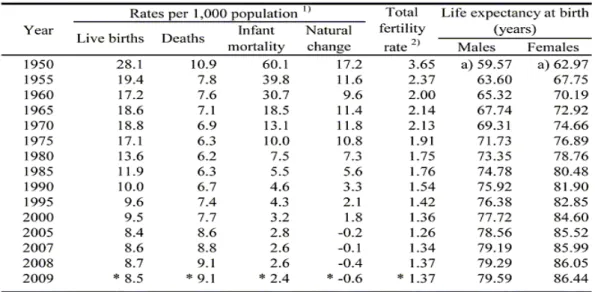
First of all, with the introduction of a general healthcare system, Japan was able to decrease its infant mortality rates from one of the highest in Asia to one of the lowest worldwide. As illustrated in Table 2, in 1950, 60.1 children per 1,000 live births children did not reach their first birthday, since then it constantly declined to 2.4 in 2009. In particular, farmers and other inhabitants of the rural
areas often did not have the means to protect their children against illnesses via inoculation and hospitals were spread sparsely across the country. Unlike modern times with 222.3 physicians (nurses an assistant nurses: 980.7) per 100,000 citizens, that number was much lower in the early postwar years (Statistical Bureau 2010: 172)2. People often had to travel long distances to bring their
children to a hospital, often not in time. However, after 1945 with the introduction of its current healthcare system, these mortality numbers dwindled drastically, as can be seen in Table 2, with new hospitals built across the country and declining treatment costs.
Table 2. Vital Statistics
Source: Statistical Bureau (2010: 13).
2 “While the number of physicians providing healthcare is increasing nationwide, their uneven distribution has become a problem due to the lack of physicians specializing in certain areas of medicine and the lack of physicians operating in regional parts of the country.” (Statistical Bureau 2010: 172).
Secondly, due to its resource scarcity, people are Japan’s primary source of economic prosperity. As prosperity rose and the birthrate declined, the public and private sector acted accordingly to improve the general health of the people. Smoking, for example - once a sign of achievement and independence - was increasingly regarded as health risk. However, as the influence of Western cuisine has increased, so also have obesity rates increased in Japan. There is growing health consciousness (e.g. in relation to smoking, alcohol) in all age cohorts, despite the recent increase in the incidence of obesity. Respiratory illnesses related to production which once were a burden for the public, have now been reduced, as the government has promoted the change to a green Japan. Environmental
regulations were introduced, and government became conscious of the problems caused e.g. by pollution in production processes, as the 1970s led to the spread of diseases such as Minamata disease, itai itai disease, and Yokaiichi asthma
(McKean 1983, George 2006). Military disarmament meant the end of the military campaigns – particularly the Second World War – which had emptied the ranks of young men in prewar Japan. Economic prosperity and the absence of war allowed the underlying trends that were brought about by better hygiene and other factors to become more visible. National access to affordable healthcare at first decreased infant mortality, high by western standards, and this was eventually supplemented by increasing life expectancy to provide a longer, healthier life after retirement. Famines and starvation which had been a feature of the prewar period in some regions disappeared after land reform. The advances in medical technology in the developed countries since 1945, coupled with the effective delivery of medical
services in Japan, resulted in increasing life expectancy, while the high-speed economic growth which began in the 1950s also contributed to a fall in the birth rate.
As a result, financial experts now warn of a collapse of the social security system. The causes of population decline are varied and the influence of
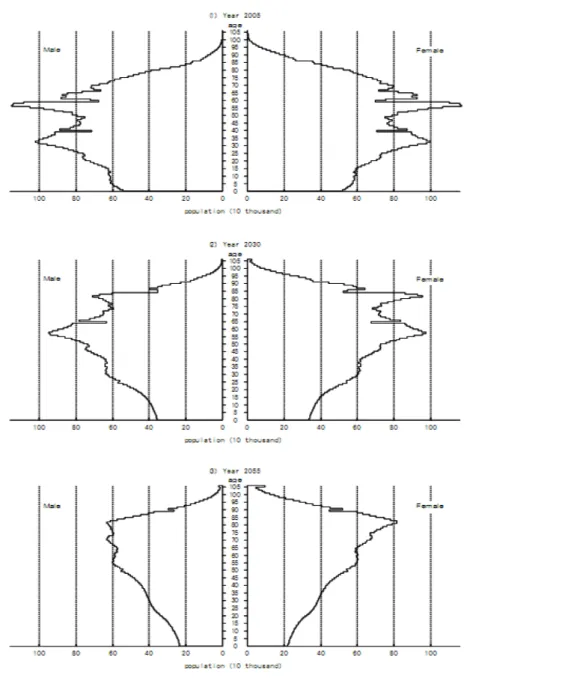
politicians over these factors is limited. The aging of the population becomes more pronounced as the numbers and proportions of the young and elderly groups move in opposite directions: there is an increasingly small number of young people, and an increasing number of old people. The age pyramids in Figure 2 illustrate the aging of Japan for the future.
Figure 2. Population pyramid: Medium fertility (with Medium mortality) variant
Source: Kaneko et al. (2008: 90).
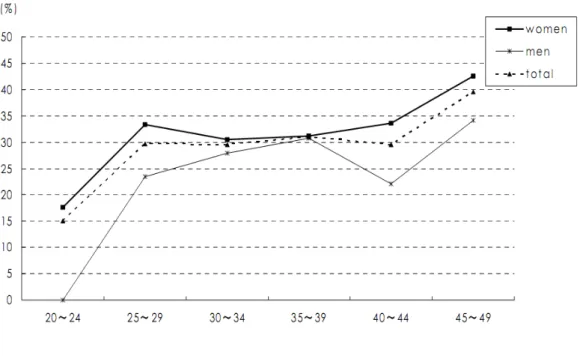
This development is apparently due to an avoidance of procreation, and
cohabitation frequencies for married and unmarried couples are at an all-time low (marital sex about 40 times a year), often attributed to long working hours.
Figure 3. Proportion of sexlessness among married couples by age group
Source: Sato et al. (2008: 14).
The key problem of future population change therefore does not arise only from decreasing size, but also from its changing age structure. From a simplistic viewpoint, we have a situation where we have an aging population, a dropping birth rate in most prefectures, and no comprehensive strategy to respond to that. Since the 1960s, the period during which the average person draws a pension has doubled, and the size of pensions has also increased, which culminates in a higher burden than ever before. The baby boomers who dedicated their lives to the rise of the world’s second – now third – largest economy, through their retirement, are leaving the country with a serious problem. Rising numbers of divorces further accelerate the process, as procreation outside of marriages is still rare and
pregnancies often result in wedlock marriages, or in other words: “Given the rise of the divorce rate among mature couples in Japan, marriage can no longer
provide a guarantee of long term care by the spouse or children in old age” (Yamashita 2008: 167).
1.2 The declining birth rate and costs of children
In Japan, in relation to the number of children a woman has during her life, significant differences can be identified between the generations. Reproductive behavior is dependent on several factors, including forms of contraception available, women’s employment, and the financial conditions of a life with or without children.
Japan’s nonphysical infrastructure, in terms of human resources, is
crumbling away and the future appears bleak at best. It requires a birth rate of 2.1 children per women for the population to remain stable, and a higher rate if it is to increase (United Nations Population Division 2001). The reasons for the decline of the birth rate are well known: the readily availability of abortion and several contraceptives after the Second World War, the absence of the pronatal
propaganda seen during the militarist period, and the high-speed economic growth from the 1950s have all contributed.
Figure 4. Number of births and total fertility rate (1947 – 2005)
Source: Sato et al (2008: 4).
The wane of arranged marriages and societally preferred role models has allowed women more freedom in their choice of partner and employment, and reproductive behavior and frequency in general: sexual intercourse and
conception is no longer only controlled by the husband, but by the wife as well, ultimately giving both partners control over the number of children, time of birth and a variety of options for family planning, as can be seen in Figure 5. The number of women who never used contraceptives declined from around 65 to less than 20 percent over the last 50 years, while the combined majority – over 70
percent - of married Japanese women are nowadays either current or past users.
Figure 5. Contraceptive use among married women
Source: Sato et al. (2008: 11).
The widespread improvement of secondary and tertiary education was accompanied by the introduction of freely available family planning and
information (Coleman 1992). As the economy grew in the 1950s and 1960s, there was a decline in the proportion of families with more than three children, and the family with one or two children became the socially acceptable norm. This was coupled with an increase in marriage age (1950: groom 25.9, bride 23.0; 2009: groom 30.4, bride 28.6 years) (Statistical Bureau 2010: 16)3. There has also been
the growing independence of children, and their increased mobility, with serious implications for the future well-being of their parents. As children moved to the cities, a larger proportion of the elderly stayed in the smaller towns and the rural areas, particularly in the north of the country. Some social classes, such as male farmers in the rural areas who are eldest sons, have found it increasingly difficult to find wives, leading to them either remaining bachelors, or finding wives outside the country. From the 1970s, the phenomenon of Japayuki – women from the Philippines and elsewhere in Southeast Asia, many of whom were coming to Japan hoping to marry – has been a feature of migration, and some rural areas now have significant proportions of these women maintaining the rural social structure (Faier 2010). “There is a positive correlation between income level and the probability of marriage, particularly for males” (Toyota 2008: 166).
The increasing competitiveness of the school system in terms of academic achievement has resulted in parents spending more money on their children’s education, including evening classes provided by the juku that specialize in getting children through examinations to high school and university, and has increased the costs of education for many families, also putting pressure on them to reduce family size. However modern family policy could exacerbate the central demographic problem – chronic childlessness – even further. This is clear from the age of mothers when they have their first children. In the 1960s and 1970s of the last century, it stood at around 25. In 2009, the average age climbed to 29. This trend increases the risk of remaining childless.
in both the marriage and the birth rates. As the equality of sexes has increased, many women have been unwilling to remain as only housewives, and have had less children as a result. Parallel to the decrease in the average number of children, the share of women who remain childless has permanently increased. More
importantly, therefore, is the drastic decrease in the number of births, which has become irreversible, while, as several scholars pointed out, small nuclear families have gradually became the predominant and most popular norm, and even these are starting to disappear. As in other highly developed countries, many couples do not get married at all, but simply cohabit – and tend not to have children. Millions of young people in Japan find themselves supported by their wealthier parents and live at home into their 20s, the so-called “parasite singles”. The number of
potential parents has been reduced in the last three decades to such an extent that further serious birth declines are inevitable. Many people prefer their material comfort over having a family. The long economic recession since 1990 has increased this trend in Japan: people are living within their means, and with decreased earning potential, they tend to have lower numbers of children. The opportunity costs of having children have increased with the prolonged decline of Japanese economy, leading to stagnant wages, and the need for two breadwinners instead of one.
When they were set up in the postwar period, the social security and pension systems were based on the paradigm of numerous youngsters and a limited group of old people with relatively low expectation of life (the old age support rate), but the age pyramid has changed drastically in shape, from a pyramid to coffin as
noted above. In Japan, the dependency ratio in the next few years will continue to rise (see the figures for potential support ratio in Appendix 16). This development is set to make the cost of pension and health care to rise sharply. This is a huge challenge when one considers that the national debt already exceeds 100 percent of GDP (net value) (Rogers 2010). There is now a major cleavage in society between childless people/couples versus families with children in regard to current disposable income and future pensions, instead of a simplistic old vs. young. Generally families with children have lower disposable incomes and lower pension prospects, as the wife stops working to have children, and her lifetime income is reduced as a result.
Government programs implemented to increase the birth rate have had little success so far. Despite the increase of child allowances, statistics show that parents spend about 37.6 percent - 1,982,000 yen - of their income on the education and related costs for their children, and the financial aid provided to families is a mere fraction of that (Japan Today 2010). With the introduction of the national healthcare and pension systems, children have gradually lost their
economic value to their parents, and have instead become a drain on the family. In times of flexibility in terms of (un)employment and location, children act as irremovable anchors: people without children enjoy higher economic prosperity both while they work and in retirement, given that pensions are determined by income and number of years employed. In Japan, there are fewer and fewer families with multiple children and more and more university graduates without children.
1.3 Rural depopulation
As birthrates have declined and the expectation of life has increased, so has the population become concentrated in urban areas. The result is the depopulation of many of the smaller towns and rural areas, particularly in the more remote parts of the country. People have moved because of better labor opportunities and higher income in urban environments, the small size of the farms inherited from parents, better infrastructure and academic opportunities in the cities, and the availability of jobs in building projects, mostly located in already urbanized areas, and in the large sized industrial production sites which grew up after 1945. There is thus increased friction between a growing periphery and the major economic and administrative centers, including the Greater Tokyo area, which now produces 25 percent of national economic output. In the rural areas there has been a process of fusion of administrative units (gappei), to make the administration of the declining population more economical. There are regions where people have left and are leaving, and where companies have difficulties to procure enough labor. The problem in Japan is the increasing gap between highly developed regions around the capital and the rest of the nation (cf. Tabb 1995: chapter 7). Aging mainly takes place in the countryside. Also this is a trend that other developed countries in Europe and the rest of East Asia will probably face in future. Particularly badly hit are the areas in the north of Japan, including Tohoku and Hokuriku, as Matanle notes for Niigata prefecture: “To put these figures into their national context, […] the 46 per cent decrease in Sado's population occurred at the same time as a 51 per cent increase in the population of Japan from approximately
84 million to 127.5 million between 1955 and 2005” (Matanle 2006: 151). As rural populations decline, so other services collapse: for instance, transport companies have been striving to adapt their services for a rapidly aging population, and reduced demand.
1.4 The problem of government expenditure
While today Japan is mostly indebted to its own population (foreign debts stand at around 5 percent), in the future public spending will not be a feasible option. At the end of January, 2011, the rating agency Standard & Poor's reduced the credit rating for Japan for the first time in years by one point, from previous AA to AA-, three levels below the top rating of AAA (Kajimoto 2011). Fitch did the same recently (White and Ishiguro 2011). However, unlike the United States or some European countries at the moment, Japan is not immediately threatened by insolvency.
There is also the problem of deflation: the Japanese government has tried for some time to keep it in check. Since the beginning of the 1990s, it has launched dozens of economic programs to stimulate the economy, so far without success. Instead, the Japanese public debt has risen to 104 percent of its GDP (net value) and with the volatile economic situation across the globe, interest rate are on the rise4. Japan has already ceded its position of second largest economy to
China, and the financial burden related to the Fukushima incident and the Tohoku earthquake and tsunami is still increasing.
1.5 Labor force and immigration
Japan’s response to its aging crisis has taken a number of forms. First, many companies have outsourced their production to other countries. This has some effect on reducing the demand for labor, but it hardly touches the problem of lack of people.
Second, there has been a trend towards automation and the use of robots in industry, but as a general solution this would be expensive, and current and future generations of people still would face lower incomes.
A third response is to raise the retirement age. Measures such as increasing the retirement age of a now healthy elderly population would increase the ratio between active workers and retired persons. This is already happening in some industries, e.g. the rise in the retirement age for professors in some of the major national universities, from 60 to 65 and beyond.
A fourth response is to export the problem of the aged. In fact there is some retirement migration, with countries such as Malaysia and Thailand opening their doors to rich pensioners from Japan and the West to come and settle in purpose built settlements (Miyasaki 2008, Ono 2008). If it is difficult to bring nurses to Japan, the elderly can go elsewhere. Retirement migration is an emerging global trend, but given the size of the problem it cannot be a general solution.
A final solution is to expand the group of contributors to the pension system by the employment of people currently unemployed (including the NEETS, people not in employment, education or training, and the furiita who choose to do only occasional casual work). In Japan, there is a growing proportion (after the
bubble bust) of NEETS, temporary workers, and poor workers without the chance of societal mobility. Young people know that they must be flexible and extremely hard working to get good job opportunities, and overtime is seen by them as a practically mandatory part of their life, which is why many prefer the furiita option. The problem is that those who are affected by unemployment for a long time are not likely to be in demand from companies as permanent workers. The long recession in Japan means that companies have cut costs by hiring more workers on a temporary basis. The result is that there is a growing proportion in the post-bubble period of NEETS, temporary workers, and poor workers without the chance of societal mobility. Even the traditional urban casual workers are being largely replaced by foreign labor (Gill 2001). A large number of hard-to-employ job seekers will remain. In some industries it is likely that many open positions can be filled only if higher wages are paid.
So how willing is Japan to raise its net immigration rate to raise the size of the population? There is a limit to which existing unemployed persons can be reeducated for other jobs (mailmen cannot to changed into heart surgeons). Outsourcing of production sites in manufacturing is already well advanced, and many of the jobs remaining in Japan are skill-intensive, which requires local training. As the working age population declines and as skilled and experienced workers retire, the viability and prosperity of Japan’s future is endangered, despite the mass provision of tertiary education. The shortage has so far only affected individual professional groups, and the national labor market at large is not yet impaired. In particular, Japanese SMEs (small and medium size enterprises) face
serious problems and do not have the potential of large corporations to use international staff to remove these bottlenecks.
1.6 Competition from other regions
Increasingly international immigration draws on a global labor market, and Japan is involved in increasing (economic) competition from neighboring regions. Its competitive advantage is declining in conventional manufactures, which means that in future, it will have to focus on high quality and sophisticated products. If the population is aging and reproductively unwilling, Japan has to worry about its competitiveness if it is unable to bring the best and the brightest into the country in future. So, despite its dire need for foreign labor, Japan is losing in the
competition with other countries in terms of accessibility and attractiveness5. It is
now low ranking, behind most European countries, the USA, Australia and even Korea (in regard to accessibility) (Global Migration Barometer 2008: 9-12).
1.7 Japan as a model for other countries with similar aging problems The reason why Japan is interesting from a research and policy point of view is simply that it is the first economically advanced nation to suffer from a super-aged, shrinking population, and therefore one that has to choose from a variety of options how to handle this peculiar development. Independent of the prospect of failure or success, any data generated from Japan's experience can aid other countries in finding their own solution when they reach that inevitable
crossroad.
1.8 Research questions and the remainder of the thesis
Given these variables, the remainder of the thesis will concentrate on the following research questions.
• What has been the impact of population decline on Japanese society?
• What have been the main patterns of migration to and from Japan
historically, and what are the most important contemporary flows in and out of Japan?
• What ethnic and national minorities are now resident in Japan, what are their main social characteristics, and in what kinds of niches in the labor market are they primarily employed?
• What has been the government response to population change, both at the national and local level? In particular, what attitudes to migration have developed at the grass roots level, in local administrations, and what initiatives have they put in place to support the integration of the migrants?
Chapter 2 discusses population decline in Japan, particularly with reference to the rural areas. It also discusses the impact of population decline on the rural family, and in particular relations between the generations, and between foreign wives and their husbands’ families. Finally this chapter discusses the implications of these findings for the labor market and patterns of immigration.
goes back longer than is often supposed. It considers the main patterns of
migration from the end of the Edo period, and the impact of Japanese imperialism on flows of migrants, mainly from China and Korea. The chapter then turns to a discussion of the postwar flows of migration, as Japan’s economy moved into a long period of high-speed growth, followed by the end of the bubble economy, and the long period of recession starting in the early 1990s. The main minorities present in Japan are then discussed in detail, in particular Koreans, Chinese, Filipinos, and Nikkeijin as well as smaller groups including Thai, Nepalese, Pakistanis, Iranians and others.
Chapter 4 describes the response of Japanese government and society to population change, and the changing policies towards immigration and the integration of the newly arriving migrants. It discusses local government initiatives, together with less formal mechanisms of integration organized by NGOs or by groups of migrants themselves.
The final chapter summarizes the arguments, and considers the most likely scenarios for the development of the Japanese population, the labor market, and immigration in the future.
Chapter 2. The impact of population decline 2.0 Introduction
In the first and second sections, Chapter 2 discusses the current and future population decline in Japan and its consequences with a particular focus on rural areas. The available data show that economically weaker regions are already facing the outmigration of younger people, with even the most prosperous regions and their younger working age populations facing decline by 2025, ultimately decreasing the number of (financial) providers of services and social security. Particularly hard hit are likely to be the education institutions in rural areas with schools closing down, further reducing the competitive advantages of these regions. As an example, Tohoku’s Towa-cho tries to overcome these trends by subnational cooperation, tourist activities, going green, etc.
The third section discusses the subsequent effects on rural families that in some cases arise from inheritance traditions, which cause intergenerational tensions between family members still living in the rural areas, and their relatives who now live in the cities but are considering returning. The results of these disputes range from living in separate households on the same property to divorce.
The fourth section introduces already visible evidence of aging and
depopulation in postwar Japan’s labor market, and how the domestic labor market circulation has been supplemented by international immigration.
2.1 Population decline in Japan
A look at the subnational level reveals that today’s differences in rates of speed and severity of population decline continue to increase, widening the gap both between regions and prefectures (Nishioka 2011). In the future, this will result in damaging some prefectures, and leading to demographic collapse in others, even in the absence of future adverse events including natural disasters such as the recent Tohoku earthquake, which will lead to even more rapid population decline.
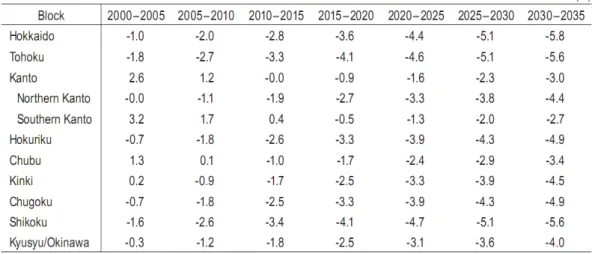
Generally speaking, the previously described evolution of the Japanese population living in what are, for the time being, economically stronger and wealthier urban areas and relatively weaker rural regions, has revealed its full effects since the onset of nationwide population decline in 2005. Nishioka’s figures (2011) show that Japan’s only remaining growth regions before the population reached its inevitable peak (Kanto, Chubu, Kinki), only Kanto, or more precisely Southern Kanto (2005: 34.48 million; 2010: 35.06 million; 2015: 35.2 million) has withstood the general trend and has a growing citizenry, Chubu’s population has stagnated at around 17 million, and the other regions are falling below their previous levels at an accelerating rate. None of the losses in the country’s nine regions between 2030 and 2035 are forecast to be less than three percent; whilst today (2010-15) only Tohoku and Shikoku have reached that level. Another four regions are losing only up to two percent, as can be seen in Table 3.
Table 3. Projected Population Growth Rate by Regional Block
Source: Nishioka et al. (2011: 14).
On a prefectural level, this development becomes even more polarized (for prefectural figures, see Appendix 8, for prefectural growth rates, see Appendix 9). Between 2005 and 2010, only seven prefectures could retain or expand their total populations, primarily Tokyo6 and Okinawa – both of which will continue to
grow in future. On the other hand, the worst cases of shrinkage have occurred in Akita (-4.5%) (cf. Mock 2008), followed by Wakayama (-4.1%) (cf. Knight 2003) and Aomori (-3.5%), which will lose more than one fourth of their populations in the near future (2035: Akita: 31.7%; Wakayama 28.8, Aomori 26.9%); others will also depopulate fast. Besides Tokyo and Okinawa, by 2035, only other six
prefectures will have rates of decline lower than that of the Japanese population as a whole, and they are located in the three main urban areas of Kanto, Chubu and Kansai (Nishioka et al., 2011). With that in mind, Japan’s urbanization will
6 Tokyo will follow the general trend in 2020, first declining by 57.000 people to 13.05 million over a five year period (2035: 12.7 million), following its industrial brothers in the Kansai area, yet still larger than current levels.
continue on an unbroken path. In the future, three in ten people (2010: 27.6%) will be living in Southern Kanto, already today Japan’s most populated region, and 35.8 percent in Kanto as a whole. Furthermore, whilst its second most populated region – Kinki – faces a minuscule decrease of 0.5 percentage points (2035: 15.9%) due to Osaka losing 1.5 million, Chubu can catch up. Overall, Japan’s dwindling population is projected to work, live, and procreate in further concentrated areas of the country.
The continued increase in childlessness, continuing the decline which began back in the late 1940s (see Figure 3), further exacerbates the shrinking of the general population. It can be found anywhere in Japan, on any subnational level, and there are no exceptions. In spite of temporary growth in some places, only a little more than one million children will populate the playgrounds and schools of Tokyo in 2035. But these children will make up only eight percent of the
population, the lowest proportion of any prefecture. At the other end of the scale will be Okinawa, which will maintain the highest rate of children aged 14 or less throughout the projected period (2010: 17.4%, 2035: 13.3%). Whilst today the rate of the child population in every prefecture is still in the two digit range, just as at the national level, the majority (27) of prefectures will fall into the single digit range, aggravating the existing burden on the shoulders of current working age citizens and children already born, who are facing a growing elderly
population (see Appendix 11).
Unsurprisingly, with minor exceptions, the working age population will continue its downward trend since it peaked around 1995 (see Appendices 5 and
6). Exceptions include Okinawa, where due to its comparatively higher fertility rate in the past, its present labor force will continue to increase until 2015 in absolute numbers. Tokyo, Aichi, Kyoto and Osaka will increase between 2020 and 2025 in relative numbers. The implications for the labor force can be seen in the difference of 11.1 percentage points between the participation rates projected for 2035 for Tokyo (61.4%) and Akita (50.3%) (see Appendix 12).
The severity of the problem of aging in Japan can be seen in the increase in the old-age population (Nishioka et al. 2011, see Appendix 14). Its size will continue to increase in the course of the next decades in absolute and relative numbers. There are already today 13 million more pensioners than children living in Japan, and further along the road, this difference will increase to 27 million. If both are seen in combination, the dependency ratio will increase to unprecedented levels.
In conclusion, you can say that the general age-structure will be turned upside down. Where once the number of children supported economic prosperity in later years as they turned into adults, the same cohort of once playful children has turned old and grumpy, burdening the succeeding generations, with no option of escape.
One consequence of this is that the number of people living beyond 100 will dramatically increase in future. In their paper, “Survival beyond Age 100: The Case of Japan,” Robine and Saito note that the number of centenarians has grown by a factor of 100 in just 38 years – from 154 in 1963 to 13,036 in 2000. In the 1960s, the number of people over 100 doubled around every six years, which had
fallen to 4.8 years at the end of the 1990s (Robine and Saito 2003: 210). The greater part of the increase since 1973 in the number of persons 100 years old currently living in Japan (55 percent) was due to the increased probability of surviving, while the rest of the increase (45 percent) was due to the increase in the size of the birth cohorts (Robine and Saito 2003: 213). Their results suggest that the emergence of the centenarian population in Japan will continue to accelerate, with the time necessary for this population to double being reduced by half in just 25 years.
2.2 Rural depopulation
The impact of the demographic trends of aging population and declining fertility is regionally very different: some prefectures, especially those near the large cities, are still growing in population, while many in the rural areas are already in rapid decline. At present, the effects of persistently lower numbers of children has already been visible for some time in rural areas where large families were once the norm (Matanle 2006). These regions have supplied growing
metropolitan areas with migrants for some time, and outmigration, coupled with low rates of fertility, mean that the population is already in rapid decline, a trend that dates back in some prefectures to the early 1950s. In recent years there have been increasing examples of the merging of administrative bodies and the unification of cities, towns and villages, to decrease the related costs of public officers. The closing of schools, primarily elementary schools, is well advanced in some rural areas, and the children are sent to urban areas where they can attend
more prestigious schools, a stepping stone for their later careers. The urbanization of the education system results in a vicious circle, with children getting worse education than the rest if they stay in the rural areas, and middle class parents moving to the larger cities, as the rural environment does not provide the best educational infrastructure for the future of their children.
In John Mock’s study of Akita, the trends are particularly dramatic. He gives the example of Kita Akita City, an amalgamation of four small townships arranged so that they would qualify for better funding from the central government. The population was 42,050 in 2000, and is expected to fall to 30,040 by 2020 (Mock 2008: 126). The decline in the population of rural townships began in the middle of the 20th century, with an increase in the upper age cohorts, and the population
over 65 has been increasing. Mock argues that only systematic long term social and economic restructuring can position Japan to cope with the post-maximum population era.
As the population falls, there are severe implications for the education system. Since local districts cannot effectively raise funds, either the prefecture or the national government will have to be the sources for basic funding of
education, against the background of rapid population decline. As for the school curriculum, it follows national standards set by MEXT, but there are differences between townships and major urban areas, and in the peripheral cities, there are fewer juku, to provide the additional training necessary to get into the higher ranked universities. Most secondary schools are located in densely inhabited areas of the prefecture, and tertiary institutions are located mainly in Akita and
Yurihonjo City. The implication is that children from rapidly depopulating areas will be at a disadvantage in competing for the best universities. In addition, as in other rural areas of Japan, there are many marriages between Japanese men and women from other countries such as the Philippines (Faier 2009), but
multicultural education is not given priority, either in the formal or informal educational sectors. There has been little impact in terms of making Japan more multicultural. The expectation so far is that minorities will assimilate. Chinese and Filipinas will take Japanese names and blend into the Japanese cultural scene.
John Knight’s study of rural Wakayama shows some of the environmental problems of the aging society (Knight 2003). He cites examples of efforts to resist rural depopulation in upland Japan, though the populations of many uplands areas are still declining (2003: 107). In Wakayama, forest was the dominant local industry. Fairly typically, the population of the community he studied had fallen from 10,276 in 1955 to 4,310 in 1995, due to the outmigration of younger family members rather than the departure of whole families. The low fertility rates therefore result from the removal of the more fertile younger age groups through outmigration. In 1970, local deaths exceeded local births for the first time. In 1960, children aged between 0 and 14 made up 37 percent of the population but by 1996 this had diminished to 12 percent. In 1955 people, aged over 65 made up 6.7 percent of the local population, but by 1995 this proportion had increased to 33 percent. In 1994, 31 percent of men in their 30s were unmarried, compared with a national figure of around 25 percent. These problems tend to affect white collar workers much less than agricultural workers. Even though family ties bind
migrants to their natal localities, the population still continues to drop (Knight 2003: 108-109).
Things are made worse by the demoralization of the residents in
depopulating areas (Knight 2003: 110). There has been a large drop in the area of rice cultivation, much of which has been transformed into dry fields for the cultivation of vegetables. As a result, the forest has expanded in upland areas. The countryside is seen by many as a depressing place, due to the number of empty houses, closed schools, abandoned farms, and the spread of the forest with its wild animals. There are high rates of family breakdown and depression, with high rates of suicide among unmarried men. The incursion of wild animals, such as bears, boars, deer and monkeys into the village space is accelerating the process (Knight 2006). The damage that they do to houses and farms, and the dangers which they pose helps speed up the migration of the local population to the cities.
The local administrations are trying to reverse this with programs of akarui
machizukuri (Creating the Bright Town), in order to promote positive thinking
about the town’s future. There are infrastructural projects, construction of
facilities, and attempts to attract investment from the private sector, including the location of industry. The hope is that the availability of jobs might attract migrants looking for employment. There are also efforts to stimulate the birthrate, through setting up marriage brokerage services, establishing clubs in which local men and women can meet, and even creating formal relations with foreign countries to recruit potential brides. There are also schemes to promote having children, as well as encouraging people who have left the town to consider returning, through
nostalgic furusato images and cash incentives. There are also initiatives to provide housing for migrants wishing to come back. To publicize the district, a rural-based mail order operation has been established to sell local produce to the urban areas. There have been a small number of new settlers since the 1980s: Knight found that some people living in the cities had been attracted back to try their hand at organic farming or to work in forestry (for these initiatives see Knight 2003: 112-118).
One further strategy is to attract the elderly (Knight 2003: 119-120). Given that some towns with high rates of aging and large populations over 65 have good services, it would seem rational to concentrate large numbers of old people in one place. Some rural municipalities have established “Silver Areas” and “Welfare Villages” as special zones to meet this need. He argues that in future,
municipalities may could compete with each other to attract the elderly, and to attract additional funding for these services. Even though these schemes in effect define the elderly as a resource which can be exploited, they have also been criticized, on the grounds that areas which already have a large proportion of elderly people are being used to dump the elderly from other areas. The argument is that a balanced population is needed in order to prevent the outmigration of the remaining local youth.
However, a more demographically balanced rural society really depends on the establishment of a viable economic base. Whether organic farming or forestry can supply this is doubtful: the problem is that most young people are already used to living in the city: as Knight notes, in a sociological sense, rural Japan has
ceased to exist, as most people’s experience is now of urban life (Knight 2003: 121).
Thompson’s study of Towa-cho in Tohoku suggests similar problems and strategies (Thompson 2003). As in other parts of Tohoku, the main direction of migration is from rural to urban Japan (ibid: 93-94). The municipality is striving to retain its vibrancy, and local bureaucrats are also fighting for the survival of their jobs and budgets (ibid: 95-96). The key is to generate new patterns of income and consumption. Restrictions on agriculture have led to a situation in which farming has become a part-time job, and living only on the income from agriculture becomes difficult. Generally, levels of employment in occupations outside agriculture have increased.
The government recognized the problem and gave grants to communities of ¥100 million to promote their “home town” image, and to develop new kinds of crops which could find a wider market. In line with this, Towa-cho attempted to improve its image nationally by getting together with three other towns with the same name to form a “Four Towa Alliance” and market the towns’ products throughout Japan (ibid: 100-103). After the Kobe earthquake of 1995, Towa-cho also gained publicity by offering empty houses to help earthquake victims relocate to Iwate prefecture. There were also attempts to develop a hot spring resort by drilling for hot water. However, these projects came to nothing and did not increase employment or reverse the population decline. The mayor, who was the main force behind these developments, resigned in an argument over rice
Another problem resulting from depopulation is the fall in the government funding which comes to the village for each additional resident (Thompson 2003: 95-96). Local communities and politicians spend much time and effort traveling to Tokyo to lobby the central bureaucracy. Given the fall in the population, they have become increasingly dependent on additional sources of funding for their
operating budget since the 1980s. Like other rural communities, the town is making efforts to stop young people from leaving, and to attract new residents, mainly through generating jobs in the service sector. It is making efforts to project the image of the town as a community full of possibilities, and the media coverage helps to heighten the town’s profile, which makes funding easier to raise in Tokyo. Solving the town’s problems therefore depends on the ability of its bureaucrats to utilize the Japanese system and devise creative solutions to the problems the communities face, through what Thompson terms “population politics” (2003: 97).
2.3 The family and population decline
In addition to its effects on the local economy and politics, rural
depopulation in Japan is having a profound impact on the family. This is also linked to the issue of the support of old people in old age, given that families are now small and scattered, and younger people are more likely to live in the city than in the rural areas.
In prewar Japan, the general principle was that the eldest son would inherit the parent’s property, together with the leadership of the household and its
economic activities. In return for this, he and his wife would have the primary responsibility of looking after his parents in old age. One major area of change is therefore the relationship between married women and their in-laws, discussed most dramatically by John Traphagan (2003). Historically, in the Japanese family, married women were expected to support their husbands’ parents rather than their own parents in old age, and to some extent this is still the case. But it is a role that potentially can lead to conflict, and many stress their independence by refusing to provide this support. Living with in-laws potentially means conflict, and a lack of independence. Some 90 percent of those providing care for the elderly are women, and with the increasing number of people living to a great age, and the declining number of their children, the probability of having to share this kind of
responsibility is much higher than it was in the past (for details, see Traphagan 2003: 204-210).
Whether or not a woman should live with her in-laws or parents is therefore a major issue. Traphagan cites a number of cases from his research in Mizusawa, a town in Tohoku with an aging population. In the first case, a woman’s mother-in-law decided that she would buy land for her son to build a house, so that she could come and live with him and his wife, should she become ill in later life. The wife was horrified, and her husband eventually persuaded his mother to use the money to buy help if necessary, rather than move in with her son. Traphagan’s informant also said that if the mother-in-law did move in with her son, she would consider divorcing him (this case is drawn from Traphagan 2003: 212-213).
daughter, who married a man who was an eldest son. She had married late, by which time, from her viewpoint, the only prospective husbands available were eldest sons7. However, she could not agree with the attitudes and values of his
parents, and the conflict over which set of elderly relatives they would support finally led to divorce.
A third informant (ibid: 214-217) lived together with her mother-in-law in separate houses on the same plot. She had married a third son, but his two elder brothers moved to Tokyo, leaving her husband to look after the parents. She said that if she had found out that he would have to do this, she would not have
married him. After some years living in Yokohama, her husband decided that they would have to return to his home town to look after his parents, who were noisily demanding he should return. After they moved, her father-in-law died, and her husband was transferred by his company back to Yokohama – leaving his wife living with her mother-in-law. She had provided in-home care for her father-in-law before he died, and also much of the hospital care such as taking him food and changing diapers. She told Traphagan she intended to move back to Yokohama herself when her children had grown up and moved out – but
anticipated big problems if her mother-in-law was still alive. She mentioned two specific problems with mothers-in-law in rural areas: pressure for her to go out and work to bring in extra money, and conflict over how to bring up the children.
The fourth case (ibid: 217-220) was that of a couple who had moved back to
7 “I married late, in my early thirties. The problem is that by that age, the only ones remaining are eldest sons and eldest daughters, because nobody wants to marry an eldest. They have a very difficult time getting married. This is unlike being a second son or second daughter.”
Mizusawa five years before, to help the husband’s mother take care of his grandmother. She got on relatively well with her husband’s mother and grandfather – but neither of them got on well with his father, who they saw as trying to control their lives. The wife said that she had taken a job, simply to get out of the house and get away from her father-in-law. The husband had problems with him as well – which had led to physical fights in the past.
Traphagan’s conclusion is that co-residence is often resisted, and the precise terms have to be negotiated. To many women, it “implies loss of autonomy, personal conflict, and emotional strain” (Traphagan 2003: 224). The values of the older and younger generations are often different, and parents often assume that their children and their spouses should look after them in return for the eventual inheritance of property. They have the attitude that they save money for their child’s college, and intend to give it their property, so it is natural that they should expect to be cared for by their children in the future. However, wives are often unwilling to provide care for their in-laws. There is often a power struggle over the raising of the children, and to some extent the grandmother has the upper hand because it is often her household and the son’s bride is considered essentially an outsider. In some cases, like the fourth of Traphagan’s informants (2003: 217-220), they even dislike their in-laws intensely. Co-residence is therefore both contested and resisted – so that assumptions that the welfare of the elderly can be left to their children and their spouses in future would seem to be rather
unrealistic.
peripheral areas of the country to find spouses at all, and this increasingly means that Japanese without partners look for them internationally, as described by Chris Burgess in his study of Yamagata (Burgess 2008). Most of the foreigners in Yamagata are permanent migrants, and many of them have married locally. Because of their location, they are more likely to make efforts to integrate with local society in the region, making it more multicultural in the process, and
challenging stereotypes of who is “Japanese” and who is “foreign” (Burgess 2008: 65). As is typical of peripheral areas, the population of Yamagata is aging faster than the national average, with the result that spouses are likely to be living with their in-laws and working in the local labor market. Yamagata took the lead in the 1980s in bringing in brides from abroad, and one in fourteen marriages in 2000 was international (ibid: 65-66). The area therefore has long and extensive
experience in helping these foreign newcomers settle into their new surroundings, so that cultural change may be more rapid in these peripheral areas than
elsewhere. Burgess argues that it is the local communities like Yamagata which are at the forefront of internationalization in Japan (2008: 76) as well as the debate as to whether to open up the country for foreigners. Two-thirds of the foreign residents in the area are Chinese and Korean, though in some other areas of the country there are also a number of brides from the Philippines (Faier 2009). Women are at the center of these changes. To make the most of these
opportunities, the foreign women have to be proactive, appear to accept local customs and values, and make the most of the situation. They have to change their own lives, rather than wait for someone to do it for them, and they find that with
patience and understanding, acceptance is possible. Burgess argues that to construct a society that can accept foreigners requires a change in the way that identities are represented in Japan (2008: 76). Even though Japan is less
homogeneous than it once was, the influx of transnational migrants can also help reinforce both local ethnic identities and national(istic) ideologies, a point which will also be apparent from the consideration of Latin American migrants in a later section.
2.4 Labor markets and immigration
Given the problems of the falling population and the labor shortage in some sectors of the market, it is not surprising that many people see the necessity of an increase of immigration into Japan in the future. Douglass and Roberts note that there is a popular view in Japan of migration as a temporary phenomenon, “which will be overcome through factory automation and off-shore relocation of
corporate Japan’s labor-intensive industries” (Douglass and Roberts 2003: 3). In fact, an increasing numbers of foreign workers and their families will probably settle permanently in Japan, and despite the long economic recession, migrants are still finding niches in the domestic labor market. Despite negative stereotypes in the media, they are hard working and responsible, very similar in many cases to the rest of the Japanese. There are therefore many people willing to champion the rights of foreign workers to equal treatment, both at work and in the community. With the influx of migrants, Japan is becoming more multicultural: “Ethnic neighborhoods are appearing in cities, and urban as well as rural areas are seeing
an influx of foreign brides who bring along their own cultural heritage and lifestyles” (Douglas and Roberts 2003: 5).
The influx of foreigners since 1945 has gone through a number of phases. Even before WWII, there was a substantial influx of Chinese and Koreans into Japan (Yamawaki 2003). After WWII and the exodus of most of the Koreans and Chinese “oldcomer migrants” in Japan, some 34,000 Chinese (14,000 of them Taiwanese) and around 600,000 Koreans remained. After the end of the War, both the Chinese and the Koreans lost their rights as citizens, and the Alien
Registration Law (1952) deemed both Korean and Taiwanese residents aliens. This in turn meant exclusion from many social welfare benefits, and from public sector employment. They could naturalize – but this meant assimilating and losing their own identities. Meanwhile, the large numbers of soldiers and Japanese colonial settlers returning after the war meant that little additional immigration was needed until the late 1970s. In addition, 50 percent of Japan’s labor force was in the agricultural sector, and they provided much of the urban labor as the
economy started to expand (for details, see Douglas and Roberts 2003: 5-6). In the 1970s and 1980s, rural-urban migrants dried up as a pool of cheap labor, and more than 75 percent of the total population was now living in urban areas, while this proportion was about one third in 1950. The increasing shortage of labor and the rising value of the yen during the bubble economy of the 1980s meant an increasing number of foreign laborers in Japan, and immigrants became a new source of cheap labor. Emigration gave way to immigration. From the 1970s, Asian women began to come to Japan in search of jobs as “entertainers”
![Table 1. Projected future population, proportion by the major three age groups (under 15, 15-64 and 65 and over) and age structure coefficient: [Medium-variant fertility (with Medium-variant mortality)]](https://thumb-ap.123doks.com/thumbv2/123deta/6580825.1134042/13.892.155.734.328.972/projected-population-proportion-structure-coefficient-medium-fertility-mortality.webp)