1.は じ め に
現在の地球表層に生息するほとんどの生物が構成す る生態系は,光合成を行う生物が一次生産者となる食 物連鎖によって成立している。一方,太陽光の届かな い深海のような場所では,火山噴火や熱水循環などに よって放出される還元的な化学種と海水中の酸化的な
総 説
深海熱水環境における非生物的な炭化水素合成:
熱水実験による制約
鈴 木 勝 彦
*,**・吉 崎 もと子
***,**(2010年9月15日受付,2010年11月8日受理)
Experimental constraints on abiotic hydrocarbonsynthesis in deep-sea hydrothermal environments
Katsuhiko S
UZUKI*,**and Motoko Y
OSHIZAKI***,***
Institute for Research on Earth Evolution (IFREE),
Japan Agency for Marine-Earth Science and Technology (JAMSTEC), 2-15 Natsushima, Yokosuka, Kanagawa 237-0061, Japan
**
Precambrian Ecosystem Laboratory,
Japan Agency for Marine-Earth Science and Technology (JAMSTEC), 2-15 Natsushima, Yokosuka, Kanagawa 237-0061, Japan
***
Department of Earth and Planetary Sciences, Tokyo Institute of Technology, 2-12-1 Ookayama, Meguro-ku, Tokyo 152-8551, Japan
Hydrocarbons and other organic compounds in hydrothermal fluids in deep-sea environ- ments have attracted broad interests because they can work as sources of metabolic energy and various nutrients to microbial communities (primary producer), which maintain the other lives in food-chain in the ocean. Three possible processes have been proposed as sources of hydrocar- bons and other organic matters: thermal digestion of biologically formed organic matters such as kerogen and living biomass (thermogenic), production in biological activities (biogenic), and generation by inorganic reactions in hydrothermal systems such as reduction of CO
2in interac- tions between ultramafic rocks and hydrothermal solutions in un-sedimented deep seafloor (abi- otic). Abiotic synthesis of methane and other hydrocarbons in hydrothermal systems possibly served as a source of prebiotic materials on the early Earth. Therefore, submarine hydrothermal vents are considered as a possible site for the origin of life. Here we review the results of hydro- thermal experiments which can make constraints on the abiotic organic carbon syntheses such as Fischer-Tropsch type reactions in deep-sea hydrothermal environments.
Key words: hydrothermal experiment, deep-sea hydrothermal system, abiotic organic synthe-
sis, Fischer-Tropsch type reaction, water-rock interaction
* 独立行政法人海洋研究開発機構地球内部ダイナミ クス領域
〒237―0061 神奈川県横須賀市夏島町2―15
** 独立行政法人海洋研究開発機構プレカンブリアン エコシステムラボ
〒237―0061 神奈川県横須賀市夏島町2―15
***東京工業大学理工学研究科地球惑星科学専攻
〒152―8551 東京都目黒区大岡山2―12―1
Chikyukagaku(Geochemistry)44,115―125(2010)
化学種との酸化還元反応を用いる化学合成独立栄養微 生物が一次生産者となる海洋底下生態系が発達してい る(Winn et al., 1986)。海洋全体を見たとき,海洋 表層で光合成を行う生物よりも,熱水活動域における 化学合成独立栄養微生物のほうがが海洋生態系での重 要な生産者であるという仮説も存在する(Jannasch,
1985)
。この仮説の検証は科学研究費新学術領域研究「海底下の大河」計画の,重要なテーマのひとつであ る。熱水の化学組成は実に多彩である。その多様な化 学組成は,そこで生息する微生物の多様性を生み出 し,多様な生態系を支えている。
現世の熱水域の微生物に関しては,様々な視点から の豊富な研究が存在する。熱水噴出口は1970年代の その発見以来(Corliss et al., 1979; Edmond et al.,
1979)
,必然的に生命誕生・進化の場の有力候補として考えられてきた(Yanagawa and Kojima, 1985;
Rusell and Hall, 1997)
。特に,リボゾームのRNA
など微生物進化系統学,あるいは進化生化学,地球初 期を扱う地質学などの知見を集めた結果,水素を二酸 化炭素で酸化するメタン生成菌が全生物の共通祖先で は な い か と い う 仮 説 が 提 案 さ れ(Takai et al.,2006)
,この仮説の検証の努力がなされている。メタン菌の代謝活動には,二酸化炭素と水素の存在が必要 である。地質学的観点から,初期地球には二酸化炭素 が現在の100倍以上もあったと考えられている(例え ば
Ohmoto
et al., 2004)。また,超マフィック岩の熱 水系ではその熱水変質反応によって水素が発生するこ とが知られており,初期地球には超マフィックの火山 岩であるコマチアイトが存在していたため,初期地球 の熱水系では,コマチアイトと熱水の反応で高濃度の 水素が発生した可能性がある。実際,Yoshizakiet al.(2009)は,コマチアイトの熱水変質で2.4 mMとい う高い濃度の水素が発生することを示した。これらの 観察事実も,初期の地球で誕生・繁栄した生態系はメ タン生成菌を一次生産者に持つ微生物生態系であった ことを支持する(Takai et al., 2004; 2006)。水素の 発生に関しては,Sleep et al.(2004)によって超マ フィック岩の熱水変質反応(蛇紋岩化)が有力な水素 の起源の候補として提案されている。超マフィック深 成岩であるかんらん岩を構成しているかんらん石や輝 石に含まれる鉱物中の2価の鉄が水と反応して3価の 鉄となり,水の中の水素が還元されてガスとして発生 する。
2
(FeO)rock+H2
O
→ (Fe2O
3)rock+H2 (1)現在の地球でも,水素が豊富に存在する熱水系でメタ ン生成菌の存在が確認されている。また,この蛇紋岩 化による水素が,後述のメタンや他の炭化水素の非生 物合成に寄与することが明らかになっている。
さて,地質環境におけるメタンの起源としては,以 下の3つが考えられている。微生物の代謝や生体内に おける有機物合成などによる 生物起源 ,堆積物中 で続成作用を受けるなどし,生物有機物が熱分解する ことによって発生する 熱起源 ,フィッシャー・ト ロプシュ型合成反応などの生物活動が全く関与しない 無機反応による 非生物起源 である(McCollom and
Seewald, 2007)
。この無機炭素から非生物的に合成 された有機物(炭化水素)は,初期地球の熱水系にお いて最初の生物の材料であったと期待される(熱水実 験による有機物合成と生物の起源に関してはHolm and Anderson(2005)のレビューが参考になる)
。 非生物起源のメタンは陸上の蛇紋岩近辺のガス溜り(例えば
Abrajano
et al., 1988)や,海底の蛇紋岩ホ ストの熱水プルーム(例えばCharlou and Donval, 1993)や,岩石中の流体包有物中でも観測される(例
えばPotter
et al., 2004)。ところが,一般的には岩石 と熱水の反応による炭化水素合成の速度は決して速く ないために,非生物的な有機物合成を天然でその場観 察をすることは容易ではない。また,天然の有機物の 起源が非生物かどうかを検証する決定的な方法が開発 されていない。そのため,天然試料の有機物が非生物 起源であるかどうかを特定するのは容易ではない。そ こで,主に熱力学的,あるいは,熱水実験による研究 が精力的に行われ,非生物炭化水素合成条件の制約を 行ってきた。室内熱水実験は,観察ではなしえない,条件の自由な設定が可能である点で有利である。
本総説では,熱水実験による深海熱水条件における 非生物的な有機物合成に関して今まで得られてきた知 見について,最新の研究を含めてレビューする。
2.海洋底熱水環境における非生物炭化
水素合成反応と熱力学熱水環境における無機炭素から炭化水素が生成する 反応は,フィッシャー・トロプシュ型反応と呼ばれ る。有機合成化学におけるフィッシャー・トロプシュ 反応とは,本来一酸化炭素ガスと水素ガスから,コバ ルト,鉄,ルテニウム金属・酸化物の触媒の存在下,
メタンや高級炭化水素を合成する工業的な方法(例え ば
Anderson, 1984)を指す。化学工業では,非常に
多くの研究がなされており,化石燃料の枯渇が問題に なりつつある現在,燃料や潤滑油を合成する方法とし ても期待されている。この反応は熱水環境において も,熱水中に含まれる溶存炭素と蛇紋岩化によって生 成する水素からメタンなどの炭化水素が生成すること が知られている(例えばJanecky and Seyfried, 1986;
Berndt
et al., 1996; McCollom and Seewald, 2001)。 熱水系での反応は下記のようにまとめられる。CO
2+[2+(m/2n)]H
2 →(1/n)
C
nH
m+2H2O
(2)堆積物に覆われた熱水域では,有機物の熱分解生成物 である炭化水素を始めとした有機化合物に富む。一 方,堆積物による被覆が顕著でない海嶺などでの熱水 活動では,フィッシャー・トロプシュ型反応による非 生物起源の炭化水素が観察される。堆積物被覆の少な い主な熱水域での水素,炭化水素のデータを
Table 1
に示す。水素濃度の高い熱水では,メタン濃度もとも に高く,フィッシャー・トロプシュ型反応による炭化 水素生成が起きていることを示唆する。熱水環境における炭化水素の生成に関する熱力学的 研究は,Shockと共同研究者の一連の研究(Shock et al., 1989; Shock, 1992; Shock and Schulte, 1998)に よって大きく進展した。平衡を仮定できる反応におい て は,熱 力 学 的 に 有 利 な 方 向 に 反 応 が 進 行 す る。
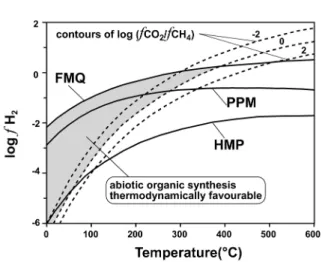
Fig. 1に Shock
の熱力学計算の結果を示す。横軸が温 度,縦軸は水素フュガシティー,FMQ, PPM, HMP は,それぞれ(fayalite-magnetite-quartz),(pyrite-pyrrhotite-magnetite),
(hematite-magnetite-pyrite)鉱物組み合わせによってバッファーされた酸化還元状 態を示す。点線は,(3)の反応において,熱力学計算 による
log(f CO
2/f CH
4)=−2,0,2を示したもので ある。CO
2+4H2 ←→CH
4+2H2O
(3)この図から,天然の鉱物組み合わせと平衡になるよう な酸化還元においては,
500° C
を超えれば,log
(fCO
2/
fCH
4)=2となり,ほとんどがCO
2となる。逆に,酸 化還元状態が変化せずに温度が下がれば,log(fCO
2/
fCH
4)は下がり,すなわち,CO2がCH
4に還元 さ れ る反応を促進する。ただし,500°C
以下に温度が下がれば反応速度が下がるために,平衡に達するまでの時 Table1Concentrationsandisotopiccompositionsofdissolvedgasesinrepresentativeunsedimentedhydrothermalventfluids.ModifiedfromMcCol- lomandSeewald(2007).
間が長くなり,室内実験においては
Fig. 1で示唆され
る生成物が観察されないこともある。さて,(2)式が示すように,岩石―熱水反応による 水素生成は,フィッシャー・トロプシュ型反応による 炭化水素生成には非常に重要である。熱水環境におけ る水素の発生は,(1)式のように,鉱物中のカンラン 石や輝石の2価鉄が酸化される反応によって起きる。
いわゆる蛇紋石化である。
Olivine+H
2O
→serpentine+brucite+magnetite+H
2 (4)超マフィック岩と熱水との反応で高濃度の水素が発 生することは,多くの室内熱水実験で確認されてき た。Allen and Seyfried(2003)はかんらん岩の構成 鉱物(かんらん石,輝石)と,それらをレールゾライ ト組成に混ぜた試料を用いて,海水との反応を観察し た。400°
C,500気圧で,発生した水素濃度はかんら
ん石,斜方輝石,斜方輝石+単斜輝石,レールゾライ ト 組 成 で そ れ ぞ れ 最 高 で2.3 mM,25.6 mM,15.9mM,11.6 mM
だった。また,Seyfriedet al.(2007)ではレールゾライト組成に混ぜ合わせた鉱物粉末と海 水を200°
C,500気圧下で反応させた結果,得られた
水素濃度は76.7 mMであった。炭化水素の生成は,(2)式に示す平衡反応であり,
熱力学的に炭化水素が安定な領域で起きるが,この平 衡には水素濃度が深く関与する。一方,蛇紋岩化によ る水素の発生は,(3)式に示す非平衡反応である。す なわち,熱力学的に炭化水素が安定な領域で,蛇紋石 化に伴う水素発生が起きることが,非生物的な炭化水 素合成に最も適した条件ということになる。実際,
Table 1が示すように,天然でも超マフィック岩をホ
ストとする熱水系では,メタンと他の炭化水素の濃度 も同様に高い。一方,地球初期の熱水活動を支えたと考えられるコ マチアイトを用いた熱水実験も行われ,コマチアイト ガラスを300°
C,500気圧 で 加 熱 し,2.4 mM
と い う 高 濃 度 の 水 素 発 生 を 確 認 し た(Yoshizaki et al.,2009)
。始源的メタン菌エコシステムの発生とその生息を支えるとともに,無機的なメタンなどの炭化水素 を発生し,それらを代謝の材料にする微生物生態系を 維持していた可能性がある。
3.熱水実験装置
熱水実験の歴史は古く,1850年代には砲身を利用 した実験が行われていた。その後,鉱床学に関する多 くの実験が試みられ,それに伴って数々の熱水実験装 置が開発された。熱水実験装置には,主にバッチ式
(閉鎖系),フロー式(開放形)があり,開発と発展 の歴史は,鈴木ほかの総説(鈴木ほか,2009)に詳 しくまとめられているので,そちらを参照されたい。
ここでは簡単に,現在最も利用されているバッチ式
(閉鎖系)の実験装置について紹介する。
近年使われている熱水実験の装置は,
Dickson
et al.(1963)によって開発された熱水実験装置をベース に,Seyfriedら に よ っ て 改 良 さ れ,発 展 し て き た
Dickson
型実験装置と呼ばれるものである(Fig. 2)。Dickson
型の装置は,ステンレス鋼の圧力釜の内部にボトル状サンプルセルを入れたものである。テフロン は化学的に不活性で,可変性があるため用いられる。
セルは様々な体積のものが取り付け可能である。この サンプルセルはばね式の密封装置によって圧力釜の内 部とは隔てられており,溶液試料を採取・導入するた めの管が備わっている。管の下部とセルとの間にはテ フロンのフィルターがある。
Fig. 1 Diagram illustrating mineral-buffered redox
potential, expressed as the fugacity of H
2(g),
and carbon speciation as a function of tem-
perature (modified from McCollom and
Seewald (2007); originally from Shock
(1992)). Curves labeled FMQ (fayalite-
magnetite-quartz), PPM (pyrite-pyrrhotite-
magnetite), and HMP (hematite-magnetite-
pyrite) correspond to the oxidation state
that would be attained at thermodynamic
equilibrium in geologic systems buffered by
these mineral assemblages. Dotted lines re-
flect equilibrium ratios of
fCO
2to
fCH4.
岩石―水反応の実験で注目されるのは,反応の前後 の鉱物や溶液の違いのみでなく,反応の過程である。
そのため,実験途中にサンプルセル中の試料の採取・
分析を行う。Dickson型は試料採取用のチューブの先 端に付けたバルブ(①)を開閉することで試料採取を 簡単に行うことができ,熱水実験では利便性が良い。
装置の基本原理は単純である。サンプルセル(②)
は周囲の水の圧力変化に反応して形状を変えるため,
サンプルセルの内側と外側で圧力は等しくなる。ま た,サンプルセルから試料採取用のチューブ(③)の 先端に付けたバルブを通じて,実験途中の溶液試料を 採取することで,内部の化学組成の変化を知ることが 出来る。試料を採取する時は,試料採取と同じ率で圧 力釜中に水を送り込むことで,実験の温度と圧力を保 つ。初期の
Seyfried
型実験装置では,テフロン製の サンプルセルが採用された。一方,天然の熱水研究が 進むにつれて,熱水系で採取される熱水の組成は,そ の場の海洋地殻を構成する岩石と循環する海水の反応 で決まっていることが分かった。また,その反応温度 は,噴出される熱水の温度が300°C
以上の高温である ものが多いことから,300°C
を超える岩石―海水実験 の必要性が認識されてきた。さらに,電荷のない化 学 種(H2S,CO
2,H2O
な ど)は テ フ ロ ン の 孔 を 通 り抜けてしまうため,Seyfriedのグループによって(Seyfriedet al., 1979; Seyfried and Bischoff, 1979)
では金製のサンプルセルが採用され,現在広く使用さ
れる
Dickson
型熱水実験装置の原型となった。試料に触れる部分は,試料採取用のチューブの中に
も金を通してある。サンプルセルのふた(ヘッド④)
には,チタンを使用している。これは,チタンが腐食 性・耐蝕性に優れており,高温の海水や塩水,希酸に 不活性であるためと,実験終了後に容易に金のサンプ ルセルを取り外せるためである。
チタン製のヘッドは高温の海水によっても腐食され ないものとされていたが,近年の水素やメタンなどの ガス分析が行われるようになってからは,その反応に よるガスの発生が無視できないことがわかってきた。
水素は金属の酸化で容易に発生し,そこに炭素源があ れば金属を触媒にしてフィッシャー・トロプシュ型反 応が起こり,メタンなどの炭化水素が発生する。その ため,McCollom and Seewald(2001)や
van Dover
et al.(2001)ではサンプルセルを400°C
で24時間加 熱してチタンヘッドの表面に酸化皮膜を作ることで,チタンの腐食の影響を軽減している。
Seyfried and Dibble(1980)と Janeckey and Seyfried
(1986)は,海洋地殻における蛇紋岩化過程 の一般的なモデルを提案する目的でかんらん岩の実験 を行った。これらの実験以降はほとんど全ての実験でDickson
型熱水実験装置が用いられている。これまでの研究については柳沢(1992)を参照していただき たい。
4.
熱水条件下での非生物炭化水素合成1990年代に入り,超マフィック岩の蛇紋岩化にと
もなう熱水に高濃度のメタンが確認された(Rona et al., 1992; Charlou and Donval, 1993)。Table 1にもFig. 2 Cross-section of Dickson-type hydrothermal apparatus composed of large-volume
pressure vessel and flexible gold reaction-cell with titanium closure (after Sey-
fried
et al., 1979).示されるように,蛇紋岩をホストとする熱水系では,
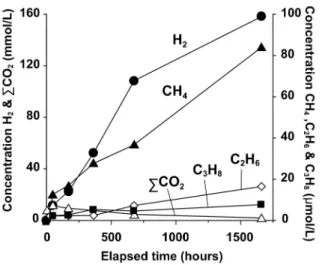
水素濃度とともにメタン濃度が高い傾向がある。そこ で,熱水系における無機的なメタンの生成メカニズム の解明を目的として,Berndt et al.(1996)によっ て,室内熱水実験が行われた。彼らは,Dickson型熱 水実験装置を用い,かんらん石と
NaCl-NaHCO
3溶液 とを300°C,500気圧下で反応させた。NaHCO
3は高 温で分解してCO
2が発生し,これが炭化水素生成反 応の炭素源となる。実験の結果,かんらん石の蛇紋石 化反応によって69日後には高濃度の水素(160 mM)が発生し,さらに
CO
2と水素とのフィッシャー・ト ロプシュ型反応(式(2))によって高濃度のメタン(84μ
M)や,エタン,プロパン,ブタンの生成が確認さ
れた(Fig. 3)。フィッシャー・トロプシュ合成には,
先述のように金属やその酸化物などの触媒が必要であ るが,Berndt et al.(1996)の実験では,蛇紋石化に よって水素が生成する際の副生成鉱物の磁鉄鉱を触媒 にしていると考えられた。
Berndt
らの実験をきっかけに超マフィック岩の熱水系を想定した,蛇紋岩化にともなう水素や炭化水素 生成に関する実験が次々になされた。それによって,
Berndt
et al.
(1996)らの最初の実験による熱水系に お け る 炭 化 水 素 の 発 生 は,CO2の 還 元 に よ る も の ではないことが証明されてしまう。McCollomand Seewald
(2001)では,Berndt et al.(1996)で確認 された炭化水素化合物の炭素源がCO
2であるかを確認 す る た め に,13
C
で ラ ベ リ ン グ し たNaH
13CO
3とH
13COOH
を 用 い て,か ん ら ん 石―海 水 反 応 実 験 を 行った。NaH
13CO
3とH
13COOH
は,高温で分解して,13
CO
2を発生する。この実験では,あらかじめ装置に 付着した有機物の混入を防ぐためにサンプルセルの焼 きだしを行い,また,ヘッドのチタンが海水によって 腐食される際に発生する水素の影響を除去するために ヘッドの加熱処理を行っている。実験の結果,Berndt
et al.(1996)による水素,メタン,他の炭化水素の発
生量は再現したが,発生した炭化水素は13
C
をほとん ど含んでいなかった。この実験でかんらん石の蛇紋石 化にともなって発生するメタンの大部分は,かんらん 石中に含まれる有機物の熱分解によって生成し,ごく 一部のみが溶液中のCO
2由来の炭素を使って発生し たと結論付けた。さらに,McCollom and Seewald(2003)では,赤鉄鉱,磁鉄鉱,蛇紋石,鉄ニッケ ル 合 金 を 触 媒 と し て,175〜260°
C,350気 圧 で,
そ れ ま で よ り 長 時 間 の 実 験 を 行 っ た。そ の 結 果,
McCollom and Seewald(2001)同様,発生した炭化
水素は13C
をわずかしか含んで い な か っ た。す な わ ち,発生した炭化水素は,出発物質や器具に残る有機 物が熱分解したものであり,溶液に加えたCO
2の還 元によって発生したものではない。一方,この結果と は異なる結果も報告されている。Foustoukosand Seyfried
(2004)ではMcCollom and Seewald
(2003)を受けて,390°
C,400気圧下で同様の実験を行い,
クロマイトや磁鉄鉱の存在下,メタンのみならず,
C
2H
6,C3H
8なども無機的に生成することを示した。Fig. 4は,熱水実験で発生したプロパンの質量スペク
トルである。質量数45には,12C
213
CH
8が検出される。ここで,12
C
3H
8のみが観察される質量数44か ら 天 然 の12C/
13C
比 を 用 い て,質 量 数45の12C
213
CH
8の 量 を 見 積もったのが黒い帯である。実験によって得られた質 量数45の量は,黒い帯よりはるかに高い。すなわち,出発物質として加えた13
C
でラベリングをした13CO
2が 熱水反応で還元され,プロパンが生成していることが 明らかになった。このように,Foustoukos and Seyfried(2004)で は,メタンのみならず,エタン,プロパンの発生が観 察されたのに対し,McCollom and Seewald(2001;
2003)では同程度の CO
2,H2が溶液中に存在するに もかかわらず,Foustoukos and Seyfried(2004)の 実験で発生したような高濃度の炭化水素の発生が観察 されなかった。McCollom and Seewald(2007)は,Fig. 3 Concentrations of dissolved H
2, CO
2, and
light hydrocarbons during serpentinization
of olivine in the experimental study of
Berndt
et al.(1996). Modified after
McCollom and Seewald (2007).
そ の 原 因 と し て
McCollom and Seewald(2001;
2003)では,175〜300° C
での反応であり,Foustou-kos and Seyfried(2004)の390° C
と比較すると温度 は 低 く,温 度 の 高 いFoustoukos and Seyfried
(2004)の実験より反応速度が遅かったために,検 出できるほどのメタンが生成していなかったのではな いかと推測している。しかしながら,正確な理由は定 かではない。
上記の水素濃度では,CO2から熱水中で無機的にメ タンが生成する反応に関して,熱力学的にはよりメタ ンを生成する方向に反応が進むはずである。いずれの 実験においても,実験で設定した水素濃度であれば,
熱力学的には平衡時に溶液中のほぼすべての
CO
2が メタンになる。ところが,いずれの実験でも最終的に0.5%ほどの CO
2しかメタンに還元されていない。また,水素濃度は天然の熱水の水素よりはるかに高く,
それでも反応が遅いのは,メタン生成を阻害する速度 論的な要因があるためと考えられる(McCollom and
Seewald, 2007)
。反応速度に強い影響を与えるのは 触媒である。Horita and Berndt(1999)は,ニッケル鉄合金と
磁 鉄 鉱 の 存 在 下,200〜400°C,50 MPa
で,溶 液 中 のCO
2がメタンに還元される反応実験を行った。300°
C
で行った実験の結果をFig. 5に示すが,触媒の量
を変えたいずれの実験でも,350時間後までにはほと んどのCO
2がメタンに還元されている。ニッケル鉄 合金触媒の量が多いほど,反応速度が速い傾向があ り,この還元反応では,触媒によって速度論的な障壁 が除かれることを示している。天然では,ニッケル鉄 合金が生成するほどの還元的環境の実現は容易ではな いが,超マフィック岩が熱水と反応しているような環 境では,小さなニッケル金属鉱物が生成することがあ りうると考えられている(McCollom and Seewald,2007)
。McCollom and Seewald(2006)でも,触媒 として鉄粉を用い,250°C,32.5 MPa
で,ギ酸を反 応させ,10%以上の炭素が,炭化水素に還元される ことを示している。Jiet al.(2008)は,コバルト:鉄=1: 3の マ グ ネ タ イ ト の 存 在 下 で,300°
C,30 MPa Fig. 5 Concentration of methane of hydrothermal fluids formed by reduction of CO
2catalyzed by varying amounts of NiFe-alloy (after McCollom and Seewald (2007); originally from Horita and Berndt (1999)). The experi- ments were carried out at 300° C.
Fig. 4 Mass spectrum of propane generated during hydrothermal reaction of
13CO
2in the pres- ence of chromite plus magnetite in an ex- periment by Foustoukos and Seyfried (2004). Measured abundances of propane with mass/charge ratios (m/z) of 44, 45, 46, and 47 are shown, corresponding to molecu- lar ions for
12C
3H
8,
12C
213
CH
8,
12C
13C
2H
8, and
13
C
3H
8, respectively.
13C-bearing products represent those synthesized in reduction of
13
CO
2during the experiment, while
12C is de- rived from background sources of organic matter in starting materials or on the sur- face of experimental apparatus. The black bar represents the amount of
12C
213
CH
8ex-
pected for natural abundances of
13C based
on the abundance of
12C
3H
8. Modified from
McCollom and Seewald (2007).
で実験を行い,プロパン以上の炭化水素が数μ
M
発 生することを確認している。これらの実験は触媒がメ タン生成に重要な要素であることを示す。一方で,最 近,炭酸塩がメタンの生成をコントロールしていると いう報告もある(Jones et al., 2010)。彼らは,熱水 実験におけるカンラン石の蛇紋石化の際,鉄が酸化さ れて水素が生成する反応より,炭酸塩がFe
2+を取り 込む反応の方が早いことを示した。そして,その反応 が水素の生成を阻害する結果,メタンの生成が抑えら れ る と 指 摘 し た。最 近 で はCO,CO
2,HCOOH,CH
4など様々な炭素源を用いた実験(McCollomet al.,2010)が行われている。結果として,その反応過程
は未だ不明な点が多いが,炭化水素生成反応のメカニ ズムに迫ろうという意欲的な実験も多く見られるよう になってきた(Fuet al., 2009など)。さて,非生物炭化水素合成における炭素の同位体分 別はどのようになるのであろうか?
McCollom and Seawald(2006)は,上記の実験条 件 で,ギ 酸 を 反
応させ,Fig. 6のような結果を得た。得られた炭化水 素はすべて反応溶液中のCO
2の炭素同位体より約36‰,反応中に沈殿した菱鉄鉱より約31‰低いという 結果が得られた。同位体比の低い炭化水素は一般的に 生物起源として扱われるが,この実験によって,熱水 条件でも非生物的に合成された炭化水素の炭素同位体 比は低くなることが示された。また,Takai et al.
(2008)は,122°
C(2008年までに行われた生物培養
実験の最高温度)でメタン菌を培養し,メタン菌が作 り出したメタンの炭素同位体が非常に重くなることを 示した。この結果は,生物起源の炭素化合物の炭素同 位体比は低いという常識は必ずしも正しくないことを 示す。今後の検証を期待したい。
5.
お わ り にはじめに書いたように,非生物的に無機炭素から有 機物を合成する反応は,初期地球の熱水系において最 初の生命の材料を作り出したことと期待されることか ら,多 く の 研 究 者 の 注 目 を 浴 び て い る。先 に,
Yoshizaki
et al.(2009)によって,コマチアイトガラ スと水の反応で高濃度の水素が発生することが示され たことを記したが,今後この熱水系でメタンが発生す る か ど う か を 調 べ る 実 験 が 興 味 深 い。現 在 で は,McCollom and Bach(2009)によってかんらん岩の
蛇紋岩化による水素発生に関する熱力学的制約が提案 されているが,コマチアイトについては全く明らかに なっていない。熱水系における非生物的な有機物合成反応は,主に 熱水実験装置を用いた高温高圧実験によって制約が与 えられてきた。しかしながら,今回のレビューに記し たように,実際の実験では天然の熱水より高濃度の水 素,二酸化炭素が反応物質として実験系に導入され,
天然ではあり得ない量の金属鉄,クロマイトなどが触 媒として加えられている。天然の系よりも高濃度の材 料,触媒が必要なのは,単に天然と室内実験のタイム スケールの違いのためなのか,あるいは室内実験では 現れない天然にのみ働くファクターが存在するのかは 明らかではない。同様の実験を行っても異なる結果が 出るなど,その反応メカニズムにはほとんどわかって おらず,新たなアイディアでの熱水実験のデザイン と,さらなる実験の繰り返しが必要である。今後の進 展を期待するとともに,我々も室内熱水実験に携わっ ている研究者として,実験計画をさらに進めていきた い。
謝 辞
この総説を書く機会を与えてくれた高野淑識氏に感 謝する。2人の匿名の査読者には丁寧に原稿を見てい ただき,非常に有益なコメントをいただいた。それに よって原稿の記述が明確になった。ここに深く感謝す る。この論文は,科研費新学術領域「海底下の大河」
の一部を利用した。
Fig. 6 Carbon isotopic composition of hydrocarbons produced during Fischer-Tropsch-type syn- thesis in the presence of iron under hydro- thermal conditions at a temperature of 250
°
C and a pressure of 32.5 MPa (McCollom
and Seewald, 2006; 2007). Horizontal lines
represent isotopic composition of dissolved
CO
2(−14.2‰) and precipitated siderite
(−19.1‰).
文 献
Abrajano, T. A., Sturchio, N. C., Bohlke, J. K., Lyon, G. L., Poreda, R. J. and Stevens, C. M. (1988) Methane- hydrogen gas seeps, Zambales ophiolite, Philippines:
deep or shallow origin?Chemical Geology,71, 211―222.
Allen, D. E. and Seyfried, W. E. (2003) Compositional controls on vent fluids from ultramafic-hosted hydrothermal sys- tems at mid - ocean ridges: An experimental study at 400
°C, 500 bars.Geochimica et Cosmochimica Acta,67, 1531
―1542.
Anderson, R. B. (1984)The Fischer-Tropsch Reaction, Aca- demic Press, London.
Berndt, M. E., Allen, D. E. and Seyfried, W. E. (1996) Reduc- tion of CO2 during serpentinization of olivine at 300°C and 500 bar.Geology,24, 351―354.
Charlou, J. and Donval, J. (1993) Hydrothermal methane venting between 12N°and 26N°along the Mid-Atlantic Ridge. Journal of Geophysical Research, 98, B6, 9625―
9642.
Charlou, J. L., Donval, J. P., Jean-Baptiste, P., Dapoigny, A.
and Rona, P. A. (1996a) Gases and helium isotopes in high temperature solutions sampled before and after ODP Leg 158 drilling at TAG Hydrothermal Field (26°N, MAR).Geophysical Research Letters,23, 3491―3494.
Charlou, J. L., Fouquet, Y., Donval, J. P., Auzende, J. M., Jean-Baptiste, P., Stievenard, M. and Michel, S. (1996b) Mineral and gas chemistry of hydrothermal fluids on an ultrafast spreading ridge: East Pacific Rise, 17°to 19°S (Naudur cruise, 1993) phase separation processes con- trolled by volcanic and tectonic activity.Journal of Geo- physical Research,101, B7, 15899―15919.
Charlou, J. L., Donval, J. P., Douville, E., Knoery, J., Fouquet, Y., Jean-Baptiste, P., Bourg, C., Prieur, D. and German, C. (1998)Reunion des Science de la Terre,98, 89.
Charlou, J. L., Donval, J. P., Douville, E., Jean-Baptiste, P., Radford-Knoery, J., Fouquet, Y., Dapoigny, A. and Stievenard, M. (2000) Compared geochemical signatures and the evolution of Menez Gwen (37°50′N) and Lucky Strike (37°17′N) hydrothermal fluids, south of the Azores Triple Junction on the Mid-Atlantic Ridge.Chemical Ge- ology,171, 49―75.
Charlou, J. L., Donval, J. P., Fouquet, Y., Jean-Baptiste, P.
and Holm, N. (2002) Geochemistry of high H2 and CH4
vent fluids issuing from ultramafic rocks at the Rainbow hydrothermal field (36°14′N, MAR). Chemical Geology, 191, 345―359.
Cody, G. D., Boctor, N. Z., Brandes, J. A., Filley, T. R., Hazen, R. M. and Yoder Jr., H. S. (2004) Assaying the catalytic potential of transition metal sulfides for abiotic carbon fixation. Geochimica et Cosmochimica Acta, 68, 2185―
2196.
Corliss, J. B., Dymond, J., Gordon, L. I., Edmond, J. M., von
Herzen, R. P., Ballard, R. D., Green, K., Williams, D., A., Bainbridge, A., Crane, K. and Van Andel, T. H. (1979) Submarine thermal springs on the Galapagos Rift. Sci- ence,203, 1073―1083.
Dickson, F. W., Blount, C. W. and Tunell, G. (1963) Use of hy- drothermal solution equipment to determine the solubil- ity of anhydrite in water from 100°C to 275°C and from 1 bar to 1000 bars.American Journal of Science,261, 61―
78.
Edmond, J. M., Measures, C., McDuff, R. E., Chan, L. H., Collier, R., Grant, B., Gordon, L. I. and Corliss, J. B.
(1979) Ridge crest hydrothermal activity and the bal- ances of the major and minor elements in the ocean: The Galapagos data.Earth and Planetary Science Letters,46, 1―18.
Evans, W. C., White, L. D. and Rapp, J. B. (1988) Geochemis- try of some gases in hydrothermal fluids from the south- ern Juan de Fuca Ridge. Journal of Geophysical Re- search,93, B12, 15305―15313.
Foustoukos, D. I. and Seyfried, W. E. (2004) Hydrocarbons in hydrothermal vent fluids: the role of chromium-bearing catalysts.Science,304, 1002―1005.
Fu, Q., Lu, P., Konishi, H., Dilmore, R., Xu, H. F., Seyfried, W. E. and Zhu, C. (2009) Coupled Alkali-feldspar dissolu- tion and secondary mineral precipitation in batch sys- tems: 1. New experimental data at 200°C and 300 bars.
Chemical Geology,258, 125―135.
Holm, N. G. and Anersson, E. (2005) Hydrothermal simula- tion experiments as a tool for studies of the origin of life on earth and other terrestrial planets: A review.Astrobi- ology,5, 444―460.
Horita, J. and Berndt, M. E. (1999) Abiogenic methane forma- tion and isotopic fractionation under hydrothermal condi- tions.Science,285, 1055―1057.
Janecky, D. R. and Seyfried, W. E. (1986) Hydrothermal ser- pentinization of peridotite within the oceanic crust: Ex- perimental investigations of mineralogy and major ele- ment chemistry. Geochimica et Cosmochimica Acta,50, 1357―1378.
Jannasch, H. W. (1985) Review lecture: The chemosynthetic support of life and the microbial diversity at deep-sea hy- drothermal vents. In:Proceedings of the Royal Society of London. Series B(ed. Biological Sciences),225, 277―297.
Ji, F., Zhou, H. and Yang, Q. (2008) The abiotic formation of hydrocarbons from dissolved CO2 under hydrothermal conditions with cobalt-bearing magnetite.Origins of Life and Evolution of Biosphere,38, 117―125.
Jones, L. C., Rosenbauer, R., Goldsmith, J. I. and Oze, C.
(2010) Carbonate control of H2and CH4production in ser- pentinization systems at elevated P-Ts.Geophysical Re- search Letters,37, L14306.
Kelley, D. S., Karston, J. A., Früh-Green, G. L., Yoerger, D.
R., Shank, T. M., Butterfield, D. A., Hayes, J. M., Schrenk, M. O., Olson, E. J., Proskurowski, G., Jakuba,
M., Bradley, A., Larson, B., Ludwig, K., Glickson, D., Buckman, K., Bradley, A. S., Brazelton, W. J., Roe, K., Elend, M. J., Delacour, A., Bernasconi, S. M., Lilley, M.
D., Baross, J. A., Summons, R. E. and Sylva, S. P. (2005) A serpentinite-hosted ecosystem: The Lost City Hydro- thermal Field.Science,307, 1428―1434.
Kumagai, H., Nakamura, K. Toki, K., Morishita, T., Okino, K., Ishibashi, J. -I., Tsunogai, U., Kawagucci, S., Gamo, T., Shibuya, T., Sawaguchi, T., Neo, N., Joshima, M., Sato, T. and Takai, K. (2008) Geological background of the Kairei and Edmond hydrothermal fields along the Central Indian Ridge: Implications of their vent fluids distinct chemistry.Geofluids,8, 239―251.
McCollom, T. M. and Bach, W. (2009) Thermodynamic con- straints on hydrogen generation during serpentinization of ultramafic rocks.Geochimica et Cosmochimica Acta, 73, 856―875.
McCollom, T. M., Lollar, B. S., Lacrampe-Couloume, G. and Seewald, J. (2010) The influence of carbon source on abi- otic organic synthesis and carbon isotope fractionation under hydrothermal conditions. Geochimica et Cosmo- chimica Acta,74, 2717―2740.
McCollom, T. and Seewald, J. S. (2001) A reassessment of the potential for reduction of dissolved CO2to hydrocarbons during serpentinization of olivine.Geochimica et Cosmo- chimica Acta,65, 3769―3778.
McCollom, T. M. and Seewald, J. S. (2003) Experimental con- straints on the hydrothermal reactivity of organic acids and acid anions: I. Formic acid and formate.Geochimica et Cosmochimica Acta,67, 3625―3644.
McCollom, T. M. and Seewald, J. S. (2006) Carbon isotope composition of organic compounds produced by abiotic synthesis under hydrothermal conditions. Earth and Planetary Science Letters,243, 74―84.
McCollom, T. M. and Seewald, J. S. (2007) Abiotic synthesis of organic compounds in deep-sea hydrothermal environ- ments.Chemical Reviews,107, 382―401.
Ohmoto, H., Watanabe, Y. and Kumazawa, K. (2004) Evi- dence from massive siderite beds for a CO2-rich atmos- phere before〜1.8 billion years ago. Nature, 429, 395―
399.
Potter, J., Rankin, A. H. and Treloar, P. J. (2004) Abiogenic Fischer-Tropsch synthesis of hydrocarbons in alkaline ig- neous rocks; fluid inclusion, textural and isotopic evi- dence from the Lovozero complex, NW Russia.Lithos,75, 311―330.
Prokurowski, G., Lilley, M. D., Kelley, D. S. and Olson, E. J.
(2006) Low temperature volatile production at the Lost City hydrothermal field, evidence from a hydrogen stable isotope geothermometer. Chemical Geology, 229, 331―
343.
Rona, P. A., Bougault, H., Charlou, J. L., Appriou, P., Nelsen, T. A., Trefry, J. H., Eberhart, G. L., Barone, A. and Needham, H. D. (1992) Hydrothermal circulation, ser-
pentinization, and degassing at a rift valley-fracture zone intersection: Mid-Atlantic Ridge near 15°N, 45°W.Geol- ogy,20, 783―786.
Rusell, M. J. and Hall, A. J. (1997) The emergence of life from iron monosulphide bubbles at a submarine hydrothermal redox and pH front. Journal of the Geological Society, 154, 377―402.
Seyfried, W. E., Gordon, P. C. and Dickson, F. W. (1979) A new reaction cell for hydrothermal solution equipment.
American Mineralogist,64, 646―649.
Seyfried, W. E. and Bischoff, J. L. (1979) Low temperature basalt alteration by seawater:an experimental study at 70°C and 150°C.Geochimica et Cosmochimica Acta,43, 1937―1947.
Seyfried, W. E. and Dibble, W. E. (1980) Seawater-peridotite interaction at 300°C and 500 bars: implications for the origin of oceanic serpentinites. Geochimica et Cosmo- chimica Acta,44, 309―321.
Seyfried, W. E., Foustoukos, D. I. and Fu, Q. (2007) Redox evolution and mass transfer during serpentinization: An experimental and theoretical study at 200°C, 500 bar with implications for ultramafic-hosted hydrothermal systems at Mid-Ocean Ridges. Geochimica et Cosmo- chimica Acta,71, 3872―3886.
Shock, E. L. (1992) Chemical environments of submarine hy- drothermal systems.Origins of Life and Evolution of Bio- sphere,22, 67―107.
Shock, E. L. and Schulte, M. D. (1998) Organic systhesis dur- ing fluid mixing in hydrothermal systems. Journal of Geophysical Research,103, 513―517.
Shock, E. L., Helgeson, H. C. and Sverjensky, D. A. (1989) Calculation of the thermodynamic and transport proper- ties of aqueous species at high pressures and tempera- tures: Standard partial molal properties of inorganic neu- tral species.Geochimica et Cosmochimica Acta,53, 2157―
2183.
Sleep, N. H., Meibom, A., Fridriksson, T., Coleman, R. G. and Bird, D. K. (2004) H2-rich fluids from serpentinization:
Geochemical and biotic implications.Proceedings of the National Academy of Sciences,101, 12818―12823.
鈴木勝彦・中村謙太郎・加藤真悟・山岸明彦(2009)海底熱水 循環系の生物地球化学的理解に向けた実験的アプローチ.
地学雑誌,118,1131―1159.
Takai, K., Gamo, T., Tsunogai, U., Nakayama, N., Hirayama, H., Nealson, K. H. and Horikoshi, K. (2004) Geochemical and microbiological evidence for a hydrogen-based, hy- perthermophilic subsurface lithoautotrophic microbial ecosystem (HyperSLiME) beneath an active deep-sea hy- drothermal field.Extremophiles,8, 269―282.
Takai, K., Nakamura, K., Suzuki, K., Inagaki, F., Nealson, K.
H. and Kumagai, H. (2006) Ultramafics-Hydrother- malism-Hydrogenesis-HyperSLiME (UltraH3) linkage: a key insight into early microbial ecosystem in the Archean deep-sea hydrothermal systems. Palaeontological Re-
search,10, 269―282.
Takai, K., Nakamura, K., Toki, T., Tsunogai, U., Miyazaki, M., Miyazaki, J., Hirayama, H., Nakagawa, S., Nunoura, T. and Horikoshi, K. (2008) Cell proliferation at 122°C and isotopically heavy CH4production by a hyperthermo- philic methanogen under high-pressure cultivation.Pro- ceedings of the National Academy of Sciences,105, 10949
―10954.
Van Dover, C. L. V., Humphris, S. E., Fornari, D., Cavanaugh, C. M., Collier, R., Goffredi, S. K., Hashimoto, J., Lilley, M. D., Reysenbach, A. L., Shank, T. M., Von Damm, K. L., Banta, A., Gallant, R. M., Götz, D., Green, D., Hall, J., Harmer, T. L., Hurtado, L. A., Johnson, P., McKiness, Z. P., Meredith, C., Olson, E., Pan, I. L., Turnipseed, M., Won, Y., Young, III, C. R. and Vrijenhoek, R. C. (2001) Biogeography and ecological set- ting of Indian Ocean hydrothermal vents.Science,294, 818―823.
Yanagawa, H. and Kojima, K. (1985) Thermophilic Micro- spheres of Peptide-Like Polymers and Silicates Formed
at 250°C.Journal of Biochemistry,97, 1521―1524.
柳沢文孝(1992)熱水反応装置とガラスの化学的耐久性試験.
資源地質.42,415―422.
Yoshizaki, M., Shibuya, T., Suzuki, K., Shimizu, K., Nakamura, K., Takai, K., Omori, S. and Maruyama, S.
(2009) H2generation by experimental hydrothermal al- teration of komatiitic glass at 300 degrees C and 500 bars: A preliminary result from on-going experiment.
Geochemical Journal,43, E17―E22.
Welhan, J. A. and Craig, H. (1983) Methane, hydrogen and helium in hydrothermal fluids at 21N on the East Pacific Rise. In:Hydrothermal Processes at Seafloor Spreading Centers(ed. P. A. Ronaet al.), Plenum Press, New York, pp. 391―409.
Welhan, J. A. and Lupton, J. E. (1987) Light Hydrocarbon Gases in Guaymas Basin Hydrothermal Fluids: Thermo- genic Versus Abiogenic Origin.American Association of Petroleum Geology Bulletin,71, 215―223.
Winn, C., Karl, D. and Massoth, G. (1986) Microorganisms in deep-sea hydrothermal plumes.Nature,320, 744―746.