Determination of Ytterbium by Pyrocoated Graphite Furnace Atomic Absorption
Spectrometry
-Application to Seawater-
Osamu FUJINO and Akemi ADACHI
Resea1·ch Institute for Science and Technology,J(inki University
J( owakae, Higashiosaka 577 Japan
(Received October 7, 1991)
Abstract
Atomic absorption spectrometry using a pyrocoated graphite furnace atomizer was applied for the determination of the trace amounts of ytterbium in sea water. The ytterbium ion was concentrated by coprecipitating with ferric hydroxide and its precipitation was dissolved in 2 ml of 8 mol/dm3 hydrochloric acid solution. Twenty microliters of this solution were directly injected into the graphite furnace atomizer. By this analysis, the content of ytterbium in sea water was found to be (0.68..., l.l)x 10-9gjf.
Keywords: Ytterbium, pyrocoated graphite furnace atomic absorption spectrometry, sea water, coprecipitation, solvent extraction
1 Introduction
Recently the study of functional material using rare earth elements (REE) has developed rapidly and its achievements have become a center of attraction.1 On the other hand, more recently in- terest in contents and distribution of REE in nat- ural sample. And the determination of REE in sea water has become increasingly important in order to understand various aspects of chemical oceanography.2 In general, the determination of REE ("' ng/ £) in natural water is most difficult, because of the similarity of chemical behavior and very low its concentration. Therefore, after REE in natural water was preconcentrate, there have been attempts activation analysis method which is relatively high sensitivity for REE. However, this method can not be always used. On the
other hand, it is well known that graphite fur- nace atomic absorption spectrometry ( G FAAS) is very high sensitivity ( ca.0.1 ppb for 1% absorp- tion) for only ytterbium though other REE is very poor sensitivity. However, direct determination of ytterbium in sea water by GFAAS is very diffi- cult, because ytterbium concentration in sea water are very low, ranging between 0.5 and 1.2ng/f.3•4
Therefore, a preconcentration method is needed for ytterbium in sea water sample before GFAAS.
In the present paper, the method of determi- nation of ytterbium by GFAAS after preconcen- tration of ( 1 "' 2.5) x 103 fold by coprecipitation of ytterbium in sea water with ferric hydroxide is described.
- 5 5 -
...
:i rG
IU u c Ill .D
...
0 Ul .D oct
0 0.5 1.0 1.5 2.0
Ashlng temperature, x103·c
Fig.l Effect of ashing temperature on absorbance of ytterbium.
Yb 4ppb (20J,tt'), Atomizing temperature 2800°C Atomizing time 5 sec.
2 Apparatus and Reagents
Atomic absorption measurements were made with a Hitachi 180-70 Model Zeeman atomic absorp- tion spectrometer in conjunction with a furnace atomizer and a Zeeman background corrector was used. Graphite atomizer was used a pyrocoated graphite tube (pyro-cuvette), and graphite tube (normal cuvette) which were prepared by Hitachi Co.
Standard ytterbium solution was prepared by
3 Procedure
Sea water sample was filtered through 0.45 Jtm
millipoure filters, the filtrate sample solution was acidified to pH 1.0 by the addition of hydrochlo- ric acid, they were stocked in a 5£ polyethylene bottles.
A 2 rv 5 liter sample was placed in a glass beaker, and 5mf of lmgjme ferric ion solution was added to a sample solution and the pH was ad- justed to 8 with aqueous ammonia. After standing 2 rv 3 days, decant the supernatant and centrifuge ferric hydroxide precipitation. The supernatent solution was pulled off by an aspirator working through a glass filter, and the residue precipitation
was digested with hydrochloric acid. The solution was transferred into lOml-centrifuge tube~ Then,
...
:i IIi ...
.,
u c
Ill .D
...
0 .D Ul
oct
2.4 2.5 2.6 2.7 2.8 2.9 3.0 3.1
Atomlzl,ng temperature, x to3·c
Fig.2 Effect of atomizing temperature on ab- sorbance of ytterbium.
Yb 4 ppb (20J,tf), Ashing temperature 500oC Ashing time 30 sec.
dissolving ytterbium oxide (Yb203 ; 99.999%) with nitric acid, and other REE were high purity (99.99rv99.9999%) oxides. A solution containing 1 mg/ml of ferric ion was prepared by dissolving fer- ric nitrate nonahydrate [Fe(N03)3·9H20] 7.232g in a 10 ml of concentrated hydrochloric acid and di- luting to lt' with distilled water. Other Chemicals were reagent grade materials.
second and third reprecipitation in its vessel are carried in the manner described above. And fi- nally, precipitate was added 2 ml of 8 mol/dm3 concentrated hydrochloric acidsolution, was dis- solved with hot water in the beaker on the hot plate.
Then a 20 J,tf aliquot of the solution injected into the atomization graphite furnace using a mi- cropipet (Eppendorf Co.)
The conditions for ytterbium measurement by using a pyrocoated were: drying, 80rvl20°C for 30 s ashing, 500oC for 30 s; atomizing, 2800°C for 5 s argon flow rate, 2£/m. The spectral line at 398.8 nm was used for measurements.
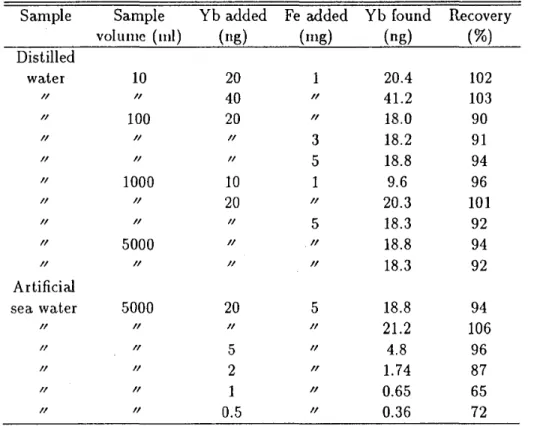
Table 1: Coprecipitation of ytterbium from distilled water and artificial sea water Sample Sample Yb added Fe added Yb found Recovery
volume ( ml) (ng) (mg) (ng) (%)
Distilled
water 10 20 1 20.4 102
II II 40 II 41.2 103
II 100 20 II 18.0 90
II II II 3 18.2 91
II II II 5 18.8 94
II 1000 10 1 9.6 96
II II 20 II 20.3 101
II II II 5 18.3 92
II 5000 II II 18.8 94
II II II II 18.3 92
Artificial
sea water 5000 20 5 18.8 94
II II II II 21.2 106
II II 5 II 4.8 96
II II 2 II 1.74 87
II II 1 II 0.65 65
II II 0.5 II 0.36 72
Table 2: Effect of foreign ions for ytterbium
Element [Salt]/[Yb]* Element [Salt]/[Yb]*
X 102 X 103 X 104 X 101
None 100 100 100 None 100
Al 96 108 Sc 99
Zn 93 95 y 89
u
103 104 La 97Cu 101 96 Ce 98
Fe 93 95 Pr 87
Ni 97 101 Nd 98
:tvln 96 97 Sm 95
v
104 101 Eu 98Ti 103 98 Gd 93
Cr 108 Tb 93
Co 96 Dy 96
Cd 101 Ho 89
· Pb 105 Er 95
Zr 102 Tm 92
Th 98 Lu 98
*Concentration of coexisting element to concentration of ytterbium.
- 5 7 -
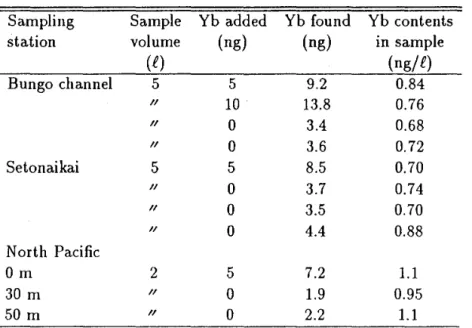
Table 3: Determination of ytterbium in sea water Sampling Sample Yb added Yb found Yb contents
station volume
(f) Bungo channel 5
II II II
Setonaikai 5
II II II
North Pacific
Om 2
30m II
50 m II
4 Results and Discussion
Analytical conditions
The ytterbium absorption signal varies with the applied pyrocoating graphite furnace tempera- tures. Therefore, the measurement conditions for the ytterbium were studied. At the drying step, almost constant absorbance were obtained for 20
J-Lf of ytterbium (2ng/m€) within 80 rv 200 at dry-
ing time for 30s. Then, Fig.1 and Fig.2 shows the effect of the ashing and atomization temperatures respectively. At the ashing step, the absorbance of ytterbium reached maximum value at 500°C with ashing time for 30s. At the atomization step, the maximum absorbance was obtained at 2800°C for Ss of heating.
Calibration curve
Calibration curves were obtained by the injection of 20J-L€ of ytterbium solution (1 rv Sng/m€) at- omized from a pyrocoa.ted graphite and uncoated graphite. The results are shown in Fig.3 . The sensitivities are considerably poor when an un- coated graphite are used, whereas the pyrocoated graphite provide very high sensitivities. The sen- sitivity for ytterbium increased ca.10 fold by using the pyrocoated graphite tube. For this reason, py- rocoated graphite tube was chosen as atomizer.
However, the direct determination of ytter-
(ng) (ng) in sample
(ng/f)
5 9.2 0.84
10 13.8 0.76
0 3.4 0.68
0 3.6 0.72
5 8.5 0.70
0 3.7 0.74
0 3.5 0.70
0 4.4 0.88
5 7.2 1.1
0 1.9 0.95
0 2.2 1.1
bium in sea water5 by atomic absorption spec- trometry with pyrocoated graphite tube atom- izer is difficult because of the very low ytterbium (ca.1ng/f) contents. Therefore, (1rv3)x103 fold concentration of ytterbium in sea water is needed.
Optin1un1 conditions for coprecipi- tation
Ferric hydroxide is an effective coprecipitant for preconcentration prior to the measurement of trace amounts of REE in sea water.5 Therefore, we intended to use for ferric hydroxide for the concen- tration by coprecipitation of ytterbium in sea wa- ter. The recovery of ytterbium from pure water or artificial sea water into ferric hydroxide ( 0. 3rv5mg) was studied with the solution ( 10 "' 5000ml) con- taining (5rv40ng) of ytterbium, according to pro- cedure of previous page. The results are show.n in Table 1. More than 90% of ytterbium was recov- ered from distilled water and artificial sea water.
Effect of some foreign substances
First, the effect of several inorganic acids (JICI, HN03 , H2S04 , HC104 ) at concentrations of 0.01 rv 10 mol/dm3 on the absorbance for 10 ppb yt- terbium was studied. The results were shown in
Gl
g 0.15
Ill .0
...
0 Ill .0
<( 0.10
1 2 3 4 5
Concentration of ytterbium, ng /m L
Fig.3 Calibration curves for ytterbium on pyrocoated and unpyrocoated graphite tube.
Sample injection volume 20j1£, 0 pyrocoated graphite furnace, 0 unpyrocoated graphite furnace.
Concentration of acid, mol/ dm3
Fig.4 Effect of acid concentrations on absorbance of ytterbium.
10 -4 1~ 1~ 1~
Concentration of Iron , mgtml
Fig.5 Effect of iron concentrations on the absorbance of ytterbium.
- 5 9 -
Fig.4. Absorption of ytterbium for these acid con- centrations becomes scarcely affected and showed a constant value. However, absorbance of ytter- bium tends to decrease at higher concentration than 1 mol/dm3 of perchloric acid. For this rea- son, hydrochrolic acid was used in this study.
Secondly, the effect of coexisting ions in sea water which seems to be probable of coprecipita- tion with ferric hydroxide on the peak absorbance of ytterbium were studied. The results was shown in Table 2. The concentration ratio of coexist- ing ion to ytterbium in this Table were approxi- mately comparable to those that may be found in sea water6. Many ions in Table 2 did not interfere with the determination of ytterbium.
Effect of concentrations of ferric hydroxide as a coprecipitation carrier was investigated on the absorbance of 10 ppb ytterbium in the presence of 10-4rv101mg/ml of ferric ion. The results are shown in Fig.S . No influence was observed at
w-
4"'w-
2mg/ml concentration levels of ferricReferences
ion. However, the signal of ytterbium decreased by an increase of concentration at higher concen- tration than 10-2 mg/ml of ferric ion. A partic- ularly, on the concentration of 5 mg/ml of ferric ion using coprecipitation agent showed a large de- crease for absorbance of ytterbium.
Therefore, it was necessary to make correction for interference of ferric ions.
Analysis of sea water
The present method was applied to determine yt- terbium in sea water. The samples were collected from the Bungo channel, Setonai the Inland Sea and North Pacific. As the results are shown in Table 3, satisfactory results were obtained. The concentrations were (0.68 "' 1.1) ng/ £. These val- ues was in good agreement with values obtained by activation analysis.3•4 This method will be use- ful for the analysis of natural water which contains ca.1 ng/f of ytterbim:n.
(1] H.Yanagida and T.Kanou, RARE EARTHS-Properties and Applications, Gihodo.1980.
(2] P.Henderson, RARE EARTH ELEMENT GEOCHEMISTRY Elsevier, Amsterdam.1965.
(3] H.Elderfield and M.J .Greaves, Nature, 296, 214 (1982).
(1] H.J.W.De Baar,M.P.Bacon and P.G.Brewer,Nature, 301, 302 (1983).
[5] T.Shigematsu, M.Tabushi, T.Aoki, O.Fujino, Y.Nishikawa and S.Goda, Bull.Inst.Chem.Res., Ky- oto Univ. 45, 307 (1967).
[6] C.Koyama, A.Handa and Y.Sugimura, J(osui/(aisui no Bunseki, Koudansha (1972).