九州大学学術情報リポジトリ
Kyushu University Institutional Repository
質問に基づく形式言語の機械学習に関する研究
坂本, 比呂志
Graduate School of Information Science and Electrical Engineering, Kyushu University
https://doi.org/10.11501/3147889
Studies on the Learnability of Formal
Languages via Queries
ABSTRACT
Studies on the Learnability of Formal Languages via Queries
Hiroshi Sakamoto Kyushu U niv rsity
1998
Th pres nt th sis d als with the l arnability of formal languages via queries based on Angluin'
[6]
learning protocol. Assuming a class of concepts and a finite or countabl hypothesi space corresponding to it, for ev ry unknown target concept, a learning algorithm is r quired to output a hypothe is that correctly describes the target using additional information provided by membership queries and eq'uivalence queries.
For such 1 arning problems, two oracles for membership and equivalence queries are a sumed, i . . , for the m mbership qu ry, one oracle exactly answers any question
"I thi exan1ple a member of the target concept?" and for the equivalence qu ry, the other xactly an wers any question "Does this hypothesis correctly describe the target concept?". The equivalence oracle returns a counterexample for the hypothesis if it does not.
First, languag l arning from good examples is investigat d. The concept class stud
ied i a subclass of cont xt-fr languages because of their rich pot ntial of application.
On 1 arning via qu ri s, the capacity of an equivalence query may be too powerful and not r a onable sine the quivalenc probl rn for context-free languages is undecidable.
On th other hand, it is also tru that additional information sometimes makes lan
guage learning ffici nt. Thu , th aim of this re arch i to pres nt a natural learning mod l by combining l arning via queri with l arning from good examples. Inst ad of quival nc qu ries, a method for providing good examples is applied to the class of paTenthesis languag
(
cf.[44]).
hese good exampl s are called characteristic stTings.A uming the setting of m mb r hip queri s and characteristic strings for the class of parenthesis grammars, it is shown that th re exist a polynomial-time algorithm to learn every parentbesis language.
Second, the leaTnability of finite-m mory automata via queTies is studied. Learning th regular languag s is on of the ultimate objectives learning theory. Although the learnability of the regular languag s via queries w.r.t. the hypothesis space of deterministic finite automata
[4],
there are very f w results for other hypothesis space,e.g., r gular expressions and nondeterministic finite automata. The aim of this research is to present a learning algorithm for regular languages using a new hypothesis space, i.e., the finite-memo-ry automata
(
cf.[32]).
A finite-memory automaton is assumed to us -registe-r to store symbols, and the number of these registers is fixed a p-rio-ri.Such an automaton is defined over an infinite alphabet and for any finite alphabet A, th languag accepted by the automaton is equivalent to a regular language over the alphab t A. Thus, we start with the natural question whether finite-memory automata r pr sent regular languages than finite automata more compactly. This cmnpactn ss is indirectly shown by the negative results for computational hardness of d cision probl ms for finite-memory automata, and the learnability of the automata is exp t d to b difficult. Th n, we investigate the learnability of a subclass of finite
mern ry automata referred to as simple dete-rministic finite-memory automata. Almost all omputational probl rns are intractable ven if restricted to the class of simple det rministic automata. Thus, the learnability of this simple deterministic class is also difficult. However, we show that ther exists a learning algorithm for this class using memb rship and equivalence queries.
Finally, language lea-rning f-ro·m incomplete data is studi d. There is another hier
archy of formal languages the so-called patte-rn language
(
cf.[1]).
The aim of this study is to analyze the contribution of negative examples to the learnability of patt rn languag s. Several negative results concerning the feasibility of the consistency probl m for pattern languag s hav b en obtained previously
(
cf. e.g.,[1, 46, 73]).
H r the consistency probl m is d fined a follow . Given any set of labeled exam
ples, d cid wh th r th re xists a pattern gen rating all positive xamples given and none of the negative exampl s. Th s results provide substantial evid nee for the dif
ficulty of learning the patt rn languag s consistently w.r.t. the hypothesis space of all pattern . How ver, th re i an int r ting case r maining op n, i.e. the case of one-variable pattern languag s. In thi cas th consist ncy problen1 is n ither known to b NP-complete nor to b in P. Whil thes r ults support th difficulty of learning patterns from both positiv and n gativ example , there is an exp ctation for effective learnability of th class of one-variabl pattern languages, and it is an interesting open question whether th con ist ncy problem is d cidable in tim polynomial.
In ord r to approach a solution of this probl m, incomplet strings are introduc d.
This notion is an application of the framework of monotone extensions introduced by Boros et al.
[14]
for th s tting of learning Boolean functions. An incomplete string is assumed to contain unsettled symbols denot d by a wild card * which potentiallyn1atch s with every symbol. Thus, by fixing any finite alphabet E plus *, the consis
tency probl m is generalized informally as follows. Given two disjoint sets T and F of strings in (E U {*})+,an algorithm must decide whether there exists a one-variable pat
tern consistent with each strings in T and F with respect to several criteria of suitable settlements for these wild cards*· The computational complexity of these problems is investigated, and it is concluded that incomplete strings make the consistency problem difficult, i.e. almost problems studied are shown to be NP-complete.
ACKNOWLEDGMENTS
This res arch was supported by a JSPS
(
Japan Society for the Promotion of Scienc ) Research Fellowship for Young Scientists. Th results in this thesis were or will b partially publish d in the proceedings of ALT'9.S, '97 and '98, the proceeding of MCU'98, the Bulletin of Informatics and Cybernetics, and in Theoretical Computer Science. I am thankful to all editors, program committees, the anonymous referees, and th publi hers.
At ALT'95, the chairman of my session was Prof. Klaus P. Jantke. His smile relaxed
n1c and my pr sentation was successfully completed. At ALT'97, I had the opportunity to meet Prof. Ming Li. He s riously listened to my talk in front of me. At MCU'98, the progra1n committee chair Prof. Maurice Margenstern, gave us a warm welcome.
Prof. Markus Holzer was interested in our study and he bombarded us with questions one after anoth r. We are deeply grateful to Prof. Volker Diekert for his careful proof r ading of our u bmission to this colloquium and to the TCS special issue. At ALT'98, I got respon to my study from Prof. Frank Stephan and his colleagues as soon as I came back to Japan. They solved an important open probl m, and I am very glad to have their permission to include the new result into my publication.
I invcstigat d a theme tog ther with Daisuk Ikeda. H got married this month, and I shall wish th m good luck. I appreciate the benefits from Miss Noriko Sugimoto, Mr Eiju Hirowatari, and other coll agu s. My incere gratitude is owing to the teach
ing staff of Departm nt of Informatics, Kyushu University. I further give my gratitude to m mbers of our monthly " ever minar". This seminar is supported by Prof. Set
suo Ari kawa, Hiroki Arimura Hiroki Ishizaka, Ayumi Shinohara, Takeshi Shinohara, Masayuki Takeda, and Thomas Zeugrnann.
This th sis was publi h d with h lpful and a curate omments from Prof. Fumihiro Matsuo. I want to xpr s special thanks to my sup rvisor, Prof. Thomas Zeugrnann, who had guided me for a long time. Finally, my deepest thanks go to my family.
Octob r 31, 1998 Fukuoka
Hiroshi Sakamoto
Table of Notations
In this the is, w will use s veral notations which may be not standard. The following tabl onsists of these notations. Moreover, we provide another tabl listing computational problems as well as their abbreviations, and locations in this thesis.
J
Expression log nlxJ; fxl
f:A-+B
small Greek letter
A*
IIAII; lal
A\
BandA
EBB 1NL: =
{a,
b, . . ., c}
n =
{ ai I i
EIN}
calligraphic fac
I
Usagemax
{
nI
n:::; x};
min{
nI
n� x}
a partial function from domain
A
to range B potentially any string e.g.,a, /3,
. . . , 1the free monoid over th set
A
cardinality of set
A·
length of stringa
difference and yn1metric difference of sets the set of all natural numb rs
th et of all n-ary Boolean vectors a finite alphabet
an infinit alphab t
a cla of r pre entation e.g., P and Pk small capital face a computational probl m, e.g., SAT and CvP capital bold italic face nam of an algorithm, e.g., A
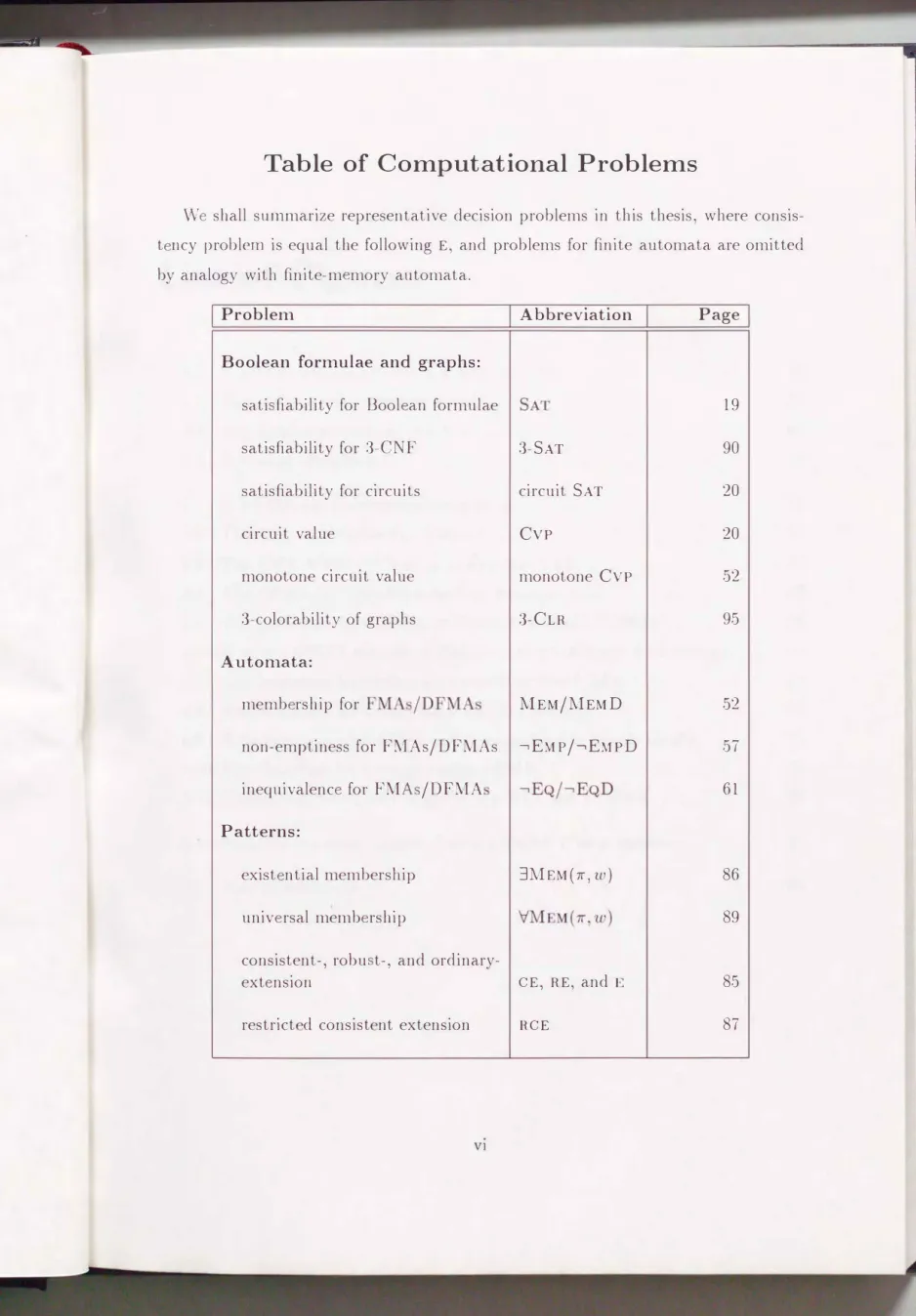
Table of Computational Problems
W shall summarize representative decision problems in this thesis, where consis
t ncy problem is equal the following
E,
and problems for finite automata are omitted by analogy with finite-m mory automata.I
ProblemI
AbbreviationBoolean formulae and graphs:
sati fiability for Bool an formulae SAT
satisfiability for 3-CNF 3-SAT
satisfiability for circuits circuit SAT
circuit value
CVP
monotone circuit value monotone
CvP
3-colorability of graphs 3-CLR Automata:
memb rship for FMAs
/
DFMAsMEM/MEMD
non-emptiness for FMAs
/
DFMAs-,EMP j-,EMPD
inequivalenc for FM
/
DFMA Patterns:exist ntial membership univ rsal memb rship
consistent-, robu t-, and ordinary
ext nsion
restrict d consist nt extension
3MEM(7r w)
CE, RE,
andE RCE
Page
I
1 9 90 20 20 52 95
52 57 61
86 89
85 87
List of Figures
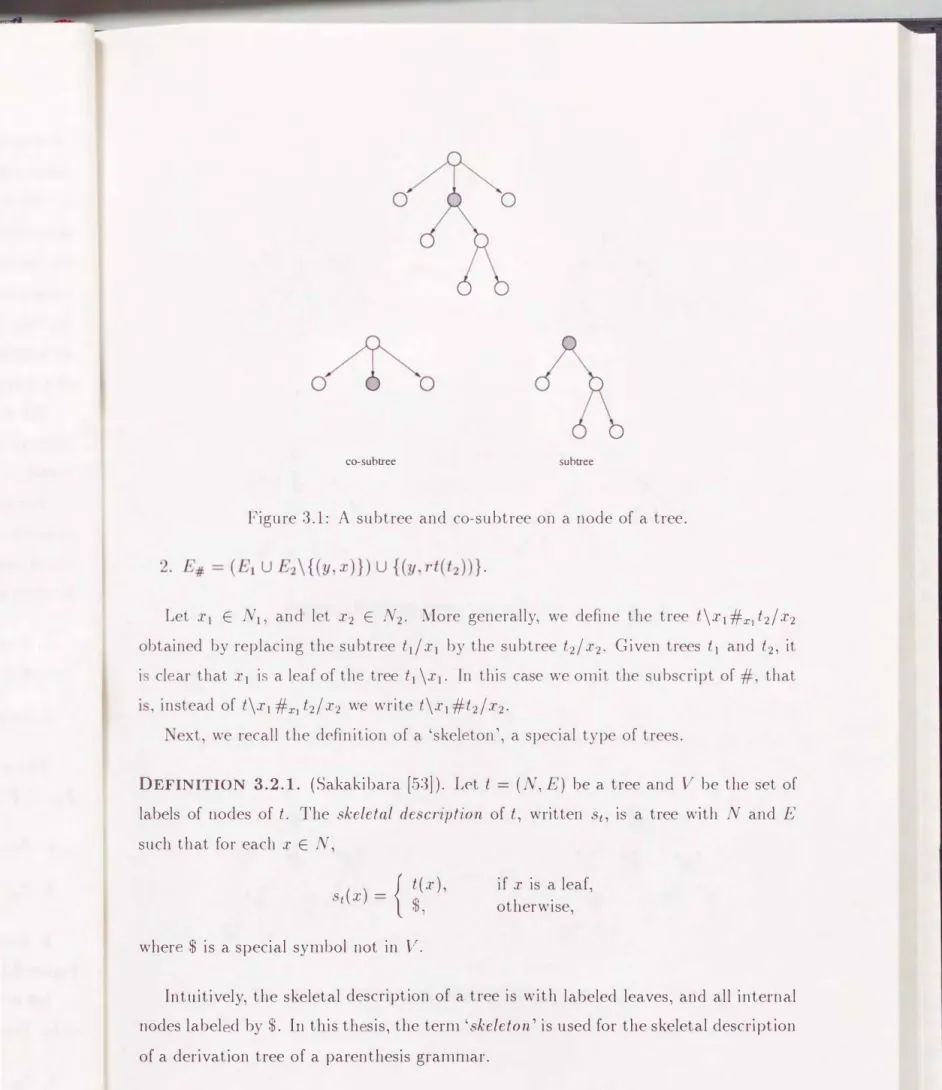
3.1 A subtree and co-subtree on a node of a tree.
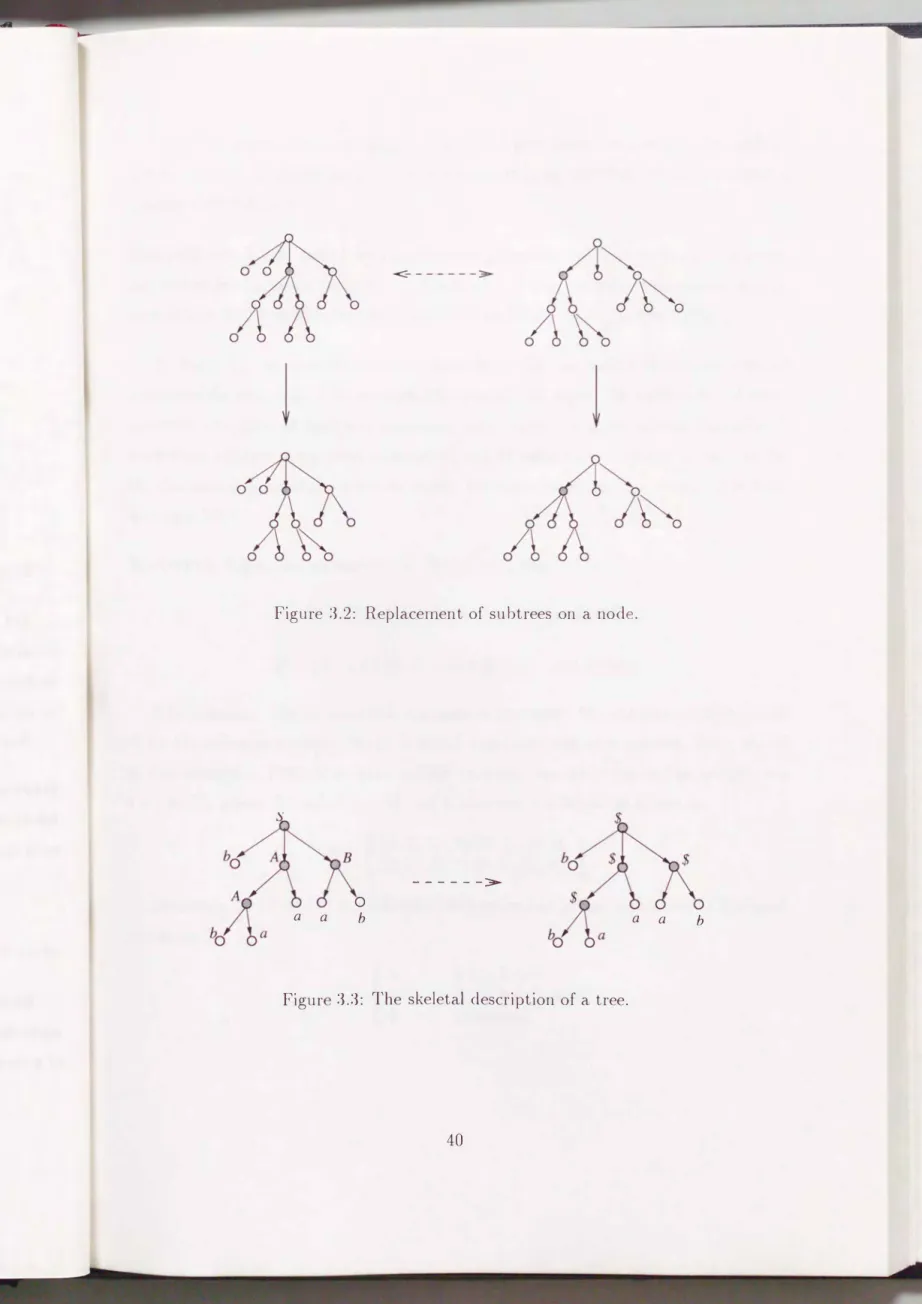
3.2 Replac ment of subtrees on a node.
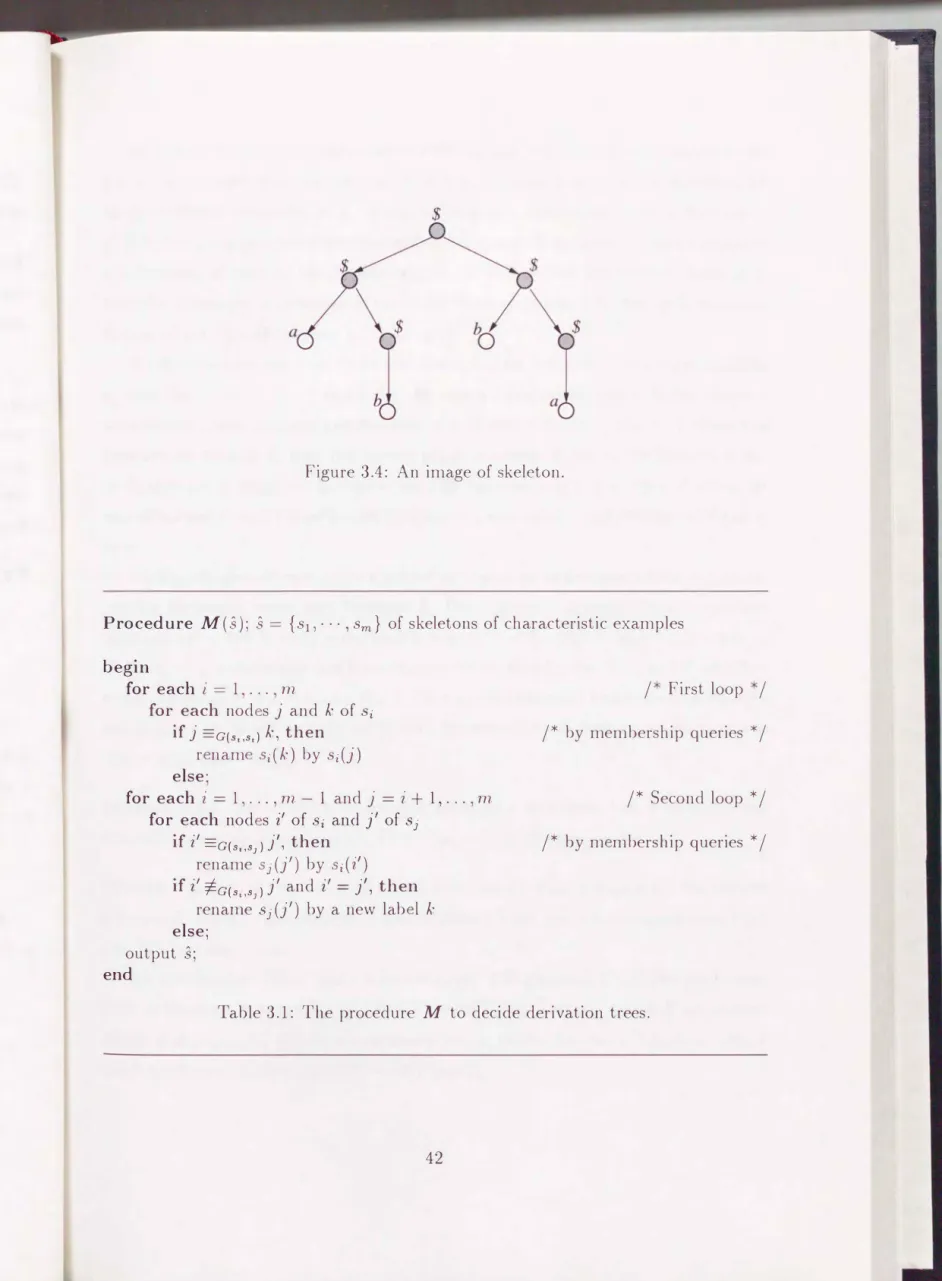
3.3 he skeletal d scription of a tre . 3.4 An image of sk leton . . . .
4.1 A DFMA and the corresponding DFA . 4.2 The FMA A computed in Example 4.2.1.
4.3 The FMA A reduced from G in Example 4.2.2.
4.4 The DFMA A computed from G in Example 4.2.3.
4.5 The procedure for deciding consistency of simple DFMAs.
39 40 40 42
51 55 60 62 65 4.6 A simple DFMA with the initial assignment of empty two registers. 67 4. 7 The procedure for finding a p rmutation clos d DFA. 70 4. The procedure for computing a simple DFMA . . .
4.9 A permutation clos d DFA and a corresponding simpl DFMA.
4.10 The algorithm for a target simple DFMA. . . . . 4.11 Comparing th number of stat s of a DFA and a DFMA.
5.1 Negative examples comput d from a 3-CNF C of n variables . . 6.1 Pattern automata.
72 73 75 78
91 100
Contents
1 Introduction 1
2 Preliminaries 12
2.1 Basic Notations and Definitions 12
2.2 Formal Languag s . 13
2.3 Decision Probl ms 18
2.4 Language Learning via Queries 22
3 Learning Parenthesis Gran1mars 30
3.1 Characteristic Examples 31
3.2 Learning Par n thesis Languag s 37
3.3 Discussion 45
4 Learning Finite-Memory Automata 47
4.1 FMAs and DFMAs . . 48
4.2 Decision Probl ms for FMAs . 52
4.3 Learning Simple D FMAs 6 2
4.4 Discussion . . 77
5 Learning One-Variable Patterns 81
5.1 Consistency Problem 82
5.2 Variants of Extension Problem . 84
5.3 Discussion 96
6 Conclusion 98
References 103
CHAPTER 1 Introduction
The pr s nt thesis studies learning based on Angluin's
[6]
framework of learning via queries. Let� = {a,
b, . . ., c}
be any finite alphabet. We write�*
to denote the free nwnoid over . The underlying learning domain is�*.
The concepts to be learned are recursively enumerabl subsets of�*
i.e., any r.e. language inR(�*)
may be a target concept. Subclasses ofR(�*)
are referred to as concept classes. Throughout this thesis, we shall mainly study indexable concept classes. A language class £ �R(�*)
is said to be indexable provided all
L E
£ are non-empty and there exists a recursive enumeration( Lj) iElN
of all the languages in £ as well as a recursive procedure f such that for all j E lN and all sE �*,
J(j,s)= { �: s ELi
otherwise.Prominent xampl s of ind xable cla se ar the r gular languages, the context-free language , and the pattern languages. he indices j can be thought of as suitable finite encodings or, synonymously finite representations. For xample, the regular languages can b represented by finite automata or regular expr ssions whil pushdown automata or cont xt-free grammars may s rv as repres ntations for the context-free languages.
Pattern languag s are most usually repr nt d by patterns. It hould be considered that all these repr sentation classes constitute themselves indexable class s in a normal way. Therefore, in th following, we shall always assume all language classes and all representations for them to be indexable.
Now, learning is a proc ss of identifying a target language automatically by means of a finite repres ntation for it. More formally, assuming a class £ of languages and
a class H of representations corresponding to £, a target L E £ is arbitrarily chosen, and information about L is provid d to an algorithm as input.
The algorithm is said to
learn
£ if for every target L E £, it stops and outputs a hypoth sish
E H which is a representation for L. Moreover, we are interested inefficient l arning:
the running time of the algorithm for every concept L E £ can be stimated by th size of a minimum representationh
for L and by the size of input in binary. For a concept class, when we construct a learning algorithm satisfying the crit rion of fficient learning a problem arises naturally-From
what information does the alg01�ithm l a1�n?
Throughout this thesis, we mainly consider active learning. That is, the learn r obtains information about the unknown target by askingqueries.
The motivation for a th or tical study of qu ry learning goes back to system implementations that allow a computer to ask its user.
For instanc , Sammut-Banerji's
(60] expert system
uses questions about specific exampl s as part of its strat gy for efficient learning a target concept, and Shapiro's[62, 63, 64] algorithmic debugging system
makes a variety of questions possible to a user to pinpoint errors in Prolog programs.Th e intellig nt systems stimulated the theoretical analysis of exact learning, and the framework of Angluin 's
[6]
query learning model has been introduced to model the ituation in which al arn r
can put qu ri s to ateacher
by oracle Turing machines. She tudied th pow r of s veral types of queries, r ferred to asmembership, equivalence, subset sup rset, disjointn
, andxhaustiv n s.
In particular the m mbership andquival nc query attract d consid rabl attention during the last decad .
Th 1 arning protocol using m mb rship and equivalence queries is referred to as
minimally adequat teach
r. Consider the problem of identifying a target language L E £ from a finit or countabl hypoth sis space H =h0, h1,..
.. Then, a 1 arning algorithm ha ace ss to a fixed set of
oracles
that correctly answer the following questions.Membership:
Input IS an lement x E �* and th output ISyes
if x E L andno
oth rwise.
Equivalence:
Input is an index n In the hypothesis space, and the output isyes
if Ln = L and
no
otherwise. Moreover, if the answer isno,
then an elementx E Ln EB L, called a counterexample, is returned, where Ln EB L is the symmetric difference of Ln and L.
For xample, 1 t £ be the set of all regular languages L � �*, and let the class of det rministic finit automata, DFAs, be assumed to be hypothesis space for the learning algorithm. The goal is to identify a correct DFA which accepts the target language L chosen by the teacher. For each w E �*, the membership oracle answers wheth r w E L, and for each DFA M the equivalence oracle answers whether L =
L ( M ) . If
not, then it returns a counterexample w for the hypothesis M such that wE L EB L(M).The choic of a hypothesis spac 1i plays an important role in the running time of a query l arning algorithm A for a class £ of languages. A class £ is said to be l arnabl in time polynomial using the specified queri s w .r. t. the hypothesis space 1i if for ev ry target L E £, the total running time of A is bounded by a polynomial in n and m where n is the size of a minimum h E 1i for L and m is the length of a longest counterexample returned. The query model is powerful to learn various classes of formal languages. Angluin
[4]
showed that the cla s of regular languages is learnable in tim polynomial in the parameters using equival nc and membership queries w .r. t.the hypoth sis space of DFAs.
After h r work a numb r of r earch rs succeeded to expand her result, th reby still achieving polynon1ial-tim learning algorithm, e.g. the learnability of the class of language ace pt d by one-counter automata by B rmann and Roos
[12],
even-liner grammars by Takada[70],
and simple deterministic grammars by Ishizaka(29].
Theseclasses of formal languages ar ubclasses of the cont xt-fre languages which have attracted a great deal of attention b caus of the rich potential of application.
For exampl , it is w 11-known that all programming languages in BNF (Backus Naur Form) ar mainly d fined by cont xt-fr e grammars, e.g., C and PASCAL.
Furthermore, Shinohara
[67]
developed a data entry system for text data base. He investigated the learnability of regular pattern languages in the framework of Gold's(21]
identification in the limit. Although different data bases usually have different formats for records, e.g., "Author", "Title", and "Year", his system effectively learns different types of these formats using the patt rn inference techniques.
We can find other examples of wide application of context-free languages nearby.
An HTML document on web-page is defined by a parenthesis gramrnar that is also context-fre sin e a source file consists of structural text parenthesized by a pair of beginning tags and the corresponding ending tags, e.g., < html> text< /html>. When consid ring the setting of equivalence queries, the answer to an equivalence query is carried by users in real application.
How v r, this setting would make the burden too heavy for users because we need nough information about the target beforehand to provide a correct answer to an equival n query. Moreover, it seems that equivalence query is not reasonable accord
ing to hypothe i spaces, since the equivalence problem of two context-free grammars con1pu tationally undecidable.
Sine m mb rship queries alon are too weak to achieve powerful learning algo
rithm (cf. .g.,
[6 8]),
various authors have considered suitably chosen finite sets of strings as information given to the learner. Intuitively, all thes sets can be thought of as sets of good examples. For instance, Angluin s live-complete ets[2],
Ibarra-Jiang's lexicographicallyfi
rst string[28],
and Oncina-Garda's characteristic set[49]
for DFAsand Ibarra-Jiang s shortest trings
[28],
Marron-Ko 's positive initial sample[43],
andMarron's single positive example
[42]
for pattern languages.ate that humans al o 1 arn mainly from good examples, or at least much more effi iently. Ther for w shall continu along this lin . The motivation of this study to provid good xampl s com from the cla of parenthesis languages ( cf.
[44]).
Aparenth i languag is a context-fr languag poss ing a grammar in which ach application of a production rule introduc s a uniqu pair of parenth es, delimiting th scope of that production. Par nthe is languages ar nontrivial since only one kind of par nthesis is used, and they are on of rich clas s for which equivalence problems are decidable ( cf.
[44, 36]).
How v r, it is not known wh th r th equival nc probl m for given two parenthesis grammars is in P. Thus, inst ad of equivalenc qu ry, we propose a setting to provide polynomially many good xampl s to 1 arning algorithm, and present a learning model by combining membership qu ry with good examples. Our idea comes from the fact that each parenth sized string pre erv s the structur of its derivation, in other words, a pair of parentheses in the string corresponds to an application of a production rule.
A good example of a parenthesis grammar G is, intuitively, a string derived by as n1any production rules of G as possible. L t L be a target parenthesis language defin d by a grammar G. The learning algorithrn takes good examples of G and outputs a grammar G' such that
L(
G) = L( G') using only membership queries. The total running tim is bounded by a polynomial in the number of productions of the targ t as w ll as in the length of a longest string provided to the algorithm. From the r suiting correctness of the algorithm, we conclude that good examples contribute to 1 arning par nth sis grammars without equivalence queries.As w shall saw in the above paragraph, when a target parenthesis language L is l ted good xan1ples are decided by a grammar G such that L = L(G). Thus the r sult d p nds on the hypothesis space of parenthesis grammars. This phenomenon is al o found in other results in language learning, for example when dealing with the clas of r gular languages. It is well-known that regular languages are learnable in time polynomial w.r.t. the hypoth ses of DFAs, however, few results were obtained for other hypothesis spac
(
cf., e.g.[4,
15, 75]
). That is, both successful! arning and efficiency of learning may d p nd on the hypothesis space cho en. This study is motivated by al o the above problem.There is no polynomial-time algorithm to decide whether two regular expre wns are in qui al nt* v n if only U, ·, and 2 ar allowed where e2 is a regular expression equal to for v ry r gular xpression e. imilarly, inequivalence problem for finite automata is PSPA E-compl t ( cf., .g.,
[69 23]).
Th s equivalence oracles are too powerful, and it i not r a onabl to assume such orad s for the e hypothesis spaces.Then, we consider anoth r hypoth is space consisting of
finite-memory automata,
FMAs for r gular languages ( cf.
[32]).
Compared with finit automata, the cliff r nee of definition is that an FMA can use k registers to m moriz k symbols. It is pos ibl to r place the content of a register by any input symbol. Th transition is defined by only the tate and the address of a register which contains th same symbol to input. Thus, FMAs ar released from sp cification of alphabets of its definition. That i , an FMA potentially represents a language over an infinite alphabet.
Assuming the hypoth sis spac of all FMAs, the following question arises naturally:
"'This problem is NEXP-complete [69], wh re NP-::/= NEXP = Uk>oNTIME[2nk].
Can finite-memory automata represent regular languages more compactly than finde automata? Thi question is partially solved by mabng a cornparison of the complexity of s veral decision probl ms between finite-memory automata and finite automata. The con1plexiLy of studied decision problems is also interesting in its own right, and has been remained open in
[32].
However, unfortunately, the resulting intractability of alrnost all d cision problems supports the hardness of the learnability of th full class of finit -In mary automata.Th r fore, w introduc the class of simple FMAs and investigate the learnability of imp! DFMAs via membership and equival nee queries, where DFMA denotes a det rmini tic FMA
(
cf.[32]),
and an FMA is simple if its all registers are initially empty. Although th studied decision problems remain intractable for the restricted clas , w construct an algorithm to learn each target language. This algorithm is ba d on Angluin 's[4]
observation table t chnique. The hypothesis space assumed is all simple DFMAs, and it is allowed to use membership and equivalence queries for each target language over an infinite alphabet. For every target languageL
accepted by a simple DFMA, our learning algorithm terminates and outputs a correct hypothesisA
such thatL = L(A)
over the infinite alphabet.We have m ntion d learning subclasses of languages in the Chomsky hierarchy at the points: th confid n of a hypoth i proposed by an algorithm and the conver
g nee of a hypoth s s into a corre t one. Th form r is solv d by equivalence oracles for th s hypothe is pa but the latter is not becaus these are independent problems each oth r for in tanc , th re is other int r ting hi rarchy of the clas es of pattern languages
(
cf.[1]).
L t
�
be any finit alphab t, and l t X= {
x1, x2, ...}
such that�
n X=
0.A patt rn is a non-null string ov r U X. L t
f
b a nonerasing homomorphism from patterns to patterns. Iff( a) = a
for all�'
th nf
is called a substitution. The language of a pattern 7f is th s tL(1r) = {wE�+ I w = j(1r), f
is a substitution}
, wh re�+ = �* \ {
c}
for th null string c. h class of all patterns is denoted by P.For the class P, ther is no polynomial-time learning algorithm even though mem
bership and equivalence qu ri s ar assumed
(
cf.[6]).
Thi is because in a worst case, a learner must receiv xponentially many counter xampl s to achieve a correct hypothesis when a targ t pattern language is a singleton. Mor over, learning pattern
languages is still difficult even if we assume a target is not singleton. This difficulty is relat d to the computational problem: assuming the hypothesis space P, and given finit sets T and F of strings, decide whether there is a pattern language L(1r) such that T �
L (
1r) and Fn L(
1r) = 0. The samples T and F are called positive and negative r sp ctively. This problern is r ferred to as the consistency problemf
or P.The computability and learnability of patterns have been widely investigated and several n gativ results were shown (cf., e.g.,
[1, 31, 46, 61, 73]).
From these results it follows that 1 arning pattern languages consistently is very hard, nevertheless not all possibiliti s disappeared. An interesting question that remains open is the consistency probl m for th one-variable patterns. The class of one-variable patterns, denoted by PI, is th t of all patterns overL:UX
such thatJJXJJ::; 1.
It is neither known whether this probl rn i in P nor NP-complete. In order to shrink the gap of our knowledge cone rning th complexity of the consistency problem, we shall relax this problem step by step and w analyze th complexity of each of the resulting problems.The idea of relaxation of this problem comes from the motivation of incomplete data given in Boros t al.
[14]
which is helpful when looking at monotone exten ions from the view point of how noisy data may influenc the complexity of learning. Since real world data may be noisy, allowing strings to contain indefinite values can be modeled by introdu ing a wild card * as a placeholder. Giv n samples T and F of strings containing* w provid th following interpr tations for these indefinite values w.r.t.th consistency probl m for P1. The ordinary consi t ncy problem for PI is equivalent to the case that any giv n string contains no wild card.
If a string w contains at 1 ast one *, th n w consider an assignment for w such that it replac s ach * by a constant and do not replac any constant. Then, the first problem is wh th r th r exist a pattern 7r E P1 and a suitable assignment for each string in T
U
F su h that 1r is consist nt with all the assigned strings. The second problem is wheth r ther xi t a patt rn 1r E PI such that 1r is consistent with all the assigned strings what v r assignment for TU
F we choose.In order to study the above problems in detail, we also consider the restricted version for th m such that th positive sampl consists of only constant strings. Con
sequently, we con lud that th first probl m is equivalent to the ordinary consistency problem w.r.t. log-space reductions if the positive sample is restricted. Mor over, all
other problems are intractable. In particular, the proof of the NP-completeness of the first probl
mwas provided in [68]. This problem was an open question of this study and th author had expected that it is also equivalent to the consistency problem.
We have discussed the outline of thi th sis, now, explain the technical part for each them . Th following chapter consists of the bases on formal languages, computational complexity and learning theory, which are necessary for our discussions. Recent results of languag learning via queries ar also presented in this chapter.
In
Chapt r
3we deal with the announced learning parenthesis languages us1ng memb rship and good examples. Let
Gbe a context-free grammar over a set
�of terminal and a s t N = N'
U{ (,)} of non terminals. Then, the grammar G is said to be
par nth iz dif each production rule
A -+ aof G satisfies that
A EN',
a= ({3) and {3
E(I:
UN')*. On a parenthesis grammar, for each usage of a production rule, xactly on pair of ' (' and
')' is derived in the leftmost and rightmost positions of a string.
Hnc for any parenthesis grammar G the language L( G) becomes to be
unambiguou t,
i . . , for every w
EL( G), there exists exactly one leftmost derivation of G for
w.Thi point is one of the critical parts of our study.
Th unambiguity of a target grammar
G= (N, �'
PS) can be considered that a string w derived from
Gpreserves the structure of its derivation tree
T.The task of the learning algorithm is to d id all labels of internal nod s of
T.A string w is said to b a
charact ristic stringof G if all production rul s of
Gare used to derive the w, but not all parenthe is grammars have such a tring.
Thus we refine th notion of good exampl for
Gby partitioning the grammar G. A grammar
G'(N',
�',P', S) is said to be a
sub-grammarof G if N' � N, E' � �' and
P'�
P. Wprov that ther are polynomially many sub-grammars G1 ... , G k for any con t xt-fr (of cours par nthesi ) gran1mar
Gsuch that Gi derives at
1ast one characteristic string Wi for all
i=
1,. . .
k.Thus we assume that these strings w1, ... , wk are giv n to the
1arning algorithm and show that ev ry parenthesis grammar
Gis learnable using th charact ristic examples and membership queries in time polynomial inn and
m,wh re n = liP II and
m=max{ lwill
i= 1,
. . . , k}.
In Chapter
4,we study the
1arnability of simpl DFMAs via membership and
t Although a context-fr e grammar is inherently ambiguous, Sakakibara (53] avoided this difficulty using special strings represented by trees for learning context-free grammars.
equivalen e queries. Let lN be the set of all natural numbers. Then an FMA defines a language over the infinite alphabet n =
{
aiI i
EIN}.
Let � be any finite subset of n, and let A be an FMA. The language L(A) n �* accepted by A is a regular language, i.e., the cla s of languages of FMAs over the finite alphabet � is equivalent to that of finite automata over �.The deterministic class DFMAs is a subclass of FMAs. One easily shows that this class is clo d under complem nt, but not closed und r union and intersection ( cf.
[32]).
Moreover, th r exists a language L accepted by an FMA but the language n*
\
L is not. Thus, it is traightforward that the deterministic class is properly included in the g neral cla s ( cf.[32]).
Several interesting closure properties of both classes of finitememory auton1aLa w r investigat d in
[32]
however, there is a lack of investigation on decision problems for them.As it is well-known, the d cision problems for finite automata referred to as mem
bership, non- mptiness, and inequivalence are complete for the classes NLOG NLOG, and PSPACE, r spectively, and the corresponding problems for the deterministic fi
nit automata ar compl te for DLOG LOG and NLOG respectively. On the other hand, we prove that the membership and non-emptiness proble1ns for the class of FMAs are both NP-cornplete. Furthermore, for the class of DFMA , the membership probl n1 i P-compl te and th non-emptiness probl m is P-complete.
From th se r suits, we observe that, in the polynomial hierarchy, the complexity of th studi d probl ms for FMAs hape a counterpart of th corresponding problems for finite automata. Thus, the inequival nc problen1 for the deterministic and nonde
terministic cla s s are xpected to b NP-complete and NEXP-complete resp ctively.
While the inequi valenc problem for th d t rmini tic cla s is in PSPACE and its NP-hardn ss is prov d the probl m wh th r it is in P remains open.
We next turn our att ntion to the 1 arnability of a subclass of FMAs via membership and equivalenc qu ri s. We introduc the class of simple DFMAs, and for every targ t, we assum m mbership and quival nee queries to the learner. Even though the alphabet n is infinite, we conclude that th setting is reasonable since, as we have mentioned above, both r lat d decision problems for the class are decidable.
When a counterexample is returned, our 1 arning algorithm constructs a finite automaton M based on the notion of observation table
[4],
and in the next stage, thisalgorithm successively translates M into a simple DFMA
A
such thatL(A) n I:*
=L(J\;1),
wher I: is a set of all symbols in counterexamples returned so far. Consequently, we show that the class of languages accepted by simple DFMAs is learnable using m mbership and equivalence queries w .r. t. the hypothesis space.In Chapter 5, the difficulty of the consistency problem for one-variable patterns is studied. IL is known that consistency problem is very hard for almost all subclasses of the clas P (cf., e.g.,
[1 46, 73]),
however, no one has been proved its intractability within P1 yet. Thus, we analyze the consistency problem as well as its variants for the cla s P1 w.r.t. incomplete examples defined as follows.An incomplete exampl is any string over I: U
{
*}
, where the * potentially matches with ev ry ymbols. We assume the s t of all functionsf
:(I:
U{ *} )+
-+I:+
such that it maps very * in a string to a constant in I: and maps any constant in the string to it elf. Then, given finite positive and negative samplesT, F � (I:
U { *})+,
an algorithm must decide whether there exists a 1rE
P1 and a functionf
defined above such that 1r is consistent withf(T)
andf(F),
wheref(T)
={f(w) I wET}
andJ(F)
analogou . The studied problem ar d fin d by the following criteria:
1. Ther exists a on -variable pattern 1r consistent with the given
T
andF
provided T,F
CI:+.
This is the ordinary consi tency problem referred to as extension.2. Th r exi ts a on -variable pattern 1r and a suitabl function
f
such that 1r i con istent withJ(T)
andf(F).
Thi problern is referred to as consistentxtension.
3.
Ther exists a one-variable patt rn 1r consistent withf (T)
andJ(F)
for allf.
This problem is referred to as robust ext nsion.
Moreover, the restrict d consistent extension and robust xtension are also studied, where a r stricted problem is that any string in
T
contains no*· We show that the extension and restricted consistent ext nsion are computationally quivalent with respect to log-space reductions. The robust extension is NP-complete ev n if an alphabet con
sists of only two symbols. Addibonally, the consistent ext n ion is also NP-complete+, thus, we arrive at th conclusion that almost all problems are intractable.
tThe NP-completeness
wasprov
dby Stephan [68], personal communication.
Finally, in Chapter 6, we mainly discuss several open questions not solved in this thesis, i.e., the NP-completeness of th equivalence problem for the class of DFMAs, and the computability of the ordinary consistency problem for the class P1.
CHAPTER 2 Preliminaries
This chapter contains basic definitions necessary to make this th sis self-contained. We as ume familiarity with formal language theory
(
cf., e.g.[26]
and[27]),
computational complexity theory(
cf., .g.,[23]
and[50]),
and algorithmic learning theory(
cf., e.g.,[35]
and [4 ]).
For our fram work, in the first section of this chapter, we begin with formal languages including context-free grammars, patterns, and other convenient notions.In the next section, we d al with decision problems. Typical complete problems are specified as well as the notions of reduction and completeness. Finally, we formalize our learning model using queries and ummarize previously known results on learning formal languages.
2.1 Basic Notations and Definitions
A graph is denoted by G = (N,
E),
wh r N is a finit set of nodes andE
� N x Nis a set of edges. A path in G is a s quence of nod s n1, n2, · · · , nk such that there Is an dge
{
ni, ni+I}
for ach 1 � i � k - 1. The number k - 1 is called the length of th path. A direct d graph, alsod
not d by G =(
N,E),
consists of a finite set of nodes N and a set of ordered pairs of nodE
called arcs. If(
v, w) EE,
we referto
(
v w) as to an arc from v tow and d note it som tim s by v ---+ w. A path in a dir cted graph is a sequ nc of nodes n1, n2, · · · , nk such that ni ---+ ni+I is an arc for each 1 � i � k- 1. W say the path is from n1 to nk. If v ---+ w is an arc, then we call that v is a predecessor of w and w is a successor of v.A tree is a directed graph that satisfies the following conditions. There is one node, called the root, that has no predecessor and from which th re is a path to every node.
Each node other than the root has exactly one predecessor. The successors of each node are ordered from the left. We continue with sorne special terminology for trees.
A
succ ssor of a nod is called its child, and the pr decessor is called its parent. If there is a path from nod ni to node nj, then ni is said to be an ancestor of nj, and nj i said to b a descendant of ni, where each node is an ancestor and a descendant of itself.
Anode with no child is call d a leaf, and all oth r nodes are called internal nodes ex ept the root.
A
binary r lation is a set of pairs. The first component of each pair is chosen from a set call d the domain, and the s cond component of each pair is chosen from a (possibly cliff
rn t) set called the range. In particular we are in teres ted in relations in which th domain and range are the same set S. In this case we say the relation is on
S. If R
is a r lation and (a, b)
ER, then we also write aRb. We say a relation R on S i refi xive if aRa for all a
ES, transitive if aRb and bRc imply aRc, and symmetric if aRb implies bRa for all a, b, c
ES.
A refi xive, symmetric and transitive relation is said to be an equivalence relation.
An quivalence r lation
Ron S partitions into disjoint nonempty sets called equiv
al nc class s. That is S = 51
u52
u · · ·such that for each i and j with i #- j, Si
nSj = 0, aRb is tru for each a, b
ESi, and aRb is fals for each a
ESi and b ri Sj.
Th tran itiv clo u1 e of a relation R, denot d by R+, i defined recursively by th following conditions. ( 1)
If(a b)
ER then (a, b)
ER+. (2) If (a, b)
ER+ and ( b, c)
E Rthen (a, c)
E R+.(3) Nothing is in R+ unl it follows from th condition (1) and (2). Furth rmore th r fl xiv , tran itiv closur of R, denoted by R* is the s t R+
U{ (a, a) Ia
E} .
2.2 Formal Languages
An alphabet E = {
a0,a1, . .. } is a t of partial ord r d symbols (i.e., for all ai, aj
EE,
ai
<a j iff
i <j). Th expression E* d notes the free monoid over E and we set
E+ = E*\ {
c} (i . . , the s t of all non-null trings over E) wh re
cdenot s th empty string. The length of a string w and the cardinality of a set S are denoted by lw I and I lSI I, resp ctively. Th l xicographical ord ring relation
<on E* is defined as follows.
Let x = x1
· · · Xsand y =
y1 · · · Xtbe strings in E*. Th n x
<y if (a) s
<t or (b)
s = t and there exists an l � r � s such that xi = Yi for all i = l � ... , r
-
l � and:r;r < Yr· A language over � is any subset of �* and a class of languages over � is a collection of languages containing at least one nonempty language over �.
DEFINITION 2.2.1. A context-free grammar CFG is 4-tuple G = (N, �' P,
S),
where N and � are finite sets of symbols such that N n � = 0,S
E N, and P is a finite subs t of N x ( N U �)*. Elements of N and � are called nonterminals and terminals, r sp ctively. ThS
is called the start symbol. Any element of P is called a productionnde denoted by A----+ a for A EN and a E (N U �)*.
Let a', (J' E ( NU �)*. We say that a' directly derives (J', denoted by a' ==> (J', if there xist a1, a2 a, (J E (NU�)* such that a'= a1aa2, (J' = a1(Ja2 and a----+ (J E P. If there xi t a1, a2, · ·· ,On E (N U �)* such that ai directly derives Oi+l for all i = l, ... , m,
th n w ay that a1 derives am and this is denoted by a1 ==> * Om. That is, ==> * is the transitive closure of==> on (N U �)*.
A sequ nee like the above is called a d rivation. The set of sentential forms of a FG
G
== (N �' P,S)
denot d byS( G)
is the set{a
E (N u E)*I
S ==>* o}.
Thus, the language generated by G, denoted by L( G), is the setS
(G) n �*. A language gen rat d by a CFG is referred to as a context-free language denoted by CFL. Two CFGs G1 and G2 ar said to be equivalent if L(G1) = L(
G2).A d rivation tree T of a grammar G = (N �' P,
S)
i a tree such that each internal node ofT is label d with an lement of N, each l af ofT i labeled with an element of � and, for each internal nod lab led with A E N, ther exists a production ruleA ----+ a E P , w her a is the concatenation of the labels of its children in left-to-right
ord r.
W can characteriz suffi iently long string in a CFL L by the following, referred to as the pumping l mma. his lem1na is us ful to obtain s v ral results in Chapter
3.
LEMMA 2.2.1. (Harrison [26]). Let L b a CFL such that Lis not finite. There exists
a constant n such that if z ELand lzl 2:: n, then z = uxvyw satisfies (1) jxyj 2:: 1, (2) lxvyj � n, and
(3)
uxivyiw E L for all i 2:: 1.Every CFG G = (N, �' P,
S)
has s v ral normal forms equivalent to G as follows.A nonterminal A E N is said to be useless if either
S
derives no sentential formcontaining A, or A derives no terminal string. Non terminals A, B E
N
are said to beequival nt
if for ev ry sentential form w ES( G)
A d rives w iff B derives w. A production rule A ---+ B EP
is said to be achain rule
if A, B EN.
A CFG G is said to be
reduced
if no useless nonterminal, no two equivalent nonternlinals, and no chain rule are defin d in
G.
It is well known that every CFL L is gencrat d by a reduced CFGG
and w can effectively compute such aG
from arbitrary CFG G' su h that L =
L( G').
Thus in this study, we assume that a CFG always d note a "r du ed CFG '.production rule of the form A ---+ c is said to be an
E:-production.
A CFGG
is said to b c-
fre
ifG
has no c-production. A CFL L is also called c-free if c tf_ L.Furth rmore, a FG
G
=(N E P, S)
i said to beinvertible
if A ---+a
B ---+(3
E Pimpli s A= B. Invertible grammar is one of normal forms of context-free grammars.
A CFG G =
(N, E P, S)
is said to be inGreibach normal form
if each production rule in P is of the form A ---+ aa,
wherea
E E anda
EN*.
Moreover,G
is said to be in m-tandard form
ifG
is Greibach normal form and, for each A ---+aa
E P,iai :::;
m.THEOREM 2.2.1. (Harrison
[26]).
Every CFL L is generated by an invertible CFG G such that ifL
is c-free, then so isG.
Moreover, every CFL L\ { c}
is g n rated by a CFG in Greibach normal fonn.A sub la of FG is obtained by r tricting forms of production rules. A CFG
G
=(N E, P, S)
is said to bright linear grammar
if each production rule in Pis of the form A ---+aB
or A ---+a
where A, B EN,
and symm trically aleft linear grammar
is d fined. A right (or left) linear grammar
G
is said to b aregular grammar
and the language of L(G)
is said to be ar gular language.
The clas of regular language is an inter sting subclas of FLs for our study. A r gular languag can be alternatively d fin d by the following d t rministic s qu ntial machinDEFINITION 2.2.2. A
d termini tic finite automaton,
denoted by DFA, is 5-tuple A =(Q,
E, 8, q0,F),
wh r Q is a finit set ofstates, E
is a finitealphabet,
8 is atransition function: Q
xE
---+Q
such that for each p E Q anda
E E, exactly one q E Q satisfies 8(p, a)
= q, q0 EQ
is thstart state,
and F� Q
is a set offinal states.
The xtension of
8
to handle input stringw E E*
is the reflexive, transitive closure of8
denoted by8*,
such that for eachp E Q, 8(p, c)
= p and for allp E Q a E E,
andwE LJ*, 8*(p,wa)
=8(8*(p,w),a).
For simplicity, we denote8*
by just8.
Thus, thelanguage accept
dby
A, denoted byL (
A),
is the set{ w E E* I 8( w, q0) E F}.
Two DFAs A and Bare said to be
equivalent
ifL(
A)
=L(B).
A DFA A is said to bemini·mum
if for any DFAB
such thatL (
A)
=L(B),
th number of states of A is less than or equal to that of B. Moreover, a minimum DFA is referred to ascanonical
if it is l xicographically first.
DEFINITION 2.2.3. (Angluin
[1]).
LetE
be a finite alphabet ofconstant
and letX
={
x1 x2..
.}
b a recursively enumerable set ofvariables
whereEn X
=0.
Any finit tring in( U X)+
is said to be apattern.
Let
f
be a nonerasing homomorphism from patterns to patterns overE U X.
Iff( a)
=a
for alla E E,
thenf
is called asubstitution.
We may use the notation[s1/
x1,.
.. , k/ xk]
for the substitution which maps each variableXi
to the string si(
i = 1,.
.. , k)
and maps any other symbol to itself. Thus for a pattern 1r containing variabl s x1,.. . , XkJ
the expression 1r[
s1j
x1 . . ., s k/
xk]
denotes the string obtained by replacingXi
bysi
for all i = 1, ..
. , k. Thelanguage of a pattern
1r, denoted byL(
1r)
,i th et of all w
E E+
such that there exists a substitutionf : (E U X)
--+E+
such that w =j (
1r)
.A pat tern 1r is said to b a
k-variabl pattern
provid d the 1r contains exactly k different variables for k2::
0. In parti ular, ifk
= 0, th n th 1r is said to be aproper pattern.
Moreov r, a pat tern 7r is said to be aregular patte·rn
provid d the 1r contains any variable inX
at most on timThe class of k-variabl patt rn d noted by
Pk,
th class of regular patt rns 1s denot d byPR,
and analogously w d not the class of all patterns byP
=Uk?_oPk.
THEOREM 2.2.2. (Angluin
[1]).
The class of all pattern languages is incomparable with the class of regular languages and with the class of context-free languages. The class of all pattern languag s is closed unci r concatenation and reversal, but not closed under union, complement, int rs ction, Kleen plus, homomorphism, and inverse homomorphism.
A finit s t S of I;+ is referred to as a sample. A pattern
1r
is said to be descriptive of S iff S� L( 1r)
and for any pattern 7r1 such that S� L( 1r'), L( 1r')
is not a proper subsetof L(
1r).
Th r fore, we shall consider the problem of finding a descriptive pattern.PROBLEM 2.2.1. Given a sampleS, find a pattern which is descriptive of S.
Angluin
[1]
also studied the problem of finding descriptive patterns and she showed that th re i an algorithm which, given a sample S C I;+ as input, outputs a pattern1r E (I; U X)+
which is d scriptive of S. In particular, she proposed an effective algorithm for this problem in the special case of the class of one-variable patterns as follows.THEOREM 2.2.3. (Angluin
[1]).
There exists an algorithm which, given a sample C I;+ outputs a one-variable pattern that is descriptive of S within P1 in 0(n4
logn)
time, where
n
=LsES l
si
.This result has b n improved to 0(
n 2
log n)
time by Erlebach et al.(
cf.[18]).
For th class PR of regular patt rns, Shinohara[65]
provided a polynomial-time algorithm for th problem of finding a descriptive pattern within PR.THEOREM 2.2.4. (Shinohara
[65]).
Th r xists an algorithm which, given a sample SCI;+ outputs a regular pattern that i de criptive of S within PR inO(m2n)
time, w h rm
= max{ I
wI I
wE
S} andn
=II II·
Shinohara
[66]
showed that a descriptiv patt rn is polynomially computable within PR with respect to any (pos ibly rasing) ubstitution. Since for every sample S andXi EX ,
S� L(xi),
th probl m of finding d criptiv patt rn must have at 1 ast one solution. On the other hand, 1 t us tak a pair of samples denoted by(
T, F)
, suchthat
T,
F C andT
n F =0.
Elements of th sample T are called positive examples and elem nts of F are called negative examples. A pattern 1r is said to be consistentwith
(
T,F)
if T� L(1r)
and F nL(1r)
=0.
PROBLEM 2.2.2. Giv n a pair
(
T, F)
of samples, decide whether there exists a pattern that is consistent with
(T, F).
This problem is r ferred to as the consistency problem.The consistency problem is a
decision problem.
Unfortunat ly, there is no known polynon1ial-tim algorithm for the consistency problem even withinP1.
Moreover, we suspect that this problem isintractable,
that is, the consistency problem withinP1
can be r garded as a most difficult problem of NP and there is no polynomial-time algorithrn for this problem unless P = NP. For mathematical discussion of intractable probl Ins in the next section, we shall introduce
reductions
andcompleteness
for compl xity class s and discuss the difficulty of several decision problems with respect to the cri t rion.2.3 Decision Problems
Let u take a graph G =
(V, E).
Many con1putational probl ms are connected with graph . The most basic problem on graphs is called thereachability
problem: Given a graph G and two nodes m, n EV,
is th re a path from m to n? Like this problem, an int r sting problem has an infinit et of possible instances. Each instance is a mathematical object (in this case, a graph and two nodes), of which we ask a question and expect an answer. Note that the reachability problem asks a question that requires either "yes' or "no". In complexity th ory, we usually find it conveniently unifying and simplifying to consider only these problems, instead of probl ms requiring all sorts of cliff r nt answers. Such problems ar call dd cision problems.
Th lem nts of a recursively enum rabl t .){ =
{ x1 x2
.. .}
are calledBoolean variabl .
Bool an variables take the two valu s 1' or 0.
W combine these variables usingBoolean conn ctiv s
such as V(logical or),
1\(logical and)
and---,(logical not).
DEFINITION 2.3.1. A
Boolean expr s ion
i one of (1) a Boolean variable and (2) an xpression of th form--.¢ ¢1
V¢2
or¢1
1\¢2
wh r¢ ¢1
and¢2
ar Boolean expressions. In particular, a Bool an expr s ion in case--.¢, ¢1
V¢2,
and¢1
1\¢2
arerespectively called the
n gation
of¢, thdisjunction
of¢1
and¢2,
and theconjunction
of
¢1
and¢2.
An xpr ssion of th form Xi or --.xi is called aliteral
of the variable xi.A
truth assignm nl
T is a mapping from a finite set X' of Boolean variables to the set oftruth values {
0,1}.
Let ¢ be a Boolean expression and X( ¢)
denot the set of Bool an variables appearing in¢.
Then, w call T isappropriate
to¢
if X( ¢) � X'.
We next define what it means for
T
to satisfy¢Y,
denoted byT I= ¢Y.
If¢Y
is a variableX i
E X( ¢Y),
thenT I= ¢Y
ifT( xi) = 1.
If¢Y = •¢Y1
thenT I= ¢Y
ifT [F ¢Y1.
If¢Y = ¢J1
V¢J2,
thenT I= ¢Y
ifT I= ¢Y1
orT I= ¢Y2.
Finally, if¢Y = ¢Y1
1\¢Y2,
thenT I= ¢Y
if bothT I= ¢I
and TI= ¢2·
W say two xpr ssions
¢1
and¢Y2
areequivalent
if for each truth assignmentT
appropriate to both of them,
T I= ¢Y1
iff TI= ¢2.
Every Boolean expression can be rewritt n into an equivalent one in a convenient specialized style as follows.DEFINITION 2.3.2. A Boolean expression
¢Y
is said to be inconjunctive normal form
if
¢Y = /\�1 Ci,
where n2:: 1
and each of the Cjs is in the disjunction of one or more literals. Th Cj are called theclauses
of thrfy.
Symmetrically, an expression¢
is said to be indi junctiv normal form
if¢Y = V�1 Di,
where n2::
1, and each of the Djs is th conjunction of one or more literals. The Djs are called theterms
of the¢Y.
We say that a Bool an expression
¢Y
issatisfiable
if there exists a truth assignmentT
appropriat to it such thatT I= ¢Y.
E pecially a¢Y
is said to btautology
ifT I= ¢Y
for all T appropriate to it. Satisfiability is an important property of Boolean expressions, so we shall consider the following decision problem.PROBLEM 2.3.1. Giv n a Boolean expr s ion ¢Yin conjunctive normal form, decide whether
¢Y
is satisfiable. This problem is ref rr d to as thesati fiability problem
and is d noted by SAT.This probl m is one of th most fundamental decision problems. It is of interest to note that SAT can b solv d by a d t rministic algorithm that tries all possible combinations of truth values for the variabl s appearing in th expression. B sides, this problem can be solv d by a nond termini ti polynomial-time algorithm that guesses a truth assignment and check that it ind d satisfi s all clauses. Rene , this problem is in NP, but pres ntly, we do not know wh ther it is in P.
An