Japan Advanced Institute of Science and Technology
JAIST Repository
https://dspace.jaist.ac.jp/
Title
話し言葉音声認識のためのトリガーペアに基づく言語
モデルの適応
Author(s)
Troncoso Alarcon, Carlos
CitationIssue Date
2006‑03
Type
Thesis or Dissertation
Text versionauthor
URL
http://hdl.handle.net/10119/969
RightsDescription
Supervisor:党 建武, 情報科学研究科, 博士
Trigger-Based Language Model Adaptation for Conversational Speech Transcription
by
Carlos TRONCOSO ALARCON
submitted to
Japan Advanced Institute of Science and Technology in partial ful llment of the requirements
for the degree of Doctor of Philosophy
Supervisor:
Professor Jianwu DANGSchool of Information Science
Japan Advanced Institute of Science and Technology
March, 2006
Abstract
When humans are learning a second language, the presence of keywords in foreign speech helps the non-native speaker to recognize the subject matter of the conversation and, consequently, recall the already acquired vocabulary that belongs to the corresponding topic, thus facilitating the comprehension of the foreign language. Computers are like non-native speakers when it comes to automatic speech recognition, because they often misrecognize what they \hear", so we also expect topic information characterized by related keywords to aid the recognition process in this case.
Recently, the major target of automatic speech recognition research has shifted from dictation of document-style sentences to transcription of spontaneous conversational-style speech. Research in this eld is still immature, and the current recognition accuracy is low.
Language models play a crucial role in automatic speech recognition since they provide eective constraint and preference for possible word sequences. Without language models, speech recognizers would blindly choose among candidate words without any linguistic criterion. The most widely used language model is the n-gram model, which models the occurrence probability of n consecutive words in the text. n-gram models are powerful in modeling short-distance dependencies between words, but cannot capture long-distance dependencies because they rely on a word history limited to n ;1 words. This thesis addresses the trigger-based language model. This model is a good complement of the n-gram language model, because it incorporates long-distance topic constraints by means of related keywords, called trigger pairs. Meetings and conversations, which are the main target of this study, are centered in a topic in many cases, so the trigger pairs could capture long-distance topic constraints in these tasks. The trigger-based language model is also insensitive to disuencies, which are prominent characteristics in conversational speech, because it focuses on the co-occurrence of topic keywords.
However, reliable statistical estimation is the most critical problem for this kind of long-distance language model, especially for spontaneous speech, where only a small amount of training data is available compared with document-style language. This work proposes two methods to fully exploit the available in-domain data to adapt the trigger- based language model to conversational speech. Here, task-dependent trigger pairs are extracted that match more closely the addressed task. In addition, to enhance the relia- bility of probability estimates derived from the small amount of data, a back-o scheme that incorporates the statistics from a large corpus is proposed.
Chapter 1 introduces the two main approaches to language modeling and the applica- tion of statistical language modeling to automatic speech recognition.
Chapter 2 reviews the major language modeling techniques and presents the concept of the proposed approach. Then, the evaluation measures for language model performance and the dierent ways of incorporating long-distance language models are explained.
Chapter 3 presents a trigger-based language model for the transcription of travel ex- pressions and extemporaneous speeches on given topics. Generally in language model- ing, when the training corpus matches the target task its size is typically small, and
i
therefore insucient to provide reliable probability estimates. On the other hand, large corpora are often too general to capture task dependency. The proposed approach tries to overcome this generality-sparseness trade-o problem by constructing a trigger-based language model in which task-dependent trigger pairs are rst extracted from the corpus that matches the task, and then their occurrence probabilities are estimated from both the task corpus and a large text corpus to avoid the data sparseness problem. In the experiments, the perplexity by the proposed model was lower than that by the conven- tional trigger-based model constructed from one single corpus, and 12.8% lower than the baseline.
Chapter 4 addresses the trigger-based language model for the transcription of panel discussions on political and economic issues. Here, the previous approach cannot be used because of the lack of in-domain training data. In meetings, the topic is focused and consistent throughout the whole session, therefore keywords can be correlated over long distances. The trigger-based language model can capture such long-distance dependen- cies, but the derived trigger pairs are not task-dependent if it is typically constructed from a large general corpus. The proposed method makes use of the initial speech recognition results to extract task-dependent trigger pairs and to estimate their statistics. More- over, the back-o scheme is introduced to exploit the statistics estimated from a large corpus. The proposed model reduced the perplexity considerably more than the typical trigger-based language model constructed from a large corpus, and achieved a remarkable perplexity reduction of 44% over the baseline when combined with an adapted trigram language model. In addition, a reduction in word error rate was obtained when using the proposed language model to rescore word graphs.
Chapter 5 concludes the thesis with a summary of contributions and future directions.
ii
Acknowledgments
The present research would have been impossible to complete without the help of many people.
First and foremost, I wish to express my most sincere gratitude to my principal advisor, Professor Tatsuya Kawahara of Kyoto University, for inviting me to join his lab in rst place, for his priceless guidance and advice during my research, for the uncountable things I learned from him, and also for his help during my job search.
I would like to thank my advisor Professor Jianwu Dang of Japan Advanced Institute of Science and Technology for his helpful suggestions and support.
I also wish to express my gratefulness to Dr. Hirofumi Yamamoto and Dr. Genichiro Kikui of Advanced Telecommunications Research Institute International (ATR) for their fruitful guidance during the beginning of this research during my internship at ATR, and for their valuable comments.
I am very grateful to Dr. Shinsuke Mori of IBM Tokyo Research Laboratory for his helpful suggestions and discussion.
I devote my sincere thanks to Dr. Yuya Akita of Kyoto University for his constant help and support throughout this work, and for providing me with many helpful tools for my experiments.
I would like to thank Dr. Nobuhiro Kaji and Professor Sadao Kurohashi of the Uni- versity of Tokyo for providing me with the conversational web corpus.
I would also like to give thanks to Professor Hiroshi Shimodaira of the University of Edinburgh for his guidance during the Master's course and the start of the doctoral course.
I am grateful to Professor Kentaro Torisawa, Professor Kiyoaki Shirai, and Professor Isao Tokuda for revising my work and for their valuable comments.
I thank researchers at IBM TJ Watson Research Center, Microsoft, and IBM Tokyo Research Laboratory for their fruitful comments on my work during my presentations in their respective locations.
I owe a considerable debt of gratitude to my wife, Remedios Garca Bonilla, for her encouragement, support, and patience during my research.
I am particularly thankful to God, who helped me in every moment.
Last, but not least, I would also like to take this opportunity to thank all my fellows in Professor Kawahara's laboratory for their sincere help and cooperation, and my family and friends for their constant support and encouragement.
iii
To Reme
iv
Contents
Abstract i
Acknowledgments iii
1 Introduction 1
1.1 Motivation . . . 1
1.2 Language modeling . . . 2
1.3 Language models in automatic speech recognition . . . 3
1.4 Problems addressed by this thesis . . . 5
1.5 Thesis organization . . . 5
2 Overview 7
2.1 Introduction . . . 72.2 Review of conventional language models . . . 7
2.2.1 Short distance . . . 7
2.2.2 Intermediate distance . . . 10
2.2.3 Long distance . . . 11
2.3 Proposed approach . . . 14
2.3.1 Trigger-based language model . . . 14
2.3.2 Transcription of conversational speech . . . 14
2.3.3 Adaptation scheme . . . 15
2.4 Language model evaluation measures . . . 16
2.4.1 Word error rate . . . 16
2.4.2 Perplexity . . . 17
2.5 Handling long-distance language models in ASR . . . 17
2.5.1 The decoder . . . 17
2.5.2 N-best rescoring . . . 19
2.5.3 Word graph rescoring . . . 19
3 Trigger-Based Language Model Construction by Combining Dierent Corpora 20
3.1 Introduction . . . 203.2 Proposed approach . . . 20
3.2.1 Extraction of trigger pairs from task corpus . . . 21
3.2.2 Probability estimation from two corpora . . . 22
3.2.3 Proposed trigger-based language model . . . 23
3.2.4 N-best rescoring . . . 23
3.3 Evaluation in travel expressions task . . . 24 v
3.3.1 Corpora and procedure . . . 24
3.3.2 Experimental setup . . . 26
3.3.3 Perplexity evaluation . . . 26
3.3.4 Rescoring experiments . . . 27
3.4 Evaluation in extemporaneous speeches task . . . 27
3.4.1 Corpora and procedure . . . 27
3.4.2 Experimental setup . . . 31
3.4.3 Perplexity evaluation . . . 31
3.4.4 Rescoring experiments . . . 32
3.5 Conclusion . . . 32
4 Trigger-Based Language Model Adaptation for Automatic Transcription of Meetings 34
4.1 Introduction . . . 344.2 Trigger-Based Language Model Adaptation . . . 35
4.2.1 Description of task and corpora . . . 35
4.2.2 Proposed approach . . . 36
4.3 Extraction of Trigger Pairs from Initial Transcription . . . 37
4.3.1 Extraction based on TF/IDF instead of mutual information . . . . 38
4.3.2 Part-of-speech and stop word ltering . . . 38
4.3.3 Filtering with condence score and large corpus . . . 38
4.4 Probability Estimation and Back-o Method . . . 39
4.4.1 Probability estimation from initial transcription . . . 39
4.4.2 Proposed trigger-based language model . . . 39
4.4.3 Back-o method using statistics from large corpus . . . 40
4.5 Perplexity Evaluation . . . 41
4.5.1 Experimental setup . . . 41
4.5.2 Parameter optimization . . . 41
4.5.3 Experimental results . . . 42
4.5.4 Comparison and combination with n-gram model adaptation . . . . 47
4.6 Speech Recognition Evaluation . . . 49
4.6.1 Word graph rescoring . . . 49
4.6.2 Experimental results . . . 49
4.7 Application to the National Diet Corpus . . . 51
4.7.1 Task and procedure . . . 51
4.7.2 Perplexity evaluation . . . 52
4.7.3 Speech recognition evaluation . . . 54
4.8 Conclusion . . . 56
5 Conclusion 58
5.1 Summary and contributions . . . 585.1.1 Summary . . . 58
5.1.2 Contributions . . . 58
5.1.3 Applicability . . . 59
5.2 Future directions . . . 59
vi
A Lists of Trigger Pairs 61
A.1 Trigger pairs extracted from training data . . . 61
A.1.1 Trigger pairs from Mainichi Shimbun . . . 62
A.1.2 Trigger pairs from BTEC . . . 63
A.1.3 Trigger pairs from CSJ . . . 64
A.2 Trigger pairs extracted from initial transcriptions . . . 65
A.2.1 Trigger pairs from initial transcription of Sunday Discussion . . . . 66
A.2.2 Trigger pairs from initial transcription of National Diet . . . 67
References 68
Publications 75
vii
List of Figures
1.1 Example of conversation in which the topic resort facilitates the compre-
hension of the words beach, palm, trees, and water. . . 2
1.2 The automatic speech recognition paradigm. . . 4
2.1 Example of long-distance dependency captured by the trigger-based lan- guage model but not by the trigram model. . . 12
2.2 Example of alignment of hypothesis with reference transcription. . . 16
2.3 Example of path merging when using a trigram language model. . . 18
3.1 Outline of the proposed approach. . . 21
3.2 A sample from the web corpus. . . 25
3.3 Perplexity against hit rate of trigger-based models for dierent sets of trig- ger pairs extracted from the BTEC with the TF/IDF measure. . . 28
3.4 Perplexity against hit rate of trigger-based models for dierent sets of trig- ger pairs extracted from the BTEC with the LLR. . . 28
3.5 Word error rate against hit rate of trigger-based models for dierent sets of trigger pairs extracted from the BTEC with the TF/IDF measure. . . . 29
3.6 Word error rate against hit rate of trigger-based models for dierent sets of trigger pairs extracted from the BTEC with the LLR. . . 29
3.7 Perplexity against hit rate of trigger-based models for dierent sets of trig- ger pairs extracted from the CSJ with the TF/IDF measure. . . 32
3.8 Word error rate against hit rate of trigger-based models for dierent sets of trigger pairs extracted from the CSJ with the TF/IDF measure. . . 33
4.1 Outline of the proposed approach. . . 37
4.2 Perplexity of the proposed trigger-based language model for dierent values of the number of hypotheses K. . . 42
4.3 Perplexity of the proposed trigger-based language model for dierent values of the history size L. . . 43
4.4 Perplexity of the proposed trigger-based language model for dierent values of the interpolation weight . . . 43
4.5 Perplexity of the proposed trigger-based language model for dierent values of the interpolation weight . . . 44
4.6 Perplexity improvement by the back-o model over the proposed trigger- based language model (IT) for dierent sizes of the initial transcription. . . 44
4.7 Perplexity improvement by the TF/IDF method over the AMI for dierent sizes of the initial transcription. . . 46
4.8 Perplexity evaluation of reference and proposed trigger-based language models among dierent topics. . . 48
viii
4.9 Perplexity evaluation of reference and proposed trigger-based language models among dierent speakers. . . 48 4.10 Word error rate improvement by the proposed trigger-based language model. 50 4.11 Word error rate improvement by the trigger-based language model that
uses only correct trigger pairs. . . 52 4.12 Perplexity evaluation of reference and proposed trigger-based language
models for dierent data sets. . . 55 4.13 Word error rate improvement by the proposed trigger-based language model
for the National Diet task. . . 55
ix
List of Tables
3.1 Example of trigger pairs extracted from the BTEC. . . 24
3.2 Experimental setup for the application of the proposed approach to the BTEC. . . 26
3.3 Topics used in CSJ. . . 27
3.4 Example of trigger pairs extracted from the CSJ. . . 30
3.5 Specication of used corpora. . . 30
3.6 Experimental setup for the application of the proposed approach to the CSJ. 31 4.1 Specication of the \Sunday Discussion" corpus. . . 35
4.2 Categories and number of documents in the National Diet corpus. . . 36
4.3 Example of trigger pairs extracted from the initial transcriptions of Sunday Discussion. . . 39
4.4 Experimental setup. . . 41
4.5 Results of parameter optimization. . . 45
4.6 Perplexity evaluation of trigger-based language models constructed by dif- ferent methods. . . 45
4.7 Comparison of perplexity reductions for correctly recognized words and incorrectly recognized words. . . 46
4.8 Number of used pairs and perplexity reductions when using only self- triggers and non-self-triggers from the initial transcription. . . 47
4.9 Perplexity evaluation of the adapted n-gram and its combination with the proposed trigger-based language model. . . 49
4.10 Distribution of correct and incorrect trigger pairs used during the rescoring experiments when condence score ltering and large corpus ltering were used and not. . . 51
4.11 Distribution of the total number of extracted correct and incorrect trig- ger pairs and of those used during the perplexity and speech recognition experiments. . . 51
4.12 Example of trigger pairs extracted from the initial transcription of the National Diet. . . 53
4.13 Experimental setup. . . 53
4.14 Results of parameter optimization. . . 54
4.15 Perplexity evaluation of trigger-based language models constructed by dif- ferent methods. . . 54
4.16 Comparison of perplexity reductions for correctly recognized words and incorrectly recognized words. . . 56
4.17 Distribution of the total number of extracted correct and incorrect trigger pairs and of those used during the rescoring experiments. . . 56
x
Chapter 1 Introduction
1.1 Motivation
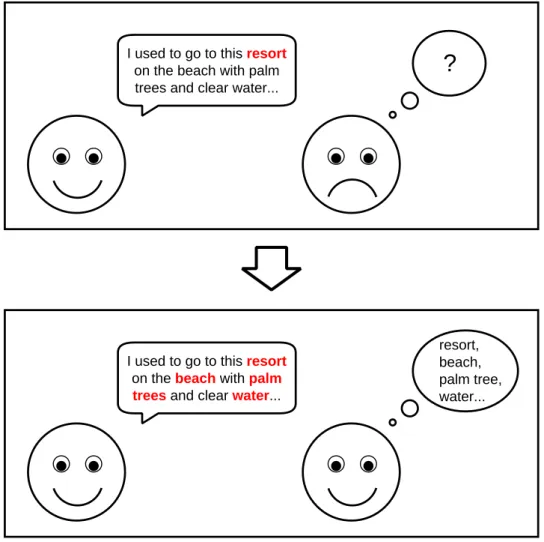
When humans are learning a second language, the presence of keywords in foreign speech helps the non-native speaker to recognize the subject matter of the conversation and, consequently, retrieve the already acquired vocabulary that belongs to the corresponding topic, thus facilitating the comprehension of the foreign language. For example, when Japanese students of English hear the word \pitcher", they will immediately recognize the topic \baseball", and they will expect words like \catcher" or \base" to come up afterwards. Figure 1.1 shows another example of conversation in which the topic facilitates the comprehension of the foreign speech.
Computers can be thought of as non-native speakers when it comes to automatic speech recognition (ASR), because they often misrecognize what they \hear", that is the input speech, so we can expect topic information characterized by related keywords to aid the recognition process in this case too.
Language models are an important and necessary part of ASR systems, because they model the linguistic relations among words in the utterance that is to be recognized. With- out language models, speech recognizers would blindly choose among candidate words without any linguistic criterion, resulting in ungrammatical and nonsensical sentences in most cases. The most widely used language model in ASR is then-gram model. n-grams model the occurrence probability of n consecutive words in the text, and their param- eters are estimated from a large text corpus. n-gram models are powerful in modeling short-distance dependencies between words, but they cannot capture long-distance de- pendencies such as topic information, because they rely on a word history limited ton;1 words, where n typically ranges from 2 to 4. Nevertheless, it has proved very dicult to outperform these models, mainly due to their simplicity.
There are some alternative language models that try to overcome this limitation of n- grams. Examples of those that make use of long-distance topic information are the trigger- based language model, the cache-based language model, and latent semantic analysis- based language models. This thesis focuses on the trigger-based language model, which is capable of capturing long-distance dependencies between words. The trigger-based language model uses a set of correlated word pairs, known as trigger pairs, to raise the probability of the words \triggered" by others in the word history. The trigger-based language model has been mainly applied to the recognition of newspaper tasks, and it has been typically constructed from large corpora such as newspaper articles. This kind of
1
I used to go to this resort on the beach with palm trees and clear water...
?
I used to go to this resort on the beach with palm trees and clear water...
resort, beach, palm tree, water...
Figure 1.1: Example of conversation in which the topic resort facilitates the comprehension of the words beach, palm, trees, and water.
corpora is usually too general in topic and does not closely match the specic test data, thus the trigger pairs constructed from them are not task dependent.
Language model adaptation tries to improve language modeling by creating language models close in style or topic to the target task. In this research, the trigger-based language model is used to adapt a baseline language model to the target domain by exploiting the available in-domain data to try to take advantage of topic information during the speech recognition process.
The following sections 1.2 and 1.3 introduce language modeling in general as well as its application to ASR. Then, section 1.4 deals with the problems addressed by this research, and section 1.5 describes the organization of this thesis.
1.2 Language modeling
Language modeling is the attempt to characterize, capture and exploit regularities in natural language 55]. Natural language is extremely dicult to model formally, due to its inherent variability and uncertainty.
2
There are two main approaches to language modeling: statistical language modeling and knowledge-based language modeling. The statistical approach tries to capture regu- larities in language from large amounts of text in a process known as training. On the other hand, knowledge-based modeling uses a set of linguistic rules coded by experts, as well as domain knowledge, to assess the grammaticality of sentences.
The advantages of statistical language modeling over the knowledge-based approach are:
Statistical models assign a probability to each possible sentence, while knowledge- based models usually only provide a \yes"/\no" answer to the grammaticality of a sentence. Probabilities convey much more information than such a simple answer.
Moreover, spoken language is often ungrammatical.
Statistical models can be inexpensively built from a great variety of domains, as soon as the training procedure has been implemented.
Coding linguistic rules by hand can be tedious, often incomplete, and sometimes erroneous.
At runtime, knowledge-based models like parsers are more computationally expen- sive than statistical models.
Statistical language modeling has also some disadvantages:
They do not capture the meaning of the text. Therefore, they may assign a high probability to nonsensical sentences. Nevertheless, this kind of sentences can be sometimes found in spontaneous speech due to disuencies or sudden termination.
Statistical models require large amounts of training data, which are not always avail- able. However, these language models can also take advantage of smaller training sets through language model adaptation.
Statistical language modeling often do not make use of linguistic and domain knowl- edge, which sometimes can be very helpful.
Language modeling is useful, and often crucial, in areas like ASR, machine translation (MT), spelling correction, handwriting recognition, optical character recognition (OCR), document classication, information retrieval, and any other application that process natural language with incomplete knowledge.
In this work, statistical language modeling is used for ASR, because it is less expensive than knowledge-based language modeling and better suited for spoken language tasks, which is the target of this thesis.
1.3 Language models in automatic speech recogni- tion
ASR deals with the problem of automatically transcribing speech into text. ASR is typically performed as follows. First, a preprocessor generates a set of feature vectors
3
ACOUSTIC MODEL
LANGUAGE MODEL FEATURES
EXTRACTION DECODING RECOGNITION RESULTS SPEECH
Figure 1.2: The automatic speech recognition paradigm.
which capture the spectral characteristics of the input speech signal (acoustic waveform) at discrete time intervals. Then, these feature vectors are passed to the decoder, which, based on the acoustic and the language model probabilities, searches for the string of words that best matches these vectors. The result of this search is a list of hypothesized transcriptions, which is the output of the ASR system. This paradigm is illustrated in gure 1.2.
The most successful approach to ASR is the statistical one proposed in 2]. The aim is to nd the word sequence ^W that maximizes the probability of a word sequence W given the observed acoustic signal A. Applying the Bayes rule:
W^ = arg maxW P(WjA) = argmaxW P(AjW)P(W)
P(A) = arg maxW P(AjW)P(W) (1.1) The calculation of P(AjW) is the role of the acoustic model, whereas the language model is responsible for the computation of P(W).
Let W = w1n , w1w2:::wn, where the wi's are the words that make up the word sequence. P(W) can be decomposed, by using the chain rule, in the following way:
P(W) =Yn
i=1P(wijwi1;1) (1.2) Most statistical language models try to estimate expressions of the form P(wijH), where H =wi1;1 is known as the history.
Since the number of possible histories that can precede a given word is very large, it is unfeasible to try to estimate the probability of all of them from the limited corpora that are available. Therefore, some simplication must be applied to the above equation.
Usually, the event space is partitioned in equivalence classes depending on some property of the history, that is, we use a function (H). As a result, the simplied equation
4
becomes:
P(W)Yn
i=1P(wij(h)) (1.3)
For instance, in the trigram (3-gram) model the partition is based on the last two words of the history.
1.4 Problems addressed by this thesis
Recently, the major target of automatic speech recognition research has shifted from dictation of document-style sentences to transcription of spontaneous conversational-style speech. Research in this eld is still immature, and the current recognition accuracy rates are low. Therefore, more eort should be devoted to devise new technologies that contribute to further progress in this eld.
Meetings and conversations, which are the main target of this study, are centered in a topic in many cases, so the trigger-based language model could be used to capture long-distance topic constraints in these tasks. The trigger-based language model is also insensitive to disuencies, because it focuses on the co-occurrence of topic keywords. Dis- uencies (lled pauses, repetitions, repairs...) are a kind of phenomenon often found in spontaneous speech that disrupts the smooth ow of the discourse. They are a se- rious problem for language modeling, because they can make sentences ungrammatical, contribute to data sparseness, and make dependencies between words longer.
Although the trigger-based language model seems appropriate for conversational speech, its reliable statistical estimation is the most critical problem, especially for this kind of corpora. Conversational text corpora are expensive to produce, as compared to written- style text corpora, so the available amount of training data is usually insucient to derive reliable task-dependent language models.
This work proposes two methods to fully exploit the available in-domain data to adapt the trigger-based language model to conversational speech. In both methods, task- dependent trigger pairs that match more closely the addressed task are extracted from the in-domain data. In the rst approach, the available training data is used to extract the trigger pairs, while in the second approach the initial speech recognition results are used for this purpose. In addition, to enhance the reliability of probability estimates derived from the small amount of available data, a back-o scheme that incorporates the statistics from a large corpus to the model is proposed.
1.5 Thesis organization
The rest of this thesis is organized as follows. First, chapter 2 presents a review of conventional statistical language modeling techniques. Then, the concept of the proposed approach is introduced. This is followed by the explanation of the main measures for language model evaluation and common methods for the incorporation of language models in the ASR system. Chapter 3 describes the application of the trigger-based language model to two dierent conversational speech tasks by obtaining the trigger pairs from the target corpus and estimating their probabilities from both this task corpus and a large
5
corpus, and then combining these probabilities by means of a back-o model. Chapter 4 proposes a dierent adaptation scheme based on the extraction of trigger pairs from the initial speech recognition results and also a back-o model using the probabilities estimated from the recognition results and a large corpus. Finally, chapter 5 concludes this thesis by summarizing and giving future research directions for it.
6
Chapter 2 Overview
2.1 Introduction
This chapter presents an overview of both the basic language modeling theory and the proposed approach. First, section 2.2 explains the major language modeling techniques.
Then, the proposed approach is presented in section 2.3. The two most important evalu- ation measures for language model performance are introduced in section 2.4, followed by the dierent integration methods of language models in the ASR system in section 2.5.
2.2 Review of conventional language models
Many dierent language models have been proposed in the literature. Below is a de- scription of the most interesting approaches classied by the length of the scope they cover.
2.2.1 Short distance
Word
n-grams
A word n-gram 2] is a model that uses the last n ;1 words of the history as its sole information source. Typically n equals 2 to 4, and they are called bigram, trigram, and 4-gram models, respectively.
As commented in the previous chapter, n-gram models partition the data into equiv- alence classes based on the last n ;1 words of the history. Therefore, the following simplication is made:
P(wijw1i;1)P(wijwii;1;n+1) (2.1) In this way, a bigram estimates P(wijH) by P(wijwi;1), a trigram by P(wijwi;2wi;1), and so on.
The probabilities of an n-gram model are estimated from large amounts of text data by the relative frequency of appearance of the tuple, that is:
f(wijwii;;1n+1) = N(wi;n+1wi;1wi)
N(wi;n+1wi;1) (2.2) 7
where N(W) denotes the number of times the tupleW is observed in the training data.
n-grams are aected by the classic modeling trade-o between detail and reliability.
When n is small, the parameters are reliably estimated from the training data, because the tuples are found easily. However, the modeling power is smaller than for greater values ofn. On the other hand, whenn is big, the data are insucient and the estimates become unreliable.
Some smoothing techniques such as deleted interpolation 29] or back-o 35, 42] have been proposed to assign proper probabilities to events that were not seen during training.
Deleted interpolation consists of linearly interpolating an n-gram model with lower- ordern-grams down to the unigram. For example, a trigram probabilityP(wijwi;2wi;1) may be estimated as:
P(wijwi;2wi;1) = 3(wi;2wi;1)f(wijwi;2wi;1) +2(wi;2wi;1)f(wijwi;1) +1(wi;2wi;1)f(wi) +0 (2.3) where the history-dependent weights j are chosen to maximize the likelihood of some held-out data, and satisfy:
3
X
j=0j = 1 (2.4)
for each history.
Back-o smoothing uses lower-order n-grams with enough evidence to approximate higher-order n-grams with insucient evidence. For example, a trigram model is esti- mated as:
P(wijwi;2wi;1) =
8
<
:
f(wijwi;2wi;1) if N(wi;2wi;1wi)> T QT(wijwi;2wi;1) if 1N(wi;2wi;1wi)T
(wi;2wi;1)P(wijwi;1) otherwise (2.5) where QT is a discounting function, T is a threshold, and is the remaining probability mass for all the unseen wi.
The choice of n in n-grams should depend on the amount of data available. For the sizes of the corpora typically available nowadays, trigrams own the best balance between reliability and detail, although interest is gradually moving towards 4-grams and beyond.
n-gram models are easy to implement and easy to interface to the ASR decoder. They are very powerful and dicult to improve, mainly because of their simplicity. They seem to capture well short-range dependencies. It is for these reasons that they have become the standard language models in ASR.
Unfortunately, they also have their drawbacks. First, they are unaware of any phe- nomenon or constraint that is outside their limited scope. Therefore, they may assign high probabilities to nonsensical and even ungrammatical utterances, as long as they sat- isfy local constraints. In addition, the predictors in n-gram models are dened by their order in the sentence, not by their linguistic properties. Therefore, histories like \the reman extinguished the" and \the reman extinguished quickly the" are very dierent for a trigram, even though they are very likely to precede the same word.
8
Class-based
n-grams
Class-basedn-grams 7] aren-grams whose parameter space has been reduced by cluster- ing the words into classes. The n-grams are then based on these classes, rather than the words themselves.
If it is assumed that each word wbelongs to only one class g(w), then this model can take many forms, for example,
P(wijH) =P(wijg(wi;2)g(wi;1)) (2.6) P(wijH) =P(wijg(wi;2)wi;1) (2.7) P(wijH) =P(g(wi)jg(wi;2)g(wi;1))P(wijg(wi)) (2.8) In practice, it is the last one that is the most used in class-based n-grams.
The clustering method itself can also take many forms. Firstly, the clustering can be based on the linguistic knowledge. The best known example of this method is clustering by part of speech (POS). POS clustering attempts to capture syntactic dependencies between adjacent words in the text. This approach has several problems, though: some words can belong to more than one POS, POS classications made by linguists may not be optimal for language modeling, and there are many dierent schemes for POS classication.
In second place, in clustering by domain knowledge, all words that will behave in a similar fashion are manually grouped together. For example, days of the week, numbers, etc. This approach can be especially helpful when the amount of training data is limited.
Finally, in data-driven clustering, a large amount of data is used to automatically derive classes by statistical means. This is often better than clustering by hand based on one's intuition. However, reliance on data instead of on external knowledge sources can also be problematic. For example, if the amount of training data available is not large enough, the resulting classes may not be reliable. The ideal data-driven clustering would be one supervised by an expert.
Class-basedn-grams have advantages over the basicn-grams. Since the possible num- ber of histories is reduced, the model becomes more compact. Therefore, it could be expanded to include more context. For example, a class-based 4-gram model might be approximately the same size as a trigram. In addition, since the number of classes is gen- erally smaller than the size of the vocabulary, the data sparseness is reduced, and even if a word n-gram is not found in the training data, the equivalent class-based n-gram is likely to have been seen. For this reason, these models have been very helpful in situations where the training data available were limited.
The disadvantage of these models is that they lose some of the semantic information that word n-grams capture. For example, the word trigram \Sunday school teacher"
captures the semantic relations between Sunday, school, and teacher, which cannot be captured by class trigrams. This can be partially overcome by constructing language models that incorporate information from both word and class-based n-grams. A more important drawback of class-basedn-grams is that they do not solve the locality problem of n-grams.
Mixture-based language models
These models 11, 27] are composed of several language models, each of which is specic to a particular topic or sub-language. The probability distributions from these component
9
language models are linearly interpolated to form the global language model probability.
The interpolation weights reect, at each moment, which component sub-language is currently being emphasized.
Let M1M2:::Mk be the component language models. The overall language model probability is then
P(wijH) =Xk
j=1jPMj(wijH) (2.9) where the j's are the interpolation weights, with values such that
k
X
j=1j = 1 (2.10)
Usually, the rst step when creating a mixture-based language model is the clustering:
the training data has to be partitioned in homogeneous components. This can be done automatically, with some iterative clustering algorithm, or manually, according to the topic, style of text, etc.
The number of clusters in which the training data should be partitioned is a delicate matter. A number too small will result in a model incapable of discerning between topics or linguistic styles in detail. Too large a number will lead to a bunch of undertrained models with poor probability estimates. It is common that one of the components be the whole training data, in order to smooth the estimates and avoid data fragmentation.
The next step is typically to construct an n-gram model for each of the constituents.
Then, the interpolation weights can be calculated by using the expectation maximization (EM) algorithm 18] in such a way as to maximize the likelihood of some held-out data.
These language models are theoretically very attractive and represent a sound ap- proach to language model adaptation. However, they still have the short-scope limitation of n-grams, and they have not signicantly improved speech recognition accuracy so far.
2.2.2 Intermediate distance
Long-distance
n-grams
These models 25] attempt to capture the dependencies between the predicted word and n;1-grams that are some distance back in the history. For instance, a distance-2 trigram predicts wi based on (wi;3wi;2). Distance-1 n-grams are consequently the conventional n-grams themselves.
These models have very serious limitations. Even though they capture dependencies between words that are separated by distance d, they cannot merge training instances that use dierent values of d, therefore, they unnecessarily fragment the training data.
In other words, they do not pay attention to the nature of the text in order to decide an appropriate value ford, but they simply skip the words that are nearer than dwords back in the history.
10
2.2.3 Long distance
Cache-based language model
This model 44, 45] is based on the observation that a word that has appeared recently in the history has a high probability of reappearing.
A cache memory similar to that of computers is used to store the words of recent appearance. The word probabilities are estimated from their recent frequency of use. If a candidate word is in the cache, its probability is raised.
Typically, a cache-based component is linearly interpolated with an n-gram language model:
P(wijH) =Pcache(wijH) + (1;)Pn;gram(wijH) (2.11) Usually, a cache of the last K words is maintained, and the cache-based probability of a word is computed as the unigram probability of the word within the cache, that is,
Pcache(wijH) = Ncache(wi)
K (2.12)
where Ncache(w) is the number of times w appears in the cache.
The original cache-based model was interpolated with a class-based trigram based on the POS, and a cache of size 200 was maintained for each POS. The interpolation weights were calculated individually for each POS.
Several extensions have been proposed to this language model, being the most obvious the addition of the cache-based component to a word-based trigram, rather than a class- based model 27].
The cache need not be limited to containing single words. Instead, recent bigrams and trigrams can also be incorporated to the cache and their probabilities boosted 31].
This approach has the problem that the probabilities of n-grams in the cache cannot be reliably estimated due to the insucient information contained in several hundred words back.
Another extension used the idea that the more recent words are more inuential in predicting forthcoming words than those in the more distant past 11]. With this in mind, an exponentially decaying cache was constructed. This is a cache in which the probability of the words inside the cache decay exponentially with the distance from the word being predicted.
The cache-based language model signicantly reduces the perplexity of standard lan- guage models, and some of the extensions mentioned above contributed to a further improvement in terms of perplexity. However, the same does not apply to recognition accuracy, which has not been noticeably improved by this model so far. This is because during the speech recognition experiments the word history is erroneous, so the cache- based model helps to propagate the errors to the succeeding utterances.
Trigger-based language model
The trigger-based language model 47, 55, 56], like the cache-based model, also uses a cache memory of recent words. However, contrary to the original cache-based model, only \rare" words are incorporated to the cache. A word is dened as rare relative to a threshold of static unigram frequency.
11
Parent’s education level affects academic success PTP
P3G
Figure 2.1: Example of long-distance dependency captured by the trigger-based language model but not by the trigram model.
In order to extract information from the document history, a basic information bearing element called trigger pair is used. If a wordais semantically well correlated with another word b, then a ! b is called a trigger pair, with a being the triggering word and b the triggered word. The occurrence ofain the word history triggers the appearance of b, that is, if a appears in the text, the model will predict a heightened probability for b.
Figure 2.1 illustrates an example of long-distance dependency captured by the trigger- based language model but not by the widely used trigram model. In the example, the trigger pair education !academic is used to help predict academic, a dependency that falls out of the scope of the trigram model in this case.
The trigger pairs are created from a large text corpus by using the average mutual information measure between the triggering word a and the triggered word b:
I(a b) =P(ab)logP(bja)
P(b) +P(a!b)logP(!bja) P(!b) +P(!ab)logP(bj!a)
P(b) +P(!ab!)logP(!bj!a)
P(!b) (2.13)
Here, !a means \any word dierent froma". A high average mutual information indicates that the appearance of b is highly correlated with the appearance of a.
The model is usually formulated as a constraint of a maximum entropy (ME) frame- work 17, 28] in which n-grams, long-distance n-grams and so on can also take part as constraints of the model, although there are works in which linear interpolation is used to combine the baseline n-gram model with the trigger-based model 73, 74, 80, 5]. In this thesis we adopt the latter approach, because it is simpler and because ME suers from very long training times.
Latent semantic analysis-based language model
Latent semantic analysis (LSA) 16] is an algebraic technique that can be used to infer the latent semantic relationship among words by means of their co-occurrence in identical contexts. Given a text corpus T of N documents, with a vocabularyV of M words, LSA denes a mapping between the discrete sets T and V and a continuous vector space S. A document here is a semantically cohesive set of words such as a sentence, paragraph, newspaper article, etc.
12
The rst step is to construct a word-document co-occurrence matrix W, with rows corresponding to words inV and columns to documents inT, where word order is ignored.
Each element in W is the word count in the corresponding document normalized for document length and word entropy:
wij = (1;i)ci j
nj (2.14)
where ci j is the number of times word wi occurs in document dj, nj is the total number of words present in dj, andi is the normalized entropy of wi inT, given by:
i =; 1 logN
N
X
j=1
ci j
ti logci j
ti (2.15)
where ti =Pjci j is the total number of times wi occurs in T.
The second step is to reduce the dimensionality of the resulting large sparse matrix by applying order-R singular value decomposition (SVD):
W W^ =USVT (2.16)
where UMR is a left singular word matrix, SRR is a diagonal matrix of singular values, and VNR is a right singular document matrix. This transformation captures the major structural associations inW and removes noise. Values ofRin the range of 100 to 300 are typically used for information retrieval. The R-dimensional representations of the word and document vectors are given by uiS and vjS, respectively, where ui and vj are the corresponding rows of U andV. Any new document dcan be considered as an additional column of the matrix W, and can be represented as v =dTU.
In the LSA-based language model 3], the closeness between a word wq and its associ- ated history, that is the current document so far, represented asdq;1, is measured by the cosine of the angle between uqS1=2 and vq;1S1=2:
K(wqdq;1) = cos(uqS(1=2)vq;1S1=2) (2.17) Since the range of this distance measure is within -1,1], we need to transform it to a probability measure. One way to do this is as follows:
PLSA(wqjdq;1) = ;cos;1(K(wqjdq;1))
P
wk ;cos;1(K(wkjdq;1))] (2.18) The LSA-based language model is usually combined with an n-gram model. The combination proposed in 3] is the following:
P(wqjH) = Pn;gram(wqjwqq;1;n+1)PLSAP((wwqjq)dq;1)
P
wi2VPn;gram(wijwqq;;1n+1)PLSAP((wwiijdq;1)
) ] (2.19)
The LSA-based language model eectively captures large-span semantic relations among words and has proved successful in terms of perplexity and word error rate re- duction. However, strictly speaking it is not a probabilistic model, because it requires heuristics to compute the probability of an unseen document. Another approach known as probabilistic latent semantic analysis (PLSA) has been applied to language modeling to account for this 22]. Here, documents are represented as sets of word occurrence prob- abilities. The problem with the PLSA-based language model is that it can suer from the overtting problem 72].
13
2.3 Proposed approach
2.3.1 Trigger-based language model
This thesis focuses on the trigger-based language model, which is a good complement of the standardn-gram language model because it eectively exploits long-distance dependencies by means of related keywords (trigger pairs). Research on trigger-based language models is insucient, and they are simpler and easier to implement than other more complex topic-dependent approaches such as LSA-based language models.
The drawback of trigger pairs is that far more information is contained in self-triggers (words that trigger themselves) than in any others even non-self-triggers tend to be trig- gers with the same stem (e.g. abuse, abused, abusing). Self-triggers are virtually equiva- lent to the cache-based language model, so the original trigger-based language model does not signicantly outperform the cache-based model. In addition, trigger pairs are usually constructed from a text window of xed length with the average mutual information mea- sure. This window limits the scope of the dependencies that the trigger-based language model can capture. Therefore, the model captures local topic constraints, rather than global.
In this research, instead of the average mutual information measure, we use the term frequency/inverse document frequency (TF/IDF) to extract the trigger pairs from the whole document, rather than a text window, to capture topic constraints global to the document.
2.3.2 Transcription of conversational speech
This thesis deals with the automatic transcription of conversational speech. Recently, in the speech recognition community, the interest has shifted from written language-style tasks to the recognition of spontaneous speech, which is a eld that poses many more challenging problems. Research in this eld is still immature, and the current word recognition accuracy rates are low, as opposed to dictation systems or written-style tasks.
Therefore, more eort should be devoted to devise new technologies that contribute to further progress in this eld.
So far, the trigger-based language model has been mainly applied to the recognition of newspaper tasks. In this case, the trigger pairs are constructed from a large newspaper corpus and the test data consists of some articles read aloud. Spoken language is very dierent from written language, but like the latter, the former has also many long-distance dependencies that we want to capture and conversations are also centered in a topic in many cases. Therefore, the trigger-based language model could be used to capture long- distance topic constraints in these conversational speech tasks.
When transcribing conversational speech, however, we nd two serious problems for statistical language modeling: the appearance of disuencies in speech and the small amount of available in-domain data.
Disuencies can be of dierent types such as lled pauses (e.g. \uh", \um"), repetitions (e.g. \I I mean"), and repairs (e.g. \he she doesn't like it"). Disuencies can be considered as noise in the linguistic channel, and they are a serious problem for language modeling, rst because sentences can become ungrammatical, for example by having several subjects or by ending unexpectedly second because disuencies contribute to data sparseness, since
14
we could partition the word history into unnecessary equivalence classes (e.g. the trigram model would have dierent equivalence classes for \my former job" and for \my former uh job") and third because disuencies can make the dependencies between words longer, for example when llers occur between two related words.
The second problem is the small amount of available in-domain data. Contrary to written style text, there are much less available training data for conversational speech domains, because it is much more expensive to produce these corpora than those from newspapers or newswires, for example. The available conversational corpora are usually insucient to derive a stand-alone task-dependent language model from them. Recently, the number of works that use the World Wide Web (WWW) as a source for extracting training data for language models for conversational speech tasks has been increasing.
However, the extracted web pages are not domain matched, and they must be ltered to discard out-of-domain text.
The trigger-based language model is insensitive to disuencies in speech, because it focuses on the co-occurrence of topic keywords, so it is not aected by the rst problem.
As for the second problem, the proposed approach uses the available in-domain data to adapt the language model to the conversational speech task.
2.3.3 Adaptation scheme
In this study, the language model adaptation scheme is based on the trigger pairs that are extracted from the available conversational in-domain data. By extracting the trigger pairs from the in-domain data, contrary to the conventional trigger-based language model that constructs the trigger pairs from a general large corpus, we can obtain task-dependent trigger pairs that match more closely the addressed task. In addition, since the probability estimates derived from the target domain might not be reliable, because the amount of in-domain data is typically small, a back-o scheme that uses the statistics from a large corpus is also proposed. In this thesis we propose two dierent adaptation schemes, which will be presented in chapters 3 and 4.
In the adaptation scheme presented in chapter 3, the trigger pairs are extracted from the target corpus, and their probabilities are estimated from both the in-domain data and the large corpus, resulting in two dierent sets of trigger pairs, depending on where the probabilities have been estimated from. We apply this method to two dierent domains:
a travel expressions task and an extemporaneous speeches task. Both tasks have the same amount of in-domain training data (3.5M words), which we presume sucient to extract task-dependent trigger pairs. However, this amount of data might be insucient to derive reliable probability estimates for the trigger pairs. Therefore, we propose a back- o scheme that backs o to the set of trigger pairs whose probabilities are estimated from the large corpus when there are no applicable trigger pairs in the trigger set estimated from the task corpus.
In chapter 4, the target task is the transcription of panel discussions. In this case, the total size of the available in-domain data is only 134K words, a much smaller size than that of the tasks addressed in chapter 3. All these data are used as the test set, so actually there are no available training data. Therefore, we cannot use the previous adaptation scheme here, because this amount of data is too scarce to obtain the expected quantity and quality of trigger pairs. Instead, we present an adaptation scheme where the trigger pairs are extracted and their probabilities estimated from the initial speech recognition
15
REF: Parent's education level affects academic success HYP: Further education affects an academic success
EVAL: S C D C I C C
Figure 2.2: Example of alignment of hypothesis with reference transcription.
results and from a large corpus, resulting in two dierent trigger sets, each constructed from a dierent source. Here, we also use a back-o scheme to back o to the probabilities from the trigger set constructed from the large corpus when there are no applicable trigger pairs in the trigger set constructed from the initial transcription. In addition, we describe the application of the proposed method to another meeting transcription task.
2.4 Language model evaluation measures
2.4.1 Word error rate
The ultimate evaluation measure of a language model is the one that assesses its perfor- mance in the particular task for what it was created. In ASR, this measure is the word error rate (WER). The WER is the rate of erroneous words in the output of the speech recognizer. Given a reference (correct) transcription and the output of the ASR system, we align the hypotheses of the output with their respective correct counterparts, and then we count the number and type of errors.
There are three dierent types of errors: substitutions, insertions, and deletions. When a word is misrecognized and a dierent one is output instead, it is a substitution (S). If a word appears in a hypothesis but it does not appear in the corresponding acoustic signal, or it is not a misrecognition of any of the words in this acoustic signal, then it is an insertion (I). Deletion (D) is the case when a word is skipped during the recognition, that is, it appears in the observed acoustic signal but it is neither correctly nor incorrectly recognized it simply does not appear in the hypothesis.
The WER is dened as follows:
WER = # of errors
# of tokens in the reference transcription = S+I+D
N 100 (2.20)
Figure 2.2 shows the alignment of two sentences with their corresponding errors. The WER here isWER = 3=6 = 50%.
In order to compare the performance of two dierence language models with the WER, the acoustic model must be xed and the WER of the system using the two language models must be compared.
In practice, this measure is not necessarily perfect. In order to reliably measure the WER, we need to perform recognition experiments with large amounts of test data, which consumes a great deal of time. Furthermore, the WER depends on complex interactions among many components, so it is virtually impossible to nd analytical expressions for the relationship between the WER and the values of language model parameters.
16
2.4.2 Perplexity
An alternative measure to WER for evaluating the performance of language models is the perplexity 30]. The perplexity can be interpreted as the branching factor of a language model, that is the average number of words that will follow a given word history.
Mathematically, the perplexity is derived from the entropy. Let P(x) be the real probability distribution ofxandPM(x) be the probability estimate ofxbased on language modelM. The entropy of P(x) is dened as:
H(P) =;X
x P(x)log2P(x) (2.21)
Then, the cross-entropy (also called the logprob) ofP and PM is:
H(P PM) =;X
x P(x)log2PM(x) (2.22) The cross-entropy measures the similarity between the distributions P and PM. The smaller the cross-entropy, the better the language modelM approximatesP.
If the size of the test text N is suciently large and the language source is ergodic (i.e. every suciently long sentence is equally representative), the previous equation can be approximated by:
H(PM);1 N
N
X
i=1log2PM(wijw1wi;1) (2.23) The perplexity of the text with respect to the model M is nally dened as:
PPL(PM) = 2H(PM) (2.24)
The perplexity depends on both the quality of the language model and the complexity of the text. For the same text, the model with the lowest perplexity is the better model, whereas, for the same language model, the text with the highest perplexity is the most dicult to process. Therefore, a comparison between language models must be made with respect to the same text, and also the same vocabulary, because smaller vocabularies result in lower perplexities.
Perplexity is practically a faster way of evaluating the performance of a language model, but it does not take into account acoustic confusability. Moreover, although WER and perplexity are well correlated, lower perplexities do not necessarily imply lower WERs, specially when the reduction in perplexity is low.
2.5 Handling long-distance language models in ASR
2.5.1 The decoder
The decoder is the subsystem of the ASR system that, using the acoustic and language models, searches for the word string that best matches the input feature vectors. Since the search space consists of all the possible combinations of word strings, it is necessary to nd some way of reducing the size of this space to make the search feasible. There are two common techniques to achieve this: path pruning and path merging.
17
Let
us me
merge these two paths
mix these two paths
Let
us me
merge these
two
mix these
two
paths
Figure 2.3: Example of path merging when using a trigram language model.
Path pruning is the method that discards very unlikely paths at a particular time point. By using this method, the search space can be considerably reduced, but it is possible that a path very unlikely at an early stage becomes more likely later on, so it may happen that the best path is pruned from the space, thus leading to a search error.
Path merging is the technique that merges two or more converging paths at some point and continue the search with only the more likely of the paths, since a path that is less likely at the point where the paths converge will remain less likely. In order to do this, the converging paths must have equivalent histories according to the language model being used. For instance, if a trigram model is used, two paths can be merged if the nal two words in the paths are the same. Figure 2.3 shows an example of path merging with a trigram model. Long-distance language models cause problems to this decoding scheme, because it is not possible to merge paths so frequently, and therefore the search space will probably remain too large.
Moreover, long-distance language models usually require much more memory than a standard n-gram model, which added to the memory required by the acoustic model can make it very costly to use these language models during the decoding step.
In order to overcome these problems, there are two alternative methods for integrat- ing long-distance language models into the speech recognition framework, namely N-best and word graph rescoring. In these methods speech recognition takes place in two or more passes. The rst pass generally uses a simple language model such as a bigram to generate a simplied search space. It is hoped that the best hypothesis according to the nal language model is not pruned from this space at this step. The output from
18