On An Approximation Equation Applicable to the
Designing of the Trawl Net I : On the Net
mouth Central Height of the Four Panelled Net
著者
MOURI Kourou, HIGO Nobio, GOTO Masahiro
journal or
publication title
鹿児島大学水産学部紀要=Memoirs of Faculty of
Fisheries Kagoshima University
volume
25
number
1
page range
107-115
別言語のタイトル
底曳網の設計に関する略算式I
Mem. Fac. Fish., Kagoshima Univ.
Vol. 25, No. 1, pp. 107-115 (1976)
On An Approximation Equation Applicable to the
Designing of the Trawl Net-I
On the Net mouth Central Height of the Four Panelled Net
Kourou Mouri,* Nobio Higo** and Masahiro Gotoh***
Abstract
Concerning the shape of the net mouth of the trawl net a theoretical equation applicableto the measuring of the net mouth central height (N. C. H.) was noted after, basing on the following
two the hypothesis: —
(1) The net mouth is of the elliptical shape.
(2) The perimeter of ellipse is unvarying, irrespective of the towing speed and the interval
between the wing ends.
and we have the following theoretical equation, given; namely
kp-2d *
-d(kP-2d)
This theoretical equation value in the figure ascertained to be lower, at the low speed side, than the model experimental value, and conversely this was higher, at the high speed side, than the model experimental value. At the same time, it was ascertained that when the towing speed approached to 1 m/sec the theoretical value approximately agreed with the experimental value.
Introduction
It has been confirmed that the shape of the net mouth, usually, covers a range,
from like cyclic to elliptical (1959),1) (1971).2) Of this, it was ascertained by Hamuro (1959)1} that provided that the diameter of a twine (dmm)/the mesh size (1 mm) has been set, to be large at the baiting, and small at the side panel, the shape of the net mouth approaches to be cyclic one, making, consequently, the N. C. H., or the short diameter of the ellipticity, rather, enlarged. Furthermore, it was mentioned hydro-dynamically, by the previous reports (1974),3) (1975)4) that the variations in the shape
of the net mouth and the N. C. H. are depending upon those of djl value. As shown in Fig. 1, these items are to be noted in the photograph taken by Gotoh (1970)5)
basing on the model experiments.
Beyond a certain towing speed, the perimeterof net mouth of a trawl net is assumed to come to be kept approximately unvarying. The justification of this is to be found in a lot of model experimental results showing the fact that when the towing speed comes to be beyond 2 knots, approximately an unvarying value begins to be shown
* Pacific Aero Survey Company, Tokyo, Japan.
** Laboratory of Fishing Gear, Faculty of Fisheries, Kagoshima University, Japan. *** Miyazaki Fisheries high school, Miyazaki, Japan.
108 Mem. Fac. Fish.. Kagoshima Univ. Vol. 25, No. 1 (1976)
•
Fig. !. 1'he front views ofthe net mouth at the various speed by photograph.
Bl: 0.31 knot B2 : 0.63 knot 133: 0.94 knot B4:1.29 knot 135: 1.64 knot B6: 1.95 knot
by the N. C. H. and the crossed area of the net mouth (1953),6> (1961),7' (1966).8>
Basing on the above mentioned facts confirmed about the shape of the net mouth, a theoretical equation about the N. C. H. — an equation which was believed by the author to play an important part in designing a highly effective trawl net — was noted
after.
Deployment of the theoretical equation
Mouri •Higo •Gotoh : Design of Trawl Net-1 109
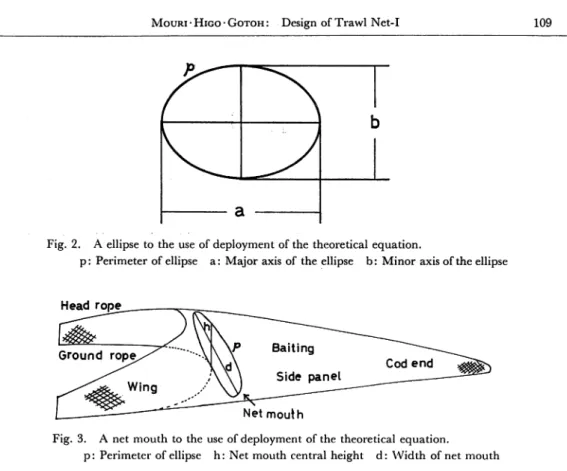
a
Fig. 2. A ellipse to the use of deployment of the theoretical equation.
p: Perimeter of ellipse a: Major axis of the ellipse b: Minor axis of the ellipse
Head rope
Net mouth
Fig. 3. A net mouth to the use of deployment of the theoretical equation.
p: Perimeter of ellipse h: Net mouth central height d: Width of net mouth
is unvarying, irrespective of the varieties in the major axis (a) and of the minor axis
(b), we have following equation (1961),9) (Fig. 2).
^ = 20(1 + 0.57 (b/a)k)
k = 1.55- 0.217 (b/a)
•(1) •(2) In the equation (1), the error of p value is only 1/8%. If the K value in the equation (2) is fixed to be 3/2, the error of P value in the equation (1) comes to be 7/8%.
Accordingly, if the perimeter of the ellipse is allowed to lie within the error range
of approximately 1%, the equation is to be turned into
jD = 2o[l + 0.57(6/a)^] •(3)
Here, the shape of the net mouth might be substituted for the above mentioned ellipse; and under the application of the two assumptions, namely (1) the net mouth
is elliptically shaped (2) perimeter of net mouth is unvarying, irrespective of the towing
speed, and the interval between the wing ends, the equation (3) is to be deployed into the following (Fig. 3):
110 Mem. Fac. Fish., Kagoshima Univ. Vol. 25, No. 1 (1976)
Here, P is the total length of the net mouth (p=kP), d is the width of the net mouth,
h is the N. C. H. Equation (4) may be deployed further into
a J kP-2dV
h=d\-Tud-J
Here, the value of h is represented by a functional number which is to be fixed by the relationship between the perimeter of the net mouth and the total length of the
net mouth; this is to say that the value is not fixed, but variable in accordance with the variations in the shape of the net.
In dealing with the interval between the wing ends and the towing speed, or the conditions indispensable for the calculation of the N. C. H., the figures representing
the width of the net mouth counted from the relationship between the above mentioned 2 items, were substituted for the figures in the equation (5).
Confirmation of the theoretical equation
The confirmation of the theoretical equation was carried out by substituting the
values obtained from the model experiments of the typical four panelled net for the
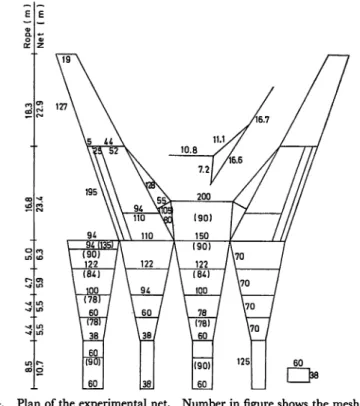
figures in the equation (Fig. 4). The majoring measures of the real trawling net
Fig. 4. Plan of the experimental net. Number in figure shows the mesh number,
bracket number shows the mesh size (mm).
Mouri •Higo •Gotoh : Design of Trawl Net-I 111
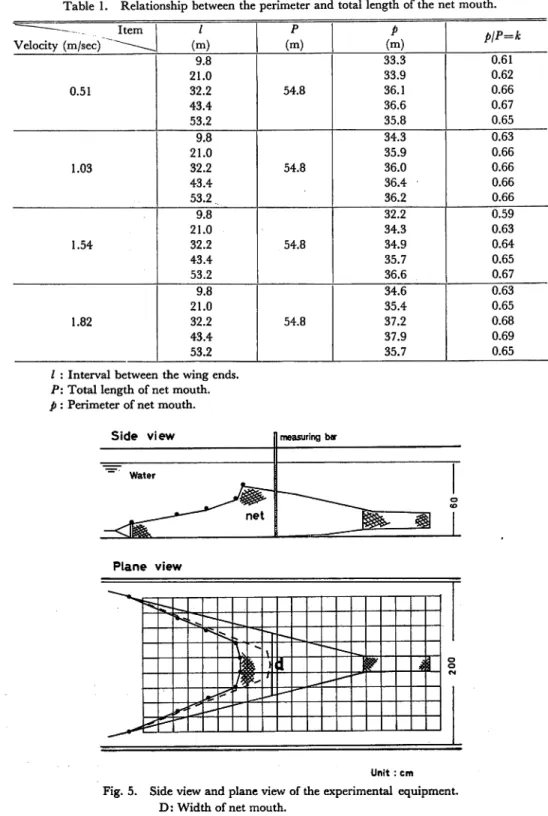
Table 1. Relationship between the perimeter and total length of the net mouth.
"~~ "~-—•—_ Item Velocity (m/sec) ^~~~-—^ / (m) P (m) P (m) plP=k 9.8 33.3 0.61 21.0 33.9 0.62 0.51 32.2 54.8 36.1 0.66 43.4 36.6 0.67 53.2 35.8 0.65 9.8 34.3 0.63 21.0 35.9 0.66 1.03 32.2 54.8 36.0 0.66 43.4 36.4 0.66 53.2 36.2 0.66 9.8 32.2 0.59 21.0 34.3 0.63 1.54 32.2 54.8 34.9 0.64 43.4 35.7 0.65 53.2 36.6 0.67 9.8 34.6 0.63 21.0 35.4 0.65 1.82 32.2 54.8 37.2 0.68 43.4 37.9 0.69 53.2 35.7 0.65
/ : Interval between the wing ends.
P: Total length of net mouth. p : Perimeter of net mouth.
Plane view 5*»s ^ ^ «* • ^ \ "*•«» - - ^ *"—.•»*, ) i
1
r 4i *** / •-—•— . — ^ Unit : cm Fig. 5. Side view and plane view of the experimental equipment.112 Mem. Fac. Fish., Kagoshima Univ. Vol. 25, No. 1 (1976)
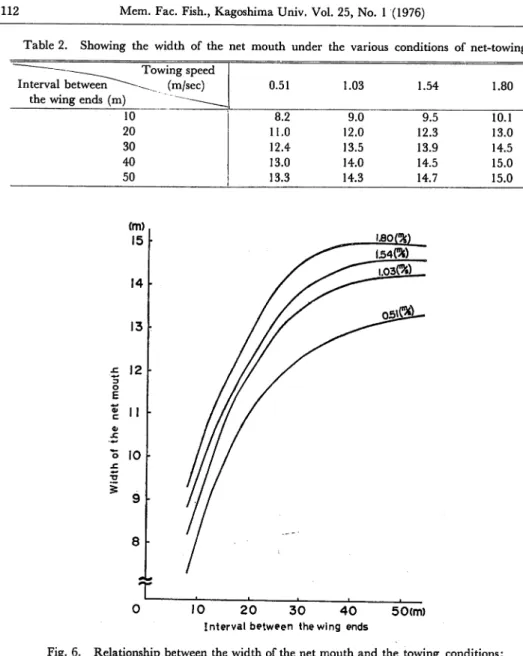
Table 2. Showing the width of the net mouth under the various conditions of net-towing.
—-—^-___^ Towing speed
Interval between""^^^ (m/sec) 0.51 1.03 1.54 1.80
the wing ends (m) ^—--___
10 8.2 9.0 9.5 10.1 20 11.0 12.0 12.3 13.0 30 12.4 13.5 13.9 14.5 40 13.0 14.0 14.5 15.0 50 13.3 14.3 14.7 15.0 (m> 15 14 13 12 II 10 10 20 30 40
Interval between the wing ends
\BOCk)
50(m)
Fig. 6. Relationship between the width of the net mouth and the towing conditions; interval between the wing ends, towing speed.
(m/s): Towing speed.
are as in the following: total length of the net, 62.1 m, head rope, 66.4 m (in total length); ground rope, 73.8 m (in total length); the value of djl is 0.018 at the wing, 0.023 at the square part, 0.016 at the baiting, respectively; and the mean value at the net mouth is 0.018.
The relationship between the perimeter of the net mouth and the total length of the
net mouth under trawling is as shown in table!.. In the value of.p/P=k, there is a
Mouri •Higo •Gotoh : Design of Trawl Net-I 113
The range ofkvalue lies within 0.59-0.68, the mean value being 0.6. The value of
p was obtained by measuring the wire ring set around the perimeter of the net mouth.
The wire is made of the extremely slender pianowire; and during the towing net it was held up from above in order to prevent the shape of the net from being collasped. The width of the net mouth was measured with the calibrated board, set beneath the net, with the towing speed and the interval between the wing ends kept changing,
variously (Fig. 5).
The results obtained are as shown in Table 2 and Fig. 6. The width of the net mouth is to be obtained through the figures showing the interval between the wing ends and the towing speed which are to be obtained from Fig. 6, respectively. By the way, the net used in this experiment is the four panelled net which is the most typical one among the various sorts of net, which makes it applicable to a lot of nets
similar to the adopted one.
"O cOf c EJ2 . U x 73 u o 10
Interval between the wing ends
3201,3801,4301,48171
measured *— calculated
0.5 10 1.5 2.0
Towing speed (m/sec)
Fig. 7. Showing the net mouth central height (N. C. H.) on measured bythe
114 Mem. Fac. Fish., Kagoshima Univ. Vol. 25, No. 1 (1976)
When the value of k obtained from Table 1, and the value of the width of the net
mouth obtained from Fig. 6 are substituted for the figures in the equation (5), the
N. C. H. with a certain the interval between the wing ends and the towing speed can
be got theoretically.
Here, concerning the N. C. H., comparison was made between the theoretical value
and the experimental value. The result obtained by the comparison is as shown
in Fig. 7. In this figure, firstly, it was noted that the theoretical value was lower than the experimental value, at the side of low speed; and the reverse was noted at the side of high speed; and, secondly, it was noted that theoretical value and the experimental value came to be approximately equal at the towing speed of 1 m/sec. The fact that at thelow speed side thetheoretical value was lower thantheexperimental
value was lower supposed to be derived from the error of assuming the shape of the
net mouth to be perfectly ellipse. The fact that at high speed side the theoretical value was higher than the experimental value suggested that the theoretical value
was nearer to the real one than the experimental value.
Discussion
This theoretical equation was induced from the two hypothesis, hence the necessity
of discussing the hypothesis, themselves. The first hypothesis that the net mouth is of the elliptical circle offer no significant problem, because there is the ascertained
fact that under a certain towing speed —at least 1 m/sec, it shows a shape quite
similar to an ellipse.
The hypothesis that the perimeter of the net mouth is unvarying is open to various questions, but it was assumed that the proper arrangement of the d\l expression would allow us to make them negligible. This is to say that, in applying this theoretical
equation to the practical cases, it will be necessary for us to assort the nets into groups,
in accordance with the shape of the net (varying according to the panelling number)
and with djl value, with theascertainment ofthekvalue and ofthefigures representing
the relationship among the width of the net mouth, the interval between the wing
ends and the towing speed before we can carry out a successful substitution of these value for the figures in the theoretical equation.
Acknowledgment
The authors are grateful to Lecture T. Imai and Technical Officer S. Tabata, Kagoshima Univeristy, for their technical assistances in the tank experiment.
References
1) C. Hamuro (1959): Gyogu Sokutei Ron. 225~229, Maki Ltd, Tokyo.
Mouri •Higo •Gotoh : Design of Trawl Net-I 115
This Bull, 20(2), 86-96.
3) N. Higo, Y. Tokunaga and S. Fuwa (1974): Studies on the Drag net-Ill. This Bull, 23,
29-34.
4) N. Higo and K. Mouri (1975): Studies on the Drag Net-IV. This Bull, 24, 57-63.
5) M. Gotoh (1969): Model Experiments on the two types of the Danish Seines. Note of
the Graduation thesis of Kagoshima University, 1—30.
6) M. Nomura and T. Yasui (1953): Model Experiments on Trawl Nets Various Types. Bull.
Jap. Soc. Sci. Fish.y 13, 727—733.
7) T. Taniguchi (1961): Model Experiments on the Japanese Two-Boat-Type Trawl Net-1.
Jour. Shimonoseki Coll. Fish., 10, 355—369.
8) N. Higo: Studies on the Relationship between the gear-type and the Fishing Efficiencies in
the Trawl Nets-1. Bull. Jap. Soc Sci. Fish., 32, 130—136.