Decision Usefulness of Cash Flow Information
Format : An Experimental Study
journal or
publication title
International review of business
number
12
page range
23-44
year
2012-03
Decision Usefulness of Cash Flow Information Format
– An Experimental Study–
Koji KOJIMA*
Abstract
The main purpose of this study is to examine whether the method of presenting financial reports influences the decisions made by their users. Two operating cash flow presentations, namely, direct and indirect, are employed to investigate whether the presentation format of operating cash flow influences lending decisions using financial information about a hypothetical retail company, as a pilot study for an international project. Thirty-eight accounting students (graduates and undergraduates) participated. Following the methodology of Klammer and Reed (1990) and Conover et al. (2011), the findings show that more accurate decisions can be made by the direct method of presentation than by the indirect method of presentation.
Keywords: Experiment, Statement of Cash Flows, Operating Cash Flow, Format,
1. Introduction
The main purpose of the study is to examine whether the method of presenting financial reports influences the decisions made by their users. Two operating cash flow presentations, namely, direct and indirect, are employed to investigate whether the presentation of operating cash flow influences hypothetical lending decisions by users. I believe that this paper provides evidence for the IASB (International Accounting Standards Board)’s decision process on the Preliminary Views document on Financial Statement Presentation, which is a joint project with the FASB (Financial Accounting Standards Board).
Previous research has shown that a relationship exists between the presentation of financial information and users’ decisions. Libby (1981) points out that changing the presentation and amount of information can improve users’ decision making. A study conducted by Stock and Watson (1984) concludes that users’ judgment can be influenced by the accounting report format. Maines and McDaniel (2000) conclude that alternative presentation formats affect the degree of investors’ understanding of accounting information.
* Koji Kojima is an Associate Professor at the School of International Studies, Kwansei Gakuin University, Hyogo, Japan. Email: [email protected]
Numerous research studies have focused on differences between the direct and indirect method formats, especially the use of the financial statements’ individual components versus aggregate information (Krishnan and Largay 2000, CFA Institute 2005, 2007). Although both the IASB and the FASB permit the indirect method, they consider the direct method of presenting operating cash flow the preferred method. The IASB’s conceptual framework (IASB 2010) lists understandability as an identified factor that enhances the qualitative characteristics of financial information. Understandability is defined as “the quality of information that enables users to comprehend its meaning” and “understandability is enhanced when information is classified, characterized and presented clearly (IASB 2010, pp.30-31)”. Previous studies on the statement of cash flows show that there are material differences between estimated and actual operating cash flow calculated using the direct method of presentation of cash flow1. Also, it has been pointed out that even when operating cash flow in the direct method of presentation is estimated from indirect components, it is not a true representation of the actual direct method of presentation of operating cash flow. The CFA (Chartered Financial Analyst) Institute, formerly known as the AIMR (Association for the Investment Management and Research) also has shown strong support for the direct method of presenting operating cash flow. Although the FASB and CFA Institute support the direct method, however, a survey conducted by the AICPA (American Institute of Certified Public Accountants) in 2000 revealed that only seven companies out of the 600 companies sampled use the direct method.
Klammer and Reed (1990) show that bank analysts’ lending decisions are influenced by the presentation of statement of cash flows. However, a study by Kwok (2002) shows that users’ lending decisions are not affected by the format of operating cash flow and concludes that they rely on accrual based accounting figures rather than cash flow figures when making lending decisions.
The author is currently working on an international project to test the decision usefulness of the direct and indirect methods of presenting cash flows from operating activities on the statement of cash flows in a cross-cultural setting (Conover et al. 2011). The main purpose of the project is to extend Klammer and Reed’s (1990) seminal work entitled “Operating Cash Flow Formats: Does Format Influence Decisions?” in an international setting. The project will conduct a cross-cultural experiment on bankers to examine whether two different operating cash flow formats, namely, direct and indirect, influence their hypothetical loan decisions.
In this study, a pilot study for the international project, I conducted experimental tests using financial information about a hypothetical retail company. Thirty-eight students 1 See Krishnan and Largay (2000) and Orpurt and Zang (2009).
studying accounting at graduate school and vocational school participated in the experiment. Following the methodology of Klammer and Reed (1990) and Conover et al. (2011), I find that direct method presentation of operating cash flow significantly reduces computational errors. The results support the views by the IASB and FASB that the direct method of presentation of operating cash flow should be a requirement for all firms.
The paper is organized as flows. Section 2 offers a brief introduction of previous cash flow literature. Section 3 describes the experimental design employed by the study with descriptions of participants. Section 4 presents the experimental results.
2. Literature Review
Previous studies of the statement of cash flows and its decision usefulness have focused on the differences between the direct and indirect method of presentation. Krishnan and Largay (2000) use data of a 405 U.S. firm/year sample that adopts the direct method for the period 1988-1993. They find that there exist considerable forecasting errors in articulating cash flow from operating activities using income statement and balance sheet information. They conclude that using the direct method is a better predictor of future operating cash flow than the indirect method, earnings or accrual information. A more recent study by Orpurt and Zang (2009) confirms these findings. Their sample uses companies using the direct method in the period 1989-2002 (604 firm/year sample). Clinch, Sidhu and Sin (2002), using a sample of Australian companies (648 firm/year sample) in the period 1992-1997, find that the components of operating cash flow have greater explanatory power over aggregated operating cash flow when predicting future operating cash flow. Barth, Cram and Nelson (2001) find that cash flow components increase predictability of future cash flows when they disaggregate earnings into accrual components. They suggest disaggregating cash flow from operating activities into the direct method components and other components to increase the predictive ability of future cash flows. Cheng and Hollie (2007) extend Barth et al.’s (2001) work and show that disaggregating cash flow into core and non-core cash flows—which is readily available from the direct method of presentation of cash flows—improves predictability of future cash flows.
As previously noted, the CFA Institute has contended for many years that experienced analysts have difficulty in constructing direct method cash flow information from financial statement data for companies using the indirect method2. Several studies have confirmed this (Krishnan and Largay 2000, Orpurt and Zang 2009, Hriber and Collins 2002 and Clinch et al. 2002). These studies show that even when the direct method of presenting financial information is constructed from other information sources, it is not a true representation of the 2 See CFA Institute (2005, 2007) for detailed discussion.
actual direct method of presenting operating cash flow. These studies all find that when calculating operating cash flow by the direct method of presentation using figures estimated from the indirect method of presentation of operating cash flow and other financial statement information, there are material differences between the estimated and actual direct method operating cash flow3. These studies conclude that the statement of cash flows should be prepared using the direct method.
Another area of concern that extends from the wide adoption of the indirect method in practice4 is the use of aggregate cash flow information. The CFA Institute (2007) states that “cash collected from customers is perhaps the single most important direct cash flow figure and is a primary indicator of the company’s cash generating ability”5. Krishnan and Largay (2000) in fact find that gross cash receipts and gross cash payments are more relevant than net amounts.
Survey studies have been used to assess the usefulness of cash flow information. Jones and Widjaja (1998) conducted a survey on bank loan officers and financial analysts in Australia to examine relevance of financial information on their economic decision making process. They find that both groups of participants rate the statement of cash flows and other financial statements as having a high level of relevance in making economic decisions. They point out that the statement of cash flows supplements or complements financial information. They also found that the majority (more than 70 percent) of the participants support the direct method for decision making while less than five percent prefer the indirect method6.
3. Research Design
I follow a similar research design to that of Klammer and Reed (1990). They asked bank loan officers and analysts with experience in making lending decisions to participate in their study to compare the decision usefulness of the statement of cash flows. Klammer and Reed (1990) suggest future studies employ less experienced users of financial statements to obtain more generalized results7.
In this study, the participants, accounting students, are given a research instrument that tests decision making based on two different presentations of the statement of cash flows (see Appendices 1 and 2). Half of the participants received a research instrument using the direct method of presentation and the other half received a research instrument using the indirect 3 See Krishnan and Largay (2000) and Orpurt and Zang (2009).
4 See AICPA (2000) for U.S. firms. Also, the author finds that among 2,239 firms listed at the Tokyo Stock Exchange, only four firms present cash flows from operations using the direct method.
5 CFA Institute (2007), p.22.
6 See discussions in Jones and Widjaja (1998), p.213-214. 7 Klammer and Reed (1990), p.233.
method of presentation. The participants were randomly assigned to one of the two research instruments. A total of 38 subjects (indirect = 20, and direct = 18) participated in the experiment. The participants were either students studying accounting at the graduate level (14) or vocational school students studying for the Japanese Certified Public Accountants’ Examination (24).
The participants were provided a randomly selected set of comparative financial statements for the experiment. All packets contained identical cover letters, three-year balance sheets, three-year income statements and set of questions. The presentation of the operating section of the statement of cash flows was different between the two groups, but the investing and financing sections of statement of cash flows were identical.
The cover letter informs the participants that a hypothetical firm, Crescent Company, had applied to their bank for a four billion Japanese yen (about 51.5 million US dollars) loan. In the hypothetical setting, the loan is to be used for Crescent Company’s expansion plan. Based on the provided materials, the participants are asked to make a decision about the company’s ability to meet future debt services and to decide the size of the loan, if any, that should be provided to Crescent Company.
The participants are asked to compute several important financial ratios related to the loan before they come up with the size of the loan, if any. Namely, they are asked to respond to five questions related to accounting ratio questions (Inventory turnover ratio, Labor intensity ratio), cash flow questions (Cash collected from customers, Unanticipated cash collection, Dollar contribution margin, Total fixed payment) and future projection questions (Projected breakeven sales, Projected fixed charges). Participants are asked to answer these questions so that they could measure Crescent Company’s future operating performance as well as their future debt repayment ability before making the lending decisions. Participants were also asked to record their starting and ending times.
Answers to the above questions are grouped into four categories as follows. The first category serves as a check of the comparability of the two groups8: Question IV asks participants to find “Total Debt Repaid” from given data. Since exactly the same information is available in the statement of cash flows under financing activities for both groups, all participants would be expected to experience identical difficulty in finding this piece of information.
The second category reveals whether format differences matter in decision making: Participants are asked to answer four questions relating to operating cash flow, specifically (1)
8 In the original Klammer and Reed (1990) paper, they use three variables to check the comparability between the two groups. In this study, to reduce participants’ expected time to complete the experiment, I decreased the number of questions from three to one.
Cash Paid for Inventory (QI), (2) Cash Collected From Customers (QII), (3) Cash Paid for Employee Wages (QIII) and (4) Cash Paid for Selling, General, and Administration (QIV). The main question of this study is to examine whether there is a material difference in decision usefulness between the two different presentation formats, namely, direct or indirect. I expect that the answers can be more easily obtained by participants using the direct method of presentation than by participants using the indirect method of presentation. However, identical answers could be calculated by using indirect cash flow information as well as by adjusting appropriate income statement numbers.
The third category comprises three variables that serve as important figures to predict Crescent Company’s ability to meet its future debt service requirements: Total Dollar Contribution Margin (QIV), Total Fixed Payments (QIV) and Breakeven Sales (QV).
The fourth category comprises six variables considered to be important in making lending decisions, which are compared between the two groups: (1) Inventory Turnover Ratio (QI), (2) Unanticipated Cash Collection (2010) (QII), (3) Labor Intensity Ratio (QIII), (4) 2010 Fixed Payments (QIV), (5) Fixed Charge Coverage (QIV) and (6) Total Projected 2011 Fixed Charges (QV)9.
After participants record the ending time, they are asked to indicate the amount, if any, that they would lend to Crescent Company. Although participants of this study are accounting students without significant working experience (on average less than a year), I asked the participants to provide their lending decisions to compare the results with previous studies. The mean and the variance of the lending amount, if any, are then compared between the two groups.
Finally, participants are asked to answer the RCE (Reading Complexity Elicitation) survey sheet10, to answer their perceptions of the complexity of the experiment. The answers to the RCE questions serve as a validity check on this study.
4. Experimental Results
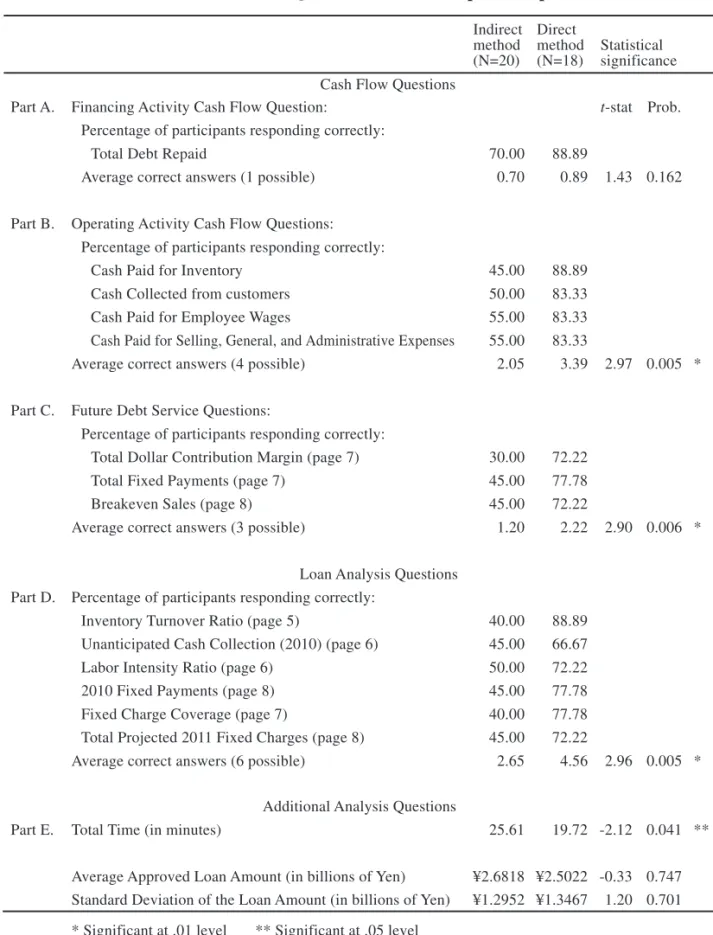
Table 1 shows the variables examined in this study for each group (direct or indirect) as well as the percentage of participants responding correctly to the above mentioned four questions. Part A of the Table 1 shows that participants of both groups are equally capable of correctly answering the same question with identical given information.
9 These variables, considered to be useful in lending decisions, were also used in Klammer and Reed (1990). I did not include breakeven sales which was included in this part of the analysis in Klammer and Reed (1990) because the Breakeven sales figure can be very easily calculated by the Total Projected 2011 Fixed Charges (i.e. by dividing Total Projected 2011 Fixed Charges by a given number (0.10) in the question.
10 Used in Koch and Kalinsky (1984) and Klammer and Reed (1990). See details in Klammer and Reed (1990, footnote 3).
Indirect Direct
method method Statistical (N=20) (N=18) significance Cash Flow Questions
Part A. Financing Activity Cash Flow Question: t-stat Prob. Percentage of participants responding correctly:
Total Debt Repaid 70.00 88.89
Average correct answers (1 possible) 0.70 0.89 1.43 0.162 Part B. Operating Activity Cash Flow Questions:
Percentage of participants responding correctly:
Cash Paid for Inventory 45.00 88.89 Cash Collected from customers 50.00 83.33 Cash Paid for Employee Wages 55.00 83.33 Cash Paid for Selling, General, and Administrative Expenses 55.00 83.33
Average correct answers (4 possible) 2.05 3.39 2.97 0.005 * Part C. Future Debt Service Questions:
Percentage of participants responding correctly:
Total Dollar Contribution Margin (page 7) 30.00 72.22 Total Fixed Payments (page 7) 45.00 77.78 Breakeven Sales (page 8) 45.00 72.22
Average correct answers (3 possible) 1.20 2.22 2.90 0.006 * Loan Analysis Questions
Part D. Percentage of participants responding correctly:
Inventory Turnover Ratio (page 5) 40.00 88.89 Unanticipated Cash Collection (2010) (page 6) 45.00 66.67 Labor Intensity Ratio (page 6) 50.00 72.22 2010 Fixed Payments (page 8) 45.00 77.78 Fixed Charge Coverage (page 7) 40.00 77.78 Total Projected 2011 Fixed Charges (page 8) 45.00 72.22
Average correct answers (6 possible) 2.65 4.56 2.96 0.005 * Additional Analysis Questions
Part E. Total Time (in minutes) 25.61 19.72 -2.12 0.041 ** Average Approved Loan Amount (in billions of Yen) ¥2.6818 ¥2.5022 -0.33 0.747 Standard Deviation of the Loan Amount (in billions of Yen) ¥1.2952 ¥1.3467 1.20 0.701 * Significant at .01 level ** Significant at .05 level
In contrast, Part B of the Table 1 shows that on average, the two groups show different capabilities when asked to answer operating cash flow questions. The participants in the direct method presentation group answered all four questions significantly more accurately compared with the indirect method presentation group at the 0.01 level of significance (two-tailed t test). The results suggest that format or presentation method does matter in users’ information processing. These findings are consistent with those of Klammer and Reed (1990).
The results of Part C of Table 1 also suggest participants had difficulty in answering the questions related to the likelihood of the firm’s future debt service abilities. Similarly, Part D of Table 1 shows that participants given the direct method of presentation could answer important loan analysis questions significantly (at the 0.01 level, two-tailed t test) more accurately than participants given the indirect method of presentation.
Part E of Table 1 shows the results of additional analyses. I compared the average total time between the two groups to answer Questions I through V. The results show that, on average, participants given the indirect method of presentation took statistically significantly (significance at the 0.05 level, two-tailed t test) more time to finish their task than the direct method group.
Although the above results support the view that the direct method of presentation is more useful, on average, to find information from a given data set and to more accurately calculate financial ratios typically used in loan analyses, I did not find statistically different results in the amount of loan approved between the two groups. These findings are partly supported by informal interviews with participants after the experiment. Some of the participants argued that they were familiar with the financial ratio questions given in the experiment, however, it was extremely difficult for them to connect the financial ratios they had calculated and the amount of loan that they should approve, if any.
Overall, the results shown in Table 1 suggest that selection of presentation format may improve users’ decision making and may reduce calculation errors.
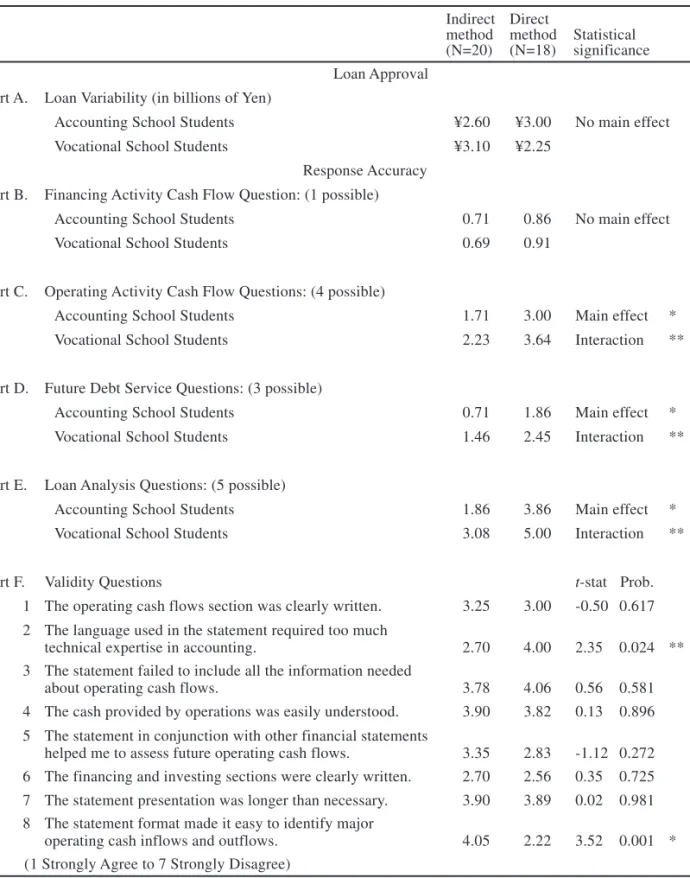
Part A to Part E of Table 2 summarize the results of the 2 x 2 factorial design ANOVAs. Since two different groups of students participated in the experiment (i.e. 14 accounting school students and 24 vocational school students), I examined the degree to which the observed results were caused by differences among the participants.
Regarding the loan variability (in billions of yen) and financing activity cash flow questions, there are no statistically significant differences between the two different groups of students according to the ANOVA analyses (Parts A and B). However, I find statistically significant differences in the accuracy of answering these questions between the two groups of students for the results of the operating cash flow questions, future debt service questions and loan analysis questions, in addition to the main effects that were found in Table 1 (Parts
Indirect Direct
method method Statistical (N=20) (N=18) significance Loan Approval
Part A. Loan Variability (in billions of Yen)
Accounting School Students ¥2.60 ¥3.00 No main effect Vocational School Students ¥3.10 ¥2.25
Response Accuracy Part B. Financing Activity Cash Flow Question: (1 possible)
Accounting School Students 0.71 0.86 No main effect Vocational School Students 0.69 0.91
Part C. Operating Activity Cash Flow Questions: (4 possible)
Accounting School Students 1.71 3.00 Main effect * Vocational School Students 2.23 3.64 Interaction ** Part D. Future Debt Service Questions: (3 possible)
Accounting School Students 0.71 1.86 Main effect * Vocational School Students 1.46 2.45 Interaction ** Part E. Loan Analysis Questions: (5 possible)
Accounting School Students 1.86 3.86 Main effect * Vocational School Students 3.08 5.00 Interaction ** Part F. Validity Questions t-stat Prob. 1 The operating cash flows section was clearly written. 3.25 3.00 -0.50 0.617 2 The language used in the statement required too much
technical expertise in accounting. 2.70 4.00 2.35 0.024 ** 3 The statement failed to include all the information needed
about operating cash flows. 3.78 4.06 0.56 0.581 4 The cash provided by operations was easily understood. 3.90 3.82 0.13 0.896 5 The statement in conjunction with other financial statements
helped me to assess future operating cash flows. 3.35 2.83 -1.12 0.272 6 The financing and investing sections were clearly written. 2.70 2.56 0.35 0.725 7 The statement presentation was longer than necessary. 3.90 3.89 0.02 0.981 8 The statement format made it easy to identify major
operating cash inflows and outflows. 4.05 2.22 3.52 0.001 * (1 Strongly Agree to 7 Strongly Disagree)
* Significant at .01 level ** Significant at .05 level
B, C, and D). Specifically, the vocational school students’ accuracy in answering these questions, on average, was significantly higher than that of the accounting school students at the 0.05% level of significance for both the indirect and direct groups.
Finally, Part B of Table 2 summarizes the average responses to the eight RCE questions. These questions are expected to provide further insight on participants’ perceptions about questions in the experiment. Among the eight RCE questions, I find that there are statistically significant results for question two (“The language used in the statement required too much technical expertise in accounting.”) and question eight (“The statement format made it easy to identify major operating cash inflows and outflows.”). Although the direct method presentation group, on average, more accurately responded to the operating cash flow questions, participants in that group thought that the language used in the direct method presentation required a higher degree of expertise in accounting (significant at the 0.05% level). In addition, the direct method presentation group, on average, thought it was easier to identify major operating cash flow.
5. Conclusions
This paper presents the following results. Participants provided the indirect format of presentation showed significantly less accurate results than participants provided the direct format of presentation when both groups were asked to calculate the financial ratios related to a firm’s ability to meet future debt service requirements. The results suggest that presentation format influences users’ decision making, and the direct method of presentation, partly because it does not require additional calculation needed as under the indirect method of presentation to calculate operating cash flow information, is the preferred method to use because of such advantages. The results of the paper extend Klammer and Reed (1990) in that in comparison with experienced bank loan managers and analysts, even less experienced users of financial statements, namely, accounting students with little work experience, find that the direct method of presentation of operating cash flow is more understandable (i.e. would cause fewer computational errors). The results of the paper suggest that, as IASB (2008) recommends, the direct method of presentation of operating cash flow should be a requirement for all firms.
REFERENCES
American Institute of Certified Public Accountants (AICPA). 2000. Accounting Trends and Techniques. New York. NY: AICPA.
Barth M.E., Cram, D.P., Nelson, K.K. 2001. Accrual and the Prediction of Future Cash Flows. The
Accounting Review 76(1): 61-74.
Chartered Financial Analysts (CFA) Institute. 2005. A Comprehensive Business Reporting Model. Financial
Reporting for Investors. Charlottesville, VA: CFA Institute.
CFA Institute. 2007. A Comprehensive Business Reporting Model. Financial Reporting for Investors. Charlottesville, VA: CFA Institute.
Cheng, C.S.A., and D. Hollie. 2008. Do Core and Non-Core Cash Flows from Operations Persist Differently in Predicting Future Cash Flows? Review of Quantitative Finance and Accounting: 31: 29-53.
Clinch, G., B. Dishu, and S. Sin. 2002. The Usefulness of Direct and Indirect Cash Flow Disclosures.
Review of Accounting Studies 7 (4): 383-404.
Conover, T., Dahawy, K., Dick, W., Iatrides, G., Klammer, T., Kojima, K., Lai, S., Paananen, M., Poli, P., and Rahman, A. 2011. Research Proposal: Decision Usefulness of Operating Cash Flows: Direct
Method or Indirect Method.
International Accounting Standards Board (IASB). 1992. Cash Flow Statements. International Accounting
Standard 7. London, U.K.: IASB.
International Accounting Standards Board (IASB). 2008. Discussion Paper: Preliminary Views on
Financial Statement Presentation. London, U.K.: IASB.
International Accounting Standards Board (IASB). 2010. Exposure Draft: Conceptual Framework for
Financial Reporting. London, U.K.: IASB. February.
Jones, S. and L. Widjaja. 1998. The Decision Relevance of Cash-Flow Information: A Note. Abacus 34 (2): 204-219.
Klammer, T.P. and A.A. Reed. 1990. Operating Cash Flow Formats: Does Format Influence Decisions?
Journal of Accounting and Public Policy 9: 217-235.
Koch, B.S., and Karlinsky, S.S. 1984. The Effect of Federal Income Tax Law Reading Complexity on Students’ Task Performance. Issues in Accounting Education 1: 98-110.
Krishnan, G.V. and J.A. Largay III. 2000. The Predictive Ability of Direct Method Cash Flow Information.
Journal of Business Finance & Accounting 27 (1-2): 215-245.
Kwok, H.2002 The Effect of Cash Flow Statement Format on Lenders’ Decisions. The International
Journal of Accounting 37(3): 347-362.
Libby, R. 1981. Accounting and Human Information Processing Theory: Theory and Applications. Englewood Cliffs, NJ: Prentice Hall.
Maines, L.A., and L.S. McDaniel. 2000. Effects of Comprehensive-Income Characteristics on Nonprofessional Investors’ Judgments: The Role of Financial-Statement Presentation Format. The
Accounting Review 75(2): 179-207.
Mello-e-Souza, C. 2009. Taking the Mystery out of the Cash Flow Statement: A Simplified Implimentation
of the Indirect Method. Working Paper, Seattle University.
Nurnberg, H. 2006. Perspectives on the Cash Flow Statement Under FASB Statement No.95. October. Columbia Business School CEASA Occasional Paper Series.
Orpurt, S.F. and Y. Zang. 2009. Do Direct Cash Flow Disclosures Help Predict Future Operating Cash Flows and Earnings? The Accounting Review 84(3): 893-935.
Sharma, D.S. and E.R. Iselin. 2003a. The Relative Relevance of Cash Flow and Accrual Information for Solvency Assessments: A multi-Method Approach. Journal of Business Finance & Accounting 30(7-8): 1115-1140.
Information in a Behavioural Field Experiment. Accounting and Business Research 33(2): 123-135. Stock, D. and C.J. Watson. 1984. Human Judgment Accuracy, Multidimensional Graphics, and Humans
Appendix 1 Survey Sheet for Indirect Method. Dear Participant,
Cash flow analysis is an important part of the lending decision. Proposed changes in financial statement presentation requirements are expected to put more emphasis on cash flow information. Financial institutions are likely to modify the ratios used to assess borrower’s potential future cash flows as these changes are implemented.
For this study we are asking you to review the financial statements (balance sheet, income statement, and statement of cash flows) for Crescent Company, a fictional retail entity. This entity has been repositioning itself in the market place and narrowing its geographic focus. You will use the given financial statements to compute a series of financial ratios. Using the ratio information and the financial statement data you are then asked what, if any, portion of a requested loan you would make to Crescent Company. Please assume that the ratio definitions used have been agreed upon as being appropriate for this type of analysis.
For simplicity, none of the supplemental financial data that would normally be available for your use has been provided. However, additional detail has been included on the income statement and your analysis is not complicated by mergers or non-operating transactions in receivables, payables, inventory and so forth.
Before you begin to compute the requested financial ratios take a few moments to review the financial statements. When you are ready to begin working on the questions, separate the financial statements from the rest of the instrument and follow the instructions for each segment.
Thank you for agreeing to participate in this study.
Koji Kojima
School of International Studies Kwansei Gakuin University
Crescent Company Statement of Financial Position
December 31, 2010 (Yen in Millions) 2008 2009 2010 Assets Current assets Cash ¥430 ¥750 ¥2,220
Trade receivables, net 1,600 1,840 1,850
Inventories 1,250 1,130 1,200
Total current assets ¥3,280 ¥3,720 ¥5,270
Investments in subsidiaries (equity method) 760 890 860
Property and equipment (net) 6,810 6,960 7,040
Total Assets ¥10,850 ¥11,570 ¥13,170
Liabilities and Owners Equity Current liabilities
Accounts payable – trade ¥1,400 ¥1,490 ¥1,460
Short-term debt 240 130 180
Wages payable 170 290 450
Accrued interest payable 200 240 310
Accrued selling, general and administrative expenses 280 300 380
Current portion – store shutdown costs 120 120 40
Total current liabilities ¥2,410 ¥2,570 ¥2,820
Long-term debt 2,540 2,760 2,730
Deferred income taxes 160 210 330
Long-term portion-store shutdown costs 520 420 270
Total liabilities ¥5,630 ¥5,960 ¥6,150
Owners Equity
Common stock, no par 2,130 2,160 2,670
Retained earning 3,090 3,450 4,350
Total owners equity ¥5,220 ¥5,610 ¥7,020
Crescent Company Income Statement
For the Year Ending December 31, 2010 (Yen in Millions)
2008 2009 2010
Sales revenue, net ¥12,930 ¥12,490 ¥13,940
Operating expenses
Cost of goods sold 10,710 10,070 11,140
Wage expense 770 760 830
Depreciation expense 530 520 570
Selling, general and administrative expense 660 660 690
Total operating expense 12,670 12,010 13,230
Income from primary operations ¥260 ¥480 ¥710
Other
Income from equity investments in subsidiaries 130 160 370
Gain on sale of property and equipment 40 160 810
Gain – repurchase of debt 70 60 40
Interest expense (180) (210) (230)
Loss on partial sale of subsidiaries (40)
Estimated cost of store closing (810) --
Other income (¥750) ¥170 ¥950
Income before tax (¥490) ¥650 ¥1,660
Less - income tax expense ¥190 (¥150) (¥580)
Crescent Company Statement of Cash Flows
For the Year Ending December 31, 2010
(Yen in Millions) 2008 2009 2010
Operating Activities
Net Income ¥ (300) ¥ 500 ¥ 1,080
Adjustments for non-cash items
Depreciation ¥ 530 ¥ 520 ¥ 570
Dividends on equity investments 70 90 190
Loss on sale of investments in subsidiaries 100 -- 40
Store shutdown costs 640 (100) (230)
Change in deferred income taxes (250) 50 120
Gain on sale of property and equipment (40) (160) (810)
Equity method investment revenue (130) (160) (370)
Gain on repurchase of debt (70) (60) (40)
Change in trade receivable (170) (240) (10)
Change in inventories 10 120 (70)
Change in trade accounts payable 140 90 (30)
Change in wages payable 40 120 160
Change in interest payable 30 40 70
Change in selling, gen. & adm. Costs 30 20 80
Net Cash Flow From Operating Activities ¥ 630 ¥ 830 ¥ 750
Investing Activities
Inflows
Disposal of property and equipment ¥ 50 ¥180 ¥860
Partial liquidation of subsidiary investments -- -- 170
Investing Inflows 50 180 1030
Outflows
Acquisition of property and equipment 970 690 700
Additional investment in subsidiaries 50 60
Investing Outflows 1070 750 700
Net Cash Flows from Investing Activities (¥970) (¥570) ¥330
Financing Activities
Inflows
Long-term borrowings 480 460 190
Short-term borrowings 170 90 140
Sale of common stock 20 30 510
Financing Inflows 670 580 840
Outflows
Long-term debt repayment 130 180 180
Short-term debt repayment 190 200 90
Reacquisition of common stock 180 --
--Payment of cash dividends 120 140 180
Financing Outflows 620 520 450
Net Cash Flows from Financing Activities ¥ 50 ¥ 60 ¥ 390
Answer Sheet
Student ID # Year Name LOAN ANALYSIS
Below your are asked to compute several financial ratios as part making a decision on whether to loan Crescent Company additional funds to help them expand. The formula for computing the ratios are provided with each question. The information you need to make the computations can be obtained from an analysis of the provided financial statements.
You will find it helpful to separate the cover sheet and financial statement pages (pages 1-4) from the remainder of the questionnaire. Room for computations is provided below each question. Use the back of the cover sheet if you need additional computational room. Certain computations you make for one ratio question will be used in one or more additional questions. The questions refer you back to the original computation question so you can simply copy your prior computation.
Please Record the Time You Start: Time :
I. In 2008, accounts receivable turned over 7.98 times. In 2010, receivables were converted less quickly to cash (The accounts receivable turnover ratio was 7.53). In 2008, inventories turned over 8.44 times. What was the comparable inventory turnover ratio for 2010? Please round your answer to two decimals.
2008 2010
Accounts Receivable Turnover Ratio: (Cash basis) 7.98 7.53 Inventory Turnover Ratio: (Cash basis)
Cash Paid for Inventory Purchases
Inventories at Year End = 8.45 Ans.
II. Operating cash inflows must be adjusted for spontaneous (sales driven) changes. In 2010, how much more or less cash was collected from customers by Crescent Company than one would have anticipated, given that sales increased by 11.6% over 2009 (Calculate whether cash collections from customers increased by more or less than 11.6%).
Unanticipated Cash Collections:
Less
Anticipated 2010 Cash Collections [Cash Collected from Customers (2009)
Adjusted for Expected Increase of 11.6%] ¥14,210 millions Unanticipated Cash Collection (2010) Ans. _________millions
(bracket answer if negative)
III. Crescent Company shut down stores that they believed were obsolete because they were too small and thus overly labor intensive. In 2008, approximately 5.7% of the cash collections from customers were used to pay payroll related costs. What was the comparable labor intensity ratio in 2010?
Please round your answer to two decimals.
Labor Intensity Ratio (2008) 5.72%
Labor Intensity Ratio (2010):
Cash Paid for Employee Wages
X 100 = __________ x 100 Cash Collected from Customers (from II above)
Ans. ___________%
IV. Crescent Company has applied for a ¥4,000,000,000 loan. The firm plans to use 90% of their cash (as of 12/31/10) along with the loan proceeds to purchase several new super stores. Cash, not profits, repays loans. You must make a judgment about Crescent Company’s ability to meet future debt service requirements. One indicator is the margin of comfort in the existing repayment ability of Crecent Company? What is the firm's fixed charge coverage ratio for 2010? Please round your answer to two decimals.
Fixed Charge Coverage:
Dollar Contribution Margin (a) = ____________________=
Total Fixed Payments (b) Ans. ___________ a. Dollar Contribution Margin: (Yen in millions)
Cash Collected from Customers (from question II or III) _______________ less Cash Paid for Inventory (from question I) - _______________ less Cash Paid for Employee Wages (from question III) - _______________
less Cash Paid for Income Taxes - 460,000 Total Dollar Contribution Margin _______________ b. Total Fixed Payments:
Cash Paid for Selling, General and Administrative Expenses _______________ plus Interest Paid in Cash + 160,000
plus Total Debt Repaid + _____________
Total Fixed Payments ______________
(Note) Assume all “Cash Paid for Selling, General and Administrative Expenses” are fixed payments.
V. If Crescent Company’s Loan request is approved the interest rate will be 10% interest rate and there will be a principal payoff of ¥160 millions per year for 25 years. The projected additional debt service charges would be ¥560 millions in 2011 (¥400 millions interest and ¥160 millions principle). You project that Crecent Company's Average Contribution Margin will be 10% in 2011. Compute the projected breakeven sales needed to cover 2010 fixed payments and the projected new annual debt service charges of ¥560 millions.
Breakeven Sales:
Total Projected 2011 Fixed Charges (a)
= ______________ = Average Projected Contribution Margin .10
Ans. ___________ a. Total Projected Fixed Charges:
2010 Fixed Payments (from question IV) _____________ plus Projected New 2011 Debt Charges + 560,000
Total Projected Fixed Charges _____________
Review your answers as desired
AUTHORIZE LOAN QUESTION
Based totally upon your analysis of Crescent Company’s financial statements and the ratios you computed, how much, if any, of the ¥4,000,000,000 loan request would you agree to lend to Change Company?
Assume, your bank is eligible by Federal regulations to lend ¥10,000,000,000 to a single firm. Your bank also has corresponding bank relationships with several other banks which allow you to participate in lending.
You may (1) approve Crescent Company’s loan request for the full ¥4,000,000,000; (2) deny the loan in its entirety; or (3) agree to be part of a participation of several banks for some amount between ¥0 and ¥4 billion. Please indicate what you would do with an X and provide the Yen amount if you select the partial loan option.
_____ Deny loan request
_____ Approve the total ¥4 billion loan request
_____ Approve a loan for the Yen amount indicated below _______________
Demographic Information
Student ID # Year Name
This information will be used only to help analyze the results. All details will be kept totally confidential, as will your answers to the questions asked.
Education: Major Year
Masters Degree ____________ ____________ _________ Bachelors Degree __________ ____________ _________ No College Degree _________
Professional Certifications: (Certificate of Book Keeping, CFA, CPA, etc.) (Please list)
Years studying for CPA examination ________________ year(s) Experience in job (years) ___________________________ year(s) Experience in current job (years) ________________
We are interested in your opinion of the cash flow statement that was included as part of the set of financial statements that you just used. Listed below are a series of statements that represent possible feelings that you might have about the cash flow statement. Think about the cash flow statement that you just used to answer questions and indicated below, by circling the numbers provided, your level of agreement or disagreement with each of the following statements.
1 Strongly Agree 2 Agree 3 Slightly Agree 4 Neither Agree or Disagree 5 Slightly Disagree 6 Disagree 7 Strongly Disagree
1. The operating cash flows section was clearly written.
1 2 3 4 5 6 7
2. The language used in the statement required too much technical expertise in accounting.
1 2 3 4 5 6 7
3. The statement failed to include all the information needed about operating cash flows.
1 2 3 4 5 6 7
4. The cash provided by operations was easily understood.
1 2 3 4 5 6 7
5. The statement in conjunction with other financial statements helped me to assess future operating cash flows.
1 2 3 4 5 6 7
6. The financing and investing sections were clearly written.
1 2 3 4 5 6 7
7. The statement presentation was longer than necessary.
1 2 3 4 5 6 7
8. The statement format made it easy to identify major operating cash inflows and outflows.
Appendix 2 Survey Sheet for Direct Method (SCF only) Crescent Company
Statement of Cash Flows
For the Years Ending December 31, 2010
(Yen in Millions) 2008 年 2009 年 2010 年
Operating Activities
Inflows
Cash collected from customers ¥12,760 ¥12,250 ¥13,930
Dividends received on equity investments 70 90 190
Operating cash inflows 12,830 12,340 14,120
Outflows
Cash paid for inventory purchases 10,560 9,860 11,240
Cash paid for employee wages 730 640 670
Cash paid for selling, general and administrative costs 630 640 610
Interest paid 150 170 160
Store shutdown cost 170 100 230
Income taxes paid (refunded) (40) 100 460
Operating cash outflows 12,200 11,510 13,370
Net Cash Flow From Operating Activities ¥630 ¥830 ¥750
Investing Activities
Inflows
Disposal of property and equipment 50 180 860
Partial liquidation of subsidiary investments -- -- 170
Investing Inflows 50 180 1,030
Outflows
Acquisition of property and equipment 970 690 700
Additional investment in subsidiaries 50 60
---Investing Outflows 1,070 750 700
Net Cash Flows from Investing Activities (¥970) (¥570) ¥330
Financing Activities
Inflows
Long-term borrowings 480 460 190
Short-term borrowings 170 90 140
Sale of common stock 20 30 510
Financing Inflows 670 580 840
Outflows
Long-term debt repayment 130 180 180
Short-term debt repayment 190 200 90
Reacquisition of common stock 180 --
--Payment of cash dividends 120 140 180
Financing Outflows 620 520 450
Net Cash Flows from Financing Activities ¥ 50 ¥ 60 ¥ 390