ページ番号は挿入しないこと タイトル:ゴシック,20pt 著者名:明朝/Times 12pt E-mail アドレス:Times 9pt (連絡著者のみ) キーワード:Times イタリック,10pt,最大 2 行 固有名詞以外は頭文字は小文字 要旨:明朝/Times 9pt,最大 7 行 ボールドイタリック,10pt 章見出し:ゴシック,11pt 本文:明朝/Times10pt 単位は「立体」 所属・連絡先:明朝/Times 9pt
岩盤力学に関するシンポジウム講演集の
講演原稿体裁サンプル
岩盤 太郎
1*・進歩 大輔
1・亀裂 花子
2・Jimmy PAGE
3 1岩力建設株式会社 技術開発部(〒160-0004 東京都新宿区四谷一丁目無番地) 2岩盤大学大学院 工学研究科建設工学専攻(〒160-0004 東京都新宿区三矢六丁目13-5)3Hard Rock Corp. (1600 Pennsylvania Avenue NW, Washitngon, DC 20500) *E-mail: [email protected] このファイルは岩盤力学に関するシンポジウム講演集の講演原稿(和文)を作成するために必要な,レ イアウトやフォントに関する基本的な情報を記述しています.このファイルの中の文章や図表をこれから 書こうとしている実際のものに置き換えれば,所定のフォントや配置の原稿を容易に作成することができ ます. この要旨を含め,タイトル部分の幅は本文よりも左右10 mmずつ狭くします.要旨のフォントは,日本 語は明朝体9 pt,英数字はTimes9 ptを用いてください.要旨の長さは7行以内です.要旨の後に1行空けて, キーワードを 5 つ程度,Times-Italic 10pt のフォントで書いて下さい.
Key Words : times, italic, 10pt, one blank line below abstract, indent if key words exceed one line
1. タイトルページ
タイトルページは2つの部分で構成されます. (a) タイトル部分:横1段組(題目,著者,所属,連絡 先住所,E-mailアドレス(連絡先著者のE-mailアドレスの み),要旨,キーワード) (b) 本文部分:横2段組,文字数は25文字,行数は48行 とします.(英文原稿の場合は56行) (1) タイトル部分のレイアウトとフォント 全てのページのマージンはこのサンプルにありますよ うに上辺19 mm,下辺24 mm,左右ともに20 mmに設定し てください.タイトル部分の左右のマージンは、本文の 左右のマージンよりもそれぞれ10 mm ずつ大きくとって 下さい.すなわち,A4用紙の幅に対して左右それぞれ 30 mm ずつのマージンをとります.そして以下次の順に タイトル部分の構成要素を書いて下さい. ・タイトル:ゴシック体 20 pt ,センタリング (2行(12pt)の空行) ・著者名:明朝体/Times 12 pt,センタリング (2行(12pt)の空行) ・著者所属:明朝体/Times 9 pt,センタリング ・E-mailアドレス:Times 9 pt,センタリング (1行(12pt)の空行) ・要旨:明朝体/Times 9 pt,7行以内 (1行(12pt)の空行) ・キーワード:Times - Italic, 10pt,5つ程度,2行以内 (4行(12pt)の空行) 著者と所属とは肩付き数字で対応づけ,上記のように 並べて下さい.また,著者のうち,連絡先著者となる方 の名前の右肩には「*」を付し,そのE-mailアドレスを上 記の見本のように「*」の後に記載してください.限ら れた紙面ですので,肩書きや学位の記載は省略いただき, 所属はできるだけ取りまとめてください. 'Key Words' という文字はボールドイタリック体にしま す.また,各キーワードは固有名詞を除いて小文字で始 めてください. (2) 本文部分のレイアウトとフォント キーワードの後に4行(12pt)空けて,本文を開始し てください. 本文は2段組で,左右のマージンは 20 mm ずつ,段と 段との間のスペースは約 6 mm とします.文字数は25文 字,行数は48行とします. 本文のフォントは,日本語は明朝体,英数字は Times/Symbolとし,文字の大きさは10 ptを用いてくださ い. タ イ ト ル 部 の マ ー ジ ン は 10 m m 余 分 に タイ ト ル 部 の マ ー ジ ン は 10 m m 余 分 に 2 行(12pt)の空行 2 行(12pt)の空行 1 行(12pt)の空行 上辺マージン 19 mm 下辺マージン 24 mm 右 マ ー ジ ン 20 m m 左 マ ー ジ ン 20 m m 4 行(12pt)の空行 約 6 m m の ス ペ ー ス 1 行(12pt)の空行 1 行(12pt)の空行節の見出し:ゴシック 10pt,上 1 行の空行 数式はセンタリング 項の見出し:ゴシック 10pt,上に空行なし 数番号は右詰 日本語フォントにおけるギリシャ文字(σδε等)の 使用は可能ですが,機種/フォントに依存する特殊文字 (○付数字,ローマ数字,全角 1 文字に変換した単位 等),半角カタカナおよび HG 系のフォントは文字化け の原因となるので使用しないでください. 文字色は黒を用いてください.図・表・写真等につい ては色の制約は設けませんが,白黒モニタ/プリンタに 出力した際に問題が生じないよう配慮してください. 和文原稿の場合でもカンマ「,」とピリオド「.」を 用いてください.句読点「、」「。」を用いないこと. カンマ「,」やピリオド「.」あるいは文献番号3) な どが行頭にこないようにすること.また,カッコが行末 にこないようにすること.
2. 一般ページ
第2ページ以降はタイトルページの本文部分と同じレ イアウトとフォントで本文を作成します. 脚注や注はできるだけ避けて下さい.本文中で説明す るか,もしくは本文の流れと関係ない場合には付録とし て本文末尾に置いて下さい. 専門用語は,JISに基づき正しく用いて下さい.以下 によくある間違いを例示します. ・誤「一軸圧縮強度」⇒ 正「一軸圧縮強さ」 ・誤「破壊基準」⇒ 正「破壊規準」3. 見出し(見出しが1行以上に長くなるときはこ
の例のようにインデントし折り返す)
(1) 見出しのレベル 見出しのレベルは章章章,節章 節節節,項項項項の3段階までとします. 章 章 章 章の見出しはゴシック体とし,2.などの数字に続けて書 きます.また,見出しの上下にスペースを空けます.こ のファイルのサンプルから分かるように,上を2行,下 を1行程度空けて下さい.ただしページや段が切り替わ る部分は章の見出しが最上部に来るよう調整してくださ い. (2) 節の見出し 節の見出しもゴシック体で,(4) などの括弧付き数字 を付けます.見出しの上だけに1行程度のスペースを空 けて下さい. a) 項の見出し 項の見出しもゴシック体で,片括弧付きアルファベッ トを付け,上下には特にスペースを空けません.項より 下位の見出しは用いないで下さい.4. 数式および数学記号と単位
(1) 数式および数学記号 数式や数学記号は次の式 (1a)( )
G
b t
n n=
= ∞∑
0 (1a)F
=
∫
sin
z dz
Γ (1b) のように本文と独立している場合でも,C
D,
α
( )
z
の ように文章の中に出てくる場合でも同じ数式用のフォン トを用いて作成します.数式や数学記号の品質が悪いと 原稿として受け付けません. 数式はセンタリングし,式番号は括弧書きで右詰めに します.数式と式番号との間にリーダーを付けないでく ださい. 式や図に使われる文字,記号,単位記号などは,でき るだけ常識的な記号を使い,必要に応じて記号の一覧表 を付録としてつけてください.数式はできるだけ簡単な 形でまとめて,式の展開や誘導の部分を少なくして文章 で補ってください.式を書く場合には,記号が最初に現 われる箇所に記号の定義を文章で表現して使用してくだ さい.また,同一記号を2つ以上の意味で使うことは避 けてください. 本文中の式番号は,式(1),式(2)のように表記してく ださい. 数字および記号(特に上付,下付のあるもの)は2行 にわたらないようにすること. (2) 単位 単位は原則としてSI 単位を使用すること.従来単位系 を用いる場合は,カッコ書きで併記してください. 例: 9.8 kN/m3(1 tf/m3),0.49 MPa(5 kgf/cm2) 単位の字体には「立体」を用い,「斜体」や「イタリ ック」を用いないでください.5. 図・表・写真
(1) 図・表・写真の位置 図表はそれらを最初に引用する文章と同じページに置 くことを原則とします.原稿末尾にまとめたりしてはい けません.また,図表はそれぞれのページの上部または 下部に集めてレイアウトして下さい.図表の横幅は, 章の見出し:ゴシック 11 pt,上 2 行 下 1 行の空行図表番号の本文での引用:ゴシック ゴシック 9pt 明朝 9pt 「2段ぶち抜き」あるいはこのサンプルの表-1 や図-2 の ように「1段の幅いっぱい」のいずれかとします.図表 の幅を1段幅以下にして図表の横に本文テキストを配置 することはやめて下さい.図表と文章本体との間には1 ~2行程度の空白を空けて区別を明確にします. (2) 図・表・写真中の文字およびキャプション 図表中の文字や数式の大きさが小さくなり過ぎないよ うに注意してください.特にキャプションの大きさ (9pt) より小さくならないようにして下さい. 長いキャプションは表-1 のようにインデントして折り 返します. 「図-1」,「表-2」,「写真-3」はゴシック体で表示 し,ハイフンもしくはマイナスで結ぶこと.
6. 参考文献の引用とリスト
参考文献は出現順に番号を振り,その引用箇所でこの ように1)上付き右括弧付き数字で指示します.参考文献 はその全てを原稿の末尾にまとめてリストとして示し, 脚注にはしないでください. 本文中の引用は1,5)ではなく,このように1), 5)としてくだ さい. 本文中で引用は,3名以上の場合に限り,第一著者の みを書き,あとを“ほか”もしくは“et al.”などと省略 してかまいません. 参考文献は,原稿登載後に時間が経過してもたどれる ものだけを挙げてください.すなわち,インターネット 上のホームページアドレスや私信などを参考にした場合 は,本文末の参考文献に挙げずに本文中または脚注で示 してください. 参考文献リストの書き方は,論文の場合は著者名,論 文名,雑誌名(書名),巻号,ページ,発行年の順に記 入してください.発行年については,西暦を使用してく ださい.英文雑誌の場合は,姓,イニシャルとしてくだ さい.著者数が多い場合でも参考文献リストには全ての 著者名を記載してください.単行本の場合は,著者名, 書名,ページ,発行所,発行年とします.英文の単行本 の場合は,書名は各単語とも頭文字は大文字としてくだ さい.英文の雑誌名,書名はイタリック体とします. 和文の場合も参考文献リスト中の人名はカンマでつな いでください. 良い例:「高橋茂,木村直樹:地盤の………」 悪い例:「高橋茂・木村直樹:地盤の………」 参考文献リストの一つの項目が2 行以上にわたるとき, 2 行目以降はインデント(頭下げ)してください. 表-1 表のキャプションは表の上に置く.このように長いとき はインデントして折り返す. 資料番号 高さ h (m) 幅 w(m) 1 1.45 0.25 2 1.75 0.40 3 1.90 0.65 0 5 10 15 20 25 0 2 4 6 イベント カ ウ ン ト (N ) 図-2 図のキャプションは図の下に置く7. 最終ページのレイアウトと英文要旨
(1) 最終ページのレイアウト 最終ページには英文のタイトル,著者名および要旨を 横1段組で書きます.このサンプルにあるように,本文 や参考文献リストまでの2段組部分の左右の柱の高さを ほぼ同じにし,10 mm 程度の空白を入れて英文要旨を配 置します. (2) 英文要旨部分(和文原稿のみ) 和文原稿の場合は,最終ページに 7 行以内の英文要旨 をつけます. タイトル部分と同様に,本文よりも左右のマージンを 10 mm ずつ広くとり,横 1 段組で,次の項目を書いてく ださい. ・英文タイトル:Times 12 pt,センタリング(タイトル はすべて大文字 1 行の空行(12 pt) ・英語著者名:Times 12 pt,センタリング(名は頭文字 のみ大文字,姓はすべて大文字.) 1 行の空行(12 pt) ・英文要旨:Times 10 pt, 7 行以内 英文タイトルはすべて大文字としてください.また英 語著者名は,名前は頭文字のみ大文字で姓は全て大文字 としてください. 図表と本文の間は 1~2 行の空行9pt ゴシック,10pt 英文要旨:Times 10pt,7 行以内 英文著者名:Times 12pt First name は頭文字のみ大文字 Family name は全て大文字 英文タイトル:Times 12pt,全て大文字 英文要旨は,国外への成果の発信の面で重要であるの で,研究の成果がその内容に十分反映されるようにし, また英文についても英語を母国語とする人の校閲を受け るなどの配慮を行ってください. 謝辞:「謝辞」は「結論」の後に置いて下さい.見出し とコロンをゴシック体で書き,その直後から文章を書き 出して下さい.
付録 「付録」の位置
「付録」がある場合は「謝辞」と「参考文献」の間に 置くこと. 参考文献 1) 山田靖紀,辻田 満,脇田和試:山岳トンネルおよび 周辺岩盤の地震時挙動,土木学会論文集,No.374/I-6, pp.249-259,1986.2) Barton, N., Bandis, S. and Bakhtar, K. : Strength, deformation and conductivity coupling of rock joints. Int. J. Rock Mech. & Min. Sci. & Geomech. Abstr. 22 (3), pp. 121-140, 1985.
3) 都城秋穂,久城育夫:岩石学 II,岩石の性質と分類, 共立全書 205,p.171,共立出版,1975.
4) 国立天文台編:理科年表,pp.726-764,丸善,1993. 5) Franklin, J.A. and Dusseault, M.B. : Rock Engineering,
p.296, Mc Graw Hill, 1989.
6) Smith, W. : Cellular phone positioning and travel times estimates, Proc. of 8th ITS World Congress, CD-ROM, 2000.
PRINT SAMPLE FOR JAPANESE MANUSCRIPT FOR PROCEEDINGS OF THE
SYMPOSIUM ON ROCK MECHANICS
Taro GAMBAN, Daisuke SIMPO, Hanako KIRETSU and Jimmy PAGE
The present file has been made as a print sample of the manuscripts for Proceedings of the Symposium on Rock Mechanics. Its text describes instructions to prepare the manuscripts: the layout; the font styles and sizes; and others. If you replace the text or the figures of the present file by your own ones, using CUT & PASTE procedures, you can easily make your own manuscripts.
This English ABSTRACT has narrower width than the main text by 10 mm from the left and the right margins of the main text, respectively. Font used here is Times-Roman 10pt. The length should be within 7 lines. It is preceded by the title and the authors; both are centered and the font size is 12pt.
英文書名,雑誌名はイタリック 発行年は西暦 長い場合はインデント 1 行(12pt)の空行 1 行(12pt)の空行 英 文 要 旨 の マ ー ジ ン は 10 m m 余 分 に 英文 要 旨 の マ ー ジ ン は 10 m m 余 分 に
1
Instructions for Mauscript for JSCE Journals/ Author
Guidelines for Manuscript Preparation for JSCE
Taro DOBOKU
1, Hanako YOTSUYA
2and John SMITH
3 1Member of JSCE, Professor, Dept. of Civil Eng., University of Doboku(Yotsuya 1, Shinjuku-ku, Tokyo 160-0004, Japan) E-mail:[email protected]
2Member of JSCE, Dept. of Civil Eng., Doboku Corporation (13-5, Mitsuya 6, Shinjuku-ku, Tokyo 160-0004, Japan)
E-mail:[email protected]
3Member of JSCE, Professor, Inst., Industrial Science, University of Tokyo (7-22-1 Roppongi, Minato-ku, Tokyo 106-8558. Japan)
E-mail:[email protected]
This template is prepared for your preparion of manscript for JSCE journals. It provides instructions: page layout, font style, size and others. You may use it to create your own manuscript by replacing the relevant text with your own, using “cut & paste.”
The Abstract should be justified, leaving a 30 mm margine on the left and right sides. Font should be a 10-point Times-Roman. The length should be 300 words or less.
Key Words : times, italic, 10pt,one blank line below abstract, indent if key words exceed one line
1. TITLE PAGE
The first page consists of two parts:
(a) Front matters : single column (title, author(s),
affiliation(s), contact address(es), E-mail address(es),
abstract, key words) E-mail address should be
indi-cated in a separate, independent line.
(b) Main text in double columns.
The journal name, volume and issue numbers and
the date of issue should be aligned right in the top
margin. Page numbers are to be put in the bottom
margins of the manuscript. Some word processing
softwares do not allow texts in both single and double
columns to be put together in one file, and thus,
cre-ate two separcre-ate files for the title page.
(1) Layout and fonts for the front matters
Left and right margins for the front matters are
equally set at 30 mm, The front matters are, thus, to
be laid-out within the borders narrower than those for
the main text.
The front matters include the followings:
(About 10 mm blank space)
Title in Times-Roman, 18pt, bold
(About 15mm blank space)
Author(s) in Times-Roman, 12pt.
(About 5 mm blank space)
Affiliation(s) in Times-Roman, 9pt.
E-mail address(es) in Times-Roman, 9pt
(About 10 mm blank space)
Abstract in Times-Roman, 10pt, max. 300 words,
(1 line spacing) and
About 5 Key Words in Times-Italic, 10pt,
(max. 2 blank lines).
The name(s) and affiliation(s) of the author(s)
should be numbered in order of appearance as shown
above. The title 'Key Words' is bold and italic.
(2) Layout and fonts of the main text
The text should be placed about 1cm below the key
words. Left and right margins for the text are equally
set at 20 mm. The text, in double columns put side by
side with 6 mm gap in between, must be
sin-gle-spaced with double spacing between chapters.
Use 11pt Times-Roman font for the text.
(3) page number
Page numbers should be center-aligned and should
appear at the bottom of each page. Since these pieces
of information will be notified by the secretariat of
JSCE before completing the final manuscripts, leave
the blanks as they are, and number the pages
tenta-Top margin 19 mm Left margin 20 mm about 10 mm about 15 mm 18 pt, bold 12 pt about 5 mm 9 pt 10 pt 10 mm 10 mm about 5 mm
about 10 mm 10 pt, Italic, max 2 lines
10 pt, bold Italic 12 pt, bold 11 pt 6 mm 9 pt right margin 20 mm bottom margin 24 mm about 10 mm
2
tively from 1.
2. ORDINARY PAGES
In ordinary pages, the text must be placed within
borders immediately below 19mm top margin. The
other layout is same as the main text in the title page.
(1) Footnotes and remarks
Avoid using footnotes and/or remarks. If any, try
to explain it in the text, or in appendices.
3. HEADINGS (INDENT LIKE THIS
SAMPLE IF IT IS LONG)
(1) Main heading
Capital letters in 12pt bold face fonts should be
used for main headings (chapter titles) that follow the
chapter numbers as is shown in this example. Leave
double and single spacing of lines before and after
every main heading.
(2) Sub-headings for sections
The sub-headings for sections, in 10pt. bold face
fonts, with their initial letters capitalized, are
pre-ceded by parenthesized section number like (2).
Leave single spacing of line before every sub-
heading.
a) Sub-headings for sub-sections
They are written just as the sub-headings for
sec-tions are done, but follow alphabets with right
pa-rentheses. No spacing of lines is left before and after
every sub-heading.
4. MATHEMATICS
Use special high quality fonts for all mathematical
equations in the text. Some equations may be placed
off the text as:
( )
∑
∞ ==
0 n nt
b
G
(1a)
∫
Γ=
z
dz
F
sin
(1b)
and some appear in the text as.
CD,α
(z)If their
quality is not satisfactory, the manuscript may not be
accepted. Numbered equations ((1a) and (1b) for
example) should be center-aligned. The equation
numbers in parentheses should be placed flush right.
5. FIGURES AND TABLES
(1) Location of figures and tables
Figures, tables and photographs should be inserted
at the upper or lower part of the page where reference
is first made to them. Do not place them altogether at
the end of the manuscript.
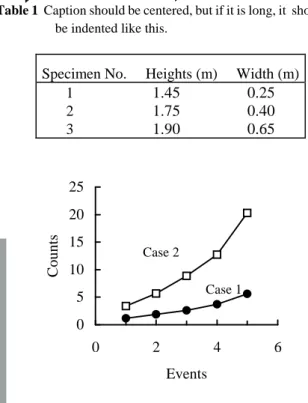
Figures or tables should occupy the whole width of
a column, as shown in Table 1 or Fig.2 in this
ex-ample, or the whole width over two columns. Do not
place any text besides figures or tables. Insert about
one to two lines spacing above the main text.
(2) Fonts and captions
Do not use too small characters in figures and
ta-bles. At least, the letters should be larger than those in
the captions (9 pt). Captions should be centered, but
long captions must be indented like an example of
Table 1. The heading of captions is 9pt bold face.
6. CITATION AND REFERENCE LIST
All the references must be numbered in the order
of appearance in the article and the right
parenthe-sized numbers are used at the text where it is referred
like this
1). The reference list must be summarized at
the end of the main text. Use 9pt font for the list. The
reference list is followed by the date of acceptance
Table 1 Caption should be centered, but if it is long, it should
be indented like this.
Specimen No. Heights (m) Width (m)
1 1.45 0.25 2 1.75 0.40 3 1.90 0.65 0 5 10 15 20 25 0 2 4 6 Events Counts
Fig.2 Place the caption below the drawing.
2 lines 12 pt, bold 11 pt, bold 1 line 1 line 11 pt, bold
Within 56 lines per a coulmn
centered centered 1 or 2 lines Case 2 Case 1 9 pt, bold 9 pt
3
with one line spacing between them as shown in the
present sample.
ACKNOWLEDGMENT: Acknowledgment should
follow Conclusions and its text should be preceded
by bold face heading directly.
APPENDIX A APPENDIX
Appendix should be placed between Acknowledg-
ment and References.
REFERENCES
1) Miles, J. W. : On the generation of surface waves by shear flows, J. Fluid Mech., Vol. 3, Pt. 2, pp. 185-204, 1957. 2) Miche, M. : Amortissement des houles dans le do-maine de
l’eau peu profonde, La Houile Blanche, No. 5, pp. 726-745, 1956.
3) Gresho, P. M., Chan, S. T., Lee, R. L. and Upson, C. D. : A modified finite element method for solving the time- dependent incompressible Navier-Stokes equations, part 1, Int. J. Numer. Meth. Fluids, Vol. 4, pp. 557-598, 1984. 4) Shepard, F. P. and Inman, D. L. : Nearshore water
circula-tion related to bottom topogrphy and wave refraccircula-tion, Trans. AGU., Vol. 31, No. 2, 1950.
5) Smith, W. : Cellular phone positioning and travel times estimates, Proc. of 8th ITS World Congress, CD-ROM, 2000.
(Received July 1, 2009)
10 pt, bold 9 pt