PROCEEDINGS OF THE 8TH JAPAN-CHINA
TEACHER EDUCATION CONFERENCE
Papers from the 8th Japan-China Teacher Education Conference, held on November 9th and 10th, 2019,
at Hyogo University of Teacher Education, JAPAN
Edited by
The Local Organizing Committee of
the 8th Japan-China Teacher Education Conference
PROCEEDINGS OF
THE 8TH JAPAN-CHINA TEACHER EDUCATION CONFERENCE
under the theme of
“Teacher Education corresponding to Change in School Education”
Co-hosted by Hyogo University of Teacher Education Beijing Normal University
Naruto University of Education Joetsu University of Education
Organized by Hyogo University of Teacher Education
Dates : November 9th and 10th, 2019
Venues: Hyogo University of Teacher Education
Kato campus and Kobe Harborland campus
EDITORIAL REMARKS
We are pleased to announce the publication of the PROCEEDINGS OF THE 8TH JAPAN- CHINA TEACHER EDUCATION CONFERENCE.
The Japan-China Teacher Education Conference was founded as an International Conference in 2004 between Naruto University of Education (Japan) and Beijing Normal University (China).
Since then, the conference has been held at the two universities alternately approximately every two years.
The 8th Japan-China Teacher Education Conference was held on November 9th and 10th, 2019 under the theme of “Teacher Education corresponding to Change in School Education.” It was organized by Hyogo University of Teacher Education (Japan) at Kato campus and Kobe Harborland campus.
This Proceedings contains 12 papers that were orally presented, and 10 papers that were presented as poster presentation. It is noteworthy that the oral presentations and poster presentations were reviewed by referees in some way when they applied for submission.
March 2020
Editorial Office
CONTENTS
A Study of the Development and Implementation of the Graduate-Level Teacher Training: In Collaboration with the Prefectural Programme
SAKAGUCHI Masayasu (Hyogo University of Teacher Education) TSUDA Seisuke (Hyogo University of Teacher Education) IKEDA Masafumi (Hyogo University of Teacher Education) YAMAMOTO Shinya (Hyogo University of Teacher Education) TOKUSHIMA Yuya (Hyogo University of Teacher Education) SAKAUE Hiroaki (Hyogo University of Teacher Education) IZUMIMURA Yasuji (Hyogo University of Teacher Education)
1
A Survey of the Mental Health of Chinese Special Education Teachers
ZHANG Shudong (Beijing Normal University) LIU Junli (Beijing Normal University, Graduate Student) CHEN Chunhui (Beijing Normal University) ZHAO Libo (Beihang University)
15
The Redefinition of Teachers’ Roles in the Age of AI:An Analysis of the Chinese Discourse
LIU Fan (Capital Normal University) LI Yingtao (Capital Normal University, Graduate Student)
29
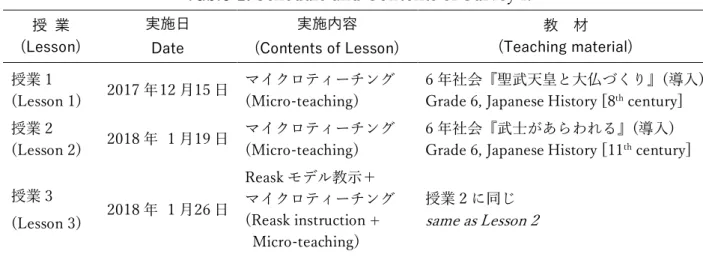
Reaskモデルを⽤いたマイクロティーチングの開発と効果
Development of Micro-teaching with Reask Model and Investigation of its Effect 森 康彦 MORI Yasuhiko (鳴⾨教育⼤学 / Naruto University of Education)
⽊下光⼆KINOSHITA Mitsuji (鳴⾨教育⼤学 / Naruto University of Education) 藤原伸彦 FUJIHARA Nobuhiko (鳴⾨教育⼤学 / Naruto University of Education) 若井ゆかり WAKAI Yukari (鳴⾨教育⼤学 / Naruto University of Education)
41
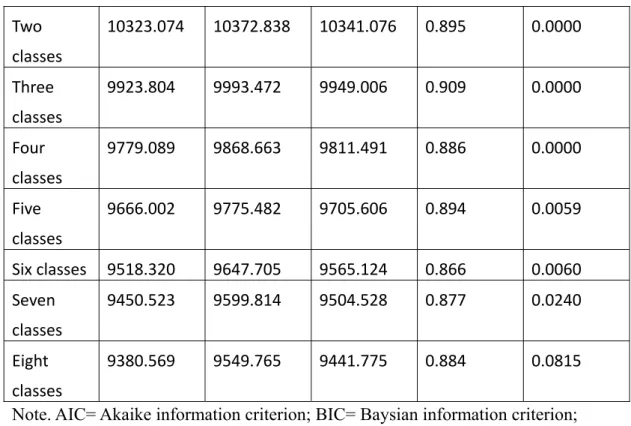
Patterns of kindergarten leaders' instructional coaching and their association with instructional leadership
PAN-Yuejuan (Beijing Normal University) YANG-Qingqing (Beijing Normal University) WU-Niwen (Beijing Normal University) LIU-Shanshan (Beijing Normal University)
55
The Problem and Its Solving of Teaching Quality in Kindergarten Visual Arts Education and Kindergarten Teacher Education: Based on the Exploration of Pedagogical Content Knowledge
FENG Wanzhen(Beijing Normal University)
69
Teaching Research on Improving Preschool Education Students' P.E Implementation Ability from the Perspective of Core Competencies
GU Changwei (Capital Normal University) 80
The Practice System of Peiping Preschool Education Normal School and Its Contemporary Significance
LI Xiaohua (Shanxi University ) 90
A Classroom and Teacher Self-efficacy:Affordances for the Instructional Speech OMOTE Akihiro (Hyogo University of Teacher Education, Graduate Student)
103
A Study of Cross-Disciplinary Learning Based Music Lesson Programs:
Referencing a Case Study of an American Teacher’s College
TOKIE Noriko (Joetsu University of Education) 117
The improvement of teaching and learning Pashto and Dari through Teacher Guidebook at primary school level in Afghanistan
ZAHID Zabihullah (Naruto University of Education, Graduate Student) 130
The Need for Contextualization of Education for Sustainable Development (ESD) – A Study of ESD in Fiji and Japan
Improving Problem Solving as a skill of ESD in Science Classrooms in Fiji VESIKULA, Adi Lamawanaivalu (Naruto University of Education, Graduate
Student) 144
Quantitative research on TPACK status and development strategies of secondary school teachers under the background of "Internet + education"
YIN Yali (Beijing Normal University, Graduate Student) 158
The Application of Facilitation in Humanist Teacher Education:Consideration of A Practical Method of Teacher Education
SHI Junqi (Beijing Normal University, Graduate Student) 172
Fostering University Students’ Teaching Skills through Learner-centered Instruction -Effective Usage of ICT -
KITA Yoko (Naruto University of Education) 185
A study on formulation of early childhood education teachers’ capabilities to arrange the educational environment
SHIOJI Akiko (Naruto University of Education) YUJI Hiroki (Naruto University of Education) TAMURA Takahiro (Naruto University of Education) KINOSHITA Mitsuji (Naruto University of Education) FUJIHARA Nobuhiko (Naruto University of Education) SONE Naoto (Naruto University of Education) SASAKI Akira (Naruto University of Education Attached Kindergarten)
196
Study of career guidance in intellectual disabilities special support school—
employment support practice in care, etc.—
YASUDA Yoshito(Otani University Professor) 210
Difference in physical fitness and body composition by habits of physical activity in Japanese junior high school students
AKIHARA Yu (Hyogo University of Teacher Education) ODA Toshiaki(Hyogo University of Teacher Education) YAMAMOTO Tadashi(Hyogo University of Teacher Education)
SOGABE Akitoshi (Konan university) 215
An Examination of Primary Education Music Lesson Planning Based on a Workshop Case Study
TOKIE Lisa (Tokyo Gakugei University, Graduate Student) 225
The Effect of Drama Education on Communication Skills ―In the Case of Japanese High School Students―
OGAWA Miyoko (Hyogo University of Teacher Education, Graduate Student) 238
A Study of Teachers’ Professional Development through Lesson Study: A Focus on the Use of One Page Portfolio Assessment (OPPA)
OKUMURA Yoshimi (Hyogo University of Teacher Education) 248
Study of Radio Waves at a Special Needs School: Construction of an IC radio through combined basic and work learing
YOTSUMOTO Terumichi (Hyogo prefectual School for Kobe Special Needs Education)
256
A Study of the Development and Implementation of the Graduate-Level Teacher Training: In Collaboration with the Prefectural Programme
SAKAGUCHI Masayasu (Hyogo University of Teacher Education) TSUDA Seisuke (Hyogo University of Teacher Education) IKEDA Masafumi (Hyogo University of Teacher Education) YAMAMOTO Shinya (Hyogo University of Teacher Education)
TOKUSHIMA Yuya (Hyogo University of Teacher Education) SAKAUE Hiroaki (Hyogo University of Teacher Education) IZUMIMURA Yasuji (Hyogo University of Teacher Education)
Keywords: graduate-level teacher training, the ALACT model, teachers who continue learning
0. Introduction
The purpose of this study is to introduce and discuss the development and implementation of the graduate-level teacher training, in collaboration with the prefectural programme. In doing so, this study focuses on the attempt of developing and implementing the graduate-level teacher training programme named the “Educational Issues Training (Implementation of “Learning Cycles for Teachers”),” which was organised by the Hyogo University of Teacher Education (HUTE), in collaboration with the Hyogo Prefectural Institute for Educational Research and In-service Training (HPIERIT) in 2019.
According to Sadayuki Yada, it is crucial for universities and boards of education to collaborate in order to create a structure for supporting “teachers who continue learning,” which was proposed in the report by the Central Council for Education (Japan) in August 2012. Additionally, he
indicates that the Japanese Ministry of Education, Culture, Sports, Science and Technology (MEXT)’s reply as to why teachers need to continue learning is because there is a requirement for advanced teachers in the society. Yada also mentions that when considering MEXT’s definition of the necessary quality and ability of the present day teachers, the teachers of today need to be able to address the tasks related to such as special needs education and an increase of foreign pupils and students in Japan. Furthermore, he argues that there is a request for present day teachers to function as advanced professionals in order to correspond to those tasks by equipping themselves with the necessary knowledge and skills – in other words, there is a demand for teachers to continue learning (Yada, 2015, pp.71-72). Thus, this study suggests that there is a need to develop and implement graduate-level teacher training in Japan, in collaboration with local educational institutions.
1. Explanation of the Training Programme
The above-mentioned training programme focused on teachers who were expected to become middle leaders, in an effort to solve critical issues by improving the quality as “teachers who continue learning” based on graduate-level knowledge. In particular, with the training, we positioned the “learning cycle (experience-based)” for identifying and solving issues based on personal experience as the basis of the “teachers who continue learning.” The model for “reflection”
indicated by Fred Korthagen named the ALACT model was referred to as the “learning cycle.” In the ALACT model, there are five processes for reflection; (1) Action, (2) Looking back on the action, (3) Awareness of essential aspects, (4) Creating alternative methods of action, and (5) Trial (cited in Yamabe, 2019, p.16). The vital thing to note about this cycle is how important issues are identified by reviewing one’s actions, leading to new perspectives and ideas and expanding oneself.
The significance of the model is considered to be its introduction of “an awareness of essential aspects” as opposed to simple reflection and countermeasures (cf. Yamabe, 2019, pp.15-17).
With their busy routines, it is not easy for teachers to reflect on their own actions to analyse essential issues and create new teaching methods. It is believed that there is a need for theoretical and collaborative training through lectures and various forms of active learning. We therefore developed a training programme for mid-career teachers to experience the reflection cycle.
The training was conducted in Kobe as a kind of educational training of HPIERIT ’s 2019 mid- career teacher training programme. The two major aims of the training were as follows:
(1) Establish a “learning cycles for teachers” that involves uncovering modern educational issues through routine school activities, discovering new ways of thinking and finding solutions to these issues, and repeated implementation of these in the field.
(2) Through the “learning cycles for teachers,” the participants deepen their understanding of modern educational issues (any one of inclusive education, disaster prevention education or education for multicultural coexistence), and implementing new practices at school.
The outline of the training is shown in Table 1(1). There were 13 participants (seven for “inclusive education” and six for “multicultural coexistence”) who were high school teachers; “disaster
prevention education” was not offered because fewer participants picked the course. In line with the schedule, the intentions and ideas of the training can be summarised in three points shown below.
(a) Awareness of the Differences between the Two Types of “Reflection” (“Reflection” for Immediate Solutions and “Reflection” for Teachers Continuing Their Learning)
The training programme involved a form of “reflection” that was different from routine
“reflection,” where the individual quickly reached a resolution through a “that didn’t work, so I’ll try something else” thought process. The reflection assumed stages two to four of the ALACT model where the individual could review his/her actual practices, and considered future actions
Table 1 Overview of the Training
Date and time Course Details
Until the training day
Preliminary assignment
Participants watched a video that provided an overview of the ALACT model and contemporary issues (inclusive education and reasonable accommodation; sustainable society and disaster prevention education; multicultural coexistence in a global age).
First day (30/7/
2019)
a.m. General course
(1) Participants engaged in a self-introduction activity. (2) They watched a video and analysed the intentions of the teacher and the pupils using “eight questions” (2), and exchanged
interpretations with each other.
p.m. Individual course
(3) Each participant looked back on his/her experience as a newly appointed teacher. (4) Participants noted inclusive
education/multicultural experiences (educational opportunities).
(5) Participants questioned themselves in a group with members asking each other “eight questions” in the training session.
Second day (20/8/
2019)
a.m. Individual course
(1) Lectures and training exercises on inclusive education or multicultural coexistence (including social background, global trends, and historical transitions) were held, with participants encouraged to think about future practices.
p.m. Individual course
Continuing the lectures and training exercises, (2) participants considered the future of them 10 years ahead, and considered the inclusive/multicultural education through macro-level reflection.
Third day (21/8/
2019)
a.m. Individual course
(1) Participants wrote a report on the issues that should be addressed at school and recalled what they had learnt over the previous two-and-a-half days.
p.m. General course
(2) An explanation regarding the structure of the training was provided. (3) A workshop on realistic approaches was
conducted. (4) Individual workshops were held allowing participants to consider how to engage in group reflection with their colleagues.
based on new interpretations of these practices. In addition, the intention here was not simply to impart knowledge regarding reflection to participants but rather to provide them with a sense of
“creating knowledge from their daily experiences.” Furthermore, the emphasis was on calling into question “assumptions” cultivated over 10 years until the individual becomes a mid-career teacher in an effort to re-discover the teacher’s own (core) beliefs.
We devised the following three points as the main measures for the reflection: (1) On the first day of training, we indicated Korthagen’s “eight questions”reflection method that delved into experiences. (2) At p.m. the same day, using these “eight questions,” the participants reviewed each other’s experiences. (3) To help the participants learn about the creation of knowledge based on their experiences, we explained the structure of the three-day training period and the framework of reflection at p.m. on the third day without revealing anything about reflection on the first day.
(b) Panoramic Reflection (Reflection based on Social, Global and Historical Perspectives)
The training programme aimed to create continuous learning cycle through reflection on contemporary educational issues. We therefore aimed to cultivate a perspective that provided a panoramic view (meta-cognition) by alternating between micro- and macro-level reflection, daily practice perspectives, and wide temporal and spatial perspectives. Moreover, the training was developed with the aim of re-examining the perspective of inclusive education/multicultural coexistence itself, rather than immediately seeking a solution.
As a measure of the reflection, we devised five major points: (1) We took up inclusive
education/multicultural coexistence as a contemporary educational issue that could be considered based on social background, global perspective, and historical background; (2) On the second day, rather than solutions, we tackled global trends and the historical background consisting of graduate- level content where the participants could gain panoramic self-views; (3) At p.m. on the second day, the participants reflected on society 10 years ahead based on global trends/historical backgrounds;
(4) Based on lectures in each area, at a.m. of the third day, the participants reflected on their practices, incorporating activities that envisioned the issues that should be addressed at school and how these might be solved. Moreover, during the training; (5) Instructors in charge of the various lectures given on the first and third days attempted to link the general course to each course.
(c) Continuous Reflection (Continuing Individual/Collective Reflection)
The training programme was aimed at mid-career teachers, as part of efforts to develop middle leaders. Thus, we established an individual reflection cycle and envisioned a training method so that participants could learn the importance of reflection. Moreover, through the training, we aimed to not only reflect on past actions, but to also allowed participants to utilise methods involving future
“experience-based learning.” Therefore, the following two points were devised: (1) Performing work on how to best continue reflection on the third day and (2) Creating opportunities for group and overall learning exchanges and increased reflection activities with others.
2. Analysis Results
(1) Survey Overview and Analysis Viewpoint
Before and after the programme, it was planned to evaluate the characteristics of the programme by attempting to conduct both qualitative and quantitative research. Specifically, in addition to questionnaires that contained queries related to the training programme and the qualifications of participants which were administered in the beginning of the first day of the training started (hereafter called “pre-training questionnaire”) and in the end of the third day of the training ended (hereafter called “post-training questionnaire”), semi-structured interviews were conducted with the participants. Moreover, the instructor survey was conducted after the completion of the entire training programme (third day) through a group interview (unstructured interview method) to
review the overall training.
As mentioned earlier, there were 13 participants, of which 12 agreed to take part in each questionnaire, with eight participating in the interview as well. In addition, the group interview of instructors covered three of them who lectured in the training programme as respondents, with four others who were involved in the development and implementation of the programme, not lecturing but participating as researchers. We should note that, in this paper, analysis results of the interviews of the eight participants and the group interview of the three instructors are analysed based on transcripts of recorded data(3). The data obtained through the survey will be analysed in accordance with the three intentions of the training programme described above. It is worth noting that, in this paper, amongst these narratives, we conduct analysis and discussions focusing on characteristic narratives obtained from instructors and participants related to those viewpoints.
(2) Instructors’ Perceptions of the Training Programme
(a) Awareness of the Differences between the Two Types of “Reflection”
Regarding the work of reflection, which was at the core of the training programme, the
instructors reported during the introduction on the first day that participants had difficulties with the subject matter, but by the third day, it was sort of apparent that they had somehow gained a better understanding. For example, Instructor A said the following when sharing impressions after the completion of the training programme:
“In short, because the subject of reflection remains a mystery, on the first day, ah, well, [the participants] were not sure what they were supposed to be learning, and because this feeling didn’t go away, ah, well, there seemed to be a certain anxiety. I think [participants] first came to understand the meaning on the third day.” (Instructor A).
Given this narrative, despite the fact that it seems that the concept of reflection was not well communicated on the first day, if you look at the entire three days, we could see that the instructors became aware that this had been communicated effectively.
Moreover, while Instructor C revealed that the participants struggled to work on the tasks about their reflection on the second day, this proved to be a sign that usually participants were not consciously engaged in reflection, and thus indicated that undertaking the training programme resulted in an increased awareness of reflection. Next, let us look at what Instructor C had to say while sharing his/her impressions after completing the training programme.
“In the afternoon on the second day, when I had participants think 10 years ahead by reflecting 10 years back into the past, [Omitted] I thought it was a little difficult for the
participants at the beginning. However, after listening to [the name of one of the instructors]’s final reflection today, [Omitted] I think it was good that everyone was aware of whether they were able to reflect or not, or, conversely, whether it was meaningful that they could not
immediately recall things that happened some 10 years ago.” (Instructor C)
Based on this instructor’s perception, the fact that reflection, which was addressed on a trial basis in the training programme, is an activity generally unfamiliar to teachers, and can be considered as having a certain significance when taken up as a teacher training programme.
(b) Panoramic Reflection
When discussing the topic with regard to the significance of conducting the training programme combining general course with individual courses, for example, Instructor B said, “Because, well, I don’t think there’s an opportunity to think deeply about inclusiveness nor this multicultural
coexistence in the days that remain, when I look at this particular inclusive team, well, they recall, look back and write down which they had never really thought about before” (Instructor B).
Instructor B continued with the theme that there is no real opportunity to consider this matter seriously, indicating a perception that while “there may have been some difficulties,” participants were probably more engaged due to this being a “non-mainstream topic [Omitted] that one did not usually think about” (Instructor B). In light of this, it can be indicated that, similar to the reflection that is mentioned above, the two topics of contemporary educational issues covered in the training programme were meaningful in the sense that they provided opportunities for participants, who usually do not have a chance for deep reflection, to provide some careful thought to the topic.
Similarly, Instructor C mentioned being aware of the fact that participants were not usually conscious of this by broaching the topic of modern educational issues and the possibility that they had been given an opportunity to recognise what they did not fully understand.
Based on these Instructor B’s and C’s opinions, it can be assumed that the topics of inclusive education/multicultural coexistence as contemporary educational issues may encourage participants to become aware of issues that they do not usually pay attention to, and, in the process of creating this awareness, it is possible that they gain a panoramic view (metacognition) of their perceptions.
(c) Continuous Reflection
By organising the characteristic narratives of the instructors from the viewpoint of continuation of reflection, the following interactions are presented. On the topic of the significance of the training programme combining reflection and modern educational issues, the following is an information exchange on the diversity of participants’ main subjects (subject backgrounds).
Instructor C Well … Subject backgrounds [of the participants] were certainly diverse.
[Omitted]
Instructor C Such people do not usually meet in training sessions.
Instructor B That’s certainly true.
As shown here, with all participants focusing on modern educational issues in the training programme, it can be pointed out that the instructors recognised that it was meaningful in that
teachers with different subject backgrounds could avail training opportunities. As a result, it can be inferred that participants will be aware of the importance of having diverse perspectives. Also, if we delve into this deeper, this can be seen as possibly leading to learning the benefits of reflecting with colleagues, in addition to individual reflection.
(3) Participants’ Perceptions of the Training Programme
Next, we analyse participants’ perceptions of the training programme. Let’s begin by looking at the basic attributes of participants prior to the analysis. Based on responses to the pre-training questionnaire, the following points are noteworthy. First, participants who had a relatively strong desire to learn are considered based on the number of participants who have acquired a master’s degree (degree; three Bachelors, seven Masters, no Master of Education (professional), two did not respond) and the number of trainings that they have voluntarily participated in (the number of training sessions that they participated voluntarily in the last ten years; one participated in no such sessions, four participated in one to four sessions, three participated in five to 10 sessions, four did not respond). Second, participants included teachers with diverse subject backgrounds (major subject areas; four Japanese languages, five mathematics, two sciences, one English).
(a) Awareness of the Differences between the Two Types of “Reflection”
The following narratives from the participants speak to the fact that, in the design of the training programme, there were many exercise-type activities in which the participants took the lead. The following narrative was obtained as a result of asking for opinions on the training programme.
“[As with the paper task from a.m. of the third day,] I thought it was good that it was summarised in [participants] own words. As with the [Omitted] results, other training courses provide little room in which to take notes.” (Participant No.3)
Similarly, looking at a response where one participant was asked to share his/her opinions on the fact that the training programme was held for three days, he/she had the following to say: “In the lecture part, I also learned a lot, got to practice and, also listened to others’ opinions. Yes.
[Omitted] I think it was good” (Participant No.6). Given these responses, we can see that when it came to teacher training, participants seemed to desire to some extent an exercise format. In this respect, the training programme can be regarded to have been in line with participant expectations.
Meanwhile, when asked about problems, etc. with the training programme as a whole, some participants presented challenges such as finding enough time for activities. This sentiment can be summed up by the following comment: “For improvements, what I thought was pity was the fact that this morning [third day] during the summary, there was not enough time for everyone to share his/her thoughts” (Participant No.11). From this comment, we can see that, rather than individual work, we need to establish more time for participants to share their opinions during the exercises.
So, what were the participants’ perceptions of their learning experiences during the training
programme? As mentioned earlier, in the training programme, the details of reflection were not clarified at the beginning on the first day, but, rather, the overall picture of the training programme and the framework of reflection were finally unveiled at p.m. on the third day. However, when asked what could be improved, etc., one participant admitted to a certain anxiety about goals not being specified on the first day, as indicated by the comment: “I was not sure what was the purpose nor the flowchart of the three days [of the training programme].” (Participant No.3).
Conversely, it can be indicated that there were also aspects in which it was recognised that some participants gained an understanding of the purpose of the training programme through the entire session. For example, when one participant was asked what he/she learned in the training
programme, the following comment was given after mentioning that he/she usually looked back at his/her own lessons by taking notes, etc.:
“[Like the task of looking back over 10 years] I’ve surely not been looking back to long ago.
Thinking as much, I thought [by attempting to look back] I might uncover some problem areas.
[Omitted] I usually think of how to deal with the situation in front of me.” (Participant No.10) Following this admission, the participant said, “it was good to know, well, about kind of new methods” through the training programme. Given all of these, in other words, there is a possibility that some participants were aware that the reflection technique taken up on this occasion was different from the simple task of looking back that they had engaged in, during their regular classes.
Reinforcing such narratives, for example, in the post-training questionnaire, one can cite respondent answers to the question: “Did you understand the training content of the ‘Learning Summary and Construction of the ‘Learning Cycles for Teachers’’?” where four selections were available: “I understood everything,” “I understood almost everything,” “I didn’t understand much,”
and “I didn’t understand.” All 12 participants responded that they understood the training content (one “understood everything”, while the other 11 “understood almost everything”). Based on this, while not revealing the aim of the training programme in detail on the first day may have helped alleviate participant anxiety, it can be interpreted that such anxiety may have dissipated during the three-day training programme – the aim of the training may have become apparent to participants.
Meanwhile, another participant’s comment indicates that difficulties experienced during the training programme may have fostered a new awareness. The following narrative was obtained in an exchange over a question about what impression, etc. the training programme had left.
“When it comes to my non-consciousness, well, I thought it was very difficult to look back on, or verbalise it. [Omitted] But, I understood that if I don’t do it, [Omitted] I wouldn’t make any progress.” (Participant No.6)
From this comment, we can see that, through uncommon tasks as introduced by the training programme, the participant could gain a sense of awareness. Also, with the tasks completed in the
programme, it is clear that becoming conscious of something that one was not previously aware of, may have resulted in the creation of an opportunity for the participants to understand reflection.
(b) Panoramic Reflection
As mentioned above, one contrivance used in the individual courses of the training programme was dealing with historical backgrounds, etc., rather than solutions, in an attempt to transform this into a graduate-level training. As symbolised by the following narrative, given the circumstances, we can see that the subject matter covered in the individual courses was received positively from the viewpoint that participants could satisfy their intellectual needs. For instance, the following comment was gained when hearing a participant’s opinions about improvements of the contents.
“It [the individual course] was fantastic in terms of the opportunity it presented.[Omitted]I really didn’t have much interest in, or, rather I was not familiar with the field of multicultural coexistence at all.[Omitted]It [the individual course] provided me with a great opportunity to think about various matters.”(Participant No.10)
It is evident from this narrative that, with the training programme, some participants were capable of considering modern educational issues that they usually would not have the opportunity to think about profoundly, and that this may have some significance from the viewpoint of improving the participants’ willingness to learn.
Meanwhile, from the comment below, we can see that it is possible that the contents covered in the training programme’s individual courses were at the graduate-level, and was based on the historical background and theory. It also had a certain significance when it came to providing participants with new learning possibilities. The following narrative was obtained when we asked a participant what he/she perceived his/her learning through the individual course.
“We looked back on history, well, [the instructor] said it was important to incorporate [Omitted] applied behaviour analysis into inclusive education. [Omitted] Learning about the theoretical parts, [Omitted] I came to understand that I could figure out the causes.” (Participant No.6)
It is also evident that such new learning methods may vary with regard to quality and quantity depending on how knowledgeable each participant is. This can be pointed out by the case where we asked one participant the improvements, etc. of the overall training programme. The participant answered: “There was just so much. I think for me, too much, as least at times. [Omitted] Yesterday [the second day] when I got home, my head was crammed with information, and I just couldn’t put it all together. [Omitted] It was actually a little too much” (Participant No.9). As can be seen from this, for some participants, the amount of works covered in the training programme was excessive.
However, when we analysed the results of the post-training questionnaire, it became apparent that the participants, on the whole, by no means failed to understand the training as presented in the
individual courses. Specifically, when asked: “Did you understand the training content of the individual courses (inclusive education and reasonable accommodation/sustainable society and disaster prevention education/multicultural coexistence in a global age)?” with four choices: “I understood everything,” “I understood almost everything,” “I didn’t understand much,” and “I didn’t understand.” All 12 participants replied that they understood the training content (two
“understood everything”, while the remaining 10 “understood almost everything”).
Analysing this result along with the previous participant’s narrative, even if it was difficult for some participants to understand all training subject matter as presented in the individual courses, it can be inferred that, upon completion of the entire training programme, enough learning had taken place to provide for an understanding of the content.
Outlined above are some aspects of the learning that the participants engaged in during the individual courses. From the testimonials of the participants, however, we discovered that there was an instance where a participant understood not only the content of the individual courses, but also the relationship between the general and the individual courses. Following is what one participant said when asked about the improvements, etc. of the training programme.
“Well, one thing, in the guideline or rather the paper we received at the beginning. I think it presented the theme as considering multicultural coexistence through the ‘learning cycle for teachers’; however, it was actually the opposite, wasn’t it? It was considering the ‘learning cycle for teachers’ through lessons on multicultural coexistence, wasn’t it?” (Participant No.10) Given this comment, it can be surmised that the participant recognised that both the general and individual courses were connected from the perspective of reflection. Therefore, we can assume that some participants were able to recognise the association between the general and individual courses as intended by the training programme.
(c) Continued Reflection
It is believed that building relationships is important when reflecting with others. The training programme was conducted in a small group, so it can be inferred that it was easier to build relationships between participants. In fact, the small class size may have resulted in participants recognising that they could express their opinions and participate in activities with ease. Following is what a participant had to say when asked of the improvements, etc. of the training programme.
“With such a small number of people, but, the atmosphere was harmonious, so nobody
hesitated to ask questions and share their opinions with others. [Omitted] Well, it was really nice to be able to spend three days with this small group. [Omitted] We had time to go way beyond scratching the surface, and really delved deep into things.” (Participant No.10)
Considering the statement presented by this particular participant, the small class sizes were viewed as a positive, providing the participants with ample discussion time.
Furthermore, another participant mentioned that while the limited number of participants in the training programme allowed for more substantial learning, a larger number of participants might allow for even more substantive learning. For example, when asked about the improvements, etc. of the training programme, one answered: “Although even with six teachers [participants], I was able to understand a lot through their opinions, I feel that it would have been better if there were a few more participants” (Participant No.9). Taking into account the various backgrounds of the
participants, we can surmise from this narrative that the opportunity to hear a variety of opinions may result in diverse discussions, despite the fewer number of people, and can be interpreted as being salient to the substantial learning that the participants experienced.
Moreover, it can be inferred from the following narrative that the learning engaged in the training programme may be put to practice by the participants. Following is what a participant said when asked if he/she had learned anything new regarding education, etc. during the training programme.
“Today, I learned from discussion about the ‘Doubting Assumptions’ and how others think.
[Omitted] Since I usually think of something through my perspectives, [Omitted] I’d like to improve that and [Omitted] incorporate the perspectives of others more.” (Participant No.11) We can interpret this as the participant being aware of the importance of thinking outside the box and incorporating various perspectives, and being willing to engage in continuous reflection.
3. Discussion
The purpose of this paper is to evaluate the graduate-level teacher training programme jointly developed and implemented by HUTE and HPIERIT based on instructor and participant
perceptions. In conclusion, we discuss the analysis results of this paper, while focusing on common points of perceptions between the instructors and the participants, and then, based on the
discussions, we present three hypotheses regarding the graduate-level teacher training programme.
With the training programme, the participants were not presented with the significance of the overall training on the first day; instead, it was emphasised that they would not understand it until the third day, when an explanation would be provided. Under these circumstances, with the analysis results of this paper mentioned above, while both sides, the instructors and the participants,
recognised that the first half of the training programme was difficult for the participants, by the end of the third day, these difficulties had been resolved, with the participants finally able to
comprehend the purpose of the training programme. Based on these results, it is possible to present the idea that “by establishing learning content that participants fell that they ‘do not
understand’, it is possible for them to cultivate an attitude befitting teachers who continue learning” as Hypothesis (1). Moving forward, with regard to Hypothesis (1), it will be necessary to confirm the establishment of learning content that participants do not initially understand along with
a time period (although not set in stone, this was generally from the first to the second or third day) from the perspective of whether in the end reflection can be enhanced or not. In other words, it is necessary to further analyse and consider the learning content and structural design when
developing and implementing a training programme based on reflection.
In the training programme, we have taken up modern educational issues as the subject for learning about engaging in reflection as teachers who continue learning. As a part of this, the analysis results of this paper mentioned above indicated a common perception on the sides of both the instructors and the participants that taking up contemporary educational issues, which
participants usually did not have the opportunity to think deeply about, triggered reflection. Based on these results, it is possible to present, as Hypothesis (2), the idea that “by tackling educational issues that one does not usually have an opportunity to think deeply about, it is possible to promote an understanding of the need for engaging in reflection as teachers who continue learning.” Moving forward, with regard to Hypothesis (2), it can be argued that it is due to the very fact that there was a moderate level of understanding with regard to the modern educational issues covered in the training programme – i.e. this is an area where there is still room for more learning – that there was a need to engage in analysis and consideration from the perspective of whether or not the participants had come to an understanding of the need for engaging in reflection as teachers who continue learning. At such times, it can be argued that, for example, in order for teachers in such areas as school subject to receive training, analysis and consideration of differences addressing issues in more familiar fields are critical. This led to an examination of whether it was appropriate to reflect on the ALACT model, which is purportedly mainly utilised in class reflection.
Furthermore, in the training programme, the participants from various subject backgrounds exchanged their opinions in an exercise format. As part of this, the analysis results mentioned above indicated a common perception on the sides of both the instructors and the participants that in the training, listening to the opinions of various people was important. Based on the above, it is possible to present, as Hypothesis (3), the idea that “by providing opportunities for reflection among participants with diverse backgrounds, it is possible to promote an understanding of the importance of listening to the opinions of various people.” Moving forward, with regard to Hypothesis (3), it can be argued that it is critical that analysis and consideration from the same viewpoint be applied to training related to school subjects for people with the same subject background. At such times, the appropriate number of training participants needs to be verified.
4. Research Limitations and Future Challenges
In this paper, we first analysed and considered the perceptions of the instructors and the participants regarding the training programme, mainly focusing on qualitative research methods
(interviews) to explore issues (hypotheses) related to the development and implementation of graduate-level teacher training programmes. We did not, however, address changes in the qualities of the participants; i.e., we did not verify the “effects” of the training programme. In the future, it will be necessary to work on further analysis and consideration of the learning characteristics of mid-career teachers based on questionnaire data not covered in this paper.
Next, we attempted to develop and implement the graduate-level teacher training programme aimed at upgrading teacher training. However, moving forward, it will be necessary to analyse and consider how such a training is linked to graduate school learning. Even as discussions on
recognition of teacher training programmes as credits at graduate schools have just started in Japan, the issues (hypotheses) taken up by this paper can be considered as references for proceeding with these types of discussions. In light of this, graduate school recognition of graduate-level teacher training programmes as credits will need to be examined and discussed in more detail in the future.
Acknowledgements
We would like to acknowledge everyone who cooperated in this study. In developing and implementing the training programme, we consulted with Mr. Tetsuhito Sakata and Mr. Hiroshi Yano, and we are very grateful for their contributions. This study and the training programme were supported with a subsidy by the 2019 National Institute for School Teacher and Staff Development
“Training Programme Development and Implementation Support Project to Improve Teachers Qualities (A: Development and Implementation Programme for In-Service Teacher Training Based on Indicators),” (Project name: “Development of a Training Programme for “Teachers who
Continue Learning” in Their Fourth Through Ninth Year Career: Learning About Contemporary Educational Issues,” Research representative: HUTE) that were jointly implemented with HPIERIT.
Notes
(1) In developing and implementing the training programme, we mainly referred to REFLECT ed.
(2019) and Takeda et al. (2016).
(2) The questions were created by referring to Korthagen’s “eight questions” (cf. Yamabe, 2019, p.17). The “eight questions” were “1. What did the teacher do?” “2. What did the teacher think?” “3. How did the teacher feel?” “4. What did the teacher want to do?” “5. What did the opponent (pupil) do?” “6. What did the opponent (pupil) think?” “7. How did the opponent (pupil) feel?” “8. What did the opponents (pupils) want to do?”
(3) The added texts by authors when quoting the narratives of the interviewees appear in
parentheses (e.g. [Omitted]). In this paper, the names of survey respondents have been replaced with alphabetic or alphanumeric characters (e.g. Instructor A).
References
Manabituzukeru Kyoikusya no tameno Kyokai [REFlective LEarning Community for Teaching]
(REFLECT) (ed.); Tetsuhito Sakata, Masahiro Nakada, Naoko Murai, Hiroshi Yano and Eriko Yamabe, 2019, Refurekusyon Nyumon: The Book of Reflection [Introduction to Reflection: The Book of Reflection], Gakubunsya. [in Japanese]
Takeda, Nobuko, Kaori Kanai and Satoko Yokosuka (eds.), 2016, Kyoin no tame no Refurekusyon Wakubukku: Oukan suru Riron to Jissen [A Reflection Workbook for Teachers: Going back and forth in between Theories and Practices], Gakuji Shuppan. [in Japanese]
Yada, Sadayuki, 2015, “Waga Kuni ni okeru Kyoin Yosei Kodoka wo meguru Syoso no Tenkai [A Study on Aspects of the Development of Japanese Teacher Education Reform],” Tokai Gakuen Daigaku Kiyo [Bulletin of Tokai Gakuen University], Vol. 20, pp. 69-83. [in Japanese]
Yamabe, Eriko, 2019, “Korutohahen no Refurekusyon no Houhouron [Korthagen's Reflection Methodology],” Manabituzukeru Kyoikusya no tameno Kyokai [REFlective LEarning Community for Teaching] (REFLECT) (ed.), Refurekusyon Nyumon: The Book of Reflection [Introduction to Reflection: The Book of Reflection], Gakubunsya, pp.12-27. [in Japanese]
Abstract
The purpose of this study is to introduce and discuss the development and implementation of the graduate-level teacher training, in collaboration with the prefectural programme. In doing so, this study focuses on the attempt of developing and implementing the graduate-level teacher training programme named “Educational Issues Training (Implementation of “Learning Cycles for
Teachers”),” which was organised by the Hyogo University of Teacher Education, in collaboration with the Hyogo Prefectural Institute for Educational Research and In-service Training in 2019.
Specifically, this study explains the characteristics of the programme, and discusses the evaluation of it by analysing the interviews with the instructors and the participants, and the questionnaires with the participants. In the discussions, this study addresses the following results; a) the instructors and the participants both believed that it was difficult to understand the concept of the reflection based on the ALACT model on the first day but it was possible on the last day of the programme, b) the instructors and the participants both believed that it was meaningful to use the topics of
inclusive education and multicultural coexistence for learning about the reflection, and c) the programme may have been effective in offering opportunities for participants to reflect on their experiences with teachers with diverse backgrounds. In conclusion, this study indicates three hypothesises related to the above three results and points out that it will be necessary to analyse and consider these hypothesises from various points of view in the future study.
A Survey of the Mental Health of Chinese Special Education Teachers
ZHANG Shudong (Beijing Normal University) LIU Junli (Beijing Normal University, Graduate Student)
CHEN Chunhui (Beijing Normal University) ZHAO Libo (Beihang University)
Keywords: special education transition; SCL-90; special education teacher; mental health;
inclusive education
1. Introduction
The prevalence of mental problems was generally higher than that of any other class of chronic conditions (Kessler, Keller, & Wittchen, 2001). Several studies found that the mental health of special education teachers (SET) were worrisome (Adeniyi, Fakolade, & Tella, 2010; Shyman, 2011; Kucuksuleymanoglu, 2011; Zhao & Wang, 2012; Brunsting, Sreckovic, & Lane, 2014), wherein the working environment plays an important role (Mathers & Loncar, 2006; Tang, Leka, &
MacLennan, 2013). To migrate their working pressure and improve their mental health status, a large body of research has focused on working factors that influence the mental health of SET and measures were taken to cope with them accordingly.
Inclusive education is an international trend that refers to all children learn in the same classrooms regardless of the presence of disabilities (Loreman, Earle, Sharma, & Forlin, 2007), and the Chinese government has formulated policies and several plans to promote the development of inclusive education recently. Such macro-environment changes would bring influence to SET undoubtedly. In this way, although there have been several studies surveyed the mental health status of SET in China, we believe that these studies may have been outdated or can only provide limited information for special education development and further policies formulating. This study, which utilizes representative data SET of different levels of in-service SET training from Hubei province and Fujian province, aimed to determine the mental health status of different levels of training participants in this new period. In addition, this study also provides some enlightenment for policy formulation and school management.
1.2. The mental health of SET
“Mental health” refers to basic cognitive and social skills; emotional regulation; flexibility and ability to cope with adverse life events and function in social roles; and harmonious relationship between body and mind (Galderisi, Heinz, Kastrup, Beezhold, & Sartorius, 2015). Studies have shown that the mental health status of Teaching professionals was a worldwide concern (Stansfeld, Rasul, Head, & Singleton, 2011; McLean, Abry, Taylor, Jimenez, Granger, 2017). Even worse, it is acknowledged that SET bear the most stress-laden working conditions that are associated with poor mental health (Brunsting et al., 2014), such as challenging student behaviors (Hastings & Brown, 2002), role overload (Adera & Bullock, 2010), lack of sense of achievement in spite of efforts (Kucuksuleymanoglu, 2011).
Many studies in China have pointed that the rate of SET with mental health problems far exceeded the national average (Shen & Lin, 2007; Xu, 2004; Yu, 2007; Zhao & Wang, 2012; Zhou
& Liu, 2013). However, research about factors that contribute to this unsatisfactory mental health status of SET is still dispute and inconsistency (Zhao & Wang, 2012). Hence, it is of great
importance to re-evaluate the mental health of SET in China given to the reformation of inclusive education, so as to accurately assess the levels of support (psychological, social and professional) that should be provided to them. This will be not only beneficial for promoting the mental health of SET, but also for making the right policies to ensure the best effect of special education
transformation.
1.2. New change, new challenges
Learning in regular class (LRC), which was initiated in the 1980s, was the prime model to meet the educational need of the disabilities (Deng, Poon-mcbrayer, & Farnsworth, 2001). LRC is
“to allow special children and teenagers with certain abilities, such as visually impaired, hearing impaired, and mentally handicapped, to enter common schools to study together with common children and to take part in activities together” (The State Education Commission Basic Education Department, 1986). Over 30 years of LRC practicing shows that it cannot meet the real demand of students with disabilities because they usually are usually treated as subordinated students in regular classes (Deng & Poon-McBrayer, 2012).
To further carry forward inclusive education in China, new policies have been formulated in recent years. For example, the “Special Education Enhancement Plan (2014-2016)” (Ministry of Education of China, 2014), combined with “The Second Special Education Promotion Plan (2017- 2020)” (Ministry of Education of China, 2017) had exerted great influence on inclusive education development. Special education, an important part of Chinese educational modernization, has ushered in the transition period (Yin, 2016; Shen, 2017). The transformation of special education school (SES) is a direct reflection of special education transformation, mainly manifested in three aspects: (a) various types of disabled children out from home to receive education in schools rather than just children who are visually impaired, hearing impaired, and mentally handicapped; (b) since children with slight or mild disabilities go to regular schools to receive inclusive education, the disability degree of students in SES are shifting from mild to serious and even extreme serious; (c) with the changes in the structure of disabled students, single type of SES (e.g., deaf schools, schools
for intellectual disabilities), which was used to admit a particular type of disabled children, is developing to a comprehensive SES that admit kinds of disabled children. Undoubtedly, SET is pivot in achieving inclusive education goals. However, have these changes brought influence to the mental health of SET? An investigation is needed to discuss the mental health of SET under this new social situation.
1.3. Research aims
The overall purpose of this article was to examine, through the Symptom Check List (SCL- 90), the mental health status of SET under the background of the transition period. It is
hypothesized that: (1) the mental health of SET is worse than Chinese population norm (CPN) nowadays; (2) the mental health of different special education training programs participants various; (3) SET with different managerial position may demonstrate various mental health status;
and (4) there is no difference among SES in different teaching age groups and different types in this transition period.
2. Method 2.1. Participants
218 SET (27.06% male) from Fujian and Hubei province in China positions. The sample included SET receiving three kinds of training programs, with 42.20% received national training in Beijing, the capital city of China; 47.25% received provincial training in the capital city of Fujian province, and the rest 10.55 % received local school-based training. The national training was the most advanced, and the school-based training was the most basic, but the quality of training was equal because all these trainings were instructed by professors from Beijing Normal University.
Descriptive of sampling are presented in Table 1. 34.40% of our sample were from comprehensive special schools, 61.01% from schools for intellectual disabilities, and 4.59% from deaf schools;
44.04% had a teaching age of fewer than 5 years, 35.78% between 6-15 years, and 20.18% over 16 years. As for managerial position, 22.94% associated with the higher managerial position, 36.24%
associated with the class teacher and 40.82% were SET without managerial position. All volunteers gave informed consent for their participation.
Table 1. Descriptive of Sampling
2.2 Measurement
Symptom Check List (SCL-90). It is a self-report symptom inventory, widely used for assessing a broad range of mental disorders and symptom intensity (Rytilämanninen et al., 2016).
The scale has 90 items and covers 9 dimensions of psychological distress: somatization (12 items), interpersonal sensitivity (9 items), depression (13 items), anxiety (10 items), phobic anxiety (7 items), obsession-compulsion (10 items), hostility (6 items), paranoid ideation (6 items), and psychoticism (10 items) (Olsen, Mortensen, & Bech, 2004). The frequency of adults’ negative perception in each item is rated on a 5 points scale (1= never and 5 = very serious). SCL-90 has demonstrated good internal consistency reliability, with Cronbach’s alpha coefficient (α) for the in this study was .977 and the range of α of dimensions was from .735 to .895.
2.3. Procedure
Data were collected in summer during training. Two trained research assistants who were master students of special education and a psychologist collected the data. All participants in this study consent to fill out scale faithfully. The instruction of the SCL-90 was explained by the psychologist. In addition, demographic information was also collected. It took about 10 to 20 minutes for each participant to complete the scale.
2.4. Statistical Analysis
There was a very small proportion of missing data in the dataset. On average 3.3% of the data was missing for each variable. Since a complete dataset increases the accuracy of statistical analyses, the mean-imputation method was performed to impute the missing data. All data were
Variables Characteristics
Training level National training (42.20%); provincial training (47.25%); school-based training (10.55%)
Type of SES Comprehensive special schools (34.40%); schools for intellectual disabilities (61.01%); deaf schools (4.59%)
teaching age Less than 5 years (44.04%); between 6-15 years (35.78%); over 16 years (20.18%)
Managerial position
higher managerial position (22.94%), class teacher (36.24%); general SET (40.82%)
analyzed with SPSS 20.0. One-sample t-tests were used to examine whether the scores of SET greater than the Chinese population norm (CPN), One-Way ANOVA was used to test the main effects of these variables and post-hoc tests were used to reveal differences in more details.
3. Results
3.1. The overall mental health status of SET
Among the 218 valid questionnaires, 70 (32.11%) cases with positive symptoms (mean scores of each dimension scores > or = 2) were identified. That is, nearly 1/3 of the SET suffered different levels of mental health problems. Obsessive-compulsive, interpersonal sensitivity, and paranoid ideation ranked the top three in the percentage of mental health problems detected in SET.
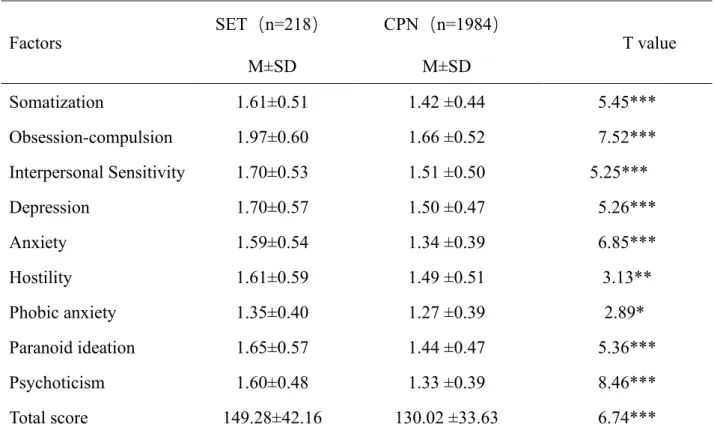
One-sample t-tests revealed that not only the total score but also all dimension scores of the 218 SET in this study were significantly higher than the corresponding mean scores in CPN (see Table 2), indicating that SET mental health status was worse than the average condition of Chinese adults.
Table 2. T- Tests on the SCL-90 Scores Between SET and CPN
Factors SET(n=218)
M±SD
CPN(n=1984)
M±SD
T value
Somatization 1.61±0.51 1.42 ±0.44 5.45***
Obsession-compulsion 1.97±0.60 1.66 ±0.52 7.52***
Interpersonal Sensitivity 1.70±0.53 1.51 ±0.50 5.25***
Depression 1.70±0.57 1.50 ±0.47 5.26***
Anxiety 1.59±0.54 1.34 ±0.39 6.85***
Hostility 1.61±0.59 1.49 ±0.51 3.13**
Phobic anxiety 1.35±0.40 1.27 ±0.39 2.89*
Paranoid ideation 1.65±0.57 1.44 ±0.47 5.36***
Psychoticism 1.60±0.48 1.33 ±0.39 8.46***
Total score 149.28±42.16 130.02 ±33.63 6.74***
Note: SET=special education teacher; CPN= Chinese domestic normal. *p< .05. **p< .01.
***p< .001.
3.2. The effect of the training level
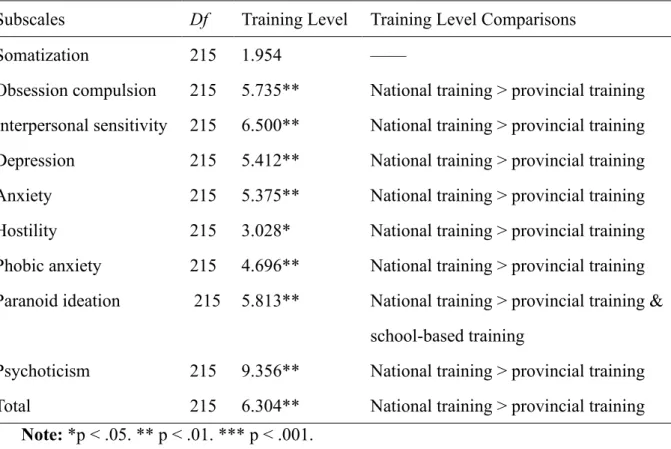
One-Way ANOVA revealed a significant training level effect for the overall score of SCL-
90, F (2, 215) =6.304, p < .001 (see Table 3). The post-hoc test further revealed that this effect was driven by the fact that the average score of SCL-90 in the national training group was statistically higher than the provincial training group except for the somatization subscale, implied that the national training participants had poorer mental health than provincial training participants.
Table 3. One-way ANOVA and Post-hoc Analysis on the Training Level Effect Subscales Df Training Level Training Level Comparisons
Somatization 215 1.954 ——
Obsession compulsion 215 5.735** National training > provincial training Interpersonal sensitivity 215 6.500** National training > provincial training Depression 215 5.412** National training > provincial training Anxiety 215 5.375** National training > provincial training Hostility 215 3.028* National training > provincial training Phobic anxiety 215 4.696** National training > provincial training Paranoid ideation 215 5.813** National training > provincial training &
school-based training
Psychoticism 215 9.356** National training > provincial training Total 215 6.304** National training > provincial training
Note: *p < .05. ** p < .01. *** p < .001.
3.3. The effect of managerial position
As Table 4 shows, One-Way ANOVA revealed a significant managerial position effect for the overall scores of SCL-90, F (2, 215) = 5.959, p < .01, and for all of its subtests (all
subtests< .05). The post-hoc tests showed SET who was class teachers had the worst mental health status than others.
Table 4. One-way ANOVA and Post-hoc Analysis on the managerial position Effect
Subscales Df
Managerial
Position Managerial Position Comparisons Somatization 215 4.068* Class teacher > higher managerial position
Obsession
compulsion 215
5.784** Class teacher > higher managerial position
Interpersonal
sensitivity 215
5.330** Class teacher > higher managerial position
Depression 215 4.377* Class teacher > higher managerial position Anxiety 215 5.114** Class teacher > higher managerial position Hostility 215 7.395*** Class teacher > higher managerial position
Phobic anxiety 215
5.626** Class teacher > general SET > higher managerial position
Paranoid ideation 215 3.164* Class teacher > higher managerial position Psychoticism 215 5.988** Class teacher > higher managerial position Total 215 5.959** Class teacher > higher managerial position Note: *p < .05. ** p < .01. *** p < .001.
3.4. The effect of teaching age, types of SES
The one-way MANOVA on the SCL-90 scores for SET with teaching age as the factor was nonsignificant. Nor the nonsignificant correlation between different types of SES and SET mental health was found.
4. Discussion
4.1. The mental health of SET was worse than CPN
In this study, we investigated the mental health of SES in the transferring period that the Chinese government is promoting inclusive education vigorously. This result is consistent with those of previous studies, which showed that the mental health of SET was poor (Xu, 2004; Shen &
Lin, 2007; Zhao & Wang, 2012; Zhou & Liu, 2013), but extended previous research through the analyses of a relatively national representative sample of SET. The professional social status is still not attractive enough may be an important reason. A study (Wang, Xiao, Zhu, Wei, & Li, 2011) pointed out that social factors are the primary factors affecting special education work, and the influence of social approval is the highest influential factor among all social factors. Undoubtedly, although the development of special education in China has made great achievements, the social recognition degree of the SET profession is still not high enough, and its social status needs to be further improved. Fortunately, many researchers have proposed several suggestions to enhance the social status of teachers which may be useful to the mental health improvement of SET, such as improving political status, protecting legal rights and interests, boosting professional (Zhao & Jiang, 2001), and enhancing economical income (Fang, Yang, & Lu, 2017).
4.2. The mental health of national training program participants was poorer than provincial participants
The results indicated that national training program participants suffered heavier mental health disorders. It can be explained by “Effort-Reward Imbalance Model”, first proposed by Siegrist in 1996, which is used to describe job stress and strain arouse when what you paid off in work do not match with reward (for example, money, esteem, and career opportunities) received in turn (Shyman, 2011). In contrast, balanced effort and reward are a benefit to worker’s mental health. Specially, because that the opportunity for SET to take part in national training is rare, all participants must have undergone tough assessment. In other words, they may shoulder more expectations from outside. However, too much work pressure caused by personal desire and outside conditions also leads them to feel exhausted and suffer mental health problems. Therefore,
stimulating personal innate desire for success is quite necessary, but providing appropriate chance and enough quota to assess excellence also should be considered to avoid fierce competition among SET. Both government and school administrations should consider this aspect of determining related decisions.
4.3. SET in different teaching age had a similar mental health status
Inconsistency with some existed studies, we found that each dimension score of SCL-90 in different SET teaching age groups didn’t differ significantly (Xu, 2004; Zhao & Wang, 2012). This result may relate to the transformation of special education. Specially, as aforementioned above, many SET in SES were transferred from the deaf school nowadays. Though they were experts in instructing deaf students, it may not do great help for them to adapt to the new working
environment because of the giant gap in physical and mental development between deaf students and other disabilities groups. Thus, when these transferred SET confronting unfamiliar types of disabilities, they may feel stressful as well. As a result, the mental health of SET in different teaching age groups was approximate. Schools are an important source of factors that affect the mental health of teachers. “School management factor causes psychological distress to nearly half of the participated teachers and has a statistically significant impact on teachers’ mental health”
(Huang, 2012). Therefore, schools should take measures (e.g., considering different needs from different age and teaching groups, reduce unnecessary chores in their work and develop proposals to help transferred SET adapt to new surroundings rapidly, arousing their enthusiasm and love for children with disabilities) to improve SET mental health.
4.4. The mental health of SET in different types of SES was parallel
![Figure 3. Diagram of a part of protocol from a lesson by Student A [Before Reask instruction]](https://thumb-ap.123doks.com/thumbv2/123deta/6667643.1144808/54.892.94.802.498.1087/figure-diagram-protocol-lesson-student-reask-instruction.webp)
![Figure 5. Diagram of a part of protocol from a lesson by Student A [After Reask instruction]](https://thumb-ap.123doks.com/thumbv2/123deta/6667643.1144808/55.892.89.806.98.854/figure-diagram-protocol-lesson-student-reask-instruction.webp)
![Figure 7. Diagram of a part of protocol from a lesson by Student B [Before Reask instruction]](https://thumb-ap.123doks.com/thumbv2/123deta/6667643.1144808/58.892.119.796.669.978/figure-diagram-protocol-lesson-student-b-reask-instruction.webp)
![Figure 8. Diagram of a part of protocol from a lesson by Student B [After Reask instruction]](https://thumb-ap.123doks.com/thumbv2/123deta/6667643.1144808/59.892.100.842.58.546/figure-diagram-protocol-lesson-student-b-reask-instruction.webp)