学位論文要旨
A Study on the Guarantee of Rural Teachers’ Training Rights in the Midwest Areas of China through a National Training Project
広島大学大学院教育学研究科 教育学習科学專攻
D165891 Zhang Zhiguo
I. The Constitution Introduction
1 The purpose of the study
2 Literature Review, Research Questions and Research Methodology
Chapter One Rural Teachers’ Training in the Starting Period of TTMP (2010-2014) 1 The generation of TTMP
2 Outcome of training time of TTMP from 2010 to 2014 3 Analysis of training quality of TTMP from 2010 to 2014
Chapter Two Rural Teachers’ Training in the Development Period of TTMP (2015 - 2018) 1 Reform and expansion of TTMP
2 Outcome of training time after the reform of TTMP 3 Changes of training quality after the reform of TTMP
Chapter Three Western Guarantee with Sub-project of “Sending Trainers to Rural Schools”
(Case Study Ⅰ) 1 Background
2 Introduction of the case
3 Organization and management of the project 4 Training activities and processes of the project 5 Interview with receivers
6 Summary and reflection
Chapter Four Central Guarantee with Sub-project of “Sending Trainers to Rural Schools”
(Case Study Ⅱ) 1 Background
2 Introduction of the case
3 Organization and management of the project 4 Training schedule and processes of the project 5 Interview with receivers
6 Summary and reflection
Chapter Five Western Guarantee with Sub-project of “Visiting Famous Schools”
(Case Study Ⅲ) 1 Background
2 Introduction of the case
3 Organization and management of the project 4 Training curriculum and processes of the project 5 Interview with visitors
6 Summary and reflection
Chapter Six Central Guarantee with Sub-project of “Visiting Famous Schools”
(Case Study Ⅳ) 1 Background
2 Introduction of the case
3 Organization and management of the project 4 Training curriculum and processes of the project 5 Interview with visitors
6 Summary and reflection Conclusion
1 Findings and significance 2 Issues in the future II. Summaries of each chapter Introduction
The purpose of this study is to illuminate the situation of the guarantee of rural teachers’ training rights by analyzing the changes on “training condition guarantee” in a national training project and its sub-projects for rural non-backbone teachers.
Since the adoption ofRecommendation Concerning the Status of Teachersby UNESCO in 1966, the collective movement of teacher professionalization has gradually developed into a trend of individual professional development. In this process, teachers’ professional development cannot be separated from the guarantee and promotion of the necessary external environments, conditions and systems (Ruan, 2005, p. 168). China’s Normal Education has entered the stage of Teacher Educationsince 2001, and teacher professional development[1]has become the development goal of the new stage, and the training as the important part of teacher professional development has become significant. This requires the country to provide the necessary external environments, conditions and systems as the guarantee and promotion conducive to teachers’ training.
However, with the rapid development of China’s economy since 1979, the gap between eastern-Midwest areas and urban-rural areas has also been gradually widened in the 1990s. Such a development situation has resulted in backward on education in the Midwest areas and rural areas, which is reflected in training that rural teachers[2] in compulsory education stage in the Midwest areas have a few training opportunities[3], especially,Non-backbone Teachers[4]as the majority of rural teachers[5]have fewer training opportunities[6].
With the lens of law, teachers’ legal status is different in different countries, such that Japan and the United Stated treated teachers as civil servants and public employees respectively, this clear status establishes the time, finance and human resources for guarantee on their training rights. In China, according to the Teacher’s Law of the People’s Republic of China in 1993, teachers are treated as professionals who are engaged in education and teaching activities. This ambiguity about the legal status of teachers results in some problems in practice. These problems include the lack of opportunities and finances and human resources on teachers’ training rights (e.g., Wang, 2007), though the right of teachers’ training is clearly stated that ‘teachers have the rights to take refresher course or other forms of training’ in this law of China.
The above situation has begun to change. In 2010, the Chinese government issued the Training
Project of Rural Backbone Teachers in the Midwest Areas (Teacher Training Midwest Project [TTMP]) of National Teacher Training Program(NTTP), which covers all teachers in rural primary and secondary schools in central and western provinces to carry out a 10-year training plan. This implies that TTMP, as a national training project, is a training activity with the longest time, the highest level and the largest number of rural teachers. Moreover, in TTMP, distance training as a sub-project carried out during the period of 2010--2014 and sub-projects of sending trainers to rural schools and visiting famous schools[7] in 2015 covered all the rural non-backbone teachers, which are special training activities for them[8].
With respect of the literature review of TTMP and its sub-projects for non-backbone teachers (e.g., Zhao, 2011; Cai, 2011; Jia & Huang, 2013; Li, 2017; Cheng, 2018, etc.), the preceding researches summarized the implemented experience on the effectiveness of training activities. But, there is no study as to what means the guarantee of training project has been investigated and analyzed, with the rights-based perspective. Especially, there are no studies on the value and significance about training time and overall effectiveness of sub-projects for training rights, and on the investigation and analysis between the whole implementation process of sub-projects and the guarantee of training rights for rural non-backbone teachers. On the other hand, regarding literature review of the guarantee of teachers’ training rights (e.g., Li, 2003; Feng, 2012; Shinohara Kiyoaki,1995; Robinson. B, 2008, etc.), these studies pointed out general problems, such as the lack of training funds, training opportunities and contradiction in training time between working and studying, etc. And these studies revealed some general legal problems, for example, there is a legal shortage of teachers’ continuing education and corresponding relief law. However, there are no studies as to what investigates and analyzes of guarantee for teachers’ training rights have been conducted by empirical research, particularly, based on the definition of guarantee with a conceptual framework and theoretical basis.
The above literature reviewed so far indicates that the interrelation between the implementation of TTMP and the guarantee of teachers’ training rights is blank and significant that any study attempting to investigate training rights which neglects the actual guarantee with training activities is subject to enormous flaw. Conversely, specifying only the implementation at project activities with training effectiveness will probably underestimate training values on the guarantee of training rights. Therefore, a systemic investigation and analysis on changes of training condition guarantee included an array of factors in TTMP is needed so that a basic situation can be illuminated on the guarantee of training rights for rural teachers, especially rural non-backbone teachers. Based on the purpose of this study, four research questions are cited as following:
1. What have been the changes in training opportunities and approaches for rural teachers since the implementation of TTMP?
2. What these changes mean for the guarantee of rural teachers’ training rights?
3. What about the present training opportunities, approaches and contents of sub-projects for rural non-backbone teachers?
4. What does the present sub-projects mean for the further guarantee of the rural non-backbone teachers’ training rights?
At present, academic learning of teachers’ training rights mainly conducted around learning right as a bundle of rights composed by free learning, learning condition guarantee and individuality development. Among them, learning condition guarantee means that the government
and social organizations compulsorily create learning conditions to realize the abstract learning right for the realization of the ultimate objective of learning established by individuality development (Chen, 2003). According to the above, teachers’ training rights should be composed bylimited free learning,training condition guaranteeand professional development.In previous studies,teachers’ training rights,which means that ‘the rights and interests owned by teachers in their education and teaching activities according to law are the abilities and qualifications to develop their abilities and improve their quality through learning, and to require the obligor of rights to provide conditions’(Wang, 2007, p.7), is teachers’ learning right as reception education right to ask the government to create training conditions for teachers’ responsibility of teaching and education(Wang, 2007). ButTraining Condition Guaranteestill remain the blank of stage.
According to the studies of Chen (2003) & Wang (2005), with the lens of learning process, learning condition guarantee includes learning opportunities, learning approaches and learning contents. Thus, Training Condition Guarantee, which means that the government compulsorily creates training conditions to realize the abstract teachers’ training rights, should include training opportunities, training approaches and training contents, with the lens of training process. As the specific training conditions created by the Chinese government, TTMP creates training opportunities for the fairness with distribution such as scope and objects and timing, training approaches for the sustainability on utility such as relationship between forms of various project styles and trainers and management as key factors determined effectiveness of approaches, and training contents for the corresponding compatibility between the supply and the demand demonstrated by the curriculum or schedule and process(Chen, 2005; Wu & Ge, 2016). Thus, this study forms a conceptual framework to investigate and analyze relationship between these parts and the guarantee of training rights.
Based on the above framework, training condition guarantee of TTMP was analyzed through literature of review as research method to transcend the limitation of space and time (e.g.,Wang Li-bing, 2005; Sun, 2010). Firstly, the data of TTMP was collected by websites of Ministry of Education of China (MOE) and China National Knowledge Infrastructure (CNKI), which included policy texts and conference records, newspapers, conference records, journal papers from 2010 to 2018. Then, the data was analyzed to illuminate the situation around changes of TTMP, and then gave summaries on the overall situation of the guarantee of training rights (Chapter 1- Chapter 2).
Secondly, taking the total rural population density and the total number of rural teachers as the criteria of case study which as research method supported by Robert. K.Yin (2017)[9], four typical cases[10] carried out in Shannxi province and Henan province from September to December in 2018 were selected to study[11]. First, information was collected from the school principals and managers in charge of the sub-projects. The information included opportunities such as trainees’
number and scope and times, project styles such as trainers and management, and project contents such as training curriculum or schedule and process in cases. Then, as effective research method to get more deep, specific and authentic information (Sun, 2010), semi-structured interview was adopted to evaluate the effect of the training condition guarantee. Thirteen teachers were interviewed which was recorded electronically. The interview time for each teacher was about 30 minutes according to the interview outline reviewed by experts and teachers. Third, information and text-recording of interviews were identified and categorized according to the factors of conceptual framework, and were analyzed and verified each other. Finally, the basic situation on the guarantee of rural non-backbone teachers’ training rights was concluded(Chapter 3-Chapter 6).
Chapter One Rural Teachers’ Training in the Starting Period of TTMP (2010-2014)
The purpose of this chapter is to illuminate the basic situation on the guarantee of rural teachers’
training rights during the start-up period of TTMP by investigating the background, content and results of TTMP, as well as the correlation, management and trainers of TTMP.
In July 2010, the Chinese government published the Outline of the National Medium-and Long-Term Program for Education Reform and Development (2010-2020). It proposed to improve the teachers’ training system and implement a five-year training plan for all teachers. As a specific plan of the outline, the Ministry of Education and the Ministry of Finance launched the NTTP for primary and secondary school teachers in 2010. As one of the sub-projects of NTTP, the Training Project of Rural Backbone Teachers in the Midwest Areas (Teacher Training Midwest Project [TTMP]) has been established.
In the starting period of TTMP, thinking about deficiency of backbone teachers’ quantity and so on (Tang & Song, 2012; Li & Cai, 2012), thus, backbone teachers were allowed to take part in training for three months by replacing backbone teachers with seniors of normal universities, the sub-project of replacement of full-time training was formed. Meanwhile, because rural teachers in the Midwest areas were far behind in the level of teaching on subjects, TTMP set up a sub-project of short-term centralized training in 10 to 20 days. In addition, most of the rural teachers were unable to participate in out-of-school training due to the inconvenience of transportation and high costs, 80 hours of training was conducted by setting up the sub-project of distance training.
Therefore, the training time of rural teachers was guaranteed to be no less than 360 hours per person for five years. However, average training hours of backbone teachers and non-backbone teachers were 256-336 and 80 respectively, and the difference was 3-4 times. Therefore, there was a big gap between teacher groups.
Although sub-projects had been set up for rural teachers, each sub-project was implemented separately, so it was difficult to form a sustained and effective training force (Xue, 2011, p. 117).
In the management system managed by provincial educational administrative departments, this top-down management system ensured the strong implementation, but it also led to the low enthusiasm and effectiveness of grass-roots management (Zhang & Wang, 2012; Wang & Feng, 2015). At the same time, trainers who undertook the sub-projects of replacement of full-time and short-term centralized training mainly came from urban areas. Furthermore, there were some problems such as the unclear orientation of the internal structure and division of labor and roles of training teams (e.g. Ye, 2011; Chen, 2014; Tan & Lv, 2016, etc). Meanwhile, distance training was only trained by rural teachers themselves through the network and lacking the practical guidance and management of trainers (e.g. Liao & Ou, 2011; Lian, 2017). Thus, there was a lack of trainers who were suitable for rural education. All in all, the overall quality of training was unsatisfied.
From the above investigation of the starting period of TTMP, it was found that all rural teachers were covered by TTMP, and backbone teachers and non-backbone teachers in the Midwest rural areas were given training opportunities, and professional development was improved through the implementation of three sub-projects. However, there existed a gap between rural teachers’ groups.
At the same time, it was also found that the overall training quality of TTMP was still at a low level. Therefore, there were still gaps and problems in the guarantee of training rights of teacher groups and the whole of rural teachers. In a word, in this period, TTMP has more meaning of popularization on the guarantee of rural teachers’ training rights.
Chapter Two Rural Teachers’ Training in the Development Period of TTMP (2015 - 2018) The purpose of this chapter is to figure out that situation on the guarantee of rural teachers’
training rights through the review of the reform of TTMP, the content and results of TTMP after the reform, as well as the correlation, management and trainers in the development period of TTMP.
In November 2012, the 18th National Congress of the Communist Party of China (18th NCCP) decided to allocate educational resources toward to focus on rural, remote, poverty-stricken and minority areas, and strengthen the construction of the teacher teams. Accordingly, it requested the NTTP to concentrate on supporting the Midwest areas from 2015 and 360 hours of professional training will be given to all rural teachers and principals by 2020. Therefore, TTMP has been reformed and entered a development period since 2015.
After the reform of TTMP, the policy required that TTMP should serve for school-based study and building local training teams, the sub-project of replacement of full-time training is adjusted to the replacement of full-time training for trainer team. On this basis, the sub-project of sending trainers to rural schools has been added. At the same time, thinking about that most of the rural teachers have fewer training opportunities (Luo, Wang, & Zhou, 2018), the sub-project of distance training has been expanded into sub-project of network training. In addition, the short-term centralized training has been adjusted to the sub-project of visiting famous schools for rural teachers in remote areas (Zhang, Wu, & Ye, 2016; Ren & Xie, 2017, etc). Thinking about the previous weak situation in the training of school principals (Yang, 2015; Sun, 2014), sub-projects for rural principals have been added. Thus, the average training time of rural teachers is at least 296 hours per year, which is 3.7 times than that of the previous cycle. Meanwhile, the difference of total training time between backbone teachers and non-backbone teachers in secondary schools and primary schools is 1.4 times and 1.33-1.29 times respectively. Thus, the gap is narrowed in the training time.
On the other hand, backbone teachers participating in the training of teacher teams not only link with non-backbone teachers through the sub-project of sending trainers to rural schools, but also form self-training organizations with non-backbone teachers through sub-projects of network training. The sub-project for rural principals provides external environment support for the school-based study. In addition, the sub-project of visiting famous schools is mainly carried out for non-backbone teachers who lack training opportunities in remote areas. Overall, a service &
support system of professional development with school-based study has been formed (e.g. Mu 2017, Wang 2016, & Hu, 2016). In the management system, a school-level management layer has been formed, which is responsible for the management and implementation of the training of primary and secondary school teachers in the township area. Therefore, the function of grass-roots management has been strengthened. Meanwhile, county-level teacher training teams are established, which are familiar with rural education. Therefore, the overall training quality has been guaranteed and improved.
Through the analysis of the above-mentioned, it can be found that TTMP has increased the types and timing for rural non-backbone teachers, and has narrowed the gap between teacher groups. Moreover, with the strengthen of the correlation between sub-projects, the setting of rural teachers’ training teams and the shift of the focus of training management system, the overall training quality has been strengthened and improved, which means that the gap in professional
development between teacher groups has gradually narrowed. Meanwhile, the overall training quality of TTMP has also changed from low-level popularization to professional improvement.
Therefore, TTMP has meaning of promotion for all rural teachers in the guarantee of training rights in this period.
Chapter Three Western Guarantee with Sub-project of “Sending Trainers to Rural schools”
(Case Study Ⅰ)
The purpose of this chapter and next chapter is to illuminate the present situation on the guarantee of training rights of rural non-backbone teachers in western and central areas and related issues by investigating background, implementation process and feedback on representative cases in the sub-project of sending trainers to rural schools.
The sub-project of sending trainers to rural schools aims at serving for rural primary and secondary school teachers to carry out periodic training for 2-3 years, which are carried out by the county-level trainer teams four times a year and two days at a time. The sub-project includes the stages of diagnosis and demonstration, improvement of lessons, demonstration of training results, summary and promotion, so as to promote the development of the school-based study. In 2018, the focus of the sub-project is to enhance the classroom teaching capacity of rural teachers.
Accordingly, the sub-project in Shaanxi province stipulated that the county-level training teams conduct training activities in township-level central schools to help rural teachers solve practical problems and improve their teaching capacity. As a typical model of the sub-project in Shaanxi province, P county, which is located in the southern mountainous area, conducted the activities of the sub-project in Baxian town’s secondary school, a remote mountainous area in the southern part of the county.
Founded in 1958, Baxian town’s secondary school is a township-level central school with a large number of rural teachers (75 people). As a target of the sub-project, P County implemented four stages of training activities in Baxian town’s secondary school from October to November in 2018. The results interviewed by 9 teachers show that the implementation of the sub-project provided a convenient opportunity for rural non-backbone teachers to promote the development level of teaching capacity. But it is found that in the training process, the opportunities for demonstration for teachers are fewer, and the number and time of training are relatively short, which makes it difficult to meet the needs of rural teachers' professional development in the long-term period.
Through investigation on this case, the sub-project is suitable for the situation and needs of rural teachers’ education and teaching, and effectively solves the problem of the poor on training effect caused by the previous sub-project that was far from the actual teaching environment of rural teachers. However, it is also found that rural non-backbone teachers lack effective support in the long-term of professional development. Meanwhile, trainer team’s professional level still needs to be improved. But there is no clear guidance on how to carry out long-term training. Therefore, it is an issue that how to further provide long-term and continued professional training for rural non-backbone teachers, which needs to be studied and solved in the further development of the sub-project.
Chapter Four Central Guarantee with Sub-project of “Sending Trainers to Rural Schools”
(Case Study Ⅱ)
According to the requirements of the sub-project of sending trainers to rural schools in 2018, the sub-project in Henan province aims to promote the quality of school-based study through sending local training teams to rural schools. As an outstanding representative of the sub-project in Henan province, Y county, located in the eastern plain area, carried out the sub-project in Primary School of Li-min Town in Chinese as the object. Founded in 1999, Limin town’s primary school is a training center of township area in the northern area of Y county. Y county implemented four stages of training activities in Limin town’s primary school from December 6 to 29 in 2018. The stage of demonstration of results was implemented in Limin town’s primary school from December 21 to 22. In this training stage, Y County organized a trainer team included 8 experts and carried out training activities for 50 rural teachers through the following steps: (1) Demonstration and guidance. Trainees firstly demonstrate a public prepared course in the classroom, and then training experts carry out the same course in public. Lastly, trainers and trainees discuss the process of teaching. (2) Study on course. Teachers and training experts conducted the evaluation activities around the generation, design and evaluation of good course.
According to the purpose of this study and the conditions of investigation, five teachers were randomly interviewed as group interview. The results of the interview show that the implementation of the sub-project provides a direct and important opportunity for non-backbone teachers, promotes the development of teachers’ teaching capacity in subject effectively. However, it is also found that provincial regulations on the selection of trainees led to unequal opportunities for non-backbone teachers to participate in training, meanwhile, the time of training is difficult to meet the needs of the long-term professional development.
Generally, from this case, the current training content conforms to the actual situation and needs of rural teachers. However, it shows that the lack of effective support for the long-term professional development of rural non-backbone teachers has become prominent. In addition, although the policy clearly defines the tasks of the sub-project, there is no clear regulation on how to ensure that teachers in village schools can be trained in the implementation of the training process. Therefore, how to combine the actual situation of rural teachers, and refine the implementation of rural teacher training, and provide long-term professional training are the issues of this sub-project needed to be improved and solved.
Chapter Five Western Guarantee with Sub-project of “Visiting Famous Schools” (Case Study Ⅲ)
The purpose of this chapter and the next chapter is to illuminate the present situation and related issues of the guarantee of training rights for rural non-backbone teachers in the western and central region through the investigation of representative cases on the sub-project of visiting famous schools.
The sub-project of visiting famous schools is mainly aimed at proposing that provinces should organize teachers in teaching sites and villages to visit colleges and universities in provincial capitals or eastern central cities to attend a centralized training for about 10 days of centralized training to broaden their horizons, renew their concepts and enhance their abilities. In 2016, the focus of the sub-project is adjusted to ‘support for rural teachers who have fewer opportunities to participate in high-level training’. In 2018, this project focused on training for rural teachers who are mainly from primary school in poverty-stricken areas of the province.
Founded in 1920, the D primary school is a provincial model school in Xi’an, which has
become one of the better representatives in Shaanxi province. The D primary school carried out this sub-project from November 4 to 18. This project conducted three stages of training activities.
In the first stage, experts explained the educational concepts for trainees. In the second stage, the weakness of rural teachers’ teaching skills and abilities in the classroom was improved. In the third stage, trainees are organized to visit the advanced educational bases.
Considering the limitations of field research conditions, the individual interview was conducted with five interviewees selected randomly. The results of the interview show that the implementation of the project provided timely and important opportunities and help for rural teachers’ professional development. However, it also shows that in the training process, trainees lack the opportunity to present their demonstrated course, the training content is not systematic, and the educational environment of rural teachers should be more tailored for this sub-project.
Generally, from the case, the current training content of this project mainly stays in the practice of teaching. However, the teaching environments and conditions of rural teachers, including the situation of students, teachers’ working conditions, is seldom mentioned in the implementation of this project. At the same time, experts are lack of background and experience of rural education, and the tendency of urbanization training is still obvious. Therefore, how to offer training more suitable for the teaching environment and conditions of rural teachers and improve the effectiveness of training is an issue that needs to be solved when the project is further developed.
Chapter Six Central Guarantee with Sub-project of “Visiting Famous Schools” (Case Study Ⅳ)
In accordance with the requirement of the sub-project of visiting famous schools in 2018, the project in Henan province provided high-level training for rural teachers with fewer opportunities to participate in training. In 2018, the sub-project focused on rural primary and secondary school teachers in poverty-stricken areas of the province.
As one of the models of sub-project in Henan province, S city’s normal university carried out this sub-project from November to December in 2018. According to the number of participants and the effect of implementation, considering the time and other conditions, the sub-project, No.2 class of primary school in Chinese subject implemented from December 17 to 31, was selected as the investigated object. The training organization was composed of 50 rural primary school teachers and 20 training experts as the trainer team. The project conducted three stages of training activities. In the first stage, the expert team gave an explanation for trainees to have a good understanding of modern training concepts. In the second stage, training activities concerning trainees' teaching abilities and skills were conducted. In the third stage, trainees visited two excellent primary schools inside and outside the provinces.
Considering the limited time of training activities and training regulations, we interviewed two trainees selected randomly. The purpose of the interview is to figure out the effectiveness and implementation of this project in the S city’s normal university. The results show that the implementation of the project provides good opportunities and help for the professional development of rural teachers. However, there are some problems reflected in the process, such as the lack of a process of generation of curriculum and systematic training content. Meanwhile, it is also found that experts hardly have background and experience in rural education.
Generally, based on this case, the current project is basically suitable for actual rural teachers.
However, considering the teaching environment and conditions of rural teachers, including the situation of students, teachers’ working conditions are seldom reflected in the implementation of the project. At the same time, from the perspective of trainers, there is a general lack of rural educational background and experience, and the tendency of urbanization training is also still obvious. Therefore, how to further improve the quality of training so as to meet the rural teachers’
actual needs is an issue that needs to be studied in the future.
Conclusion
The purpose of this study is to illuminate the situation of the guarantee of rural teachers’ training rights by analyzing the changes on “training condition guarantee” in TTMP and its sub-projects since the implementation of TTMP. According to the above, this study has the findings as below:
The first finding is that through both investigation of TTMP and analysis of an array of factors of training condition guarantee, the study has identified several stages on the guarantee of since implementation of TTMP. Concerning the meaning of changes on TTMP for the guarantee of training rights (Research Question 2), it has been shown that before the reform in 2015, TTMP has covered all regions of Midwest rural areas through the implementation of three sub-projects. And a bigger gap between backbone teachers and non-backbone teachers was found in training timing and the quality of training. Therefore, the popularization of guarantee is general situation in this period. After the reform, it was found that with the implementation of five sub-projects, the gap in training timing between backbone teachers and non-backbone teachers was decreased while the improvement on quality of training, e.g., the internal and external links between rural teachers’ groups have become stronger. Therefore, the promotion of guarantee is general situation after the reform.
The second finding is that with respect to the changes on opportunities with the investigation and analysis of an array of factors of TTMP (Research Question 1), it has been illuminated that rural teachers not only have adequate guarantee on training opportunities compared with inadequate opportunities before the implementation of TTMP, but also have balanced guarantee by comparison of training times and hours between backbone teachers and non-backbone teachers before and after the reform. Meanwhile, through investigation and analysis of changes on three factors of project styles, i.e., correlation, trainers and management, the results showed that the guarantee on training approaches have been strengthened and improved with the reform of TTMP.
At the present opportunities and approaches and contents for non-backbone teachers (Research Question 3), the interviews and these factors in cases of two sub-projects have been investigated and analyzed to the guarantee of their training rights. The results indicated that although training opportunities have been guaranteed for the non-backbone teachers, such a high level of training activities was expected to further add on training times and hours based on the feedback of interviews. There was obvious effect on the guarantee with stronger organization and management of these sub-projects, but teachers’ training guarantee was restricted due to some lacks in training implementation. The lacks included the management rules on fair participation in teaching activities and trainers’ effective capacity in learning organization. While there was an emphasis on development of rural teachers’ teaching skills in the policy of TTMP, rural teachers’ utilization of the training contents is limited, because of the incompatibility between rural teachers’ different professional development needs and training curriculum and process supplied by the government.
The incompatibility included that training places divorced from the teaching environment of rural
teachers, and training course or contents was difficult to adapt with rural education and the long-term development for rural teachers, with the insufficient capacity of trainers in the training process. Generally, the above suggests that these sub-projects providing direct short-term training guarantee, and have only a limited effect on the long-term training guarantee.
The third finding is that the study has illuminated the results of guarantee both the case-studies about two sub-projects in two provinces in terms of training opportunities, approaches and contents. Among this, the present rural non-backbone teachers have better guarantee on opportunities and approaches than that of reform, with the implementation of two sub-projects.
However, it was clear that the present teachers’ needs were limited to the training contents in the guarantee of their training rights. The contents included incompatible curriculum with rural teachers’ actual teaching environment, the difficulty of trainers’ capacity to meet with trainees’
needs in the training process. Among the above, as the key role impacted on the training contents, trainers and their professional training level were difficult to adapt with the requirements of further guarantee for the rural teachers’ training. This means the guarantee of rural teacher’
training rights will enter a deeper stage.
Considering problems reflected on rural teachers’ teaching environment in cases, such as, the mobility of students in rural schools, and weak foundation on subjects and unsatisfied learning habits and ability of left-behind children, it is necessary to improve the corresponding professional level of teacher-trainers for stronger support. But the present capacity of teacher-trainers is difficult to meet the above-mentioned needs due to the influences from the reform on normal universities and colleges in the 1990s. Therefore, as a main issue, how to solve the above limitations for the better guarantee of rural teachers’ training rights should be further studied in the future.
In addition, as specific aspects of this study, some other issues should be studied in the future as shown as follows.
In the first place, based on the investigation and analysis of two sub-projects from chapter 3 to chapter 6, it should be noted that present management rules and its process are more established from the perspective of teachers’ obligations to conduct training activities, thus, some problems such as more emphasis on trainees’ tasks in rules are obvious. Thus, it is necessary to study how to change this orientation to trainees’ needs and requirements in management rules with rights- based perspective so as to well guarantee the realization of training rights. At the same time, in the implementation of the sub- project of sending trainers to rural schools, there is a lack of clear policy at the provincial level on the guarantee of training opportunities for village-level teachers, and the improvement of the relevant policies of village-level teachers’ participation in training should be issue of the sub-project to be studied. Moreover, in the implementation of the sub-project of visiting famous schools, how to build organic correlation between some factors such as places and methods in training process and rural teachers’ teaching circumstance will be an important issue for this sub-project to carry out effective training in the next step.
Secondly, according to the feedback from the interviewees in the cases of this study, it reflected the actual situation that rural teachers encountered some problems in their teaching and educational environment, for example, the mobility of students in rural schools is relatively high, and unsatisfied learning habits caused by the lack of effective support from rural students’ parents, as well as how to effectively improve the learning ability of left-behind children, which more or
less affect the effectiveness of training content and professional development of rural teachers, thus, these problems are necessary to be further studied and solved in the further rural teachers’
training activities.
Finally, this dissertation also needs to be perfected from the following aspects in the future:
Above all, through analysis of an array of factors in training opportunities and approaches and contents, this dissertation mainly focuses on the research on the guarantee of the training rights of rural non-backbone teachers, and gives some researches on the guarantee of training rights of rural backbone teachers in TTMP, which illuminate the basic situation of guarantee of rural teachers’
training rights in central and western areas of China. However, this is not enough for the illumination fully of the guarantee of rural backbone teachers’ training rights. Therefore, based on findings of this study, it is necessary to further illuminate the whole situation of the guarantee of rural backbone teachers’ training rights in the Midwest areas.
Furthermore, through interviews in two sub-projects, this dissertation had an investigation and conclusions on the guarantee of rural teachers’ training rights in the central and western areas.
Although the results obtained by qualitative research method can better excavate and reflect the substantive problems of training condition guarantee encountered by rural teachers in the implementation of the project (such as lack of long-term professional support for teachers, higher mobility of students faced by rural teachers, etc.), this is hard to absolutely certain the generalize results from the case-studies in the whole national appearance. Therefore, in the future, it is necessary to carry out questionnaire survey as quantities research method and large-scale sample data statistics to confirm the results and further study on the related educational issues, for example, the researches on relationship between the factors of rural students’ mobility and the professional development of rural teachers, the correlation between rural teachers’ teaching environment and the support of rural students’ parents, so as to further clarify the reasons affecting the guarantee of rural teachers’ training condition.
In addition, this dissertation is only based on the investigation of two representative provinces in the central and western areas, and only selected some representative cases as study cases in this study. Therefore, it is difficult to absolutely conclude that there be the same situation in the guarantee of rural teachers’ training rights in other provinces of the central and western areas, especially when we consider the bigger gap on economic development level and teaching level between the western provinces and the eastern and central provinces. Therefore, it is also necessary to study and analyze the whole situation on this study in the future through the investigation of the two sub-projects in each provinces of the Midwest areas of China.
Notes
[1]In this study, teacher professional development as concept means that under the guarantee and promotion of the necessary external environments, educations and systems, teachers as subject constantly realize the diachronic process of restructuring, renewing, improving and perfecting on themselves professional structure through their own learning and practice activities (Ruan, 2005, p.168).
[2] In here, rural teachers refer to the teachers in primary schools, teaching sites and secondary schools in central and western rural areas of China. And rural areas refer to administrative regions in county level (Zhang, 2013), which include counties, autonomous counties and the
administrative regions at township, ethnic township. The specific scope of the provinces in the Midwest areas is as follows:
Table 1 Provinces of the Midwest areas in China
Areas Provinces
Central Shaanxi, Jilin, Heilongjiang, Anhui, Jiangxi, Henan, Hubei and Hunan Western Sichuan, Chongqing, Guizhou, Yunnan, Tibet, Shaanxi, Gansu, Ningxia,
Qinghai, Xinjiang, Guangxi and Inner Mongolia
Source:The Notice of the Office of the Ministry of Education and the Office of the Ministry of Finance on Organizing the 2010
"National Teacher Training Program " - the Declaration and Publication of Project Tendering Guidelines for TTMP.
[3]With respect of training opportunities, there is no accurate statistics on teachers’ training times and hours. However, Chen & Wang (2013) conducted a large-scale investigation on teacher training from April 2010 to September 2011, their findings proved that there were obvious differences in training opportunities between urban and rural teachers, and training times that urban school teachers participated in all kinds of training is greater than that of rural school teachers. And the opportunity to participate in the training above prefecture level and city level is also significantly less in rural teachers than that in urban teachers.
[4]Here, non-backbone teachers refer to teachers who do not have the qualifications of backbone teachers. And they mainly include primary school teachers, secondary school teachers, special post teachers and teaching sites teachers in rural areas. In addition, there is no generous definition of "backbone teachers". Some kinds of different definitions were defined by people (Wang, 2017).
In this study, backbone teachers are people who have obtained professional title of provincial, municipal and county-level expert of education and teaching according to the regulations of policy issued by provincial educational administration, such as Shaanxi province’s policy.
[5] There is a lack of specific statistics. According to The Report on the Development of Compulsory Education in Rural Areas of China (Yu, 2013), there were 59.223 million rural full-time teachers in the Midwest areas, accounting for 90.3% of the total number of teachers in rural compulsory education. Among which non-backbone teachers form a large part.
[6]Compared with the Rural backbone teachers who have more opportunities to go out for training, non-backbone teachers rarely have opportunities to go out for training. At the same time, because a considerable number of non-backbone teachers are from primary schools, teaching sites and secondary schools in rural remote areas, so the conditions are limited, and they have fewer opportunities to participate in training activities.
[7]In here, the sub-project of visiting famous schools means that non-backbone teachers in rural primary schools and sites participate in short-term training activities in the famous primary schools in urban areas so as to improve their teaching level and broaden their horizons.
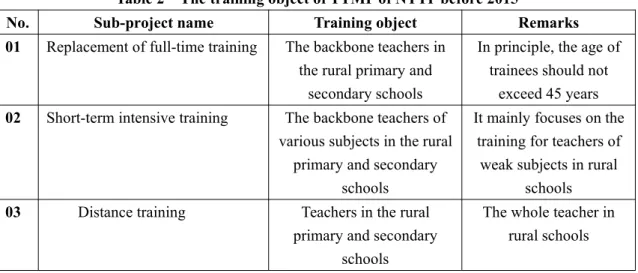
[8]From 2010 to 2014, sub-projects for non-backbone teachers in rural compulsory education stage in the Midwest areas are as follows:
Table 2 The training object of TTMP of NTTP before 2015
No. Sub-project name Training object Remarks
01 Replacement of full-time training The backbone teachers in the rural primary and
secondary schools
In principle, the age of trainees should not
exceed 45 years 02 Short-term intensive training The backbone teachers of
various subjects in the rural primary and secondary
schools
It mainly focuses on the training for teachers of
weak subjects in rural schools 03 Distance training Teachers in the rural
primary and secondary schools
The whole teacher in rural schools
Source: The Circular of the Ministry of Education and the Ministry of Finance on the Implementation of National Teacher Training Program for Primary and Secondary School Teachers (2010) .
Note: In the No.1 and No.2, the proportion of rural teachers came from township level in the total number of teachers participating in training activities is not less than two-thirds.
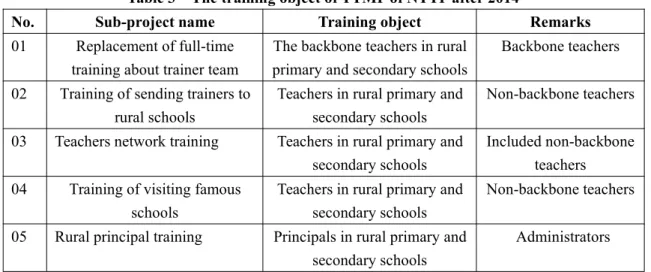
After 2015, TTMP has been adjusted and reformed. The training object of each sub-project in the reformed project is as follows:
Table 3 The training object of TTMP of NTTP after 2014
No. Sub-project name Training object Remarks
01 Replacement of full-time training about trainer team
The backbone teachers in rural primary and secondary schools
Backbone teachers 02 Training of sending trainers to
rural schools
Teachers in rural primary and secondary schools
Non-backbone teachers 03 Teachers network training Teachers in rural primary and
secondary schools
Included non-backbone teachers 04 Training of visiting famous
schools
Teachers in rural primary and secondary schools
Non-backbone teachers 05 Rural principal training Principals in rural primary and
secondary schools
Administrators
Source. "National Teacher Training Program in 2015 - the Implementation Plan of TTMP" and " National Teacher Training Program in 2015 - TTMP ".
After the reform of TTMP in 2015, the sub-projects involving non-backbone teachers include No 2, 3 and 4 in table 3. Among them, the sub-object of the teacher network training is a self-research activity for non-backbone teachers under the leadership of rural backbone teachers.
Thus, it is not suitable for the research object of this study.
[9]As for the question: how you can deduce conclusion from a case study? case study research can be used as analytic generalization rather than statistical generalization, and its purpose is to generalize theories, not to calculate probabilities as use of sample (see Robert K.Yin, 2017, p.26-27). In a word, the purpose of using case study is not as one sample to search answer for the statistical question but for the generalization.
[10] It is considered in policies that giving priority to rural primary school teachers, especially, teacher in villages and townships schools in the sub-project of visiting famous schools, and rural townships schools are training places in the sub-project of sending trainers to rural schools.
Meanwhile, considering the recommends of the deputies of NTTP in two provinces, four provincial typical training models of sub-projects were selected as cases to study.
[11] According to the total number of rural teachers(Education Statistical Yearbook of China in 2015) and the population density(Statistical Yearbook of Urban Construction in 2018), this study selects Henan province and Shaanxi province as research places in the central and western regions respectively, which based on the following reasons: 1, In the central areas, Henan province ranks first in the central areas included 8 provinces. Moreover, as the economic, cultural and educational central in central areas, Henan province has an important impact on education in the central areas;
2, In the western areas, although Shannxi province is cited in the 10th place in the total number of primary and secondary school teachers in the western areas included 12 provinces, it ranks first in the western areas of population density. More importantly, as major population aggregation areas and educational & economic center in the western regions of China, Shannxi province has a huge impact on the education in the whole western areas.
References
Chen An-ning, (2015). The problems and countermeasures in the implementation of the national training plan.The Inservice Education and Training of School Teachers,No.7, Sum No.348, 8-11.
Chen En-lun, (2003). On learning rights. Unpublished doctoral dissertation, Southwest normal University, Chongqing.
Chen Bi-fa, (2005). The research on content, trainers, methods and management of school-based training for primary and secondary school teachers.Journal of Qilu normal university, No. 2, 27-29.
Chen Xiang-ming & Wang Zhi-ming, (2013, January 28). Education survey: there are obvious differences in training opportunities between urban and rural teachers. China Education Daily.
Cheng Ming-xi & Ma Yun-peng, (2018). Vision, change and characteristic analysis of National Training Program from the perspective of public policy. The Inservice Education and Training of School Teachers,No.8. Sum No.385,1-5.
China rural education, (2015). The training program of the New National Training Program has been normalized from separateness to integration.China rural education,No.9,Total 237,7-8.
Dai Ming-li, (2018). On the cooperative development strategies of normal universities in the National Training Program.Higher Education Forum,No. 02, 35-36, 46.
Feng Chen, (2012). On the legal guarantee of right of teachers' further training in primary and secondary schools.Journal of Liaoning Educational Administration Institute, No.1,43-44.
Feng Jian-xia & Li Jin-qi, (2013). The Problems of rural education and the implementation of TTMP of the National Training Program.Journal of Huanggang Normal university, Vol.33 No1,115-118,171.
Fu Yu, (2018). The analysis of model construction and strategy of the National Training Program from the perspective of teacher learning theory. The Inservice Education and Training of School Teachers,No.5, Sum No.382, 1-5.
Ge Zhen-jiang, (2012). Speech at the senior seminar on project management of the National Training Program in 2012.The Inservice Education and Training of School Teachers,No. 7, No. 312, 3-7.
Hou Long-long & Zhu Qing-huan, (2018). Policy analysis of teachers professional development:
self-supporting professional development and task-based professional development.
Educational Science Research,No.4, 72-76.
Kang Li, (2015, September 9), Reform of National Training Teacher Program lights up rural teachers.China Teacher Daily.
Kurosawa Nobuaki & Zhang Mei, (2000). Modern China and Teacher Education. Tokyo:Akaisi Bookstore,May the 31st.
Li Jin-yu, (2018). Teacher issues and the imperative research topics in the context of China teacher policy.Contemporary Education and Culture,Vol. 10, No.5, 48-54.
Li Ze-min & Cai Ming-qin, (2012). Study on significance, situation and strategy of national school students’ replacement teaching practice. Journal of Guangzhou open university, Vol.12, No.5, 30-34.
Lian Qing-hua, (2017). Practice and consideration of rural teacher training. Journal of Fu-jian radio & TV University,No.5, General No.125,32-36.
Liu Jian-long, (2009). Countryside elementary and middle schools teachers troop construction existence question and countermeasure,JiaoYu JiaoXue YanJiu,Vol.4,236.
Liu Fang-guo, (2016), (b). Research on the ability construction of trainers for primary and secondary school teachers.The Science Education Article Collects,Total 371, 19-20.
Luo Yan-hua & Song Wan-ju, (2013). Four transformations of improving the teacher training effectiveness in national training plan.Adult Education,No.5, Total No.316, 67-68.
Luo Jiang-hua, Wang jing-xian, & Zhou wen-jun, (2018). The participation of rural teachers in the network training: conditions, problems and adjustment strategies. Educational Research, General. No.465, No.10,138-145.
Mou Yan-na, (2011). Purpose, significance and effectiveness of distance training of National Training Program - interview with Wang Zhu-zhu, director of the executive office of the distance training program of National Training Program. Education of Information Technology in Primary and Secondary Schools,No.1, 5-6.
Ou Dian-nan & Liao Shi-chang, (2011). A brief discussion on the investigation and reflection on distance training of primary and secondary school teachers in counties. Teacher, No.19,114-116.
Robert.K.Yin, (2017). Case study research: design and methods(5Ed), Chongqing university press, Chongqing.
Robinson. B, (2008). Using distance education and ICT to improve access, equity and the quality in rural teachers’ professional development in western China. International Review of Research in Open and Distance Learning, Vol.9, No.1, 1-17.
Ren Meng & xie Fei, (2017). The research of rural training school teachers’ demand in the national training plan.Journal of Guizhou Education University,Vol. 33. No.3, 75-79.
Ren Miao, (2015). The research about the guarantee of teachers' rights of educating and training in Liaoning rural primary schools and middle schools.Unpublished master dissertation, Shenyang Normal University, Shenyang.
Ruan Cheng-wu, (2005). ZHU TI XING JIAO SHI XUE (Subjective Teacher Study). Hefei: Anhui University Press.
Shinohara Kiyoaki, (1995). The teacher-employment system in present-day China an: Analysis of the "teachers' law of the people's republic of China"(vii. Research reports). Bulletin of the Japan Educational Administration Society, Vol. 21, 237-251.
Sun Chuan-yuan, (2010). Teacher learning: expectation and reality. Doctoral dissertation, Shanghai Normal University, Shanghai.
Sun Zhong-hua, (2014). A study on the rural principal professional development under the background of Urbanization.Unpublished doctoral dissertation, Northeast Normal University, Changchun.
Sun Jian & Chen Yan-hua, (2010). Problems and suggestions of the construction of rural teachers’
team.Journal of He-nan Institute of Science and Technology,Apri, 21-23.
Tan Jie & Lv Zhi-gang, (2016). The problems and countermeasures in the project management of the National Training Program.Journal of Seeking knowledge Guide,Oct.2016.
Wang Bei-sheng & Feng Yu-hong, (2015). The realistic dilemma and breakthrough in the implementation of the National Training Plan.Journal of China’s Education, No.10, 88-92.
Wang Dong-ni, (2007). The research on the right of teachers’ attending in training. Unpublished master dissertation, Shaanxi Normal University, Xi’an.
Wang Hong, (2018, April 12). The five major dilemmas are binding the teacher training, Guangming Daily.
Wang Li, (2016). A practical research on the research methods of "Teachers' Workshop".Journal of Heilongjiang College of Education,Vol.35 No.10, 22-23.
Wang Li & Yin Hong-fei, (2017). Research on school-based study methods based on the projects in the "national training plan".Journal of Heilongjiang College of Education, Vol.36 No.12, 22-24.
Wang Li-bing, (2005). Procedures and methods of comparative analysis of educational policies.
Exploring Education Development, No.10, 64-67.
Wang Li-juan, (2001). On the Elements and Nature of Teachers' Rights. Education and Management,Vol.11, 43-45.
Wang Yan-Bei, (2017). Research on the Current Situation, Problems and Countermeasures of the Training of Key Teachers in Rural Primary and Secondary Schools. Unpublished master dissertation, Shenyang Normal University, Shenyang.
Wei Shi-qiang, (2017). Cohesion problems between national training program and guangxi rural junior middle school history teachers' training. Journal of Guilin Normal College, Vol.31 No.2 (Sum No.112), 98-101.
Wen Chuan, (2012). A survey of domestic researches on teachers’ rights. Journal of hunan university of technology social science edition,Vol.17, No.6, 108-113.
Wu Lun-dun & Ge jixue, (2016). Thematic training mode of teachers in primary and middle school:connotation and structure.Teacher training,No.1, 85-89.
Wu Lun-dun & Ge jixue, (2016). Thematic training management of teachers in primary and middle school:strategies and measures.Teacher training, No.5, 68-73.
Wu Lun-dun & Ge jixue, (2016). Thematic training curriculum design for teachers in primary and middle school:principle and method.Teacher training, No.3, 59-85.
Xu
Jie, (2018). The dilemma and problem solving strategies of replacement training of rural primary and secondary school teachers.Journal of Lingnan Normal University, Vol.39, No.1, 27-32.Xu zhe, Liu Yao-long, Zhai Mei-hua, & Su Ya-qin, (2017). Review of the domestic research on the
“national training plan".SCI-TECH INNOVATION & PRODUCTIVITY,No.5, Total No.280, 52-54.
Xue Jian-Gang, (2011). Thoughts on implementing TTMP of the National Training Program.
Teacher,No. 19,116-117.
Yang Jing-hai, (2015). To improve the effectiveness of training for rural primary and secondary school principals.Liaoning Education,No. 22, 46-47.
Yang tian-ping & Shen-tu Jiang-ping, (2012). Jiao-shi Zhuan-ye Fa-zhan Gai-lun. Chongqing:
Chongqing University Press.
Ye Li-xin, (2011). Analysis on the three fundamental issues in teacher training——reflection originating from implementation of national trainers training program. Global Education., Vol.40, No 7,60-66.
Yin Xiao-li & Zhang Hai-yan, (2012). On the level pasitioning and role playing of chief expert in
"national training plan" program.Teacher Education Research,Vol.24, No.6,41-45.
Yu Wei, Li Guang-ping, Qin Yu-you, & Li Bai-ling, (2007). Structural problems and countermeasures of teachers' team of compulsory education in rural areas of China. China Teacher,No.7, 12-13,16.
Yu Wei-yue, (2013). The Report on the Development of Compulsory Education in Rural Areas of
China. Retrieved from
http://www.360doc.com/content/18/0316/10/2981900_737454505.shtml
Zhang Er-qing & Wang Xiu-hong, (2012). The main problems and analysis existing in teacher training——taking nation-level teacher training plan for example. Journal of Educational Science of Hunan Normal University,Vol.11, No.4, 36-39.
Zhang Shi-seng, (2013). Research on rural primary and secondary school backbone teachers’
training effectiveness. Unpublished master dissertation, Southwest university, Chongqing.
Zhao Hong-Ya, (2011). The role, problems and countermeasures of the Midwest Training Program for rural key teachers in China.Journal of College of Adult Education of Hubei University, No.5, 5-8.
Zhong Qiquan & Wang Yaling, (2012). Discussion on the transition from “Teacher Preparation" to
“Teacher Education".Global education,Vol.41, No 6, 22-25.
Zhang Xian-jin, Wu Xin-jian, & Ye Yan-zhu, (2016). Implementing and reflecting on the training project of Visiting Famous Schools of the National Training Program. Journal of Teaching and Management,No.31, 11-13.
Zhang Xiao-bao et al., (2017). Where is the way for the reform of normal education? Journal of Higher Education Management, September 20.
Zhang Zhi-guo, (2019). A Study on the Guarantee of the Training Rights for Teachers of Rural Primary School through the Case of the Project of Visiting Famous Schools in the D Primary School of Xi'an in China,EDUCATION SCIENCES, No.3, 7-33.
Zhang Zhi-guo, (2020). The research on the guarantee of the rural non-backbone teachers’ training rights in western China through a national project in Baxian town’s secondary school, Educational Administration Research, No.41, 25-36.