Received August 9,2016;Accepted November 10,2016
Tr eat ment of t r i s omy 18 at 2 Japanes e hos pi t al s dur i ng a 10- year per i od
Satoshi Marutani
웋
,Tomohiro Inoue워
,Nori Imaoka웋
,Miho Ichiki워
,Hiroki Kondou워
, Toshiharu Miyake워
,Tohoru Shinohara웋
,Sotaro Mushiake워
,Tsukasa Takemura웋
웋
Department of Pediatrics,Kindai University Faculty of Medicine워
Department of Pediatrics,Kindai University Nara Hospital
Abstract
Introduction.Trisomy 18 is a chromosomal abnormality associated with a poor prognosis.It is difficult to determine the proper treatment for patients with trisomy 18 because of ethical considerations.
Materials and methods.We encountered 29 infants with trisomy 18 between 2005 and 2015 at Kindai University Hospital and Kindai Uni- versity Nara Hospital.Of these,22 cases,which were treated at our hospitals since their neonatal period,were examined.
Results. Of the 22 infants,13 were male and 9 were female. In 4 cases,a definitive diagnosis of trisomy 18 was made antenatally.
The median birth of the 22 infants weight was 1723 g.Ventricular septal defect was present in all infants.Esophageal atresia was noted in 7 patients and omphalocele was observed in 3 patients.Pulmonary artery banding was perfor-
med in 4 infants,and a tracheostomy was perfor- med in 4 infants.Twelve infants were dischar- ged at least once.Seventeen infants died,with a median age at death of 3 months.Three of the 5 surviving children are now older than 1 year. A tracheostomy was performed in all 3 children, while pulmonary artery banding was performed for 2 children.The oldest patient is now 7 years of age.
Conclusion. Results of treatment of our patients suggest that reduction of pulmonary hypertension by pulmonary artery banding,tra- cheostomy,and gastrostomy can contribute to an improved prognosis and quality of life of patients with trisomy 18,although these outcomes vary because of concurrent anomalies.
Key words:Trisomy 18,positive treatment, improvement of prognosis,ethics
Introduction
Trisomy 18,which was first reported in 1960 by Edwards et al.,웋refers to a congenital abnor- mality that results from the triplication of chro- mosome 18. The estimated incidence is 1 case per 3,500 to 8,500 neonates. Trisomy 18 is the third most frequently occurring chromosomal replication,following trisomy 21 and 22q11.2 deletion syndromes.Symptoms vary,but include prenatal developmental disorder;develop- mental disability;external characteristics,such as finger deformities and“rocker-bottom”feet;
congenital heart disease;pulmonary hyperten-
sion;respiratory complications, including apnea attacks;digestive tract anomalies,such as esophageal atresia;urologic complications,in- cluding inguinal hernia and hydronephrosis;
hearing impairment;and malignant tumors. The 1-year survival rate of this condition ranges from 0 to 10%.워
Treatment of trisomy 18 is difficult in many cases because of ethical considerations. How- ever,several recent Japanese studies have demon- strated the efficacy of positive treatment.웍웦웎 Treatment approaches have also been changing.
At our two institutions (Kindai University Hospital and Kindai University Nara Hospital),
Acta Med Kindai Univ Vol.42,No.1 13‑16,2017
13
we have begun planning and discussing treat- ment options with parents,without ruling out positive measures,such as palliative surgical interventions.In this study,we review the treat- ment of trisomy 18 over the past 10 years and report on prognosis and quality of life(QOL) outcomes after surgery.
Materials and methods
Twenty-nine children with trisomy 18 (full trisomy)were treated at Kindai University Hos- pital (Osakasayama City, Osaka Prefecture, Japan,n=14)or Kindai University Nara Hospi- tal(Ikoma City,Nara Prefecture,Japan,n=15) between January 2005 and October 2015. Of these,22 were treated at these two hospitals, initially as neonates and later into infancy,ex- cluding referrals to other hospitals for the pur- pose of surgery. We retrospectively examined these 22 children with trisomy 18 based on medical records.
Results
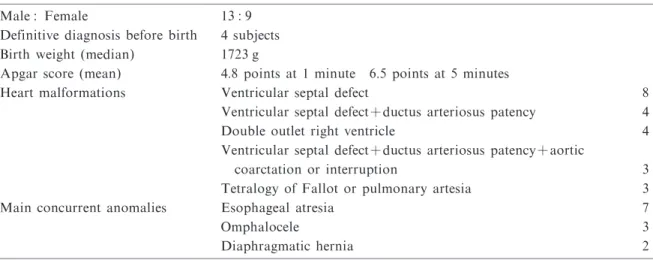
Subjects consisted of 13 male and 9 female infants.In 4 patients,a definitive diagnosis of trisomy 18 was made antenatally based on the results of amniocentesis.The median birth weight was 1,723 g.Mean Apgar scores at 1 and 5 minutes were 4.8 and 6.5 points,respectively.
While the nature of heart defects varied, ventricular septal defect was present in all sub- jects.Esophageal atresia was noted in 7 patients, omphalocele was observed in 3 patients,and diaphragmatic hernia was observed in 2 patients. In addition,various externally evident anom-
alies,such as cleft lip and palate,hypoplasia of the limbs,hypoplasia of the ears,and anal anom- alies(cutaneous fistula with spontaneous defeca- tion),were present(Table 1).
Among the 22 subjects,surgery was performed in 8 patients,following consultation with their parents.Pulmonary artery banding was perfor- med to counteract left-to-right shunting in 4 patients, gastrostomy was performed in 5 patients, tracheostomy was performed in 4 patients,repair of omphalocele was performed in 2 patients,and repair of gastroschisis was perfor- med in 1 patient(Table 2).
Of the 22 patients,12(54.5%)could be dischar- ged at least once.Among these,the mean cumu- lative admission duration as a percentage of the lifetime was 59.3%,the mean survival age in months for these patients was 19 months,which includes currently living patients.Eighteen sub- jects have died,with a median age of 3 months at death.The 1-week and 1-year survival rates were 77.2 and 22.7%,respectively.
We present 3 patients who are now older than 1 year,thereby indicating that long-term survival is possible.
Case 1 is a 7-year-old boy. At the time of birth,he presented with an omphalocele and bilateral great vessels that originated from the
Table 1 Demographic and clinical features of the 22 subjects Male:Female 13:9
Definitive diagnosis before birth 4 subjects Birth weight(median) 1723 g
Apgar score(mean) 4.8 points at 1 minute 6.5 points at 5 minutes
Heart malformations Ventricular septal defect 8 Ventricular septal defect+ductus arteriosus patency 4 Double outlet right ventricle 4 Ventricular septal defect+ductus arteriosus patency+aortic
coarctation or interruption 3 Tetralogy of Fallot or pulmonary artesia 3 Main concurrent anomalies Esophageal atresia 7
Omphalocele 3
Diaphragmatic hernia 2
Table 2 Surgical procedures
Surgery was performed for8subjects.
Pulmonary artery banding 4 Gastrostomy 5 Tracheostomy 4 Surgery for omphalocele 2 Repair of abdominal wall defect 1
S.Marutani et al.
14
right ventricle.After birth,surgery was perfor- med to treat the omphalocele.The liver,colon and a portion of the small intestine prolapsed, making primary closure impossible.To reduce pulmonary blood flow volume, pulmonary artery banding was conducted 6 days after birth.
Subsequently,the abdominal wall was closed step by step before 1 month of age.As chronic respiratory hypofunction was noted, a tra- cheotomy was performed at 5 months of age. Total enteral nutrition is still being conducted under artificial respiratory care.Although he is capable of body movement,focused exercise is impossible,and he is bedridden.He smiles,and expresses his emotions.
Case 2 is a 3-year-old boy who presented with esophageal atresia(gross C),tetralogy of Fallot, cleft lip and palate,and dysplasia of the bilateral forearms. Before 1 month of age,gastrostomy was performed and an upper esophagus cutaneous fistula with ligation of the tracheoeso- phageal fistula was established,thereby facilitat- ing saliva excretion. Total enteral nutrition is still being conducted.Tracheotomy for chronic respiratory failure was performed 2 months after birth. Although artificial respiratory care has continued,a respirator is used for assistance. Furthermore,spontaneous respiration with an artificial nose is possible.The patient has been undergoing follow-up for medical treatment without surgical treatment of tetralogy of Fallot, as there has been no marked decrease in pulmo- nary blood flow.Although the patient is exper- iencing hypoplasia of the forearms,he can raise his upper arms and express his emotions by smiling or crying.
Case 3 is a 2-year-old girl who presented with ventricular septal defect.To treat an increase in pulmonary blood flow,pulmonary artery band- ing was performed 1 month after birth. Oral ingestion was impossible,and,after establishing enteral nutrition using a transnasal gastric tube, gastrostomy was conducted at 3 months of age. A tracheotomy was also performed at the same age for chronic respiratory hypofunction. We continue to administer total enteral nutrition under artificial respiratory care;however,she is able to grasp items with her hands,smile,and vocally express emotions despite the tra- cheotomy.
These children have received home care pro- vided by home-care practitioners and nurses in cooperation with their families. All three
patients have spent more than half of their lives at home.
Discussion
Newborns with trisomy 18 have a 1-year sur- vival rate that ranges from 5.57%to 8.4%,with a median survival time of 10 to 14.5 days,based upon studies of two large databases in the US.웏 A study from the UK indicated that mortality was related primarily to central apnea.원Despite differences in medical environments and health insurance systems,aggressive treatment is not often provided for trisomy 18 in Europe,Amer- ica or Japan.Considering this life expectancy, positive treatment typically has been avoided, although differences exist among medical institu- tions.웑웦웒Recently,however,several reports from Japan described the efficacy of neonatal inten- sive care웓as well as surgical treatments(particu- larly heart surgery)for the improvement in the prognosis and quality of life in patients with trisomy 18.웍웦웎Indeed,one previous study as well as our current experience,has indicated progress in achieving long-term survival in children.웋월
Despite such progress,perceptions of treat- ment possibilities are frequently disparate between health care professionals and families of the patients.Many health care professionals feel that positive treatment for children with such poor prognosis merely prolongs the stress of the condition and offers little satisfaction to either themselves or the families.Nevertheless,some studies emphasize that many families accept their children and desire treatment.웋월웦웋웋 Thus,we believe that it is necessary for medical staff to be able to understand the opportunities and limita- tions of active treatment,including surgery, based upon literature-based treatment options.
Discussions with the family of the patient whether positive treatment is indicated depends on the type and severity of anomalies are neces- sary. In considering surgical treatment for pediatric patients with trisomy 18,the treatment approach can be largely sorted into three cate- gories:surgical treatments to maintain life,sur- gical treatments to improve prognosis,and surgi- cal treatments to improve QOL.Surgical treat- ments to maintain life are procedures for abdom- inal wall rupture and esophageal atresia that must be considered immediately after birth and, if not performed,result in a drastically shortened prognosis.Surgical treatments to improve prog-
Treatment of trisomy 18 at 2 Japanese hospitals during a 10-year period
15
nosis are procedures that enable long-term sur- vival,though their omission may not affect immediate life maintenance.For example,for a pediatric trisomy 18 patient who develops chronic respiratory hypofunction as a result of complex interactions among respiratory dis- orders due to central apnea,underdeveloped respiratory strength, and heart failure, tra- cheotomy and artificial respiratory management may contribute to improved prognosis by preventing central apnea and reducing respira- tory effort.For pediatric patients with comorbid heart disease with increased pulmonary blood flow,pulmonary artery banding can be perfor- med without cardiopulmonary bypass and may greatly contribute to improvements in long-term prognosis,despite the risks associated with car- diac surgery.A typical surgical treatment to improve QOL is gastrostomy(in cases of eso- phageal atresia,see the previous“surgical treat- ments to maintain life”).Though it is possible for patients to lead a normal life with a nasogas- tric tube,considering the hazards surrounding NG tube removal and functional and aesthetic problems with the nose,gastrostomy can perhaps be expected to improve QOL.
In our series,all surviving subjects underwent surgical interventions.Surgical treatments,such as gastrostomy and tracheotomy,are essential for maintaining the patientʼs life and daily quality of life. These interventions may contribute to improvements in prognosis and QOL. Our results suggest that a patientʼs condition can be stabilized by surgical intervention. Of course, the risks and validity of surgical treatment must be considered in light of complications and the patientʼs general condition. For example,we have never performed pulmonary artery banding in a patient with right-to-left shunting;even if it were successful,intracardiac repair using car- diopulmonary bypass may be too invasive for the patient to tolerate. Ultimately,treatment that focuses on these symptoms permits the transition to home care and significantly improves the prognosis and quality of life of patients.
Conclusion
For the treatment of trisomy 18,though treat- ment choices may differ based on the individual
patientʼs pathophysiology,proactive treatment including surgical procedures is a valid option for patients,their families,and health care pro- fessionals.
Acknowledgement
The authors are grateful to pediatric surgeons and cardiac surgeons of Kindai University Hospital and Kindai University Nara Hospital for useful discussions.
Conflict of interest
The authors declare that they have no conflicts of interest.
References
1.Edwards JH,Harnden DG,Cameron AH,Crosse VM,Wolff OH (1960)A new trisomic syndrome Lancet 1 pp787‑790
2.Carey JC (2010)Trisomy 18 and trisomy 13 syn- dromes. Management of Genetic Syndromes 3rd edition Wiley-Blackwell Hoboken pp807‑823
3.Ehara E et al.(2015)Clinical Course of 16 Patients with Trisomy 18 Who Underwent Cardiac Surgery Pediatric Cardiology and Cardiac Surgery 31(5)pp254
‑264
4.Maeda J et al.(2011)The impact of cardiac surgery in patients with trisomy 13 and trisomy 18 in Japan Am J Med Genet Part A 155A pp2641‑1646
5.Rasmussen A et al.(2003)Population-based analysis of mortality in trisomy 13 and trisomy 18 Pediatr 111 pp777‑784
6.Embleton ND,Wyllie JP,Wright MJ,Burn J,Hunter S(1996)Natural history of trisomy 18 Arch Dis Child 75 pp38‑41
7.Nishida H et al.(1987)Medical decision making in neonatal medicine Acta neonat Jap 23 pp337‑341 8.Chervenak FA,McCullough LB(1990)An ethically
justified,clinically comprehensive management strategy for third-trimester pregnancies complicated by fetal anomalies Obstet Gynecol 75 pp311‑316
9.Kosho T et al.(2006)Neonatal management of trisomy 18:clinical details of 24 patients receiving intensive treatment Am J Med Genet PartA 140A pp937‑944
10.Kosho T,Kuniba H,Tanikawa Y,Hashimoto Y, Sakurai H (2013)Natural history and parental experi- ence of children with trisomy 18 based on a question- naire given to a Japanese trisomy 18 parental support group Am J Med Genet PartA 161A pp1531‑1542 11.Janvier A1,Farlow B,Wilfond BS(2012)The experi-
ence of families with children with trisomy 13 and 18 in social networks Pediatr 130 pp293‑298
S.Marutani et al.
16