九州大学学術情報リポジトリ
Kyushu University Institutional Repository
Oryza sativa L.を遺伝的背景とするO.glaberrima遺 伝子導入系統の作出とその利用
土井, 一行
Graduate School of Agriculture, Kyushu University
https://doi.org/10.11501/3154803
出版情報:Kyushu University, 1999, 博士(農学), 課程博士
)
Construction and Utilization of Oryza glaberrima Introgression Lines in the Background of 0. sativa L.
Kazuyuki Doi
1999
Contents
General Introduction ... !
General Materials and Methods ....... 7
Chapter I. Construction of an RFLP Linkage Map Using a Backcross Population between Oryza sativa L. and 0. glaberrima Steud .... 10
Chapter II. QTL Analysis of Heading Date and Pollen Sterility Using Backcross Progenies between Oryza sativa L. and 0. glaberrima Steud . ... ! 7
Chapter III. Construction of a Series of Introgression Lines of Oryza glaberrima Steud. in 0. sativa L . ...... 26
Chapter IV. RFLP Mapping of a QTL for Heading Date Found on Chromosome 10 ... ...... 36
Chapter V. A New Locus Causing High Fl Pollen Sterility Found in Backcross Progeny between Oryza sativa L. and 0. glaberrima ... ... . . . ....... 43
Summary and Conclusion ....... 50
Acknowledg:rnents ... ....... 55
References ... 67
Appendices ....... 64
General Introduction
Asian rice, Oryza sativa L., is a major food crop in the world and the most common cultivated rice. African rice, Oryza glaberrima Steud., is an endemic cultivar in West Africa.
Taxonomically 0. glaberrima belongs to 0. sativa complex (A
genome) in the genus Oryza (Vaughan 1994). Phylogenetic analyses based on isozymes, chloroplast DNA and nuclear DNA (Second 1985, Dally and Second 1990, Ishii et al. 1988, 1995, Wang et al. 1992, Doi et al. 1995) revealed that 0. glaberrima was cultivated from 0. barthii A. Chev. (formerly 0. breviligulata A. Chev e t Roehr.) while 0. sativa was believed to be differentiated from 0. rufipogon Griff. Geographical distribution of the A-genome species was shown in Fig. 1. Other A-genome wild species, 0. nivara Sharma et Shastry, 0. longistaminata Chev. et Roehr., 0. glumaepatula Steud. (sometimes called 0.
rufipogon) and 0. meridionalis Ng are known to exist in Asia, Africa, Latin America and Australia, respectively.
Morphological key characters of 0. glaberrima are the lack of secondary and tertiary branching of panicles, short and rounded ligule, generally awnless spikelets and non-shattering (Vaughan 1994). Pubescent leaves and sparse spikelets are also generally found in this species. Physiologically it has strong seed dormancy and annual growth habit quite different from those of 0. sativa. Although 0. glaberrima has interesting characters
Southern limit of 0. sativa cultivation
Fig. 1. Geographical distribution of A-genome species in the genus Oryza.
such as mentioned above, it has not been extensively used in rice breeding program and molecular-marker-assisted genetic analysis in rice. One of the most possible reasons is that F1 hybrids between 0. sativa and 0. glaberrima show complete male sterility.
Using RF LP markers, well-saturated linkage maps of rice were constructed. Traits of agronomic importance, such as disease and insect resistance and even quantitative trait loci (QTLs) were mapped onto them (e. g. Tsunematsu et al. 1995, Xiao et al. 1995; 1996, Lin et al. 1996, Redofia and Mackill1996).
QTLs control many traits of agronomic importance. Development of molecular markers enabled geneticists and breeders to systematically detect QTLs (Lander and Botstein 1989). To manipulate the selection of desired genotypes, molecular markers can be employed instead of expensive evaluations over years and locations.
C urrently international effort in molecular-marker-assisted genetic analysis is directed to identify QTLs. Molecular markers are used in mapping populations derived from distantly related crosses and many QTLs are ordinarily detected in the mapping populations. However, simultaneous QTL mapping based on conventional populations such as F2, BC1F1, or recombinant inbred lines makes it difficult to precisely evaluate the phenotypic effect of each QTL. In other words, accuracy of QTL analysis is limited by environmental variance although the
progeny test or replication of recombinant inbreds is effective (Lander and Botstein 1989, Burr and Burr 1991). Hence, it is also difficult to fine-map each of the QTLs in these populations. This difficulty attributes to the great genetic variation in mapping populations.
Some new concepts, such as advanced backcross (AB) QTL analysis (Tanksley and Nelson 1996) and introgression line (IL) analysis (Eshed and Zamir 1994, 1995, Eshed et al. 1996), were proposed to overcome these difficulties. These methods utilize backcross progeny (BC2, BC3, BC4) with a more uniform genetic background. AB QTL analysis employs BC2F1 or BC3F1 populations while IL analysis uses fixed lines with a small chromosome segment from the donor. Both new methods, therefore, enable researchers to generate isogenic lines for each QTL in the background of an elite breeding line more rapidly than the conventional methods. Isogenic lines are important to evaluate precisely the phenotype of each plant or line, resulting in fine mapping of QTLs.
In rice, it is generally difficult to obtain many crossed F1 seeds sufficient for repeated or multilocational evaluation as reported in AB QTL analysis in tomato (Bernacchi et al. 1998).
Introgression lines, therefore, are more rational in rice for such purposes. Systematically bred introgression lines using marker assisted selection (MAS) were developed or are currently developed in some plant species other than tomato, such as
Brassica (Ramsay et al. 1996).
To analyze the genetics of traits specific to 0. glaberrima and to exploit fully the genetic potential of the species, a series of 0. glaberrima introgression lines (GILs) in the background of 0.
sativa was developed in the present study. Each GIL carrying homozygous chromosome segments from 0. glaberrima was selected using RFLP markers. MAS was done ahead of the phenotypic selection, while conventional breeding methods gave priority to phenotypic selection.
During breeding of GILs, a large variation of heading date and pollen sterility was observed. Heading date, which is related to many characters of agronomic importance such as grain yield or stress avoidance, is an important character of rice. Sterility is a major key trait for utilizing alien germplasm in rice breeding as well as hybrid rice breeding. Although complete male sterility is observed in hybrids between two cultivated rice species, genetic information about the phenomenon is still very limited (Yabuno
1977, Sano et al. 1979, Sano 1983, 1986, 1990).
The present thesis described the following subjects: The first step was the construction of an RFLP linkage map as a framework of MAS for the development of GILs (Chapter I). In the BC2Fl generation, QTL analysis for heading and pollen fertility was done (Chapter II). The construction of a series of GILs was described in Chapter III. Some of the detected QTLs were identified using genetically simplified segregating
populations (Chapters III and IV). An overview of the whole experiments was described in the Summary and Conclusions.
General Materials and Methods
An 0. glaberrima accession, IRGC 104038, from Senegal kindly supplied by the International Rice Germplasm Center, the International Rice Research Institute, Los Banos, Philippines was used as a donor parent. A Japonica rice variety, 0. sativa cv.
Taichung 65, was used as a recurrent parent. In the initial cross, Taichung 65 was used as a female parent, while in backcrosses it was used as a male parent with (BC)F1 plants as female parents.
Therefore, all the progeny carried cytoplasm from Taichung 65.
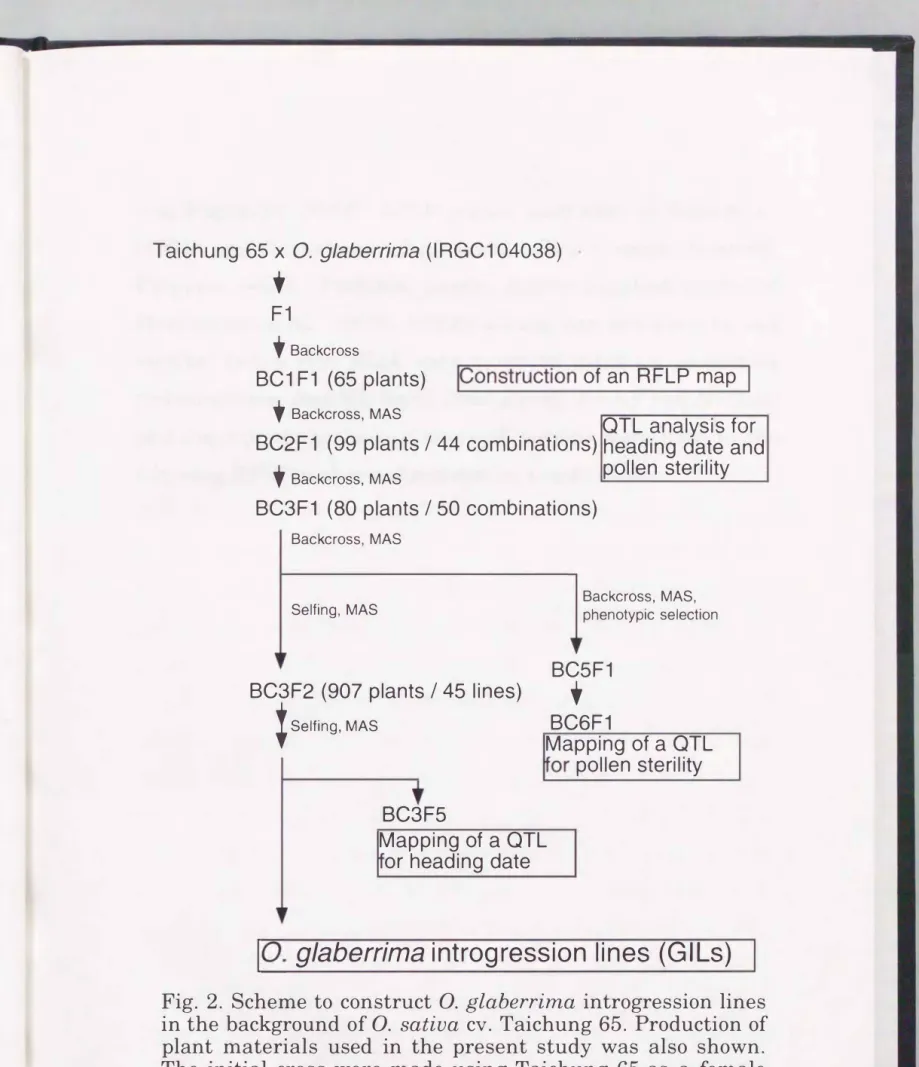
The breeding scheme of the plant materials was shown in Fig. 2. Using BC1F1 population (65 plants), a framework RFLP linkage map was constructed. The plants in this population were backcrossed with Taichung 65 and derived BC2F1 plants were used for QTL mapping of heading date and pollen sterility.
BC3F1 plants were selected using RFLP markers and its selfed progeny (BC3F2) were selected again for fixed GILs. A BC3F5 population from one of these lines was used to verify a QTL for heading date found in BC2F1. On the other hand, to produce isogenic lines of QTLs for pollen sterility, backcrossing was continued to BC6F1 with phenotypic and marker assisted selection. One of the derived BC6F1 populations was used for mapping a QTL for pollen sterility.
Procedure of DNA extraction and RFLP detection fundamentally followed the procedure described by Ban (1996)
Taichung 65
x 0. glaberrima(IRGC1 04038)
'
F1
f
BackcrossBC1 F1 (65 plants) !Construction of an RFLP map I
f
Backcross, MASQTL
I. f
. . ana ys1s or
BC2F1 (99 plants
I44 comb1nat1ons) heading date and
f
Backcross, MASpollen Sterility
BC3F1 (80 plants
I50 combinations)
Backcross, MAS
Selfing, MAS
BC3F2 (907 plants
I45 lines)
;
Selling, MASBC3F5
Backcross, MAS, phenotypic selection
BC5F1
+
BC6F1
Mapping of a QTL
�or pollen sterility
Mapping of a QTL or heading date
10. glaberrima introgression lines (Gils)
Fig. 2. Scheme to construct 0. glaberrima introgression lines in the background of 0. sativa cv. Taichung 65. Production of plant materials used in the present study was also shown.
The initial cross were made using Taichung 65 as a female parent and all backcrosses were made using Taichung 65 as a pollen parent so that all the progenies carried cytoplasm of
and Nagamura (1996). RFLP probes used were of Saito et al.
(1991) and Harushima et al. (1998). Rice Genome Research Program (RGP), Tsukuba, Japan, kindly supplied probes of Harushima et al. (1998). RFLPs among the two parents and another Indica rice, IR24, were surveyed using six restriction endonucleases (BamHI, Bglii, Dral, EcoRI, EcoRV and Hindiii) and appropriate probe-enzyme combinations were used in the following RFLP analyses of segregating populations.
Chapter I
Construction of an RFLP Linkage Map Using a Backcross Population between Oryza sativa L. and 0. glaberrima
Steud.
Introduction
As a first step towards construction of GILs, an RFLP linkage map based on a backcross population was constructed. A precise linkage map is essential for conducting MAS. Since GILs will be selected through entire genome, an RFLP linkage map that covers whole rice genome is required. 0. glaberrima has not been used for molecular-marker-assisted genetic analysis in rice while RFLP maps based on intraspecific crosses (McCouch et al.
1988, Saito et al. 1991, Tsunematsu et al. 1996, Harushima et al.
1998), interspecific backcross (Causse et al. 1994) and crosses between wild species other than the 0. sativa complex in the genus Oryza (Jena and Kochert 1991, Jena et al. 1994) were constructed. The map will also give some additional information about differentiation between 0. sativa and 0. glaberrima.
Materials and Methods
Backcrosses were performed using F1 plants as the female parent and Taichung 65 as the pollen parent. DNA of 65 BC1F1
plants was extracted and used for RFLP mapping.
RFLPs were surveyed among three rice varieties, Taichung 65, IR24 (an Indica variety of 0. sativa), and 0. glaberrima, using six restriction endonucleases (BamHI, Bglii, Drai, EcoRI, EcoRV and Hindiii).
Recombination values were estimated using the maximum likelihood equation (Allard 1956), and the recombination values were converted into the genetic map distances (eM) using Kosambi function (Kosambi 1944).
Results
Crossability of Fl and backcrossed progenies
F1 seeds were easily derived from the cross, Taichung 65 x 0. glaberrima, and they germinated normally. Crossability of Fl hybrids with Taichung 65 pollens appeared to be lower than in the case of the interspecific cross described by Oka (1988) (approximately 30%). However, 5 to 40 seeds were generated from each of the F1 plants following a standard crossing method.
Detection of RFLPs between 0. sativa and 0. glaberrima
RFLPs between Taichung 65 and 0. glaberrima were examined. Out of 415 recordable probe-enzyme combinations (75 probes and 6 enzymes), 245 polymorphic combinations were observed. The frequency of the RFLPs was 59%. In the same
manner, RFLPs were detected in the intraspecific combination between Taichung 65 and IR24 and the frequency was 51%. The frequency of RFLPs detected from the interspecific combination between Taichung 65 and 0. glaberrima was slightly higher than that from the intraspecific combination. Almost all the probes showed polymorphism between Taichung 65 and 0. glaberrima and were used for the interspecific mapping.
Evaluation of the RFLP map
The RFLP map based on the BClFl population is shown in Fig. 3. It includes 101 well-dispersed RFLP markers. Since markers located in telomeric regions (Tsunematsu et al. 1996, Harushima et al. 1998) were used in this study, the present map covered whole genome. The total map length was 1403. 4 eM.
Linkage arrangement of the RFLP markers was in good agreement with that of the previously constructed maps (Saito et al. 1991, Tsunematsu et al. 1996, Harushima et al. 1998).
Segregation distortion
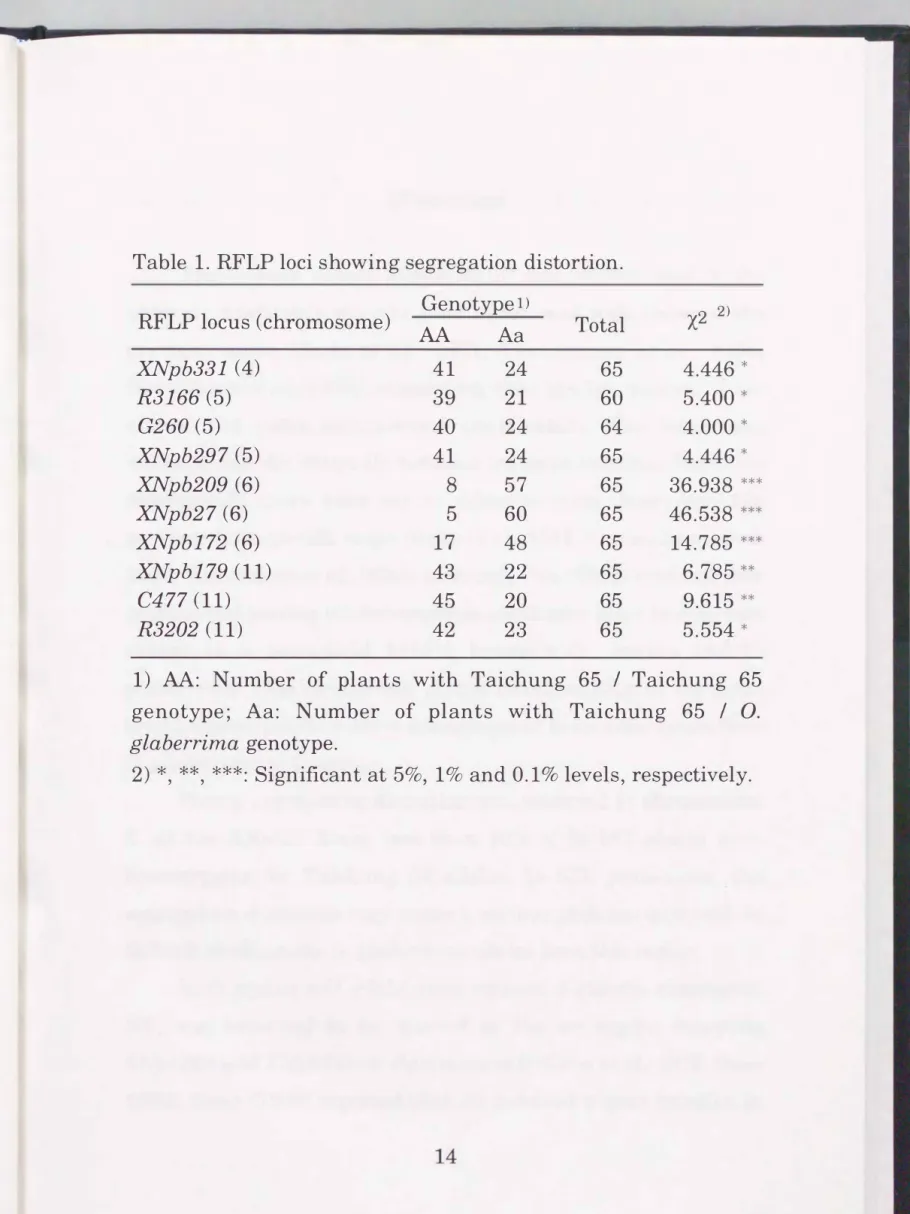
Significant segregation distortions were observed in chromosomes 4, 5, 6 and 11 (Table 1). In chromosome 6, a strong distortion towards 0. glaberrima was detected. In chromosomes 4, 5 and 11, alleles from Taichung 65 were preferentially transmitted to the progenies.
1--L CJ.:)
1
10.9
11 5
28 1
36
15.9
29 0
93
10 0
66
78 C970
18 2 XNpb359
R1944
C1211 XNpb2&Jl
XNpb3@16
93
R2635
C86
9 31 I 41
XNpb113
23 0
XNpb346
2 3
R2510 3 11'"'"tC515
9.3
G1327 23.4
XNpb227 19 1
XNpb21 R1843
15 9
62
C499 27.5 XNpb45
27 5 R3393
C560 C1221
290
12 6
XNpb279
XNpb238
31 2 XNpb51 XNpb144
19 7 XNpb362
XNpb249
XNpb164
XNpb48
4
XNpb247
23.2
XNpb237
30 3
XNpb311
25.4
XNpb331
Ky4
2 1 2 C445
5
XNpb105
38.4 XNpb255
XNpb297
6
XNpb386
Ky11 XNpb342
7
XNpb338
R1440
369 C451 XNpb117
39 R1245
31 2 R1789
C213 4 6
8 9 10
XNpb278 +-+ XNpb36
C1107
29.6 R1394 G1073
XNpb56 XNpb397
176 XNpb103
62
R1751 27 0
XNpb13 3 1
27 5
XNpb293
16 2 C701
XNpb37 R1877
C16
11
95 C405 3 1
12
��gg�4
XNpb44 27 5
XNpb257 1 5
2 1 6 C1003
G14659 5 XNpb181
XNpb344-2
��gg1�3
C1336
R3375
e�f�402
e���48
C901
Fig. 3. An RFLP map based on the backcross population (Taichung 65 I 0. glaberrima (Ace. IRGC 104038) I I Taichung 65). Markers with the prefix
"XNpb" were supplied by Saito et al. (1991). Other markers (Harushima et al. 1998) were kindly provided by RGP. Marker intervals are indicated in eM. The total map length is 1403.4 eM.
Table 1. RFLP loci showing segregation distortion.
RFLP locus (chromosome) Genotype I)
X2 2) AA A a Total
XNpb331 (4) 41 24 65 4.446 *
R3166 (5) 39 21 60 5.400 *
G260 (5) 40 24 64 4.000 *
XNpb297 (5) 41 24 65 4.446 *
XNpb209 (6) 8 57 65 36.938 ***
XNpb27 (6) 5 60 65 46.538 ***
XNpb172 (6) 17 48 65 14.785 ***
XNpb179 (11) 43 22 65 6.785 **
C477 (11) 45 20 65 9.615 **
R3202 (11) 42 23 65 5.554 *
1) AA: Number of plants with Taichung 65 I Taichung 65 genotype; Aa: Number of plants with Taichung 65 I 0.
glaberrima genotype.
2) *, **, ***: Significant at 5%, 1% and 0.1 o/o levels, respectively.
Discussion
The linkage orders of the RFLP map constructed in the present experiment were in good agreement with those of the previous maps (Saito et a l. 1991, Tsunematsu et a l . 1996, Harushima et al. 1998), suggesting that the two species share almost the same chromosome constitution. The total map distance and the intervals between markers obtained from this interspecific cross were not so different from those from the previous intraspecific maps (Saito et al. 1991, Tsunematsu et al.
1996, Harushima et al. 1998), although Oka (1968) reported that preferential pairing of chromosomes could take place to a certain extent in a tetraploid hybrid between 0. sativa and 0.
glaberrima. This mechanism of free recombination at the same level as intraspecific cross is advantageous to transfer genes from 0. glaberrima to 0. sativa.
Strong segregation distortion was observed in chromosome 6. At the XNpb27 locus, less than 10% of BC1F1 plants were homozygotes for Taichung 65 alleles. In GIL production, the segregation distortion may cause a serious problem as it will be difficult to eliminate 0. glaberrima alleles from this region.
In 0. sativa x 0. glaberrima crosses, a gamete eliminator, S 1, was reported to be located in the wx region (between XNpb209 and XNpb27) on chromosome 6 (Sano et al. 1979, Sano 1990). Sano (1990) reported that Sl behaved a gene complex in
the hybrid. Detailed observation using molecular markers will be able to dissect this complicated loci. The loci showing segregation distortions found in chromosomes 4, 5 and 11 were less serious compared with those in chromosome 6 and therefore not critical for GIL production.
Previous RFLP maps of rice were constructed based on intraspecific crosses, interspecific backcross, and crosses using wild species other than the 0. sativa section in the genus Oryza.
The map presented here was based on a new mapping population derived from the cross between 0. sativa and 0. glaberrima.
Covering the rice genome adequately, it could be used as a framework map for the construction of GILs.
Chapter II
QTL Analysis of Heading Date and Pollen Sterility Using Backcross Progenies between Oryza sativa L. and 0.
glaberrima Steud.
Introduction
Technique of QTL analysis is appropriate when used as a first survey for genetic analysis in those traits showing continuous variation. Another reason is that QTL analysis can accept phenotypic data that fund amen tally contain environmental errors.
Heading date in rice was extensively studied. Major genes were found and summarized in Kinoshita et al. (1995). However, it was hardly possible to conduct detailed genetic analysis of the trait without molecular markers because many loci were involved in the trait.
On the other hand, when distantly related species were hybridized, various pre- and post-mating disorders are observed.
Oka (1988) summarized post-mating barriers. Among them, F1 sterility is the most important hurdle to overcome in utilization of alien germplasm and hybrid rice breeding. Many loci causing hybrid sterility have been reported (for summary, Kinoshita 1995). Although F1 sterility is commonly found in 0. sativa x 0.
glaberrima crosses (Yabuno 1977, Sano et al. 1979, Sano 1983,
1986, 1990), genetic information about the phenomenon was limited.
BC1F1 plants, used for construction of an RFLP linkage map described in Chapter I, were backcrossed with Taichung 65.
In the derived BC2F1 population, large variation for male sterility and heading date was observed. The results of QTL analysis for these two traits are presented in this chapter.
Materials and Methods
Taichung 65 was used as a female parent in the initial cross so that all the progeny carried its cytoplasm. Succeeding backcrosses were performed using F1 or BC1Fl plants as the female parent and Taichung 65 as the pollen parent (Fig. 2).
During the 1995 spring-summer season, ninety-nine BC2F1 plants (derived from 44 BC1F1 plants) were grown in pots and subjected to short-day treatment (9 h daylight and 15 h darkness) for 3 weeks (August 4 to August 25) at Kyushu University, Fukuoka, Japan. This treatment could synchronize the heading date of two parents.
These BC2F1 plants were genotyped for RFLP loci, and evaluated for heading date and pollen sterility. All the plants were also backcrossed with Taichung 65 for generating the GILs.
Heading date was recorded as the day when the first spikelet of the plant flowered. Pollen fertility, on the other hand,
was evaluated by observing anthers microscopically. Anthers were collected from spikelets on 1 to 2 days before anthesis and stored in 70% ethanol. Pollen fertility was estimated as the percentage of pollen grains that could be stained by acetic carmine. Pollen grains well stained and filled with the contents were determined as fertile.
QTLs were detected using the QGENE (Nelson 1997), a software for DNA-marker-based genetic analysis on Macintosh.
Results
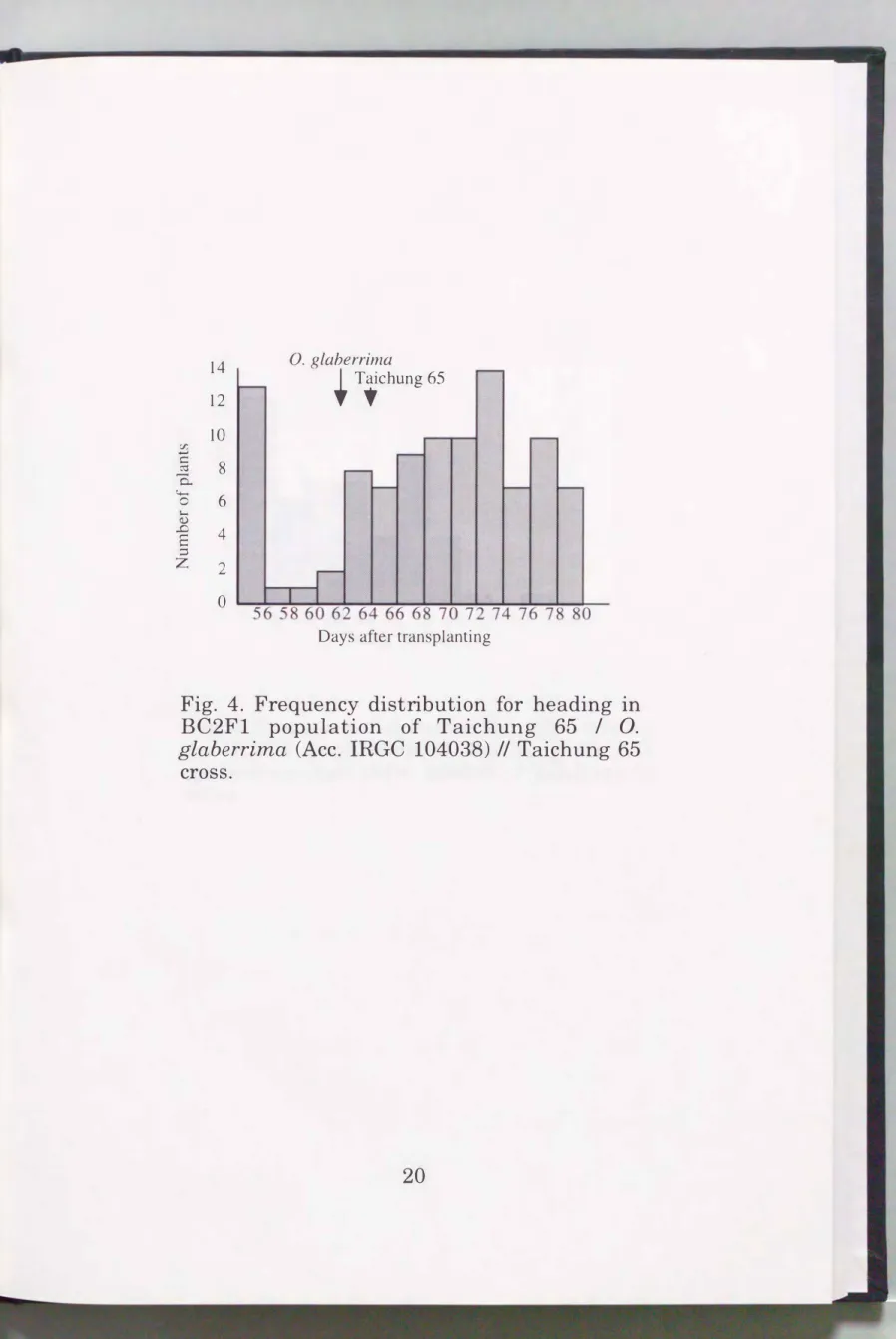
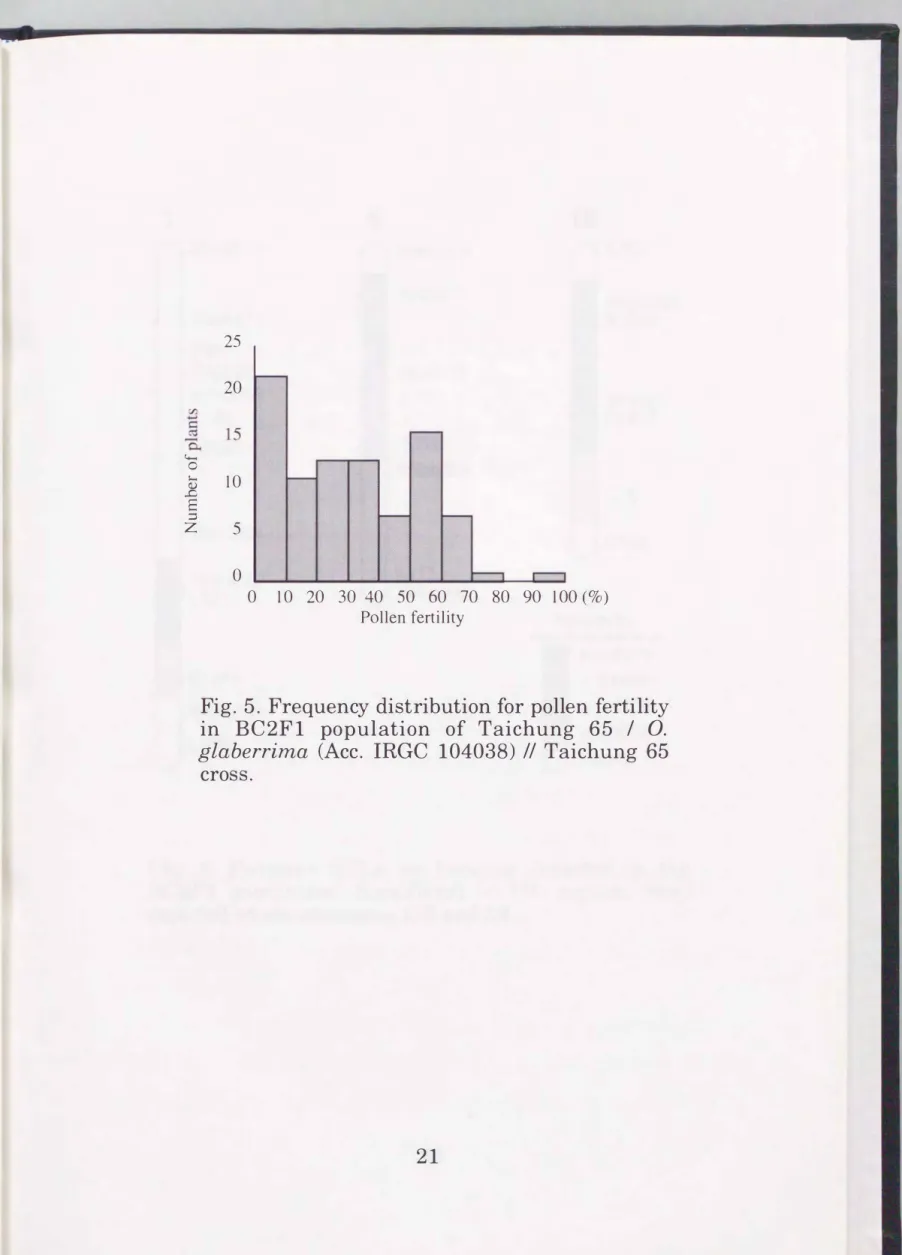
Heading date and pollen fertility were determined in the BC2F1 population. Frequency distribution of these traits is shown in Figs. 4 and 5. Heading date of two parents were almost the same, and pollen fertility of them were normal. These data were combined with the RFLP genotype of each BC2F1 plant and loaded to the QGENE. The loci affecting these traits were estimated (Figs. 6 and 7) using the "Single-point" and "Interval"
commands of the QGENE. Figures 6 and 7 were derived from
"Multiplot" command.
On chromosomes 1, 6 and 10, significant ( < 1%) QTLs for heading were detected (Fig. 6). In the heterozygous condition, 0.
glaberrima alleles around the RFLP markers C1211 (chromosome 1) and XNpb27 (chromosome 6) delayed the heading by 5.5 and 7.8 days, respectively, while another 0.
14 0. glaberrima
•
T.
chung 6512
(/} 10
...
§'"a 8
4-; 0
...
C) 6,£:J 8 4
z ::J 2
0
Days after transplanting
Fig. 4. Frequency distribution for heading in BC2Fl population of Taichung 65 I 0.
glaberrima (Ace. IRGC 104038) // Taichung 65 cross.
� 0
25 20
� 10
�
::::Jz 5
0
0 10 20 30 40 50 60 70 80 90 100 (o/o) Pollen fertility
Fig. 5. Frequency distribution for pollen fertility in BC2F1 population of Taichung 65 I 0.
glaberrima (Ace. IRGC 104038) II Taichung 65 cross.
1 6 10
XNpb346 C701
XNpb333
XNpb113 R1629
C86
XNpb92 Npb172
XNpb343 XN
�
b37C122 R1 77
R2635
C16
XNpb364 C405
XNpb252 Ky11
C1211 XNpb342
Probability
•
< 0.0010R1944
•
< 0.0050XNpb359 < 0.0100
C970
D
< o.o5ooD
AboveFig. 6. Putative QTLs for heading detected in the BC2F1 population. Significant
(
< 1%)
reg1ons were detected on chromosomes 1, 6 and 10.glaberrima allele(s) around XNpb37 (chromosome 10) caused early heading by 11.2 days. These three markers explained 50.9%
of total variation based on the "Multiple regression" command of the QGENE.
On chromosomes 3, 7 and 10, significant ( < 1 %) QTLs for pollen sterility were detected (Fig. 7). 0. glaberrima alleles in these regions reduced the pollen fertility in the heterozygous condition. On chromosome 10, a wide region showed a significant association with the trait.
Discussion
Major genes affecting heading date are known to be located on chromosome 6 (Sel = Lm, Yokoo and Kikuchi 1982) and chromosome 10 (Efl, Sa to et al. 1988). In the present experiment, corresponding regions to these major genes were detected. This indicated that 0. glaberrima carried loci for heading date similar to those observed within 0. sativa. Presumably, only in the present interspecific cross combination a QTL for heading could be detected on chromosome 1. This implied that genetic variation of rice could be able to be extended using 0. glaberrima as a genetic source.
Putative QTLs on chromosome 10 most significantly (P <
0.001) reduced pollen fertility. Yabuno (1977) reported the presence of some kinds of cytoplasmic-genic male sterile system
3 7 10
XNpb48 C1057 C701
XNpb164 R2401
XNpb333 R1629 XNpb338
XNpb249 R1440
C451 XNpb37
R1877 XNpb117
XNpb362 R1245
C16 R1789
XNpb144 C405
XNpb51 C213
XNpb238
Probability XNpb348
•
< 0.0010•
< 0.0050R2247
•
< 0.0100XNpb279
D
< o.o5ooC515
D
AboveFig. 7. Putatjve QTLs for pollen fertility detected in the BC2F1 population. Significant
(
< 1%)
regions were detected on chromosomes 3, 7 and 10.between the two species. Nuclear genes of 0.
glaberrima
could not restore the pollen fertility in the Japonica cytoplasm. The strongest restorer in Japonica was calledRfak (=Rfj,
Yabuno1977). Rfl
on chromosome10
is known to consist of a series of restorer alleles. However, the most significant peak of the QTL region on chromosome10
found in the interval analysis was apparently different from the previously reported location ofRfl
(Fukuta
et al. 1992).
In the knownRfl
region, a peak with lower LOD score was observed (data not shown). It is necessary to elucidate if there would be another locus related to the pollen sterility in thisRfl
region.Rf4
(Zhanget a l . 1994, 1997)
on chromosome7
is also known as fertility restorer gene. QTLs detected in the present study appeared to correspond to these fertility restoration loci.GILs or near-isogenic lines for these loci may enable to further analyze these loci in detail.
Once QTLs were detected, they should be verified by different methods. These methods include those using simple, single-generation segregating populations as well as comparison between a series of overlapping introgression lines. Using genetically simplified segregating populations, two of the QTLs detected in this chapter were confirmed. These experiments were described in chapters IV and V.
Chapter III
Construction of a Series of Introgression Lines of Oryza glaberrima Steud. in 0. sativa L.
Introduction
In the previous chapters, an RFLP linkage map based on the BC1F1 population was constructed and QTL analysis of heading date and pollen sterility was done using the BC2F1 population. The present chapter describes the construction of GILs.
Materials and Methods
Succeeding backcrosses were continued to BC3Fl generation. All backcross progeny were made using BCF1 plant as the female parent and Taichung 65 as the pollen parent (Fig.
2). DNA of 65 BC1F1 plants were extracted and used for RFLP mapping using 104 RFLP markers described in Chapter I. The same BC1F1 plants were backcrossed with Taichung 65. MAS throughout whole genome using 101 RFLP markers was continued in 99 BC2F1 plants and 80 BC3F1 plants. For fixed GILs, 907 plants from 45 BC3F2 lines from the selected BC3F1 plants were genotyped and MAS was conducted to make each line to carry homozygous introgressed chromosome segments
overlapping those of the next lines. Eighty eight candidate BC3F2 plants for GILs from 22 BC3F2 lines were selected. Two BC3F3 plants from a BC3F2 plant were harvested. In 1997, resulting 156 BC3F4 lines were grown. The genotypes of chromosomal regions which were heterozygous in the BC3F2 were determined in the BC3F4.
Results
High sterility observed in BCFl populations
In the BC1F1 population, all plants were highly sterile, no selfed seeds being obtained. This high sterility was still observed in BC3F1s. One hundred and seventeen BC3F1 plants out of 281 were highly sterile. Spikelet fertility of BC3F2 plants derived from BC3F1 plants ranged from 0% to more than 80%. As a result, GILs were strongly selected for fertility.
Genome coverage of GILs
In the BC3F1 population, the average length of introgressed chromosome segments was 32.7 eM. Fig. 8 represents the introgressed chromosome segments in the GILs (for details, see Appendix). Most of the GILs had two or more introgressed chromosome segments from 0. glaberrima, with an average of 3.4 segments. The average length of introgressed segments was 32.5 eM. In spite of high sterility in BC3F1, almost
Chrumo.!o.ume I Ch rtlllltl'\IHH� 2 :hrumo.,.ume 4 ChrnrtiU<iltlm� 5 Chronw..,onu.• 6 Chrnmo�unu: 7 Chromu�ome X Chrumu"'nlllt: 9 Chnnnt"llll1t" IU ChruntP"'Oillt: II ChroiHO"'fllllt: 12 -
;:::====' r====:::! [ l
r===-;===:::! r====� r=====::::l r;==� ;===� ;:::===_J
L I r===:::!
;====' ;====::=:-Jill [
- ;:===_j r=====� L --., ;====...�
I - -, ;====='
entire parts of the genome was covered by homozygous introgression, except the parts of chromosomes 1, 5, 7, 10 and 12 indicated by arrows on Fig 8.
Discussion
Initial goal of GIL production was to make lines each carrying single introgressed chromosome segments that make contiguous introgression. Selection for such lines that had single introgression were difficult due to the high sterility of backcross progeny and the limited number of individuals that could be analyzed. In spite of these difficulties, obtained GILs covers the entire rice genome well with overlapping introgressed chromosome segments. This implies that almost all genes from 0. glaberrima can be transferred to 0. sativa. In the future, chromosome segments except targeted region will be eliminated by further backcrossing and selection.
GILs have known chromosomal constitutions defined by RFLP markers. By evaluating the characteristics of GILs, relevant genes are easily located on the RFLP map as reported in tomato (Eshed et al. 1996). At present, F2 analysis is needed to locate genes because most of GILs had two or more introgressed segments. Actually, some GILs have morphological characteristics of 0. glaberrima (panicle with few secondary and tertiary branch, pubescence on leaves and spikelets, short ligule
etc.). Some of the non-0. sativa, non-0. glaberrima traits were observed only in hybrid progeny (seed shattering, awnness, spreading panicle branch etc.). F2 analysis of such characters are underway. However, expression of these traits were not distinct when compared with 0. glaberrima, suggesting that the inheritance of these key characters of 0. glaberrima were oligogenic or polygenic, i.e. controlled by QTLs. It was also difficult to find segregants with the typical key characters in early backcross generations as well as in Fls. Therefore, the key characters of 0. glaberrima were controlled by mostly recessive QTLs.
Theoretically, when near-isogenic lines or ILs were used for QTL detection, increased numbers of replication were needed compared with the conventinal way using RI or F2 populations (Kaeppler 1997). For the initial detection of QTLs, QTL analysis using conventional mapping populations, especially recombinant inbred lines, are efficient. In spite of this limited statistical power of IL analysis, a series of ILs must be a powerful tool for QTL identification because of its uniform genetic background.
However, in distant crosses as those made in the present study, high sterility prevents the utilization of F2 or recombinant inbred lines.
Results of QTL analysis using conventinal generations can make researchers to identify putative QTLs, and the QTL analysis as a initial survey for relatively major QTLs make it
easier to find minor QTLs through the backcross-selfing cycles during construction of ILs. When QTLs for the trait of interest could be both dominant and recessive like the key characters of 0. glaberrima in the present study, QTL analysis using a population backcrossed with the donor parent would be also efficient to identify QTLs, although this goes against the paradigm of IL analysis that integrates QTL analysis with isogenic line breeding. Whether such as "opposite" backcross QTL analysis was possible or not, results of QTL analysis may provide important information for detailed analysis of quantitative traits.
In the present study, MAS was performed in all the backcross generations. This monitoring will help to minimize the occurrence of very small unexpected introgressions that is difficult to detect in later generations. In spite of this advantage, however, following alternative method is proposed as an approach to produce a series of introgression lines:
1) Backcross continuously until BC4Fl or BC5Fl generation 2) then select the plants with one or two introgressed (donor) chromosome segment(s) from the large BCFl population as far as possible and
3) select the plants carrying homozygous target segments from the selfed progeny of the selected BCFl plants.
Presumably this method leads to more "isogenic" introgression lines and is totally more efficient. Moreover, if a trait of interest segregates in the progeny of step 3), it can be easily identified
and mapped as a single Mendelian factor. It is expected that even minor QTLs can be detected in the backcrossed progeny as reported by the group of RGP (Yamamoto et al. 1996, Shimizu et al. 1997).
On chromosome 6, a gamete eliminator locus, S 1, was reported (Sano et al. 1979, Sano 1990). It causes abortion of gametes carrying allele from 0. sativa, resulting transmission of only gametes carrying allele from 0. glaberrima. This gene was involved in the present cross combination. In the region between XNpb209 and XNpb27, more than 70 lines out of 156 were fixed with chromosome segments from 0. glaberrima.
Since the waxy (wx) locus was closely linked to S1 (2.4% to 3.4%, Sano et al. 1990), wx could have been used as a selective marker for the fixation of an 0. sativa allele. Because of high
"frequency of S 1, it is hardly possible to eliminate the 0.
glaberrima allele from this region without using large F2 populations. PCR-based markers will enable to select plants with favorable genotypes in the seedling stage. This marker system will be discussed later.
In rice, many loci concerning sterility has been reported (for review, Kinoshita et al. 1995). Hybrid sterility between two cultivated rice involves both genic (Sano et al. 1979, Sano 1990) and cytoplasmic-genic (Yabuno 1977) sterility. Previous QTL analysis using the BC2F1 population described in Chapter II revealed some chromosome regions related to the pollen sterility.
GILs for the region between XNpb333 and R1629 (chromosome 10), and between R1245 and C213 (chromosome 7) could not be obtained due to sterility. Presumably pollen sterility loci in these regions also caused spikelet sterility and this fact supported the results of the previous QTL analysis. S 1 and QTLs detected in Chapter II as well as other undetected minor sterility loci including duplicate gametic lethals (Oka 1974) would account for the high sterility observed in BCF 1 populations. When the Sl allele from 0. glaberrima included in many backcrossed progeny was combined with other pollen sterility genes, anthesis was presumably prevented in the plant, resulting in spikelet sterility.
GILs for the regions between XNpb346 and XNpb113 (chromosome 1), R3166 and G26 0 (Chromosome 5) and R3375 and XNpb402 (Chromosome 12) were not obtained. These regions were certainly segregated in BC3F2 populations, although homozygous plants could not be selected. 0. glaberrima alleles of these regions were eliminated by selfing followed. Segregation distortion or sterility caused by recessive allele(s) from 0.
glaberrima, including the delay of heading or the hybrid weakness, were presumed to be the cause of these hybrid breakdown. It needs further confirmation to reveal why this region could not be introgressed. By going back to earlier generation before selfing, these phenomena will be verified.
The authors employed the RFLP marker system, which is the most reliable choice currently available in rice, but more
laborious than the PCR-based marker system. A high-throughput system of genetic marker analysis is essential. Ghesquiere et al.
(1997) emphasized the need for PCR-based markers. One of the most promising marker systems, microsatellite markers (SSR I SSLP), is currently developed in rice (McCouch et al. 1997), but it is still insufficient. The International Rice Genome Sequencing Project (http://www. staff. or .j p/rgp/N ews/N ewsletter. h tml) will greatly facilitate the development of genetic markers.
As a genetic resource for rice breeding, 0. glaberrima had not been used extensively. Recently similar projects as the present study are initiated by researchers of France (Ghesquiere et al. 1997) and Cote d'Ivoire (Jones et al. 1997). 0. glaberrima has potential for increasing rice yield especially under low-input conditions (Ghesquiere et al. 1997). Systematically produced GILs are useful to exploit fully the genetic potential of 0.
glaberrima.
For realization of rice genetics, a series of introgression lines will provide good genetic materials. They will provide materials for "library" for phenotypic selection and multilocational evaluations that enable direct correspondence of the QTL to the trait. Involved genes were conventionally located by comparison between lines carrying overlapping introgressed segments. Recombinants with small introgression (i.e. near
isogenic lines) can be obtained by a few additional backcrosses.
GILs also provide the ideal materials for studying epistasis
between identified genes or QTLs. As such materials for rice genetics and breeding, developed GILs will be distributed to any interested institution.
Chapter IV
RFLP Mapping of a QTL for Heading Date Found on Chromosome 10
Introduction
Following a QTL analysis, fine mapping of QTLs is needed for MAS or map-based cloning of identified QTLs. However, due to limited statistical power of QTL analysis, an identified QTL is not located on a precise map position, but in a chromosome region. Precise map position of a QTL and number of QTLs in the putative chromosome region is still uncertain when compared with mapping of qualitative traits.
QTL analysis in the BC2F1 population revealed three QTLs for heading date on chromosomes 1, 6 and 10. In this chapter, the QTL on chromosome 10 were mapped as a single Mendelian factor.
Materials and Methods
Three putative QTL regions for heading date were identified using the BC2F1 population. Then another backcrossing and three times selfing were made and a BC3F4 plant (BC3F4 151) heterozygous for the putative region of the QTL for heading date on chromosome 10 (hereafter referred to as
Ef(t)) was selected using RFLP markers CXNpb37 , R1877, C16) (Fig. 2). Its selfed progeny, the BC3F5 population consisting of 14 7 plants, were used as the mapping population of Ef(t). The seeds of the mapping population were sown on December 11, 1997, and the seedlings were transplanted on January 1, 1998, at the International Rice Research Institute, Los Baiios, Philippines.
Results
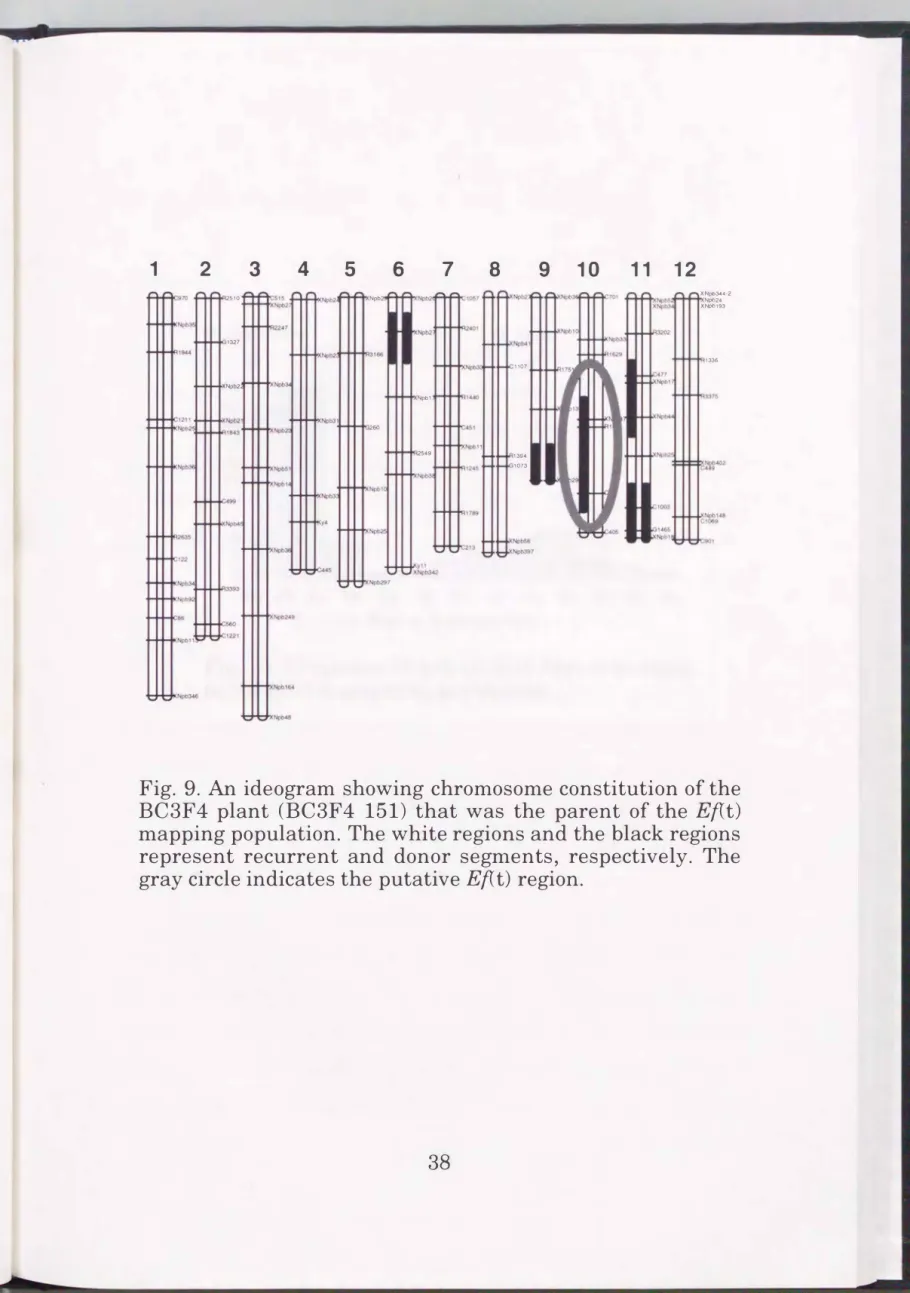
Graphical genotype of the BC3F4 plant (BC3F4 151) which was the parent of the mapping population was shown in Fig. 9.
Putative region of Ef(t) was heterozygous. Although there were another heterozygous region in chromosome 11, and 0.
glaberrima homozygous regions in chromosomes 6, 9 and 11, these regions did not affect the Ef(t) mapping.
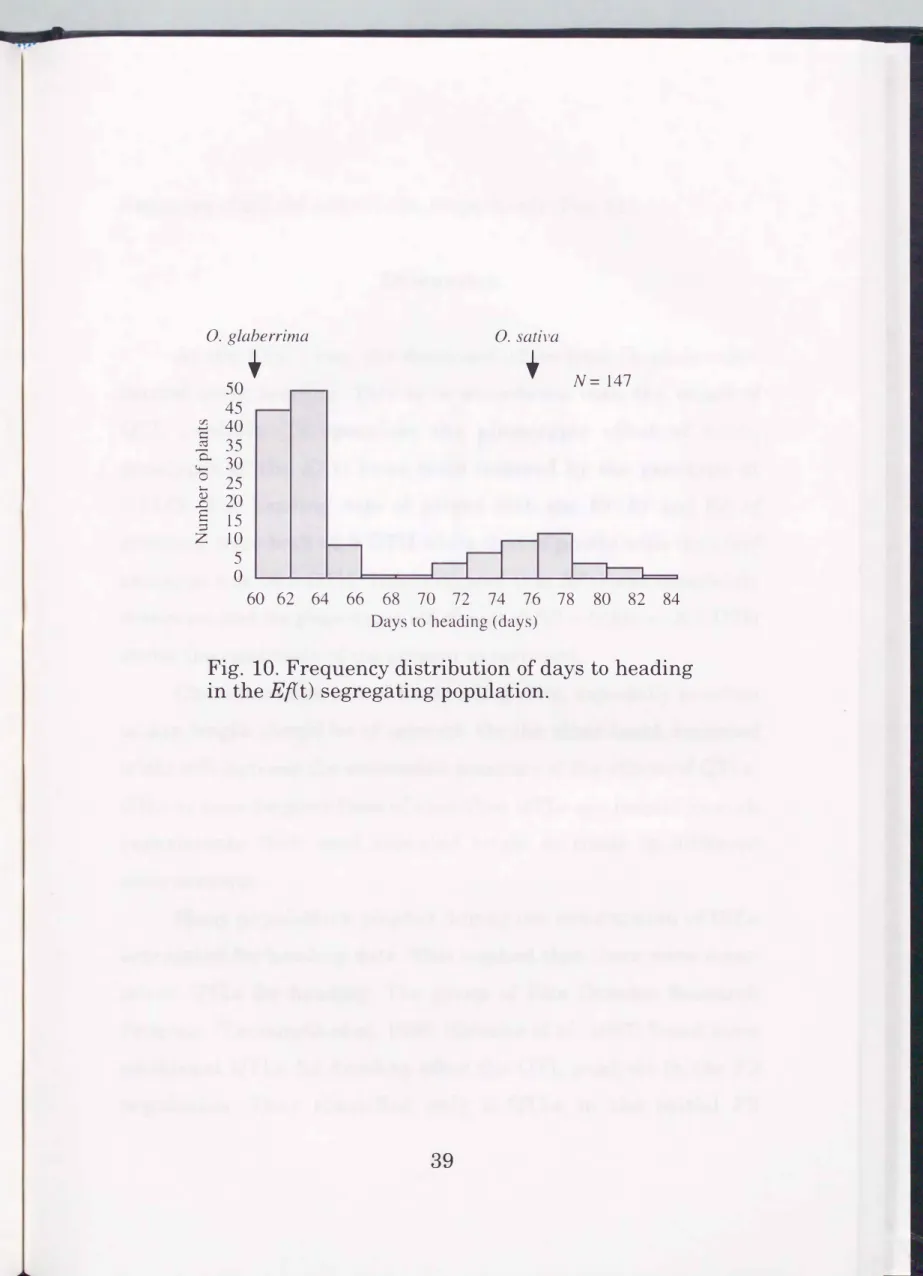
The frequency distribution of heading date in the BC3F5 mapping population was shown in Fig. 10. A bimodal distribution was observed. Early-heading (60-67 days to heading (DTH)) plants and late heading (69-84 DTH) plants segregated in a ratio of 105 : 42, fitting the expected 3 : 1 ratio Ct = 1.000, p = 0.32).
Linkage analysis with RFLP markers revealed that this segregation of heading date was controlled by a major gene that was very tightly linked to C1369. Two flanking markers, C234 and XNpb37, were located on the opposite sides of Ef(t) with map
1 2 3 4 5 6 7 8 9 10 11 12
2510 Npb XNpb344·2
Npb24 XNpb193
1327
1336 1107
Npb2
Npb1
260
2549 1394
1073
Fig. 9. An ideogram showing chromosome constitution of the BC3F4 plant (BC3F4 151) that was the parent of the Ef(t) mapping population. The white regions and the black regions represent recurrent and donor segments, respectively. The gray circle indicates the putative Ef( t) region.
0. glaberrima 0. sativa
' '
N= 14750 45
VJ 40
�
c::
C'j 35
-a 30
t+-;
0 25
...
C) 20
..0 8 ::l 15
z 10 5 0
60 62 64 66 68 70 72 74 76 78 80 82 84
Days to heading (days)
Fig. 10. Frequency distribution of days to heading in the Ef(t) segregating population.
distances of 0.3 eM and 0. 7 eM, respectively (Fig. 11).
Discussion
At the Ef(t) locus, the dominant allele from 0. glaberrima caused early heading. This is in accordance with the result of QTL analysis. To speculate the phenotypic effect of Ef(t), genotypes at the Ef(t) locus were inferred by the genotype at C1369. The heading date of plants with the Ef/ Ef and Efl ef genotype were both 62.9 DTH while that of plants with the ef/ef genotype was 76.3 DTH. This indicated that Ef(t) was completely dominant and its phenotypic effect was d(Ef) = h(Ef) = -6.7 DTH under the conditions of the present experiment.
Characteristics of loci for heading date, especially reaction to day length should be of interest. On the other hand, repeated trials will increase the estimation accuracy of the effects of QTLs.
GILs or near-isogenic lines of identified QTLs are helpful in such experiments that need repeated trials or trials in different environments.
Many populations planted during the construction of GILs segregated for heading date. This implied that there were many minor QTLs for heading. The group of Rice Genome Research Program (Yamamoto et al. 1996, Shimizu et al. 1997) found some additional QTLs for heading after the QTL analysis in the F2 population. They identified only 5 QTLs in the initial F2
lOS
C1286
CEN
r 1
C234C1369
Ef(t)
".7
XNpb37JOL
RGP's map
Chromosome 10
Fig.
11.
RFLP linkage map of rice chromosome10
showing the location of Ef(t). Left vertical bar shows the RGP's RFLP linkage map (Harushima et al.1998).
population (Yano et al. 1997). However, 5 additional QTLs were found and mapped as Mendelian factors by repeated backcrossing - selfing cycles. This isogenic-line approach to identify QTLs is supplemental for QTL analysis whose resolution tends to be limited by its statistical power. Minor QTLs found through this method would greatly facilitate better understanding on many agronomic traits.
Recently some genes for flowering time were isolated by the positional cloning method in Arabidopsis. In rice, some genes were also cloned using the same method in rice (Song et al. 1995, Yoshimura et al. 1998, Ashikari et al. 1998). Fine-mapping population (> 10,000 plants) is being produced from the Ef(t)
heterozygous progeny of the mapping population used in the present study. Two current flanking markers of Ef(t), C234 and XNpb37, linked with each other at a map distance of 1.1 eM (see Fig. 11). Using this material, Ef(t) can be presumably isolated by posi tiona! cloning in future.
ChapterV
A New Locus Causing High Fl Pollen Sterility Found in Backcross Progeny between Oryza sativa L. and 0.
glaberrima Steud.
Introduction
Hybrids between
0. sativa
and0. glaberrima
generally show male-sterility. Oka(1968)
reported preferential paring of homoeologous chromosomes in meiosis of induced tetraploid F1 plants, suggesting that this chromosomal differentiation was related to the sterility. Sanoet al. (1979; 1983)
identified hybrid sterility loci, 81, 82 and 83 in0. sativa
x0. glaberrima
crosses.They caused selective abortion of gametes, 81 and 82 affects both male and female gametes while 83 was a pollen killer. Yabuno
(1977)
reported that the combination of Japonica(0. sativa)
cytoplasm and nucleus of
0. glaberrima
produced male sterility.Rb (Rfak)
was responsible for the full restoration of pollen fertility.QTL analysis using BC2F1 population detected some loci for pollen sterility as described in Chapter II. The identification of one of the QTLs detected on chromosome 10 (referred to as 8(t) hereafter) is described in this chapter.
Materials and Methods
Further backcrossing with Taichung 65 was continued after the QTL analysis. BC5F1 plants heterozygous for putative S(t) region of chromosome 10 were selected using RFLP markers (XNpb333, R1 6 2 9, R1877 and XNpb37) and they were backcrossed with Taichung 65. The resulting BC6F1 population consisting of 57 plants was used as a mapping population (Fig, 2). Flo\vering spikelets were collected from all plants and stored in 70% ethanol. Pollen fertility was estimated as the percentage of pollen grains that could be stained by the iodostarch reaction.
Results
The mapping population was classified into three groups with discrete pollen fertility; high-sterile (pollen fertility was 0- 20%), semi-sterile (40-70%) and fertile (80-100%) (Fig. 12). The numbers of plants in these groups were 28, 23 and 6, respectively (Fig. 13).
When the mapping population was divided into two groups:
high-sterile group and semi-sterile plus fertile group, the observed segregation of 28 : 29 fit the expected monogenic ratio of 1 : 1. Linkage analysis using RFLP markers revealed that S(t) was located between G1084 and R1629 of chromosome 10 (Fig.
14).
a
b
c
., ' >
.•.•• , , .
·- - ·
1
•
..
•
•
. ...
••• f
• •
• • •
••Fig. 12. Pollen grains stained by the iodostarch reaction. The S(t) mapping population segregated into three groups with discrete pollen fertility, high-sterile
25
N=57 20
(/) 15
...
c::
0.. (1j
f.H 0 10
I-., 0) ..D a
::l 5
z
0
0 10 20 30 40 so 60 70 80 90 100
Pollen fertility (o/o)
Fig. 13. Frequency dist ribution of pollen fertility in the S(t)-segregating backcross Fl plants (BC6Fl).
lOS
/1.8
L682 C4891.8
G1084I I
\3.5 1.8 R1629 518
CEN
Chromosome 10
JOL
RGP's map
Fig. 14. RFLP linkage map of rice chromosome
10 showing the location of
818.Left vertical bar
shows the RGP's RFLP linkage map
(Harushima
et al.1998).
Since a strong segregation distortion towards the 0.
glaberrima allele was observed around the 81 (Sano 1990) region on chromosome 6 in the BC1F1 and BC2F1 populations, semi
sterility in the mapping population appeared to be due to the 81 locus. All semi-sterile plants segregated in the present population were heterozygous for wx-linked (8 1 region) RFLP markers, C1496 and C1084.
Discussion
The gene 8(t) was linked to G1084 and R1629 with map distances of 3.5 eM and 1.8 eM, respectively (Fig. 14). Since no locus affecting such high F1 pollen sterility has been reported in this region, 8(t) was a new locus for F1 pollen sterility. Therefore, this gene controlling high F1 pollen sterility was designated as 818.
Most of rice F1 sterility caused by single locus were either sporo-gametephytic interaction type (sterile plants show semi
sterility, Oka 1974) or cytoplasmic-male-sterility type (summarized in Virmani and Shinjo 1995). Most of these sterility loci caused semi-sterility. 818 that causes high F1 pollen sterility in heterozygous condition is unique when considering genetic models of F1 sterility (Oka 1974).
Sano (1979, 1990) reported the F1 sterility locus 81. It was found as a locus causing semi-sterility in the progeny from the
cross between 0. sativa and 0. glaberrima and tightly linked to the wx locus. In the mapping population used in this experiment, 81 locus still segregated. This made the evaluation of the phenotypic effect of 818 uncertain. In the high-sterile group, 5 plants out of 28 were homozygous for 81 region. Pollen fertility of 4 plants out of these 5 plants were 0%, and that of the remaining one plant was 9. 7%. High-sterile plants other than these 5 plants showed pollen sterility ranging from 0% to 15. 7o/o. This implies that there was no non -allelic interaction between 81 and 818.
However, the level of pollen sterility caused by 818 should be verified by using a new population without segregation of 81.
To identify other pollen sterility loci found in the QTL analysis in the BC2Fl population, near-isogenic lines for these sterility loci were already produced by using MAS.
Understanding of mechanism of hybrid sterility leads to overcome the reproductive barrier. It is essential for utilizing alien germplasm and breeding high-potential hybrid rice variety.
Summary and Conclusion
To exploit fully the genetic potential of Mrican rice, Oryza glaberrima Steud., a series of 0. glaberrima introgression lines (GILs) in the background of Japonica rice (0. sativa L. cv.
Taichung 65) was constructed.
As a first step, an RFLP linkage map based on the backcross population (BC1F1) was constructed. It contained 101 well-dispersed RFLP markers. The total map length was 1403.4 eM. This map could be used for the construction of GILs, as it covered the rice genome adequately.
Linkage arrangement of the RFLP markers was in good agreement with that of the previously constructed maps, suggesting that there was no drastic chromosomal differentiation between two cultivated nee species. Since chromosomal rearrangements theoretically cause sterility of various levels, GILs will help to fmd such small changes although it is very difficult to determine if there are very small linkage rearrangements or not.
Recent spreading of large insert genomic libraries may help to prove this question discussed for years.
Significant segregation distortions were observed m
chromosomes 4, 5, 6 and 11. In chromosome 6, a strong distortion towards 0. glaberrima was found. The Sl locus was thought to be the main cause of this distortion and it was very difficult to eliminate 0. glaberrima allele(s) from this region in the
construction of GILs. A distorted region on chromosome 5 could not be introgressed to GILs, while regions on chromosomes 4 and 11 were successfully introgressed, proving the effectiveness of MAS.
In the BC2Fl population, QTLs for two quantitative traits, heading date and pollen fertility, were investigated. On chromosomes 1, 6 and 10, significant ( < 1 %) QTLs for heading were detected. In the heterozygous condition, 0. glaberrima alleles around the RFLP markers C1211 (chromosome 1) and XNpb27 (chromosome 6) delayed heading, while another 0.
glaberrima allele(s) around XNpb37 (chromosome 10) caused early heading. On chromosomes 3, 7 and 10, significant ( < 1 %) QTLs for pollen sterility were detected. 0. glaberrima allele(s) in these regions reduced the pollen fertility in the heterozygous condition. On chromosome 10, a wide region showed a significant association with the trait, suggesting the presence of a strong male-sterility gene.
Succeeding backcrosses were continued to the BC3Fl and GILs were selected from 907 BC3F2 plants. Genotypes of heterozygous regions were determined in the BC3F4 generation.
Constructed 156 GILs cover 0. glaberrima genome well with homozygous overlapping introgressed chromosome segments, in spite of high sterility observed in the BC3Fl plants. Some GILs showed the characteristics of 0. glaberrima to a certain extent and F2 analysis of these characters will be possible. However, it was impossible to find lines clearly showing typical 0. glaberrima
phenotype. This implied that two or more QTLs controlled key characters of 0. glaberrima such as few secondary panicle branch or short rounded ligule. It was also difficult to find segregants with the typical key characters in early backcross generations as well as F 1s. It was revealed that recessive minor QTLs were controlling these characters
Due to the Sl locus causing abortion of gametes carrying 0.
sativa allele, more than 70 GILs were fiXed with the 0.
glaberrima allele in the Sl region on chromosome 6. Because of high frequency of Sl, it was hardly possible to eliminate the 0.
glaberrima allele from this region without using large F2 populations. PCR-based markers will enable to select plants with favorable genotypes in seedling stage. GILs for regions of chromosomes 7 and 10 were not obtained due to F 1 sterility and GILs for the regions in chromosomes 1, 6 and 12 were also not available by unknown reasons.
In contrast to the key characters of 0. glaberrima, two QTLs for two agronomically important characters were located onto the RFLP map using genetically simplified populations. A QTL for heading date on chromosome 10 was located between RFLP markers C234 and XNpb37, using a BC3F5 segregating population consisting of 14 7 plants. On the other hand, using 57 BC6F 1 plants segregating pollen sterility, a new locus causing high pollen sterility, 818, was identified between RFLP markers G1084 and R1629 on chromosome 10.
Results of the QTL analysis were very informative when the identification of the loci for heading and pollen fertility was concerned. The capability of the combination of QTL analysis and MAS enabled by molecular markers was confirmed through the present experiments. Using information of the QTL analysis as
"navigator", relatively major QTLs were easily identified. On the other hand, loci controlling the key characters of 0. glaberrima were difficult to identify from the observation of GILs. This implied that the inheritance of these key characters of 0.
glaberrima was oligogenic or polygenic. It was also difficult to find segregants with the typical key characters in early backcross generations as well as Fls. Recessive minor genes controlling these characters are difficult to identify with the breeding scheme of the present study. The reciprocal backcross QTL analysis was proposed to overcome this difficulty.
In addition to breeding strategy of experimental populations, establishment of systems to evaluate quantitatively the characters of interest will be essential in the future genetic analysis of quantitative traits. Once an evaluating system was established, the power of molecular markers will greatly facilitate the genetic analysis of quantitative traits as indicated for the cases of heading date and pollen fertility in the present study.
Although the inheritance of the key characters of 0.
glaberrima was complicated and could not be fully realized, a series of GILs was constructed and some loci for important
characters were identified. A series of GILs is expected to be used as breeding materials fully exploiting 0. glaberrima as a genetic source, library for phenotypic selection and materials for studying epistasis.