特集にあたって : インドネシア人労働者の国際動 向と日本の雇用構造における位置づけ (<特集> 茨 城県大洗町のインドネシア人労働者コミュニティ)
著者名(日) 奥島 美夏
雑誌名 異文化コミュニケーション研究
巻 17
ページ 1‑47
発行年 2005‑03
URL http://id.nii.ac.jp/1092/00000249/
asKUIS 著作権ポリシーを参照のこと
<訂正 Corrections >
・Page 2-Line 21:irregular workers → irregular migrant workers
(*Also the same in P. 4- L. 32, P. 5-L. 24 & L. 36, P. 8-L. 1)
・12頁21行:資格外活動などの非正規就労者(irregular workers)
→ 資格外就労などの非正規移民労働者(irregular migrant workers)
(*18〜38頁の「非正規就労者」も同様)
・P. 49-L. 21:Irregular workers → Irregular migrant workers
・P. 50-L. 5 & L. 6:irregular workers → irregular migrant workers
・P. 108-L. 18:irregular workers → irregular migrant workers
(*Also the same in P. 111-L. 30, P. 112-L. 6, P. 121-L. 22, P. 122-L. 2, P. 123-L. 1, P. 126-L. 20 & L. 22 & L. 25, P. 128-L. 14, P. 129-L. 2 & L. 14, P. 131-L. 13 & 24-25)
〈特集〉茨城県大洗町のインドネシア人労働者コミュニティ
特集にあたって
——インドネシア人労働者の国際動向と 日本の雇用構造における位置づけ——
島 美 夏
Introduction to a Special Issue:
International Trends of Indonesian Migrant Workers, and their Employment System in Japan
OKUSHIMA Mika
This paper is an English abstract of my introduction for this 17th volume of Intercultural Communication Studies, special issue on Indone- sian migrant workers in Japan.
Since 2003, the Intercultural Communication Institute (ICCI) of Kanda University of International Studies has carried out several projects on multicultural issues, under the aegis of which the members of the Indonesia Team have been conducting inter-disciplinary research on Indonesian residents in Japan, examining their employment system, community formation, developing family and religious networks, etc. As a result of the first workshop, which was held on 23 January, 2005, three articles appeared in this journal (Meguro, Pudjiastuti, Tirtosudarmo), all focusing on a community of Indonesian migrant workers in Oarai Town, Ibaraki Prefecture. This community consists almost entirely of a single ethnic group, the Minahasan people from North Sulawesi, who are employed, both regularly and irregularly, in the local seafood pro- cessing companies. The population is estimated to number from 700 to more than 1,000 according to informants and changing somewhat with the time of year. The Oarai community is quite a remarkable case due to its high density and homogeneity; nevertheless, it still has the character- istics of a typical type of community in early stage of immigration, the so-called “new comer” foreigners who arrived in Japan in the 1980s. The
Minahasan have now become one of the most important subgroups of Indonesian residents in Japan, consisting of about 6 thousand workers including trainees, entertainers, and other irregular workers (Yayasan Excel 2003: 18, 26).
To complement the articles of this journal, I provide below some background information on Indonesian and Minahasan migrant workers in Japan, as well as on international trends in labor migration.
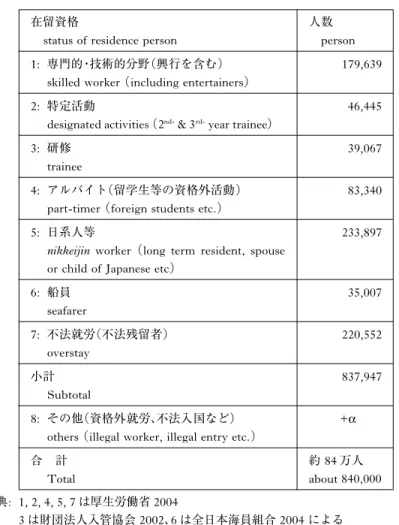
In the first section, I summarize and give statistical data on the migration to Japan of Indonesian laborers, in comparison with other dominant nationals. The Japanese Ministry of Health, Labor and Wel- fare (Kôseirôdô-shô) estimates (2004) the number of foreign workers at the end of 2002 to be more than 760,000, or 1.2% of the total labor force in Japan. If we add to this number the foreign trainees (a virtual labor force in the Japanese context) and seafarers (not included in immigra- tion statistics because of the seamen’s passport and because of foreign registry of vessels), approximately 840,000 foreigners help to sustain the economy of Japan (see Table 1 in the Japanese paper): About one-third of them are skilled workers, while another third are legal but unskilled nikkeijin, or Japanese-descended foreigners, chiefly from the South Ameri- can countries. The rest of the foreign workers include various types of irregular workers, including illegal workers (fuhô-/shikakugai-shûrôsha) and overstays (fuhôzanryûsha). This results from the fact that Japanese Immigration Control Law has been excluding unskilled migrant work- ers, officially at least, except for certain special classes of worker like trainees (kenshûsei) and nikkeijin (see also Athukorala and Manning 1999).
The total number of foreign residents of Japan will reach two million in the near future, and 80% of that number will be accounted for by the 5 largest nationality groups (Korean, Chinese, Brazilian, Filipino and Peruvian)(Table 2). A great number of these immigrants are the
“new comers”, who intended to work in Japan and who arrived mainly in or after the 1980s, while the Korean and Chinese national groups also include the “old comers” or “old-timers,” that is, foreign residents who settled in Japan either willingly or by force before World War II.
Indonesians rank 9th at 22,862 people, or 1.2% of the total number of foreigners. They began to increase only after 1990, although migration flows between Japan and Indonesia had been going on since the early 20th century (Table 3).
The first stage of migration of Indonesian laborers to Japan came about when the Japanese government started to accept them as trainees in 1982, in proportion to Japanese investment in Indonesia. After the training period was extended to a maximum of 3 years, the number of Indonesian trainees came to exceed 10,000 every year. Also, the employ- ers of Japanese deep-sea fishing vessels introduced foreign seafarers, first informally and then officially, after the revision of the so-called Maru- ship system (Gyosen Maru-ship) in 1990, which primarily targets low- cost Indonesian laborers. In 1997, offshore fishing vessels followed the example of the deep-sea vessels in hiring Indonesian and other seafarers as fishery trainees (for details, see Okushima 2005). Furthermore, some small and medium-sized Japanese companies, including the seafood processing companies of Oarai, began to recruit Indonesian nikkeijin at the end of the 1990s, following the introduction of South American nikkeijin workers in the manufacturing industry.
Indonesian workers are in general preferred by Japanese employers because of their docility, eagerness and patience in carrying out hard work. Additionally, it costs less to recruit Southeast Asian workers than to hire other nationals, and Indonesian workers are willing to accept jobs whose conditions may be unacceptable to other foreign workers like the South American nikkeijin.
Thus, Indonesian migrant workers are rapidly increasing in Japan.
Before 1990, Indonesian residents of Japan belonged primarily to certain professions such as officials, skilled workers and students. However, the situation has changed drastically, as half of the Indonesian population (22,862 people in 2003) now consists of unskilled workers (trainees and nikkeijin), or perhaps even as many as two-thirds of the population if we include seafarers (3,000–3,500) and irregular workers (over 7,000 over- stays)(Figure 1). The dominant visa statuses of Indonesian residents are ‘trainee’ and ‘designated activities’ (that is, 2nd- and 3rd-year trainees), which account for 10,124 individuals, the second highest number among the total foreign trainees in Japan (10.4%) in 2003. The number of
‘entertainers’ has also been rising in recent years, and now numbers 1,524 individuals, or 5th place (2.3%). The visa classifications of ‘long- term resident,’ ‘spouse or child of Japanese resident,’ and ‘permanent resident,’ including nikkeijin workers now amount to some 300 people (and, about 200 of them are working in Oarai, see Meguro 2005 in this journal).
Indonesian migrant workers in Japan can be said to be the “‘new
comers’ of the new comers,” having arrived relatively late in the new comer trends of immigration since the 1980s, and being still in small in number in comparison to the other dominant national groups. Neverthe- less, their numbers are expected to rise in the near future, as it is very likely that Japan will require a greater Indonesian work force, together with the Filipinos, and that the Japanese government will therefore open its doors to unskilled migrant workers.
In Section 2, I present the background of Indonesian labor migra- tion throughout the world, including to Japan, such as growing labor export to newly industrializing economies (NIE) countries in East Asia since the 1980s, the economic crisis and political unrest in the 1990s, etc.
(for more details, see also Asato 2003, 2004a, 2004b, 2004c; Ananta et al.
1998; Chin 1997; Hugo 1995a, 1995b, 2000; Mizuno 1992; Ogata 2004;
Okunishi 1996; Okushima 2005; Spaan 1994; Tirtosudarmo 2004;
Yoshimura 2000; Watanabe 1998).
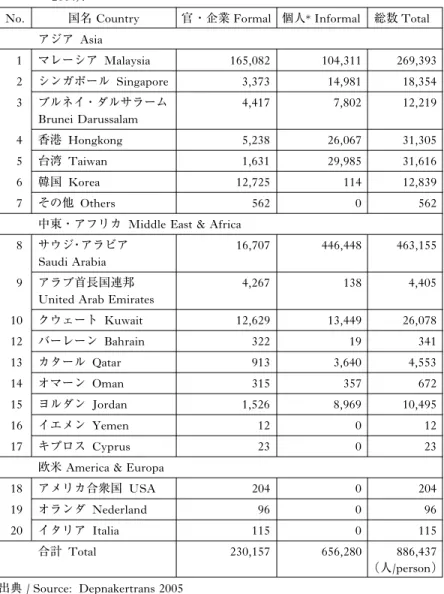
The Indonesian Department of Manpower and Transmigration (Departemen Tenaga Kejra dan Transmigrasi, or Depnakertrans), un- der the Ministry of Manpower, traditionally sent overseas workers to the Middle East, primarily females for work as house maids, and both males and females to Association of Southeast Asian Nations (ASEAN) coun- tries like Malaysia and Singapore. In the 1990s, the target was extended to East Asia, especially to NIEs countries like Hong Kong, Korea and Taiwan. In 2004, 886,437 Indonesian workers were sent out between January and September (Table 4). Based on this number, we can roughly calculate an estimated yearly emigration from Indonesia of about 1.18 million individuals. Even this number, however, is less than the half of that calculated by Hugo (Hugo 2000: 102, Table 3): 2.54 million Indonesian workers in the world.
This discrepancy arises because Indonesians very frequently be- come irregular workers by overstaying, changing jobs arbitrarily or practicing illegal entry or illegal employment in order to maximize their earnings and pay back their debts. The problem of debt results from the fact that overseas workers are required by both governmental and private worker placement systems to pay not only extraordinary charges but also bribes in many cases, while abroad they often face troubles because of lack of training in the language or in other special skills, or the lack of necessary certificates or qualifications for work. There is also a vicious circle: even legal Indonesian workers tend to draw lower wages than
workers of other national groups such as the Filipinos; therefore, natu- rally, irregular Indonesian workers must often reconcile themselves to jobs under the worst working conditions. The outflow from Indonesia of both regular and irregular Indonesian workers was further stimulated by the social disturbance of their homeland in the 1990s, including natural disasters (e.g., earthquakes and tsunami in Flores, Sulawesi, Irian, etc.), and monetary crisis with its subsequent political unrest.
In response to the tendency for Indonesians to work illegally, some of the receiving countries like Malaysia and Taiwan have taken stern measures to slow or stop the increase in Indonesian irregular workers by repatriating them or refusing to receive them initially (see Pictures 1 and 2). On the other hand, foreign non-governmental organizations (NGOs) as well as Indonesian public opinion criticized the indifferent attitude of the Indonesian government toward these problems. In consequence, the situation was improved to some extent, though it is still far from sweep- ing reformation. For example, Indonesian migrant workers in Hong Kong succeeded in forming a workers’ union (Indonesian Migrant Workers Union, or IMWU) at the end of the 1990s. Indonesian man- power agencies were also reorganized and unified under a governmental association (Asosiasi Perusahaan Jasa Tenaga Kerja Indonesia, or APJATI) at the time of the revision of the Labor Standards Law in 2004 (see also Pudjiastuti 2005 in this journal).
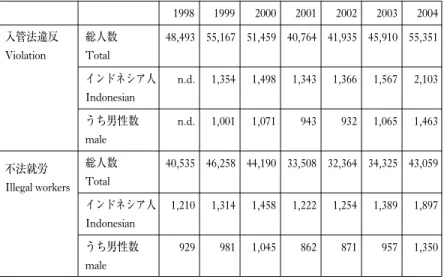
The Indonesian migrant workers in Japan, who are mainly males and whose numbers include many irregular workers, shared the same characteristics as those of Malaysia, Singapore and the USA. During the early stages of the monetary crisis in 1997–98, the total number of Indonesian entrants to Japan showed a drastic decline, losing 40% from the previous year, but the number of Indonesian residents of almost all visa categories continued to rise by a few or even several hundreds per category per year. Indonesian overstays have also been increasing since 1990, in contrast with those of the other dominant national groups, which started to decline in the 1990s (Table 5-A). Most overstays use a tourist visa (’temporary visitor’) to enter Japan, though some leave former regular jobs as trainees, seafarers, etc. (Table 5-B). In fact, approximately 90% of all Indonesians in violation of the Japanese Immi- grant Act (nyûkanhô-ihan) are found to be irregular workers, as are those of other national groups (Table 6).
In Section 3, I describe the development of the employment chan-
nels of Indonesian migrant workers in Japan between the two countries, as influenced by structural changes in the Japanese economy and the related amendment of laws in Japan, and by two grouping patterns of Indonesian migrant workers reflecting that trend (see also Ananta et al.
1998; Hugo 1995a; Nagayama 1996; Okunishi 1996, Okushima 2005;
Spaan 1994).
In Indonesia, where the intermediary business of manpower has been essentially legal, people who intend to work overseas must first apply to one of several types of manpower agency (most commonly called a “broker,” or “agensi (= agency)/agen (= agent)”), each of which specializes in a given visa procedure, language or required skill.
These agencies often cooperate with other smaller agencies for pre- training or other assistance, or they may also establish an independent branch agency in some cases. Even governmental programs for sending trainees used to be run through such agencies. Moreover, candidates may sometimes require the assistance of a single, or multiple inter- intermediates between themselves and the manpower agencies, such as promoters (calo, tauke, etc.) who informally recruit their relatives and friends at a smaller charge. Given this situation, it is clear why Indone- sian migrant workers usually suffer from enormous debts. In addition to these legal agencies and promoters, there are also many illegal ones, such as certain travel agencies which send undocumented workers. Neverthe- less, Indonesian migrant workers must depend on these manpower agencies in order to minimize the procedure, the amount of time re- quired to emigrate, and financial charges.
In contrast, the Japanese Labor Standards Law (Rôdôkijunhô) and the Employment Stability Law (Shokugyôanteihô) after World War II strictly prohibited both Japanese and foreigners from participating in the manpower business, except for dispatching workers of some special classes. However, the structure of the Japanese economy shifted rapidly from a direct employment system to an indirect (dual) employment system after the economic bubble burst, especially in manufacturing, entertainment and other services industries, by hiring more part-time, temporary or seasonal workers (see Tanno 1999, 2001). The new comers in the 1980s, almost all irregular workers in the visa statuses like artist, student and temporary visitor, began to intrude into these temporary jobs, as well as into day-labor jobs such as construction, mingling with Japanese students, housewives, farmers, free arbeiters, and other part- time workers. After the revision of the Immigration Control Law and
related regulations in 1989–90, the South American nikkeijin then came to be posted in temporary jobs, especially in the manufacturing industry (automobiles, electronics etc.), replacing the former legally risky irregu- lar workers. Limited by the laws above, however, employers recruited these nikkeijin not through a legal manpower agency, but through an outsourcing services company (gyômu’ukeoikigyô). It was the amended Employment Stability Law and Temporary Staffing Services Law (Rôdôshahakenhô) in 2004 that finally legalized the outsourcing and dispatching business in general.
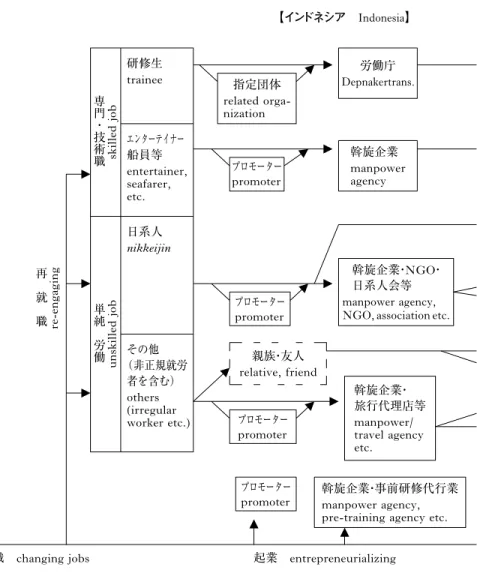
Therefore, in the main employment channels between Indonesia and Japan (Figure 2; see also their wage standards, which are shown in Table 7), the receiving organizations show considerable variation ac- cording to the type of job, while the sending organizations can catego- rized as governmental organizations, legal and illegal manpower agen- cies, and informal connections among friends and family. In the cases of skilled jobs such as seafarer and entertainer, any two agencies in partner- ship monopolize the pipeline to provide a firm with workers. The channels of trainees are generally controlled by governmental organiza- tions of both countries, specifically, the Depnakertrans and the Japan International Training Cooperation Organization (JITCO).
The channels of unskilled workers are much more diverse, however, because of the absence of a legal manpower agency to monopolize the labor market of the partner firms. Hence, early new comers including Indonesians used to enter Japan on their own a tourist visa, or through illegal agencies and promoters. They then got jobs in Japan through networks of their relatives and friends who had come to Japan earlier to work, through illegal agencies and promoters, or even by direct applica- tion to employers who dared to hire irregular workers, or needed to due to the lack of labor force. However, in proportion to the increasing numbers of alternative workers, especially legal South American nikkeijin, the employment channels for unskilled jobs in manufacturing were largely shifted to an indirect employment system using the outsourcing companies discussed above. At the same time, intensifying control over both irregular workers and employers also promoted the adoption of nikkeijin or trainees in unskilled jobs. The Indonesian nikkeijin thus came to participate in the Japanese labor market, having been introduced first by NGOs or non-profit organizations (NPO) like a nikkeijin asso- ciation or volunteers associations. After entering Japan, some of these nikkeijin also use informal networks of their relatives and friends or even
illegal agencies and promoters to change jobs, as irregular workers have always done.
The grouping pattern of Indonesian migrant workers is also chang- ing in response to trends in the employment system discussed above. In the early communities which arose in the 1980s, migrant workers pre- ferred to live together with relatives and friends in the same apartment building or in a relatively small neighborhood, in or around the three largest metropolitan cities in Japan (Tokyo, Osaka and Nagoya), where various temporary jobs were available as was the support of the old- timers. In these dense communities, the Indonesians established direct connections with their employers, who ensured their engagement for a long period of time. The community of Oarai is a typical case of this type of community.
Later, however, many Indonesian workers relocated to the country- side, especially to the main industrial cities of the Chubu and northern Kanto areas like Toyota, Suzuka, Yokkaichi, Hamamatsu, Oizumi, and Ota. Because of the predominance of outsourcing companies rather than networks of friends and relatives in the local manufacturing industry, these workers formed a new type of community which was sparser and scattered over a wider space, and therefore were required to depend more heavily on portable phones, cars, or religious institutions to help them keep in touch with their relatives and friends. Thus, they accommodated themselves to the indirect employment system and its shorter-term contracts, drifting from one job to another, and from one residence to another.
Again, it was not the Indonesian migrant workers who pioneered such communities, but the preceding new-comers. For example, Oarai Town experienced several waves of different migrant workers, such as the Iranian, Pakistani and Brazilian nikkeijin, before the arrival of the Indonesians (see Meguro 2005 in this journal). Also, in the communities of Chubu and northern Kanto, the Indonesians participated in the manufacturing industry after various irregular workers and the South American nikkeijin, and so shared the available jobs with the latter.
Indonesian migrant workers in general rarely intend to stay in Japan permanently or semi-permanently, nor do they intend to become natu- ralized; in most cases, they wish to work overseas only for several years.
Figure 2 shows that they are largely separated in three directions after returning home: to find another job, sometimes using their savings; to re- engage in other overseas jobs; or to become entrepreneurs in Indonesia
or in Japan, copying similar businesses that they encountered during their stay in Japan. Thus, new manpower agencies and related organiza- tions have been opened recently by ex-migrant workers, who may be less qualified, or even illegal in some cases. Additionally, in Japan, some ex- migrants succeed in so-called “ethnic business” in Japan, that is, in stores, restaurants, media services, or various kinds of intermediate services which target their countrymen as well as people of other nation- alities (see Picture 3).
Finally, in the last section, I present briefly the contents of the three articles, with some notes on the Minahasan people. All of the authors focus their papers on the place of the Indonesian/Minahasan migrant workers in the circumstances of Oarai Town as well as terms of general trends, discussing where these migrant workers settled and developed a community through external and internal factors such as local industry, administration, family ties, religion and contact with other foreigners.
Meguro reports, on the basis of his human geographic discipline, on the past and present movements of the Indonesian nikkeijin between Japan and North Sulawesi through generations, and also between Oarai and the neighboring regions (Narita airport, the capital city of Ibaraki, Tokyo etc.) in contemporary dairy life, through which they came to obtains job opportunities. Pudjiastuti, who specializes in political science, describes the contradictions between the Japanese authorities involved such as the various ministries and departments (of Justice, Labor, Immigration, etc.), the police, the local government, and business, all of which prevent or disharmoniously promote the employment of Indonesian migrant workers.
The social demographer Tirtosudarmo suggests that Indonesian migrant workers adapted themselves to their new environment using social institutions as their self-support system, on the basis of family and locality principles in the case of the Minahasan people. The Minahasan also extend these institutions to their occupational and religious places, companies and Church, from which they can interact with the outside world. Indeed, the importance of religion is on the rise among those migrant workers, especially among those who have relocated to the regions of the manufacturing industry, as mentioned in Section 3.
Okushima will also report (2006 in press) in next journal, on the trends of religions and the places of foreigners in Japan, especially with respect to the Church and the people including the Minahasan.
The Minahasan are nearly 660,000 persons in today’s Indonesia.
70% of religious population in their province North Sulawesi is Christian (Suryadinata et al. 2003: 7, 117). As historical background, those non- Islamic agriculturists were strongly Westernized under the Dutch colo- nial government in the early 19th century. Due to the facilities provided by the Christian missionaries, three elite strata arose among the Minahasan:
political aristocrats, intellectuals and soldiers. A mestizo society also arose, both in the physical and cultural sense, in their mixing with the Dutch and with other non-Minahasans, including the Japanese. During the Independence of their homeland as part of the Republic of Indone- sia, many of them fled to the Netherlands to seek political asylum.
Therefore, a great number of the previous studies on the Minahasan region and people concentrate on their transformation in a foreign environment and the persistence of their language, social organization and regional economy (Lundström-Burghoorn 1980; Mai 1987; Muchtar 1990; Buchholt and Mai 1994; Schefold 1995; Rumagit and Gonarsyah 1999; Hirabayashi 2003; Kipp 2004), and also on a discussion on histori- cal conflicts between central and local authorities in the process of nationalization (Watuseke 1986; Henley 1996; Schouten 1998). Further- more, issues concerning the recent labor migration in this region are expected to be forthcoming (for example, on the old migrants in the Netherlands, see Jacobsen 2002).
The Japanese migrants to the region Minahasa since the early 20th century were very fond of its scenic landscape, settling more than 500 people at the time of the greatest migration. Some of them married with local people, from whom are descended the contemporary Minahasan nikkeijin workers in Japan (Nan’yôchô Chôkankanbô-chôsaka 1939;
Nan’yôdantai-rengôkai 1942; Fujibayashi 2001, 2004; Fukuoka 2004;
Zenimoto 2004 etc.)(on the estimated number of nikkeijin throughout the world, see Table 8). After the occupation and defeat of the Japanese Army in World War II, communication between Japan and Minahasa was opened again beginning in the 1960s, mainly by Christian and academic organizations. Some local universities and other institutes in Minahasa started programs in the Japanese language and medical train- ing. However, increasing social pressure, like the stagnation of the local economy since the 1980s and the monetary crisis of the late 1990s, stimulated the people to venture abroad, making the best use of their language skills and other skills, Christianity, and knowledge and experi- ence of foreign countries, just as we see among the Minahasan migrant
workers to Japan today. In the last few years, the recruitment of Minahasan workers as entertainers has also arisen as a new social development in this region (see Yayasan Excel 2003). In response to recent immigration trends, greater cooperation must be achieved immediately between Indo- nesia and Japan.
キーワード: インドネシア人労働者、送り出し制度、雇用構造、集住 化、親族、宗教、日系人
はじめに
20世紀後半、とくに1980年代以降は、少子化・高齢化、円高、グロー バリゼーションの浸透などの諸要因があいまって、日本にも類をみない規 模の外国人人口が流入した。これに伴い、人口移動や経済政策として、あ るいは外国人受入政策、法制、医療、教育、文化摩擦などのさまざまな社 会問題としてとりくむ研究がなされてきた。また、この25年を経る中で、
出身国籍別人口比率の激変、定住化傾向の深化に対応しての職業・アイデ ンティティの変容、二世以降の教育問題、本国とのネットワークの強化な いし断絶など、さまざまな変化があらわれるにつれ、研究動向も社会制度 的な論議から、コミュニティ内部の変化や軋轢、マイノリティ間のネット ワークなどへと重点を移すようになってきている(たとえば樋口1998;梶田 2001; 川上2001; 戸田2001; 飯田2002; 駒井2003; 桜井2003; 広田2003;
白水2004など)。しかし、こうしたいわゆる ‘多文化共生社会の形成’ に 着目した研究においても、在日コリアンのようなオールドタイマーや、南 米からのニューカマーといった大集団に焦点があてられがちで、それ以外 の集団については十分な研究がなされているとはいえない。
神田外語大学異文化コミュニケーション研究所では、2003年度より共同 研究プロジェクトとして、近年拡大してきた日本のインドネシア人コミュ ニティをとりあげ、そこに表象される多民族国家インドネシアならではの 多様な言語文化・宗教・経済階層や、コミュニティの形成過程、日本国内 や母国とのネットワーク形成などについて学際研究をおこなってきた。 本 特集は、そうした共同研究の成果の一つとして、茨城県大洗町におけるイ ンドネシア人労働者のコミュニティに焦点をあてたものである。
茨城県大洗町には、スラウェシ島北部の少数民族ミナハサが数百から千 人以上集住するとみられ、1) その2〜3割は日系人からなっている。また、
彼らの高い文化的同質性や、地元企業との密接な結びつきにおいても興味 深い事例といえる。インドネシアの NGO の推計によると、ミナハサ族は 現在およそ6千人が日本各地で働いており (Yayasan Excel 2003: 18, 26)、
インドネシア人総数(下記参照)のなかでも主要民族のひとつとなっている。
ここに収録された論文(目黒、Pudjiastuti、Tirtosudarmo)は、こうした大 洗町でのフィールドワークを重ね、公開ワークショップでの討議2) を経て とりまとめられた。
国際的な人の流れを考えるとき、グローバリゼーションという世界的動 向とともに、送り出し国と受け入れ国の関係や、それぞれの国における雇 用体系など、固有の事情を併せて考察することが欠かせない。以下、論文 趣旨の補足をかねて、本研究の背景を簡単にまとめておく。
1. 日本におけるインドネシア人労働者の動向
1–1. 在留外国人の中のインドネシア人
現在の日本における外国人、とくに南米・アジア諸国出身者の大半は就 労目的で来日していると考えられる。厚生労働省(2004)は2002年末の時 点で日本の総労働力人口の1パーセント以上にあたる約76万人の外国人労 働者が就労していると推計したが、現在は80万人に達しようとしている。
そのうち3分の1は南米を中心とした日系人、さらに3分の1が不法残留 や資格外活動などの非正規就労者 (irregular workers) からなる。これに、
実質的には労働力としてあてにされている研修生と、一般の在留外国人統 計には表れない外国人船員3)も加えてみると、表1のように2002年末は約 84万人が日本経済を支えていたことになる。
在留外国人の総数はまもなく200万人に達しようとしている。彼らには 当然ながら、国籍ごとに固有の来日事情や主要な在留資格があり(表2)、 たとえば、戦前から日本に滞在していた人々とその子孫(特別永住者)の大 半を占める在日コリアン(韓国・朝鮮籍)は、今も最大のグループで約49
表1: 日本の外国人労働者概数(2002年末)
Table 1: Estimated number of foreign workers in Japan at the end of 2002.
出典: 1, 2, 4, 5, 7は厚生労働省2004
3は財団法人入管協会2002、6は全日本海員組合2004による
Sources: Japanese Ministry of Health, Labor and Welfare 2004, Japan Immigration Association 2002, Japan Seamen’s Union 2004.
在留資格
status of residence person 1: 専門的・技術的分野(興行を含む)
skilled worker (including entertainers)
2: 特定活動
designated activities (2nd- & 3rd- year trainee) 3: 研修
trainee
4: アルバイト(留学生等の資格外活動) part-timer (foreign students etc.)
5: 日系人等
nikkeijin worker (long term resident, spouse or child of Japanese etc)
6: 船員 seafarer
7: 不法就労(不法残留者) overstay
小計 Subtotal
8: その他(資格外就労、不法入国など) others (illegal worker, illegal entry etc.) 合 計
Total
人数 person
179,639
46,445
39,067
83,340
233,897
35,007
220,552
837,947
+α 約84万人 about 840,000
195019601970198019851990199520002003 総数Total598,696650,566708,458782,910850,6121,075,3171,362,3711,686,4441,915,030 主要9カ国人数9 largest nationality groups in 2004 1:韓国・朝鮮South & North Korea544,903581,257614,202664,536683,313687,940666,376635,269613,791 2:中国China40,48145,53551,48152,89674,924150,339222,991335,575462,396 3:ブラジルBrazil1692403911,4921,95556,429176,440254,394274,700 4:フィリピンPhilippine3673909325,54712,26149,09274,297144,871185,237 5:ペルーPeru1784013434848010,27936,26946,17153,649 6:アメリカ合衆国USA4,96211,59419,04522,40129,04438,36443,19844,85647,836 7:タイThailand732667211,2762,6426,72416,03529,28934,825 8:ベトナムVietnam25575572,7424,1266,2339,09916,90823,853 9:インドネシアIndonesia2574201,0361,4481,7043,6236,95619,34622,862
表2:外国人登録者数の動向(総数と主要9カ国内訳) Table2:Trends in the number of foreign residents in Japan (total and 9 largest nationality groups in 2004). 出典:財団法人入管協会“在留外国人統計”各年度版 Source:Japan Immigration Association.
万人にのぼるが、外国人全体に占める割合は1960年代までの約9割に比べ ると今日は3割弱まで低下してきた。その大きな要因となったのが、1970 年代末以降の新規入国者、つまりニューカマーの急増である。留学生やビ ジネスマンが急増しただけでなく、南米諸国からはかつて日本政府の送り 出した移民の子孫である日系人が1990年の入管法改正によって流入し、
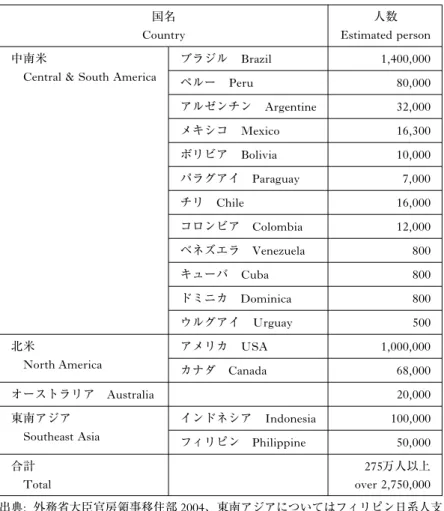
‘定住者’ ‘日本人配偶者等’ の在留資格を得ており、いまやその数は26万 人を数える(‘永住者’ なども含めると32万人以上)。また、労働力輸出大 国であるフィリピンからはエンターテイナーや船員といった特定分野の人 材が送り込まれ、さらに、いわゆる国際結婚による日本人の配偶者や定住 者・永住者があわせて10万人以上にのぼる。
上記と比べると、インドネシア人登録者数は現在国籍別で第9位、2万 3千人弱で、在留外国人全体の1.2%にすぎず、1万人を突破したのも1990 年代後半からであった。
インドネシアと日本の関係は古く、また第2次世界大戦中は日本の軍政 下にあったが、日本との人流は長い間ごく少数にとどまり、流れも双方向 的なものではなかった。これは、日本人にとってインドネシアがもっぱら
‘フロンティア’、つまり出稼ぎや開拓といった経済進出の場であったとい う事実によっている(後の第4節参照)。戦後も、1970年代から日本の対イ ンドネシア投資や企業進出が伸び、また80年代後半から公用・商用の他に 観光や文化交流目的でのインドネシア渡航が激増したのに対して、インド ネシアから日本への入国者・在留登録者は順当に伸びてきたものの、著し い増加にまでは至らなかった(表3)。
このような状況から一転して、近年インドネシア人が急増している理由 には、コストの安い東南アジアにあって人材ストックも豊かな点が注目さ れたことがある。第一段階として、日本政府は対インドネシア投資の増加 と連動して82年から技能研修制度を開始し、千人ほどのインドネシア人を 受け入れた。その後、次第に数を増やし、97年からは最大3年まで研修期 間を延長したため、図1にみるように ‘研修’ と ‘特定活動’ の在留資格 者が倍増し、2000年以降は1万人以上が定着した。また、日本漁船(遠洋 船)でも、90年に外国人船員の混乗が可能な漁船マルシップ制度が導入さ
表3:インドネシア人入国数と日本人のインドネシア入国数の対比 Table 3:Trends in the number of Indonesian entrants to Japan/Japanese leaving for foreign countries. 出典:法務省大臣官房司法法制部(編)“出入国管理統計年報”各年度版;財団法人入管協会2004“出入国管理関係統計概要” *2000年以降は入国先統計廃止 Sources:Japanese Ministry of Justice, Japan Immigration Association.
196519701975198019851990199520002003 外国人入国総数291,369775,061780,2981,295,8662,259,8943,504,4703,732,4505,272,0955,727,240 Total foreign entrants うちインドネシア人4,6568,69211,37717,85447,54132,60531,26539,38951,160 Indonesian entrants 日本人出国総数265,683608,379246,3263,909,3334,948,36610,997,43115,298,12517,818,59013,296,330 Total Japanese leaving うちインドネシア入国者2,3456,79025,27862,09893,638199,091301,375444,113n.d.* Leaving for Indonesia
図1:在留インドネシア人の内訳(上部:在留登録者、下部:船員、不法残留者) Figure 1:Trends in the number of Indonesians, classified by status of residence (above:Indonesian residents; below: seafarers and overstays). 出典:財団法人入管協会“在留外国人統計”各年度版および2005 *船員数は全日本海員組合1991–94(内部統計資料)、および2004(1995–2002年は全体数の8割として推計) Sources:Japan Immigration Association, Japan Seamen’s Union.
25000 20000 15000 10000 5000 0 (5000) (10000) (15000) 1990929495969798992000010203
その他 others 定住 long term resident 日本人の配偶者等 spouse or child of Japanese national 永住 permanent resident 家族滞在 dependent 特定活動 designated activities (2nd & 3rd year trainee) 研修 trainee 留学 college student 短期滞在 temporary visitor 興行 entertainer 不法残留者 overstay
船員 seafarer
人/person 年
れ、ピーク時には5千人以上、現在も3〜4千人の外国人が雇用されてお り、その7〜8割は常にインドネシア人に占められている。その関連で、後 に開始された国内の漁業研修制度でもインドネシアが主要派遣国となった ( 島2005)。さらに、90年代末になると日系インドネシア人が大洗町の水 産加工企業のような一部の中小企業に導入された。ただし、南米諸国と 違って送り出し・受け入れ体制が確立されていないため、今のところは企 業関係者が個人ないし非営利団体として、あるいはインドネシア人自身が 起業しておこなうという小規模な事業にとどまっている。東南アジアの日 系人は大半が戦前の零細商人や戦後の残留兵の子孫であるため、センシ ティヴな分野だからでもあるだろう(第4節参照)。筆者の知るかぎり、大 洗町に約200人(本特集の目黒の論文参照)、その他 NGO やインドネシ ア人自身が仲介した例をあわせると、およそ250–300人の日系インドネシ ア人がこれまでに来日している。
これらの分野・職種ではいずれも、インドネシア人労働者が定評を得る につれ、労務管理の便宜もあって次第に他の外国人からインドネシア人に 受け入れを一本化している。また、漁船や水産加工業のように、一社が外 国人労働力を導入すると、他社もそれにならって同一業界内に普及してゆ く傾向もある。4) インドネシア人労働者は概して従順で、劣悪な環境でも忍 耐強く働くため、日本人の雇用主には人気が高い。もっとも、東南アジア の労働力導入には、コスト削減や、日系南米人・外国人研修生の定着しに くい職場の人材確保といった合理的目的がまずあるようだ。
一方、インドネシア側でも、80年代からの東アジア諸国への送り出しの 増加に加えて、90年代には自然災害・通貨危機などによる政治的混乱があ り、比較的近い東アジアで高給が稼げ、かつ ‘先進国’ としてのイメージ もある日本をめざす者が徐々に増えてきた。ただし、日本では非熟練労働 者の受け入れが制限されているため、上記のような研修生などの特定分野 と、日系人や日本人配偶者以外は、非正規就労者として働くことになる。
さらに、2001年の9.11テロ事件の後は、インドネシアを含むイスラーム国 出身者は先進諸国への入国が厳しくなり、従来の出稼ぎ先や職種を変更せ ざるをえなくなったことも、非正規就労者が増える一因となっている。こ
うした事情については、後の2節で詳しく述べる。
1–2. ‘ニューカマーの中のニューカマー’—インドネシア人の在留資格 と位置づけ
以上の諸要因により、日本におけるインドネシア人は総じて増加の一途 をたどっている。90年以前の在留インドネシア人の主流は公用・商用や、
専門的・技術的労働者、留学生であったが、現在は非熟練労働者が同程度 の規模となり、これに船員やエンターテイナー、資格外就労者も含めると 1対2の割合で労働者層がまさるという大きな質的変化を遂げた。就業分 野や在留資格の内訳をみると(図1)、2003年末のインドネシア人登録者の 約半分にあたる研修生・実習生は、国籍別の人数比においても中国につぐ 第2位、10,124人となっており、全体の10.4%5)を占める。近年はエンター テイナーも急増中で、フィリピン、中国、ルーマニア、ロシアについで第 5位の1,524人、‘興行’ 全体では2.3%となっている。さらに、‘定住者’
‘日本人配偶者等’ ‘永住者’ もそれぞれ2〜300人単位で増加しており、少
なくともこれらの何割かは先述の約300人の日系インドネシア人労働者と その係累にあたると考えられる。この他、漁船部門を中心とする船員の一 部や不法残留者7千人あまりもあわせると、実際には3万人前後のインド ネシア人が日本、ないし日本人の経営する船舶などに就労しており、その うち2万人は実質的な非熟練労働者とみてよいだろう。6) なお厳密には、留 学生も一定の範囲内ながらアルバイトや親族・知人の手伝いという形で就 労に携わっている。2003年末は中国、韓国・朝鮮、マレーシア、タイにつ
いで第5位の1,662人(‘留学’ 全体の1.3%)のインドネシア人学生が日本で
学んでいた。
このように、いわば ‘ニューカマーの中のニューカマー’ であるインド ネシア人は、外国人登録者数では上位10国に入っているものの、外国人労 働力としては未だ少数派にとどまり、先住の外国人労働者に追随する形で 労働市場や集住地域に参入している。しかし、1990年以降は急成長を続け ていることと、世界の労働力移動の動向と考えあわせると、フィリピン人 労働者などとともに今後さらに増加してゆく可能性がある。そこで次に、
インドネシア本国における労働力輸出の概況をふりかえっておこう。
2. インドネシアの送り出し体制と問題点
2–1. 労働力輸出の概況
第2次世界大戦後に独立したインドネシア共和国は、今日までに世界第 4位の人口をかかえる大国家へと成長した(2004年は約2.38億人、Central Intelligence Agency 2005)。雇用創出や外貨獲得の解決策として、インド ネシア政府は第3次5ヵ年開発計画 (Republik Indonesia 1984)から労働 力輸出にも力を入れるようになる。80年代は日本や経済成長を遂げた東ア ジア NIES 諸国の対インドネシア投資が大きく伸びた時期でもあり、こ れらの国々では研修制度という形でインドネシア人の受け入れを開始した。
これとは別に、政府は伝統的に旧宗主国オランダや、イスラーム教徒の巡 礼路が確立されている中近東、そして距離的にも言語民族的にも近いマ レーシアやシンガポールへも労働輸出をおこなっていた。政府による送り 出しはサウジアラビアなどへの女性家事労働者を中心としており、90年代 には上記の NIES 諸国でも家事労働者の需要が高まった。一方、大規模 なインドネシア人移民人口をかかえるオランダやアメリカ7)、ASEAN 地 域の先進国マレーシア、そして上記東アジア諸国などへの出稼ぎには、建 設、農場・プランテーション、製造などに従事する男性労働者が多く(写真
1)、また不法入国や不法就労といった非正規就労者もかなりの割合を占め
る、という対照的な特徴がみられる(以上、Hugo 1995a, 1995b, 2000; Asato 2004a, 2004b)。
インドネシアの労働力送り出し制度には、政府プログラムにせよ斡旋企 業・業者を経由するにせよ、いずれも法外な手数料や賄賂がかかり、語学 力や資格免状、事前研修などの質が低いために受入国でトラブルの原因に なったり、他の外国人労働者より安く買いたたかれたりするという問題が ある。政府の出稼ぎ労働者に対する人権保護や支援活動、また企業のアフ ターケアなどは全般に未発達で、インドネシア人労働者は各国で低賃金や 長時間労働、強制貯蓄や給与未払い、パスポートの差し押さえ、暴力など
さまざまな困難に直面してきた。特に女性労働者の待遇についてはメディ アや NGO が声を上げ、90年代後半から支援ネットワークの形成8) や受 入国でのデモ、労働組合の結成9)などの展開をみせた(水野1992; Chin 1997;吉村2000; Asato 2003: 58–60, 2004b: 260–263, 安里2004a: 7–8, 19–
20; 大形2004: 201–202; Tirtosudarmo 2004: 320–324; 島2005: 61, 65 な ど)。
ただし、これらの問題の一部は、インドネシア人労働者自身の転職・逃 亡率の高さにも由来している(たとえば強制貯蓄やパスポート差し押さえ。
安里2004a: 19; 日本インドネシア NGO ネットワーク2002; 7, 59)。労 働者は就労までに高額の手数料を負担しなければならないため、少しでも 多く稼げる職へうつりたがるからである。海外に元雇い主や親族・友人が いる場合は、観光ビザや不法入国を手引きする船を利用して費用を最小限 に抑え、自力で仕事を探す者も多い。しかし非正規就労者であるため足元 写真1: 東マレーシアの木材工場で働くインドネシア人(2002年7月、サバ州サン
ダカン)
Picture 1: Indonesian workers in a sawmill company in East Malaysia (Sandakan, July 2002).
をみられ、結局は低賃金の雇用に甘んじるという悪循環にも陥りやすい。
2–2. インドネシア人労働者の国際動向
こうした体制不備とそれゆえの非正規就労者の多さは、前節で触れた 1997年からのアジア通貨危機、その前後の自然災害や紛争10) といった政 情不安によってさらに拍車がかかる。インドネシア政府は外貨獲得のため にいっそう労働力輸出に依存するようになるが、手数料や賄賂の額も高騰 し、結果として各国への非正規就労が激増するという事態をひきおこした。
なかでも、隣国マレーシアには90年代末で190万人のインドネシア人労働 者がいると推計された。流出した人口の中には労働と一時退避を兼ねた移 民も多く、留学生や暴動の際に標的にされることを恐れた中国系民も含ま れている (Hugo 2000; Ananta et al. 1998)。
こうした人流は一度経路が確立されてしまうと止めようがなく、制裁措 置に及ぶ受入国も出てきた。たとえば、すでに近隣諸国からの過剰な移民 に危機感を覚えていたマレーシア政府は、インドネシア人労働者の暴動
(2001–02年)をきっかけに入管法改正と外国人労働者の大量送還にふみ
きった(写真2)。また台湾政府も、インドネシア人労働者の定着率の悪さ、
法外な斡旋料や汚職、インドネシア政府・企業の非協力的態度などのため に、2002年8月から受け入れを一時停止していた(安里2004a: 7–8)。
インドネシア国内でも、90年代末から政治改革の気運が高まるにつれて 労働運動がさかんになり、海外労働者の人権保護も叫ぶ声も強くなった。
2003年に新労働法(労働者保護法)が成立した関連で、2004年にインドネシ ア人出稼ぎ労働者の保護法 (Undang-Undang Republik Indonesia No. 39,
2004) が制定された。これは、政府の送り出しを請け負う企業、正規の民
間企業、不法就労と知りながら観光ビザなどで送り出す斡旋企業や旅行代 理店、あるいはこれらの混合形態など、従来のさまざまな企業をすべて政 府の管理下にあるインドネシア人出稼ぎ労働者送り出し企業協会 (Asosiasi Perusahan Jasa Tenaga Kerja Indonesia: 略称 APJATI) に所属させて不正 不備を防ぐねらいがあった(本特集の Pudjiastuti 論文参照)。しかし、実 際には抜本的改革からはまだ遠く、政府の汚職を助長する危険も心配され
ている。
表4のように、2004年1月から9月までにインドネシア労働省が送り出 した人数は89万弱となっている (Depnakertrans 2005a)。これを一年分に 換算すると118万人以上となる。それでもこの数は、世界各国にいるイン ドネシア人労働者の推定数254万人 (Hugo 2000: 102, Table 3)と比べる と半分以下であり、古くからの海外移住者を除いても、おびただしい人数 が流出していると考えられる。 また、2 0 0 4 年の出稼ぎ労働者のうち 2 4 4 , 6 2 4 人から、1 7 0 , 8 6 9 , 2 8 7 米ドルの外貨が送金されているので (Depnakertrans 2005b)、一人当たりの年間送金額は概算で931ドルとなる。
これは日本円にして11万円強、インドネシア貨では890万ルピア強と十 分大きな額だが11)、日本ではこれ以上の額を送金しているインドネシア人 労働者もいる(第3節参照)。フィリピンなどの労働輸出大国に比べると体 制整備で大幅に遅れをとっているインドネシアではあるが、国内の依存度 と先進諸国の少子化の進行などを考えると、労働力輸出産業の重要性は今 後増す一方だろう。
写真2: マレーシア入国管理法改正により本国へ送還されるインドネシア人労働者 たち(2002年8月、サバ州タワウ)
Picture 2: Indonesian workers being repatriated after the revision of the Malaysian Immigration Act (Tawau, August 2002).
表4: インドネシア人正規労働者の送り出し状況(2004年1–9月)
Table 4: Total demand for Indonesian overseas workers (January to September, 2004).
出典/ Source: Depnakertrans 2005
*‘個人’ の内訳は主に家事・介護労働者
No. 国名 Country 官・企業Formal 個人*Informal 総数Total アジア Asia
1 マレーシア Malaysia 165,082 104,311 269,393 2 シンガポール Singapore 3,373 14,981 18,354 3 ブルネイ・ダルサラーム 4,417 7,802 12,219
Brunei Darussalam
4 香港 Hongkong 5,238 26,067 31,305
5 台湾 Taiwan 1,631 29,985 31,616
6 韓国 Korea 12,725 114 12,839
7 その他 Others 562 0 562
中東・アフリカ Middle East & Africa
8 サウジ・アラビア 16,707 446,448 463,155 Saudi Arabia
9 アラブ首長国連邦 4,267 138 4,405 United Arab Emirates
10 クウェート Kuwait 12,629 13,449 26,078 12 バーレーン Bahrain 322 19 341
13 カタール Qatar 913 3,640 4,553
14 オマーン Oman 315 357 672
15 ヨルダン Jordan 1,526 8,969 10,495
16 イエメン Yemen 12 0 12
17 キプロス Cyprus 23 0 23
欧米 America & Europa
18 アメリカ合衆国 USA 204 0 204
19 オランダ Nederland 96 0 96
20 イタリア Italia 115 0 115
合計 Total 230,157 656,280 886,437
(人/person)
2–3. 日本への影響
先にみた近年の日本の動向にも、インドネシア本国の事情がやはり反映 されている。たとえば、アジア通貨危機が始まった1997–98年にはインド ネシア人入国者数が40%以上減ったにもかかわらず、‘興行’ ‘短期’ ‘家 族滞在’ ‘日本人配偶者等’ など大半の在留資格者は増加し続けた(図1参 照)。同様に非正規就労者も増加しており、表5-A のように他の主要国籍 がどれも2000年以前にピークを迎えて減少しているのに対して、インドネ シアは数こそ少ないが増加の一途をたどっている (Watanabe 1998も参照 のこと)。12) その8割以上は観光などの短期滞在ビザで入国しているので (表5-B)、上記のような違法斡旋企業を通じて、あるいは自力で来日した と推測される。その他、研修生や船員といった正規就労者の脱走を手引き して他の職に斡旋する暴力団やブローカーの組織的ビジネスも出現してお り、非正規就労者の摘発件数は年々あがっている(表6)。その男女の内訳 をみると、非正規就労者の多いマレーシアや欧米と同様に (Hugo 2000)、 7〜8割が男性からなっている。
表5-A: 不法残留者の主な国籍と推移
Table 5-A: Trends in the number of overstays classified by nationality.
出典:財団法人入管協会2005より
Source: Japan Immigration Association 2005.
1990 1995 2000 2005
人/person 70,000 60,000 50,000 40,000 30,000 20,000 10,000 0
韓国 Korean 中国 Chinese
フィリピン Flipino タイ Thai
マレーシア Malaysian インドネシア Indonesian
表6: 入管法違反事件の推移
Table 6: Trends in the number of violations of the Immigrant Act.
出典:財団法人入管協会2004 “出入国管理関係統計概要” Sources: Japan Immigration Association 2004.
1998 1999 2000 2001 2002 2003 2004 総人数 48,493 55,167 51,459 40,764 41,935 45,910 55,351 Total
インドネシア人 n.d. 1,354 1,498 1,343 1,366 1,567 2,103 Indonesian
うち男性数 n.d. 1,001 1,071 943 932 1,065 1,463 male
総人数 40,535 46,258 44,190 33,508 32,364 34,325 43,059 Total
インドネシア人 1,210 1,314 1,458 1,222 1,254 1,389 1,897 Indonesian
うち男性数 929 981 1,045 862 871 957 1,350 male
入管法違反 Violation
不法就労 Illegal workers
表5-B: インドネシア人不法残留者の内訳(2005年1月1日)
Table 5-B: Residence status of Indonesian overstays in Japan (1 January, 2005).
総数 在留資格の内訳 (人)
Total Status of residence (person)
短期滞在 興行 就学 留学 研修 その他
temporary visitor entertainer pre-college student college student trainee others
7,169 5,914 134 8 10 396 705
出典:財団法人入管協会2005より
Source: Japan Immigration Association 2005.
3. 労働市場への参入—就労サイクルと集住化
次に、世界各国に流出しているインドネシア人労働者が、どのようにし て日本の労働市場に参入するのかをみてみよう。
3–1. 二国間の間接雇用体系と相違点
前節で述べたように、インドネシア人の海外就労に関する諸手続きはさ まざまな形態の企業・機関が請け負っているが、その官民や正規・非正規 の境界はかなり曖昧で、むしろ入国方法や要求される技能・語学によって 棲み分けているといえる。なかには家事労働、エンターテイナー、研修な ど複数分野へ送り出したり、旅行代理店の形態をとりながら違法に送り出 している企業もある。政府プログラムでも、実際の募集や人選は民間企業 に委託されている場合がある。もっとも政府経由の場合、各種書類の作成 からはじまって面接、健康診断、技能テストなど一連の手続きがあり、各 役人への賄賂や語学などの事前研修費も必要になるので、地方出身者や低 学歴者が出国する場合は、煩雑で時間も旅費もかかる方法よりも、手数料 を払えば出国できる正規 ・ 非正規の民間企業を好むことになる (Hugo 1995b, 2000; Ananta et al. 1998)。
これら送り出しにたずさわる諸機関やそのプロモーターは、13) インドネ シア人労働者の間では一般的に ‘ブローカー’ (broker) ないし ‘(斡旋)企 業/業者’ (agensi= agency/agen= agent) と呼ばれる。より慣習的には、
“calo” (‘買付人’、プロモーター)、“taikong/tekong” (中国語の ‘船長’、 不 法入国船業者) “tauke” (中国語 ‘親方’)、“mandor” (ポルトガル語 ‘苦 力頭’)、“juru mundi” (‘操舵手’、港湾労働者の元締め)などの名称もあっ
た (Spaan 1994)。船舶関係の名称が多いのは、空路が普及する以前は船
舶が主たる移動手段であり、インドネシアによらず世界各国で交易、出稼 ぎ、巡礼などの人足・乗客をとりしきる業務が古くから発達していたため だろう。日本にもかつてはボーレンと呼ばれる船員斡旋企業や各種の日雇 いを集める手配師などが存在し、戦後の職業安定法によって消えていった が( 島2005)、世界的にはこうした伝統的制度が今も根強く残る国の方が
多い。インドネシアでも、査証手続きや事前研修が多様化したとはいえ、
基底は従来どおりの企業が官製ベールの下で存続しているのである。
一方、日本では単純労働の仲介を禁ずる労働法の一部(職業安定法・労働 者派遣法)が2004年に改正されるまで、特定の分野を除いて日本人にも外 国人にも斡旋業(派遣業・業務請負業などを含む)は公認されていなかった。
したがって、円高景気の人手不足の時代になると、雇用主や違法の斡旋業 者の類は非正規就労者と知りながら外国人をパートやアルバイトとして採 用したり、業務請負業や先述のような個人・非営利団体という変則的な形 で受け入れなければならなかった。しかし、日本の雇用構造が製造業を中 心に間接雇用へとさらに傾いてゆき、日系南米人を中心とする外国人労働 者がその主力の一部として定着するようになると(丹野1999、2001)、つい に業務請負業や製造業分野への派遣業も合法化されるに至ったのである。
ただし、大半のインドネシア人労働者はこうした二国間の法体系や名称の 違いを区別せず、日本の斡旋業者や請負業者、またそのプロモーターの類 もすべて一括して ‘ブローカー’ と呼んでいる。
今日のインドネシア人労働者の日本における就労・再就労の経路をまと めると、 およそ図1のようになる (Hugo 1995a; Ananta et al. 1998;
Nagayama 1996; Okunishi 1996なども参照のこと)。船員やエンターテイ ナーのように専門・技術職とされている分野では、事前研修や労務管理の 問題があるため、送り出し・受け入れは基本的に二国間で提携する斡旋企 業間に特化されている。 研修生の場合は、 それが政府系機関(労働庁/
Depnakertrans と、財団法人国際研修協力機構/JITCO) となり、そこから
各商工会・農協・地方自治体などに託されて、さらに個々の企業や農家、
漁協へ振りわけられる。こうした経路を独占している斡旋企業は、登録者 を能力や体力、年齢、気質や容貌などに応じて雇用主の注文とすりあわせ、
また家庭の経済状態や賄賂の有無も考慮しながら配属を決めている。たと えば、貧しい家庭の出身者ほど企業や雇用主に従順で、労働条件の劣悪な 職場でも定着しやすいという。反対に、日本語力が高く、現地情報や法に も詳しくなると、 労賃交渉や訴訟、脱走を試みる危険性もあるため、か えって敬遠される。したがって、出稼ぎ経験者を再度起用するよりも、企
業の社員や知人・親族を通じて、あるいはプロモーターを通じてわざわざ 素人をスカウトする場合もある( 島2005: 82–83)。
一方、仲介業が認められていなかった単純労働の分野では、就労経路が より複雑になっている(図2)。出稼ぎ移住ブームの当初、インドネシア人 労働者は他のニューカマーと同様に、まず自力で、あるいは無免許の斡旋 企業(旅行代理店など)を通じて入国し、さらに違法の斡旋企業・業者やプ ロモーターを経て農業、飲食店などのサービス業や製造業、建築現場の日 雇いなどに就いた。だが滞日経験が長くなるにつれ、雇用主に直接自らを 売り込んだり、親族や友人のつてを頼るなどして就労経路を確保するよう になり、斡旋企業・業者を介さない者も増えてきた。とくに個人ないし家 族経営の小企業や農家、あるいは都市部に多い ‘エスニック・ビジネス’、
すなわち外国人が同国人などを相手に開いたレストラン・雑貨屋・メディ アサービスなどでは、直接かつ長期的な関係を雇主との間に築きやすい。
本特集の舞台・大洗町の水産加工業にみる事例もその一例である。
さらに、90年代末からはインドネシア人労働者の中にも、南米日系人の 従事する中部・北関東の機械製造業に進出する者が目立つようになった。
自動車や機器を中心とする機械製造業では1回の就労期間が短く、比較的 広範囲に分散しながら転々と職や住まいを替えるため、その都度、業務請 負業・派遣業者やそのプロモーターを頼る必要があり、また親族・友人と の連絡を保つために携帯電話や移動手段などの費用もかさむ。それでも、
従来の食品加工業や農業よりは多少給与が良く、残業や休日の融通も利く ので人気があるようだ。また、一つの企業・業者が全面的に生活の面倒を みるのでなく、住居や中古車の保証人などを複数の業者が分担している場 合もある。こうした間接雇用では長期的に安定した就労経路は構築しにく いが、業者や職場についての情報交換や、よい業者への転職や仲間の紹介 などはさかんにおこなわれている。
専門 ・ 技術職と単純労働のいずれの分野でも、‘ニューカマーの中の ニューカマー’ であるインドネシア人は、先住の外国人労働者が開拓した 就労経路にあとから参入する形で各地に定着していった。大洗ではインド ネシア人労働者が今日のように定着するまでに、西・南アジアの非正規就
図2: 日本のインドネシア人労働者の就労サイクル
Figure 1: Employment channels and re-engagement cycles between Indonesia and Japan.
研修生 trainee
エンターテイナー 船員等 entertainer, seafarer, etc.
日系人 nikkeijin
その他
(非正規就労 者を含む)
others (irregular worker etc.) 単
純 労 働 unskilled jobskilled job 専 門
・ 技 術 職
再 就 職 re-engaging
指定団体 related orga- nization
プロモーター promoter
プロモーター promoter
プロモーター promoter
プロモーター promoter
親族・友人 relative, friend
労働庁 Depnakertrans.
斡旋企業 manpower agency
斡旋企業・NGO・ 日系人会等 manpower agency, NGO,associationetc.
斡旋企業・
旅行代理店等 manpower/
travel agency etc.
斡旋企業・事前研修代行業 manpower agency, pre-training agency etc.
起業 entrepreneurializing 転職 changing jobs
【インドネシア Indonesia】
退
職 retiring
親族・友人 relative, friend
親族・友人 relative, friend 斡旋企業 manpower agency
斡旋企業・業者 manpower agency (ethnic broker) JITCO
業務請負・派遣企業・
個人・非営利団体 outsourcing companies, NGO, volunteers etc.
自治体・農協・
商工会議所等 local government, farmers’co-op’,chamber of commerce, etc.
企業・農業・雑貨 飲食店・建築等 firm, farm, store restaurant, construction etc.
企業・農業・雑貨 飲食店・建築等 firm, farm, store restaurant, construction etc.
企業 firm
企業 firm
自営業(雑貨・飲食店等)
store, restaurant etc.
(ethnic business)
起業 entrepreneurializing
【日本 Japan】
企業 農家 漁協等 firmetc.
斡旋企業・業者
(車・住居保証人等も)
manpower agency, broker (car, house etc.)
労者や日系南米人などが幾度か流入しては他と入れかわってきたし(本特集 の目黒論文参照)、中部や北関東の製造業でも日系南米人労働者が確立した 労働市場にインドネシア人その他の外国人が便乗しているのである。
3–2. 集住傾向、労働条件、帰国後の就労状況
したがって、インドネシア人労働者の集住傾向もまた在留外国人労働者 の全国的動向を反映している。大洗のようなコミュニティは、非正規就労 者が中心だった初期のニューカマーが、就職口も先住の外国人も多い東京、
大阪、名古屋のような首都圏に形成したエスニック街とよく似ている。こ うしたエスニック街は、人々は同じアパートや小さな区画内に長期滞在す る密集型コミュニティである。他方、中部や北関東のコミュニティは、就 労期間や業務請負業者によってあちこちへ移動してゆく分散型であり、労 働者は三々五々に豊田、鈴鹿、四日市、浜松、太田、大泉といった工業都 市に配属されて、親族・友人との交流が希薄になる分、定期的な集会場所 や宗教施設をより切実に必要とするようになる。
次に労働条件をみてみると、業種や能力、個々の受入会社によってかな り幅はあるものの、おおよその目安は表7のようになる。月ごとの給与だ けでみると、一番賃金の低いのはエンターテイナーで、次に研修生、実習 生、遠洋漁船などの船員、そして各種の単純労働者となる。インドネシア 人たちが来日するまでに負担する斡旋料・賄賂も、ほぼこの水準に応じて 設定されている。実際には、契約期間の違いや衣食住の保証の有無、その 他の手当などを考慮すると、一見高給とりにみえる単純労働者も相当期間 働かなければ他の職より稼げるとはいいがたいのだが、概して外国人労働 者は額面のみを比較して判断することが多い。インドネシア人でも金額の より高い職へ移ろうとして失踪したり、2度目の来日から非正規就労者に なったりする者が後を絶たない。
また、インドネシア人労働者は全般に定住する意志が非常に希薄で、あ る程度まとまった金額を母国の家族に送金すれば、あとはいつ帰国しても よいと考える傾向が強い。理由としては、日本語や生活習慣の壁、親族・
知己との離別に対する強い不安や葛藤、寒冷な気候などがあげられる。ま