The Influence of Motivation
on Incidental Vocabulary Acquisition through Extensive Reading
MARUYAMA Yuka
Key Words: extensive reading, graded readers, receptive and productive vocabulary, motivation 多読、グレーディッド・リーダーズ、受容語彙、発表語彙、動機 づけ
1. Introduction
A considerable amount of ESL/EFL research on the effectiveness of doing extensive reading via graded readers (books written for English language learners) has been conducted over the last twenty years (e.g. Krashen, 1993; Maruyama, 2009; Nation, 2001; Waring & Takaki, 2003). Graded readers have been widely acknowledged as one of the effective tools to improve students’ motivation to read in the target language especially in EFL contexts (Takase, 2007). For instance, Day and Bamford (1998) applied the expectancy value model
1)of psychology to the context of second language reading of motivation. The model consists of four variables:
materials, reading ability, attitudes and socio-cultural environment. Among them, the materials that they read and attitudes towards reading were the principal variables which determined the motivation to read in their target language.
As increasing number of educators implement extensive reading programs in their language courses, researchers have found that reading graded readers for pleasure positively affected learners’ linguistic performance (e.g. Hafiz & Tudor, 1989).
Learners are able to increase their vocabulary size, improve their reading fluency,
quality of writing, and even speaking fluency. Particular attention has been paid on
increasing receptive vocabulary size (i.e. the number of words one can recognize and
recall their meanings). However, very limited research has been conducted to date
that shows a relationship between motivational factors and vocabulary acquisition through extensive reading.
1.1. The role of extensive reading and graded readers
According to the definition given by the Longman Dictionary of Language Teaching and Applied Linguistics, extensive reading is “intended to develop good reading habits, to build up knowledge of vocabulary and structure, and to encourage a liking for reading” (Richards, Platt, & Platt, 1992, p. 133). Graded readers play an important role especially in EFL contexts for learners of all ages since they have very limited amount of exposure to the target language outside of class (Elley & Mangubhai, 1981, 1983; Grabe & Stoller, 1997; Horst, Cobb, & Meara, 1998; Krashen, 1993;
Nagy, Herman & Anderson, 1985; Nation, 2001, 2009; Saragi, Nation & Meister, 1978; Waring & Nation, 2004).
They are books written especially for foreign- or second language learners to develop their reading ability by simplifying the vocabulary and grammar so the learner can more easily understand the story. They are divided into different levels, according to the number of headwords, difficulty of grammatical structures, level of syntax, and plot devices.
Graded readers may not be appropriate as the main textbook for a course which focuses on intensive reading and learning reading skills; however, they can be used effectively to encourage a pleasure of reading, improving students’ reading fluency, and incidental vocabulary acquisition. For instance, a study done by Elley and Mangubhai (1981, 1983) examined the effectiveness of extensive reading in Fijian primary schools in what they called their Book Flood program study. In this study conducted in 1983, the experimental group of 380 students from eight schools in Fiji was given access to 250 high-interest storybooks in English. After eight months, the students made remarkable progress in reading comprehension, writing, grammar and also vocabulary development (twice that of the control group of 234 students).
1.2. Previous studies on incidental vocabulary learning via graded readers
Among the numerous extensive reading studies, particular focus has been
paid to the effectiveness of incidental vocabulary learning especially on receptive
vocabulary size. Hulstijn (2003) defines incidental learning as the process of learning
vocabulary and structures when the “learner’s attention is focused on the meaning rather than on the form of language” (p. 349) usually through reading and listening. In the case of reading, Nation and Wang (1999) state that incidental learning takes place when the focus is on the content of the story, not on vocabulary learning. Learners’
attention is on the meaning of the text and on developing reading fluency.
A famous research known as the Clockwork Orange Study (Saragi, Nation
& Meister, 1978) reported the effectiveness of incidental vocabulary acquisition through reading. 20 native speakers of English working in Indonesia participated in the study. Students were asked to read a novel, A Clockwork Orange (written by Anthony Burgess) within three days. The novel contained a total of 241 different Russian-based slang words called nadsat. After reading the novel, they were given a multiple-choice test which contained 90 nadsat words and showed a 76% gain on average simply through incidental learning without referring to a dictionary. The study strongly supported the notion that extensive reading leads to “a substantial amount of vocabulary learning” (p. 78).
Also, in a replication of the Clockwork Orange Study, Horst, Cobb, and Meara (1998), it was found that a certain amount of incidental vocabulary learning takes place through reading a simplified novel. In this experimental study, 34 students read a 21,232-word text of 109 pages for 14-weeks. During this time, students learned an average of 22% of the new vocabulary, about one in every five new words.
Another case study conducted by Grabe and Stoller (1997) also found significant gains in vocabulary through incidental vocabulary learning through extensive reading.
They examined the vocabulary development of an American man learning Portuguese through extensive reading. The subject received three weeks of instruction and spent additional hours reading outside of class. After being exposed to a large amount of vocabulary, he showed a 20% increase on the final vocabulary test five months later.
They claimed that the study “strongly suggests that reading and vocabulary will develop as a result of extensive reading practice” (p. 119).
1.3. Arguments countering the effectiveness of incidental vocabulary learning via ex- tensive reading
The importance of extensive reading for language development has been
widely acknowledged in the field; however, there are also many counter-arguments
to the beliefs discussed so far. While effective in an L1 context, incidental vocabulary acquisition may not be as suitable in an L2 context. For example, extensive reading may not be the most efficient way for acquiring a large volume of receptive vocabulary within a limited time (Waring & Nationl, 2004; Waring & Takaki, 2003). Instead, they believe explicit vocabulary learning (in which attention is given to linguistic forms including vocabulary) is more effective than implicit vocabulary learning (in which attention is given on comprehending the meaning of the reading text).
For instance, the author claims if an L2 learner reads for an hour, he will learn only about 3-6 words incidentally (Waring & Nation, 2004). This means if a student reads 30 minutes a day during a 15-week semester, he will have read 52.5 hours by the end of the semester, and he will have enhanced his vocabulary by 157-315 words. Also, Waring and Takaki (2003) examined the rate learners learn and retain vocabulary from reading graded readers. They found that after three months, nearly half of the words learned while reading were lost. The data suggests that limited new vocabulary was retained.
The study also showed that learners need to encounter a word at least eight times in order to have a 50% chance of recognizing it after three months. Words that were met fewer than five times had a 0 % chance. This indicates that there appears to be a strong connection between word frequency and vocabulary learning. Other studies also support the notion that learners have higher retention of words that are repeated more frequently. In the Clockwork Orange Study, Saragi, Nation and Meister (1978) concluded that in order for words to be acquired, a reader needs to encounter the same word at least ten times. In a replication study of the Clockwork Orange Study, Horst, Cobb, and Meara (1998) found that words that are repeated eight times or more were likely to be learned. They concluded by saying, “more seeds were planted and more daisies blossomed” (p. 214).
1.4. The relationship between motivational factors and linguistic performance
The contradictory results on the participants’ lexical improvement may be
attributed to the individual differences in their ‘flow of experience’, described by
Csikszenrmihalyi (1990). When readers are immersed in their own reading, they
lose track of time and self-awareness, and experience the flow situation. This
experience seems to be facilitated by intrinsic motivation (Wigfield & Guthrie, 1997).
In other words, learners are reading for their own pleasure and for getting a sense of satisfaction and achievement rather than for extrinsic reasons such as for getting good scores on their grades.
It is also important to note that the flow of experience can be only experienced when they are processing reading texts that are well within their linguistic level.
If a text contains too many unknown words, reading will become intensive and disrupts their fluency. As Nation (2009) stated, “unsimplified texts have a very heavy vocabulary load and, for the purposes of extensive reading, do not set up the conditions needed for successful learning from meaning-focused input”(p. 58). Thus, using authentic texts for extensive reading may negatively influence learners’ self efficacy (Wigfield & Guthrie, 1997). If the texts are too challenging for them, students may feel less competent at reading.
In order to meet such linguistic demands, especially for basic and intermediate learners, graded readers play an important role. There is a general consensus that 95% of lexical coverage or higher is essential for minimal comprehension of a reading text. This means that a threshold of 3,000 word families has to be attained for minimal comprehension (Laufer, 1992). In order to read a short unsimplified novel for pleasure, learners need to know more than 98% of the words in texts before the guessing of unknown words can occur. This figure translates into knowing roughly about 5,000 word families (Hirsh & Nation, 1992). Since vocabulary is carefully controlled in graded readers, they provide an ideal opportunity for learners to read at a comfortable rate and for incidental learning to happen without any assistance including the support from their teachers, peers, and dictionary (Waring & Nation, 2004).
2. Present study
It is relatively well established that extensive reading using graded readers
facilitates learners’ motivation in reading. However, none of the studies have
confirmed the relationship between learners’ motivation and vocabulary acquisition
through extensive reading. The aim of the study is to find out how motivational factors
may positively or negatively influence learners’ performance on incidental vocabulary
acquisition via reading graded readers. In an attempt to further this understanding,
the purpose of the study was to find out whether there would be any difference in part
of their amount of vocabulary size change among students who were assigned to read graded readers as a class work (Experimental Group I), and within the Experimental Group I those who read voluntarily (Experimental Group II) and those who were not assigned to read them (Control Group). While the Experimental Group I were rather motivated for extrinsic reasons (e.g. getting a good grade and comments from the instructor), the Experimental Group II read graded readers for intrinsic motivation since they were not graded or checked by their instructor.
3. Method 3.1. Participants
The study involved 67 students from one intact co-educational class at a private university in Tokyo, Japan. In other words, enrollment in these classes was controlled through the university’s enrollment system and, therefore, the students did not constitute a random sample. They were first-year students majoring in Social Welfare and Tourism enrolled in an English for Academic Purposes (EAP) reading program with the aim of developing their reading ability. The reading course was mandatory for first year students. Each English class at the university provided 90 minutes of instruction. Those students who took part in the study met 90 minutes per week for 13 weeks.
In addition to the reading course, students were taking an intercultural communication course which focused on English reading and presentation skills twice a week, as well as a writing course once a week. Therefore, students received a minimum of 6 hours (90 minutes x 4 classes) of English instruction per week for twelve classes in one semester, for a total of 72 hours of instruction over the full term.
The subjects of the present study, along with all first-year students, took an English placement test upon entrance to the university. The departments place the students in different classes based on the test scores. The subjects of this study were placed in the middle-ranking group, which corresponded approximately to a lower intermediate level.
In the study, there were three groups: 33 students were in the Experimental
Group I (students who were assigned to read extensive reading as a class work), 34
students were in the Control Group (students who were not given extensive reading)
and in the Experimental Group II (7 students who belonged to the Control Group but
read graded readers voluntarily).
3.2. Procedure
In all the groups, over 80 % of class time was spent on intensive reading and explicit vocabulary instruction, each receiving about equal time every class. In addition to these activities, the Experimental Group I students were required to read at least five books that they chose from a collection of graded readers as an additional requirement to the regular coursework. They were instructed to read for at least 30 minutes every day outside of class. Students were asked to submit reading logs, in which they recorded book titles, the total number of pages they read and the total time they spent for reading.
After students read graded readers outside of class, productive vocabulary knowledge was enhanced by writing short book responses for each graded reader in class to “process words elaborately and repeatedly” (Hulstijn, 2001, p. 272). Each book response included a short summary of the book and a reaction to the content of the book.
Members of the Experimental Group II (n = 7) in the study were intrinsically motivated to do further reading to improve their English skills, so the instructor recommended they read additional graded readers. However, they did not have any additional follow-up task. In other words, the students experienced pure incidental vocabulary learning, without any requirements or pressure of completing the books by a certain deadline.
3.3. Research instruments
Students’ vocabulary levels were checked by three unannounced vocabulary level tests administered twice: once at the beginning and once at the end of the semester. The first test was the Vocabulary Levels Test (Nation, 1990; 2001) to measure students’ receptive vocabulary knowledge. The other two tests, which were used to assess their productive vocabulary growth, were the Productive Vocabulary Levels Test (Laufer & Nation, 1999) and the English Web VocabProfile (Cobb, 1990).
The former test was used to examine the learners’ controlled productive ability,
whereas the latter was used to assess their free productive vocabulary ability. The
three tests were chosen based on Laufer’s study (1998), which measured the sizes of
receptive, controlled productive, and free productive vocabulary.
The first test, the Vocabulary Levels Test (Schmitt, 2000; N. Schmitt, D. Schmitt
& Clapham, 2001), was administered to measure students’ receptive vocabulary growth. There are five sections in the test, but only three sections were used in the present study. The university word level contains specialized vocabulary of university texts, so it was excluded from the test. The 10,000-word level was not used because it has been shown that average Japanese university students only know approximately 3,000 to 4,000 words (Mochizuki & Aizawa, 2000).
Each section comprises six words and three definitions. In each section, the test takers are asked to match the words on the left with the definitions given on the right, as in the following example:
1. original
2. private 1 first 3. royal 2 not public
4. slow 6 all added together 5. sorry
6. total
In this study, two tests were administered to estimate the learners’ productive vocabulary levels. One was a version of the Vocabulary Levels Test, called the Productive Vocabulary Levels Test (Laufer & Nation, 1999). This test measures the learners’ controlled productive ability. There are four versions of the test: A to D. In the study, version A was used for the pre-test and version B was used for the post- test. Like the receptive vocabulary test, this test is divided into five levels, from the 2,000-word level up to the 10,000-word level. Again, only three levels were used.
For each level, students are tested on 18 items. The first several letters of the target word are provided within a sentence and students are asked to complete the word, as in the following example:
I’m glad we had this opp to talk. [Answer: opportunity]
To measure their free productive vocabulary, an Internet application called
VocabProfile (VP; Cobb, 2007) was used. In order to analyze the Vocabulary Frequency Profile results, students were asked to read the first chapter of the course textbook on world population growth in class and write a reaction paper in English including a summary of the passage and reaction to the issues presented in the passage. While they were writing their reaction papers in class (about 30 minutes), students were not allowed to refer to the reading passage, the comprehension questions, or a dictionary. The same passage was used in the post-test. It was assumed that the thirteen-week gap between the pre-test and the post-test was sufficient to preclude distortion or invalidation of the VP results.
All their reaction papers were transcribed by the author. VocabProfile was then used to divide the words of each composition into four categories according to their frequency: (a) the most frequent 1,000 English words, (b) the second most frequent thousand English words, (c) academic English words, and (d) the remainder or less frequent words, that is, words that are not in any of the above lists. Because VocabProfile processes all of the words in a student’s reaction paper, the total percentage of all the four categories adds up to 100 percent.
4. Results 4.1. Receptive vocabulary size
For the receptive vocabulary test, the maximum score for each frequency level is 30 and the total maximum score is 90. The differences between the pre-test and post-test were evaluated by a paired-sample t-test. The results are shown in Table 1.
The mean scores and standard deviations of the receptive vocabulary pre- and post-tests are delineated in Table 1. The number of participants was too small to
Table 1. Comparison of receptive vocabulary size
Pre-test Post-test
Group books n Mean (SD) WF Mean (SD) WF change
Control Group 0 34 60.15(13.14) 3,411 61.97 (9.29) 3,531 +4%
Experimental Group I 5 33 64.64 (8.98) 3,680 65.42 (7.88) 3,709 +1%
Experimental Group II (3 +) 3 + 7 55.00(17.94) 3,136 57.00(13.33) 3,259 +4%
Experimental Group II (4 +) 4 + 2 46.50(36.06) 2,617 65.00 (7.07) 3,683 +41%
Note. WF = estimate in word families; books = total number of books they read in the semester.
The figure in the Experimental Group II (3+) includes the students who read four or more books,
Experimental Group II (4 +).
carry out any further statistical analyses. However, the result revealed that students who read three or more graded readers, the Experimental Group II (3+) had a similar pattern of vocabulary change as the original Control Group.
To estimate the student’s vocabulary size, a formula created by Laufer (1998) was used. In word families
2), the Experimental Group II (3+) improved from 3,136 to 3,259 word families (4% growth), which was the same figure as the Control Group.
In contrast, the Experimental Group II (4+), who read four or more books, jumped from 2,617 to 3,683 word families (41% growth). This improvement was much more significant than the Experimental Group I (1% growth) and the Control Group (4%
growth).
4.2. Controlled productive vocabulary size
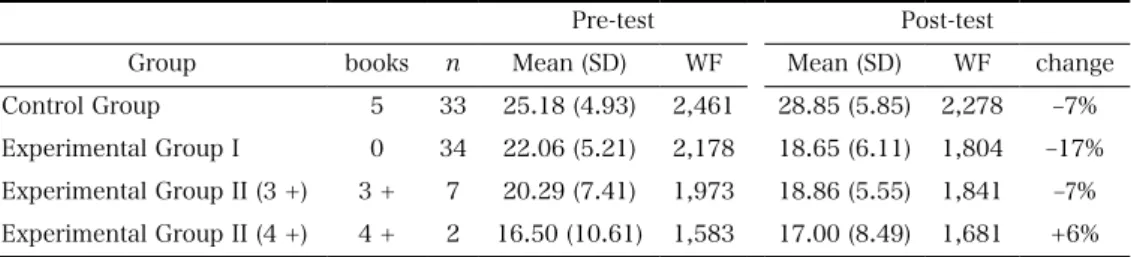
In the controlled productive test (Table 2), the Experimental Group II (3+) showed a total attrition of 7%, which was exactly the same figure observed in the Experimental Group I. The students’ mean scores dropped from 1,973 to 1,841 word families. However, the Experimental Group II (4+) attained a 6% growth (1,583 to 1,681 word families). This trend was seen neither in the Experimental Group I (7%
loss) nor in the original Control Group (17 % loss). The remarkable increase of both the receptive and controlled productive vocabulary size could be explained by the floor effect meaning they scored much lower than both groups in the pre-tests. Yet, it is noteworthy that gains could also be seen purely through incidental vocabulary learning condition.
Table 2. Comparison of controlled productive vocabulary size
Pre-test Post-test
Group books n Mean (SD) WF Mean (SD) WF change
Control Group 5 33 25.18 (4.93) 2,461 28.85 (5.85) 2,278 -7%
Experimental Group I 0 34 22.06 (5.21) 2,178 18.65 (6.11) 1,804 -17%
Experimental Group II (3 +) 3 + 7 20.29 (7.41) 1,973 18.86 (5.55) 1,841 -7%
Experimental Group II (4 +) 4 + 2 16.50 (10.61) 1,583 17.00 (8.49) 1,681 +6%
Note. WF = estimate in word families; books = total number of books they read in the semester.
The figure in the Experimental Group II (3+) includes the students who read four or more books,
Experimental Group II (4 +).
4.3. Free productive vocabulary size
For the free productive vocabulary test (Table 3), students who read 3 or more books showed a very slight decline from 8.82 to 8.76 (0.06% drop). In contrast, students who read 4 or more books showed a marked increase from 5.27% to 7.19%
(1.92 % increase) beyond the 2,000-word level. This dramatic increase was not seen in any other groups (Experimental Group I, 0.95% increase; Control Group, 0.88%
increase).
5. Discussion
The most important finding in this study was that the performance of vocabulary acquisition through extensive reading may be qualitatively different for learners with different types and with different levels of motivational factors. The dramatic vocabulary size growth of the Experimental Group II (4+) in all three tests suggests that students who were intrinsically highly motivated and were willing to read in their target language are more likely to improve their vocabulary size.
Another notable point was that although recent studies may seem to indicate that explicit form-focused instruction is more effective and efficient than meaning- focused input (e.g. extensive reading) in helping learners acquire linguistic features (e.g. vocabulary, and syntactic knowledge) within a short period of time, this may not be the case. This study suggests that learners are able to acquire receptive as well as productive vocabulary knowledge through only incidental vocabulary learning within a short period of time.
Also, the result showed that the more graded readers they read, the more Table 3. Comparison of free productive vocabulary size
Pre-test Post-test K2+
Group books n K1 + K2 K2+ K1 + K2 K2+ % change
Control Group 5 33 92.16 7.85 91.21 8.79 +0.95
Experimental Group I 0 34 92.62 7.38 91.74 8.26 +0.88
Experimental Group II (3 +) 3 + 7 91.17 8.82 91.24 8.76 -0.06
Experimental Group II (4 +) 4 + 2 94.74 5.27 92.82 7.19 +1.92
Note. K1 = the first 1,000 words; K2 = the second 1,000 words; books = total number of books
they read in the semester; K2 + = beyond K2. Percentages have been rounded to the nearest whole
number and thus may not add up to 100. The figure in the Experimental Group II (3 +) includes the
students who read four or more books the Experimental Group II (4 +).
they were able to acquire not only receptive but also controlled productive and free productive vocabulary knowledge.
6. Suggestions for future research
These speculations suggest several possibilities for future studies. First, further analysis needs to be done to figure out what types of motivation may have led certain students to read graded readers voluntarily and to lexical improvement. This can be done qualitatively by conducting a follow-up questionnaire or by interviewing the participants. If we were to have a greater understanding of what motivates learners to engage in extensive reading, it may lead to learners’ further vocabulary enhancement.
Second, the current study looked only at the changes in receptive and productive vocabulary knowledge over a very limited amount of time. Waring and Takaki (2003) state, “new words will be fresh in the mind for an immediate post test, thus these scores will be higher than if the test were taken some time later” (p. 150).
It would be worthwhile to carry out the study for a longer period to see how much vocabulary learners could actually retain over time.
Third, due to the fact that the study was limited to the breadth of vocabulary knowledge, i.e., vocabulary size, it would be interesting to test different aspects of lexical knowledge, including the use of collocation, idioms, and phrasal verbs. Future research using qualitative analytical methods may provide greater insight regarding the relationships among receptive, controlled productive and free productive vocabulary knowledge.
Fourth, only a small number of students took part in the present research especially for Experimental Group II. It is necessary to carry out the same experiment with a greater number of students in order to verify the results. Also, they were from homogenous groups so it may be important to incorporate different types of learners (e.g. different genders, different linguistic ability, and different age groups) in different contexts (e.g. ESL context, junior high or senior high school) in future studies.
7. Conclusion
Though the current study is small in scale, results indicate that intrinsic
motivation may influence students’ engagement in reading and as a result affect
their performance on vocabulary acquisition. It suggests that having high intrinsic
motivation facilitates learners’ lexical growth. Another important finding pertaining to incidental vocabulary learning is that, unlike in earlier findings, massive gains in both the receptive as well as productive vocabulary size may take place within a limited amount of time.
In terms of practical pedagogy, it is important to understand learners’ attitudes towards reading to facilitate their involvement in reading. This may in turn affect their overall linguistic performance especially on lexical acquisition.
Acknowledgements
Part of the paper was presented at the International Applied Linguistics Association (AILA), 2008, Germany. I would like to express my sincere gratitude to Dr.
Yoshinori Watanabe, Professor Kensaku Yoshida, and Dr. Mitsuyo Sakamoto for their insightful comments and advice on the original version of this paper. My appreciation is also extended to Jacob Schnickel for proofreading the paper. I also appreciate the useful suggestions made by the anonymous reviewers.
Note
1) This is the model which explained that people undertake things they think they can accomplish or value and tend to avoid things which they think they cannot or feel little value for them.
2) A word family refers to a “headword, its inflected forms, and its closely related derived forms” (Nation, 2001, p. 8). For example, “accept,” “acceptability,”
“unacceptable,” “accepted,” “accepting,” “accepts,” and “acceptance” are all counted as one word family.
References
Cobb,T. (2007). Web Vocabprofile (Version 2.5) [Computer software and manual], an adaptation of Heatley & Nation’s (1994) Range. Retrieved August 24, 2009, from http://www. lextutor.ca/vp/
Csikszentmihalyi, M. (1990). Flow: The psychology of optimal experience. New York:
Harper Perennial.
Day, R. R., & Bamford, J. (1998). Extensive reading in the second language classroom.
Cambridge: Cambridge University Press.
Elley, W. B., & Mangubhai, F. (1981). The impact of a book flood in Fiji primary schools. Wellington: New Zealand Council for Educational Research.
Elley, W. B., & Mangubhai, F. (1983). The impact of reading on second language learning. Reading Research Quarterly, 19, 53-67.
Grabe, W. & Stoller, F. (1997). Reading and vocabulary development in a second lan- guage. A case study. In J. Coady & T. Huckin (Eds.), Second language vocabu- lary acquisition: A rationale for pedagogy (pp. 98-122). New York: Cambridge University Press.
Hafiz, F. M., & Tudor, I. (1989). Extensive reading and the development of language skills. ELT Journal, 43(1), 4-13.
Hirsh, D., & Nation, I. S. P. (1992). What vocabulary is needed to read unsimplified texts for pleasure? Reading in a Foreign Language, 8 (2), 689-696.
Horst, M., Cobb, T., & Meara, P. (1998). Beyond a clockwork orange: Acquiring sec- ond language vocabulary through reading. Reading in a Foreign Language, 11 (2), 207-223.
Hulstijn, J. H. (2001). Intentional and incidental second language vocabulary learning:
a reappraisal of elaboration, rehearsal and automaticity. In P. Robinson (Ed.), Cognition and second language instruction (pp. 258-286). Cambridge: Cam- bridge University Press.
Hulstijn, J. H. (2003). Incidental and intentional learning. In C. J. Doughty & M. H.
Long (Eds.), The handbook of second language acquisition (pp. 349-381). Mal- den, MA: Blackwell Publishing.
Krashen, S. (1993). The power of reading. Insights from the research. Englewood, CO.:
Libraries Unlimited.
Laufer, B. (1992). How much lexis is necessary for reading comprehension? In P. Ar- naud & H. Bejoint (Eds.), Vocabulary and applied linguistics (pp. 126-132). Lon- don: Macmillan.
Laufer, B. (1998). The development of passive and active vocabulary in a second lan- guage: Same or different? Applied Linguistics, 19, 255-271.
Laufer, B., & Nation, I.S.P. (1999). A vocabulary-size test of controlled productive abil-
ity. Language Testing, 16, 33-51.
Maruyama, Y. (2008). Incidental learning of productive vocabulary knowledge through extensive reading. Paper presented at AILA 2008 Symposium, Essen, Germany.
Maruyama, Y. (2009). Graded readers: Selecting an appropriate level for university EFL students. OnCue Journal, 3 (1), 26-47.
Mochizuki, M., & Aizawa, K. (2000). An affix acquisition order for EFL learners: An exploratory study. System, 28, 291-304.
Nagy, W. E., Herman, P.A., & Anderson, R.C. (Winter, 1985). Learning words from context. Reading Research Quarterly, 20, 233-253.
Nation, I.S.P. (2001). Learning vocabulary in another language. Cambridge, England:
Cambridge University Press.
Nation, I.S.P. (2009). Teaching ESL/EFL reading and writing. New York: Routledge.
Nation, I.S.P., & Wang Ming-tzu, K. (1999). Graded readers and vocabulary. Reading in a Foreign Language, 12, 355-80.
Richards, J. C., Platt, J., Platt, H. (1992). Longman dictionary of language teaching and applied linguistics. Essex: Longman.
Saragi, T., Nation, I.S.P., & Meister, A. (1978). Vocabulary learning and reading. Sys- tem, 6, 70-78.
Schmitt, N., Schmitt, D., & Clapham, C. (2001). Developing and exploring that behav- iour of two new versions of the vocabulary levels test. Language Testing, 18, 55-88.
Swain, M. (1985). Communicative competence: Some roles of comprehensible input and comprehensible output in its development. In S. Gass & C. Madden (Eds.), Input in second language acquisition (pp. 235-253). Rowley, MA: Newbury House.
Takase, A. (2007). Japanese high school students’ motivation for extensive L2 reading.
Reading in a Foreign Language, 19, 1, 1-18.
Waring, R., & Nation, I.S.P. (2004). Second language reading and incidental vocabu- lary learning. Angles on the English-speaking World, 4, 11-23.
Waring, R., & Takaki, M. (2003). At what rate do learners learn and retain new vo- cabulary from reading a graded reader? Reading in a Foreign Language, 15, 2, 130-163.
Wigfield, A., & Guthrie, J. Y. (1997). Relations of children’s motivation for reading to
the amount and breadth of their reading. Journal of Education Psychology, 89,
420–432.
動機づけが多読を通じた
偶発的語彙学習に与える効果について
丸 山 有 香
要 旨