Effects of Linguistic Compounding Rules and
Rhythm on the Learning of the Multiplication
Table in Japanese
journal or
publication title
Kwansei Gakuin University Humanities Review
volume
23
page range
19-38
year
2019-02-18
Effects of Linguistic Compounding Rules and Rhythm
on the Learning of the Multiplication Table in Japanese
Hiromi OTAKA*
Abstract
The present paper argues that some languages are intrinsically more advantageous than others in arithmetic education, especially for children learning multiplication. This is because at an early stage of their educa-tion, they are expected to memorize the multiplication table as accurately as possible using language so that they can answer automatically what the product is when asked the factors, and because the way of processing numbers varies from language to language (Miura and Okamoto 2003). Thus, the method of memorizing the table, which is the key to success in becoming competent in basic numeracy, may vary depending on the lan-guage learners speak. In other words, linguistic differences can lead to dif-ferences in the amount of time required for them to memorize and recall the information in the table. Moreover, it can be assumed that such lin-guistic differences may also have an effect on the amount of time learners need for computation, and their degree of accuracy may also vary depend-ing on language background (Miura, Okamoto, Kim, Steere, and Fayol 1993).
A way of chanting the times table without referring to meanings has been developed in Japan since it was brought in from China more than a thousand years ago (Ando 2002, Daily Yomiuri 2010). What makes this chanting easy is the variety of rhythmic patterns used, because they can help Japanese learners both memorize and recall the equals smoothly in combination with information on the phonemes in the sequence of each equation. To be more accurate, the application of multiple kinds of
su-────────────────────────────────────────── * Professor, Doctor of Philosophy in Linguistics, Kwansei Gakuin University
Kwansei Gakuin University Humanities Review
Vol. 23, 2018 Nishinomiya, Japan
prasegmental units such as rhythm and accent can help strengthen the bond between sounds and meanings. In the Japanese multiplication method called Kuku (literally meaning ‘9 times 9’), several phonological rules used for making compounds have been adopted into the way the equations are read so that it becomes easy for learners to memorize them and makes their recall automatic and reflexive. Thus, it can be hypothesized that Japanese-speaking people need to go through phonological coding (i.e., changing letters into sounds in recognition: Baddeley 1966, Baddeley and Wilson 1992, Leinenger 2014) rigidly to recall a target equation for com-putation purposes regardless of its manner of reading, be it aloud or si-lently.
Moreover, the level of reliance on phonological coding may vary across individuals depending on their native language.
The goal of the present study is to examine the validity of the above assumption through an experiment with informants speaking four different native languages: English, German, Chinese, and Japanese. The validity of the aforementioned assumption was supported by the results.
I. Introduction
Memorizing all the equations in the multiplication table correctly is surely the key to success in becoming numerate, especially for the study of multiplication and division. In Japan, for example, second graders aged 7 to 8 start to learn multiplica-tion relying on the times table in math class, and most of them master the table in around several months at the most, although two academic years are officially scheduled to learn it (Otaka 2002). On the other hand, this is not always the case in other countries because their languages are different from Japanese in terms of how to read the equations in the table. Therefore, the amount of time required to master the table may vary a great deal depending on the language the learners speak. In particular, as will be shown later, differences in phonology may be the most influen-tial factor in acquiring a high ability at computation. This is because numerical fig-ures, as well as letters, have to be recognized by the learners through the process of encoding them into sounds, and the process of encoding may vary depending on the language. Thus, it is possible to postulate that learners speaking some languages can remember the times table more efficiently than their counterparts speaking other lan-guages due to linguistic specificities in phonology and syntax.
The purpose of the present paper is to examine the validity of the above hy-pothesis through an experiment with informants from different linguistic back-grounds, i.e., English, German, Chinese and Japanese. Which language of the four
Hiromi OTAKA
will be most advantageous to memorizing and recalling the times table?
II. Understanding counting in the four languages
Let us begin with a linguistic analysis of Chinese numerical words used in counting. There are only 10 words needed, with which one can indicate numbers up to 99 as shown in Table 1. Neither allomorphs1) nor different versions of the num-bers from 1 to 10 are used when numnum-bers up to 99 are read in counting, which is unique and most economical compared to other languages. The number 21, for ex-ample, is composed of three words 2, 10, and 1, which are read in isolation from left to right: 2-10-1 (/èr-shi-yī/).
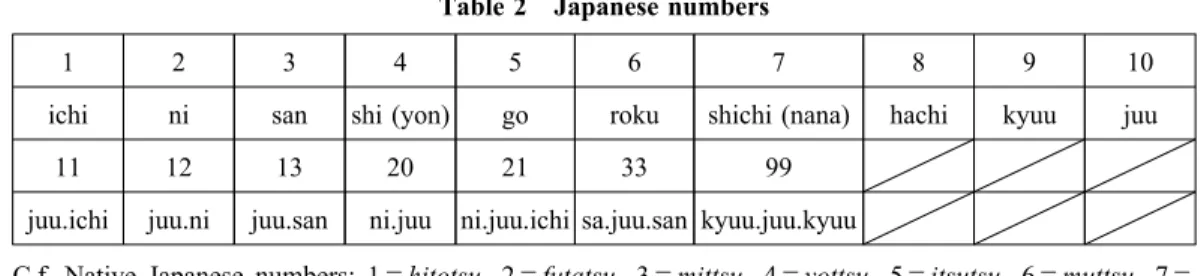
Japanese counting also involves 10 numerical words to count to 99. These words were borrowed from Chinese in the 6th century (Ando 2002). In addition to these, there is another type of number words in Japanese. These are the native Japa-nese numbers, but they are not used for calculations except for yon ‘four’ and nana ‘seven’, which are shortened forms of yottsu and nanatsu, respectively. This is probably because the native words are mostly longer than the loaned ones by one mora (or syllable-timing unit) in length. Thus, from the point of view of the Princi-ple of Economy, it makes sense that the shorter versions of numerical words have been given preference over longer ones for use in computation.
────────────────────────────────────────── 1 ) Allomorphs are any of two or more actual representations of a morpheme, such as the plu-ral endings /s/ (as in cats), /z/ (as in bags), and /ɪz/ (as in bushes) in English, for example.
Table 1 Chinese numbers up to 99
1 2 3 4 5 6 7 8 9 10
yī èr sān sì wǔ liù qī bā jiǔ shí
11 12 13 20 21 33 99
shí yī shí èr shí sān èr shí èr shi yī sān shí jiǔ shi jiǔ
Table 2 Japanese numbers
1 2 3 4 5 6 7 8 9 10
ichi ni san shi (yon) go roku shichi (nana) hachi kyuu juu
11 12 13 20 21 33 99
juu.ichi juu.ni juu.san ni.juu ni.juu.ichi sa.juu.san kyuu.juu.kyuu
C.f. Native Japanese numbers: 1=hitotsu, 2=futatsu, 3=mittsu, 4=yottsu, 5=itsutsu, 6=muttsu, 7= nanatsu, 8=yattsu, 9=kokonotsu, 10=too
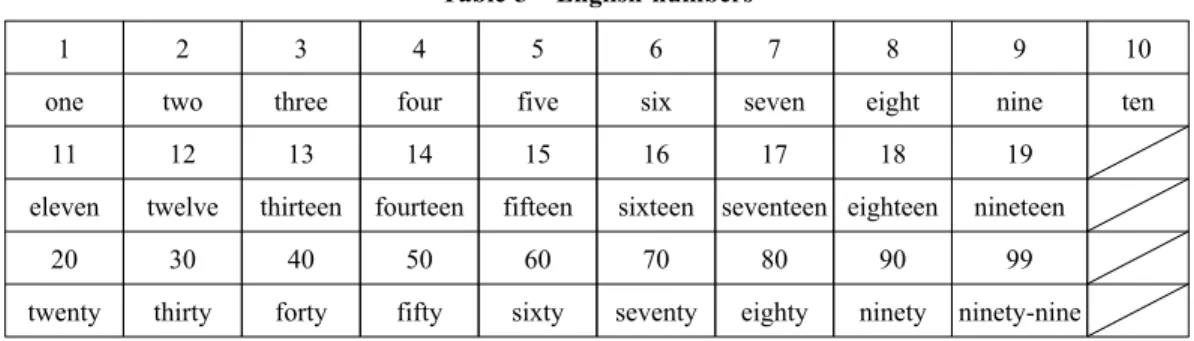
In contrast, English-speaking learners need 27 words to count to 99, as shown in Table 3, which is far more than in the previous two languages.
It is interesting to note that numbers larger than 11 follow the decimal number sys-tem in terms of their readings in both Chinese and Japanese, whereas this is not the case in English. In Japanese and Chinese for example, 21 has the structure of two tens plus one (i.e., 2×10+1); /ni.juu.ichi/, /èr shi yī/, respectively, whereas in Eng-lish it is twenty plus one (i.e., 20+1). Note that 20 twenty in EngEng-lish is a single word. Thus, it can be claimed that structure of the decimal system is more analytical in the former two languages than in English, and this may help learners understand the system more readily (Miura and Okamoto 1999, Miura, Okamoto, Vlahovic-Stetic, Kim, and Han 1999).
III. Data on primary schoolers’ numeracy performance across the world
A study was conducted internationally by the International Association for the Evaluation of Educational Achievement (IEA) in 2015 with the view of studying and comparing the arithmetic performances of 4th graders (aged 10-11) living in 49 countries. In Japan, 9,100 students participated in the study (TIMSS: Trends in In-ternational Mathematics and Science Study, 2015). According to the report, Japan ranked 5th, next to Singapore, Hong Kong, Korea, and Taiwan. Those five countries, which are all located in Eastern Asia, turned out to have significantly higher scores than other countries in numeracy. Note further that three of the top five are Chinese-speaking countries. In Singapore, English is in fact one of the four official lan-guages, but 76% of Singaporeans are descendants of Chinese immigrants and speak Chinese (Mandarin Chinese or various dialects), whether as a native language or second language.
Judging from the fact that Chinese, Korean, and Japanese-speaking children do well in international comparisons of mathematical ability, the characteristics of their languages may have had positive effects on their efforts to memorize the times
ta-Table 3 English numbers
1 2 3 4 5 6 7 8 9 10
one two three four five six seven eight nine ten
11 12 13 14 15 16 17 18 19
eleven twelve thirteen fourteen fifteen sixteen seventeen eighteen nineteen
20 30 40 50 60 70 80 90 99
twenty thirty forty fifty sixty seventy eighty ninety ninety-nine Hiromi OTAKA
ble. In Japan, as referenced above, second graders start chanting the times table over and over, and they naturally learn it by heart without knowing or learning the pat-terns of multiplication. What is more, they master the whole times table in a com-paratively short period of time (Otaka 2002). Incidentally, regarding math education in Korea, their own multiplication table has been developed as well since the educa-tional device was imported from China. The Korean times table is as a system quite similar to that of Chinese (see Section II). The only difference is that Korean does not have a tonal system.
IV. Compounding rules in English and Japanese
It is useful to refer to compounding rules in these languages in this section be-cause these are often used by people trying to memorize phrases efficiently as a kind of mnemonic.
Words can be combined to form various kinds of compounds such as com-pound nouns, comcom-pound verbs, and comcom-pound adjectives. These are very common and normally have two or more parts. The first part tells us what kind of object or person it is, or what its purpose is, i.e., the first part modifies the meaning of the second part by means of semantic restriction. Thus, the second part identifies or modifies the object or person in question. Compound nouns, for example, often have a meaning different or more specific than the two separate words. Therefore, compounding is an efficient way of building new words from a limited vocabulary. Two compound nouns in English are demonstrated in the following table.
Compound nouns can be written either as a single word, as two words with a hy-phen, or as two words. There are no clear rules about this in English orthography.
E.g. hanger-on, passer-by, washing machine, driving license
Stress is important in pronunciation, as it distinguishes a compound noun and a phrase composed of an adjective and a noun. The stress usually falls on the first syl-lable in compounds in English.
E.g. dáncing téacher vs. dáncing teacher
whíte hóuse vs. Whíte House
Table 4 Compounds in English
First part: type or purpose Second part: what or who Compound noun
break water breakwater
boy friend boyfriend
It is interesting to note from a different point of view that stress is used to define words in English. Words in English can be defined as a chunk composed of one or more syllables with one meaning having only one culmination in loudness (i.e., the primary stress).
4.1 Six ways of making compounds in Japanese
Various kinds of compounds are made in Japanese, too. However, as opposed to English, stress is not used at all, but other possible properties in this language are. Regarding ways of forming compounds,2) Japanese outnumbers English. There are at least six ways as follows.
(1) Pitch accent (2) Sequential voicing
(3) Fortition of /h/ (/h/ → /p/) (4) Vowel alternation
(5) Consonant epenthesis
(6) Rhythmicity based on monomoraic syllables and the bimoraic foot
4.2. Pitch accent
Pitch is a phonetic factor related to the frequencies of vowel sounds. Japanese is a language with pitch accent based on two phonological units, High and Low, whereas English has stress accent. English uses pitch only for intonation. In Japa-nese, a culmination in pitch occurs only once within a phonological word, and this is so in the case of compounds, as shown below. The diacritics/¯/and/¬/indicate that words with the former have no accent (the pitch remains high or rising flat) and those with the latter are accented on the mora marked with it.
E.g. 1. yama¯ + hototo¬gisu → yama.hototo¬gisu
‘mountain’ ‘quail’ ‘mountain quail’
2. hana.uri¯ + musume¬ → hana.uri.mu¬sume
‘flower-selling’ ‘girl’ ‘girl who sells flowers’
3. Ryu.u.ga¬.ku.se.e + Kyo.o.gi¬.ka.i → Ryu.u.ga.ku.se.e.kyo.o.gi¬.ka.i ‘Student from abroad’ ‘conference’
For example, the first compound of yama.hototo¬gisu ‘mountain quail’ is composed of two words (or morphemes) with different pitch patterns, but they are united by taking a new pitch pattern having one culmination in pitch. That is, the third
sylla-────────────────────────────────────────── 2 ) There are various kinds of compounds in Japanese as well, such as compound nouns (e.g.,
yuki-yama ‘snow mountain’), compound verbs (e.g., nage-dasu ‘discard’), compound
adjec-tives (e.g., hoso-nagai ‘lanky’), and compound adverbs (e.g., hito-mazu ‘for the time be-ing’).
Hiromi OTAKA
ble from the end (the antepenultimate) is accented.
A similar phenomenon to this unification of different pitch patterns exemplified above can be observed also from the readings of equations set in the times table. The sonogram of figure 1 is of the utterance of the equation 6×7=42 (ro¬ku×
shichi¬
=shi¬juu ni¬) for example recorded by a Japanese-speaking informant.
Note that pitch (shown in a blue line) rises on the second mora (ku) and maintains its highness until the third mora from the end. If the numerical words 6 ro¬ku and 7
shichi¬ are pronounced in isolation, their pitch patterns will not be the same as those used in the equation here (Otaka 2002).
4.3 Sequential voicing
Rendaku ‘sequential voicing’ occurs on the word-initial voiceless consonant of
the second word when a compound is made, except when the second element al-ready contains a voiced consonant (Lyman’s law). Compounds made through this phonological rule are exemplified below.
E.g. 1. [take] + [sao] → [takezao]
‘bamboo’ ‘pole’ ‘bamboo pole’
2. [hito] + [tsuma] → [hitozuma]
‘person’ ‘wife’ ‘someone’s wife’
3. [hana] + [ʧi] → [hanaži]
‘nose’ ‘blood’ ‘nose bleeding’
4. [buta] + [širɯ] → [butažirɯ]
‘pig’ ‘soup’ ‘pork soup’
5. [hon] + [tana] → [hondana]
‘book’ ‘shelf’ ‘bookshelf’
6. [ko] + [taiko] → [kodaiko]
‘small’ ‘drum’ ‘small drum’
Figure 1 Pitch movement in the utterance of the equation roku shichi shi.juu ni (6×7=42) in Japanese
Rendaku is a powerful rule that applied to compounding in Japanese. However, it
does not always occur when two words are combined to make a compound, even though the second word has a voiceless consonant word-initially (e.g., yaki+tori → yaki.tori ‘grilled chicken’ as opposed to yama+tori → yama.dori ‘mountain quail’). No one has ever successfully explained why Rendaku sometimes applies, but at other times does not.
4.4 Fortition of /h/
Word-initial /h/ ([h, ɸ, ҫ]3)) of the second element is realized as the voiceless bilabial plosive p when preceded by a word ending with a nasal sound, or a high vowel i or ɯ.4) In the latter case, the word-final syllable composed of a voiceless consonant plus a high vowel is replaced by p, resulting in the geminate pp. As we shall see below, this phonological rule is also involved in reading some equations of the times table, in that the left hand sides of the equations (multiplicand+multiplier) are treated as if they were compound nouns.
E.g. 1. ichi + hai → ip.pai ‘a cup of ∼’
‘one’ ‘cup’
2. satsɯ + ɸɯɯkee → sap.puukee ‘scene with no taste’
‘kill’ ‘scene’
3. kan + hai → kam.pai ‘cheers!’
‘dry’ ‘glass’
4. on + ɸɯ → om.pu ‘music notes’
‘sound’ ‘symbol’
4.5. Vowel alternation
When some compounds are formed, a word-final vowel of the first element may change into different one as exemplified below. In many cases, the mid front vowel e becomes the low vowel a, but this is not always the case. There are also other types of vowel alternation in the making of compounds in Japanese as follows.
E.g. /e/→/a/:
1. sake + ya → saka.ya ‘liquor shop’
‘wine’ ‘shop’
2. koe + iro → kowa.iro ‘voice color’
‘voice’ ‘color’
────────────────────────────────────────── 3 ) In Japanese, /h/ has 3 allophones [h, ɸ, ҫ]. It is realized as [ɸ] before /ɯ/, [ҫ] before /i/, and
[h] before /a/, /e/, or /o/.
4 ) /ɯ/ is an unrounded high back vowel in Japanese, but this is often replaced by /u/ for con-venience’ sake. /ɯ/ is used hereafter in this paper.
Hiromi OTAKA
/i/→/o/:
3. ki + kage → kokage ‘shade’
‘tree’ ‘shadow’
4. hi + kage → hokage ‘light’
‘fire’ ‘shadow’
/i/→/e/:
5. /ki/ + hai → kehai ‘hint’
‘air’ ‘distribute’
/o/→/a/:
6. /siro/ + ko → sirako ‘soft roe’
‘white’ ‘baby’
4.6. Consonant epenthesis
There are two types of compounding by means of gemination. One is called
Renjoo in Japanese, which used to be prevalent in Old Japanese during the period
between the end of the Heian Era and the following Muromachi Era (10th∼14th c.: Yamaguchi et al. 1997). When a word ending with a coda consonant called a ‘mora phoneme’ (/n/, /m/), or /t/ is compounded with a word beginning with a vowel or a glide /j, w/, one of the consonants /n/, /m/, or /t/ is epenthesized or geminated be-tween the two words as the onset of the second word.
E.g. Double consonant 1: Renjoo
1. ten + oo → tennoo ‘emperor’ 天皇
‘heaven’ ‘king’
2. han + oo → hannoo ‘reaction’ 反応
‘return’ ‘reply’
3. sam + i → sammi ‘third rank’ 三位
‘three’ ‘position’
4. set + in → settin ‘toilet’ 雪隠
‘snow’ ‘hide’
The other type of double consonant occurs when a first element ending with a syllable composed of a voiceless consonant and a high vowel is compounded with a second factor beginning with a voiceless plosive, whereupon the final syllable of the first element is replaced by a voiceless consonant identical to the word-initial conso-nant of the second element. This type of sound change is well-known as Sokuonbin (‘sound change with a double consonant’) in the development of verbal forms in Old Japanese (e.g., /kahi/ (te-form of the verb kahɯ ‘buy’)+/te/ → /kat.te/).
E.g. Double consonant 2: Sokuonbin
3. Ketsɯ + kon → kekkon ‘marriage’ 結婚
‘tie’ ‘wedding’
4. sakɯ + ka → sakka ‘writer’ 作家
‘make’ ‘person’
5. betsɯ + soo → bessoo ‘cottage’ 別荘
‘another’ ‘house’
4.7. Rhythmicity based on monomoraic syllables and the bimoraic foot
Although Japanese is a mora-counted language, the bimoraic foot composed of two moras also functions as a rhythmic unit in Japanese (Otaka 2006). What can make up a bimoraic foot are any syllable of the shape CV followed by the mora phoneme n (e.g., pan ‘bread’), any syllable of the shape CVV (e.g., too ‘ten’), or any syllable (CVC) ending with part of a geminate (e.g., kek-kaku ‘pneumonia’). However, the sequence of two CV moras are sometimes treated as a pseudo-bimoraic foot if they are sandwiched between two pseudo-bimoraic sequences, as exempli-fied below.
E.g. nen-gara-nen-juu ‘all the year round’ ⇐ nen-ga-nen-juu enɯ -eti-kee ‘NHK’ ⇐ enɯ -eiti-kee
iti-nii-san-sii-goo-rokɯ ‘1, 2, 3, 4, 5, 6’ ⇐ iti-nisan-sigorokɯ
In the first example above, the original form of the adverb was nen.ga.nen.juu, but it has taken the form nen.gara.nen.juu in modern Japanese. That is, the nonsense syllable ra appears between the particle ga and the morpheme nenjuu ‘through the year’ in order to make the whole sequence fit a bimoraic rhythm. Note that as every morpheme involved in this adverb is composed of two moras, it sounds rhythmical. Similarly, in the second example, the second morpheme H of NHK ‘Japan Broad-casting Company’ is normally pronounced /e.i.ti/ with three moras in isolation, but it gets shortened by one mora to /e.ti/ in this compound because it is sandwiched be-tween two bimoraic sequences. In the third example, the numerical numbers 2 ni, 4
si, and 5 go are all monomoraic, but become bimoraic when used in counting
to-gether with other bimoraic numbers such as iti ‘1’, san ‘3’, and rokɯ ‘6’.
The reason such rhythmicity as observed above occurs is probably because if phrases display some kind of rhythmic regularity in addition to Double Articulation, they can be more easily memorized and recalled in recognition. According to the French linguist André Martinet (1960), the stream of speech can be divided into meaningful signs (morphemes) and further subdivided into meaningless elements (phonemes). This property that all natural languages share is called Double Articula-tion or the Duality of Patterning. Note that if rhythmicity is added to this intrinsic property, the result is something we might call Triple Articulation, which can help make phrases both memorable and sustainable in long-term memory. That is why
Hiromi OTAKA
rhythmicity often applies when compounds are formed. Judging from the fact that fixed phrases such as proverbs and verses often involve rhythmic regularities includ-ing rhyminclud-ing in English also, this property of rhythm may be universal across lan-guages.
V. Japanese ways of memorizing the multiplication table
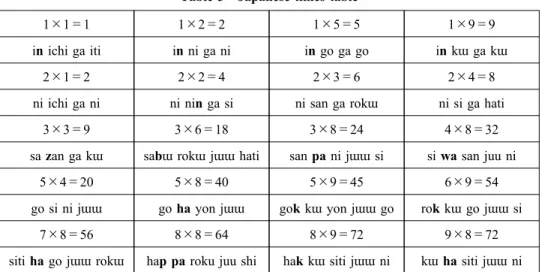
The equations shown in Table 5 are examples from Kuku,5) which are tradition-ally read in some extraordinary ways. This implies that Japanese learners have made it a practice to memorize the equations somewhat differently from the standardized pronunciation of Japanese numerals. Note that various phonological processes re-ferred to in the previous section are fully involved in the table.
First, the number 1, iti, located in the first place of the left member (multipli-cand) of the nine equations (1×1=1 ∼ 1×9=9) has been changed to in, while this is not the case for the one in the second place of the left member (e.g., 2×1= 2). This alteration between ti and n cannot be observed in the compounds in the previous section, but only in verbal declensions. The latter type of sound change is called Hatsuonbin ‘sound change with a coda /n/’ in Japanese grammar (e.g., /tobi/ +/te/ → /ton.de/: te-form of the verb tobu ‘fly’). Therefore, it can be claimed that
────────────────────────────────────────── 5 ) In old days, Japanese people started with the largest numbers (9×9) and moved down to the smallest (1×1) when learning the table, but today they recite Kuku in the opposite way. The product of 9×9, ku-ku, was the first to be chanted in this method, which is why the times table is called Kuku in Japanese.
Table 5 Japanese times table
1×1=1 1×2=2 1×5=5 1×9=9
in ichi ga iti in ni ga ni in go ga go in kɯ ga kɯ
2×1=2 2×2=4 2×3=6 2×4=8
ni ichi ga ni ni nin ga si ni san ga rokɯ ni si ga hati
3×3=9 3×6=18 3×8=24 4×8=32
sa zan ga kɯ sabɯ rokɯ jɯɯ hati san pa ni jɯɯ si si wa san juu ni
5×4=20 5×8=40 5×9=45 6×9=54
go si ni jɯɯ go ha yon jɯɯ gok kɯ yon jɯɯ go rok kɯ go jɯɯ si
7×8=56 8×8=64 8×9=72 9×8=72
siti ha go jɯɯ rokɯ hap pa roku juu shi hak kɯ siti jɯɯ ni kɯ ha siti jɯɯ ni
the use of Hatsuonbin has been extended to the readings of some equations as a kind of mnemonic, resulting in a new allomorph in. In fact, this process has applied to CV syllables of many compound nouns, especially when the C is a nasal conso-nant (n, m) followed by a high vowel (i, ɯ), although this process does not obliga-torily apply when forming compounds.
E.g., kanzashi ‘comb’ ← kami ‘hair’ + sasi ‘insertion’
tondabayashi ‘city name in the Kansai area’ ← tomi + ta + hayasi akindo ‘merchant’ ← aki ‘dealing’ + hito ‘person’
Nasal insertion occurs in the reading of the equation of 2×2=4 (ni nin ga si) as well without causing any replacement. This process probably applies to avoid the repetition of the syllable ni ‘two’, which would violate the Obligatory Contour Prin-ciple (see below).
The subject marker ga is used only in equations whose right members (prod-ucts) are smaller than 10. This is because numbers larger than ten involve more mo-ras than those smaller than 10 overall; thus one does not use ga, worth one mora, so as to keep the utterance as short as possible.6)
Next, sequential voicing is observable in the Japanese times table. For example, the number 3 is pronounced in four different ways in the chart. When it is the mul-tiplier of the equation 3×3=9, it is pronounced zan instead of the standard san. The reason why the repetition of san is avoided is the same as in the cases of 2×2 =4 (ni nin ga si) and 1×1=1 (in ichi ga iti) above. On the other hand, in the case of 3×6=18, the initial 3 becomes sabɯ, which is another allomorph of san. Thus, the number 3 is pronounced alternatively as sa, san, zan, and sabɯ.
The change of h into p can be observed from 3×8=24 (san pa nijɯɯ si) be-cause the preceding 3 (san) ends with a nasal. On the other hand, the 8 (hati) changes also into one of its allomorphs wa as in 4×8=32 (si wa san.jɯɯ ni). Thus, the number hati can be said to have two more allomorphs (pa and wa).
Another type of process called double consonants can be seen from some equations as well as from compound nouns.
E.g. 6×9=: /rokɯ/ + /kɯ/ → /rokkɯ/ 8×8=: /hati/ + /ha/ (/hati/) → /happa/ 8×9=: /hati/ + /kɯ/ → /hakkɯ/
Finally, the function of rhythm should be considered as well. Based on the
────────────────────────────────────────── 6 ) Regarding the origin of this tradition, Ando (2002) argues that it was originally adopted to meet the need of abacus users in the Edo era, who wanted to distinguish between numbers less than 10 and those greater than 10 when using an abacus for calculation.
Hiromi OTAKA
analyses of the readings of the equations in Table 5, it appears that the use of the bimoraic foot as a rhythmic chunk has been extended to the readings of the equa-tions so that each equation can have its own specific rhythmic pattern. Table 9 shows the rhythmic patterns of nine example equations. Each bimoraic foot is indi-cated with parentheses, and the moras are demarindi-cated with dots. In most cases, a chunk of the bimoraic foot falls also on an entire morpheme, as seen from 9×1=9:
kɯ.(i.ti).ga.kɯ (1-2-1-1). However, this is not the case for such an equation as 4×2
=8: si.(ni.ga).(ha.ti.) (1-2-2). Since equations are semantically and syntactically di-vided into two parts, the left and right hand sides, the subject-marking particle ga can be combined with a preceding monosyllabic morpheme to make a rhythmic chunk. In contrast, as seen from the previous case of 9×1=9 (kɯ.(i.ti).ga.kɯ: 1-2-1-1), ga does not get chunked with the following syllable, although it is a monosyl-labic number. This is because the particle ga functions to demarcate the left and right hand sides of an equation and belongs to the former syntactically.
Let us observe the variety of patterns in the equations in Table 6. Out of the nine examples, only the pattern /2-2-2-2/ is used twice, for 9×4=36 and 9×9=81. The rest all have different patterns from each other. This variety in rhythm may help prevent confusion in equations involving the same number, 9 in this case.
In summary, it can be argued that most of the processes used in compound for-mation also apply to the readings of equations of the multiplication table in Japa-nese. They are based on either of two major linguistic principles, the Principle of Economy (PE) and the Obligatory Contour Principle (OCP). The former states that speakers of any language tend to minimize their efforts when using their languages, whereas the latter states that two identical/similar sounds are likely to be avoided in use.7) Due to the application of PE, shorter versions of possible allomorphs are likely to be adopted in the readings of many equations.
────────────────────────────────────────── 7 ) For example, tongue twisters are known to be difficult to say fast because they violate the OCP. ↗
Table 6 Rhythmic patterns based on monomoraic syllables and bimoraic foot
9×1=9 kɯ.(i.ti).ga.kɯ 1-2-1-1 9×2=18 (kɯ.ni).(jɯ.ɯ).(ha.ti) 2-2-2 9×3=27 kɯ.(sa.n).ni.(jɯ.ɯ).(si.ti) 1-2-1-2-2 9×4=36 (kɯ.si).(sa.n).(jɯ.ɯ).(ro.kɯ) 2-2-2-2 9×5=45 (kɯ.go).si.(jɯ.ɯ).go 2-1-2-1 9×6=54 kɯ.(ro.kɯ).go.(jɯ.ɯ).si 1-2-1-2-1 9×7=63 kɯ.(si.ti).(ro.kɯ).(jɯ.ɯ).(san) 1-2-2-2-2 9×8=72 (kɯ.ha).(si.ti).(jɯ.ɯ).ni 2-2-2-1 9×9=81 (kɯ.kɯ).(ha.ti).(jɯ.ɯ).(i.ti) 2-2-2-2
E.g. 3: san → sa 4: si, yon → si 8: hati → ha, pa, wa 9: kyɯɯ → kɯ
On the other hand, the application of OCP allomorphs such as zan from san in 3× 3=9 (sa zan ga kɯ) and pa from hati in 8×8=64 (hap pa rokɯ.j ɯɯ si) are likely to occur. The latter case might appear to violate the principle because of the two identical consonants in pp. However, this is not the case because the first ele-ment of a geminate consonants except for the nasal geminate nn is phonologically a mere pause in Japanese phonology, which is identical to a rest in music (e.g., /ℷ/ if one mora is regarded as /♩/) from the point of view of rhythmic function.
VI. English ways of reading the multiplication table
In English, there are several ways to read one equation with no phonological processes applying, as shown below. That is, there are no traditionally developed or modified ways of reading the equations that can mnemonically help learners to memorize and recall them. This means that English-speaking people may need more time to recite the times table than their Japanese counterparts. In other words, the way of reading the equations in English does not much function as a chant. With re-gards to German, the way of reading the equations is almost the same as English because of their close linguistic relationship. For example, the equation 2×4=8 (or 2・4=8) is read Zwei mal vier ist acht, which is exactly the same in essence as English shown below.
E.g. 2×4=8:
1. Two times four equals (is, is equal to, makes) eight. 2. Two fours are eight.
3. Twice four is eight.
4. Two multiplied by 4 is eight. 12×12=144:
1. Twelve times twelve is equal to one hundred forty-four. 2. Twelve times twelve is equal to one forty-four.
────────────────────────────────────────── ↘ According to Goto (2016), children can easily recite multiplication tables when it comes to one figure multiplied by the same figure, while it takes longer for them to say tables containing the figures 4, 7, or 8. This is because these similar-sounding figures are hard for them to say: 4 (shi), 7 (shichi), 8 (hachi).
Hiromi OTAKA
In evaluating these, it appears that the most effective way to memorize and recall the times table in English is the second one above because it is the shortest. How-ever, even this method may still be confusing to English speakers because there is nothing except for the difference in phonemes that can be used to distinguish equa-tions whose numerical words are composed of the same number of syllables: e.g.,
Two twos are four, Three twos are six, Four twos are eight, etc.
VII. Chinese ways of reading the multiplication table
Since Chinese is typologically an isolating language with neither declensions nor affixation,8) unlike English, the equations of the table are just read word by word (i.e., syllable by syllable) as arranged in order. As shown below, the way of reading the equation of 3×9=27 for example is 3, 9, 2, 10, 7 (sān.jiŭ.èr.shí.qī). Each number is simply read in isolation from left to right. Twenty, which has the meaning of two tens (10 multiplied by 2), is expressed by simply conjoining the two numbers 2 and 10. However, tonal patterns characteristic of each word (mono-syllable) seem to help the learners memorize the equations just like the melodies of songs can help learners remember the lyrics in music. So (2015) found experimen-tally that Chinese speakers can guess one potential answer just by listening to the tones of the left member of a given equation. In his experiment, he asked ten Chinese-speaking informants to choose the correct answer out of four options for the product of an equation after only listening to the tones of its left hand side. It turned out that all the informants determined the right answer with 100 percent ac-curacy. E.g. 3×9=27 三 九 二 十 七 sān jiŭ èr shí qī (1) (3) (4) (2) (1) ⇐ tonal patterns 4×7=28 四 七 二 十 八 sì qī èr shí bā (4) (1) (4) (2) (1) ⇐ tonal patterns 8×9=72 八 九 七 十 二 ā iŭ qī shí èr (1) (3) (1) (4) (2) ⇐ tonal patterns ────────────────────────────────────────── 8 ) Precisely speaking, there is marginal suffixation in Mandarin, especially in the plural
marker men for pronouns.
VIII. Experiment 8.1. Goal
From the arguments made above, it can be assumed that numbers can be more easily processed in some languages than others. That is, the difficulty learners expe-rience in the process of memorizing the times table may vary depending on the characteristics of a given language, because the level of reliance on phonological coding differs depending on the language they speak. Phonological coding is, once again, the recognition process in which readers recode written, orthographic infor-mation into a sound-based code during silent reading.
We assume that German and English-speaking students are likely to have greater difficulty than Japanese and Chinese-speaking students in both memorizing and recalling the times table.
The goal of the present experiment is to confirm the validity of this assumption and to determine which language is most advantageous to mastering the table in terms of efficiency, accuracy, and sustainability. To this end, we need to explore which language group relies the most on phonological coding in order to recall the equalities, because the more phonological information one relies on to recall a target phrase, the easier it is, just like when trying to recall fixed phrases or chants. It is a fact that such phonological information as rhyming and rhythmicity can also help people memorize a target phrase effectively,9) which likewise can be recalled only through phonological coding without accessing its meaning. Therefore, it is mean-ingful to examine how much one relies on phonological coding when trying to re-call a target phrase. The level of the reliance may vary depending on the language one speaks.
8.2. Informants
A total of 23 informants in their early 20s studying at a Japanese university in 2016 participated individually in this experiment. The numbers of informants be-longing to each language group are shown below with the number of male and fe-male subjects. There were six English-speaking informants, two British and the rest American. The number of male and female subjects was equal in both the German and English-speaking groups, whereas the Chinese and Japanese-speaking groups showed a gender imbalance.
English speaking: 6 (3 females and 3 males) German speaking: 4 (2 females and 2 males)
────────────────────────────────────────── 9 ) You may have had an experience in which part of the lyrics of a song which you had
com-pletely forgotten was suddenly recalled with the help of the melody falling on the part.
Hiromi OTAKA
Chinese speaking: 7 (6 females and 1 male) Japanese speaking: 6 (2 females and 4 males)
8.3. Procedures
All the informants were asked one by one to answer 64 questions on the equa-tions of the times table. The quesequa-tions were all written on a sheet of paper and the informants were asked to fill in their answers in the blanks provided by pencil. Ex-ample questions are as follows.
2×3=[ ], 3×6=[ ], 4×5=[ ], 5×9=[ ],
6×4=[ ], 7×4=[ ], 8×6=[ ], 9×8=[ ], etc.
They were asked to answer as fast as possible twice in a quiet room. First, they filled in the blanks silently, then did the same the second time while saying “a-a-a-a -a . . .” aloud throughout the activity so as to interfere with their phonological cod-ing to some extent. The time they needed to complete a task was measured with a stopwatch, and subsequently the differences in time between the two tests were measured and recorded. It was assumed that all the informants would perform the second test faster due to possible learning effects: The more one performs a certain task, the faster its performance.
The number of mistakes they made while answering the questions was also considered in the analyses as a measure of accuracy. It was also assumed that the more accurate their answers, the less likely they were to have computed the answer. In other words, they just recited the right hand sides of the equations in question without referring to their meanings.
IX. Results
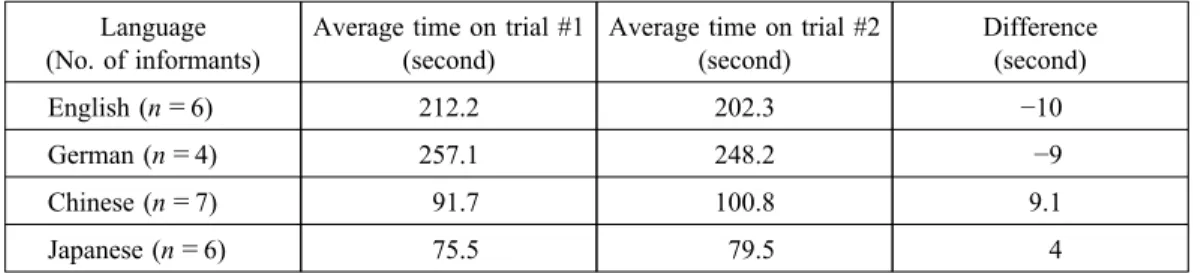
The results for the mean time in seconds required for the informants to answer the 64 questions in the two kinds of tests are shown in Table 7. The English-speaking informants improved in the second test by 10 seconds. German-English-speaking informants took more time overall than English-speaking informants, and improved by 9 seconds on the second trial. In contrast, Chinese and Japanese-speaking infor-mants took much less time than English and German-speaking inforinfor-mants, and took more time to complete the second trial than the first trial unlike the latter group. That is, no learning effect was observed for the former group of the two languages.
Table 8 presents the numbers of mistakes the informants made out of 64 ques-tions by language. The results indicate that Chinese and Japanese-speaking infor-mants performed both tests more accurately than their German and English-speaking counterparts. The former gave very few wrong answers, 0.6 to 1.4 on average out of 64 regardless of the test type, whereas the latter made 3 to 6.1 mistakes.
X. Discussion
From the results shown in the previous section, it appears that English and German-speaking informants need more time to answer questions on the times table than their Chinese and Japanese-speaking counterparts. Moreover, the former are likely to make more mistakes than the latter in recalling the tables. These facts indi-cate that German and English-speaking people cannot automatically recite all the ta-bles and thus sometimes need to calculate the answers, whereas Chinese and Japanese-speaking people are good at reciting the tables without calculation. This is why Chinese and Japanese-speaking people can quickly tell the product of a given equation upon hearing/reading its left hand side. In the process of this recitation, the phonological coding helps them to accurately connect the left and right hand sides of a given equation.
Saying “aaaaa . . .” while reciting the tables must have hindered Chinese and Japanese-speaking informants from giving correct answers more than it did their English and German-speaking counterparts. This implies that Chinese and
Japanese-Table 7 The time required to complete 64 equations
Language (No. of informants)
Average time on trial #1 (second)
Average time on trial #2 (second) Difference (second) English (n=6) 212.2 202.3 −10 German (n=4) 257.1 248.2 −9 Chinese (n=7) 91.7 100.8 9.1 Japanese (n=6) 75.5 79.5 4
Table 8 The number of mistakes made during calculation
Language No. of mistakes ontrial#1 out of 64 No. of mistakes ontrial#2 out of 64
English (n=6) 4 6.1 German (n=4) 3 3.7 Chinese (n=7) 1 0.7 Japanese (n=6) 0.6 1.4 Hiromi OTAKA 36
speaking people may rely more on sounds than their English and German-speaking counterparts when recalling the equalities in the multiplying table. In other words, the times tables in Chinese and Japanese are stored in the vocabulary as fixed phrases or chants involving multiple phonological properties as well. That is why phonological coding plays a more important role for them in recalling the table than for their German and English-speaking counterparts.
A learning effect was more rigidly observed in the English and German groups than their Chinese and Japanese counterparts, because the former groups took less time to complete the same task the second time due to the positive effect of the first test. This is normal, because they more or less have to engage in calculation. In contrast, this was not the case for the Chinese and Japanese groups. They took sig-nificantly more time on the second test because their phonological coding was pre-sumably hindered by the sounds they kept making during the test, i.e., they could not sufficiently concentrate on recalling the tables the second time.
XI. Conclusion
In conclusion, it can be argued that English and German-speaking people must more or less engage in calculation when trying to recite the times table, whereas Chinese and Japanese-speaking people can recite it quickly with the help of pho-nological knowledge as if recalling fixed phrases or chants without referring to their meanings. What helps the Japanese memorize and recall the tables with less effort are various rules of phonology such as rhythmicity, rhyming, tonal patterns, com-pounding rules, and brevity based on both the PE and the OCP. The Japanese way of reciting the times table called Kuku involves a variety of rhythmic patterns com-posed of bimoraic feet and single moras, following the OCP. As referred to earlier, applying the OCP in the readings of the table facilitates the process of memorizing and recalling the tables in recognition. In Chinese multiplication, on the other hand, the fixed tonal patterns for each equality of the table can help Chinese-speaking people to strengthen the bond between the phonemic sequence and its meaning ef-fectively, which is why they can guess the product of a given equation upon listen-ing to or readlisten-ing its left hand side in a question. The learned melody of some phrases can help them recite it without activating its meaning.
Kuku in Japanese is the times table traditionally and linguistically developed
based on specific mnemonics in which the readings of many of the equations follow the PE and the OCP as much as possible, so that memorizing and recalling them be-come efficient and automatic. What is more, once Kuku has been acquired by the learners, it is unlikely to fade easily thanks to the strengthened bond between the phonology and semantics of each equation.
References
Ando A. (2002) The enhancement of Kuku, Journal of Hokusei Gakuen University, 41, 79-101. Baddeley A. D. (1966) Short-term memory for word sequences as a function of acoustic,
seman-tic and formal similarity, Quarterly Journal of Experimental Psychology, 18(4), 362-5. Baddeley A. D., Wilson B. A. (1992) Phonological coding and short-term memory in patients
without speech, Journal of Memory and Language, 24(4), 490-502.
Buchsbaum B. R., D’Esposito M. (2008) The search for the phonological store: from loop to convolution. Journal of Cognitive Neuroscience, 20(5), 762-78.
Daily Yomiuri. (2010) Multiplication table imported from China−wooden notes found in Heijo-kyo ruins, morning edition, Dec. 4, 2010.
Goto, S. (2016) An article tittled “The multiplication table: 4, 7 and 8 are the figures likely to cause troubles” in Mainichi Daily on the 4th of October, 2016.
Leinenger M. (2014) Phonological coding during reading. Psychol Bull. 140(6), 1534-55. Martinet, A. (1964) Elements of General Linguistics, New York: Farber and Faber (translation
by E. Parmer of Éléments de linguistique générale by Martinet (1960), Paris: Armand Colin).
Miura I. T., Okamoto Y. (1999) Counting in Chinese, Japanese, and Korean: support for number understanding, in C. A. Edwards (Ed.), Perspective on Asian Americans and Pacific
Island-ers of Changing the Faces of Mathematics, In W. G. Secada, (Series Ed.), Reston VA:
Na-tional Council of Teachers of Mathematics, pp.29-36.
Miura I. T., Okamoto Y. (2003) Language support for mathematics understanding and perform-ance, in Baroody A. J., Dowker A. (Eds.), The Development of Arithmetic’s Concepts and
Skills: The Construction of Adaptive Expertise, Mahwah, NJ: Lawrence Erlbaum
Associ-ates, pp.229-42.
Miura I. T., Okamoto Y., Kim C. C., Steere M., Fayol M. (1993) First graders’ cognitive repre-sentation of number and understanding of place value: Cross-national comparisons−France, Japan, Korea, Sweden, and The United States, Journal of Educational Psychology, 85(1), 24-30.
Miura I. T., Okamoto Y., Vlahovic-Stetic V., Kim C. C., Han J. H. (1999) Language supports for children’s intuitive understanding of numerical fractions: Cross-national comparisons,
Journal of Experimental Child Psychology, 74, 355-65.
Otaka H. (2002) On the phonology in Japanese used for the multiplication table in arithmetic,
eX (Kwansei Gakuin University), 2, 95-106.
Otaka H. (2006) Phonetics and Phonology of Moras, Feet and Geminate Consonants in
Japa-nese, New York: University Press of America.
So S. (2015) Chūgokugo niokeru kukuhyōgen no gengogakuteki kōsatsu (‘Effects of linguistic tones on the learning of the multiplication table by Chinese children’), MA thesis, Kwansei Gakuin University.
TIMSS. 2015 International Report: http://timss2015.org/#/?playlistId=0&videoId=0
Yamaguchi A., Suzuki H., Sakanashi R., Tsukimoto M. (1997) Nihongono Rekishi (‘The His-tory of Japanese’), Tokyo: Tokyo University Press.
Hiromi OTAKA