総 説 ( 東 女 医 大 誌 第 時 第2号 頁
55~62
平成27i
F
4
月
)
第80回東京女子医科大学学会総会
シンポジウム「東京女子医大
小児医療の最前線!ー“なおらない"から“なおる!"
ヘ-J
P
a
r
t
1
(
6
)
腸内細菌とこどもの病気
東京女子医科大学医学部小児科学 ナ ガ タ サトル永田
智
( 受 理 平 成27年1月5日)The 80th Annual Meeting of the Society of Tokyo Women's Medical University Symposium “The Frontier Pediatric Practice at Tokyo Women's Medical University"
Part 1 (6) Gut Microbiota in Childhood: Health and Disease Satoru NAGA T A Department of Pediatric, Tokyo Women's Medical University School of Medicine Recently, the potential use of probiotics in clinical practice has been extended to regulating bowel move-ments as well as altering the course of infectious diseases, cancer, and allergies. 1mmunostimulatory probiotics, such asLactobacillus casei Shirota, which are facultative anaerobes characterized by the ability to induce predomi -nant 1L-12 production, promote the activation of NK cells and the development of Th1 cells, thereby augmenting the immune defense against viral infections and cancer and helping to decrease the rate of allergies. On the other hand, obligate anaerobic probiotics, such as Bifidobacterium, prevent harmfulluminal bacteria from approaching enterocytes by producing short-chain fatty acids and competing for adhesion sites and/or sources of nutrition. Furthermore, only the L.casei strain Shirota has been reported to cause increased endogenous intestinal B
折ぬ-bacterium production and suppress the proliferation of destructive bacteria, thus improving the enteric environ -ment. There is also evidence supporting the significant clinical benefits ofLactobacillus in treating acute gastroen -teritis, such as that due to rotaviral infection, as well as synbiotics in preventing infectious diseases in childhood, as demonstrated in randomized controlled trials. Therefore, ingesting probiotics contributes to improving and/or maintaining the health of children. Key Words: probiotics, Lactobacillus, Bifidobacterium, short-chain fatty acids, childhood はじめに 私たちの腸には,人体を構成する細胞数をも上回 る数の腸内細菌が存在するといわれている.そのほ とんどは,生直後から数日のうちに経口的に侵入し 腸管に到達したもので,大部分は人体にとって有益 な働きをしている.小腸で消化しきれず、大腸に至っ た炭水化物の消化やビタミンKの補給,有害菌の侵
入阻止などがよく知られており,菌数は,有益菌(善 玉菌)>無害,無益菌>有害菌の順に,それぞれ 100 倍以上の優劣を形成している.しかしひとたび, この秩序が乱れて,有害菌が多い腸内環境になって しまうと便秘や下痢,各種感染症,アレルギーな 図:永田 智 〒162-8666東京都新宿区河田町8-1 東京女子医科大学小児科 E-mail: [email protected] -55ー26
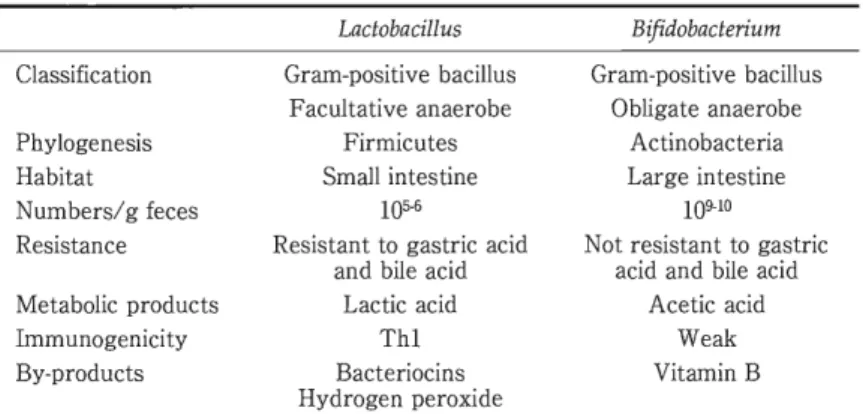
Table 1 Di旺'erencesbetween
L
a
c
t
o
b
a
c
i
l
l
u
s
and B伊d
o
b
αc
t
e
r
i
u
m
L
a
c
t
o
b
a
c
i
l
l
u
s
B伊d
o
b
a
c
t
e
r
i
u
m
Classifica tion Gram-positive bacillus Gram-positive bacillus Facultative anaerobe Obligate anaerobe Phylogenesis Firmicutes Actinobacteria Habitat Small intestine Large intestineN
u
m
b
e
r
s
/
g
feces 105-6 109-10 Resistance Resistant tbo ilegaasctirdic acid Not resistant to gastric and acid and bile acid Metabolic products Lactic acid Acetic acid lmmunogenicity Th1 Weak By-products Bacteriocins Vitamin B Hydrogen peroxide どを起こしやすくなってくるといわれている.近年, この腸内細菌の乱れを 有益菌を外から与えること によって是正しようという考え方が出現した.この 有益菌を食品や薬剤にしたものを「プロバイオテイ クス j とよんでいる. 本稿では,小児領域におけるブρロバイオテイクス の整腸効果,感染症抑制効果,抗アレルギー効果な どについて, ランダム化比較試験(
r
a
n
d
o
m
i
z
e
dc
o
n
-t
r
o
l
l
e
d
t
r
i
a
l
:
RCT)
の結果を主体に紹介する.さら に,新しいプロバイオティクスの作用として,新生 児の体重増加や,肥満児の生活習慣病予防効果,母 体投与による早産の予防効果にまで,その応用力が 広がっていることに言及する.人類と長年共生関係 にあった善玉菌の底力に驚かれるに違いない.1
.
揚内細菌叢の構成の経時的変化 ヒトの大腸内には1,0
0
0
種類以上,1
0
0
兆もの腸内 細菌が存在し,その遺伝子数はヒトの約1
0
0
倍にも 達するという1)経臆分娩出生児においては,生直後 より母体の臆内細菌を起源とする腸内細菌の定着が 起こるとされる2)生直後は,L
a
c
t
o
b
a
c
i
l
l
u
s
g
a
s
s
e
r
i
を主 体とする通性嫌気性菌の定着が起こるが,速やかに それらの菌は減少し 1~2 週間後の最も優勢な菌種 はB
i
f
i
d
o
b
a
c
t
e
r
i
u
mb
r
e
v
e
な ど のB
i
f
i
d
o
b
a
c
t
e
r
i
u
m
属 と なり,約 1 ヵ月の経過で全体の菌数の 60~90% の菌 叢を占めるに至る3)4) 新生児早期に腸内細菌叢の主 要菌種が変化する理由は明確ではないが,母体の目室 内細菌の主要菌種であるL.g
a
s
s
e
げなどは,生直後の 新生児の小腸のPeyer
板などの粘膜免疫組織の発 達に寄与しなおかつ,乳児期早期の腸内細菌叢の 主要となるB
i
f
i
d
o
b
a
c
t
e
r
i
u
m
の増殖効果があることが 筆者らの検討で知られていることから,合目的な現 象とも思われる5) 上述の推論で,経臆分娩か帝王切 聞かの分娩様式で,新生児期の腸内細菌叢の組成が -56-異なるのは説明がつくことと思われる.以前は,母 乳栄養児の腸内細菌がB
i
f
i
d
o
b
a
c
t
e
r
i
u
m
優位であるこ とが強調されていたが6) これは母乳中のガラクトオ リゴ糖が B伊
d
o
b
a
c
t
e
r
i
u
m
の増殖因子であるためとい われ,最近は人工乳にもこれらが添加されるように なっている.生後約1
年かけて腸内細菌叢の組成は 成人の組成に近づいていくが,その差異は個体にお ける成人期にも影響を受けている可能性があるとさ れる7) また帝王切開により生まれた児は経臆分娩で 生まれた児よりB
i
f
i
d
o
b
a
c
t
e
r
i
u
m
などのいわゆる善玉 菌の定着が遅れ,のちのアレルギー疾患の発症率を 増加させる可能性が報告されている8)2
.
臨床で使用されているプ口バイオティクス プロバイオティクスは,宿主に有用な作用を示す 生菌体を含む食品もしくは薬剤と定義されている. いわゆる代表的なプロバイオテイクスには“乳酸 菌“ビフィズス菌"があげられる.“乳酸菌"は総称 であり,I
グラム陽性の梓菌または球菌で,カタラー ゼ陰性,内生胞子を形成せず消費したグルコースの50%
以上を乳酸に変換しうる菌J
を指す.現在1
6
S
r
i
b
o
s
o
m
a
l
RN
A
塩基配列による系統分析により2
6
属に分類されるが,ブ9ロバイオティクスとして利用 されているものの大多数はL
a
c
t
b
a
c
i
l
l
u
s
属,E
n
t
e
r
o
-c
o
c
u
s
属,L
a
c
t
o
c
o
c
u
s
属に属している.対して“ビフイ ズス菌"はB
i
f
i
d
o
b
a
c
t
e
r
i
u
m
属に属する菌の総称、であ り ,B
.
b
r
e
v
e
,B
.
b
i
f
i
d
u
m
,B
.
i
ψ
n
t
i
s
,B
.
l
o
n
g
u
m
,B
.
l
αc
t
i
s
等があげられる.乳酸菌とのその生物学的差 異をTable1
にあげる.その他にも,酵母(
S
a
c
c
h
a
r
o
-m
y
c
e
s
)
や,真菌(
A
s
p
e
r
g
i
l
l
u
s
)
,芽胞産生菌(
B
a
c
i
l
l
u
s
,C
l
o
s
t
r
i
d
i
u
m
)
など極めて多くの微生物がプロバイオ ティクスとして研究されている.3
.
プロバイオティクスの作用機序 ヒトの健康維持に貢献するプロバイオテイクスのObli誌な;obicdニchain 均三~
Harmful bacteria Outer mucusl
a
y
e
r
、
J
;
;
;
:
;
d
J
P
E
F
for Nutrition Short-chain fatty acids O 都何~恥st凶-ThO Treg Plasma cells B cells Fig. 1 Possible mechanisms underlying the amelioration of bacterial infection by obligate anaerobic probiotics Probiotics float at a distance of 100-300μm from host enterocytes in the outer mucus layer and prevent harmful luminal bacteria from approaching enterocytes by produc -ing short-chain fatty acids and competing for adhesion sites and sources of nutrition. If pathogens manage to break through these barriers, the probiotic stimulates the host enterocytes to release antimicrobial peptides and/or increases the hos1's immunity by promoting the secretion of IgA.Some obligate anaerobic probiotics may promote the dif-ferentiation of Tregs via short-chain fatty acids. 作用として,1)整腸作用, 2)感染予防, 3)免疫調 節作用, 4)代謝調節について述べる. 1)整腸作用 整腸作用とは,下痢と便秘という相反する消化管 運動異常を制御することであり, 一般にプロバイオ ティクスがその効果を有することは経験的に知られ ている. しかし,そのメカニズムについてのエビデ ンスは意外にも多くはない. (1)下痢の抑制のメカニズム かかるメカニズムとして, ①下痢の原因となる病 原体の排除, ②消化管上皮細胞に栄養を与えてその 機能の正常化を助ける, ③消化管平滑筋や迷走神経 へ働きかけて腸管の過剰な運動を抑制する,などが 考えられるが,エビデンスが確立しているのは, ① のみである.主な病原体には,細菌,ウイルスがあ げられるが,ウイルスの排除機構に関しては次項の 「免疫調節作用」に譲るとして,本項では「腸管病原 菌の排除機構」について述べる.腸管上皮は,厚さ lOO~300μm ものムチン粘液層に覆われ,病原体は おろか常在菌さえも容易に宿主の腸管上皮細胞に近 づくことはできない9) 腸内細菌叢は,ムチンの海に 浮かび、,病原体と場所的,栄養的競合により腸管上 -57 -皮に近づかないように物理・化学的生体防御を構成 している.さらに,大腸の偏性嫌気性菌は,最終産 生物として,酪酸,酢酸およびプロピオン酸に代表 される短鎖脂肪酸を産生するが これらは,腸管上 皮細胞へのエネルギー源になるとともに,腸内
pH
を下げることで,有害菌増殖を抑える効果があると される (Fig.1).このように大腸に生息する B折
d
o
-b
a
c
t
e
r
i
u
m
属やC
l
o
s
t
r
i
d
i
u
m
属のような偏性嫌気性菌 は,主に病原菌の増殖,生体への侵入を防いでおり, これらをプロバイオティクスとして用いることによ り細菌感染による下痢を抑制することは怠義がある と思われる. (2)便秘の抑制のメカニズム プロバイオティクスの便秘抑制効果は,基礎,臨 床ともに,その効果を証明する試験は驚く程少ない. 基礎的な根拠は ,B
i
f
i
d
o
b
a
c
t
e
r
i
u
m
属の主要代謝産物 である酢酸が腸管平滑筋を刺激するというi
nv
i
t
r
o
studyがある程度である円 2) 感染予防 (1)細菌感染症 大腸の病原体の増殖・生体への侵入防御について は前述したが,主に小腸に生息する常在菌の感染防28
亡
コ
probiotics Macrophag来
l
I
L
-
1
2
I
@
ム ム
⑥
[
I
n
f
e
c
t
i
o
n
,
C
a
n
c
e
r
,
A
l
I
e
r
g
y
1
Fig. 2 Possible mechanisms underlying the amelioration of viral infection. cancer and/or allergies by facultative anaerobic probioticsll) c/i Cells: cancer cells or infectious cells. Immunostimulatory probiotics. such asL
a
c
t
o
b
a
c
i
l
l
u
s
c
a
s
e
i
Shirota. are characterized by the ability to induce predominant IL-12 production and subsequently promote the acti-vation of NK cells and Thl cells. thereby augmenting the immune defense against viral
infection and cancer and decreasing the rate of allergies. 御機構は大きく異なる •
L
a
c
t
o
b
a
c
i
l
l
u
s
属においては, 嫌気条件下でのフラビン酵素を介し過酸化水素を発 生させ,細胞膜脂質の酸化を促進させ,殺菌作用を 有する.近年 ,L
a
c
t
o
b
a
c
i
l
l
u
s
属が産生する殺菌物質と してバクテリオシンが注目されているが,これは耐 熱・耐酸性であり,腸管内のタンパク分解酵素によ り分解されることからより高い安全性を有するとさ れている.宿主の免疫増強により細菌感染症を予防 する機序については次項に譲る. (2)ウイルス感染症 ほとんどの腸管腔の抗原は分厚い粘液層をかいく ぐって上皮細胞に到達しにくいため,細菌などの異 物を積極的にサンプリングできる構造が特別に備 わっている.それが, Peyer板を主体とした腸管関連 リンパ組織(gut-associatedlymphoid tissue : GALT) であって,その表面は粘液層や微繊毛が少なく,抗 原が腸上皮に近づきやすい環境になっている.抗原 のサンプリングはその専従細胞であるM
(microfold もしくはmembranous)細胞が行っていることが知 られている.抗原は,M
細胞により取り込まれ,マ クロファージや樹状細胞などの抗原提示細胞によりB細胞,
T細胞に提示される.主に小腸で効果を発揮
するL.c
a
s
e
i
の よ う な 通 性 嫌 気 性 菌 の プ ロ バ イ オ テイクスは,このシステムによって積極的にサンプ リングされ,マクロファージにIL-12を産生させる ことによりNK
細胞が誘導され,ウイルス感染症に 対抗することが知られている (Fig.2)!l). 3) 免疫調節作用(
1
)
Th1型免疫およびNK
細胞誘導 上述した小腸に生息するL.c
a
s
e
i
のような通性嫌 気性菌は, GALTにサンプリングされた後マクロ ファージに1L-12を産生させて, Th1型免疫応答を 誘導し, Th2型免疫応答を抑制することによりアレ ルギー予防に働くことが期待されている (Fig.2).NK
細胞は,ウイルス感染症のみならず,がん細胞に 対抗する宿主免疫増強につながる. さらに,プロバ イオティクスの細胞壁構成成分の一つであるペプチ ドグリカンは,発癌物質であるヘテロサイクリック アミン類を吸着・排出させることで,抗がん作用を もつものと期待されている. (2)制御性T細胞 (Treg)の誘導 これに対して,大腸に生息するB
i
f
i
d
o
b
a
c
t
e
r
i
u
m
属>37t >3S0
C
8 8 7 7 6 6 5J1
p=O.088 days4 4 3 3 2 2o
J
-
-
-
-
0 Non-administered LcS Non-administered LcS group ・administeredgroup group 四administeredgroup Fig.3 Durationof fever (days) after the onset of norovirus gastroenteritis19l During a one-month period, there were no significant di妊'erencesin the incidence of noro -virus gastroenteritis between the group administered Lactobacillus casei Shirota (LcS)-fer -mented milk (n = 39) and the untreated control group (n = 38). However, the mean duration of fevers of >37 OC after the onset of gastroenteritis was 1.5::t1.7 days in the former group versus 2.9::t2.3 days in the latter group, indicating a significant shortening of this interval in the latter group (pく0.05). などの偏性嫌気性菌は ほとんど免疫学的な活性は もたないと信じられてきた.しかし近年,C
l
o
s
t
r
i
d
-i
u
m
属の細菌の産生する酪酸によりTreg
の産生が 誘導されることが報告されている? 4) 代謝調節 プ ロ バ イ オ テ ィ ク ス に は 消 化 管 内 の コ レ ス テ ロールに結合し,胆汁酸脱抱合作用を及ぼして,血 清コレステロールを低減する作用,アンギオテンシ ン変換酵素阻害ペプチド産生による血圧降下作用等 も報告されている.近年,成人では生活習慣病と腸 内細菌叢との関連が注目を浴びておりl幻14) 安全性の 高いプロバイオティクスにおける効果が期待されて いる.4
.
プロバイオティクスの臨床応用 現在,小児科領域の臨床におけるプロバイオテイ クスのRCT
の報告を以下にまとめる. 1)下痢2
0
1
名の乳幼児に対してB.l
a
c
t
おもしくはL.r
e
u
-t
e
r
i
投与をランダムに投与して急性下痢症の発症予 防効果をみたところ L.r
e
u
t
e
r
i
投与群において急J性
感染性下痢症の発症抑制効果および下痢持続時間 の 短 縮 効 果 が 有 意 に 高 か っ た と の 報 告 が あ る ? L.r
h
a
m
n
o
s
u
s
GG (LGG)
が,ロタウイルス感染予防 および治療効果を有することは,メタ分析,C
o
-chraneレビューでも示されている16)17) 抗菌薬関連 一59-一 下痢症は,短鎖脂肪酸を産生する腸管内の嫌気性菌 が減少することで, Na再吸収低下や炭水化物貯留が 起こることにより生じる浸透圧性下痢と考えられて いるが,メタ分析においても,同下痢症の発症予防 にLGG
,B
.
l
a
c
t
i
s
,S
t
r
e
p
t
o
c
o
c
c
u
s
t
h
e
r
m
o
p
h
i
l
e
s
,S
a
c
c
h
a
r
o
-m
y
c
e
s
b
o
u
l
a
r
d
i
i
などのプロバイオテイクスが有用で あるとされる18)-ゲ ノロウイルスに対する作用につ いては,RCT
の報告は見あたらず,臨床効果を証明 する試験もほとんどない.成人領域のオープン試験 であるが,筆者らは,7
7
例の平均年齢8
4
歳の高齢者 施 設 に て ノ ロ ウ イ ル ス 感 染 症 流 行 期1
ヵ月間に L.c
a
s
e
i
strainShirota(乳酸菌シロタ株)含有飲料を 飲用した群において,ノロウイルス感染症による3
7
0C
以上の高齢者の発熱期間を有意に短縮(飲用群1
.
5日vs非飲用群 2.9日)し (Fig.3),同飲料飲用に より,便中のB
i
f
i
d
o
b
a
c
t
e
r
i
u
m
数が有意に増加してい ることを言正明している21) 2)便秘 小児領域におけるメタ分析では,6
4
0
人の便秘の 小児においてブρロバイオテイクスの効果は否定的と 報じられているゲ 成人領域では,筆者らが4
2
例の 高齢者施設入所者を対象にしたオープン試験によ り,乳酸菌シロタ株含有飲料飲用群において有意に 便秘回数の低下を認めたことを証明している5
¥
さら に,8
8
例の高齢者施設入所者と2
0
例の施設職員を30 対象にした
RCT
により,乳酸菌シロタ株含有飲料 飲用群において有意に便秘回数の低下を認めたこと を証明している(論文投稿中). 3)感染症全般 プ ロ バ イ オ テ ィ ク ス に よ り 発 達 が 促 進 さ れ たcommon mucosal immune system
により,病原体に 対する特異的免疫応答細胞が気道など腸管外の粘膜 に分配されることで,感染全般を予防することも期 待されている.ただし, 1~6 歳までの 571 名の健常 児に対して ,LGG
もしくはプラセボをランダムに6
ヵ月間投与した試験では,呼吸器感染症に対する 発症抑制効果はLGG
には認められなかった? しか しその後,プロバイオティクスとプレバイオテイ クス(プロバイオテイクスの増殖因子)を同時投与 する「シンバイオティクス」という新たな治療戦略 が出現し新たな効果が期待されている.年齢6
ヵ月 の乳児1
8
8
例に乳酸菌の一種である L.j
討mentum
と その増殖因子であるガラクトオリゴ糖をシンバイオ テイクスとして与えることにより,6
ヵ月の観察期 間において,急性胃腸炎,呼吸器感染,急性上気道 炎を含めた感染症全般への,龍号、率が有意に低下した と報告されている24)4
)
アレルギー プロバイオティクスのアレルギー疾患予防効果に ついては,従来から期待されているところであった. アトピー性皮膚炎発症高リスク群1
3
2
名を対象とし て,妊娠末期4
週間は母体に,出生後6
ヵ月は乳児 に,LGG
もしくはプラセボを投与して同疾患発症率 をみた試験では,出生後2
年までにLGG
投与群では 有意に発症が予防され(LGG
群6
4
名中1
5
名v
s
プ ラ セ ボ 投 与 群6
8
名 中3
1
名 ; オ ッ ズ 比0
.
51
,
95%
C
l
:
0
.
3
2
-
0
.
8
4
;
p<
0
.
0
1),さらに4
歳時でもこの予防 効果は認められていたとされているゲ しかしこの 研究結果を支持する他の報告はなく,逆に別の高リ スク群を対象とした出生後のL.a
c
i
d
o
p
h
i
l
u
s
投 与 群 においては,このアトピ一発症予防効果はなく,む しろミルクアレルギーのリスクを増大させるという 報告もある26).2
0
0
7
年のCochrane
レビューでは,妊 娠中母体および出生児に対するプロバイオテイクス のアレルギー疾患予防効果については,エビデンス がまだ十分に蓄積されていないとされている27) 治療に関しては,オーストラリアの5
3
名の中等症 以上のアトピーの乳児においてL.f
e
r
m
e
n
t
u
m
もしく はプラセボを8
週間投与した後,その後8
週間後のs
e
v
e
r
i
t
y
o
f
s
c
o
r
i
n
g
o
f
a
t
o
p
i
c
d
e
r
m
a
t
i
t
i
s
に よ る 判 定 にて,プロバイオティクス投与群において有意に湿 疹が改善を示したとする報告があるおその後のC
o
-c
h
r
a
n
e
レビューにおいてはまだ十分なエビデンス があるとはみなされず,さらなる研究が必要とされ ている久 昨今,新生児84
例を対象としてランダム にL.r
h
a
m
n
o
s
u
s
とB.l
o
n
g
u
m
にガラクトオリゴネ窟と フルクトオリゴネ窟を力H
えたシンノ可イオティクスもし くはプラセボを6
ヵ月投与したところシンバイオ ティクス群において有意にアトピー性皮膚炎の擢患 率が減少したとする報告がある一気管支目指息,食物 アレルギーに関してはマウスにおいてその有効性が 報告されているが,ヒトにおけるこの分野は予防お よび治療に関しては無効で、あったとする報告が多く 現時点ではブρロバイオテイクス,プレバイオティク ス,シンバイオテイクスともにまだ十分なエビデン スはないとされ31) 現在その予防および治療効果は 否定的とされる報告が多い.アレルギー性鼻炎に関 する小児のRCT
の報告は少ないが, L.c
a
s
e
i
s
t
r
a
i
n
S
h
i
r
o
t
a
, L.g
a
s
s
e
r
i
を用いた治療介入群において,そ の臨床症状を緩和させたとする報告がある3附 . -60-一 5)早産,低出生体重 自然早産の最大の原因は繊毛膜羊膜炎(
c
h
o
r
i
o
a
m
-n
i
o
n
i
t
i
s
:
CAM)
を主体とする子宮感染であり,CAM
の原因の9
割は,細菌性臆症からの上行感染 が関与しているといわれているゲ 細菌性臆症の臆 内細菌叢の特徴として,常在菌であるL
a
c
t
o
b
a
c
i
l
l
u
s
属の減少とG
a
r
d
n
e
r
e
l
l
a
属,A
t
o
p
o
b
i
u
m
属,M
o
b
i
l
u
n
c
u
s
属,C
h
l
a
m
y
d
i
a
属,U
r
e
a
p
l
a
s
m
a
属などの複数菌の増加 が指摘されておりあ 腔内細菌叢のコントロールが 早産の予防につながるという新たな期待がよせられ ている.細菌性腔症6
4
0
例 に 対 し 妊 娠2
5
週まで 6~12 週間ランダムにL.R
h
a
m
n
o
s
u
s
+
L.r
e
u
t
e
r
i
もし くはプラセボを投与したRCT
においては,在胎3
4
週未満の早産の出生数の減少はみられたものの,統 計的有意差は残念ながら認められなかった札 6)肥満,生活習慣病 成人領域においては,肥満と腸内細菌叢との関わ りが指摘されているものの3糊,小児領域では,プロ バイオテイクスによる肥満の治療・予防については 明瞭な結論は出ていない39) 筆者らが,肥満小児と健 常児の初診時の腸内細菌叢および便中有機酸を,そ れぞれ1
6
Sr
i
b
o
s
o
m
a
l
RNA
をターゲットとした定 量的RT-PCR
とHPLC
分析により解析を行ったと ころ,肥満群の便ではB
i
f
i
d
o
b
a
c
t
e
r
i
u
m
,B
a
c
t
e
r
o
i
d
e
s
斤
α-g
i
l
i
s
group
,A
t
o
p
o
b
i
u
m
c
l
u
s
t
e
r
, L.g
a
s
s
e
r
i
subgroup
のそれぞれ有意な減少が認められた便中有機酸分 析においては,肥満群で酢酸濃度の明らかな低下が 認められた肥満群に,観察期間の前半
6
ヵ月は食 事・運動療法のみ,後半6
ヵ月に乳酸菌シロタ株含 有飲料を飲用させたところ 飲用1
ヵ月後に飲用前 に比較して有意な体重減少および血清中性脂肪値の 有意な低下,血清HDL
コレステロール値の上昇傾 向がそれぞれ認められたなお,この際の腸内環境 として ,Bifidobacterium数および酢酸濃度の有意な 増加が確認された?5
.
プ口バイオティクスの安全性L
.
reuteri,LGG
を免疫不全マウスに投与したとこ ろ,成体マウスで、は影響はなかったが,新生仔マウ スにおいて感染症死例が出たとする報告がある41) 実際に基礎疾患のない健常児におけるプロバイオ テイクスによる敗血症の報告はないが,腸内環境の 脆弱性が予想されるケースや いわゆる易感染性が 疑われるケースでは注意したほうがよいと思われ る.ただし小児科領域での敗血症報告はLGG
,S
.
boulardiiのみであり 本邦で医薬品として用いら れている“整腸薬"にこれらの菌は含まれていない. おわりに ヒトは,摂取した食物を自らの力で消化して栄養 素を吸収し,自らの生を支えていると長年信じられ てきたが,実は,消化・吸収の一部は自らの力では 不十分で,腸内細菌叢がその働きを代行しているこ とが,昨今少しず、つわかってきた.また,腸内細菌 叢は宿主の免疫力にも大きな影響を及ぼし,自身を 守り繁栄させる生物学的活動が,結果的に宿主を 様々な感染症や自己免疫疾患,悪性新生物から守る ことにつながっているといえよう.腸内細菌叢は, 成人で重さ1kg
以上にも達し,第二の肝といっても よい複雑な機能を持っていることから,まさに体の 一部という認識が生まれでも不思議はない.筆者ら は,腸内細菌叢が宿主の味方にも敵にもなりうる存 在であることから 小児領域において,患者の腸内 細菌叢を患者の味方にっけんとする新たな治療戦略 を開発中である. 開示すべき利益相反状態はない. 文 献1)Qin J, Li R, Raes J et al: A human gut microbial gene catalogue established by metagenomic se -quencing. Nature 464: 59-65, 2010 2) Bjorksten B, Sepp E, Julge K et al: Allergy devel同 opment and the intestinal microfiora during the -61-五rstyear of life. J Allergy Clin Immunol 108: 516 -520,2001
3) Rahman MS, Nagata S, Matsuda K et al: Molecu -lar biological studies of the origin ofBifidobacterium and Lactobacillusin neonatal feces. Int J Probiotics Prebiotics 7: 91-98, 2012 4) Tsuji H, Oozeer R, Matsuda K et al: Molecular monitoring of the development of intestinal micro -biota in J apanese infants. Beneficial Microbes 3: 113-125,2012
5) Bian L, Nagata S, Asahara T et al: Effects of con -tinuous intake ofLactobacillus caseistrain Shirota -fermented milk containing on risk management of long-term inpatients at health service facilities for the elderly. Int J Probiotics Prebiotics 6: 123-132, 2011 6) Mshvildadze M, Neu J:The infant intestinal micro開 biome: friend or foe? Early Hum Dev 86 (Suppl 1): 67-71,2010 7) Y oshioka H, Iseki K, Fujita K: Development and di旺erencesof intestinal fiora in the neonatal period in breast-fed and bott1e-fedinfants. Pediatrics 72: 317-321,1983
8) Renz干olsterH, David M R, Buist AS et al:Cae司
sarean section delivery and the risk of allergic dis -orders in childhood. Clin Exp Allergy 35: 1466-1472, 2005
9) Mayer L, Wa1王lerW A: Development and physiol -ogy of mucosal defense. InMucosal Immunology (Mestecky,JLamm ME, Strober W et al eds), pp5-18, Elsevier Academic Press, Amsterdam (2005) 10) Yokokura T, Yajima T, Hashimoto S: Effect of
organic acid on gastrointestinal motility of rat in vi開 tro. Life Sci 21: 59-62,1977 11) Shida K, Nanno M, Nagata S: Flexible cytokine production by macrophages and T cells in response to probiotic bacteria: a possible mechanism by which probiotics exert multifunctional immune regulatory activities. Gut Microbes 2: 109-114,2011 12) Atarashi T, Tanoue T, Shima T et al: Induction of colonic regulatory T cells by indigenous Clostrid -ium species. Science 331: 337-341, 2011
13) Backhed F, Ding H, Wang T et al: The gut micro -biota as an environmental factor that regulates fat storage. Proc Natl Acad Sci USA 101: 15718-15723, 2004 14) Creely SJ, McTernan PG, Kusminski CM et al: Lipopolysaccharide activates an innate immune system response in human adipose tissue in obesity and type 2 diabetes. Am J Physiol Endocrinol Me-tab 292: E74
o
-
E747, 2007 15) Weizman Z, Asli G, Alsheikh A: E旺'ectof a probi -otic infant formula on infections in child care cen -ters: comparison of two probiotic agents. Pediatrics 115: 5-9, 2005 16) Szajewska H, Mrukowicz JZ: Probiotics in th32 17) Allen SJ, Okoko B, Martinez E et al: Probiotics for treating infectious diarrhoea. Cochrane Database Syst Rev 2: CD003048, 2004 18) Correa NB, Peret Filho LA, Penna FJ et al: A randomized formula controlled trial of Bifidobacte -rium lactis and Streptococcus thermophilus for pre幽 vention of antibiotic-associated diarrhea in infants. J Clin Gastroentero139: 385-389, 2005
19) Hawrelak JA, Whitten DL, Myers SP: 1s Lactoba -cillus rhamnosus GG e旺ectivein preventing the on -set of antibiotic-associated diarrhea: a systematic review. Digestion 72: 51-56, 2005
20) Szajewska H, Ruszczy白kiM, Radzikowski A: Probiotics in the prevention of antibiotic-associated diarrhea in children: a meta-analysis of randomized controlled trials. J Pediatr 149: 367-372, 2006 21)Nagata S, Asahara T, Ohta T et al: Effect of the
continuous intake of probiotic幽fermentedmilk con -taining Lactobacillus casei strain Shirota on fever in a mass outbreak of norovirus gastroenteritis and the fecal microflora in a health service facility for the aged. Br J Nutr 106: 549-556, 2011 22) Tabbers M M, Boluyt N, Berger M Y et al: Non -pharmacologic treatments for childhood constipa -tion: systematic review. Pediatrics 128: 753-761, 2011 23) Hatakka K, Savilahti E, Ponka A et al: Effect of long term consumption of probiotic milk on infec -tions in children attending day care centres: double blind, randomised tria.lBMJ 322: 1327,2001 24) Maldonado J, Canabate F, Sempere L et al: Hu
-man milk probiotic Lactobacillus fermentum CECT 5716 reduces the incidence of gastrointestinal and upper respiratory tract infections in infants. J Pedi -atr Gastroenterol Nutr 54: 55-61.2012 25) Kalliomaki M, Salminen S, Poussa T et al: Probi -otics and prevention of atopic disease: 4・yearfollow -up of a randomised placebo-controlled tria.lLancet 361:1869-1871.2003 26) Taylor AL, Dunstan JA, Prescott SL: Probiotic supplementation for the first 6 months of life fails to reduce the risk of atopic dermatitis and increases the risk of allergen sensitization in high-risk chil -dren: a randomized controlled tria.lJ Allergy Clin 1mmunol 119: 184-191.2007 27) Osborn DA, Sinn JK: Probiotics in infants for pre岨 vention of allergic disease and food hypersensitiv -ity. Cochrane Database Syst Rev 4: CD006475, 2007 28) Weston S, Halbert A, Richmond P et al: E宜ectsof probiotics on atopic dermatitis: a randomised con -trolled tria.lArch Dis Child 90: -62-Probiotics for treating eczema. Cochrane Database Syst Rev 4: CD006135, 2008 30) Roze JC, Barbarot S, Butel MJ et al: An α -lactalbumin-enriched and symbiotic-supplemented v. a standard infant formula: a multicentre, double -blind, randomised tria.lBr J Nutr 107: 1616-1622, 2012
31) van der Aa LB, Heymans HS, van Aalderen W M et al: Probiotics and prebiotics in atopic dermatitis: review of the theoretical background and clinical evidence. Pediatr Allergy 1mmunol 21: e355-e367, 2010 32) Giovannini M, Agostoni C, Riva E et al: A ran -domized prospective double blind controlled trial on e旺ectsof long司termconsumption of fermented milk containing Lactobacillus casei in pre-school children with allergic asthma and/or rhinitis. Pedi -atr Res 62: 215-220, 2007
33) Chen YS, J an RL, Lin YL et al: Randomized placebo-controlled trial of lactobacillus on asthmatic children with allergic rhinitis. Pediatr Pulmonol 45: 1111-1120,2010 34) J ones HE, Harris KA, Azizia M et al: Di百ering prevalence and diversity of bacterial species in fe -tal membranes from very preterm and term labor. PLoS One 4: e8205, 2009 35) Nugent RP, Krohn M A, Hillier SL: Reliability of diagnosing bacterial vaginosis is improved by a standardized method of gram stain interpretation. J Clin Microbia129: 297-301,1991 36) Krauss-Silva L, Moreira ME, Alves MB et al: A randomised controlled trial of probiotics for the prevention of spontaneous preterm delivery associ -ated with bacterial vaginosis: preliminary results. Trials 12: 239, 2011
37) Ley RE, Backhed F, Turnbaugh P et al: Obesity alters gut microbial ecology. Proc Natl Acad Sci USA 102: 11070-11075,2005 38) Ley RE, Turnbaugh PJ, Klein S et al: Microbial ecology: human gut microbes associated with obe -sity. N ature 444: 1022-1023, 2006 39) Collado MC, Cernada M, Bauerl C et al: Microbial ecology and host-microbiota interaction during early life stages. Gut Microbes 3: 352-365, 2012 40)永田 智:プロバイオテイクスを用いた小児肥満 対策の検討 http://kaken.nii.ac.jp/d/p/22500773.e n.html 41)Wagner RD, Warner T, Roberts L et al: Coloniza -tion of congenitally immune deficient mice with probiotic bacteria. 1nfect 1mmun 65: 3345 -3351, 1997