いかなる辺展開でも正多面体は重なりを持たない
Edge-Developments of
Platonic
Solids Never
Overlap
(Extended Abstract)
堀山 貴史 庄子 亘
Takashi
Horiyama
Wataru
Shoji
埼玉大学理工学研究科
Graduate School
of
Science
and Engineering,
Saitama
University「任意の凸多面体は,単純で重ならない多角形に辺展開することができるだろうか
?」すなわち,任意の凸多面体は辺展開による展開図を持つだろうか
? 展開図(
一般展開とも呼ばれる)
は,多面体の表面を切って平面に開くことで得られる多角形である.また,多面体の辺に沿ってのみ開
切を許すものを特に辺展開と呼ぶ.展開図の起源は
16
世紀に遡る
:1525
年に,画家であり数学者
であるデューラーが書籍 “Unterweysung der
Messung mit
demZirkel un
Richtscheyt inLinien
Ebnen uhndGantzen
Corporen” [8]を著し,正多面体や半正多面体の辺展開を与えた.(同書は,
後に “The
Painter
$s$ Manual“ [9]として英訳されている.邦訳は「測定法教則」.
)
彼が先の疑問を問題として認識していた証拠はないが,実際に描いた展開図を通して,そうなりそうだとの直
感を持っていたようである [7].この直感は長年に渡り支持されてきたが,近年になって,開切の仕方によっては開いた面が重
なりを持ち得る不幸な反例が示された [7,13,15].また,凸性の条件を考慮に入れなければ,どの
ように辺展開しても重なりを持ってしまうような多面体が報告されている [3, 10].一方,一般展
開(
つまり辺だけでなく面を切ることも許したもの)
を認めるならば,任意の凸多面体からその展
開図を得る方法が2通り知られている [2,14,16].つまり,任意の凸多面体は少なくとも
1
つは一
般展開を持っ.本研究では,凸多面体を正多面体のみに限定し,別の角度からこの問題を検討する.
「正多面体
の展開図は,いかなる展開でも重なりを持たないのだろうか
$?$」この問題は,一見すると容易に見
えるが,以下のような否定的な状況証拠も挙げられる.(1)
ねじれ十二面体 (2 つ以上の正多角形 で構成される半正多面体の1
つ)
には,重なりを持つ辺展開が存在する
[6]. (2) 正四面体を除く正多面体には,重なりを持つ一般展開が存在する.(正四面体は,任意の一般展開が重なりを持た
ない.)こうした考察より,辺展開に焦点を当て,
「正多面体の辺展開は,いかなる展開でも重なりを持
たないのだろうか $?$」と問いを改める.正四面体,正六面体,正八面体については,それぞれ 2,
11,11種類の辺展開が存在する [12]ため,それらを
1
つずつ描くことで重なりを持たないと確認
できる.デューラーの頃より,同じことが正十二面体と正二十面体についても当てはまると信じ
られてきた.しかし,一般展開の場合のように,一部の正多面体が重なりを持たないのに,他の
多面体が重なりを持つこともあり得る.本研究では,この未解決問題を肯定的に解決した.
定理 1 (Main result) いかなる辺展開でも正多面体は重なりを持たない.本研究では,二分決定グラフ
(BDD) [5] を用いて任意の多面体のすべての辺展開を列挙する手法を提案し,また,これにより得られる各展開図が重なりを持つかどうかを判定する手法を提
案する.正十二面体と正二十面体は
43,380
種類の辺展開を持つ
[4,11]ことが知られているが,本
研究の結果は,すべての辺展開を具体的に与えることで,この結果を補強している.また,この
カタログを利用して隣接しない面同士はその外接円が重ならないことを示し,長きに渡る疑問を
解決することに成功した. 数理解析研究所講究録 第 1744 巻 2011 年 159-160159
References
[1] J. Akiyama. Tile-Makers andSemi-Tile-Makers. The Mathematical Association
of
Amerika,Monthlyvol. 114,pp. 602-609, 2007.
[2] B. Aronov and J. $O$‘Rourke. ”Nonoverlapof the star unfolding,” Discrete Computational Geometry,
vol. 8, pp. 219-250, 1992.
[3] T. Biedl, E. D. Demaine, M. L. Demaine, A. Lubiw, J. $O$‘Rourke, M. Overmars, S. Robbins, and
S. Whitesides. “Unfolding
some
classes of orthogonal polyhedra,” In Proc.of
the 10th CanadianConference
on
Computational Geometry, pp. 70-71, 1998.[4] S.Bouzette,and F.Vandamme. “The regular Dodecahedron andIcosahedronunfold in43380ways,” Unpublished manuscript.
[5] R. E. Bryant. “Graph-based algorithms for Boolean function manipulation,” IEEE Transactions on
Computers, vol.C-35, pp. 677-691, 1986.
[6] H. T. Croft,K. J. Falconer, andR. K. Guy. Unsolved problems in geometry. Springer-Verlag, 1991.
[7] E. D. Demaine and J. $O$‘Rourke. Geometric Folding Algorithms: Linkages, Origami, Polyhedm.
Cambridge UniversityPress, 2007.
[8] A. D\"urer. Unterweysung derMessung mitdemZirkelunRichtscheyt in Linien Ebnen uhndGantzen
Corporen. 1525.
[9] A. D\"urer. The painter’s manual: a manual
of
measurement
of
lines, areas, and solids bymeans
of
compass and ruler assembled by Albrecht Dtirerfor
the useof
all loversof
art with appropriateillustrations amnged to be printed in the year MDXX$V$
.
Abaris Books, New York, 1977 (1525).(English translation byWalterL. Strauss of[8].)
[10] B. Gr\"unbaum. “Are your polyhedra the
same
as
my polyhedra?,” In Discrete and ComputationalGeometry: The Goodman-PollackFestschrift, pp.461-488, Springer, 2003.
[11] Ch. Hippenmeyer. “Die Anzahl der inkongruenten ebenen Netze eines regul\"arenIkosaeders,” Elem.
Math.,vol. 34, pp. 61-63, 1979.
[12] M.Jeger.
“\"Uber
dieAnzahlder inkongruenten ebenenNetzedesW\"urfelsund desregul\"arenOktaed-ers,” Elemente der Mathematik,vol. 30, pp. 73-83, 1975.
[13] J. Mitani and R. Uehara. “Polygons Foldingto PluralIncongruent Orthogonal Boxes,” In Proc.
of
the 20th Canadian
Conference
on Computational Geometry, pp. 31-34,2008.[14] D. M. Mount. “Onfoldingshortest pathson
convex
polyhedra,” Technical Report 1495, DepartmentofComputer Science, UniversityofMaryland, 1985.
[15] M.Namiki and K. Fukuda. “Unfolding3-dimensional
convex
polytopes: A package for Mathematica1.2 or 2.0,” MathematicaNotebook, UniversityofTokyo, 1993.
[16] M. Sharir and A. Schorr. “On shortest paths in polyhedral spaces,” SIAM Joumal
on
Computing,vol. 15, pp. 193-215,
1986.
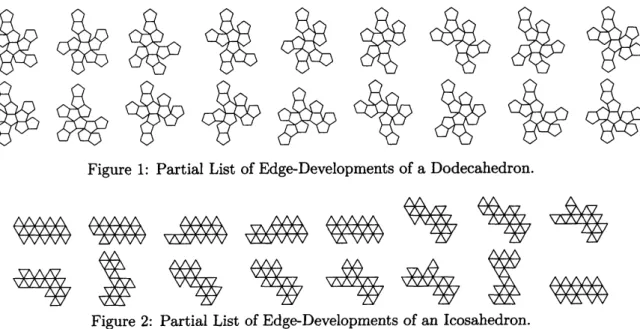
Figure 1: Partial
List
of Edge-Developmentsof a Dodecahedron.
$\ovalbox{\tt\small REJECT}$ $\ovalbox{\tt\small REJECT}$
$\ovalbox{\tt\small REJECT}$ $\ovalbox{\tt\small REJECT}$ $\ovalbox{\tt\small REJECT}$
$\ovalbox{\tt\small REJECT}$
$\ovalbox{\tt\small REJECT}$ $\ovalbox{\tt\small REJECT}$ $\ovalbox{\tt\small REJECT}$ $\ovalbox{\tt\small REJECT}$
$\ovalbox{\tt\small REJECT}$
Figure 2: Partial List of Edge-Developments of