
一次元結晶の電子スペクトル
12
0
0
全文
(2) Vol. 16, No. 1 Journal of Hokkaido Gakugei University (Section II A) Aug, 1965. Electronic Energy Spectrum of Linear CrystaF. Kimiyoshi, HATAKEYAMA The Department of Physics, Iwamizawa Branch, Hokkaido Gakugei University, Japan.. ^ 111 &^ : —^TC^^OM^-^^^ }-^. Abstract Various approximate methods for calculating the energy spectra of disordered crystals have been considered. About the accuracy of them, however, only rough estimation have been made. In the present paper, an exact calculation is carried out by Kernel's method of transfer matrix for the simplest model (a linear array of square-well potentials), as a clue to investigate the accuracy of these approximate methods.. Introduction Since the pioneering work of Saxon and Hutner0 appeared, many investigations on electronic energy spectrum, of disordered crystal have been made. Lax and Phillips25 treated the energy spectrum of the electron in a randomly distributed (5-potentials by the effective mass approximation and obtained the distribution of one-electron energy levels in an impurity band. Frisch and Lloyd35 treated the same model. They regarded the argument x of wave function <p (x) as time t and treated <p (t) as if it were a stochastic process. Klauder0 treated the problem by a perturbatlonal method, using the second quantization.. The use of ^-function for studying imperfect lattice has been criticized by Alien55 on the ground that thereby the important qualitative characters of crystals will not be reproduced. In the present paper, an exact calculation is carried out by Kerner's65 method of transfer matrix for the simplest model, as a clue to investigate the accuracy of these approximate methods. In §1, an outline of Kerner's method is given, In §2 and §3, the eigenvalue equation is derived explicitly, for the cases of one and two impuritles in a unit crystal cell, * Main content of this paper was orally published at the 1961 annual meeting of Physical Society of Japan, held at Kanazawa city, Ishikawa. 1) D. S. Saxon and R, A. Hutner: Philips Research Repts. 4 (1949), 81,. 2) M. Lax and J. C. Phillips: Phys. Rev. 110 (1958), 41. 3) H. L. Frisch and S. P. Lloyd: ibid. 120 (1960), 1175. 4) J. R. Klauder : Ann of Phys. 14 (1961), 43. 5) G. Alien : Phys. Rev. 91 (1953), 531. 6) E. H. Kerner : Phys. Rev. 95 (1954), 687 ; Proc. Phys. Soc. 69 (1956), 234.. (25).
(3) Kimiyoshi Hatakeyama respectively. In § 4, the shape of the impurity band of a crystal containing randomly distributed impurities is calculated numerically. 1. An Outline of Kerner's IMethod As an example, the linear array of square-well potentials containing the impuritles with period L. In this case wave function is ip (x)=elkxu (x), where u(x+L) =u (x). Numbering. ^ 3. I. 4. 2. 2N Fig. I.. each constant-potential region as Fig. 1, the wave function in the j-th region is written :. u (x)= aj exp(r/j x) +bj expC^j x) where «j=='/(£o—k), ^j f 2m ^ , ^^ ^'. £i==i ^-(E+Vo). -•/(Su+k), £11= ^ j^'j ' for odd regions, «j=-/(£i-k), ft=-/'(ei+k), for even regions and c<o=^N=i!'(£2—k), i3o=^N=::—'/(sg+k),. 1. £^f^-(E+U)T2-, for j=2N, 0. Introducing the vector Aj=^Jj, we obtain by the conditions of continuity of the wave function ^ and its derivative </> at the boundary of each region, the relation, Aj=TjAj-,.. It follows then AsN=(77_Tj)Ao=TAo. J=2N " ". On the other hand, by the periodicity of u (x) we have. A^FAo=(^OL,°jAo. e-PoL/""From these two equations, it is clear that following formulae must hold,. |T-F|=0 or. Tr(TF')=l+e21kL where F' is the antitranspose of F. This gives the eigenvalue equation.. 2. An Explicit Form of Eigenvalue Equation Let N be the total number of atoms in the unit cell. Let the origin of coordinate be at the boundary between the zero-th and the first regions and let —Uo and —Vo be the depth of the impurity and that of the regular atom, respectively. For simplicity, let the width of both potentials be b, and that of zero-potential region be a.. (25).
(4) Electronic Energy Spectrum of Linear Crystal. Carrying out the calculation of Tj excepting the 2N-th and 0-th regions, we obtain for even regions,. 1 /u?;eu2x^ ueu^. J=~^Leu1^ u*eu^, C2-l) where Ui='/(£o+£i), Ug^^So—Si) and xj=(j—l)c+a. Similarly for odd regions 1 /u,*eu^ u,+eu^. TJ=-^ol^eu^ u,;eu3XJ, (2'2) where xj=jc.. TgN and Ti reduce to the following form 1 ^u^eu2x2N u^eulx2N ^ —. T2N=-^(^U2N u;*eu^x2NJ ' . (2-3) and. 1 1^ U2*\. T1=-^C* so \u1^ u'^/ ,. ^J. ^4). where u[=i^£o+£z), u'^i^So—s^) and XgN= (N—l)c+a. From these equations we can calculate the matrix T as follows : . T=T2N(T2N-1 T2N-s)(T2N-3T2N-4) ............ (T3 T^)T^ =TgN FN-I FN-2 ........... . Fg FI TI.. By Eqs. (2.1) and (2.2), Fn is given by p ^ _.. 1 ^f(b) g(-b)e-^ 4£o£i \g(b)e2hl8»c f(-b) /,. where f (b)=u,*2eu!b+|u2|2euTb g (b)=u^U2euTb+<u,*eutb Now let us introduce the similar transformation /e-'8oc 0. Fn=SFn-iS-1, S-( .1, c=a+b. ^0 e'8oc/'. By tills transformation, T becomes T=TsNSN-lHN-iTi,. where H==S-lFi=-. ,f(b)e^oc g(-b)e-l8oc^ 4£oei \g(b}eis»c f(-b)e-iso^. Putting further p^ f(b)ei8«° 4£o£i. ^_ g(b)e?e«° 4£o£i ,. we obtain. H=fF G:). \G F*/.. The eigenvalues ^ of H are /i=B±(B-l)^, where. (3^).
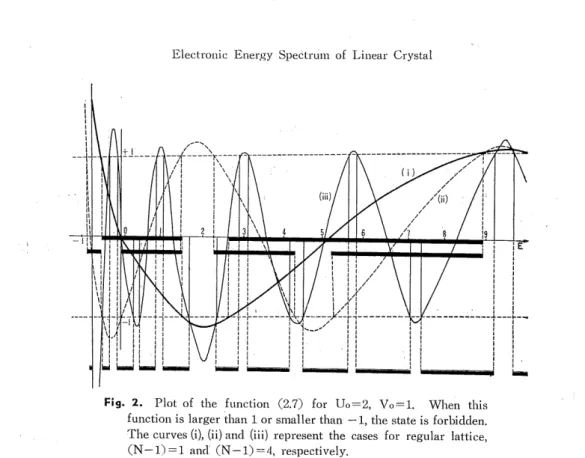
(5) Kimiyoshi Hatakeyama. B=^(F+F:i;) ==cos£ib cos So a—-^_ _ - sin £i b sin So a, for E>0. .2£0£1. ~~'l~. ""'""'. "'. "'. "'. \. (2.6). = cos £1 b cash £o a+ -^7--;— sin £1 b sinh £o a, for —Vo<E < 0.. The quantity B gives, of course, the energy eigenvalue for the regular latticecomp osed of regular atoms only. Putting cos ^=-^-(F+F:i;), become e p and e- e. From the eigenvectors of H, we obtain. the diagonalization matrices W and W-l of H, Ift Q „, (G e/p~-F. WHW-l=f ..1=L, W=. e-;PF-~' " \G e-'^-F/, \0 e-. /e-'P-F F-e''^. W-1=^F f 11-C11 |W|=-2/G sin ^ IWH.-G G. Then, we get finally Tr(TF') == Ti-CTi F'T.N S'N-1 W-1 LN-1 W) =Tr C.. The elements of matrix C are given in Appendix 1. The explicit form of the eigenvalue equation !+e2<kL=TrC becomes. cos kL=cos kN(a4-b) =^-7T{sin N ^ cos ^-sin(N-1)^3 cos ^,n}, (2.7) where . I C-". cos ^1= cos £3 b cos £o a— ,-> . . sin £3 b sin £oa, for E>0, ''0 ^2. £i. ^cosEgb cash £o a+-^—^— sin £3 b sinh EQ a, —Uo<E<0, :0£2. £i+£i. COS ^m= COS £1 b COS £3 b+ o. .. sln £i b sin £3 b, 1 ^2. and ^ is given by the right-hand side of Eq. (2.6). The eigenvalue equation (2.7) can be solved graphically. Since the left-hand side of Eq. (2.7) is cosine function, its value is confined between 1 and —1. The right-hand side is a sinusoidally varying function. The result, for the case J ^- a=l, a==b, Uo=2 and Vo=l, is shown in Fig. 2.. If there is only one regular atom in a unit cell, each band of the regular lattice splits in two bands. If there are four atoms in a unit cell, each band splits in five bands. In this cace the width of band gaps becomes much narrower than those in the case (N—!)==!, except that the leftmost gap (for E<0) becomes broader and the width of the lowest energy band becomes remarkably narrower. From this result we may expect that in general each band of the regular lattice splits into N bands and the energy gaps thus appeared becomes rapidly narrower and the band structure reduces to that of the original regular l^ttice, when the' number of the regular atoms become very large. The leftmost energy gap becomes broader,. (37).
(6) Electronic Energy Spectrum of Linear Crystal. Fig. 2. Plot of the function (2.7) for Uo=2, Vo=l. When this function is larger than 1 or smaller than —1, the state is forbidden.. The curves (i), (ii) and (iii) represent the cases for regular lattice, (N-l)=l and' (N-l)=4, respectively.. however, and the width of the lowest band becomes accordingly rapidly narrower. In the limit of N—>-oo, this gives the impurity energy level. Since the impurity level lies outside the bands of the regular lattice, the sine function in Eq. (2.7) must be replaced by hyperbolic one. Further we can put cosKL=l or —1. Then Eq. (2.7) reduces to the following equation :. 1. (2.8). 1= ^ ^{sinhN^ cos^~sinh(N-l)|3 cos ^}. Transforming this equation, we get e-CN-op=.. 1. 2 sinh ^. {(eP-e-2<N-l^e-^)cos ^- (l-e-^N-OP)cos ^}.. In the limit (N—l)—>-oo, this equation becomes. 1. 2sinh|3. {e^ cos ^i— cos ^m}=0,. i. e.. eP. cos^-cos^m=0.. (2.9). This is the equation by which the impurity energy level is determined.. § 3. Explicit Form of Eigenvalue Equation for the Two-Impurities Case Using the same method as the preceeding section, we can treat the case where there are two impurity atoms in a unit cell. Let the p-th and the N-th atoms be the impurities, as shown in Fig. 3. Matrices Tj for even regions except for j=2p, 2N are given by Eq. (2.1) and Tj for odd regions except for j=2p+l, 1 by Eq. (2.2). TgN and T^ are given by Eqs. (2.3), (2.4), respectively. Tgp is obtained from TgN by replacing Xgn in TgN by X2p=(p—l)c+a. Further, Tsp+1 is. (52).
(7) Kimiyoshi Hatakeyama. E. a. b. I. a. a. b. a. -^ x. 3 2. 4. 2F +. 2P 2P. 2N. Fig. 3. /^ Ua'XaP+l m Ui Xzp+i. T2p+l=. 2 i £g \^ gUiXzp+i ^ ^Xap+i. ).. (3.1). where u{=z'(£o+S2), u^-=i^£o—s^) and xgp+i=pc. Accordingly, we have 2NC.1-2N-1 T2N-2) ...... (T2P+3 T2p-|-2)T2p+i TgpCTgp-i Tgp-g) ...... (TsT2)Ti TaNFN-i ...... Fp-nTgp+iTapFp-i .. ... . FiT^.. Matrices relating to impurties are TgN, Tgp+l, Tgp and Ti'Fn is given by Eq, (2.5), Making the similar transformation as in the last section, we obtain T= TgN SN-P-I H'N--P-I Tap+i Tg.p S?-1 ?-1 T. (3.2). The matrix H/. H^S-.F^fF, G::) \G' G'^l. is obtained by merely replacing G in H by G'=Ge28«P°. By the same replacement, we get the diagonalization matrices W and W 1 of H/. The eigenvalue of H/, of course, remains the same as those of H. Therefore, the eigenvalue equation reduces to l+e2(kL=Tr(TF') = Tr(Ti F/ T^N SN-P-I W/-1 LN-P-1 W/ T^, T^p S?-1 W-1 L?-1 W). (3.3). =SA.jBji=TrC i.T'l. where A=T^'T^SN-P-IW-II^-P-IW, B=T2p+iT2pSP-lW-lLP-lW. Matrix elements Aij Bji. for j=l, 2 are given explicitly in Appendix 2. With the use of these quantities, the eigenvalue equation becomes. cos KL= -^ Q {sin(N-p)^ sin p |3(2 cos2 ^i-l) -Csin(N-p)^ sin(p-l)^-sin(N-p-l)l3 sin p ^(2 cos ^ cos^-cos ^) -sin(N-p-1)^3 sin(p-lM2 cos2 ^n-1}, (3.4) where cos ^i and cos^m are given by Eq. (2.7) and by the left-hand side of Eq. (2.6), respectively. We shall concern hereafter only with the impurity energy level, where E<0, cos ^>1. Replacing the trigonometric functions in Eq. (3.4) by the corresponding hyperbolic functions, it becomes. 1= _Lo{smh(N-p)j3smhp^(2cos2^-l) — (sinh(N-p)^ sinh(p-l)^ sinh(N-p-l)^ sm p^(2 cos ^m cos ^—cosh ^ X sinh(N-p-1)^3 sinh(p-1)^3(2 cos2 ^m-1) }. (3.5). (53).
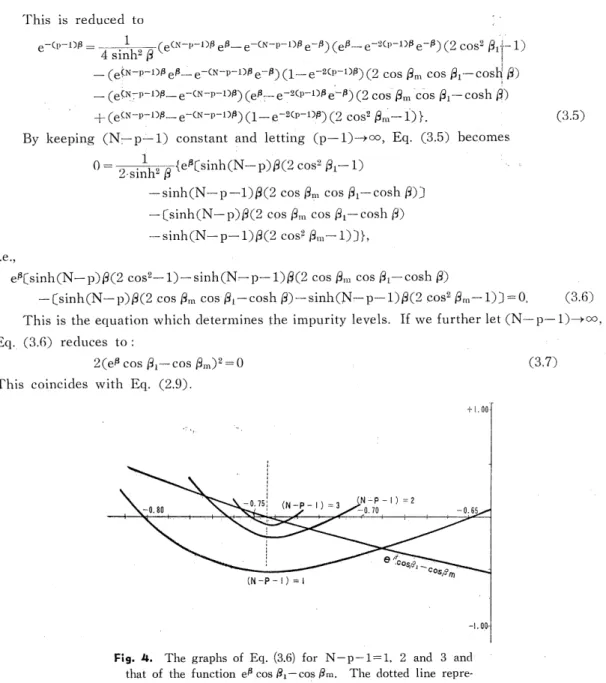
(8) Electronic Energy Spectrum of Linear Crystal. This. is. reduced. to. '. e-cp-np = _^_A^^(e<N-^-OPeP-e-^T-P-OPe-^(e^-e-2^-nPe-P)(2 cos2 ^}-1). I. _(e<:N-p-OPeP-e-^-P-DPe-P)(l-e-2tP-i^)(2 cos ^ cos ^-cosU ^3) _ (e^N-p-op- e-CN-p-oP) (eP- e-2CP-nP e-^) (2 cos ^m cos ^- cash ^). (3.5). 4-(e(N-p-op_e-^-p-oP)(l-e-2<P-l^i)(2 cos2 ^m-1)}.. By keeping (N—p—1) constant and letting (p—l)—)-oo, Eq. (3,5) becomes. 0 =-3^^-{e^smh(N-p)^(2 cos2 i3,-l) -sinh(N-p-1)^3(2 cos ^ cos ^-cosh ^ -Csmh(N-pM2 cos ^,n cos ^i-cosh ^) -sinh(N-p-l)^(2 cos2 ^~1^}, i.e.,. e^sinh(N-p)|9(2 cos2-l)-sinh(N-p-1)^(2 cos ^ cos ^-cosh ^) -Csinh(N-pM2cos^ cosj9i-cosh^)--smh(N-p-l)/3(2 cos2 ^m-l)^==0. (3.6) This is the equation which determines |;he impurity levels. If we further let (N—p—l)—>-oo, Eq. (3.6) reduces to : 2(ePcos^-cos^n)2=0. (3.7). This coincides with Eq. (2.9).. (N-P-1) =1. -1.00-1. Fig. ^. The graphs of Eq. (3.6) for N-p-l=l, 2 and 3 and that of the function ep cos/?i—cos (3m. The dotted line represents the position of the impurity level for one-impurity case.. Fig. 4 show the graphs corresponding to Eq. (2.9) and Eq. (3.6), for (N—p—1) =1, 2 and 3. It is seen that in the present case two impurity levels appear. We may interpret that the impurity level of one-impurity case splits into two levels, which become more separated as the interaction between impuritles becomes large. The figure also shows that the shift of the level with higher energy is greater than that with lower energy. 4. Random Lattice Let us next calculate the shape of the impurity band of the crystal containing the impurities randomly distributed, by calculating the impurity levels for the various distances. (34).
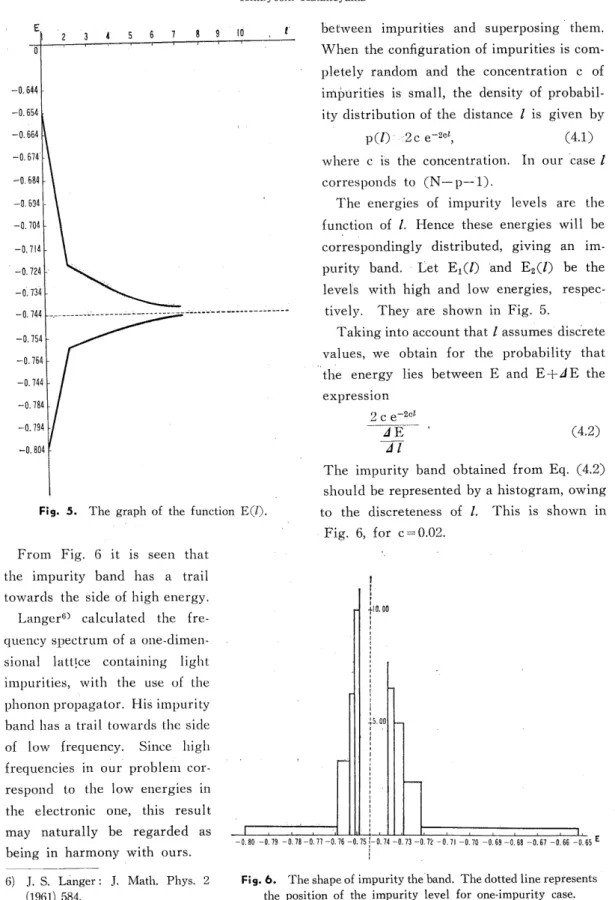
(9) Kimiyoshi Hatakeyama between impurities and superposing them. When the configuration of impurities is completely random and the concentration c of irtipurities is small, the density of probabil-. ity distribution of the distance / is given by p(0 2ce-2cl, (4.1) where c is the concentration. In our case / corresponds to (N—p—1). The energies of impurity levels are the function of /, Hence these energies will be correspondingly distributed, giving an im-. purity band. Let Ei(/) and EgC/) be the levels with high and low energies, respectively. They are shown in Fig. 5. Taking into account that / assumes discrete values, we obtain for the probability that the energy lies between E and E+^E the expression 2 c e-2c?'. ^E ~JT. (4.2). The impurity band obtained from Eq. (4.2) should be represented by a histogram, owing Fig. 5. The graph of the function E(0,. to the discreteness of /. This is shown in Fig. 6, for c= 0.02.. From Fig. 6 it is seen that. the impurity band has a trail. !. towards the side of high energy.. AI 0,00. Langer6-* calculated the frequency spectrum of a one-dimen-. sional latUce containing light impurities, with the use of the phonon propagator. His impurifcy band has a trail towards the side of low frequency. Since high frequencies in our problem correspond to the low energies in the electronic one, this result may naturally be regarded as being in harmony with ours. 6) J. S. Langer: J. Math. Phys. 2. (1961) 584.. -0.80 -0.79 -0.78-0,77-0.76-0.75 -0.74-0.73-0.7i- -0.71 -0,70 -0.69-0.68 -0.67 -0.66 -0.65. Fig. 6. The shape of impurity the band. The dotted line represents the position of the impurity level for one-impurity case.. (35).
(10) Electronic Energy Spectrum of Linear Crystal. Matsubara and Toyozawa75 calculated the impurity band of a disordered three-dimensional lattice by the method of Green's function. Their band has a trail towards the side of lower energy. Takeno85 also obtained the same conclusion by another method. The discrepancy between their results and ours is probably due to the difference of dimension of the model.. Concluding Remarks The author has recently become aware of the papers by F, Kuliasko95 in which the method very similar to ours is used. The problems treated in these papers are, however, fairly different from ours.. Acknowledgements The author wishes to express his sincere thanks to Prof. J. Hori, Dr. T. Asahi and other members of the Group of Solid State Theory of Hokkaido University for their invaluable discussions. He is especially indebted to Prof. Hori for reading the manuscript and giving several advices.. Appendix I Let us here give the diagonal elements of matrix in § 2.. Cn (Ti)u (F')u (T,N)n (SN-i)u (W-i)u (LN-I),, (W)n G 1^1 u;*2 e<<s2b+8oa5 cicN-i5P(e-(E-F)e(kL. 4soe2|W| ul. (Ti)u (F')n (T^n (SN-I)^ (W-i)^ (LN-I)^ (W)^ l'*2piC82b+8(,a5 p-iCN-03 ^F_p?P^p(kL. 4soe2|W| ui-"e-2"-o-e — —^-e^;e". (Ti)n (F')n (T^)i2 (SN-1)22 (W-1)^ (LN-I)^ (W)i, ^2. ^. .. ,;* n'p/O'ab-eoa.') p((N-OP. p(kL = 4eoS3|W| uru2e""2u uo"e~v" ^'e". ^. 0\)n (F% (T^ia (SN-I),, (W-Q22 (LN-O,, (W)^ -f^rT u{* U2e^b-e»a5 e-f<N-i5P e(kL. 4Soe2|W| ul u2'. 0\)^ (F% (T^si (SN-OH (W-i)H (LN-I),, (W)u -G^yr K|2 e-^e2b-8oa5 e<<N-nP(e-<P-F)e(kL. 4so£2|W| lu2'. (Tl)i2 (F')22 (T2N)21 (SN-I)^ (W-l),2 (LN-Q^ (W\t G ,„„ |u;,|2 e-((82b-eoa5 e-((N-l^(F-e(P)etkL 4£o£2|W| lu21 " - - - ^. (TQu, (F')^ (T2N)22 (SN-l)22,(W-021 (LN-QI, (W)^ 1.2. u;* u^* e-(ce2b+!>oa:> e<CN-153 e<kL. 4£o£2|W| ul u2. 7) T. Matsubara and Y. Toyozawa; Prog. Theor. Phys. 26 (1961) 739.. 8) S. Takeno: ibid. 28 (1962), 631. 9) F. Kuliassko : Physica 30 (1964), 2180.. (5ff). ,.
(11) Kimiyoshi Hatakeyama. (T0i2 (F% (T2N)22 (SK-l),3 (W-l)22 (L^-Q^S (W)^! '^•2. *. rr_ u;~'l; u.^, e-''<:s2b+8n»5 e-icN-ol3 elkL. 4£o£2lW| c,,. (Ti),i (?')„ (T2x)n (SN-l)n (W-l)u (LN-i)n (W)^. |G|2. ul* u,^* elcs2b+e»!^ e'CN-op e'kL. --4io-e,|W| ul. (Ti).^ (F% (^)n (SN-l)n (W-')^ (^-1)32 (W)^. _|Gp. u;* ug* e;<s2b-^,a) e-^N-i^ g.kL. 4£o£2|W| ul "2. (TOai (F')n (T^-)i., (S^-1)^ CW-1)2, (^-Qn (W)i2. G Zso^vT. |^]2 e^Bab-e^o e''CN-i)P (e^-F)eikL. -N-l)2 (W)22 (TO^I (F')n (T2N)i2 (SN-1)^ (W-1)^ (LN-Q22. G. 4 So £3 |W|. jugl2 e(ce2b-£»10 e-(CN-op(e-^-F)e!'kL. (TO^ (F')., (T,,N)2i (SN-l)u (W-Q^ (LN-I),, (W)^ li>. ,yr u;* u2e-;CE2b-e"a) ef^-°P e(kL. ^,£^W\. (TO,, (F')^ (T.^ (SN-Qu (W-i)i., (LN-I)^ (W).,,. |G|2. I'* ^^p-'^yb-s.^ p-iCK-OP pi'kL. 4£o£2|W| uru2e '"iu "^e "u' ^^. (Ti)22 (F').,2 (T2N)22 (SK-1)22 (W-1)^ (LN-I) ^ (W) ^. G. 4£o£2|W]. y^2 e-ics,b+s,a) (g(p_F)e<kL. (Ti)^ (F')^ (T2N)32 (SN-1)22 (W-1)^ (^-l\2 (W)^^. G. p-^-oprp-ip_Tn»AL a-) e-^--oP(^-ip_F^. p-i<is.^s,a-) u /•-i;2 ;-'•-' e-^c2"^°«. ^£u£2iWi ul. Appendix 2 The explicit forms of Aij Bjj. for j=l, 2 are given. A,, B,,=. G'. G. ~Is^Wr\ "Te^TWI. e-^opc [^ts,(pu+io Fy(et<N-P)P—e-''(N-p^. + (G' Gv e-?E"cpc+a)— F* FT ele»cpc+i15) (e^K-P-°P— e-lcN-P-op)^] Xe''kLCel8»!LFv(e''i>P-e-^) + (GGv e-i6»"-F* Fv e''E"") (e!<tJ-OP- e-(CP-°P)^. A^ B^= ,,G ,^,i T.r-Gi^ e''E»P"Ce-''8"(PC+'OGv(e'-<.N-^-e-t<N-. 4so£2|W'| 4£uS3|W|. + (G'* Fv e'8»CPC+io— ¥ Fv e-''s'icPC+I°) (e''^'-P-nP— e-?(N-P-1)^] X elkL Cei'e»aG^(eli-'P-e-''PP). + (GF^ e-i8"a-F*F^ e<s»a) (e^P-^P-e-'Cp-DP)^ A^ B,,=., , G^,,| , , G^^e-/E.P°Ce;e"^c+a)G.t(ef<N-^-e-^N-^). 4£u£2|W1 4£u£2|W|. + (G' F,* e-(8"cpc+a)— F* G^ eis«CPC+a:>) (eicN-P-°i8— e-icN-P-l)p)^|. (37).
(12) Electronic Energy Spectrum of Linear Crystal X e(kL Ce-teo^ Gv (e(PP— e-^p) + (G* Fv e(8oa- F Gv e-(s"il) (e'<r-i^- e-i<P-1^) ^ A22 B22= ,,,G|WI -.. ?IA^I ei8oPCCe-i8»^c+^F^(e?<N-p^-e-^N-p^). 4so£2|W/| 4so£2|W|. + (G'* G^ eie"CP+il5~ F F^ e-lsucPC+il5) (e^N-p-"P— e-fCN-p-i5P) X e(kL Ce-i8«aF^ (e(PP— e-(PP) + (G*G^ ei8oa-FF^ e-(8»a):(et^-l^-e-^P-1^)^ where Fv=u{*2e^+|u'|2e-l8ab, Gv=u{*u^e(e2b+u{*u^e-^b.. (35).
(13)
図
関連したドキュメント
The critical electron dose rate for preventing ion-induced amorphization was measured under irradiation with various combinations of ion species and energies of
[r]
Large-size bulk crystals can be obtained easily because melt growth is possible under the atmospheric pressure. From these material features, we expect high performance
〈受理 ノレス幅で対韓如実験が CCVTS~却こより測定できることを この方法を用いて、存鰻ノ勺レス幅を
A mechanism of Goss texture development during the secondary recrystallization in grain oriented electrical steel is proposed based on the physical properties of the
InGaAs/InAlAs 2 次元電子ガス 2 層系ヘテロ構造の結晶成長と輸送特性評価 胡 恺(山田研究室)
69 琉球大学工学部紀要第45号,1993年 2次元格子形フィルタの-設計法と
【緒言】
