• 検索結果がありません。

Antipsychotic Drug Zotepine in Human Serum

N/A
N/A
Protected

Academic year: 2021

シェア "Antipsychotic Drug Zotepine in Human Serum"

Copied!
5
0
0

読み込み中.... (全文を見る)

全文

(1)

To whom correspondence should be addressed.

E-mail: [email protected]

Antipsychotic Drug Zotepine in Human Serum

Kazuyoshi N

OZAKI

, Issey O

SAKA

, Hideya K

AWASAKI

, and Ryuichi A

RAKAWA

Department of Applied Chemistry, Faculty of Chemistry, Materials and Bioengineering, Kansai University, 3-3-35 Yamate, Suita, Osaka 564–8680, Japan

A simple, rapid, and sensitive on-line liquid chromatographic electrochemistry/electrospray/tandem mass spectrometry (LC-EC/ESI-MS/MS) method for the determination of zotepine in human serum was developed using a new generated-electrochemically fragment ion, and was validated. A recent novel technique of LC-EC/ESI-MS/MS that combines LC-MS/MS and the on-line EC reaction is potentially applicable to developing a quantification method for drugs in biological samples. Newly formed products generated by the on-line EC cell are expected to provide appropriate precursor and product ions for the MS/MS determination method. This technique was successfully applied to a drug assay in a biological matrix. After adding imipramine (IS) to a 30-μL aliquot of human serum, the resulting sample was simply deproteinated with acetonitrile for a measurement. The analytical run time was 5 min. The calibration curve was linear in the concentration range of 10 – 2000 ng/mL. The intra-assay precision and accuracy were in the range of 1.8 – 8.9 and 98.4 – 113%, respectively.

(Received May 30, 2009; Accepted August 11, 2009; Published October 10, 2009)

Introduction

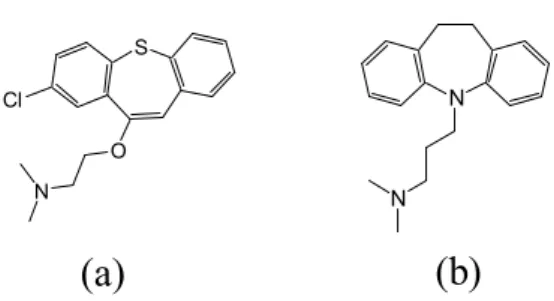
Zotepine, a dibenzothiepine-derivative compound (Fig. 1), was developed as a neuroleptic agent, and has been clinically used with relatively few extra-pyramidal side effects.

1,2

Despite the clinical usefulness of zotepine, very few studies have focused on a method for quantifying zotepine, except for an early study by Noda et al.

3

The only methods for zotepine determination reported to date involve a complicated and time-consuming extraction procedure, e.g. a gas-liquid chromatographic (GC) method consisting of three liquid–liquid extractions using 1 mL biological samples and the GC-MS method, requiring solid-phase extraction and an evaporation process.

4,5

Our previous study revealed that new fragment ions that allow a sensitive quantification of zotepine are formed by combining on-line EC/ESI-MS and collision-induced dissociation (CID).

6

The electrochemical product ion of [M–H]

+

(m/z 330) was detected, and yielded new fragment ions, such as m/z 315 and 286 ions, in the CID spectrum, while there was only one major fragment ion at m/z 72 in the CID spectrum of zotepine with ordinary ESI-MS/MS, derived from the cleaved side-chain moiety. It has been particularly difficult to use this fragment (m/z 72) with an ion-trap mass spectrometer, owing to a restriction on the lower limit of detectable fragment ions.

In recent years, the on-line hyphenation of electrochemistry with mass spectrometry has been developed as a new tool for the determination or identification of problematic compounds.

7–15

It has also been reported that an electrochemical reaction

coupled on-line to LC-MS is a promising approach in drug metabolism and protein research.

16–23

However, there are few reports on applications to methods for determining organic compounds in biological samples using this technique.

24

The combination of LC-MS/MS and the on-line EC reaction is potentially more selective as a drug quantification method, in biological samples, than ordinary LC-MS/MS.

Herein, we report a simple, rapid and sensitive method for the determination of a marketed drug, zotepine, in human serum by applying the on-line EC/ESI-MS/MS system. These results provide an example of the usefulness of this technique.

Experimental

Materials and sample solutions

Zotepine was synthesized at Astellas Pharma Inc. Imipramine hydrochloride of biochemical grade, used as an internal standard (IS, Fig. 1) was purchased from Wako Pure Chemical Industries Ltd. (Osaka, Japan). Acetonitrile, ammonium acetate and other reagents, all special grade, were also obtained from Wako Pure Chemical Industries Ltd. Human serum was supplied by Chemicon International (Millipore; Milford, MA). Water was deionized and purified on a Millipore water purification system.

A stock solution of zotepine at a concentration of 0.5 mg/mL was prepared by dissolving the drug in acetonitrile–water (50:50, v/v). A stock solution of zotepine was serially diluted with acetonitrile to give concentrations of 2000, 1000, 500, 200, 100, 50, 20 and 10 ng/mL to construct working standard solutions.

The stock IS solution was prepared by dissolving an appropriate

amount of IS in methanol to give a concentration of 0.5 mg/mL.

(2)

The stock solution of the IS was diluted with methanol to reach a final concentration of 20 μg/mL.

Sample preparation

Human serum (30 μL) was placed in a 1.5-mL Eppendorf tube. After the addition of both 30 μL of acetonitrile and a 20 μg/mL IS solution, the tube was briefly vortexed. In the case of the calibration sample, a working standard solution of zotepine was added instead of acetonitrile. Then, the tube was placed on ice for about 10 min. After vortexing again, the tube was centrifuged at 14000 rpm for 2 min at 4° C (Eppendorf 5417R centrifuge). Twenty microliters of supernatant were directly injected into the analytical column.

Chromatographic conditions

The liquid chromatography system consisted of a Model 1100 series liquid chromatograph equipped with a binary pump, a vacuum degasser, a thermostatted column compartment and an autosampler, all from Agilent Technologies (Palo Alto, CA).

The column utilized for chromatographic separation was a Tosoh ODS-100V analytical column (50 mm × 2 mm i.d., Tokyo, Japan) with a particle size of 5 μm. The analytical column was protected by a 0.2-μm filter. The flow rate was set at 0.3 mL/min and the column temperature at 40° C. The mobile phase consisted of A (10 mM ammonium formate containing 10% acetonitrile) and B (10 mM ammonium formate containing 90% acetonitrile) in the gradient mode. At the start of the gradient, mobile phase B was set to 30%, and was then linearly increased to 100% over a period of 3 min. Finally, mobile phase B was linearly brought back to 30% in 0.1 min. The system was allowed to equilibrate for about 2 min. The total run time was 5 min for each injection and the volume injected was 20 μL. A divert valve was used to discard the LC effluent during the first 1.5 min and the last 4 min of each chromatographic run.

Electrochemical reaction conditions

An ESA Coulochem 5010 analytical cell (ESA Biosciences Inc., Chelmsford, MA) was used for the electrochemical (EC) generation of zotepine and IS. The EC cell was controlled by an ESA Coulochem II potentiostat with the potential maintained at 850 mV. The ESA working electrode was porous graphite, and the cell potentials were measured versus a palladium-hydrogen reference electrode. The EC cell was protected by a graphite filter and placed between the column and electrospray ionization (ESI) interface of the existing LC-MS system (Fig. 2).

MS conditions

The mass spectrometer was a TSQ triple quadrupole equipped with an ESI interface (Thermo Fisher Scientific Inc., San Jose, CA). Detection was performed by monitoring the positive ions with the selected reaction monitoring (SRM). The heated

capillary was set at 250° C, and the spray voltage was kept at 4.5 kV. The sheath gas flow (N

2

) and auxiliary gas flow (N

2

) were set to 76 and 20 arbitrary pressure units, respectively. The capillary and lens voltages were optimized for zotepine and electrochemically oxidized zotepine. CID was carried out in the collision cell on the precursor ion of oxidized zotepine or oxidized IS using argon as a collision gas at a pressure of 2.5 mTorr. The CID energy was set at 25 eV for zotepine (m/z 330.2 → 315.2; width, 1.0; scan time, 0.5 s) and at 30 eV (m/z 277.1 → 233.0; width, 1.0; scan time, 0.5 s).

Validation of the analytical method

The analytical method was validated to determine the accuracy, precision, the lower limit of quantification, the calibration curve range and the absolute recovery, as described below.

An eight-point calibration curve was constructed by plotting the peak area ratio (y) of the analyte to IS versus the analyte concentration (x). The results for blank samples were not used as part of the calibration curve. The slope, the intercept and the coefficient of determination (r

2

) were calculated as regression parameters by weighted (1/y

2

) linear regression. For determining the intra-day and inter-day data variability, the precision and the accuracy were evaluated by determining the concentrations in five replicates at four different concentrations (10, 100, 200 and 2000 ng/mL) on 3 separate days. The absolute recovery of zotepine and IS with acetonitrile deproteination was calculated by comparing the peak-area response of extracted analytes from the sample using human serum with unextracted equal amounts of standards from the sample using water instead of human serum. The matrix effect on zotepine and IS was also evaluated at four different concentrations of zotepine (10, 100, 200 and 2000 ng/mL).

Results and Discussion

Optimization of EC-MS conditions

Although an electrolytic microflow cell was used in our previous study,

6

an ESA coulometric cell was selected for this study, because a microflow cell is vulnerable to the high pressure of an HPLC column. The optimal voltage of the ESA electrochemical cell was investigated by flow injection of the zotepine standard solution mixed with the HPLC mobile phase through a three-way union before reaching the EC cell. The mass spectrometer was operated in the positive mode. The potential at 850 mV was optimal for generating the oxidized peak at m/z 330. The base peak ion in the mass spectrum at 0 mV was m/z 332 of a protonated molecule. As the ion intensity at m/z 332 decreased, the electrolytic oxidation product ion at m/z 330 increased, like the previously reported ion intensity–potential curves. A palladium-hydrogen reference electrode was used for the ESA cell, which is different from the Ag/AgCl reference electrode of the previous microflow cell.

Fig. 1 Chemical structures of (a) zotepine and (b) imipramine (IS).

Fig. 2 Schematic of the LC-EC/ESI-MS/MS system.

(3)

When the ESA 5020 guard cell was first placed between the autosampler and the HPLC column, the peak at m/z 330 was eluted very rapidly. This suggested that the electrochemical oxidation product of zotepine at m/z 330 was very hydrophilic, like the iminium ion. Therefore, in the case of the EC reaction prior to column separation, i.e. the precolumn method, the character of the EC product affects the retention time and peak shape on column chromatography. Next, the EC guard cell was placed between the column and the ESI interface, i.e. the postcolumn method. When the pH of the HPLC mobile phase was close to neutral, there was little difference in the sensitivity of the peak at m/z 330 between the pre and postcolumn methods.

However, in the case of acidic conditions achieved with 0.1%

formic acid, the efficiency of the electrochemical oxidation of zotepine was low at the same potential, because the EC potential of the ESA coulometric cell is pH sensitive. The postcolumn method was used for the determination, since the peak obtained with the precolumn method was broader than that with the postcolumn method.

Finally, the collision energy for CID was optimized to obtain the maximal sensitivity under the MS/MS conditions. The product ion at m/z 315 with a collision energy of 25 eV was selected based on an investigation of the relationship between the collision energy and the ion intensity at m/z 315 or 286 (Fig. 3). The analytical EC cell was used instead of the guard cell because the peak obtained with the former was sharper than that with the latter, though the ion intensity was decreased to the two-thirds level. The carry-over problem was minimized by using the needle wash process of the autosampler with 40%

acetonitrile.

Sample preparation

It is preferable that the sample preparation be simple and easy.

Therefore, the on-column protein exclusion method was initially evaluated using a bovine serum albumin (BSA) coated reversed phase C18 column (Tosoh, Japan). Although this method was excellent regarding the simplicity of sample pretreatment, requiring only sample dilution and centrifugation, clogging inside the EC cell through its pre-filter developed, causing high pressure. The restoration of such an EC cell was impossible.

This is a potential disadvantage of filter types, like the coulometric EC cell for the quantification of drugs in biological samples. Thus, a deproteination process with an organic solvent was adapted before the general reversed phase C18 column

zotepine is used as the IS, the dimethyl amino moiety should be avoided as a deuterized site, since that part of the structure of zotepine undergoes electrochemical oxidization. The electrochemical product ion [M–3H]

+

(m/z 277) of imipramine was used as a precursor ion, and the product ion at m/z 232 with a collision energy of 30 eV was selected based on investigation of the relationship between the collision energy and the ion intensity, as in the case of zotepine. The ethyl moiety in the azepin ring part of imipramine may be easily oxidized into the dehydrogenation form besides the N-dimethyl amino moiety in the side chain. The product ion at m/z 232 is probably generated by cleavage of the N-dimethyl amino moiety, like that at m/z 303 from the electrochemical S-oxidation of zotepine.

6

Linearity of calibration curves and lower limits of quantification (LLOQ)

The steady-state plasma level after several weeks of treatment in 14 Asian schizophrenic patients was 39.6 ± 25.0 ng/mL (mean ± SD) for 150 mg/day.

25

Therefore, the LLOQ should be less than or equal to 10 ng/mL. The weighted (1/y

2

) least-squares linear regression for the ratio of the area of zotepine to that of IS versus the concentration was used for calibration. Good linearity was obtained in the range of 10 – 2000 ng/mL with a coefficient of determination (r

2

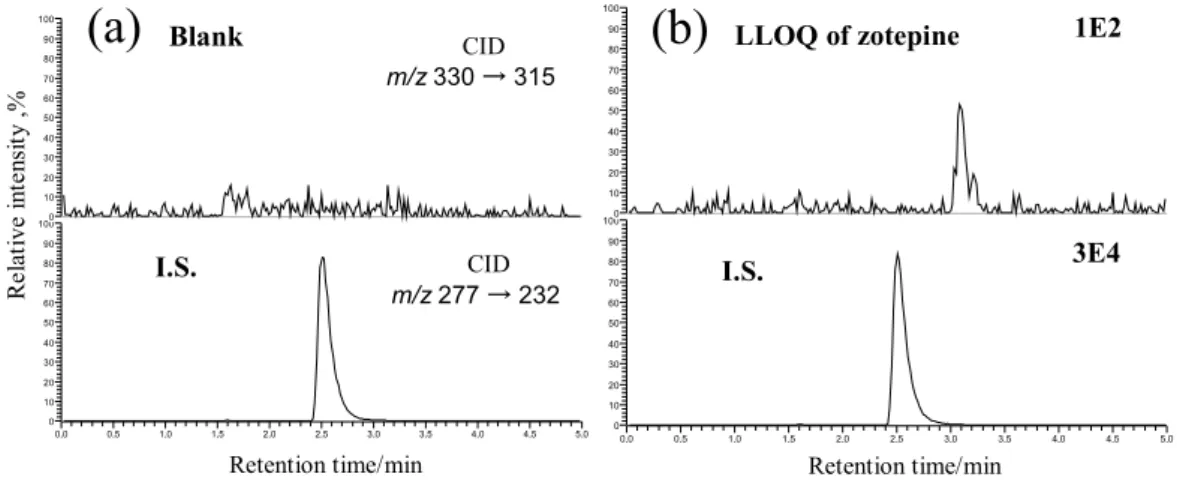
) of at least 0.998. An LLOQ of 10 ng/mL was determined as being the lowest concentration that could be measured with a precision of less than ± 20% and an accuracy of 80 – 120% from the nominal value. Typical mass chromatograms at LLOQ are shown in Fig. 4.

Precision and accuracy

The intra-assay precision and accuracy were assessed by analyzing five replicates of each of the four concentrations. The intra-assay precision (expressed as %RSD) ranged from 1.8 to 8.9%, while the intra-assay accuracy (expressed as percentages of the nominal values) ranged from 98.4 to 113%. The inter-assay precision and accuracy were determined by analyzing five replicates of each concentration in each of three assay runs (total; n = 15). The method reproducibility exhibited inter-assay precision ranging from 0.5 to 11.3%. The inter-assay accuracy ranged from 95.4 to 113% (Table 1).

Absolute recovery and matrix effect

The absolute recoveries of zotepine, determined at four concentrations (10, 100, 200 and 2000 ng/mL) of calibration samples for 3 days, were 76.5 ± 13.3, 76.8 ± 3.3, 72.5 ± 2.5 and 76.7 ± 2.7 (mean ± SD, n = 3), respectively. The absolute recoveries of IS determined in the same way were 70.4 ± 4.1, 70.1 ± 1.9, 67.1 ± 3.0 and 67.8 ± 1.1 (mean ± SD, n = 3), respectively. These values include matrix effects that take the form of either ion suppression or ion enhancement in addition to the extraction efficiency. The results indicated that relatively few endogenous compounds significantly influenced both the extraction efficiency and the ionization of zotepine and IS because the above values were good and independent of the concentrations of zotepine. The matrix effect would therefore have little impact on the quantification of zotepine in the calibration range used, if it appeared.

Fig. 3 CID spectra of the m/z 330 ion from zotepine at E = 850 mV,

obtained with collision energies of –25 eV.

(4)

Conclusions

A simple, rapid, and sensitive on-line LC-EC/ESI-MS/MS method for the determination of zotepine in human serum was developed using a new fragment ion generated electrochemically.

Compared with previously published methods, the necessary sample volume (30 μL) was much lower and the sample preparation steps were very simple. The analytical run time was also short (5 min).

The calibration curve was linear in the concentration range of 10 – 2000 ng/mL. The intra-assay precision and accuracy were good in the ranges of 1.8 – 8.9 and 98.4 – 113%, respectively.

This on-line LC-EC/ESI-MS/MS technique is a new tool that is potentially applicable to developing a quantification method for drugs in biological samples.

Acknowledgements

This work was partially supported by a Grant-in-Aid for Scientific Research (B: 19350045) and by a Grant-in-Aid for Young Scientists (B: 20710091) from the Japan Society for the

Promotion of Science and the Ministry of Education, Culture, Sports, Science, and Technology of Japan (MEXT). This research was partly supported by the Core-to-Core Program promoted by the Japan Society for the Promotion of Science (Project No.18004) and by the “Strategic Project to Support the Formation of Research Bases at Private Universities”: Matching Fund Subsidy from MEXT.

References

1. S. Uchida, F. Honda, M. Otsuka, Y. Satoh, J. Mori, T. Ono, and M. Hiyomi, Arzneim.-Forsch., 1979, 29, 1588.

2. M. A. Raggi, R. Mandrioli, C. Sabbioni, and V. Pucci, Curr. Med. Chem., 2004, 11, 279.

3. K. Noda, A. Suzuki, M. Okui, H. Noguchi, M. Nishiura, and N. Nishiura, Arzneim.-Forsch., 1979, 29, 1595.

4. S. Urlrich, F. P. Meyer, and B. Bogerts, J. Pharm. Biomed.

Anal., 1996, 14, 441.

5. O. Tanaka, T. Kondo, S. Kaneko, K. Mihara, K. Otani, and N. Tokinaga, Ther. Drug Monit., 1996, 18, 294.

6. K. Nozaki, H. Kitagawa, S. Kimura, A. Kagayama, and R.

Arakawa, J. Mass. Spectrom., 2006, 41, 606.

7. H. Deng and G. J. V. Berkel, Anal. Chem., 1999, 71, 4284.

8. J. M. E. Quirke, Y. L. Hsu, and G. J. Van Berkel, J. Nat.

Prod., 2000, 63, 230.

9. V. Kertesz and G. J. V. Berkel, Electroanalysis, 2001, 13, 1425.

10. G. Diehl and U. Karst, Anal. Bioanal. Chem., 2002, 373, 390.

11. U. Karst, Angew. Chem., Int. Ed., 2004, 43 ,2476.

12. G. J. V. Berkel, J. Am. Soc. Mass Spectrom., 2004, 15, 1691.

13. G. Diehl, F. A. H. Wasinski, B. Robertz, H. Luftmann, T.

C. Schmidt, J. T. Andersson, and U. Karst, Microchim.

Acta, 2004, 146, 137.

14. R. Arakawa, M. Yamaguchi, H. Hotta, T. Osakai, and T.

Kimoto, J. Am. Soc. Mass Spectrom., 2004, 15, 1228.

15. B. Seiwert and U. Karst, Anal. Bioanal. Chem., 2008, 390, 181.

16. U. Jurva, H. V. Wikstrom, and A. P. Bruins, Rapid.

Commun. Mass Spectrom., 2000, 14, 529.

17. U. Jurva, H. V. Wikstrom, L. Weidorf, and A. P. Bruins, Rapid. Commun. Mass Spectrom., 2003, 17, 800.

Table 1 Intra- and inter-day precision and accuracy for zotepine in human serum

Nominal concentration/

ng mL

–1

Observed concentration/

ng mL

–1

(mean

±

SD)

Precision,

a

%

Accuracy,

b

%

Intra-day (n = 5) 10 100 200 2000 Inter-day (n = 3 days)

10 100 200 2000

11.0

±

1.0 112.6

±

7.8 198.2

±

9.1 1968.1

±

34.9

9.75

±

1.10 112.90

±

0.55 196.60

±

1.46 1908.94

±

58.24

8.9 6.9 4.6 1.8 11.3 0.5 0.7 3.1

110 113 99.1 98.4 97.5 113

98.3 95.4 a. Expressed as %RSD: (SD/mean)

×

100%.

b. Calculated as (mean determined concentration/nominal concentration)

×

100%.

Fig. 4 Typical mass chromatograms of zotepine and IS at (a) blank and (b) LLOQ (10 ng/mL serum).

(5)

1633.

22. W. Lohmann and U. Karst, Anal. Bioanal. Chem., 2008,

128.

Fig.  2  Schematic of the LC-EC/ESI-MS/MS system.
Fig.  3  CID spectra of the m/z 330 ion from zotepine at E = 850 mV,  obtained with collision energies of –25 eV.
Table  1  Intra- and inter-day precision and accuracy for zotepine  in human serum Nominal  concentration/ ng mL –1 Observed  concentration/ng mL–1 (mean  ±  SD) Precision, a% Accuracy, b% Intra-day (n = 5)     10   100   200 2000 Inter-day (n = 3 days)

参照

関連したドキュメント

A selective, sensitive and rapid method for determining 8-OHdG in human urine was developed using hydrophilic interaction chromatography- tandem mass spectrometry (HILIC-MS/MS)

established ELISA, liquid chromatography tandem mass spectrometry (LC-MS/MS), and an automated high-throughput mass spectrometry (HT-MS/MS) system (RapidFire) to identify

Simultaneous Measurement of NAD Metabolome in Aged Mice Tissue Using Liquid Chromatography Tandem-Mass Spectrometry (LC/MS/MS). Overexpression of Nmnat3 efficiently increases

To determine the ratio of both constituents, we noticed that electrospray ionization mass spectrometry (ESI-MS) developed for the analysis of weakly charged species like proteins

The detection of Co was achieved by injecting a 1 μl aliquot of isoamyl alcohol containing Co-DDC complex directly into an electrospray ionization tandem mass

Recently, endocrine examination using liquid chromatography-tandem mass spectrometry (LC-MS!MS) has been developed to enable concurrent measurement of multicomponents of

A method in which liquid chromatography was coupled with tandem mass spectrometry (LC-MS/MS) was developed for determining the residues of malachite green,

量分析 k el Elimination rate constant 消失速度定数 LC-MS/MS Liquid chromatography