• 検索結果がありません。

Application of electrospray ionization tandem mass spectrometry for the rapid and sensitive determination of cobalt in urine spectrometry

N/A
N/A
Protected

Academic year: 2021

シェア "Application of electrospray ionization tandem mass spectrometry for the rapid and sensitive determination of cobalt in urine spectrometry"

Copied!
13
0
0

読み込み中.... (全文を見る)

全文

(1)

Application of electrospray ionization tandem mass spectrometry for the rapid and sensitive determination of cobalt in urine spectrometry

著者 Minakata Kayoko, Suzuki Masako, Suzuki Osamu journal or

publication title

Analytica Chimica Acta

volume 614

number 2

page range 161‑164

year 2008‑05‑05

URL http://hdl.handle.net/10271/52

doi: 10.1016/j.aca.2008.03.043

(2)

Application of electrospray ionization tandem mass spectrometry for the rapid and sensitive determination of cobalt in urine

Kayoko Minakata

a

* Masako Suzuki

b

and Osamu Suzuki

a

a

Department of Legal Medicine,

b

Research Equipment Center, Hamamatsu University School of Medicine, 1-20-1 Handayama, Hamamatsu 431-3192, Japan

*Corresponding author: (e-mail) [email protected] Abstract

Recently, cobalt (Co) is reported to be taken as a supplement by athletes for

improving anaerobic performance. For the diagnosis of abuse, the limit of detection (LOD) of Co in the analysis should be lower than the concentrations of Co in plasma and urine of normal persons. A simple, rapid and sensitive method has been

developed for the determination of Co in urine. Co was complexed with

diethyldithiocarbamate (DDC) and extracted with isoamyl alcohol in the presence of citric acid. The detection of Co was achieved by injecting a 1 μl aliquot of isoamyl alcohol containing Co-DDC complex directly into an electrospray ionization tandem mass spectrometric (ESI-MS-MS) instrument without chromatographic separation.

The quantification was performed using selected reaction monitoring at m/z 291 of the product ion Co(C

4

H

10

NCS)

2+

which was produced by collision-induced dissociation from the precursor ion Co(DDC)

2+

at m/z 355. ESI-MS-MS data were obtained in less than 10 min with an LOD of 0.05 μgl

-1

and a linear calibration range of 0.1 – 100 μgl

-1

using 10 μl of urine. The procedure was validated with certified reference materials (SRM 2670a and SRM 1643e). This method is suitable for the analysis of Co in the laboratories already equipped with an ESI-MS-MS instrument.

Key words: Cobalt; Tandem mass spectrometry; Electrospray ionization:

(3)

Diethyldithiocarbamate; Urine

1. Introduction

Cobalt (Co) is an essential element in humans necessary as a component of vitamin B

12

that catalyzes several reactions, and CoCl

2

is known to enhance erythropoiesis and angiogenesis. There is an emerging evidence that Co is used as a supplement,

resulting in increased erythrocyte concentrations occasionally observed in athletes [1,2].

Blood tests were introduced at the Sydney Olympic Game [3] to examine the injection of erythropoietin for athletes who were involved in endurance sports such as swimming, rowing and running. Co is, however, not currently comprehended within the World Anti-Doping Agency prohibited list [1,2], and the threshold of Co levels in plasma and urine had not been reported yet. Excessive administration of Co, however, impairs thyroid activity and myocardial function, and promotes carcinogenesis [2,4]. The limit of detection (LOD) of Co in the analysis should be lower than the concentration, ca. 0.3 μgl

-1

, in plasma and urine of normal persons [5-10] to discriminate the persons abusing Co. However, the LOD of Co in the analysis based on conventional inductively coupled plasma (ICP) mass spectrometry (MS) was unsuitable; the LOD was 0.7 μgl

-1

using 10 ml of urine in the determination of 13 elements, i.e., Be, Cr, Mn, Co, Mo, Sn, Sb, Cs, Ba, W, Pt, Tl and Pb together [7], and the interferences due to polyatomic isobars such as

36

Ar

23

Na,

43

Ca

16

O and

40

Ar

18

OH corresponded to such a high level as 0.4 μgl

-1

in serum [6].

To obtain much better sensitivity using MS that can afford the decisive

determination of Co, electrospray ionization (ESI) tandem mass spectrometry (MS-MS)

(4)

has been used in the present method. At first, Co was complexed with diethyldithiocarbamate (DDC, (C

2

H

5

)

2

NCSS

-

) and extracted with isoamyl alcohol (IAA) in the presence of citric acid. A 1 μl aliquot of IAA layer containing Co-DDC complex was directly injected into a triple quadrupole mass analyzer without

chromatographic separation. The first quadrupole serves then to isolate the precursor ion Co(DDC)

2+

for further analysis, the second one functions as a collision cell for collision-induced dissociation, and the third one separates the product ion

Co(C

4

H

10

NCS)

2+

. This method was applied to the determination of Co in 10 μl of urine. The merit and demerit of the present method were compared with those of newly developed sector-field ICP-MS instruments [9] and ICP-MS instruments with a collision cell [10].

2. Experimental

IAA suitable for nucleic acid purification was obtained from Sigma-Aldrich, USA.

Atomic absorption standard solutions (AASS) of Co and 20 other metals, atomic

absorption grade 35 % HCl, and other reagents of analytical grade were obtained from

Wako Pure Chemicals, Japan. Pure water, having a specific resistance of 18 MΩcm

was used. Urine was obtained from healthy volunteers and the mixture was called

as urine, hereafter. Calibration standard solutions and quality control solutions of Co

were prepared daily by spiking AASS of Co at concentrations of 0, 0.1, 1, 10 and 100

μgl

-1

to urine or 0.15 M NaCl solution. Standard reference materials of urine (SRM

2670a) and water (SRM 1643e) were purchased from the National Institute of Standards

and Technology, Gaithersburg, MD, USA.

(5)

Co was assayed as follows. To 10 μl of urine or standard solution in a

polypropylene tube (Eppendorf AG, Hamburg, Germany), a 1 μl aliquot of 1 M DDC was added and mixed for 30 s with a vortex mixer. Then, a 1 μl aliquot of 2 M citric acid and 10 μl of IAA were added and mixed for 30 s, and then centrifuged at 5000 g for 30 s.

ESI-MS-MS analysis was performed on a TSQ 7000 LC-quadrupole mass spectrometer (Thermo Quest, Japan) in the positive ion mode. A syringe (1701 PTFE- coated, Hamilton Co. Reno, NV, USA) was washed with methanol more than 5 times and with IAA sample itself twice, respectively, before the injection of each sample. Using a direct-injection apparatus attached just before a detection assembly, a 1 μl aliquot of IAA sample in the syringe was injected manually within 1 s into methanol that was flowed continuously as the carrier at 200 μlmin

-1

through the

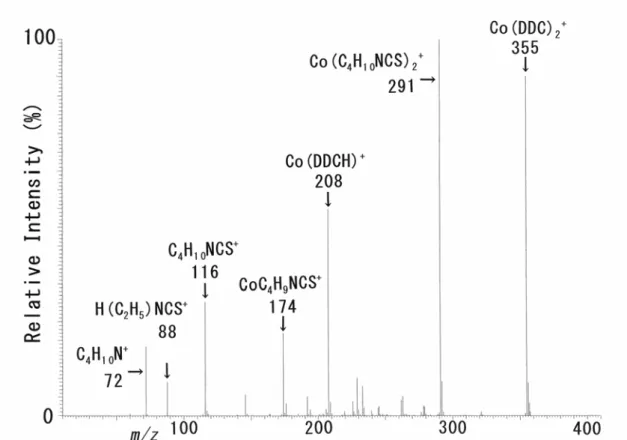
detection assembly. It means that the detection assembly is washed automatically with methanol for 59 s when a sample is injected every 60 s. The capillary temperature was set at 280 ℃. The electrospray voltage was set at 4.5 kV, the multiplier voltage at 1.3 kV and the collision voltage at 20 - 50 V, respectively. Nitrogen was used as sheath gas (469 kPa) and also as an auxiliary gas (8 units), and argon was used as collision gas (134 kPa). MS-MS spectrum was collected from m/z 10 to m/z 410 with a scan time of 0.8 s, and stored in a computer every 0.8 s continuously. Figure 1 is an example of a scan. For the quantification, the product ions in the range of m/z 290.7±0.2 that were derived from the precursor ion at m/z 354.8±0.3 were

accumulated every 0.5 s. The total amounts of product ions were recorded in a

computer every 0.5 s continuously, and were plotted as a function of time, forming a

(6)

peak. The peak area was integrated, and the amount of Co was quantified using a calibration curve made up with spiked matrix samples at different concentrations.

3. Results and Discussion

Stability of Co-DDC complex and interferences

At first, a suitable acid for the production of a ternary Co-DDC complex was examined, as explained in our ESI-MS work on chromate [11]. The rate of

production in 0.2 M ascorbic acid, 0.2 M oxalic acid, 0.2 M HCl, 0.1 M H

2

SO

4

, 0.2 M HNO

3

and 0.07 M H

3

PO

4

were found to be 100, 50, 40, 30, 20 and 10 %, respectively, by taking the rate in 0.2 M citric acid as 100 %. Since the rate in citric acid was almost the same in the concentration range from 0.06 M to 0.5 M, 0.2 M citric acid was selected. IAA was chosen for the extraction of Co-DDC complex since the

percentages of back ground signal to the signal of 0.1 pg Co at m/z 291 were roughly 20, 50 and 80 % in IAA, octanol and hexanol, respectively. Co-DDC complex

extracted with IAA was quite stable; 90 % of the complex remained after 24 h in the extract from a 0.15 M NaCl solution and after 5 h in the extract from urine, respectively, under room light at 25 ℃ .

DDC is well known to form chelate complex with various transition metals. We confirmed, however, that neither the signal of Co at m/z 355 nor that at m/z 291 was interfered with by the following metals, i.e., Ti, V, Cr, Mn, Fe, Ni, Cu, Zn, As, Zr, Mo, Ru, Pd, Ag, Cd, W, Pt, Au, Tl and Pb under the present assay.

MS-MS spectrum

Figure 1 shows the mass spectrum of product ions with a collision voltage of 25 V.

Product ions containing Co such as Co(C

4

H

10

NCS)

2+

at m/z 291, CoDDCH

+

at m/z 208

(7)

and CoC

4

H

9

NCS

+

at m/z 174 were the main ions with collision voltages at 25, 27 and 30 V, respectively. Fig. 1 also shows product ions such as C

4

H

10

NCS

+

at m/z 116, H(C

2

H

5

)NCS

+

at m/z 88 and C

4

H

10

N

+

at m/z 72, respectively [12,13]. For the quantification of Co, a mass chromatogram of the product ion Co(C

4

H

10

NCS)

2+

after dissociation from the precursor ion Co(DDC)

2+

at a collision voltage of 25 V was selected because it was the most abundant ion among the three product ions containing Co.

Precision and accuracy

Calibration standard solutions of Co were prepared by spiking AASS at

concentrations of 0, 0.1, 1, 10 and 100 μgl

-1

to 0.15 M NaCl solution and urine. The peak-width increased as the concentration increased, and the increment of the

peak-width in urine was larger than that in 0.15 M NaCl solution. The concentrations of Co determined from not the peak height but the peak area (y) were linear to the concentrations spiked (x) up to 100 μgl

-1

, y = 1.0024 x + 0.0551 with a correlation coefficient of 0.9999 in 0.15 M NaCl solution and y = 0.9978 x + 0.0867, with a correlation coefficient of 0.9991 in urine, respectively.

A 0.15 M NaCl solution and urine that were not spiked with Co were measured 6 times and their standard deviations (σ) were calculated in pg based on the calibration, respectively. Since an LOD was defined as 3σ for the reagent blank [8], LODs in the present assay were calculated to be 0.03 μgl

-1

and 0.05 μgl

-1

in 0.15 M NaCl solution and urine, respectively.

Precision and accuracy were assessed by the analysis of 0.15 M NaCl solution and

urine spiked at 0.1, 1, 10 and 100 μgl

-1

, respectively, as listed in Table 1. These

(8)

samples were analyzed three times a day as well as on three different days. The coefficient of variation was less than 17.8 %, and accuracy was between 81.1 to

121.8 % for both intra-day and inter-day variations in any samples, even urine spiked at 0.1 μgl

-1

.

To check the recovery and validate the proposed procedure, standard reference materials were examined. The certified Co levels of low level urine 2670a, high level urine 2670a and water 1643e were 0.166 ± 0.04, 51.2 ± 3.2 and 27.06 ± 0.32 μgl

-1

, and those we obtained were 0.18±0.03, 50.3±2.4 and 26.8±1.1 μgl

-1

, respectively. The recoveries of Co were within 100±8 % in these three reference materials. These high recoveries may be due to the strong affinity of Co to DDC as well as to the high solubility of the Co-DDC complex in IAA. Likewise, complete recoveries of Co complexes with dithiocarbamate derivatives were reported in the extraction with

one-volume of trichloro-trifluoroethane from 17-volumes of seawater [15] and with one volume of diisopropylketone from 4-volumes of urine [6].

Comparison with other MS methods

The LOD of the presented ESI-MS-MS method is better than that of conventional

ICP-MS method [6,7] and can quantify the concentration of Co in urine of normal

persons. Recently, however, new ICP-MS such as sector-field ICP-MS [9] and

ICP-MS with a collision cell [10] were developed. The advantages of the present

method over ICP-MS are as follows. Firstly, the required sample volume is about

one hundredth of that of ICP-MS. Secondly, in the analysis of single-mass metals

such as Co and As, the present method shows several lines for each metal due to

product ions that provide more confidential identification, whereas ICP-MS can show

(9)

only a single line for each metal. Thirdly, ESI-MS (-MS) can determine the valence state of the metal [14,15]. However, the disadvantages of the presented ESI-MS-MS method over the new ICP-MS method are as follows. Firstly, the LOD of the

presented method, 0.05 μgl

-1

in urine, is higher than that of new ICP-MS method such as 0.02 μgl

-1

[9] or 0.005 μgl

-1

[10]. Secondly the presented method can analyze only several elements having similar chemical properties such as Co, chromate [14],

molybdenum and ruthenium [15] together, whereas ICP-MS can detect quite a larger number of elements together [6,7,9,10].

In conclusion, this method enables the determination of metals in the laboratories

equipped with only ESI-MS (-MS) instrument that is currently used for the analysis of

organic molecules. The determination of metals is usually performed on ICP-MS and

atomic absorption (or emission) spectroscopy, although these methods cannot be used

for the analysis of organic molecules.

(10)

Table 1

Intra-day (3 times) and inter-day (3 days) variations of Co values were determined by the presented method. The observed values and

coefficients of variations (C.V.) were listed for Co spiked at 0.1 -100 μgl

-1

in 0.15 M NaCl solution (A) and urine (B), respectively.

Intra-day Inter-day

A B A B Spiked Observed Observed Observed Observed Co Co Co Co Co

μg l

-1

μg l

-1

C.V. μg l

-1

C.V. μg l

-1

C.V. μg l

-1

C.V.

0.1 0.096 2.9 0.122 5.5 0.120 13.5 0.081 17.8

1 1.00 7.6 1.02 2.8 0.984 2.9 0.998 9.2

10 10.1 1.0 10.1 3.4 9.98 3.6 10.0 4.1

100 101 4.0 99.2 3.7 98.8 1.4 101 2.1

(11)

Figure caption

Figure 1: Mass spectrum after collision-induced dissociation of Co(DDC)

2+

at the collision voltage of 25 V. Not only the ions containing Co such as Co(DDC)

2+

at m/z 355, Co(C

4

H

10

NCS)

2+

at m/z 291, CoDDCH

+

at m/z 208 and CoC

4

H

9

NCS

+

at m/z 174

but also ions such as C

4

H

10

NCS

+

at m/z 116, H(C

2

H

5

)NCS

+

at m/z 88 and C

4

H

10

N

+

at

m/z 72 were observed.

(12)

References

[1] G. Lippi, M. Franchini, G.C. Guidi, Br. J. Sports Med. 39 (2005) 872.

[2] G. Lippi, M. Franchini, G.C, Guidi, J. Occup. Med. Toxicol. 1 (2006)18.

[3] C.J. Gore, R. Parisotto, M.J. Ashenden, J. S. Gundersen, K. Sharpe, W. Hopkins, K.R. Emslie, C. Howe, G.J. Trout, R. Kaziauskas, A.G. Hahn, Haematologica 88 (2003) 333.

[4] A. Linna, P. Oksa, K. Groundstroem, M. Halkasaari, P. Palmroos, S. Huikko, J. Uitti, Occup. Environ. Med. 61 (2004) 877.

[5] E.S. Wittkopf, J. Angerer. Int. Arch. Occup. Environ. Health 49 (1981) 77.

[6] H. Vanhoe, C. Vandecasteele, J. Versieck, R. Dams, Anal. Chem. 61 (1989) 1851.

[7] D.C. Paschal, B.G. Ting, J.C. Morrow, J.L. Pirkle, R.J. Jackson, E.J. Sampson, D.T.

Miller, K.L. Caldwell. Environ. Research, Section A 76 (1998) 53.

[8] E. Bárány, I.A. Bergdahl, L.E. Bratteby, T. Lundh, G. Samuelson, A. Schütz, S.Skerfving, A. Oskarsson, Sci. Total Environ. 286 (2002) 129.

[9] J. Begerow, M. Turfeld, L. Dunemann. J. Anal. At. Spectrom. 15 (2000) 347.

[10] P. Heitland, H. Köster. J. Anal. At. Spectrom. 19 (2004) 1552.

[11] K. Minakata, M. Suzuki, O. Suzuki. Anal. Chim. Acta 539 (2005) 141.

[12] G.E. Manoussakis, E.D. Micromastoras, C.A. Tsipis, Z. anorg. allg. Chem. 403 (1974) 87.

[13] K.W. Given, B.M. Mattson, G.L. Miessler, L.H. Pignolet, J. inorg. nucl.

Chem. 39 (1977) 1309.

[14] L.G. Danielsson, B. Magnusson, S. Westerlund. Anal. Chim. Acta 98 (1978) 47.

(13)

[15] ] K. Minakata, M. Suzuki, O. Suzuki. Anal. Biochem. 348 (2006) 148.

Figure caption

参照

関連したドキュメント

All of the above data showed that bufogenin having the 3β-hydroxy-5β-structure is enzymatically metabolized to the inactive metabolite having the 3α-hydroxy-5β-structure (Nambara

established ELISA, liquid chromatography tandem mass spectrometry (LC-MS/MS), and an automated high-throughput mass spectrometry (HT-MS/MS) system (RapidFire) to identify

まず,PREG 及び PROG の重水素標識体をアルカリ条 件下での交換反応により合成し,それぞれを IS として Fig.. 7) .コント

Keywords: homology representation, permutation module, Andre permutations, simsun permutation, tangent and Genocchi

Standard domino tableaux have already been considered by many authors [33], [6], [34], [8], [1], but, to the best of our knowledge, the expression of the

We recall here the de®nition of some basic elements of the (punctured) mapping class group, the Dehn twists, the semitwists and the braid twists, which play an important.. role in

It is suggested by our method that most of the quadratic algebras for all St¨ ackel equivalence classes of 3D second order quantum superintegrable systems on conformally flat

[11] ISO 23830 Surface chemical analysis -- Secondary- ion mass spectrometry -- Repeatability and constancy of the relative-intensity scale in static secondary-ion