• 検索結果がありません。

Determination of Molybdenum and/or Ruthenium in Urine Using Electrospray Ionization Mass Spectrometry

N/A
N/A
Protected

Academic year: 2021

シェア "Determination of Molybdenum and/or Ruthenium in Urine Using Electrospray Ionization Mass Spectrometry"

Copied!
11
0
0

読み込み中.... (全文を見る)

全文

(1)

Determination of Molybdenum and/or Ruthenium in Urine Using Electrospray Ionization Mass Spectrometry

著者 Minakata Kayoko, Suzuki Masako, Suzuki Osamu journal or

publication title

Analytical Biochemistry

volume 348

number 1

page range 148‑150

year 2006‑01‑01

URL http://hdl.handle.net/10271/32

doi: 10.1016/j.ab.2005.07.012

(2)

Determination of Molybdenum and/or Ruthenium in Urine Using Electrospray Ionization Mass Spectrometry

Kayoko Minakata

1

*, Masako Suzuki

2

and Osamu Suzuki

1

1

Department of Legal Medicine,

2

Research Equipment Center, Hamamatsu University School of Medicine, 1-20-1 Handayama, Hamamatsu 431-3192, Japan

*Corresponding author: Kayoko Minakata

Tel/Fax: +81-53-435-2233

E-mail: [email protected]

Short title: Determination of Molybdenum by ESI-MS

Key Words: Molybdenum, Electrospray Ionization, Mass spectrometry, Diethyldithiocarbamate, Ruthenium

Category: Inorganic and Metalloorganic Compounds

(3)

Molybdenum (Mo) is utilized as a cofactor of the enzymes essential for incorporation of inorganic nitrogen in the synthesis of proteins, nucleic acids and other cellular

nitrogenous constituents. Usually Mo takes a diamagnetic +6 valence state in liver, urine and seawater but it turns to be a paramagnetic +5 valence state during turnover of the enzymes [1,2]. The complex of Mo and diethyldithiocarbamate (DDC,

(C

2

H

5

)

2

NCSS

) in a paramagnetic Mo-DDC state [3] was considered as a model of Mo-cofactor [1,2]. To determine the ratio of both constituents, we noticed that electrospray ionization mass spectrometry (ESI-MS) developed for the analysis of weakly charged species like proteins and peptides, was quite suitable for the analysis of weakly charged species like Mo(DDC)

4+

. Mo(DDC)

4+

is soluble in polar solvents like alcohols and quite stable even for 1 week, nevertheless it is a paramagnetic substance. Furthermore, the extraction of the compound with isoamyl alcohol (IAA) results in not only its concentration but also the elimination of most substances contained in biological fluids that enables to inject sample in the direct mode without staining the capillary in ESI-MS.

Mass dependent determination of Mo was introduced previously using inductively coupled plasma mass spectrometry (ICP-MS) [4,5,6]. ICP-MS, however, required large sample volume, say 1 mL, per analysis with detection limit of 90 fg/μL [5,6], whereas present method required only 1 μL per analysis with detection limit of 20

fg/μL. Furthermore, determination of Mo by ICP-MS was interfered with by isobars.

That is, monoatomic interference came from zirconium (Zr) and ruthenium (Ru) [4,5]

and polyatomic interference, from matrix materials such as Ar

2

OH, ArKO, K

2

O, Ca

2

OH and BrO [6]. These interferences were not observed in the present ESI-MS method.

That is, Zr

4+

did not show peaks and matrix materials showed peaks at low m/z region

whereas Mo and Ru showed peaks at high m/z region as 690, Mo(DDC)

4+

and 944,

Ru

2

(DDC)

5+

, respectively. Therefore, Ru can be used as an internal standard (IS)

for Mo in urine, since the contents of Ru are quite low in biological samples.

(4)

ESI-MS can be applied for a sensitive quantitation of metals when a compound is produced completely and detected efficiently as in the present case of Mo(DDC)

4+

, although it is usually used for clarifying configurations of compounds as well as valence states of metals that cannot be done by ICP-MS.

Materials and methods

Atomic absorption (AA) grade solution of Ru was obtained from Aldrich Chemical Co. Inc., USA and used as IS of Mo. AA grade solutions of Mo and other transition metals examined, AA grade of DDC and IAA, and analytical grade of other chemicals were obtained from Wako Pure Chemical Ltd., Japan. Ultra-pure water having specific resistance of 18 MΩ cm was used. Calibration standard solutions containing Mo at 0.02 – 200 pg/μL and/or Ru at 2 – 200 pg/μL in 0.15 M NaCl were prepared

every day from AA grade stock solutions containing Mo and Ru at 1μg/μL, respectively.

DDC reacts with Mo

6+

and Ru

3+

quickly at high pH and decomposes gradually at pH lower than 4. Oxalic acid (OA) can reduce Mo

6+

to Mo

5+

efficiently at pH ca.1.

Therefore, pH of sample should be adjusted to pH 4 – 8 with either 1 M NaOH or 1 M HCl using pH test paper. The pH of normal urine is in the range of 5 - 8.

Mo

6+

and/or Ru

3+

were determined as follows. To 5 μL of urine or standard solution, 0.5 μL of 1 M DDC was added and mixed for 10 sec by a vortex mixer, and 2 μL of 2 M OA preheated at 40 ℃ was added and mixed for 5 sec. Five μL of IAA was added and mixed for 5 sec and centrifuged at 500 x g for 30 sec. An aliquot of 1 μL IAA layer was subjected to the analysis.

ESI-MS was performed by using a TSQ 7000 LC-quardrupole mass spectrometer

(Thermo Quest, Japan) in the positive ion mode. One μL of IAA layer was injected

manually in the direct mode. Methanol was flowed as the mobile phase at 200

μL/min. The capillary voltage was set to be 4.5 kV and the desolvation temperature

was varied from 170 to 290 ℃ to find out the best condition. Data were collected

(5)

in the range of m/z 50 – 1000 and the quantitative analysis was conducted using molecular ions in the selected ion monitoring (SIM) mode.

Results and discussion

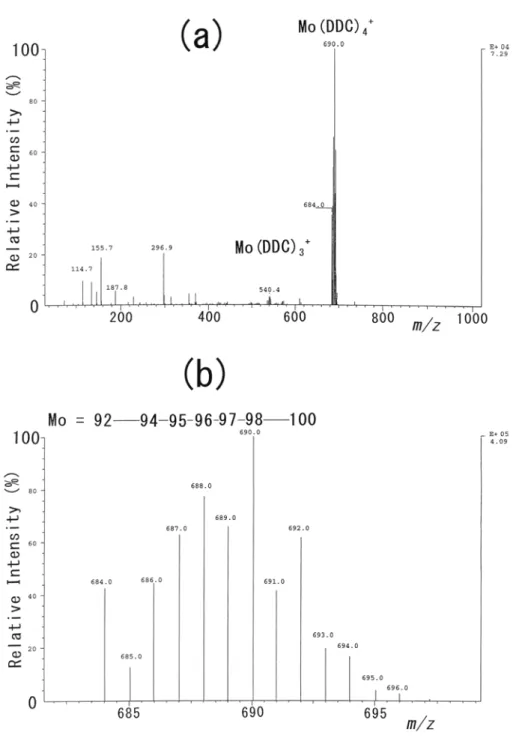
Figure 1 showed an ESI-MS of 1 μL of IAA solution containing 200 pg Mo measured at the desolvation temperature of 170 ℃ . A cluster of peaks around m/z 690 corresponds to Mo(DDC)

4+

, that around m/z 542, to Mo(DDC)

3+

and peaks less than m/z 300, mainly to solvents. Metal ions show clusters of peaks with their

isotopes, and the shapes of the clusters are quite helpful for their decisive determination.

The quantitation was performed at the desolvation temperature of 210 ℃ since the peaks around m/z 690 increased at first and decreased subsequently with raising the temperature, showing the maximum at 210 ℃ . The highest peak at m/z 690

corresponds to

98

Mo(

12

C

51

H

1014

N

32

S

2

)

4

and other peaks, to the mixture of isotopes (Mo of 92, 94, 95, 96, 97, 98, 100 and S of 32, 33, 34) with their natural abundances as shown in Fig. 1 (b). The same compound, Mo(DDC)

4+

, was reported to be synthesized from Mo(CO)

6

, tetrabutylammoniumhalogenide and

tetraethylthiuramdisulphide [7].

Next, we tried to find out a suitable metal ion for IS that gives distinctive signal from that of Mo under the same condition, and its concentration in biological materials is lower than 1/100 that of Mo. Ru showed peaks of Ru(DDC)

3+

around m/z 546 (not shown) and Ru

2

(DDC)

5+

around m/z 944 as shown in Fig. 2 (a) where 20 pg of Ru was injected. Since peaks of Ru(DDC)

3+

around m/z 546 overlapped with those of Mo(DDC)

3+

around m/z 542, only peaks of Ru

2

(DDC)

5+

around m/z 944 could be used as IS for Mo(DDC)

4+

around m/z 690 and vice versa. The peak height of 1 pg of Mo in the form of Mo(DDC)

4+

was the same as that of 5 pg of Ru in the form of

Ru

2

(DDC)

5+

. Fig. 2 (a) indicates the detection limit of Mo in the MS using 1 μL IAA

solution containing 2 pg Mo. In the negative ion mode, however, Mo and Ru did

(6)

not show any peaks corresponding to their compounds under the same treatment as that in the positive ion mode.

Effects of chelating agents as well as other transition metals were compared.

Ammonium pyrolidine dithiocarbamate showed their corresponding peaks in ESI-MS but SCN

did not under the same condition as that of DDC, although both chelating agents produced respective paramagnetic Mo

5+

compounds [3]. Previously we observed that DDC reacted with Mo 900 times more efficiently than SCN

[3]. This fact might be one of the reasons why Mo-SCN complex could not be observed in ESI-MS, although SCN

was used previously as a reagent in colorimetric determination of Mo. Mo in urine tends to react with 0.1 M DDC completely although it may bound weakly with some compounds in urine. This was proved by the following observation that urine untreated had the same Mo level as that of the urine wet-ashed by HNO

3

at 85 ℃ for 8 h or that of the urine oxidized with 10 % H

2

O

2

at 25 ℃ for 18 h.

The ESI-MS of 1 μL urine is shown in Fig. 3. The peaks observed at smaller than m/z 502 came from matrix materials and the highest peak in the range m/z 502 –1000

was that of Mo(DDC)

4+

. Therefore, Mo at m/z 690 could be quantitated using IS at m/z 944, Ru

2

(DDC)

5+

.

Transition metals such as Zr

4+

, Fe

3+

, Cu

2+

, Mn

2+

, Ti

4+

, V

5+

, Cr

6+

and Cd

2+

at 10

−4

M, i.e., about 10 ng each, did not show peaks from m/z 650 to 1000 corresponding to their compounds under the same condition as that of Mo and Ru. This fact was

confirmed by the study on urine as shown in Fig. 3. That is, only the peaks of Mo(DDC)

4+

were observed in urine although it contained several metals such as Fe and Cu reacting with DDC at higher concentrations than Mo.

Figure 2 (b) indicates chromatogram of Mo(DDC)

4+

of Mo standard solutions in

SIM mode at m/z 690. Since a weak peak was observed in the IAA solution without

Mo, i.e. blank, the detection limit was found to be 20 fg, i.e., 1 μL solution at 2 × 10

10

M Mo. The calibration curve was obtained by plotting the amount calculated by

(7)

the peak area ratio of Mo to IS (y) versus the amount of Mo (x) at six concentrations with six times determinations. With the limit of quantitation of 200 fg, good linearity was observed over the range from 200 fg to 200 pg for standard solutions, y = 0.988 x + 23, r

2

= 0.999. The recoveries of Mo from urine were determined six times

respectively by adding Mo at 0, 2, 20 and 200 pg/μL and Ru at 200 pg/μL to either urine or water. The recoveries were 92, 94 and 98 % at three concentrations mentioned above, respectively. Since sample could be injected every one min as shown in Fig. 2 (b), Mo levels of six persons were found to lie between 8 – 45 pg/μL urine within ten minutes. These values were confirmed with the values determined by electron paramagnetic resonance using 10 μL of urine [3]. In the present ESI-MS, 1 μL of urine showed the same isotopic abundances as those shown in Fig. 1 (b).

Within-day and day-to-day (for 5 days) assays were performed using six urine samples stored at 4 ℃ , and variations of both assays were not greater than10 %.

ESI-MS was found to be quite suitable for the sensitive quantitation of Mo and Ru as well as the analysis of coordination [1,2] of Mo and Ru. Irving and Williams proposed the order of complexation constants of transition metals to be Fe << Cu [8].

Although present treatment did not show appreciable signals of Fe and Cu owing to their low sensitivity, a different treatment showed that the signal of Fe << the signal of Cu, whereas another treatment, a strong signal of Fe. Therefore, this method can be applied to other metals and chelating agents by choosing reductants, oxidants and solvents that can produce weakly charged species suitable for ESI-MS.

References

[1] H.J. Cohen, I. Fridovich, K.V. Rajagopalan, Hepatic sulfite oxidase, J. Biol. Chem.

246 (1971) 374-382.

[2] J.T. Spence, M. Minelli, P. Kroneck, M.I. Scullane, N.D. Chasteen, Monomeric

molybdenum (V) oxo complexes with tetradentate aminoethanethiols, J. Am. Chem.

(8)

Soc. 100 (1978) 8002-8004.

[3] K. Minakata, O. Suzuki, New molybdenum compound suitable for determination by electron paramagnetic resonance, Anal. Chim. Acta 512 (2004) 355-357.

[4] A.D. Anbar, K.A. Knab, J. Barling, Precise determination of mass-dependent variations in the isotopic composition of molybdenum using MC-ICPMS, Anal. Chem.

73 (2001) 1425-1431.

[5] N. Dauphas, L. Reisberg, B. Marty, Solvent extraction, ion chromatography, and mass spectrometry of molybdenum isotopes, Anal. Chem. 73 (2001) 2613-2616.

[6] J.Wang, E. H. Hansen, B. Gammelgaard, Flow injection on-line dilution for multi-element determination in human urine with detection by inductively coupled plasma mass spectrometry, Talanta 55 (2001) 117-126.

[7] A. Nieuwpoort, New compounds containing molybdenum and

diethyldithiocarbamate, J. of the Less-Common Metals 36 (1974) 271-276.

[8] H. Irving, R.J.P. Williams, Order of stability of metal complexes, Nature 162 (1948)

746-747.

(9)

FIGURE CAPTIONS

Figure 1. Mass spectrum of 1 μL of isoamyl alcohol containing 200 pg Mo measured

at desolvation temperature of 170 ℃ and recorded from m/z 50 to 1000 (a), and that

recorded from m/z 680 to 700 (b).

(10)

Figure 2. (a): Mass spectrum of 1 μL of isoamyl alcohol containing 2 pg Mo and 20 pg Ru measured at desolvation temperature of 210 ℃ and recorded from m/z 650 to 1000, indicating that the detection limit was 2 pg Mo in mass spectrum mode. (b):

Chromatogram of Mo(DDC)

4+

in selected ion monitoring mode at m/z 690 measured at

desolvation temperature of 210 ℃ . The applied amounts of Mo were 0, 20 fg, 200

fg and 2 pg, respectively, indicating that the detection limit was 20 fg Mo in selected

ion monitoring mode.

(11)

Figure 3. Mass spectrum derived from 1 μL of urine of a healthy man measured at

desolvation temperature of 210 ℃ and recorded from m/z 100 to 1000 (a), and that

recorded from m/z 660 to 720 (b). The content of Mo was 45 pg in 1 μL of urine.

FIGURE CAPTIONS
Figure 3.    Mass spectrum derived from 1 μL of urine of a healthy man measured at  desolvation temperature of 210  ℃   and recorded from m/z 100 to 1000 (a), and that  recorded from m/z 660 to 720 (b)

参照

関連したドキュメント

We intend to find the condition of the plasma in order to account for the observed flux ratio ( F RRC /F line ), which is free from specific modeling with iron abundance, the

A selective, sensitive and rapid method for determining 8-OHdG in human urine was developed using hydrophilic interaction chromatography- tandem mass spectrometry (HILIC-MS/MS)

In this study, a rapid, sensitive and selective LC-MS/MS method using deuterated 1-OHP-glucuronide as an internal standard and an effective pretreatment method for urine samples

All of the above data showed that bufogenin having the 3β-hydroxy-5β-structure is enzymatically metabolized to the inactive metabolite having the 3α-hydroxy-5β-structure (Nambara

established ELISA, liquid chromatography tandem mass spectrometry (LC-MS/MS), and an automated high-throughput mass spectrometry (HT-MS/MS) system (RapidFire) to identify

Effect of mass ratio of molten steel to slag on material balance between FeO+MnO concentration in slag and [mass %Al], which determines the re-oxidation rate control process...

まず,PREG 及び PROG の重水素標識体をアルカリ条 件下での交換反応により合成し,それぞれを IS として Fig.. 7) .コント

Standard domino tableaux have already been considered by many authors [33], [6], [34], [8], [1], but, to the best of our knowledge, the expression of the