A Curriculum Outline for an Advanced
Certificate of Professional Development in TEFL/TESOL Teacher Training
journal or
publication title
Journal of Chikushi Jogakuen University and Junior College
number 1
page range 73‑88
year 2006‑01‑31
URL http://id.nii.ac.jp/1219/00000250/
A Curriculum Outline for an Advanced Certificate of Professional Development
in TEFL/TESOL Teacher Training
T. R. Honkomp
Introduction
Intensive Transition Program in English for Speakers of Other Languages
The University of Hawaii’s Kapi’olani College examined the viability of establishing a program offering an Advanced Certificate of Professional Development in TEFL/TESOL Teacher Training. This paper will present aspects of the development of the curriculum for the certificate and describe the framework in which the certificate was initially implemented at one of the college’s partner institutions, Youngsan University/University of Hawaii - International Education Institute (YSU/UH-IEI), in Ulsan, Korea.
Details of the Master Plan agreement initiated by the University of Hawaii’s Kapi’olani College and Youngsan University, dictated that the International Educational Institute (IEI) be established near the campus of Youngsan University in Ulsan, Korea. IEI was opened in late June of 2003 and offered a variety of English language learning programs for students of all proficiency levels and educational needs. Initially after opening, IEI offered a program in Conversational English and an Intensive English Program (Academic IEP) with the TEFL/TESOL certificate program following a few months later.
Under the auspices of the University of Hawaii’s Kapi’olani College is the Intensive Transition Program in English. This non-credit ESOL program offers English classes to international students most of whom come from Japan and Korea. The program is used as a stepping-stone by many students who are looking to take credit courses in a degree program at one of the branches of the University of Hawaii. Admission standards for non-native speakers to regular credit programs at the University of Hawaii require a TOEFL paper test score of at least 500. Students participating in the Intensive Transition Program in ESOL do not have the prerequisite score needed for enrollment and therefore aim to increase their proficiency. Students in the program take approximately 25 to 30 hours of English classes per week and all of the language skill areas are integrated.
The Intensive Transition Program in ESOL has enjoyed a considerable rate of success in recent years. Most of the students raise their level of English proficiency, continue on to degree programs at the University of Hawaii, successfully assimilate into regular classes and finish their degrees. One of the keys to their success has been the preparation that they receive while in the Intensive Transition Program in ESOL. The program relies on a highly coordinated effort from the teachers who integrate the language skills of the curriculum through the use of Content Based Instruction (CBI). CBI has become an effective approach for many ESOL programs and has increased its popularity in the field.
Its effectiveness stems from the theoretical foundation that language is acquired as it is used as the medium for learning other things (Kasper 2000). The curriculum of the Intensive Transition Program in ESOL has provided the topics for Content Based Instruction and has coordinated framework in all skill areas for participating students. Based on previous experiences and on documented rates of success (Kellogg 2003), the Intensive Transition Program in ESOL came to firmly trust the virtues of CBI and was eager to continue promoting this approach for other endeavors.
It then became a particular challenge while developing the curriculum for the Advanced Certificate of Professional Development in TEFL/TESOL Teacher Training to reflect the values and philosophy of the Intensive Transition Program in ESOL. More specifically, the question emerged as to how the Advanced Certificate of Professional Development in TEFL/TESOL Teacher Training could incorporate and adhere to the tenets of CBI while simultaneously address the needs of participants who intended to increase their teaching expertise through standard means. The resulting curriculum that unfolded represents a compromise of sorts. Some conventional aspects of an advanced degree in TEFL/TESOL teacher training were included in the curriculum but also included are many aspects that promote the benefits and values that are particular to CBI.
The curriculum development process used analysis of the trends that are appealing to the current generation of advanced certificate or degree seekers. There were, however, several underlying principles that had to be considered in order to direct the final outcome. The first consideration was that Kapi’olani College aspired to offer a two-semester program that could be successfully completed in one calendar year. Another consideration was that this advanced certificate was to be designed as something other than a master’s degree in ESL so as not to compete with existing master’s programs that were already being offered at the University of Hawaii’s Manoa campus. In addition, the degree was to reflect some of the pedagogical values that Kapi’olani College held in high regard and were already present in some of their other programs. For example, adhering to the basic tenets of CBI and putting an emphasis on the practical and experiential side of teacher training as opposed to a Curriculum Description
more research-based approach were two important considerations. With the aforementioned particulars in place, the design objective then became an exercise in fitting the curriculum into a framework that satisfied the goals of Kapi’olani College and at the same time provided the necessary expertise and training for potential candidates.
An added aspect of the curriculum was that ideally, it should have enough flexibility to be implemented on more than one campus and location. Kapi’olani College had intended to enter the curriculum for the Advanced Certificate of Professional Development in TEFL/TESOL Teacher Training as part of an overall curriculum to be used at international schools having partnerships with the college.
The first such partner institution to implement the curriculum was the International Education Institute which is under the auspices of Youngsan University located in Ulsan, Korea. Other schools that intended to follow the International Education Institute include Nagasaki International University, Jikei, Hokkaido Asai Gakuen University in Japan, and the Zhonghson Education Commission located in China.
The curriculum for the Advanced Certificate in Professional Development in TEFL/TESOL Teacher Training program consists of a series of six courses related to foreign and second language pedagogy. The curriculum was designed to be taken during two academic semesters with each class meeting for at least 45 hours a semester. The program consists of a total of 270 hours of instruc- tion and includes 100 hours of practice teaching and a scholarly classroom-based research paper.
Prerequisites for the program are a four-year college degree or equivalent. Participants should also have a strong command of the English language: 550 TOEFL (paper-based, for non-native speakers of English) or equivalent or permission of the program director.
The courses of the curriculum are as follows:
1) TEFL/TESOL 505: Curriculum Development: From Theory to Practice 2) TEFL/TESOL 510: Teaching Situations
3) TEFL/TESOL 515: Methodology and Approaches in Language Teaching 4) TEFL/TESOL 520: Materials Development
5) TEFL/TESOL 525: Assessment and Student Learning Outcomes 6) TEFL/TESOL 530: Seminar on Experimental Teaching/Practicum
Complete versions of the individual course descriptions are contained in Appendix II. As mentioned above, the course descriptions were carefully worded not only to provide the necessary expertise and training for successful completion of an advanced certificate in teacher training for TEFL/TESOL, but also to reflect the values and educational philosophies of Kapi’olani College.
Curriculum Modifications from the Influence of Content Based Instruction (CBI)
The Advanced Certificate of Professional Development in TEFL/TESOL Teacher Training program was not intended to be a substitute for a master’s degree. The specific justification for the development of the degree is noted in the Certificate of Professional Development Request form included in Appendix I. The original concept intended qualified candidates to get the necessary training from Kapi’olani College or its partner institutions in one calendar year. An important distinction was that the college placed an emphasis on the practical application and classroom teaching aspects of teacher training. Additionally, some features of the certificate curriculum were intentionally modified in order to fit in characteristics of Content Based Instruction (CBI).
Examples of the influence of CBI can be noted in the wording of several of the course descriptions. The description for the course entitled
specifically notes an emphasis on input theory (Krashen 1985) and resulting input based hypotheses. The materials and subsequent course syllabus design that are studied and analyzed in this course should be easily adaptable to fit an input-based curriculum. Alternatively, in a traditional TEFL/TESOL training course, current and previously established theories of Second Language Acquisition (SLA) and their applications are commonly used to influence the direction curriculum development takes.
The course syllabus for describes a class that takes on
most aspects of the variety of circumstances in which a language teacher could be found. After the physical management constraints have been examined, scaffolding, immersion situations and CBI are additionally introduced. Similarly, in
an emphasis on CBI is presented and there is less stress on traditional methodologies.
In the design of the syllabus for this course, learners are expected to use their knowledge of CBI and of the importance of content literacy and apply it to language acquisition.
The final course of the curriculum is the
The design of the syllabus for this course also stresses the preferences of Kapi’olani College in that it especially emphasizes the practical application of experiential teaching skills. The extensive practicum module of this course (100 hours of observation and practice teaching) ensures a wide window of opportunity for participants to develop the techniques and abilities that they have learned from the other prerequisite courses. As noted in the course syllabus, during the teaching practicum, a unit of content-based lessons partially consisting of a series of progressive readings is required. An additional emphasis is given to feedback and reflective processes so that students leaving the certificate program will take with them a solid basis for self-reflection that will enhance their abilities to develop teaching skills throughout their teaching careers.
Additional information of the course descriptions for the curriculum for the Advanced Certificate Curriculum Development: From Theory to Practice (TEFL/TESOL 505)
Teaching Situations (TEFL/TESOL 510)
Methodology and Approaches in Language Teaching (TEFL/
TESOL 515)
Seminar in Experiential Teaching (with Practicum) (TEFL/TESOL 530).
of Professional Development in TEFL/TESOL Teacher Training is detailed in Appendix II. Course objectives for each of the six courses are listed and when applicable, descriptions of course projects are highlighted. An attempt was made in the design of the syllabus to distinguish the teacher training certificate from other degree programs including master’s degrees in TEFL/TESOL or related fields.
The distinguishing characteristics of the curriculum reflect the successful experiences of the Intensive Transition in English Program in ESOL at Kapi’olani College. The curriculum also included Content Based Instruction and the practical nature of experiential learning as an underlying representation of the college’s teaching philosophies and beliefs.
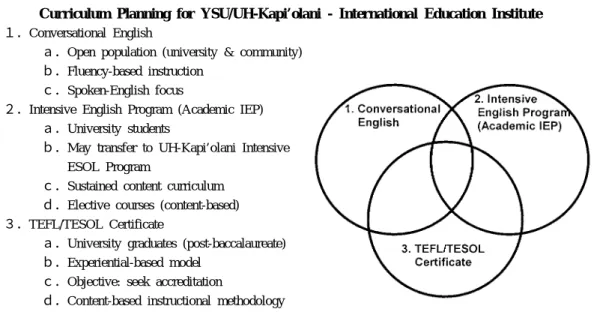
The Master Plan agreement that the University of Hawaii’s Kapi’olani College entered into with Youngsan University in April of 2003, called for the creation and development of the International Education Institute (IEI) located near Youngsan University’s campus in Ulsan, Korea. Kapi’olani College was commissioned to produce a curriculum for the three separate but related programs of IEI.
In this way, the Three-Sphere Curriculum was developed (Figure 1).
Curriculum Implementation at the International Education Institute
Fig. 1: Overview of the Three-Sphere Model
Curriculum Planning for YSU/UH-Kapi’olani - International Education Institute 1.
.
.
. 2.
.
.
.
. 3.
.
.
.
.
Conversational English
Open population (university & community) Fluency-based instruction
Spoken-English focus
Intensive English Program (Academic IEP) University students
May transfer to UH-Kapi’olani Intensive ESOL Program
Sustained content curriculum Elective courses (content-based) TEFL/TESOL Certificate
University graduates (post-baccalaureate) Experiential-based model
Objective: seek accreditation
Content-based instructional methodology
Students in all programs (spheres) are connected. Students in the Conversational English classes have the opportunity to advance to the Academic IEP. Students in the Academic IEP may give presentations to the students in the Conversational English classes. Members of the TEFL/TESOL certificate program may teach practice lessons in both the Conversational and Academic IEP spheres. Finally, the elective classes, which are required for the Academic IEP students, are open to members of the TEFL/TESOL certificate program.
a b c
a b
c d
a b c d
Notes on the relationships between the spheres
The International Education Institute implemented the Three-Sphere Curriculum before it opened with fanfare at the end of June 2003. The Conversational English and Intensive English Program (Academic IEP) were popular initial programs with the strongest appeal to the general public. The TEFL/TESOL Certificate program began its first class of specialized participants a few months later in September. Early feedback analysis indicated that teachers using the curriculum need proper time and training to plan a coordinated framework that integrates all the language skills. Regular full-time teachers at the University of Hawaii’s Kapi’olani College have the benefits of an established and well-developed program based on the years of experience of an expert teaching staff. Additionally, students who participate in the Intensive Transition Program in ESOL have the added advantage of attending classes in a native English speaking country. This type of environment supports the language integration and reinforcement that closely adhere to input theory principles and tenets of CBI. New teachers in a new environment located in a non-native English speaking setting have an extra challenge. The difficulty becomes to earnestly follow a curriculum in less than ideal conditions that threaten to undermine efforts.
The curriculum outline included in Appendix II represents the curriculum developed for the Advanced Certificate of Professional Development in TEFL/TESOL Teacher Training. It was first implemented by Kapi’olani College’s partner institution, the International Education Institute in Ulsan, Korea. The curriculum incorporates tenets of Content Based Instruction (CBI) that have been extensively used for years at the Intensive Transition Program in ESOL at Kapi’olani College. The curriculum is intended to be used at partner institutions located in several different countries. Initial feedback analysis has shown that without detailed and relatively thorough training for the teachers using the curriculum, obstacles and challenges can arise.
It is duly noted that the preparation and production of the Three-Sphere Curriculum Model and of the Advanced Certificate of Professional Development in TEFL/TESOL Teacher Training represent a collaborative effort. Particular acknowledgement and appreciation is expressed to the following contributors from the University of Hawaii’s Kapi’olani College: Dr. Leon Richards, Senior Dean of International Programs; Asst. Prof. Guy Kellogg, Program Coordinator, ESOL Department; and Prof.
Frank Noji, Department Chair, ESOL Department.
Conclusion
Acknowledgements
References
Brinton, D.M., Snow, M.A., & Wesche, M.B. (1989). New York: Newbury House.
Childs, M.R., (2002). Tokyo: The Daily Yomiuri. 15 November
2002.
Chamot, A.U., & O’Malley, J. M. (1994).
Reading, MA: Addison-Wesley.
Eskey, D.E. (1997). Syllabus design in content-based instruction. In M.A. Snow, & D.M. Briton (Eds.), New York: Longman.
Kasper, L.F. (2000). Theoretical Foundations and Pedagogical Applications.
Mahwah, NJ: Lawrence Erlbaum Associates.
Kellogg, G. (2003). Paper presented at the ESOL retreat.
Honolulu, HI
Krashen, S.D. (1982). Oxford: Pergamon Press.
Krashen, S.D. (1985). New York: Longman.
Murphey, T. (1997). Content-based instruction in an EFL Setting: Issues and strategies. In M.A. Snow, &
D.M. Brinton (eds.), New York: Longman.
Richards, J.C., & Rodgers, T.S. (1986). Cambridge: Cambridge
University Press.
Richards, L., & Koo, U.-H. (2003).
Unpublished agreement.
Stryker, S.B. & Leaver, B.L. (1997).
Washington D.C.: Georgetown University Press.
Content-based language instruction.
When is the time for content-based English?
The CALLA handbook: Implementing the cognitive academic language learning approach.
The content-based classroom.
Content-based ESL instruction.
Evolution of the UH-K ESOL program since 1997.
Principles and practice in second language acquisition.
The input hypothesis: Issues and implications.
The content-based classroom.
Approaches and methods in language teaching.
Master plan for YSU and UH-K International Education Institute (IEI).
Content-based instruction in foreign language education: Models and methods.
Appendix I
CERTIFICATE OF PROFESSIONAL DEVELOPMENT REQUEST
University of Hawaii - Kapi’olani College
(Attach Non-credit Course Outline for justifying this proposal)
Advanced Certificate of Professional Development in TEFL/TESOL Teacher Training
June 1, 2004
X NEW Certificate MODIFY or DELETE Existing Certificate
Certificate of Professional Development for an Advanced Certificate of Professional Development in TEFL/TESOL Teacher Training .
To prepare post-baccalaureate students to teach English as a Second Language or English as a Foreign Language in Asia and Pacific basin, U.S.A. and elsewhere especially for UH-K’s partner institutions. The advanced certificate not only supports the college’s goals of internationalizing the campus and the college’s efforts in teacher and educational assistants preparation and training, but also responds to requests from partner institutions (Nagasaki International University, Jikei, Hokkaido Asai Gakuen University, Zhonghson Education Commission, Youngsan University/University of Hawai’i - International Education Institute (YSU/UH-IEI), etc. for professionally prepared ESOL/EFL teachers. Furthermore, this Advanced Certificate of Professional Development in TEFL/TESOL Teacher Training will build upon and consolidate the college’s efforts to become a premier education and training center in teaching and doing applied research in English for specific purposes, content-based intensive English teaching, content-based second languages and culture teaching, etc.
1 To provide students with practical hands-on instructional techniques and motivating materials for sustained content-based language study.
2 To provide students with current and relevant background knowledge in foreign and second language teaching.
3 To provide students with opportunities to design, plan, and teach English as a Foreign Language or English as a Second Language.
Please see each course for a list of course competencies. (Attachment I)
The Program
The Advanced Certificate in Professional Development in TEFL/TESOL Teacher Training program consists of a series of six courses related to foreign and second language pedagogy. Each class Name of Certificate:
Effective Date:
Type of Action:
Credential:
Employment Objectives:
Certificate of Professional Development Objective/Competencies:
Certificate of Professional Development Requirements:
[ ] [ ] [ ]
)
)
)
A.
meets for at least 45 hours a semester. The program consists of 270 hours of instruction, 100 hours of practicum/practice teaching and a scholarly classroom-based research paper. A review of language skills is interwoven in this content-based program in language pedagogy.
Prerequisites
This program is intended for graduates of a four-year college degree program or equivalent.
Participants should have a strong command of the English language: 550 TOEFL (paper-based, for non-native speakers of English) or equivalent or permission of the program director.
1 TEFL/TESOL 505: Curriculum Development: From Theory to Practice 2 TEFL/TESOL 510: Teaching Situations
3 TEFL/TESOL 515: Methodology and Approaches in Language Teaching 4 TEFL/TESOL 520: Materials Development
5 TEFL/TESOL 525: Assessment and Student Learning Outcomes 6 TEFL/TESOL 530: Seminar on Experiential Teaching/Practicum
One hundred (100) of practicum/practice teaching
A final scholarly paper is required as part of program completion. This paper may be done as part of the course requirement for the Seminar in Experiential Teaching/Practicum.
Completion of this Advanced Certificate of Professional Development in TEFL/TESOL Teacher Training will provide the graduates with the skills, knowledge and competencies to teach English as Foreign Language or English as a Second Language. This will help to meet the current shortage of ESL/EFL teachers.
(Please circle Y or N)
Employment objective is valid and supported by the proposed certificate.
Certificate objectives and competencies enhance the student’s job skills and employability.
Non-credit course(s) is/are industry specific.
Student work is evaluated and determined satisfactory.
Date Department Chair/Program Coordinator
Date Dean of Instruction
Date Chancellor
B
)
)
)
)
)
)
Y N Y N Y N Y N
.
Certificate of Professional Development Justification:
Certificate of Professional Development Review:
Recommended by:
Approved by:
Approved by:
Appendix II
Course Syllabi for Advanced Certificate in TEFL/TESOL Teacher Training
COURSESYLLABUS
TEFL/TESOL 505: Curriculum Development: From Theory to Practice
45 hours of instruction a semester
Four-year college degree or equivalent.
Strong command of English (minimum TOEFL score of 550 or equivalent) or permission from director.
Curriculum Development: From Theory to Practice is a course designed to determine what recent research has indicated about instructed language learning.
This course will focus on the input theory and the hypotheses that have resulted from this theory. Participants will investigate the original input theory and its relationship to all of the major hypotheses on input that have been subsequently developed. In addition, learners will develop classroom materials that reflect the principles of the various input hypotheses. Commercially available texts and supplementary materials are adapted to fit an input-based curriculum.
Upon successful completion of this course, the learner should be able to:
Discuss the implications of quantitative and qualitative studies on input theory and apply the findings to classroom practice.
Discuss selected major input hypotheses and develop classroom practice around each hypothesis.
Identify specific input hypotheses in commercial texts and adapt the text material for classroom use.
COURSE TITLE
CONTACT HOURS
PREREQUISITES
COURSE DESCRIPTION
COURSE OBJECTIVES
●
●
●
●
●
COURSESYLLABUS
TEFL/TESOL 510: Teaching Situations
45 hours of instruction a semester
Four-year college degree or equivalent.
Strong command of English (minimum TOEFL score of 550 or equivalent) or permission from director.
Teaching Situations will look at all of the possible constraints that an ESL teacher may confront. It will train teachers to develop teaching techniques/
pedagogy as well as to adapt teaching materials for a variety of situations.
Examples of different teaching situations include: levels of proficiency, class size, class format and class length. Adjunct classes and learning communities are also examined. The course details the differences in teaching learners of different levels; specifically, beginning, intermediate, high intermediate, and advanced. Class length addresses different time constraints, including total contact hours in short-term courses, mid-term courses and long-term courses.
Other topics that are introduced include learning styles, learning strategies, concepts of scaffolding, immersion situations and Content Based Instruction (CBI).
Upon successful completion of this course, the learner should be able to:
Develop lesson plans and teaching strategies for learners of different proficiency levels.
Apply the use scaffolding strategies to facilitate instruction in a class with different levels of students.
Identify appropriate materials for different levels of learners.
Develop strategies for teaching in bilingual and immersion classes which include teaching one on one, small groups, tutoring and writing workshops.
Develop syllabi for courses with different time constraints including total hours and overall program length.
Develop classroom strategies for different group sizes.
Implement strategies that specifically assist students in a content-based course.
Design a syllabus for an adjunct course or a learning community.
Develop a syllabus that fits within a framework using standards, outcomes, competencies, and behavioral objectives.
COURSE TITLE
CONTACT HOURS
PREREQUISITES
COURSE DESCRIPTION
COURSE OBJECTIVES
●
●
●
●
●
●
●
●
●
●
●
COURSESYLLABUS
TEFL/TESOL 515: Methodology and Approaches in Language Teaching 45 hours of instruction a semester
(This course may also include 20 hours of class observation - an observe, discuss and report format)
Four-year college degree or equivalent.
Strong command of English (minimum TOEFL score of 550 or equivalent) or permission from director.
Methodology and Approaches in Language Teaching provides a current study of various language teaching approaches and methodologies. A brief look at the history of language teaching methods and approaches is followed by a focus on more integrated and presently used theories and trends. Some of the specific strategies examined include Content Based Instruction (CBI), tasked- based approaches to curriculum, English for Specific or Academic Purposes (ESP & EAP), and the role of culture in language teaching. Key issues of language teaching are identified through the analysis of language acquisition theory. Particular emphasis will investigate the development of content literacy.
Facilitating the development of the four skill areas through Content-Based Instruction (CBI) will show how learners comprehend and acquire language along with the acquisition of new information. This course will also include 20 hours of class observation and subsequent feedback sessions. Participants will be given the opportunity to apply the issues examined in this course to their own individual instructional needs and settings.
Upon successful completion of this course, the learner should be able to:
Examine the current study of the processes of language teaching and learning through the analysis of and experimentation with various language teaching methodologies.
Develop a curriculum based on the tenets of CBI and understand its relationship to the development of content literacy.
Create lessons in each of the four skill areas (reading, writing, speaking and listening) that develop focused, text-wise learners who effectively identify, comprehend, study and apply new information.
Explain the relationship between language methodology theory and practical applications in the classroom.
Develop a six-hour workshop designed to teach content literacy pedagogy to content-area teachers.
COURSE TITLE CONTACT HOURS
PREREQUISITES
COURSE DESCRIPTION
COURSE OBJECTIVES
PROJECTS
●
●
●
●
●
●
●
COURSESYLLABUS
TEFL/TESOL 520: Materials Development
45 hours of instruction a semester
Four-year college degree or equivalent.
Strong command of English (minimum TOEFL score of 550 or equivalent) or permission from director.
Students enrolled in Materials Development must have first completed the Curriculum Development: From Theory to Practice, Teaching Situations, and Methodology and Approaches in Language Teaching courses.
Materials Development introduces participants to the large quantity of instruc- tional materials including texts and media that are available to today’s language teachers. Participants will be required to develop critical views on instructional and educational items including currently available commercial English teaching and learning materials. They will also learn how to develop their own materials using various formats and media, for example, the internet, tape and digital recordings, and video. This course is project-based and participants will be required to complete various projects as suggested by their instructors. By the end of the course, participants will produce a materials portfolio that will be used as part of the final evaluation criteria.
Upon successful completion of this course, learners should be able to:
Identify the strengths, weaknesses, and appropriateness of commercially available materials and texts.
Understand the relation and application of English teaching materials to the four skill areas (reading, writing, speaking, listening).
Use and develop various forms of media to support, supplement and enhance existing materials and texts.
Select materials based on a variety of language teaching beliefs that can be properly integrated into different teaching situations.
Create original materials for the classroom using innovative ideas and experiences.
Create a teaching portfolio which includes a variety of tasks and projects that demonstrate the ability to develop materials for different classroom situations.
Present an analysis of case studies of CBI projects that have been done in different programs around the world.
COURSE TITLE
CONTACT HOURS
PREREQUISITES
COURSE DESCRIPTION
COURSE OBJECTIVES
PROJECTS
●
●
●
●
●
●
●
●
●
●
COURSESYLLABUS
TEFL/TESOL 525: Assessment and Student Learning Outcomes
45 hours of instruction a semester
Four-year college degree or equivalent.
Strong command of English (minimum TOEFL score of 550 or equivalent) or permission from director.
Students enrolled in Assessment must have first completed the Curriculum Development: From Theory to Practice, Teaching Situations, and Methodology and Approaches in Language Teaching courses from first semester.
Assessment and Student Learning Outcomes is a course that focuses on the various types and applications of testing and evaluation. A distinction is made between assessment in the classroom and program assessment. Formative and summative assessment within courses, placement assessment, promotion and exit assessment within language programs are explored. Learners are enabled to identify and develop appropriate techniques of testing and evaluation and to incorporate assessment into their classroom teaching. Participants explore the use of competencies and benchmarks as outcomes needed for promotion. They become acquainted with a variety of test types, including criterion-reference tests, and with testing procedures in each skill area. They also become familiar with the basic concepts and terminology in the field of testing and evaluation. Special attention is given to various issues and problems related to test administration, including the impact of testing on curriculum and the development of criteria to help in the selection of appropriate testing instruments for specific needs and situations.
Upon successful completion of this course the learner should be able to:
Differentiate various types of evaluation and testing including formative and summative assessment in each skill area.
Evaluate the competencies and benchmarks for placement, promotion and exit.
Demonstrate an ability to perform a variety of test construction tasks.
Link appropriate evaluative procedures with the goals and objectives of both teachers and students while working within the framework of curricular guidelines.
Develop methods of self-assessment and feedback for teaching and teaching activities.
COURSE TITLE
CONTACT HOURS
PREREQUISITES
COURSE DESCRIPTION
COURSE OBJECTIVES
●
●
●
●
●
●
●
●
COURSESYLLABUS
TEFL/TESOL 530: Seminar in Experiential Teaching (with Practicum)
45 hours if instruction a semester
75 hours of observation and practice teaching
Four-year college degree or equivalent.
Strong command of English (minimum TOEFL score of 550) or permission from director.
Students enrolled in the Seminar in Experiential Teaching must have first completed the Curriculum Development: From Theory to Practice, Teaching Situations, and Methodology and Approaches in Language Teaching courses.
In the Seminar in Experiential Teaching course, participants work closely with their supervising instructor to further develop and fine-tune their teaching skills.
The seminar teaches learners to gain knowledge specifically in the areas of setting classroom goals and objectives, sequencing and applying syllabus design, and developing the four skills (reading, writing, speaking, and listening). The different aspects of lesson planning, texts and materials, language teaching techniques, error correction, assessment and feedback, classroom management and self-assessment are consolidated in this seminar course. The seminar also includes aspects of experiential teaching or learning by doing in which students begin by using classmates and peers to teach mini-lessons, then progress to tutoring individuals and small groups, before eventually moving on to teaching full lessons to whole classes as part of the practicum module of the seminar.
In the teaching practicum, participants will team-teach or teach independently under the supervision of the TEFL/TESOL faculty members. Special attention will be given to Content-Based Instruction (CBI). Participants will teach a single unit of content-based lessons which include at least 5 progressive readings, computer lab, oral presentations, writing assignments, and final projects.
The practicum will provide participants with opportunities for experiential teaching practices and for developing their reflective processes in order to enhance their teaching careers.
COURSE TITLE
CONTACT HOURS
PREREQUISITES
COURSE DESCRIPTION
●
●
●
Upon successful completion of this course, the learner should be able to:
Assess strengths and weaknesses and determine future directions for self- improvement and growth.
Apply the strategies, techniques and approaches learned in prerequisite courses.
Develop and refine a philosophy of language teaching and learn to match objectives with reality.
Lead workshops with the students on successful language learning strategies.
Practice the technical aspects of language teaching including lesson planning, grammar, phonetics, drills, techniques, correction and testing.
Writc a 20 - 30 page scholarly paper which focuses on classroom-based teaching.
COURSE OBJECTIVES
●
●
●
●
●
●