IMPROVING TEACHING MATERIALS FOR BIOLOGY AT ELEMENTARY
SCHOOL IN LAOS BYCOMPARISION BETWEEN LAOS AND JAPAN
Education fir SpecializedsuQiect
and FieldInternatiornl Educational Cooperntion
~ SlVlXAY
Introduction
Nowadays, teachers in Laos are more worried to complete the curriculum rather than being concerned about students' understanding of biology concepts. Many teachers in Laos also need more preparation for lesson classes, because these text books on which most teachers teach based are also difficult for students to understand.
It can be said that classes are just "chalk and talk". For that reason, the students always think that studying biology is boring. There is also a little opportunity for practical experiments due to a lack of laboratories and teaching materials.
To improve the quality of teaching materials at elementary school in Laos is an essential focus in education reform. It is important to use good teaching materials in biology education, in order that student will understand the contents of biology better. These are reasons to deepen teachers' knowledge and experience also.
The purposes of this study were: 1) to compare the topics in Laos and Japanese elementary school science textbooks in term of biology, 2) to improve the teachers' instructional practices and management of science laboratory of Laos by comparison with Japan, 3) to find if improving biology teaching materials based on new methods or "learner centered teaching" approach to students was successful, 4) to fmd whether the new teaching method of biology is more interesting and enjoyable.
Materials and Methods
First the elementary science textbooks of . Laos, "World Around Us" is the only one from Ministry of Education. The Japanese science textbook for elementary school that made by a company, Keirinkan has been adopted at all primary schools in Tokushima prefecture. These books were compared in this study. At first,
Acalemic Advisor: Katsuyuki SAID
number of pages, presence or absence of color pictures, photographs, tables, and figures were examined. Next, the numbers of topic was counted, and it was divided in to 6 categories; human, animal, plant, organisms (containing animal and plant), environment, health and safety. Topics between the both textbooks of two countries were compared, and the laboratory works which were shown in the textbooks was investigated.
Secondly, a questionnaire was given to the elementary school teachers of Laos and Japan, and to junior high school teachers in Japan about teachers' instructional practices and management of science laboratory activities, to find out the similarity and difference between the two countries.
Finally, two topics were chosen ("Sense organ" and "Structure of flower") to make teaching materials and lesson plans. Teaching materials, specifically for Lao students, were made from materials which can easily find at the local area of Laos with low cost. These materials were ready for one class of elementary school grade 5 in Saravanh Province, Laos, total student numbers are 61), the class were divided into two groups. Group A had 28 students and was taught by using traditional teaching methods, Group B had contains 33 students; it was taught two topics by using new methods or lecture and experiments. After that, the post-test were given to students of Group A and Group B to measure knowledge. At the same time, impression questionnaires were asked to students of Group A to assess their understanding, interest and enjoyment in learning and doing experiments.
Results and Discussions
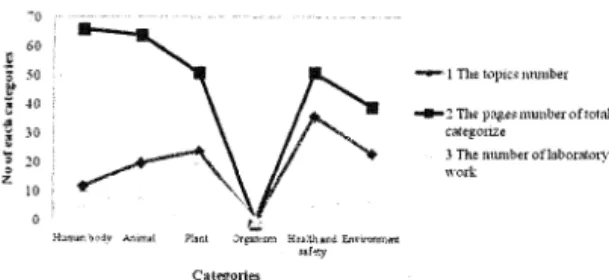
From the comparison elementary school science textbooks (Biology field) of Lao and Japan, Laos's text book had many pages. But, the
353-number of grade was 5, while it was 4 in Japan. c "5 50
r
-10 ~ 30 ~ 20 z: 10 '-....-' 1 TIle wpic;: munber
_::; Th,. pages lHunber of total categorize
J The number oflaborator~
work
Fig.l. Elementary School World around Us of Laos
100 <)0
so
Alumal P!int Orgil!\l~ Heatthlll1d &Wll'O!lIlli'!t saf'!ty
3TIlClmmber,lf l;]b<)r;'l/t)ly'n~d; It
_~ 111tp;l~e" Iilllllllerof t(lt~1 ,at~l)nZe s+
Fig.2. Elementary school science textbooks of Japan
When the average per grade was compared in the two countries, the difference was not more than 10 pages. Similarly, the average time of each grade was very similar between both. On the other hand, the number of topics was very different. Thus, in the Laos's text book, one topic seems to hold a few pages. Whereas, one topic
needs many page in Japanese. It could be said
that much more time is used for one topic in Japanese.
From data about the topic pages and numbers for the 6 categories, in Laos, "human body" and "health and safety" seem to be important. Japanese seems to consider the
environment important. It seems that this
difference comes from the circumstances of the country. This tendency was also similar for the time for laboratory work in each category of both countries, except the case about the plant in the Laos's text book.
In the questionnaire, it was conclude that Laos's teachers must make the teaching materials for the lecture and the laboratory work, because these teaching materials are not enough. Therefore, they cannot prepare for the class lesson enough. This state took the opportunity when they tried to improve their class lessons.
Future improvement is waited for. In addition, the
teachers in Laos needs the information for
development of their teaching materials. The
maintenance expected.
10
and inflection of internet are
lill
9 toScorc:-s
Fig. 3. A score of simple post-test for Group A and B
In the result from applied the simple post-test, Fig. 3 shows the score of Group A and Group B for the test of Grades 5. Both groups indicated that the test score of Group B was higher than the Group A. This means that students improve their understanding about that content of those topics after using the teaching materials and doing experiments. Students' impressions about the class work were very positive because they thought that learning through this method was interesting, interactive and enjoyable. They also thought that class work was not boring, and they could easily understand the biology experiments. Teaching through this method seemed to be also easier and enjoyable for us, because teachers and students interacted with each other.
It is well known that the instruction of
biology in Laos has complex problems. The main problems are lack of knowledge of teachers, low quality of text books, and the unavailability of teaching materials. Therefore the goal of this research is to develop teaching materials related
to biology. If this can be accomplished, it is
expected that Lao's students will become more active, be motivated more, and be interested. Moreover, they are able to understand Laos's text books easily. Also, from this study, it is recommended that teachers of elementary school in Laos should teach based on the "Leamer Centered approach," used here to improve the teaching-learning process. Therefore, Laos's teachers adopt this type of teaching method, and it is important to improve it so that it is a teaching method in accord with Laos's situation.