二ケイ酸リチウム含有セラミックスおよび石英と レジン系装着材料との接着強さに
シランと酸性機能性モノマーが及ぼす影響
日本大学大学院歯学研究科歯学専攻
田口 世里奈
(指導:松村 英雄 教授,小峰 太 准教授)
1
概 要
歯科用セラミックスは,優れた審美性,高い生体適合性,耐摩耗性により,ラミネ ートベニアや固定性補綴装置など広い範囲で使用されている。歯科用セラミックスの 中で,酸化ジルコニウムセラミックスに代表される高強度セラミックスは,シリカを 主成分とするセラミックス(長石質系陶材,二ケイ酸リチウム含有セラミックスなど)
と比較して,優れた強度と高い破壊耐久性を示す。一方,シリカを主成分とするセラ ミックスは,高強度セラミックスと比較して,より高い光透過性と透明性を持ち,優 れた審美性を獲得することが可能である。
二ケイ酸リチウム含有セラミックスは,ロストワックス法や Computer Aided Design/Computer Aided Manufacturing(CAD/CAM)で製作される。また,他のシリカ を主成分とするセラミックスに比べて,高い曲げ強さや破壊靱性を有し,かつ審美的 な修復材料として広く臨床応用されている。
セラミック修復の臨床的成功には,修復材料と支台歯間の強固で,かつ接着耐久性 のあるレジンとの結合が必要である。特に,シリカを主成分とするセラミックスは脆 性材料であり,微小な欠陥から亀裂が進展するために,支台歯との強固な接着が必須 となる。そのためには,セラミック材料とレジン間での機械的嵌合と化学的な結合が 必要となる。機械的嵌合を得るための表面処理として,フッ化水素酸(HF)処理やア ルミナブラスト処理が推奨されている。その後,二官能性シランによるシラン処理に よって,レジン系装着材料とシリカを主成分とするセラミックスとの化学的結合を獲 得する。
最近では,セラミック接着において,多くの製造会社から,1液性,2液性および3 液性の表面処理剤が発売されている。表面処理剤としては,ベースモノマー,接着性 機能性モノマー,溶媒および重合開始剤を含むものが一般的に用いられている。また,
酸性条件下や加熱条件下でのシラン処理により,接着強さが向上する。これに加えて,
表面処理剤に含まれる酸性機能性モノマーが,縮合反応を促進し,セラミック接着に 効果的に働く。これまでに,二ケイ酸リチウム含有セラミックスに対するレジン系装 着材料の接着強さについての報告はあるが,レジン系装着材料と二ケイ酸リチウム含 有セラミックスおよび石英との接着において,シランと酸性機能性モノマーとの関連 を研究したものは少ない。そこで,本研究の目的は,シランと酸性機能性モノマーが,
2
レジン系装着材料と二ケイ酸リチウム含有セラミックスおよび石英とのせん断接着 強さに及ぼす影響を評価することとした。
被着体として合計264枚の二ケイ酸リチウム含有セラミックス(e.max Press LT A2 shade,Ivoclar Vivadent,以下e.max)円形平板(直径11.0 mm,厚さ2.5 mmおよび直
径 8.0 mm,厚さ 2.5 mm)を製作した。また,SiO2の含有量 99 %からなる石英丸棒
(Kokugo,以下石英)から円形平板(直径11.0 mm,厚さ2.5 mmおよび直径8.0 mm,
厚さ2.5 mm)を切り出し被着体とした。全ての試料を400番,800番,1200番の順番
で耐水研磨紙にて,注水研削した。その後,直径 11.0 mmの試料に対して,直径5.0 mmの穴の開いた片面テープにて接着面積を規定した。
試料は 6 種類の表面処理群ごとに,各群 11 個に分けた。試料の表面処理方法は,
Clearfil Porcerain Bond Activator(Kuraray Noritake Dental,以下Act), Clearfil Photo Bond(Kuraray Noritake Dental,以下CPB),Clearfil Photo Bond UniversalとActの等量 混和液(Kuraray Noritake Dental,以下CPBU+Act),Clearfil Photo Bond CatarystとAct の等量混和液(Kuraray Noritake Dental,以下CPBC+Act),Clearfil Photo BondとAct の等量混和液(Kuraray Noritake Dental,以下CPB+Act),表面処理なし(以下UP) の計6条件とした。各種表面処理は,マイクロブラシを用いて,直径11.0 mm,8.0 mm の試料両方に塗布した。その後,オイルフリースプレーを用いてマイルドエアーにて 乾燥した。
各試料の接着には,レジン系装着材料(Panavia V5,Kuraray Noritake Dental)を製 造社指示に従って使用した。e.max および石英それぞれの直径11.0 mmの試料に直径
8.0 mmの試料を荷重5 Nで圧接後,光照射器を用いて40秒間光照射を行った。その
後,25°Cの暗室下にて30分間放置後,製作した試料(n = 22)を37°C精製水中にて 24時間浸漬した。この状態を水中熱サイクル負荷0回とした。半数の試料(n = 11) に対しては,サーマルショックテスターを用いて水中熱サイクル負荷(5°Cと55°Cに 各60秒間浸漬)を5,000回行った。
せん断接着試験は,各々の接着試験体を治具に装着し,万能試験機を用いて,クロ スヘッドスピード毎分0.5 mmの条件下で行った。
統計学的検討については,得られたデータに対して Kolmogorov-Smirnov 検定では 正規性を得られず,Levene検定では,等分散性を得られなかった。それら検定結果を もとに,6条件の表面処理群におけるせん断接着強さを比較するために,Kruskal-Wallis
3
検定後に,Steel-Dwass検定を行った。さらに,同一表面処理群における水中熱サイク ル負荷前後のせん断接着強さの比較には,Mann-Whitney U検定を用いた。なお,すべ ての検定は有意水準5%の条件で行った。
せん断接着試験後に,実体顕微鏡で試料破断面の観察を 32 倍の倍率で行い,破壊 様式を,A;レジン系装着材料とセラミック材料の界面破壊,AC;界面破壊と凝集破 壊の混在する混合破壊,C;被着体破壊に分類した。また,各破壊形式の代表的な試 料に対して,試料被着面にオスミウム蒸着処理を行い,加速電圧15 kVの条件下で走 査電子顕微鏡(以下SEM)を用いて試料表面の観察を行った。さらに,各破壊形式の 代表的な試料に対して,X線回折装置(以下XRD)を用いて,e.max試料および石英 試料表面,レジン系装着材料,せん断接着試験後のe.max試料および石英試料表面に 対して表面分析を行った。測定条件は,管電圧30 kV,管電流15 mAでCuKα線を使 用し走査角度(2θ)を3〜90°の範囲とした。得られたデータは,X線解析ソフトウェ アを使用して処理した。
e.maxおよび石英試料において,水中熱サイクル負荷の有無に関わらず,Steel-Dwass
検定では,CPB+Act が他の群に比較し有意に高いせん断接着強さを示した。また,
e.maxおよび石英試料は,水中熱サイクル負荷0回と5,000回において,Act群よりも
CPBC+Act群が有意に高い接着強さを示した。さらに,CPBU+Act群は,Act群と比 較して,水中熱サイクル負荷前では,e.max試料(p = 0.898)および石英試料(p = 0.478) で,有意差は認められなかったが,水中熱サイクル負荷後においては,有意に高いせ ん断接着強さ(p < 0.001)を示した。なお,いずれの試料においても,UPで水中熱サ
イクル5,000回負荷後では,せん断接着試験以前に接着界面で脱離した。Mann-Whitney
U検定の結果では,水中熱サイクル負荷前後で,せん断接着強さはすべての群におい て有意に低下した。
せん断接着試験後の破壊形式は,石英試料では,3-trimethoxysilylpropyl methacrylate
(3-TMSPMA)を使用した4群(Act,CPBC+Act,CPBU+ActおよびCPB+Act群)
において被着体の凝集破壊が観察された。さらに,e.max試料では,Act,CPBC+Act,
CPBU+Act および CPB+Act 群の 4 群で混合破壊が観察された。水中熱サイクル負荷
後では,石英試料のCPB+Act群のみで混合破壊が観察された。
SEM観察の結果,界面破壊を呈した試料は,注水研削後の試料表面と同様の表面構 造が観察された。また,混合破壊を呈した試料表面には,e.max および石英試料表面
4
の構造とレジン系装着材料と思われる残留物が観察された。
XRDによる破断面の分析結果において,e.maxおよび石英試料のせん断接着試験後 に,混合破壊を呈した試料は,e.max および石英試料と一致したピークとレジン系装 着材料と一致したピークの両方が検出された。
二ケイ酸リチウム含有セラミックスおよび石英とレジン系装着材料との接着強さ に,シランと酸性機能性モノマーが及ぼす影響について検討した結果,以下の結論を 得た。
1.水中熱サイクル負荷前において,二ケイ酸リチウム含有セラミックスおよび石英 とレジン系装着材料間のせん断接着強さの獲得には,シラン,酸性機能性モノマーお よび重合開始剤の併用が有効であった。
2.水中熱サイクル負荷後,二ケイ酸リチウム含有セラミックスおよび石英とレジン 系装着料間のせん断接着強さは,すべての試料で有意に低下した。
3.水中熱サイクル負荷後,シランのみを用いた場合の接着耐久性は極めて低く,接着 耐久性の獲得には,シラン,酸性機能性モノマーおよび重合開始剤の併用が有効であ った。
なお,本論文はTaguchi S, Komine F, Kubochi K, Fushiki R, Kimura F, Matsumura H (2017) Effect of silane and phosphate functional monomers on shear bond strength of a resin- based luting agent to lithium disilicate ceramic and quartz materials. Journal of Oral Science
(in press)を基幹論文とし,SEM観察像を新たに加えることによって総括したもので
ある。
5
緒 言
歯科用セラミックスは,優れた審美性,高い生体適合性,耐摩耗性により,ラミネ ートベニアや固定性補綴装置など広い範囲で使用されている。歯科用セラミックスの 中で,酸化ジルコニウムセラミックスに代表される高強度セラミックスは,シリカを 主成分とするセラミックス(長石質系陶材,二ケイ酸リチウム含有セラミックスなど)
と比較して,優れた強度と高い破壊耐久性を示す(1,2)。一方,シリカを主成分とす るセラミックスは,高強度セラミックスと比較して,より高い光透過性と透明性を持 ち,優れた審美性を獲得することが可能である(3)。
二ケイ酸リチウム含有セラミックスは,ロストワックス法や Computer Aided Design/Computer Aided Manufacturing(CAD/CAM)で製作される。また,他のシリカ を主成分とするセラミックスに比べて,高い曲げ強さや破壊靱性を有し,かつ審美的 な修復材料として広く臨床応用されている(4)。
セラミック修復の臨床的成功には,修復材料と支台歯間の強固で,かつ接着耐久性 のあるレジンとの結合が必要である(5-7)。特に,シリカを主成分とするセラミック スは脆性材料であり,微小な欠陥から亀裂が進展するために,支台歯との強固な接着 が必須となる。そのためには,セラミック材料とレジン間での機械的嵌合と化学的な 結合が必要となる(8-10)。機械的嵌合を得るための表面処理として,フッ化水素酸
(HF)処理(8,10)やアルミナブラスト処理が推奨されている(11,12)。その後,二 官能性シランによるシラン処理によって,レジン系装着材料とシリカを主成分とする セラミックスとの化学的結合を獲得する(13,14)。
最近では,セラミック接着において,多くの製造会社から,1液性,2液性および3 液性の表面処理剤が発売されている。表面処理剤としては,ベースモノマー,接着性 機能性モノマー,溶媒および重合開始剤を含むものが一般的に用いられている(15,16)。 また,酸性条件下や加熱条件下でのシラン処理により,接着強さが向上する(17,18)。 これに加えて,表面処理剤に含まれる酸性機能性モノマーが,縮合反応を促進し,セ ラミック接着に効果的に働く(19)。これまでに,二ケイ酸リチウム含有セラミック スに対するレジン系装着材料の接着強さについての報告はあるが(20-22),レジン系 装着材料と二ケイ酸リチウム含有セラミックスおよび石英との接着において,シラン と酸性機能性モノマーとの関連を研究したものは少ない。
6
本研究の目的は,シランと酸性機能性モノマーが,レジン系装着材料と二ケイ酸リ チウム含有セラミックスおよび石英とのせん断接着強さに及ぼす影響を評価するこ とである。本研究では,シランと酸性機能性モノマーの併用がせん断接着強さに影響 を及ぼさないこと,また,水中熱サイクル負荷がせん断接着強さに影響を及ぼさない こと,を帰無仮説とした。
材料および方法
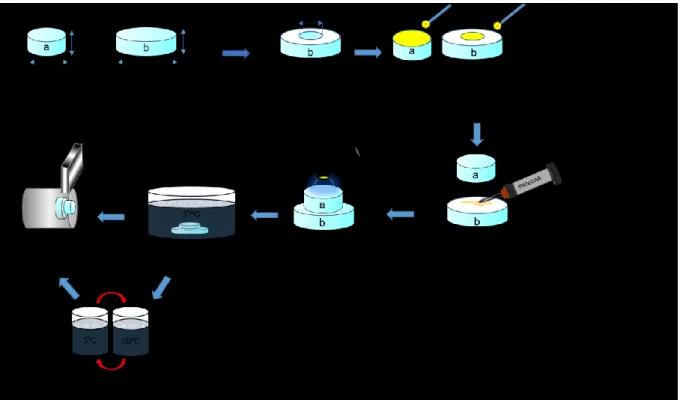
本研究で使用した材料およびその成分を Table 1に示す。被着体として合計 264枚 の二ケイ酸リチウム含有セラミックス(e.max Press,LT,A2 shade,Ivoclar Vivadent, 以下e.max)円形平板(直径11.0 mm,厚さ2.5 mmおよび直径8.0 mm,厚さ2.5 mm) を製作した(Fig. 1A)。また,SiO2の含有量99 %からなる石英丸棒(Kokugo,以下石 英)から円形平板(直径11.0 mm,厚さ2.5 mmおよび直径8.0 mm,厚さ2.5 mm)を 切り出し被着体とした。
全ての試料を400番,800番,1200番の順番で耐水研磨紙(Tri-M-ite Wetordry sheets,
3M)にて,注水研削した。その後,直径11.0 mmの試料に対して,直径5.0 mmの穴
の開いた片面テープにて接着面積を規定した(Fig. 1B)。
試料は 6 種類の表面処理群ごとに,各群 11 個に分けた。試料の表面処理方法は,
Clearfil Porcerain Bond Activator(Kuraray Noritake Dental,以下Act), Clearfil Photo Bond
(Kuraray Noritake Dental,以下CPB),Clearfil Photo Bond UniversalとActの等量混和 液(Kuraray Noritake Dental,以下CPBU+Act),Clearfil Photo Bond CatarystとActの 等量混和液(Kuraray Noritake Dental,以下CPBC+Act),Clearfil Photo BondとActの 等量混和液(Kuraray Noritake Dental,以下CPB+Act),表面処理なし(以下UP)の 計6条件とした(Fig. 1C)。各種表面処理は,マイクロブラシ(Micro Tip Applicator,
GC)を用いて,直径11.0 mm,8.0 mmの試料両方に塗布した。その後,オイルフリー
スプレー(Air Duster AD400FL,Orientec)を用いてマイルドエアーにて乾燥した。
各試料の接着には,レジン系装着材料(Panavia V5,Kuraray Noritake Dental)を製 造社指示に従って使用した(Fig. 1D)。e.maxおよび石英それぞれの直径11.0 mmの試
料に直径8.0 mmの試料を荷重5 Nで圧接後,光照射器(Optilux 501,Kerr)を用いて
40秒間光照射を行った(Fig. 1E)。その後,25°Cの暗室下にて30分間放置後,製作 した試料(n = 22)を37°C精製水中にて24時間浸漬し(Fig. 1F),この状態を水中熱
7
サイクル負荷0回とした。半数の試料(n = 11)に対しては,サーマルショックテス ター(TTS-1 LM,Thomas Kagaku)を用いて水中熱サイクル負荷(5°Cと55°Cに各60 秒間浸漬)を5,000回行った(Fig. 1G)。
せん断接着試験は,各試料をISO TR 11405に準じて,治具(Tokyo Giken)に装着 し,万能試験機(Type 5567,Instron)を用いて,クロスヘッドスピード毎分0.5 mmの 条件下で行った(Fig. 1H)。
統計学的検討については,得られたデータに対してKolmogorov-Smirnov検定(IBM SPSS Statistics version 24.0,International Business Machines)では正規性を得られず,
Levene検定では,等分散性を得られなかった。それら検定結果をもとに,6条件の表
面処理群におけるせん断接着強さを比較するために,Kruskal-Wallis検定(IBM SPSS Statistics version 24.0,IBM)後に,Steel-Dwass検定(KyPlot 5.0,KyensLab)を行った。
さらに,同一表面処理群における水中熱サイクル負荷前後のせん断接着強さの比較に は,Mann-Whitney U検定を用いた。なお,すべての検定は有意水準5%の条件で行っ た。
せん断接着試験後に,実体顕微鏡(Stemi DV4,Carl Zeiss MicroImaging)で試料破 断面の観察を32倍の倍率で行い,破壊様式を,A;レジン系装着 材料とセラミック 材料の界面破壊,AC;界面破壊と凝集破壊の混在する混合破壊,C;被着体破壊に分 類した。また,各破壊形式の代表的な試料に対して,試料被着面にオスミウム蒸着処 理(HPC-IS,Vacuum Device)を行い,加速電圧15 kVの条件下で走査電子顕微鏡(S-
4300,Hitachi High-Technologies,以下SEM)を用いて試料表面の観察を行った。さら
に,各破壊形式の代表的な試料に対して,X 線回折装置(MiniFlex II,Rigaku,以下
XRD)を用いて,e.max試料および石英試料表面,レジン系装着材料,せん断接着試
験後のe.max試料および石英試料表面に対して表面分析を行った。測定条件は,管電
圧30 kV,管電流15 mAでCuKα線を使用し走査角度(2θ)を3~90°の範囲とした。
得られたデータは,X線解析ソフトウェア(PDXL Ver.1.0.7.1,Rigaku)を使用して処 理した。
結 果
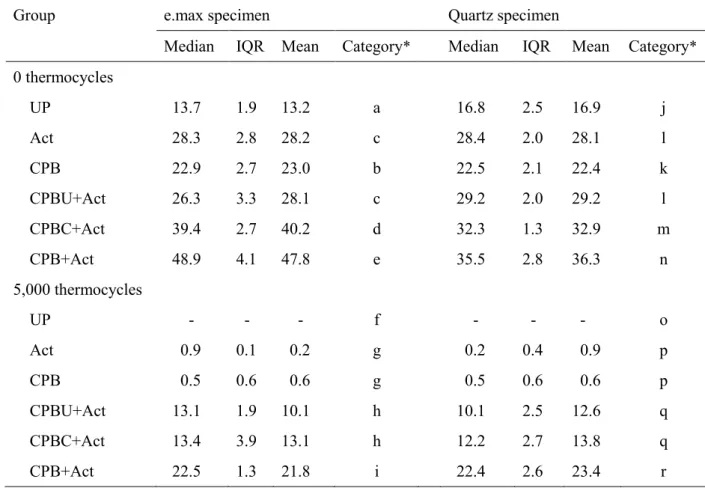
レジン系装着材料と e.max および石英試料間のせん断接着強さの結果を Table 2 に 示す。Steel-Dwass検定では,水中熱サイクル負荷の有無に関わらず,e.maxおよび石
8
英試料において,CPB+Act が他の群に比較し有意に高いせん断接着強さを示した。
また,e.maxおよび石英試料は,水中熱サイクル負荷0回と5,000回において,Act群
よりもCPBC+Act群が有意に高い接着強さを示した。さらに,CPBU+Act群は,Act
群と比較して,水中熱サイクル負荷前では,e.max 試料(p = 0.898)および石英試料
(p = 0.478)で,有意差は認められなかったが,水中熱サイクル負荷後においては,
有意に高いせん断接着強さ(p < 0.001)を示した。なお,いずれの試料においても,
UP で水中熱サイクル 5,000 回負荷群では,せん断接着試験以前に接着界面で脱離し
た。Mann-Whitney U検定の結果では,水中熱サイクル負荷後で,せん断接着強さはす
べての群において有意に低下した。
せん断接着試験後の破壊形式をTable 3に示す。石英試料では,3-trimethoxysilylpropyl methacrylate(3-TMSPMA)を使用した4群(Act,CPBC+Act,CPBU+ActおよびCPB
+Act 群)において被着体の凝集破壊が観察された。さらに,e.max 試料では,Act,
CPBC+Act,CPBU+ActおよびCPB+Act群の4群で混合破壊が観察された。水中熱サ
イクル負荷後では,石英試料のCPB+Act群のみで混合破壊が観察された。
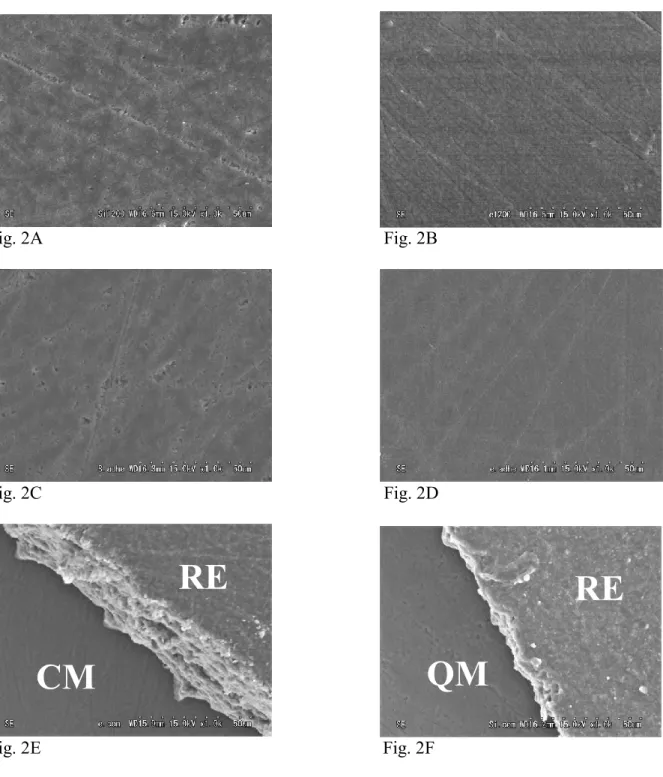
注水研削後のe.maxおよび石英試料表面のSEM観察の結果を示す(Fig. 2A,2B)。 界面破壊を呈した試料は,注水研削後の試料表面と同様の表面構造が観察された(Fig.
2C,2D)。混合破壊を呈した試料表面には,e.max および石英試料表面の構造とレジ
ン系装着材料と思われる残留物が観察された(Fig. 2E,2F)。
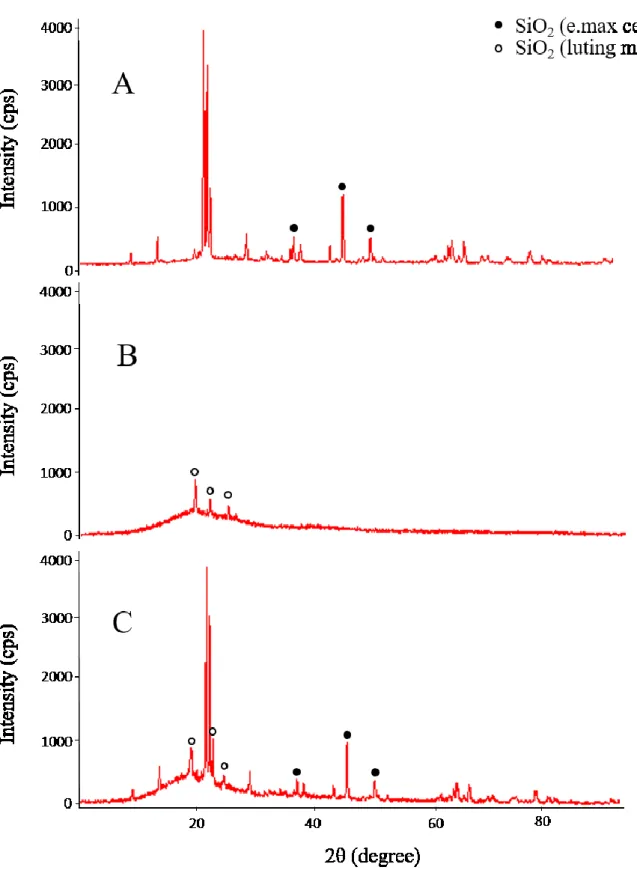
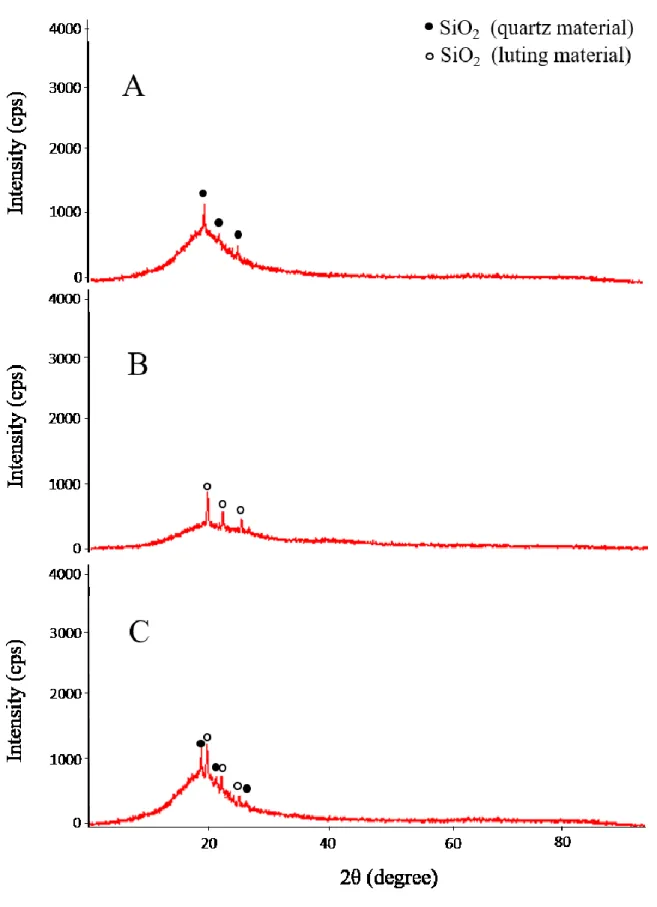
X線回折による破断面の分析結果をFig. 3,4に示す。e.max試料では,SiO2のXRD パターンのピーク(2θ = 38.0°,42.8°および50.7°)が検出された(Fig. 3A)。レジン系 装着材料では,SiO2のピーク(2θ = 22.7°,24.2°および25.6°)が検出された(Fig. 3B)。
e.max試料で,混合破壊を示した試料のXRDパターン(Fig. 3C)では,e.max試料と
一致したピーク(Fig. 3A)とレジン系装着材料と一致したピーク(Fig. 3B)の両方が 検出された。石英試料では,SiO2のXRDパターンのピーク(2θ = 21.5°,23.8°および
26.7°)が検出された(Fig. 4A)。石英と一致したピーク(Fig. 4A)とレジン系装着材
料と一致したピーク(Fig. 4B)が,石英試料で混合破壊を認めた試料(Fig. 4C)にお いて認められた。
9
考 察
本研究では,シリカを主成分としたセラミックスとレジン系装着材料との接着強さ に対して,シランと酸性機能性モノマーが及ぼす影響を評価した。特に,3液性の表 面処理剤は,各溶液を組合せることで,シランと酸性機能性モノマーの併用が,シリ カを主成分とするセラミックスとレジン系装着材料との接着に影響を及ぼすかを評 価するために用いた。本研究の結果から,シランと酸性機能性モノマーの併用がせん 断接着強さに影響を及ぼさないという1つ目の帰無仮説は棄却された。二ケイ酸リチ ウム含有セラミックスおよび石英とレジン系装着材料との接着強さは,シランと酸性 機能性モノマーの影響によって向上した。また,全ての群において,水中熱サイクル 負荷によって,せん断接着強さが有意に低下した。したがって,水中熱サイクル負荷 がせん断接着強さに影響を及ぼさないという2つ目の仮説も棄却された。
e.max と石英のいずれの試料も,水中熱サイクル負荷の有無にかかわらず,酸性機
能性モノマーである疎水性リン酸エステル系モノマー(MDP,10-methacryloyloxydecyl
dihydrogen phosphate),シランおよび重合開始剤を含むCPB+Act群が最も高いせん断
接着強さを示すとともに,試験後の破壊形式においては,混合破壊が観察された。こ れは,MDP による酸性環境下でのシラン(3-TMSPMA)と CPBUに含まれる重合開 始剤を併用することで,e.max および石英試料とレジン系装着材料との接着強さが増 加したものと考えられた。本研究の結果から,e.maxと石英におけるCPBC+Act群は,
水中熱サイクル負荷の有無にかかわらず,Act 群と比較して有意に高いせん断接着強 さを示した。このことから,リン酸エステル系モノマー(MDP)とシランを併用する ことで,表面処理溶液のpHが低下し,シランの効果がさらに高まったために,強固 な接着強さを獲得できたと考えられた(19,23-25)。すなわち,酸性機能性モノマーに よってActに含まれるシランの反応が促進され(12,13,26),さらに,CPBUに含まれ る重合開始剤と併用することが,二ケイ酸リチウム含有セラミックスおよび石英とレ ジン系装着材料間の接着耐久性の獲得に有効であることが示されたが,この結果は,
過去の研究結果と一致するものであった(19,27,28)。
本研究では,シリカ材料である石英は,SiO2に対する有効な表面処理を調査するの に用いられた。e.max 試料内での凝集破壊は観察されなかったが,Act を含む表面処 理を行った石英試料の一部の群で凝集破壊が観察された。この結果は,石英自体の機
10
械的強度の低さに起因している可能性がある(29,30)。
水中熱サイクル負荷後では,全ての群でせん断接着強さが有意に低下した。水中熱 サイクル負荷は,レジンとセラミック材料の接着における疲労耐久性を評価する方法 として一般的に用いられる(31-33)。これは実験試料の材料間での熱膨張係数の違い と熱ストレスによって,接着界面におけるシロキサン結合の加水分解が促進されたた めと考えられる。この結果においても,過去の研究結果と一致していた(34,35)。
本研究で得られた結果の範囲において,リン酸エステル系モノマー(MDP)による 酸性の環境下でシラン(3-TMSPMA)と重合開始剤の併用が,二ケイ酸リチウム含有 セラミックスおよび石英とレジン系装着材料のせん断接着強さの向上に影響するこ とが明らかになった。したがって,石英とレジン系装着材料との接着力を立証するた めの臨床研究が必要であると考えられた。
結 論
本研究の範囲内で以下の結論が得られた。
1.水中熱サイクル負荷前において,二ケイ酸リチウム含有セラミックスおよび石英 とレジン系装着材料間のせん断接着強さの獲得には,シラン,酸性機能性モノマーお よび重合開始剤の併用が有効であった。
2.水中熱サイクル負荷後,二ケイ酸リチウム含有セラミックスおよび石英とレジン 系装着料間のせん断接着強さは,すべての試料で有意に低下した。
3.水中熱サイクル負荷後,シランのみを用いた場合の接着耐久性は極めて低く,接 着耐久性の獲得には,シラン,酸性機能性モノマーおよび重合開始剤の併用が有効で あった。
11
文 献
1. Denry I, Kelly JR (2008) State of the art of zirconia for dental applications. Dent Mater 24, 299-307.
2. Schwindling FS, Rues S, Schmitter M (2017) Fracture resistance of glazed, full-contour ZLS incisor crowns. J Prosthodont Res 61, 344-349.
3. Kelly JR, Benetti P (2011) Ceramic materials in dentistry: historical evolution and current practice. Aust Dent J 56 Suppl 1, 84-96.
4. Wendler M, Belli R, Petschelt A, Mevec D, Harrer W, Lube T et al. (2017) Chairside CAD/CAM materials. Part 2: Flexural strength testing. Dent Mater 33, 99-109.
5. Behr M, Leibrock A, Stich W, Rammelsberg P, Rosentritt M, Handel G (1998) Adhesive- fixed partial dentures in anterior and posterior areas. Results of an on-going prospective study begun in 1985. Clin Oral Investig 2, 31-35.
6. Dumfahrt H, Schaffer H (2000) Porcelain laminate veneers. A retrospective evaluation after 1 to 10 years of service: Part II-Clinical results. Int J Prosthodont 13, 9-18.
7. Peumans M, De Munck J, Fieuws S, Lambrechts P, Vanherle G, Van Meerbeek B (2004) A prospective ten-year clinical trial of porcelain veneers. J Adhes Dent 6, 65-76.
8. Sorensen JA, Engelman MJ, Torres TJ, Avera SP (1991) Shear bond strength of composite resin to porcelain. Int J Prosthodont 4, 17-23.
9. Chen JH, Matsumura H, Atsuta M (1998) Effect of different etching periods on the bond strength of a composite resin to a machinable porcelain. J Dent 26, 53-58.
10. Chen JH, Matsumura H, Atsuta M (1998) Effect of etchant, etching period, and silane priming on bond strength to porcelain of composite resin. Oper Dent 23, 250-257.
11. Lacy AM, LaLuz J, Watanabe LG, Dellinges M (1988) Effect of porcelain surface treatment on the bond to composite. J Prosthet Dent 60, 288-291.
12. Blatz MB, Sadan A, Kern M (2003) Resin-ceramic bonding: a review of the literature. J Prosthet Dent 89, 268-274.
13. Horn HR (1983) Porcelain laminate veneers bonded to etched enamel. Dent Clin North Am 27, 671-684.
14. Peumans M, Van Meerbeek B, Lambrechts P, Vanherle G (2000) Porcelain veneers: a review of the literature. J Dent 28, 163-177.
15. Bertolotti RL, Lacy AM, Watanabe LG (1989) Adhesive monomers for porcelain repair.
Int J Prosthodont 2, 483-489.
16. Matsumura H, Kawahara M, Tanaka T, Atsuta M (1989) A new porcelain repair system
12
with a silane coupler, ferric chloride, and adhesive opaque resin. J Dent Res 68, 813-818.
17. Barghi N (2000) To silanate or not to silanate: making a clinical decision. Compend Contin Educ Dent 21, 659-666.
18. Lung CYK, Matinlinna JP (2012) Aspects of silane coupling agents and surface conditioning in dentistry: An overview. Dent Mater 28, 467-477.
19. Sato K, Matsumura H, Atsuta M (1999) Effect of three-liquid bonding agents on bond strength to a machine-milled ceramic material. J Oral Rehabil 26, 570-574.
20. Gré CP, de Ré Silveira RC, Shibata S, Lago CT, Vieira LC (2016) Effect of silanization on microtensile bond strength of different resin cements to a lithium disilicate glass ceramic. J Contemp Dent Pract 17, 149-153.
21. Yassini E, Mirzaei M, Alimi A, Rahaeifard M (2016) Investigation of the fatigue behavior of adhesive bonding of the lithium disilicate glass ceramic with three resin cements using rotating fatigue method. J Mech Behav Biomed Mater 61, 62-69.
22. Yao C, Zhou L, Yang H, Wang Y, Sun H, Guo J et al. (2017) Effect of silane pretreatment on the immediate bonding of universal adhesives to computer-aided design/computer- aided manufacturing lithium disilicate glass ceramics. Eur J Oral Sci 125, 173-180.
23. Taira Y, Sakai M, Sawase T (2012) Effects of primer containing silane and thiophosphate monomers on bonding resin to a leucite-reinforced ceramic. J Dent 40, 353-358.
24. Iwasaki T, Komine F, Fushiki R, Kubochi K, Shinohara M, Matsumura H (2016) Shear bond strengths of an indirect composite layering material to a tribochemically silica- coated zirconia framework material. Dent Mater J 35, 461-469.
25. Fornazari IA, Wille I, Meda EM, Brum RT, Souza EM (2017) Effect of surface treatment, silane, and universal adhesive on microshear bond strength of nanofilled composite repairs. Oper Dent 42, 367-374.
26. Tanaka R, Fujishima A, Shibata Y, Manabe A, Miyazaki T (2008) Cooperation of phosphate monomer and silica modification on zirconia. J Dent Res 87, 666-670.
27. Yanagida H, Matsumura H, Taira Y, Atsuta M, Shimoe S (2002) Adhesive bonding of composite material to cast titanium with varying surface preparations. J Oral Rehabil 29, 121-126.
28. Noda Y, Nakajima M, Takahashi M, Mamanee T, Hosaka K, Takagaki T et al. (2017) The effect of five kinds of surface treatment agents on the bond strength to various ceramics with thermocycle aging. Dent Mater J, doi:10.4012/dmj.2016-383.
29. Mueller MG, Pejchal V, Žagar G, Singh A, Cantoni M, Mortensen A (2015) Fracture toughness testing of nanocrystalline alumina and fused quartz using chevron-notched
13 microbeams. Acta Materialia 86, 385-395.
30. Alkadi L, Ruse ND (2016) Fracture toughness of two lithium disilicate dental glass ceramics. J Prosthet Dent 116, 591-596.
31. Palmer DS, Barco MT, Billy EJ (1992) Temperature extremes produced orally by hot and cold liquids. J Prosthet Dent 67, 325-327.
32. Kern M, Wegner SM (1998) Bonding to zirconia ceramic: adhesion methods and their durability. Dent Mater 14, 64-71.
33. Wegner SM, Gerdes W, Kern M (2002) Effect of different artificial aging conditions on ceramic-composite bond strength. Int J Prosthodont 15, 267-272.
34. Reich SM, Wichmann M, Frankenberger R, Zajc D (2005) Effect of surface treatment on the shear bond strength of three resin cements to a machinable feldspatic ceramic. J Biomed Mater Res B Appl Biomater 74, 740-746.
35. Chai H, Kaizer M, Chughtai A, Tong H, Tanaka C, Zhang Y (2015) On the interfacial fracture resistance of resin-bonded zirconia and glass-infiltrated graded zirconia. Dent Mater 31, 1304-1311.
14
表および図
15 Table 1 Materials assessed in this study
Material/Trade name Code Lot no. Component Manufacturer
Lithium disilicate ceramic material
IPS e.max Press LT A2
SiO2: 57-80%, LiO2: 11- 19%, K2O: 0-13%, P2O5: 0- 11%, ZrO2: 0-8%, ZnO: 0- 8%, others: 0-10%
Ivoclar Vivadent, Schaan,
Liechtenstein
Silica material
Quartz
SiO2: 99%
Kokugo Co., Ltd, Tokyo, Japan
Priming/bonding agent
Clearfil Photo Bond CPB
Catalyst CPBC 850029
MDP, HEMA, Bis-GMA, BPO, CQ, hydrophobic dimethacrylate
Kuraray Noritake Dental Inc., Tokyo, Japan
Universal CPBU 460025 Initiator, accelerator, ethanol
Clearfil Porcelain Bond Activator Act 690031
3-TMSPMA, hydrophobic aromatic dimethacrylate, others
Kuraray Noritake Dental Inc.
Luting agent
Panavia V5 1G0046 Kuraray Noritake
Dental Inc.
A Paste
Bis-GMA, TEGDMA, hydrophobic aromatic dimethacrylate, silanated barium glass filler, hydrophilic aliphatic dimethacrylate,
fluoroalminosilicate glass filler, colloidal silica, accelerator, initiator
B Paste
Bis-GMA, hydrophobic aromatic dimethacrylate, hydrophilic aliphatic dimethacrylate, silanated barium glass, silanated alminium oxide filler, colloidal sillica, CQ, accelerator, pigments, others
MDP: 10-methacryloyloxydecyl dihydrogen phosphate, HEMA: 2-hydroxyethyl methacrylate, Bis-GMA: bisphenol A- glycidyl methacrylate, BPO: benzoyl peroxide, CQ: dl-camphorquinone, 3-TMSPMA: 3-trimethoxysilylpropyl methacrylate, TEGDMA: triethylene glycol dimethacrylate.
16
Table 2 Shear bond strengths (MPa) of a luting agent to e.max and quartz specimens at 0 and 5,000 thermocycles
Group e.max specimen Quartz specimen
Median IQR Mean Category* Median IQR Mean Category* 0 thermocycles
UP 13.7 1.9 13.2 a 16.8 2.5 16.9 j
Act 28.3 2.8 28.2 c 28.4 2.0 28.1 l
CPB 22.9 2.7 23.0 b 22.5 2.1 22.4 k
CPBU+Act 26.3 3.3 28.1 c 29.2 2.0 29.2 l
CPBC+Act 39.4 2.7 40.2 d 32.3 1.3 32.9 m
CPB+Act 48.9 4.1 47.8 e 35.5 2.8 36.3 n
5,000 thermocycles
UP - - - f - - - o
Act 0.9 0.1 0.2 g 0.2 0.4 0.9 p
CPB 0.5 0.6 0.6 g 0.5 0.6 0.6 p
CPBU+Act 13.1 1.9 10.1 h 10.1 2.5 12.6 q
CPBC+Act 13.4 3.9 13.1 h 12.2 2.7 13.8 q
CPB+Act 22.5 1.3 21.8 i 22.4 2.6 23.4 r
UP: unpriming, Act: Cleafil Porcelain Bond Activator, CPB: Cleafil Photobond Cataryst and Cleafil Photobond Universal, CPBU+Act: Cleafil Photo Bond Universal with Cleafil Porcelain Bond Activator, CPBC+Act: Cleafil Photo Bond Cataryst with Cleafil Porcelain Bond Activator, CPB+Act:
Cleafil Photo Bond Cataryst and Universal with Cleafil Porcelain Bond Activator IQR: Interquartile range
*Different letters indicate statistically significant differences (Steel-Dwass test; P < 0.05).
17 Table 3 Failure modes after shear bond testing
UP: unpriming, Act: Cleafil Porcelain Bond Activator, CPB: Cleafil Photobond Cataryst and Cleafil Photobond Universal, CPBU+Act: Cleafil Photo Bond Universal with Cleafil Porcelain Bond
Activator, CPBC+Act: Cleafil Photo Bond Cataryst with Cleafil Porcelain Bond Activator, CPB+Act:
Cleafil Photo Bond Cataryst and Universal with Cleafil Porcelain Bond Activator
A: adhesive failure at the resin-based luting agent/ceramic material interface, AC: combination adhesive/cohesive failure, C: cohesive failure within the ceramic material.
Group e.max specimen Quartz specimen
A AC C A AC C
0 thermocycles
UP 11 0 0 11 0 0
Act 8 3 0 0 1 10
CPB 11 0 0 1 10 0
CPBU+Act 9 2 0 0 1 10
CPBC+Act 5 6 0 0 1 10
CPB+Act 3 8 0 0 0 11
5,000 thermocycles
UP 11 0 0 11 0 0
Act 11 0 0 11 0 0
CPB 11 0 0 11 0 0
CPBU+Act 11 0 0 11 0 0
CPBC+Act 10 1 0 11 0 0
CPB+Act 9 2 0 1 10 0
18
Fig. 1 Procedure for fabrication of the specimens and shear bond test. UP: unpriming, Act:
Cleafil Porcelain Bond Activator, CPB: Cleafil Photobond Cataryst and Cleafil Photobond Universal, CPBU+Act: Cleafil Photo Bond Universal with Cleafil Porcelain Bond Activator, CPBC+Act: Cleafil Photo Bond Cataryst with Cleafil Porcelain Bond Activator, CPB+Act:
Cleafil Photo Bond Cataryst and Universal with Cleafil Porcelain Bond Activator
19
Fig. 2A Fig. 2B
Fig. 2C Fig. 2D
Fig. 2E Fig. 2F
Fig. 2 SEM image of (A): a ceramic material surface after grinding, (B): a quartz material surface after grinding, (C): a ceramic material surface exhibiting adhesive failure after shear bond testing, (D): a quartz material surface exhibiting adhesive failure after shear bond testing, (E): a ceramic material surface exhibiting combination of adhesive/cohesive failure after shear bond testing, (F): a quartz material surface exhibiting combination of
adhesive/cohesive failure after shear bond testing (original magnification×1000). RE: resin- based luting agent, CM: ceramic material, QM: quartz material
CM
RE RE
QM
20
Fig. 3 XRD diffraction patterns of (A) an e.max ceramic material, (B) a resin-based luting agent, and (C) an e.max specimen exhibiting combination adhesive/cohesive failure after shear bond testing.
21
Fig. 4 XRD diffraction patterns of (A) a quartz material, (B) a resin-based luting agent, and (C) a quartz material specimen exhibiting combination adhesive/cohesive failure after shear bond testing.