タイトル
Fully Public Education and Low-Ability
Individuals’ Welfare
著者
Hemmi, Noriyoshi
引用
季刊北海学園大学経済論集, 66(1): 55-61
《研究ノート》
Fully Public Education and Low-Ability
Individualsʼ Welfare
Noriyoshi Hemmi
*Abstract
We have investigated how educational ability-screening affects the demand for education. If ability-screening is delayed, low-ability individuals might be overeducated. We show that when society overeducates low-ability individuals, a mixed-system is a socially optimal and, in addition, a fully public system does not maximize the welfare of low-ability individuals.
1 Introduction
Although knowledge and skills can be acquired through education, some abilities are innate. Information about individual ability is not always available, even to the individuals themselves, especially at an early stage of education. This uncertainty sheds light on the role of education in screening individual ability. For example, ability-screening in education may be beneficial for more efficient and effective human resource allocation (Arrow, 1973). At the same time, it may exacerbate inequality in future income. If so, tax-financed public education remains controversial (Stiglitz, 1975). In the existing literature, economic justifications for education subsidies rely mostly on the positive externalities of higher education (Wigger, 2001), incomplete markets for educational loans (Carneiro and Heckman, 2002), and missed opportunities to insure against educational risks (Wigger and von Weizsäcker, 2001). In more recent works, Oshio and Yasuoka (2009), in which an education has no externalities, discuss the demand for education in several educational systems and the shape of an optimal education system, opining that publicly subsidized education is efficient because it limits educational investment.
This paper is based on Oshio and Yasuoka (2009). We modify one point, the decision about whether or not to stay in school, which is based on the net benefit of dropping out. This modification simplifies Oshio and Yasuokaʼs explanation and makes it possible to show that a fully public system is not a socially optimal and does not maximize the welfare of low-ability individuals.
* Faculty of Economics HOKKAI GAKUEN UNIVERSITY 4-1-40, Asahi-Machi, Toyohira-Ku, Sapporo,
2 Demand for Education
Following Oshio and Yasuoka (2009), we divide students into high-ability ( ) and low-ability ( ), who are represented as p and ( ), respectively, for the total population. After receiving education of length , each type of individual obtains an educational output worth . ( , ) is a positive parameter of an individualʼs innate ability, and we assume that and .
2.1 Demand for a Definite Education
After receiving education of length x, the net benefit received from this education, ( )( , ) is expressed as
where c is the unit cost of education and r is the discount rate. If individuals are fully informed about their abilities in advance, they maximize ( ). The optimal length of education, for each type, denoted by ( , ), is solved by
(1)
From , we have . Because is an elasticity of educational output, and is the
discount rate, it is reasonable to assume that . Under this assumption, we can normalize as
1, without loss of generality.
Since we do not consider the positive externalities of education, the net social benefit from education is maximized when two types of individuals receive education of length and ,
respectively.
2.2 Conditions for Staying in School
We assume that the government establishes an education system with a total length of 1, since an education longer than is not demanded in our model. In addition, we assume that individuals
do not know their abilities before receiving an education and an individual who drops out before completing his education is always treated as low-ability. Only high-ability individuals who complete their education are considered high-ability. After receiving an education of length , individuals conjecture that they are high-ability with probability ( ), ( , , (x), ( )
, ( ) ( )). Thus, the condition for staying in school at is
From the above inequality, we derive the following formula:
(2)
― 56 ― 北海学園大学経済論集 第 66 巻第 1 号(2018 年 6 月) Fully Public Education and Low-Ability Individualsʼ Welfare(Noriyoshi Hemmi) ― 57 ―
図 1 図題 図 1 図題
2.3 Private Systems
We start with a non-subsidized education system, which is called private education. In this system, the graph of the right-hand side of Equation (2) has a form similar to the graph of ( ),
which peaks at . Figure 1 graphs the right-hand side of Equation (2) and ( ), which intersects
at *(
). In this case, high-ability individuals complete their education, and low-ability
individuals do not but still receive a more than socially optimal education.
2.4 Mixed Systems
Next, we examine how a combination of public and private education, which is called a mixed system, can affect the demand for education. In a mixed education, the public sector provides a partial public education of length ( ), through which all individuals can receive tax-financed education between 0 and . Given the wage-proportional tax t, the optimal length of public education for each type, is / (). Consequently, individuals do not drop out of public education. After completing public education, they can receive additional private education if they wish and drop out at any time. Thus, the net benefits received by high- and low-ability individuals who work are expressed as
(3)
(4) Public education costs are fully financed by a wage-proportional tax, with rate t. The tax rate t is solved by
Figure 1: Timing of Dropouts in Private System: Low-ability individuals drop out at *, and high-ability
(5) From Equations (3), (4), and (5), we have (1)/ , ( )/ , and (1)/ .
Therefore, an increase in public education causes the graph of the right-hand side of Equation (2) to shift upwards (Figure 2).
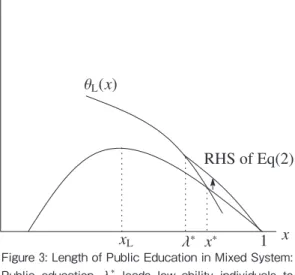
Fig 3 shows how long the public sector should set the length of public education. In Figure 3, where society faces overeducating of low-ability individuals, the public sector should set the length of public education, as follows,
where public education * leads low-ability individuals to drop out after completing public
education. Although society still overeducates low-ability individuals, they drop out at the minimum overeducation ( *
).
3 Policy Implications
3.1 Net Social Benefit from Education
When society faces overeducation of low-ability individuals in the private education system, the public sector can set the length of public education, which causes low-ability individuals to drop out at the minimum overeducation. Also, when the public sector sets the length of public education at , this education system becomes fully public. But since there is no externality, a fully public system is not a socially optimal. Thus, in this case, a mixed system can be more efficient than other systems.
― 58 ― 北海学園大学経済論集 第 66 巻第 1 号(2018 年 6 月) Fully Public Education and Low-Ability Individualsʼ Welfare(Noriyoshi Hemmi) ― 59 ―
Figure 2: Length of Public Education and the Condition for Staying in School
3.2 The Distributional Aspect of Education
A welfare government may insist that a fully public education system should be chosen for its distributional aspect from the viewpoint of equity. This is potentially an important aspect of education policy. Hereafter, we compare a mixed system ( *) in Figure 3 with a fully public
system ( ), in terms of their respective distributional aspects.
In a mixed system ( *), high-ability individuals complete their education, and low-ability
individuals receive public education * only. We can calculate the tax rate from Equation (5).
Low-ability individuals face the costs of education, whose real unit cost ( ) is solved by
Thus, the relationship between the length of public education and is expressed as
(6)
How long do low-ability individuals want to stay in school if the cost of their education is subsidized ( )? The benefit obtained from education by lowability individuals whose education is subsidized is expressed as
Thus, the optimal length of education and satisfies the following equation:
Figure 3: Length of Public Education in Mixed System: Public education λ*
leads low-ability individuals to drop out at the minimum overeducation.
(7)
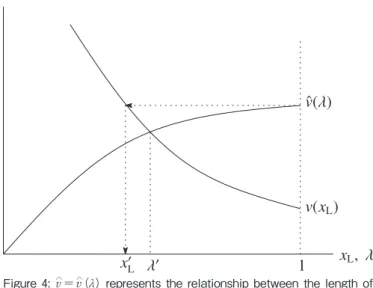
From Equation (1) and , we have (1) (1). Thus, the graphs of ( ) and ( ) are
drawn in Figure 4.
Notice that if , then a mixed system is equivalent to a fully public system. Thus, in a fully public system, (1)c is the real unit cost of education. The net benefit of a fully public system ( ) is equal to a the private education of length 1, with subsidized cost (1)c. However, Figure 4 shows that in a private system with subsidized cost (1)c, the optimal length of education is .
This means that if the real unit cost of education remains unchanged on a level of (1)c, the public sector can increase the net benefit for low-ability individuals solely by shortening the length of public education. Additionally, Equation (6) shows that a shorter leads to a lower real unit cost ( )c. Thus, a mixed system can lead to a higher net benefit for low-ability individuals than a fully public system. Considering (1)/ and the above result, a fully public system is not
Pareto-optimal.
4 Conclusion
We have investigated how educational ability-screening affects the demand for education. If ability-screening is delayed, low-ability individuals might be overeducated. When society overeducates low-ability individuals, the public sector can set the length of public education to improve its efficiency. In this case, a mixed system can be more efficient than either a private or fully public system. In addition, we show that it is irrational to shift to a fully public system,
― 60 ― 北海学園大学経済論集 第 66 巻第 1 号(2018 年 6 月) Fully Public Education and Low-Ability Individualsʼ Welfare(Noriyoshi Hemmi) ― 61 ―
Figure 4: ( ) represents the relationship between the length of public education and the real unit cost. ( ) is the relationship
because a fully public system is not a socially optimal and, in addition, it does not maximize low-ability individualsʼ welfare.
〈References〉
Arrow, K. J. (1973): ʻHigher education as a filterʼ, Journal of Public Economics, 2, pp.193-216.
Carneiro, P., Heckman, J. (2002): ʻThe Evidence on Credit Constraints in Post Secondary Schoolingʼ, Economic Journal, 112, pp.705-734.
Heckman, J. J. (2006): ʻSkill formation and the economics of investing in disadvantaged childrenʼ, Science, 30, pp. 1900-1902.
Oshio, T., Yasuoka, M. (2009): ʻHow long should we stay in education if ability is screened?ʼ, Metroeconomica, 60, pp.409-431.
Stiglitz, J. E. (1975): ʻThe theory of “screening”, education, and the distribution of incomeʼ, American Economic Review, 65, pp.283-300.
Wigger, B. U. (2001): ʻPareto-efficient Intergenerational Transfersʼ, Oxford Economic Papers, 53: pp.260-280. Wigger, B. U., von Weizsäcker, R. K. (2001): ʻRisk, Resources and Education - Public versus Private Financing of