Title
[調査報告]A Case Report on Public Health Managers in
Philippine Rural Communities −A New Career Path for
Graduates with a Bachelor of Science in Public Health−
Author(s)
Hokama, Tomiko; Ernesto R. Gregorio Jr.; Nina G. Gloriani
Citation
琉球医学会誌 = Ryukyu Medical Journal, 30(1-4): 49-54
Issue Date
2011
URL
http://hdl.handle.net/20.500.12001/10223
A Case Report
on Public
Health
Managers
in Philippine
Rural
Communities
-ANewCareer Path
for Graduates
with
a Bachelor
of Science
in Public
Health-Tomiko Hokama°, Ernesto R. Gregorio Jr.2) and Nina G. Gloriani2)
i;Graduate School of Health Sciences, University of the Ryukyus 2)College of Public Health, University of the Philippines Manila (Received on December 21, 2012, accepted on February 15, 2012)
ABSTRACT
A program called the Public Health Manager Placement Program (PHMPP) was
developed and implemented in several municipalities in the Philippines. The program aimed to complement the scarce health human resources in selected rural communities. We reviewed the perceived usefulness and relevance of the Bachelor of Science in Public
Health (BSPH) curriculum vis-a-vis the work of a Public Health Manager (PHM).
These findings can be used for curricular enhancement and/or serve as the basis for
possible replication of the program within the Asia-Pacific Region. The objective of this
case study was to document the usefulness and relevance of the BSPH curriculum to
the roles and responsibilities of a PHM in rural areas. This case report was prepared
through an in-depth interview with two PHMs assigned in the Bicol Region. Both
PHMs felt that the BSPH curriculum was useful and relevant to their PHM roles and
responsibilities because they were able to apply the competencies gained during their third and fourth years to rural communities. These skills included doing a thorough situational analysis, proper data collection, and recording and analysis of health data that were used in developing a health plan for the Municipal Health Office. Strategies/ activities in public health that they learned from the courses were used to implement the health plan. Both PHMs were actively involved in training the health center staff on data analysis, presentation, and preparation of monthly reports and vendors on food safety. PHMs also coordinated with other agencies to ensure water portability in the
community. There were minor issues related to the communication of the role and
re-sponsibilities of the PHMs to the local government unit as well as a need for training
on budgeting. Overall, the BSPH curriculum was useful and relevant to the PHMPP of
the Department of Health. This is another career path that graduates with a BSPH can
pursue in the future. Ryukyu Med. J., 30(1-4)49-54, 2011
Key words: public health managers, public health managers placement program, public
health services, Barangays/Villages
INTRODUCTION
Public Health Manager (PHM) is a position that was developed out of the collaborative effort between the University of the Philippines College
of Public Health and the Department of Health
(DOH) to complement limited human resources
for healthcare in Philippine rural communities0. In 2008, this position became part of the Public
Health Managers Placement Program (PHMPP)
of the DOH. The program brought to fore a new
avenue that a graduate with a Bachelor of Science
in Public Health (BSPH) degree can pursue apart
50
Public health managers in Philippine rural communities.
as a medical technologist, or working in research.
The program was designed to attract BSPH
graduates from the University of Philippines to
support the Doctors to the Barrios/Municipal
Health Officers (DTTBs/MHOs) in the delivery of
public health services. After developing
compe-tency as a PHM or specialist with adequate
knowledge, attitudes, and skills in the manage-ment of public health programs, providers are
ex-pected to contribute to the improvement of the
delivery of quality healthcare services in rural
areas. By allowing the PHM to assume certain
management functions from the DTTBs/MHOs, it
allows physicians to allocate more time and effort to the clinical aspect of health service delivery.
In the Philippines, a province is made up of municipalities/towns and cities. Based on Internal
Revenue Allotment, a municipality-consisting of
Barangays/Villages and the Capital, can be classi-fied based on annual income. Thus a first-class
municipality would have the highest annual
in-come (more than $1.15MUS) and a sixth-class
municipality would have the lowest annual income (less than $233,000US)2'3). The term of the con-tract of PHMs in a given municipality is 2 years.
PHMs have worked as new members of the rural
health team in the Philippines since 2008 as part
of the PHMPP. Five PHMs were deployed to
ei-ther fourth- to sixth-class municipalities in 2008
and 2009. The PHMPP later on blossomed into a
more encompassing program called the Rural
Health Team Placement Program (RHTPP),
which deployed a team of health workers that in-cluded doctors, dentists, nutritionists, midwives,
and PHMs in areas where they are needed most.
Deployment is based on the income of the munici-palities such that those with low incomes, such as fifth- and sixth-class municipalities, will be the
government's priority for deployment because
these municipalities do not have adequate
re-sources to hire sufficient manpower. In 2010, the
RHTPP deployed the third group of PHMs, which
included seven BSPH graduates from the
Univer-sity of the Philippines Manila-College of Public
Health and the University of the Philippines
Visayas. This case report was undertaken to
document the perceived usefulness and relevance of the BSPH curriculum to the roles and
responsi-bilities of a PHM. The results of the study can
also be used to plan support for PHMPP
regard-ing their work in rural communities as well as to
serve as a model that can be replicated in the
Asia-Pacific region.
METHODS and RESPONDENTS
This is a case report documenting the work
experiences of two PHMs of the DOH assigned to
fourth- and fifth-class municipalities from two
provinces in the Philippines. In-depth interviews were used to collect data. Using a topic guide, the
two PHMs were queried as to their perception of
the usefulness and relevance of the BSPH
curricu-lum on their current roles/responsibilities as
PHMs as well as issues or problems that impede
their work. Both PHMs were deployed with the
third group of the PHMPP and were working
separately in their respective rural communities
at the time of the interview. The two PHMs were
requested to present a situational analysis of
their respective areas before they were
inter-viewed. Fig. 1 shows the organizational chart of
the rural health unit. The interview was carried
out by one of the authors in a private and
neu-tral location. Upon obtaining permission from the PHMs, the interview was recorded using an IC re-corder and later on transcribed and analyzed.
RESULTS
I. Perceived relevance of the PHMPP for those
with a BSPH
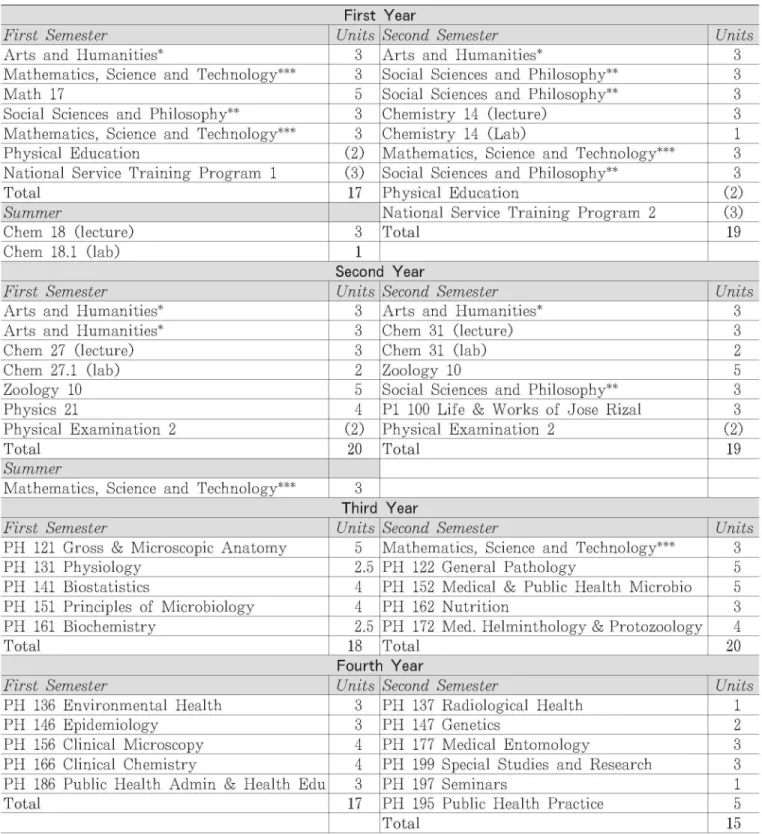
The BSPH curriculum requires 82 credit
units of general education courses (taken during
the first 2 years, including two summer courses)
and 70 credit units in public health courses (taken during the last 2 years). Public health courses in-clude public health policy and administration, health promotion and education, epidemiology and biostatistics, microbiology and parasitology, nu-trition, and environmental and occupation health. Application of the theories and strategies learned from these courses takes place during field prac-tice before the end of the fourth year4'5'.
The above-mentioned curriculum aims to
equip students with adequate knowledge,
atti-tudes, and skills in planning, implementing, and evaluating health programs in selected barangays/ villages. When asked about the perceived relevance
Table 1 The Bachelor of Science in Public Health Curriculum
College of Public Health, University of the Philippines Manila
First Year F i r s t S e m e s t e r U n it s S e c o n d S e m e s t e r U n it s A r t s a n d H u m a n it ie s * 3 A r t s a n d H u m a n i t ie s * 3 M a t h e m a t ic s , S c i e n c e a n d T e c h n o lo g y * 3 S o c ia l S c ie n c e s a n d P h ilo s o p h y * 3 M a t h 1 7 5 S o c ia l S c ie n c e s a n d P h ilo s o p h y * 3 S o c ia l S c ie n c e s a n d P h il o s o p h y * 3 C h e m is t r y 1 4 ( le c t u r e ) 3 M a t h e m a t ic s , S c i e n c e a n d T e c h n o lo g y * 3 C h e m is t r y 1 4 ( L a b ) 1 P h y s i c a l E d u c a t io n ( 2 ) M a t h e m a t ic s , S c ie n c e a n d T e c h n o lo g y * 3 N a t io n a l S e r v ic e T r a in in g P r o g r a m 1 ( 3 ) S o c ia l S c ie n c e s a n d P h ilo s o p h y * 3 T o t a l 1 7 P h y s i c a l E d u c a t io n ( 2 ) S u m m e r N a t io n a l S e r v ic e T r a in in g P r o g r a m 2 ( 3 ) C h e m 1 8 ( le c t u r e ) 3 T o t a l 1 9 C h e m 1 8 .1 ( la b ) 1 Second Year
F irs t S em es ter U n its S ec o n d S e m es ter U n its
A r ts a n d H u m a n itie s* 3 A r ts a n d H u m a n ities * 3 A r ts a n d H u m a n itie s* 3 C h em 3 1 ( lec tu r e) 3 C h e m 2 7 (lec tu r e) 3 C h em 3 1 ( la b ) 2 C h e m 2 7 .1 (la b ) 2 Z o o lo g y 1 0 5 Z o o lo g y 1 0 5 S o c ia l S cie n ce s a n d P h ilo so p h y * 3 P h y sics 2 1 4 P I 1 0 0 L if e & W o r k s o f J o s e R iz a l 3 P h y sica l E x a m in a tio n 2 (2 ) P h y sica l E x a m in a t io n 2 (2 )
T o t a l 2 0 T o t a l 19 S u m m e r M a th em a tic s , S cien c e a n d T e ch n o lo g y * 3 Third Year F i r s t S e m e s t e r U n it s S e c o n d S e m e s t e r U n it s P H 1 2 1 G r o s s & M ic r o s c o p ic A n a t o m y 5 M a t h e m a t ic s , S c ie n c e a n d T e c h n o lo g y * 3 P H 1 3 1 P h y s io lo g y 2 .5 P H 1 2 2 G e n e r a l P a t h o lo g y 5 P H 1 4 1 B io s t a t is t ic s 4 P H 1 5 2 M e d ic a l & P u b l ic H e a lt h M ic r o b io 5 P H 1 5 1 P r in c ip le s o f M i c r o b io lo g y 4 P H 1 6 2 N u t r it io n 3 P H 1 6 1 B io c h e m is t r y 2 .5 P H 1 7 2 M e d . H e lm in t h o lo g y & P r o t o z o o lo g y 4 T o t a l 1 8 T o t a l 2 0 Fourth Year F i r s t S e m e s t e r U n it s S e c o n d S e m e s t e r U n it s P H 1 3 6 E n v ir o n m e n t a l H e a lt h 3 P H 1 3 7 R a d i o lo g ic a l H e a lt h 1 P H 1 4 6 E p id e m io l o g y 3 P H 1 4 7 G e n e t ic s 2 P H 1 5 6 C lin ic a l M ic r o s c o p y 4 P H 1 7 7 M e d ic a l E n t o m o lo g y 3 P H 1 6 6 C lin ic a l C h e m is t r y 4 P H 1 9 9 S p e c i a l S t u d ie s a n d R e s e a r c h 3 P H 1 8 6 P u b lic H e a lt h A d m in & H e a lt h E d u 3 P H 1 9 7 S e m i n a r s 1 T o t a l 1 7 P H 1 9 5 P u b lic H e a lt h P r a c t ic e 5 T o t a l 1 5
choices include Communications Skills, Literature, Society and Individual, Art, Man and Society
"choices include Philippine History, Asia and the World, Kasaysayan (History) I &II. Foundation of Behavioral Sciences, Social, Economics and Political Thought, Philosophical Analysis, Asian Regions, Women in Philippine History, Health History in the Philippines
choices include Foundation of Natural Sciences I &II, Fundamental Concepts and Application of Math, Funda-mental Concepts and Application of Math, Science, Technology and Society, The Earth: Our Habitat N.B.
Num-bers in parenthesis are not included in the computation of total numbers of credit units. ***
52
Public health managers in Philippine rural communities.
Fig. 1 Organization Chart in Municipality. This chart shows the chain of command in which the Public Health Manager works under the Municipal Health Officer.
of the BSPH curriculum to their PHM roles and
responsibilities, both interviewees found the cur-riculum relevant because they were able to apply what they learned during their third-and fourth-year courses to rural communities. Several compe-tencies were mentioned by interviewees as being
very useful and relevant when they were asked to
give examples of what they have done in the
com-munities. These competencies included doing a
thorough situational analysis; data collection, processing, analysis, and presentation; conducting training; outbreak investigation; water sanitation and food safety; and control of diarrheal disease. II. Perceptions of the roles/responsibilities of
PHMs in administrative and preventive aspects of a health program
Administrative aspects
One significant accomplishment of one PHM
was the development of a system for improving
medicine and supplies inventory and procurement.
The system helped the health center keep track of their supplies, which resulted in improved plan-ning and management of limited logistics. PHMs
also contributed to the development of certain
work flows at the health center that helped organ-ize patient management for more efficient delivery of health services. PHMs also trained other rural health team members on how to properly collect,
record, and analyze health data for a more
sys-tematic and evidence-based program planning
using statistical software. Both PHMs were
re-sponsible for the preparation of the monthly
re-port of their respective municipal health offices. The PHMs were also instrumental in the accredi-tation of the rural health unit by PhilHealth-a national health insurance system in the Philippines. Coordination with other agencies for technical help, such as the local water supplier to improve
water sanitation, was also undertaken. On the
other hand, both PHMs mentioned the need for
municipal health plan because they claimed that
this had not been adequately discussed during
their undergraduate study. Preventive aspects
It was noted during the presentation of their situational analysis and validated by subsequent
in-depth interviews that one of the strengths of
the BSPH graduates was conducting a
comprehen-sive situational analysis. The PHMs also
devel-oped a health plan for 2011 for cardiovascular disease prevention and control for diarrheal
dis-eases. A training program for food handlers
(food handling, waste storage and management)
was also designed and implemented by one
inter-viewee in close coordination with the sanitary in-spector. Resource personnel included staff of the municipal health office and a sanitary inspector from a neighboring municipality. Skills in bacteri-ology and nutrition were found to be useful in en-suring water portability and food safety in the municipality.
IE. Problems that impeded the performance of
PHMs
The PHMs deployment contract with the
DOH and the local government is for 2 years,
which was based on the term of DTBBs. The two
interviewees felt that 2 years was not enough to
help improve the health systems in their respec-tive rural health units. PHMs also face different situations in their respective municipalities. There
were municipalities that were supportive of the
PHMPP as manifested by their own contribution
to the program, whereas one area, because of the
very early deployment of PHM, was unable to
provide counterpart support for the program.
This happened when deployment occurred before
the counterpart budget was made available in the
municipality. In general, counterpart budgets
should be available before implementation of the program.
DISCUSSION
The PHMPP in the rural area is a special
program that was introduced by the central office of the DOH, Philippines. The purpose of the
pro-gram was to delegate some administrative and
prevention-related responsibilities of the DTTB to
PHMs at the rural health unit so that the former
could concentrate more efforts on the curative
services of the health center. Results of this case
study revealed that the PHMs were useful in
as-suming these responsibilities. According to the in-terviewees, the MHO and other staff of the health centers often rely on PHMs as far as administra-tive and disease prevention-related roles are
con-cerned. This was consistent with the results of
the process evaluation conducted by University of the Philippines-CPH Manila in 2010, which docu-mented the usefulness and relevance of the PHMs
as perceived by the DTTBs/MHOs, Local Chief
Executives, and PHMs themselves1'. Just like
other programs, the PHMPP is never without
problems or issues. Issues on proper
communica-tion within the program, which may be due in
part to the poorly developed healthcare delivery system, as well as need for roles clarification, were identified in this case report.
Based on the interview with the two PHMs
in this case study, the following findings were highlighted. The PHMs role and responsibilities are now accepted in the rural health unit, but
be-cause the program is still new, some challenges
related to administrative functions, such as
budget preparation, are still present.
Accredita-tion of the rural health unit by PhilHealth, as
well as development of a health plan, were
recog-nized as accomplishments of these two PHMs in
their respective municipalities. The BSPH
curricu-lum was generally relevant to PHMPP as shown
by their involvement in preventive health aspects, such as development of a health plan. Strategies
and activities used during implementation were
carried out effectively.
The limited budget of the local government unit to support its health program is one of the major problems that was identified. The
deploy-ment of the PHM should be made before the
budget preparation so that appropriate counterpart
cost can be allocated to the PHMs in support of
their accommodations and stipends.
The program, apart from relieving the
DTTBs of some of their administrative and
pre-ventive functions, has contributed significantly in improving health systems in their respective mu-nicipalities. The outcome of the program was seen
in systems improvement such as improving
54
Public health managers in Philippine rural communities.
supplies inventory. Equally important was the de-velopment/strengthening of the capacity of other rural health team members in using statistical
tools in providing faster and more accurate
re-porting and updating of data. This ensures that
the system will continue even after the PHM has
left the municipality.
CONCLUSION
The PHMPP was perceived to be very useful
and relevant in improving the public health sys-tems in the rural areas of the Philippines. The
BSPH curriculum has honed the BSPH graduates'
education and helped them become highly
compe-tent PHMs in rural health units where there is
scarcity of health human resources. Although the current program was in its third year at the time
of the interview, improved healthcare systems
where PHMs have contributed will remain with
the health center and benefit the community.
Fur-thermore, a new career path for BSPH graduates
as a PHM has been integrated into the public
health system.
ABBREVIATION LIST
BSPH-Bachelor of Science in Public Health
DOH-Department of Health
DTTB-Doctor's to the Barrios MHO-Municipal Health Office/Officer
PHM-Public Health Managers
PHMPP-Public Health Managers Place Program
CONSENT
Written informed consent was obtained from
the two PHMs included in this study.
ACKNOWLEDGMENTS
This case study was carried out by the Uni-versity of Philippines Manila and the University
of the Ryukyus as a part of the Faculty
Ex-change Program granted by the Ryukyu
Univer-sity Supporting Foundation (Uehara Foundation).
We would like to thank Ms. Angelica G.
Grajo and Ms. Aniza J. Datu-Dacula for their
contribution to this undertaking. Commendable efforts and information obtained from the rural health staff are also acknowledged.
We would also like to thank the Health
Human Resources Development Bureau of the
De-partment of Health for conceptualizing this pro-gram. The contribution of Dr. Lilen Sarol during
the process evaluation of the program is also
greatly appreciated.
REFERENCES
1) Gloriani, N., Gregorio Jr, E., and Sarol, L.: Process Evaluation of the Public Health Man-ager: Placement Program of the Department of Health, University of the Philippines Ma-nila, March 2010.
2 ) Bureau of Local Government Finance, Bureau of Local Government Supervision, National Barangay Operations, www.newsbreak.com, downloaded Dec 5, 2011.
3) Philippine Islands: http://www.philippine-
islands.ph/en/manito-albay-philippines-barangays.html
4) College of Public Health, University of the Philippines Manila Catalogue 2007-2010.
5) College of Public Health, University of the Philippines Manila-www.upm.edu.ph/cp.