Overcoming the Liability of Renewal at the
Saudi Railway Sector
著者(英)
Alshehri Sultan Mohammed A
学位名
博士(先端マネジメント)
学位授与機関
関西学院大学
学位授与番号
34504甲第572号
Doctoral Dissertation
For Doctoral Degree
Kwansei Gakuin University
Institute of Business and Accounting IBA
(Overcoming the Liability of Renewal at the Saudi Railway Sector)
ALSHEHRI SULTAN MOHAMMED A
73011951
2015
Advisor: Professor David Methe’
1
Abstract
Organizational change has remained an important subject for many researchers in the field of
organization theory. We propose the importance of organizational liability of renewal1 through a model
that examines how an organization within the Saudi Arabian railway sector can overcome potential
rigidities in organizational capabilities from learning by changing those capabilities. We examine whether
organizations within the railway sector can overcome the liability of renewal by changes in organizational
capabilities.
We develop a model of organizational renewal utilizing researches from various management schools
of thought, such as Institutional Economics, Population Ecology, and Organizational Learning. Our
model relates how changes in legitimacy and performance affect pressure for change on an organization.
Further, our model relates how the organizational renewal process reflects on the balance between the
dynamic aspect of organizational learning as demonstrated by changes in capabilities and the stabilizing
aspects of organizational inertia.
In this study we are examining two organizations within the Saudi Arabian railway sector. We
analyze the Saudi Railway Organization (SRO) in terms of its freight and passenger operation from
1
The liability of renewal, in our case, can be defined as whenever an old established organization tries to minimize errors to re-gain legitimacy throughout a process of organizational learning from changes in capabilities which aims to improve its performance. During the renewal process the organization risk of failure in implementing new routines increases. This increased risk of failure, we refer to as the liability of renewal.
2
2014 and also the freight operation at the Saudi Railway Company (SAR) from 2011-2014. We also
expect that the new entrant SAR creates an environmental (institutional) turbulence or change that has an
impact on the existing organization SRO. So we examine SRO before and after SAR’s entrance into the
Saudi Arabian railway sector. We found support for our model in that most of our results were in the
hypothesized direction. We found that learning from changes in organizational capability has a positive
effect on performance. Also legitimacy has a positive effect on performance. We also found that
performance and legitimacy have a negative relationship with pressure for change. Finally, we found that
3
Acknowledgment
As my four-year journey studying PhD in the field of management comes to an end, there are so
many people I would like to thank, for they have helped me make the most out of this journey. At the
forefront is the Saudi Arabian Government and the pervious King of the Kingdom of Saudi Arabia,
Abdullah Bin Abdul-Aziz, may Allah have mercy on his soul, and for his brother our King now, King
Salman Bin Abdul-Aziz, may Allah bless him, for giving me the opportunity to pursue my postgraduate
studies through the King Abdullah Bin Abdul-Aziz Scholarship Program. Also, I would like to thank the
previous Minister of Transport, Mr. Gebara Bin Eid and the new Minister Abdullah Al Muqbel, for
facilitating my access to all the data needed in this paper.
I am forever indebted to my dissertation chair, advisor, mentor and friend Professor David Methe’ for
his exceptional guidance, inspiration and patience. I would also like to thank Professor Schumpeter
Tamada and emeritus Professor Masao Nakanishi for their suggestions and support throughout my
research. Finally, a heartfelt thanks goes to my big family for the continuous emotional and family
4 Table of Contents List of Maps ... 6 List of Charts ... 7 List of Tables ... 8 Table of figures ... 9 Chapter 1 ... 10
1- The History of the Railways ... 10
2- The History of the Railway in Arabian Peninsula ... 12
3- The Importance of the Saudi Railway Transportation Nowadays ... 14
4- The Saudi Railway organization SRO ... 16
5- The Saudi Railway Company (SAR) ... 20
6- The Institutional Change and the Expanding Project ... 22
7- Introduction to the Problem Statement and Research Question ... 28
8- Introduction of the Main Idea of This Study ... 34
Chapter 2 ... 37
1- Literature Review and Hypotheses Development ... 37
1.1. Railway System and Organizational Change, Empirical Studies on Railways Systems ... 37
1.2. Institutional Economics and the Organizational Change ... 40
1.3. Population Ecology and Organizational Change: ... 42
5
2- Conceptual Model and Propositions ... 47
Chapter 3 ... 52
1- Methodology and Analysis Development ... 52
2- Difference Equation Model ... 53
3- The Time Variation for SRO / Pre-SAR and Post-SAR Entry ... 56
Chapter 4 ... 58
1- Results ... 58
2- Discussion... 76
1- General Results Discussion ... 76
2- SRO the Period of Pre and Post SAR Entry Discussion ... 77
References ... 82 Appendix 1 ... 87 Appendix 2 ... 88 Appendix 3 ... 89 Appendix 4 ... 90 Appendix 5 ... 91 Appendix 6 ... 92 Appendix 7 ... 93
6
List of Maps
Name of Map Page
Map 1: Hijaz Railway. 14
Map 2: The Saudi Future Railway Network Map. 15
Map 3: Operated and Under Construction Line for SAR. 22
Map 4: Haramian High Speed Railway. 24
Map 5: The Land-bridge Line. 25
7
List of Charts
Chart Name Page
Chart 1: Tons of Freight SRO. 17
Chart 2: Total Number of Moved Wagons between Riyadh and Dammam SRO. 18
Chart 3:Number of Freight Trips SRO. 18
Chart 4: Number of Passenger SRO. 19
Chart 5: Number of Passenger Trips SRO. 20
Chart 6: Tons of Freight SAR. 21
8
List of Tables
Table Name Page
Table 1: GCC Current Transportation and Expected by Train. 26
Table 2 Entrepreneurial Strategies to Promote new Industry Development. Aldrich and Fiol 1994.
31
Table 3: Renewable Strategies to Promote old Industry Re-development. 32
Table 4: The Relationships among Variables and Our Measures. 57
Table 5: The Saudi Railway Company SAR, the Result of Equation 1. 59
Table 6: The Saudi Railway Organization SRO, the Result of Equation 1. 60
Table 7: The Saudi Railway Company SAR, the Result of Equation 2. 61
Table 8: The Saudi Railway Organization SRO the Result of Equation 2. 62
Table 9: The Saudi Railway Company SAR, the Result of Equation 3. 63
Table 10: The Saudi Railway Organization SRO, the Result of Equation 3. 65
Table 11 SRO 2001- 2005, the Period of Per-SAR Entry Equation 1. 66
Table 12: SRO 2001- 2005 the Period of Per-SAR Entry Equation 2. 68
Table 13: SRO 2001- 2005 the Period of Per-SAR Entry Equation 3. 69
Table 14: SRO 2006- 2014 the Period of Post-SAR Entry equation1. 71
Table 15: SRO 2006- 2014 the Period of Post-SAR Entry equation 2. 73
Table 16: SRO 2006- 2014 the Period of Post-SAR Entry equation 3. 74
Table 17: SRO the Period of Pre-SAR Entry Equation 1. 78
Table 18: SRO the Period of Post-SAR Entry Equation 1. 78
Table 19: SRO the Period of Pre-SAR Entry Equation 2. 79
Table 20: SRO the Period of Post-SAR Entry Equation 2. 79
Table 21: SRO the Period of Pre-SAR Entry Equation 3. 80
9
Table of Figures
Name of figure Page
Figure 1: The Structure of the Railway Sector in Saudi Arabia. 23
Figure 2: Institution Timeline of the Railway in Saudi Arabia for SRO and SAR. 27
Figure 3: The Development of Railway’s Operators SRO and SAR. 30
Figure 4: The Relationship between Legitimacy, Performance, and Pressure for Change.
41
Figure 5: A Capability-Based Learning Integrative Framework. 46
Figure 6: The Relationship between Inertia, Learning from Changes in Organizational Capabilities and Performance.
47
Figure 7: The Conceptual Model. 51
Figure 9: The Relationship Measured by Equation 1. 54
Figure 10: The Relationship Measured by Equation 2. 55
10
Chapter 1
- Introduction
The railway industry is known as one of the main transportation tools that can sustain an economy and develop countries. This industry has developed in the last two centuries and advanced countries keep pushing its technology to the limit to improve the railways sector. Japan can be an example of these countries, where you can find the Shinkansen or (the Bullet-train) which has a top speed of 300 km/h. Nowadays, Japan is about to introduce a new Maglev train (derived from magnetic levitation) which has a top speed of 603 km/h.
To understand how the railway industry has developed, in this section we examine the historical background of the railway industry’s development. Then we turn our attention to the first railway system in the Arabian Peninsula as well as to the current railway system in the Kingdom of Saudi Arabia. At the
end of this section we discuss the main idea of this study.
1- The History of the Railways
- Rail Track Development
MacFadyen (2013) studied the history of the British railway system and his study discussed the start
of the idea of the rail track and railway rolling stock development. According to his study, running
vehicles along a track started long time ago and this idea goes back to Ancient Greece. At that time tracks
were worn into rock by wagons which were moved by hand or animal. The passage of wheeled vehicles,
at the time of Ancient Romans, used sets of long smooth stones on their road. The wooden railed wagon
ways appeared by the 16th century which were used to move small trucks. In 1722, and as one of the
11
horse-drawn line used wooden rails and it was a 2 ½ mile long route for mine wagons in East Lothian
(MacFadyen 2013).
In the early 1800s, Britain was to pioneer the steam railway and remain the world leader in railway
development for over 150 years. In the late 18th century, Benjamin Outram developed the railway with
the use of L-shaped iron rails. Along with the railway development, an engineer called William Jessop
had made up from cast iron a type of rail which was flat on top. These were used in conjunction with
wheels which had a flange on their inside edges which allowed the wheels to stay on the track
(MacFadyen 2013).
- Rolling Stock Engine Development
In 1712 and regarding power generation, an engineer called Thomas Newcomen invented the first
practical pumping engine powered by steam and it was subsequently used to pump water out of mines up
and down England. On the other hand, in 1803 Richard Trevithick built the world's first steam locomotive.
When the Stockton and Darlington Railway was opened in 1825, it featured the first steam powered
engine railway for passenger trafficking. A civil and mechanical engineer from the North of England
called George Stephenson together with his son Robert Stephenson invented the locomotive which
influenced British railways for the next few years (MacFadyen 2013).
Obstacles such as a peat bog known as Chat Moss were overcome by Stephenson’s design by having
the railway line float over the seemingly bottomless peat bog on a base of heather, branches and moss.
12
developed the civil engineering on the railways. He, and later his son, were responsible of creating the
engines for the trains. On the Stockton and Darlington line, “Locomotion” took the lead as the first
locomotive constructed on that line. However, the best engine known for Stephenson at that time was the “Rocket”. It proved its power on the Rainhill Trials where there was a competition set up to provide locomotives for the Liverpool to Manchester route. The engine in principle was designed by Robert
Stephenson with some recommendations given from his father. During the contest, ten locomotives were
presented, five of which got the acceptance to participate in the line and they were;Sans Pareil, Cycloped,
Novelty, Perseverance,andRocket. Cycloped was powered with a horse walking on a treadmill while the
others were powered by steam. Only the Rocket was able to get to the finish line (MacFadyen 2013).
2- The History of the Railway in Arabian Peninsula
- Hejaz Railway
Here, we examine the first railway system in the Arabian Peninsula, where we discuss the Ottoman
Railway line called the Hejaz Railway. At that time, it was planned by the Ottoman Empire to facilitate
pilgrimage transportation to the holy cities of Mecca and Medina. The idea of constructing a railway in
the Hejaz region was first put forward by a German-American engineer, Dr. Charles Zimpel, in 1864
(Hülagü 2010).
According to Hülagü (2010), the Emperor or the Sultan at that time was not able to undertake a series
of valuable railroad construction projects. However, such projects were revived in the era of Sultan
Abdulhamid II, the last great Ottoman Sultan. The Sultan approved the Hejaz Railway project,
13
of the empire against foreign attacks and pave the way for international diplomacy. On May 2, 1900, he
issued an imperial edict which sowed the seeds of a decades old dream. Consequently, the rail lines were
laid from Damascus to Medina. The decision was that the project would be financed, built, and operated
by the Ottoman Empire alone. The building of the Hijaz Railway presented a financial and engineering
challenge. It required a budget of around $16 million dollars, and this was at the turn of the century when
the dollar was worth a lot more than it is today. So, the Sultan appealed to the Muslims of the world for
their emotional and financial support. Although the Hejaz Railway was short-lived, it left a remarkable
legacy of the early twentieth century since it connected Istanbul, Damascus, Mecca, Medina, and the Red
Sea.
In 1908, the Hejaz Railway started to operate and the lines were laid from Damascus to Medina as it
can be seen in map 1. The main track from Damascus to Medina was 1,302 kilometers long and contained
around 80 stations at an average distance of 16.3 km apart, which allowed for efficient track monitoring,
maintenance and rapid-response troop deployment for additional protection against anticipated Bedouin
assaults.
According to Eman (2004) on September 1, 1908, the railway officially opened and until the year
1912 the Hejaz line was transporting 30,000 pilgrims a year. At that time, the pilgrimage had just become
14
Map 1: Hijaz Railway
Unfortunately, the line was severely damaged during World War I (1914-1918) by Lawrance of
Arabia and the Arab revolt. By 1920, the line’s part of the Arabian Peninsula was totally damaged and
stopped operating.
3- The Importance of the Saudi Railway Transportation Nowadays
The railway system is known as the corner stone of the national economy in the developed world.
Although railways projects are known to have high capital investments in the beginning, they have a
relatively low operation cost. Moreover, the longer the transportation distance and the larger the
transported material, the more cost-effective railway transportation becomes. This means that the
feasibility and economic success of major industrial and agricultural projects depend heavily on the
availability of a reliable, accountable and cost-effective transportation system (SRO 2011).
15
In the domestic stage, the geographical expanse of the Kingdom of Saudi Arabia, the obvious
economic benefits of connecting the different regions of the Kingdom by railways and the discovery of
large mineral ores in different parts of the Kingdom; such as Phosphate deposits in Hazm Al-Jalamid
north of Sakakah and bauxite deposits in Al-Zubayrah; northeast of Buraydah, made the expansion of the
current railways network inevitable (SAR 2011). Map 2, as can be seen below, shows the whole railway
network in Saudi Arabia, both those in current operation and those planned.
Map 2: The Saudi Future Railway Network Map
Map 2 shows that the Kingdom of Saudi Arabia adopted a very ambitious program to develop and
expand railways services in the Kingdom. Currently, this program includes four major projects; two of
them were assigned to the Saudi Railway Organization (SRO) while the third and fourth were assigned to
the Ministry of Finance represented by the Saudi Public Investment Fund and the Saudi Arabian Mining
Company (Ma'aden) which introduced the new Saudi Railway Company (SAR).
16
4- The Saudi Railway Organization (SRO)
The Saudi Railway line from Dammam to Riyadh is considered as one of the oldest railway systems
in the Middle East region. The idea of establishing a railway line in Saudi Arabia was first introduced in
October 1947, when King Abdul Aziz gave his orders to construct a railway line that connects the
Dammam Port to the Capital, Riyadh. The railway was introduced to facilitate the transport of goods
of Saudi Aramco from ports located on the coast of the Persian Gulf to warehouses in Dhahran.
Construction started in October 1947 and the line was officially opened by King Abdul Aziz on October,
20, 1951. It was initially run by Aramco, but subsequently transferred to the state and since 1968 has
been operated as a public corporation called The Saudi Railways Organization (SRO). Several
development projects have been completed since then, including an extension of the line to Riyadh,
construction of several passenger terminals, and the opening of a dry port in Riyadh. In 1985, another line
was constructed on 450 km to save 4 instead of 7 hours. Now SRO is a state-owned organization that
provides passenger and freight services on two main lines totaling 1,018 km. SRO owns more than 2,277
railroad cars for transporting passengers and solid and liquid goods. It has also established new stations in
Riyadh, Dammam and Hofuf, in addition to updating the passengers and cargo cars, building maintenance
centers, and constructing Riyadh's dry port. Figure 2, on page 27, shows the timeline of SRO and its
institutional change from 1947-2005.
1- SRO freight operation
SRO freight’s operation which moves goods from Dammam port to Riyadh dry port is as vital as
17
rapidly between 2003 and 2014. Chart 1 shows the increase of moved tons. Accordingly, May 6, 2003, is
the date when the Saudi government decided to start the technical studies to establish the North-South
railway; SAR. Also chart 1 shows that in 2006 up to 2008 SRO slowed down its capability of moving
tons of freight, due to the fact that SAR received its operation license in May, 24, 2006. Therefore, by
2006 the railway sector became a duopoly shared by SRO and SAR.
Chart 1: Tons of Freight SRO
Also, SRO added various numbers of new and efficient cars which help SRO move more goods
between Riyadh and Dammam. The number of moved wagons can be seen in chart 2. Chart 3 shows the
number of freight trips between Riyadh and Dammam during 2001-2014.
0 1000000 2000000 3000000 4000000 5000000 2000 2002 2004 2006 2008 2010 2012 2014 2016
Tons of Freight
18
Chart 2: Total Number of Moved Wagons between Riyadh and Dammam SRO
Chart 3: Number of Freight Trips SRO
2- SRO Passenger Operation
Understanding the importance of passenger railway as a transportation option and economic
development tool could be the major concern of SRO in Saudi Arabia. People can travel by any other
transportation means such as cars, airplanes and buses but the experience of traveling by train is a
0 500 1000 1500 2000 2500 3000 3500 4000 2001 2002 2003 2004 2005 2006 2007 2008 2009 2010 2011 2012 2013 2014
Total Number of Moved Wagons between Riyadh and Dammam
0 1000 2000 3000 4000 2001 2002 2003 2004 2005 2006 2007 2008 2009 2010 2011 2012 2013 2014
Number of Freight Trips
Source: The Saudi Railway Organization (SRO)
19
different experience. Also, the safety issue of traveling by train can be another concern and may reduce
the number of travelers. This can make traveling by train the last option; however, in chart 4 we could see
that the number of passengers increased between 2001 and 2014 especially from 2003 to 2014. Also,
chart 5 shows the number of passenger trips for the same period, 2001-2014.
SRO passenger train is considered as one of the slowest trains in the Middle East, first because of the
safety issue and avoiding accidents and second because the train moves across an area which is 70%
desert. This area is hit by sand storms throughout the year where sand covers the rail tracks causing most
train accidents in Saudi Arabia.
Chart 4: Number of Passengers SRO
0 500000 1000000 1500000 2000 2002 2004 2006 2008 2010 2012 2014 2016
Passangers
20
Chart 5: Number of Passenger Trips SRO
5- The Saudi Railway Company (SAR)
Accordingly, the government adopted a very ambitious program to develop and expand railway
services in the Kingdom. Currently, this program includes three major projects; two of them were
assigned to SRO while the third was assigned to the Ministry of Finance represented by The Saudi Public
Investment Fund (PIF) and the Saudi Arabian Mining Company (Ma'aden). PIF established the Saudi
Railway Company (SAR) as a private company.
SAR was established in 2006 as a new name in the domestic transport market seeking to satisfy
market needs by providing the best advanced railway services encompassing transport of passengers,
freight, minerals and transit services between the neighboring countries. SAR is one of the biggest
infrastructure projects in Saudi Arabia that support the national industrial sector as well as provide a new,
safe means to transport passengers among the Saudi cities. According to SAR CEO, SAR has freighted
more than 1.7 million tons of phosphate during 2011-2012, replacing the need for a number of 69,000
0 500 1000 1500 2000 2500 3000 2001 2002 2003 2004 2005 2006 2007 2008 2009 2010 2011 2012 2013 2014
Number of Passenger Trips
21
trucks running on the road between the mines and the Madden factories. Chart 6 shows how many tons of
freight were moved whereas chart 7 shows the number of moved wagons.
Chart 6: Tons of Freight SAR
Chart 7: Number of Moved Wagons SAR
The current freight and the future passenger railway will link a number of cities, neighboring areas
and villages which will lead to their development socially, economically, industrially, agriculturally and
commercially. In the future, this will help also to establish advanced industries in the north of the
Kingdom of Saudi Arabia.
0 1000000 2000000 3000000 4000000 2011 2012 2013 2014
Tons of Freight
0 10000 20000 30000 40000 2011 2012 2013 2014Number of Moved Wagons
Source: The Saudi Railway Company (SAR)
22
According to the SAR project, which is known as the North-South Railway (NSR), and it is one of
the largest railway projects in the world that is currently under construction. Upon completion of the SAR
project, it will be approximately 2,750 KM long. The SAR Project consists of two main lines, one
originating in Riyadh running northwest toward Al Haditha near the Jordanian border. This line will pass through Majma’a, Qassim, Hail and Al-Jawf. The second main line running from Al-Jalamid mine in the Northern province and then passing by Al-Jawf and Hail until a point referred to as "AlBaithah Junction"
in Qassim province then going east to the processing and export facilities in Ras AlKhair in the Eastern
province on the coast of the Arabian Gulf (SAR 2011) as outlined in map 3.
Map 3: Operated and Under Construction Line of SAR
6- The Institutional Change and the Expanding Project
The Saudi Railway Authority, headed by the Ministery of Transport (MOT), monitors the operation
of SRO and SAR. Based on the Government's objective to extend new lines to cover other regions in the
Kingdom and to reach other neighboring countries due to the importance of rail transportation, MOT
23
conducted many studies about the expansion of the railway network. The Kingdom's Higher Economic
Council issued its approval of executing the expansion, after inviting financial, technical and legal
specialists to prepare the project's documents. It is open for the private sector and also for international
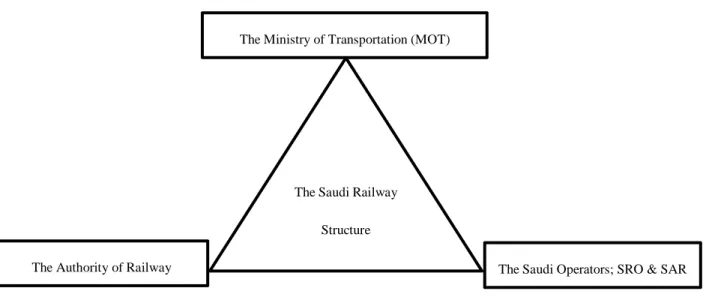
investment. The institutional structure of the Saudi Railway sector as can be seen in figure 1 shows the
government tendency to privatize this sector by investing and developing SRO and SAR. This structure
clarifies the institutional roles that the Ministry of Transportation (MOT) as a regulator, the Authority of
Railway as an infrastructure manager and supervisor and SRO and SAR as operators, play in the current
railway sector environment.
Figure 1: The Structure of the Railway Sector in Saudi Arabia
- The Haramin High Speed Line
Map 4 shows the Haramin high speed line which links Medina, Makkah and Jeddah, this line will
serve the pilgrimage as well as people living in these cities. This line is expected to transport more than The Ministry of Transportation (MOT)
The Saudi Railway Structure
24
15 million visitors and Saudi citizens. It will also reduce the number of buses and other private
transportation vehicles.
Map 4: Haramin High Speed Railway
This line will be the first high speed railway in the Middle East. A Spanish company called Renfe
signed a contract with SRO to provide the Haramin high speed railway rolling stocks with a speed that
will reach 300 km per hour.
- The Land-bridge Line
The land-bridge line aims to connect the Saudi ports in the Arabian Gulf with other ports in the Red
Sea. This project was one of SRO projects. However, the government, after long discussions considering
the rapid launch of SAR, decided to terminate the contract in 2013 with SRO and signed this project's
25
contract with SAR. The following Map 5 shows the land-bridge line. The lines from Dammam to Riyadh
are operated by SRO but the lines from Riyadh to Jeddah, as already mentioned, is under construction by
SAR.
Map 5: The Land-bridge Line
- Gulf Cooperation Council (GCC) Railway Line
At the international stage, the idea of establishing a railway network to link the Gulf Cooperation
Council (GCC) six countries, namely; Kingdom of Saudi Arabia, United Arab Emirates, Qatar, Oman,
Kingdom of Bahrain, and Kuwait, emerged in 2000. Experts believe that such network would increase the
level of trade exchange between the countries of the region, alleviate traffic congestion and reduce
pollution. It is expected that this network will be the core of the network project connecting all cities of
the Middle East. Countries in the region have realized the need for an initiative to cover the region as a
whole, prompting them in 1999 to adopt a development plan for an integrated transport system in Western
26
Asia under the auspices of the United Nations - Economic and Social Commission for Western Asia
(ESCWA). This initiative paved the way to studying the economic feasibility for a railway line linking the
Member States of the Gulf Cooperation Council for the Arab Gulf States.
It is expected that the total length of the network will be about 2,000 km starting from the
Iraq-Kuwait borders up to Oman passing through Qatar, Saudi Arabia, in parallel to the coast of the Arabian
Gulf as can be seen in map 6. Studies indicate an expected growth in figures of goods’ transport by train
after the implementation of the Gulf railway network. It is expected that an estimated 31 million tons of
goods will be transported by train in 2016 consisting of 17 million tons of heavy raw materials and 4.1
million tons of goods imported by some of the GCC countries from abroad.
The following table 1, which shows the level of transport imported by all modes of transportation in
the years 2004-2006 (in million tons), compared with the expected to be only transferred by train in 2016.
Table 1: GCC Current Transportation and Expected by Train (in Million Tons):
27
Map 6: GCC Railway
Figure 2 explains the trend of the railway institutional change and development. As mentioned
above, SRO has changed from 1947 to 2005 and since then a new company joined the Saudi railway
business which is SAR.
Figure 2: Institution Timeline of the Railway in Saudi Arabia for SRO and SAR
In this study, we aim to investigate the liability of renewal of the Saudi Railway Organization (SRO).
The first section highlights the establishment of SRO and presents the problem statement including the
28
research question. In the second section, we develop our conceptual model and the main propositions of
this research. In the third section, we examine the research methodology and how we collect the research
data. In the final section, we analyze the data and discuss the findings and conclusion of this paper. In
order to understand the process of organizational renewal in the Saudi Railway Organization (SRO), it is
important to understand the establishment, in some detail, the history of the Saudi Railway Organizations
(SRO) which was discussed in previous sections.
7- Introduction to the Problem Statement and Research Question
SRO went through different stages of change and development as can be seen in figure 1 on page 23
and figure 2 on page 27. In 2005, new projects were proposed for SRO by the Saudi government. The
initiation of new expanding projects resulted in SRO being unable to adapt to new environmental
demands. From this result we can summarize two consequences. First, the SRO failure to adapt to the
new project indicates that SRO could be exhibiting structure inertia. Second, this failure in its
performance could have impacted SRO's legitimacy. As a result the Saudi government established a new
railway organization, the Saudi Railway Company (SAR) in 2006, to carry out the new project, but it did
not close down SRO. Instead, SRO was given the opportunity to try again since it was determined that
having two functioning railway organizations would be better than just one. Part of the impact on SRO's
legitimacy has been to stimulate an attempt by SRO to enhance its organizational capabilities,
performance and learning.
We examine the period from 2001 to 2014 and focus on SRO’s attempts at organizational renewal. One reason behind choosing this period of time is that the Saudi government initiated its new expansion
29
project from 2005. At the same time, the Saudi government has pushed a new private company into the
market which is called Saudi Railway Company (SAR). The launch of SAR is an indication of the loss of
SRO’s legitimacy. Hence, we considered this period of time to be a critical one in understanding SRO’s attempts at overcoming the liability of renewal. We will examine SRO in the period 2001-2005 as the
pre-SAR institutional environment. We will then examine SRO from 2005-2014 as the period of strong
environmental change, since this is the time when SAR was established, even though it began operations
from 2011.
On the one hand, we consider the period 2005–2014 of the new company SAR as a substantial
institutional change in the Saudi Railway sector. Since SAR has three years of freight operation from
2011-2014, we assume that SAR’s freight operation is one reason of the overcoming of the liability of
renewal at SRO. Figure 3 shows the development of the railway’s operators as well as the period of our
30
Figure 3: The Development of Railway’s Operators
On the other hand, SAR as a new company may survive the period of liability of newness. We need
to understand this concept since we believe it underpins the liability of renewal that SRO is undergoing.
According to Aldrich and Fiol (1994) study, where they discussed the ability to survive the liability of
newness and how to gain legitimacy for newly established organization they recognize a multi-level
nested structure for legitimacy. In Table 2 we replicate the four levels of social context as proposed by
Aldrich and Fiol (1994) which founding entrepreneurs must work in in order to build trust, reliability,
reputation and institutional legitimacy. SRO Project:
Riyadh-Dammam
Haramin high speed
GCC line
SAR Project:
North-South
Riyadh-Jeddah SAR
Building & operation 2005 SRO
Building & operation 2005
Organization (1) 1947 Organization (2) 2006
2011-2014 2001-2014
31
Table 2: Entrepreneurial Strategies to Promote New Industry Development (Aldrich and Fiol, 1994)
Type of legitimacy
Level of Analysis Cognitive Sociopolitical
Organizational/ trust
Develop knowledge base via symbolic language and behavior.
Develop trust in the new activity by maintaining internally consistent stories.
Intraindustry/ reliability
Develop knowledge base by encouraging convergence around dominant design.
Develop perceptions of reliability by mobilizing to take collective action.
Interindustry/ reputation
Develop knowledge base by
promoting activity through third party actor.
Develop reputation of a new activity as a reality by negotiating and compromising with other industries.
Institutional / legitimacy
Develop knowledge base by creating linkages with established educational curricula.
Develop legitimacy by organizing
collective marketing and lobbying efforts.
- Building trust at SAR can be seen by the rapid launch of their freight operation and how the CEO
Dr. Romih Alromih selects employees based on their educational level as well as their experience.
Also, sharing the achievement of SAR and celebrating it as they were one team following one
leader. This team develops trust in the new activities of the freight operation. By transporting
millions of tons of Phosphate and Bauxite, SAR has internally developed stories of achievement
consistently.
- Achieving reliability at SAR by its monopoly of moving Phosphate and Bauxite and how SAR is
proud of being the first mover in this freight operation, where SAR’s team work day and night to
move million tons of Phosphate and Bauxite from the mine to the factory.
- SAR starts to gain reputation by its line that goes across different cities and villages. In these
cities and villages, companies that aim to reduce their cost of transportation sign contracts with
32
SAR to move goods. SAR became the first mining line since the beginning of railways in Saudi
Arabia. As we mentioned, SAR moves Phosphate and Bauxite for Ma’adin mining company.
- Gaining legitimacy can be seen first in SAR attempts to establish relationships with educational
institutions in Saudi Arabia aiming to increase the level of Railway knowledge. As the Saudi
government recognizes SAR as an efficient company in terms of punctuation and efficiency of
constructing the north-south line, the Riyadh-Jeddah line which is called the land-bridge was also
assigned to SAR.
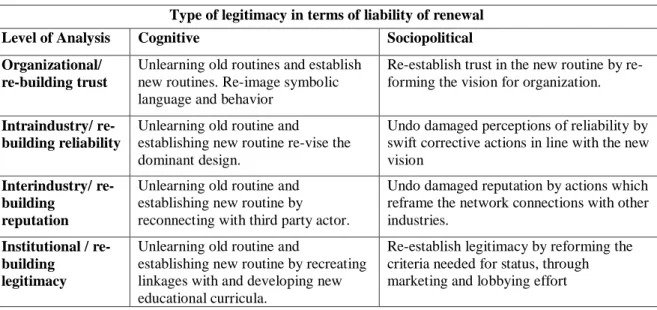
In this study, we notice that we need to have a similar discussion of SRO’s attempts to re-establish its
legitimacy as outlined in the previous page’s description of the influence of the liability of renewal on
cognitive and sociopolitical legitimacy by level of analysis as can be seen in table 3 (Methe’ and Alshehri,
2015).
Table 3: Renewable Strategies to Promote Established Industry Re-development.
Type of legitimacy in terms of liability of renewal
Level of Analysis Cognitive Sociopolitical
Organizational/ re-building trust
Unlearning old routines and establish new routines. Re-image symbolic language and behavior
Re-establish trust in the new routine by re-forming the vision for organization.
Intraindustry/ re-building reliability
Unlearning old routine and
establishing new routine re-vise the dominant design.
Undo damaged perceptions of reliability by swift corrective actions in line with the new vision
Interindustry/ re-building
reputation
Unlearning old routine and establishing new routine by reconnecting with third party actor.
Undo damaged reputation by actions which reframe the network connections with other industries.
Institutional / re-building
legitimacy
Unlearning old routine and
establishing new routine by recreating linkages with and developing new educational curricula.
Re-establish legitimacy by reforming the criteria needed for status, through marketing and lobbying effort
33
- Rebuilding trust at SRO can be seen by importing efficient rolling stocks for both freight and
passenger operation which can be seen as a reflection of the fact that old rolling stocks were the
main cause of train accidents. SRO is considered to have old infrastructure, thus it started to build
new bridges and maintain the rail tracks. SRO as a public owned organization has to face,
announce and share all its achievement and failure with the Saudi media. It has an education
center in Dammam headquarters operating to develop SRO employees only. These changes since
2001 can be seen as re-forming the vision for SRO however in reality it still cannot benefit from
its achievements to rebuild trust because of the inertia of old routines.
- Rebuilding reliability at SRO shows no change even with upgrading its rolling stock or
maintaining tracks. Although SRO is about to celebrate 65th years of operation, it is still not
reliable in terms of its capability to move goods and passengers. Staff at SRO are considered to
follow a governmental routine (working to get a salary even if the organization is not profitable,
because the government pays the salary anyway) which has an impact on their teamwork and as a
result affect their outcome. So, SRO has to unlearn the old routine and increase its ability to be
self-dependent and then become a private organization.
- Re-building reputation by signing a contract with a maintenance company that can take care of
the rail tracks. This allows SRO to prevent any government blame if any accident happened by
the dereliction of the maintenance company. Also, SRO tried to rebuild reputation by offering
discount tickets for students living between Dammam and Riyadh. According to SRO President,
34
trains’ drivers to slow the speed down at the area of frequent accidents which can help to decrease the number of accidents. We think that these actions are attempts to undo the damaged reputation
and they are actions that reframe the network connections with other industries.
- SRO loss of legitimacy is one of our main focuses in this study. Also, by not finishing the
Haramin high speed project, SRO is facing further loss of its legitimacy of being the first railway
organization to build a high speed system. Rebuilding or regaining legitimacy can occur by
recreating linkages with, and developing new educational curricula, and by attempts to market to
and lobby important stakeholders.
8- Introduction of the Main Idea of This Study
Organizational change remains an important field of research in management for many scholars.
Many schools of thought have discussed the period of change that new or established organizations need
in order to adapt to a new environment as a critical time in which some organizations may fail. Aldrich
and Fiol (1994) discussed the birth of an organization and its ability to survive as a period of “liability of newness”. They argued that this period of time can be a critical one for a new organization to adapt to the new environment. This kind of struggling to survive during the liability of newness phase may increase
the probability of gaining or losing organizational legitimacy. On the other hand, Freeman, Carroll and
Hanna (1983) argued that organizational death can occur at any time or age. We contend that
organizational death and loss is seen as resulting from organizational rigidities that may happen at any
time or age and for an incumbent organization attempting to regain its performance after a loss, it enters a
35
Structural inertia is an implicit aspect of this study which can be a cause as well as an obstacle of
organizational change. According to Larsen and Lomi, page 275 (2002) “as inertia increases the
likelihood of successful change becomes smaller, in turn prolonged period of stasis increase the pressure
for change in the organization. As pressure for change increases, it is reasonable to expect that at least some new changes attempts will be made”. An organization seeks to change in order to gain sustained competitive advantage. In addition, an organization tends to change its tangible and intangible elements in
order to be successful. Therefore, an organization must have processes in place for continued learning and
adaptation which can be called the organizational renewal process. What affects or stimulates this renewal
process and how it operates within an organization is an important aspect that is still not well understood.
Amburgey, Kelly and Barnett, (1993) argued that whenever an organization initiates a major change
it resets its organizational clock. We contend that resetting an organizational clock is equal to changing
organizational capabilities that lead to attempts at regaining legitimacy through improving performance,
which leads to a hazard state2, which we call the liability of renewal. The liability of renewal, in our case,
can be defined as whenever an old established organization tries to minimize errors to re-gain legitimacy
throughout a process of organizational learning from changes in capabilities which aim to improve its
performance. In our model we show how an organization can put under consideration the advantages and
disadvantages of a long period of operation in terms of its attempts at overcoming the liability of renewal.
The model considers changes in organizational capability as changes in organizational learning. And if
the model does not record changes it will directly show that the organization is experiencing inertia.
2
36
We develop a model of organizational renewal utilizing researches from various management schools
of thought, such as Institutional Economics, Population Ecology, and Organizational Learning. Our
model relates how changes in legitimacy and performance affect pressure for change on an organization.
Further, our model relates how the organizational renewal process reflects on the balance between the
dynamic aspect of organizational learning as demonstrated by changes in capabilities and the stabilizing
aspects of organizational inertia.
In this study we are examining two organizations within the Saudi Arabian railway sector. We
analyze the Saudi Railway Organization (SRO) in terms of its freight and passenger operation from
2001-2014 and also the freight operation at the Saudi Railway Company SAR from 2011-2001-2014. We also expect
that the new entrant SAR creates an environmental (institutional) turbulence or change that has an impact
on the existing organization SRO. So, we examine SRO before and after SAR’s entrance into the Saudi
Railway sector. We found support for our model in that most of our results were in the hypothesized
direction. We found that learning from changes in organizational capability has a positive effect on
performance. And that legitimacy has a positive effect on performance. We also found that performance
and legitimacy have a negative relationship with pressure for change. Finally, we found that
37
Chapter 2
1- Literature Review and Hypotheses Development
- Introduction
In this section, we examine the previous research literatures that are relevant to our study. We first
begin by examining research literatures which focus on railway and railway development. We then turn
our attention to institutional economics and organizational change. We then look into the elements of
population ecology research which are relevant to organizational change. At the end of this section and
after examining these research literatures we turn our attention to how we developed our conceptual
model and propositions.
1.1. Railway System and Organizational Change, Empirical Studies on Railways Systems
In order to put SRO’s and SAR’s change attempts in context, we need to examine how railway organizations have changed overtime. Rietveld and Stough (2006) examined institutional and regulatory
aspect of sustainable transport from across national perspective. They found that the role that institutions
play in sustainable development is not clear but they agreed that institution play an important role in the
economic success of rail organizations. Mulder, Lijesen and Driessen (2005), studied the assessment of
cost and benefit of the structural change in the Dutch railway system in the late 1990s. Accordingly, their
study analyzed the flexibility of economies of scope in the Dutch railways system and how institutional
changes have an effect on the efficiency of both passenger and freight. They found that institutional
38
improved through this institutional change (Mulder, Lijesen and Driessen 2005). Nevertheless, our study
focuses mainly on institutional change as environmental turbulence and how that has an effect on the
changes of organizational capability. We assume that changes may and may not improve railway
performance. We also assume that the level of organizational adaptation to the new environment can be
decided based on current capabilities and the pressure for change which is influenced by the legitimacy of
the organization as well as by the organization’s performance.
Organizational change in the railway system is connected with the restructuring of the institutional
environment in terms of nationalization and privatization. In studying privatization, Misutani and
Uranishi (2003) looked into the main factors that increase the total factor productivity (TFP) of the
privatization of the Japanese railway. They found that TFP was growing at 0.59% annually. Another
study by Mitsutani and Nakamura (2004) aimed to explain the Japanese approach to railway reform and
lessons learned from the privatization process. They found that the Japanese approach to privatization
improved productivity, cut operating deficits, decreased fares, and provided better services. In addition,
Obermauer (2002) argued that fully privatized organizations were more efficient in the domestic and the
international market. A study by Lodge (2003) discussed the regulatory change in the railways of Britain
and Germany. Lodge (2003) argued that organizational learning and transfer processes could be better
understood through an institutional perspective in each country. Thus the institutional environment is an
important consideration. Also from these studies we believe that state-owned organizations have
constraints on their productivity and such constraints impose structural inertia. This appears to be the
39
on its productivity. Oum and Yu (1994) discussed the productive efficiency of the rail way sector of 19
countries. They aimed to identify the effects on efficiency of public subsidy and the level of managerial
independency. They found that railway systems with less dependence are significantly more efficient on
public subsidies than others with high dependence. They also found that railways with high level of
managerial independency from regulatory authority tend to achieve higher efficiency (Oum and Yu 1994).
Lan and Lin (2006) measured the performance of railways in the EU regions that produce passenger
and freight services by distinguishing technical inefficiency from service ineffectiveness. They found that
railways which are distinguished by technical inefficiency and service ineffectiveness are negatively
influenced by gross national income per capita, percentage of electrified lines, and line density.
Given the sensitivity of railway system to environmental change as well as the importance of
transportation in the movement of goods and people, especially in developing countries, there is a need
for studies which examine institutional attempts to renew their capabilities within the context of being
state-owned as well as private within one sector and to understand the liabilities generated in this process.
Although most of the empirical studies were focusing on aspects of changes at the railway sector level
that may improve productivity or efficiency, in our study we focus on the changes in organizational
capabilities in terms of operation which directly affect organizational performance. These changes result
from institutional or environmental changes and how organizations react towards these changes by
40
1.2. Institutional Economics and the Organizational Change
Institutional economics examines the role that institutions play in shaping economic behaviors. And
that change in institutions can have an impact on organizations. Since organizations exist in an
institutional setting, it is important to understand how institutions change and how these changes
influence organizational change especially in terms of organizational legitimacy. Our study argues that
the institutional environment has a strong influence on the legitimacy of an organization.
North (1991) has defined institutions as rules for governing the exchanges that occurs in society.
Human beings have devised constraints on the institutional transformation process in order to regulate it,
including formal and informal rules (North, 1991). An important notion of the study of Kingston and
Caballero (2009) was that some theories indicated the importance of deliberate action in the birth of
institutions usually through some political process, while other theories saw institutions as emerging through a more bottom up emergent evolutionary process. Holm’s (1995) study has argued that understanding institutional change has problems which can be solved if institutions are seen as a nested
system. He argued that the nested system is an interconnected, multilevel system in which each
action-level is a framework for action and a product of action. His perspective on the nested system relies more
on endogenous processes than exogenous forces in explaining institutional change (Holm, 1995).
Greenwood and Hinings (1996) posited that the internal dynamic of an organization will strongly
influence the ability to respond to pressure for change that originate from institutional sources. We
contend that such institutional transformation processes have had an influence on organizational
legitimacy which increases the likelihood of environmental pressure for change. We propose a model,
41
legitimacy and pressure for change. Organizations can choose to adapt to these pressure for change or not.
Each alternative, to adapt or not, has risks associated with it.
Zucker (1987) defined the theoretical approach of institution to two concepts, one is the environment
as institution and the other is the organization as institution. In this study, we considered the environment
as an institution that affects organizational change. We assume that the level of organizational adaptation
to the new environment can be decided based on current capabilities and the pressure for change which is influenced by the legitimacy as well as by the organization’s performance. Therefore, we assert that such action and subsequent reaction increase the likelihood of an organization surviving the period of liability
of renewal. We describe the period of liability of renewal in more detail in the late section.
Organizational change theory suggests that environmental changes that cause organizational
decline in performance will lead to pressure for change. We expect that decreases in organizational
legitimacy will also influence performance and that both lower performance and loss of legitimacy will
lead to pressure for change on the organization. We also expect that whenever the level of pressure for
change increases, that may cause changes in organizational capabilities which lead to an improvement in
performance. These relationships are summarized in this portion of our model in figure 4.
Figure 4: The Relationship between Legitimacy, Performance, Pressure for Change and
Organizational Capabilities
Performance
Pressure for change
Legitimacy
Organizational capabilities
42
1.3. Population Ecology and Organizational Change:
Population Ecology theory contends that when an organization attempts to adapt to a new
environment, usually it fails and ceases to exist. In essence population ecology argues that the
environment selects for or against an organization. Organizations have a difficult time adapting to
environmental changes. Structural inertia is an important aspect of this theory which can be seen as an
obstacle to organizational change. Hannan and Freeman (1984) indicated that structural inertia influences most features of an organization’s structure. In their study, they indicated two features are important understanding the influence of inertia on organizational structure: one is the organization’s core (goals, forms of authority, core technology and marketing strategy) and the second is organization’s peripheral that is established to protect an organization’s core from uncertainty in the environment. They also
predicted that core feature change will increase the probability of organizational failure and thus
increasing the likelihood of an organization ceasing to exist (Hannan and Freeman, 1984). They noted
that formal organizations have two important advantages over other collective actors; that is, their ability
to perform reliably (in terms of capabilities) and to account rationally for their action (in terms of
legitimacy). Both organizational reliability and accountability requires organizational structures that are
reproducible or stable over time (Hannan and Freeman, 1984; Kelly and Amburgey, 1991). Alkaya and
Herpaktan (2003) discussed the phase, barriers and variables that affect organization change. They found
that if the aim is to have a successful change, the culture of an organization should be taken into account.
Lunenburg (2010) concluded that internal and external forces can create the need for change in an
organization and that would reduce resistance forces to change. Sastry (1997) also argued that internal
43
trail period following a reorientation. Haveman (1992) proposed that organizational change can be
beneficial if it builds on established routines and competences, thus we argue decreasing the liability of
renewal. On the other hand, Gilbert (2005) discussed the distinction between resource rigidit y and routine
rigidity regarding effects of threat perception on inertia. He found that resource rigidity can be overcome
but in doing this can simultaneously amplify routine rigidity.
We contend that during the time period of organizational change that is, the period of liability of
renewal, changes in organizational capabilities, as seen in changes in resources, influence both the
learning process which attempt to increase performance but can also be exhibited as lags as routines
attempt to catch up with the new environmental demands. Thus the capability may remain inert and
generate lags in adaptation and negatively affects changes in organizational capabilities.
In the discussion of Population Ecology, we saw how an organization may fail to adapt to new
environmental turbulence or changes. The degree of failure matters. With catastrophic failure an
organization ceases to exist, but with non- catastrophic failure an organization has an opportunity to
renew itself. We assert that non- catastrophic failure to adapt to the new environment causes pressure for
change to learn from failure. We expect that when pressure for change becomes high, organizations seek
for new knowledge in order to add new capability, whereas when pressure for change becomes low an
organization remains inert. While failure in the population ecology view leads to the demise of the
organization, we adopt a dynamic capabilities view as put forward by Teece, Pisaon and Shuen (1997).
The dynamic capability concept suggests that failures that are less than catastrophic leads to lower
44
Organizational capabilities are considered a core feature if they provide strategic differentiation for
the organization (Barton, 1992). Case studies on firm capabilities and adaptation have primarily served to
greatly explicate sources and causes of structural inertia and why firms are not able to adapt. Barton,
(1992) argues for example, that "core capabilities can become core rigidities that can lead to
organizational failure". As we noted we see this duality in Larsen and Lomi (2002), emphasized when
they suggest that the ‘‘moving parts’’ of an idealized organizational system as representing the dynamic duality between organizational inertia and the evolution of capabilities.
In terms of dynamic capability, Ambrosini, Bowman, & Collier, (2009) suggested three levels of dynamic capabilities. According to their study, “these levels are related to managers’ perceptions of environmental dynamism. The first level is “incremental dynamic capabilities” which are concerned with the continuous improvement of the firm’s resource base. The second level is “renewing dynamic capabilities” which are refreshing, adapting and augmenting the resource base. These two levels are usually represented as dynamic capabilities. The third level is “regenerative dynamic capabilities” which have an impact on firm current set of dynamic capabilities”. Capabilities have an effect on organizational performance. A study by Protogerou, Caloghirou and Lioukas (2008) investigated the direct and indirect
relationships between dynamic capabilities and firm performance. They found that dynamic capabilities
have a positive impact on firm performance during environmental change.
We contend that attempts at change even with the attendant organizational liability of renewal offer a
45
resources to adapt to the new environment and balance these with inertial forces in the organization as
routines to catch up.
1.4. Organizational Learning and Organizational Change under the Pressure for Change
Organizational change always requires organizational learning which is important to increase
organizational capabilities. Further, learning is not only differentiated by goal; that is, exploratory or
exploitative but it is also differentiated by means; that is, direct, indirect and vicarious (Barnett and
Hansen, 1998; Terlaak and Gong, 2008; Mitsuhashi, 2011; Greve, 2005; Levinthal and March, 1993;
March 1991). In this study, we are trying to examine how organizational learning as an implicit process is
inherent in the liability of renewal for established organization and in the liability of newness for new
organization. Hernes and Irgens (2012) discussed organizational learning under continuity in a way that
they thought that learning from past cases can be helpful in the present as well as an exploration of the
future. Thus providing an intermediate ground between organizational change being successful and
organizational change leading to catastrophic failure. Desai (2010), examined the moderating role of knowledge gained through an organization’s operating experience as a way that an organization can learn from failure. Another study focused on learning from failure and indicated that this kind of learning is
essential to adaptation. They argued that such learning complements learning from success, (Baum and
Dahlin, 2007).
In addition to learning from failure, an organization can learn through other actions. A combination
of exploitation and exploration learning which is called organizational capability-based learning can be
46
help to understand organizational learning. Accordingly, organizational capabilities can be understood as
one of the major sources of generating and developing a sustainable competitive advantage. Also
organizational capabilities result from developments over time (Lejeune 2009). His framework aims to
focus more on articulate learning dimensions such as (exploration and exploitation, cognition and action,
context and process, single-loop and double-loop) as well as capabilities’ components (resources,
activities, outcomes) as can be seen in figure 5 (Lejeune 2009).
Figure 5: A Capability-based Learning Integrative Framework
The argument by Hernes and Irgens (2012) which show that learning under continuity is equally
important and requires more investment of effort, mindfulness and preparedness for change, even if there
is no expected change. In Lejeune (2009) framework, and regarding our study, we expect that resources
and capabilities can be the process of learning from changes in organizational capability either through
47
exploration or exploitation and that activities and outcome can be the indications of performance.
Although our study does not measure organization learning directly, we conclude that organizational
capability-based learning is important as learning directly.
On the one hand, we assert that learning from changes in organizational capabilities have a positive
effect on the performance. On the other hand the lag of changes in organizational capabilities can show a
level of inertia. We assume that understanding changes in capabilities overtime as a learning process can
help to improve and develop organizational performance. And that is the main focus of our study, which
is how the organizational renewal process reflects on the balance between the dynamic aspect of
organizational learning as demonstrated by changes in capabilities and the stabilizing aspects of
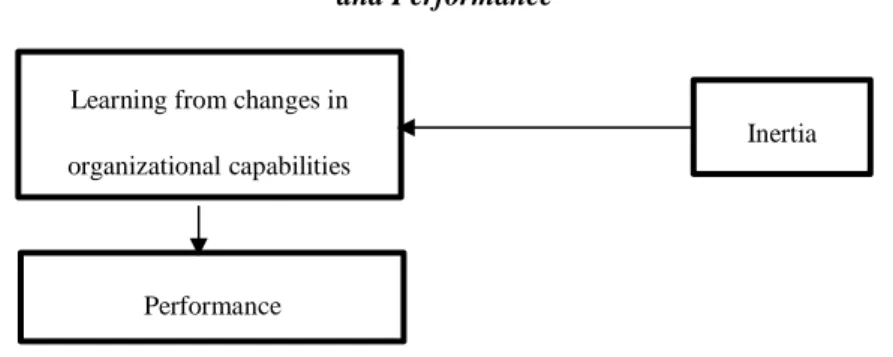
organizational inertia. We summarized these aspects of our model in figure 6.
Figure 6: The Relationship between Inertia, Learning from Changes in Organizational Capabilities
and Performance
2- Conceptual Model and Propositions
We have examined several research literatures that are important in building our conceptual model.
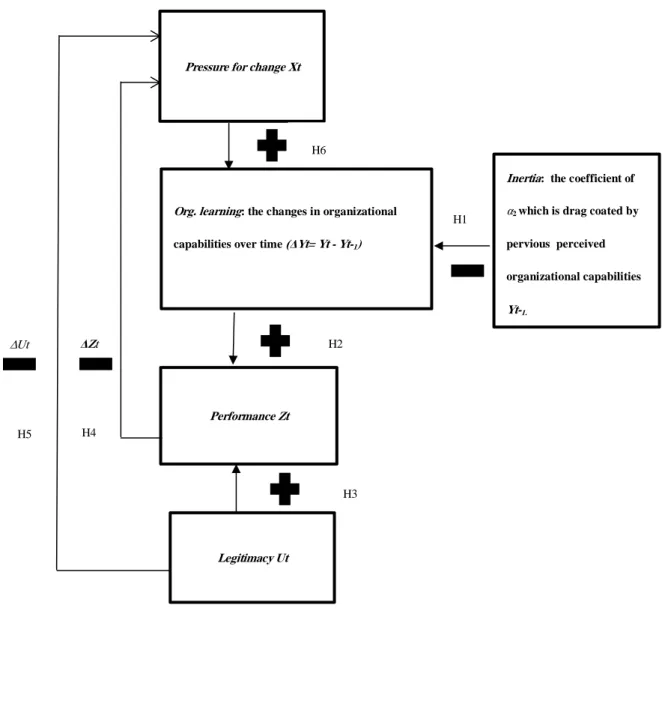
From these research literatures, we have identified the relevant variables, and general relationships among Learning from changes in
organizational capabilities
Inertia