INTRODUCTION
As the global average, only 32.8% of children attended preschool in 1999, whereas 53.7% attended there in 2013 (Jozsa 2018). Developingcountries prepared nursery schools or kindergarten as preschool education for only 27.2% of all children in 1999, whereas it was increased into 49.6% in 2013. In the developed countries, it was already 74.6% in 1999, while it was increased into 84.4% in 2013 (Jozsa 2018). Therefore, preschool education is currently common practice throughout the world. What is the situation like in Japan? Kukimoto (2016) reported that, in a Japan-wide epidemiological study (n = 8205), 55. 1% of nursery schools could accept children aged less than 6 months, whereas 27. 8% starting acceptingchildren at 6 months of age and 14.7% only accepted
children who were at least one year old. Moreover, only 42-83% of nursery schools were able to keep children after 6 p.m. (in most cases until 7 p.m.). After giving birth, many women in Japan are forced to choose between stayinghome to watch their child and continuingto work (Takahashi, 2014). Most mothers in Kochi continue workingas workingmothers, partly for financial reasons. Therefore, special services such as extended childcare until 7 p.m. is critical, and women in Japan will not be able to continue workingafter givingbirth unless nursery schools accept younger babies. Nakazono (2014) reported that children aged 0-5 in a nursery school in Kushiro, a city in Hokkaido prefecture in Japan, stayed at nursery school for 7 to > 11 hours (7-8 hours: 1 child, 8-9: 7, 9-10: 12, 10-11: 41, > 11: 10, children who stayed until 7 p.m.: 14). Part-time teachers are critical for providingcare for young
49
Correlation between desire for permanent employment and
frequency of participation in training lectures on nursery school
education in non-permanent Japanese nursery school teachers
Misako Kawamata and Tetsuo Harada
*Faculty of Education, Kochi University, Japan
Abstract
This study aims to clarify the relationship between desire for a permanent position in the near future and frequency (or opportunity) to participate in several lectures on nursery school education among non-permanent nursery school teachers. A questionnaire study was administered to 10 nursery school teachers (eight working for private nursery schools, two for a public nursery school) in Fukuoka prefecture from September to November 2014. This questionnaire included questions on basic information about the nursery school where they work and some information about the participants such as age, family, and academic career. There was significant correlation between desire to pursue a permanent position and frequency of participation in traininglectures (p = 0.048). No correlation was seen between age and index of frequency to participate in training lectures related to nursery school education. Although we could not do statistical analysis because of limited number of data, two non-permanent teachers with a nine-year-longcareer exhibited a low desire to participate in such lectures. In conclusion, non-permanent teachers at nursery schools with a strong desire for a permanent position in the near future was very active for learningon the nursery school education. The Japanese government could increase the number of permanent nursery school (or kindergarten) teacher positions in Japan as one way to increase the number of high quality nursery school teachers.
Key words: Non-permanent nursery school teachers, frequency of participation in traininglectures, quality of teachers
* E-mail: [email protected]
Kuroshio Science 12-1, 49-52, 2018
Symposium Proceedings
children for longer than 8 hours at Japanese nursery schools. In Japan, there is a high demand for non-permanent nursery school teachers in addition to permanently employed teachers because of the work structure at nursery schools. Ueno (2014) reported that 75 among159 (47.5%) students majoringin a nursery school teacher trainingcourse at a women’s junior college wanted to be homemakers after marriage and then work as non-permanent nursery school teachers after their children grow up. Meanwhile, 31of 79 students (39.2%) who majored in other fields at the same college wanted to be homemakers after marriage and work in a non-permanent position later on. Currently, the majority of youngnursery school teachers in Japan do not want permanent employment after getting married. Non-permanent positions occupy 60-70% of all employment at nursery schools and kindergartens in Japan (Kakiuchi and Obi, 2015).
How does the workingcondition differ for permanent and non-permanent nursery school teachers? The difference is most clear in salary in Japan (Obi, 2009). For example, in 2003, the annual salary for teachers at a public nursery school was 4.334 million yen (career started in 1992) or 6.883 million yen (1975) for those in permanent employment, but only 1.74 to 1.962 million yen for those in non-permanent positions, irrespective of length of career. What about the actual work? In most cases, the work day is eight hours. The type of work for non-permanent teachers can be divided into two patterns. One is very similar to permanent teachers and is that of the primary teacher who is responsible for a single class, and the other is an all-around assistant who offers help to any classes in need. On average, Obi (2009) and Sakai and Yamamoto (2015) determined that conditions for non-permanent Japanese nursery school teachers are harsher than permanent teachers in terms of both quality and quantity of job per salary. For example, there is no bonus for non-permanent teachers, which can discourage them even though the job content is often very similar to teachers in permanent positions.
Meanwhile, Kamiya (2013) showed that permanently-employed nursery school teachers can suffer psychological stress duringcommunication with other workers and also mothers because in some cases communication with mothers can be very hard due to “special characters” shown by mothers (so called “monster parents” in Japanese-English words). Permanent employees can be suffered from higher social pressure because of higher responsibility in accordance with higher salary.
Permanently-employed nursery school teachers may feel more responsible for the education of the children at the nursery schools and have more experience and up-to-date-knowledge that is required for ongoing improvement of the children’s education. If this is the case, improvingpreschool education in Japan requires increasingthe ratio of permanently
employed nursery school teachers in near future. To help achieve this, we aimed to determine the relationship between desire to work in a permanent position and frequency of participation in traininglectures on nursery school education, a question that has yet to be examined in past studies.
PARTICIPANTS AND METHODS
A questionnaire study was administered to 10 nursery school teachersat two private and one public nursery schools (eight working for private nursery schools, two for a public nursery school) located in Fukuoka prefecture in Japan from September to November 2014. The teachers were or had been in non-permanent positions. Nine of 10 participantscompleted the questionnaire. The questionnaire included questions on basic information about the nursery school where they work, information about the participants such as age, family, and academic career as a nursery school teacher. The questionnaire also contained information on the employment structure at the nursery school (e.g. number of permanent and non-permanent staff and opportunities to participate in lectures related to nursery school education). Questionnairestook one to two hours.
Statistical analysis on the results of this study was performed with SPSS version 12 statistical software (12.0 J for Windows; SPSS Inc., Chicago, IL, USA). Fisher’s probability test was used for categorized variables x categorized variables (2 X 2), The guidelines established by the Chronobiology
International Journal were followed for the conduct of
research on human subjects (Portaluppi et al., 2010). Before administeringthe questionnaires, each participant was given a written explanation detailingthe concepts and purpose of the study and stated that their answers would be used only for academic purposes. After the above explanation, all participants agreed completely with the proposal.
RESULTS
All participants were women. All non-permanent teachers answered that they were giventhe same opportunities by Fukuoka City (and Prefecture) Education Government Committee to take traininglectures in the same manner aspermanent teachers. Their age ranged from 25 to 56 years old. They worked between one and nine years as non-permanent staff at nursery schools. Five participants weremarried, three were never married, and two were divorced. Four participants wanted to continue non-permanent work, five wanted non-permanent work as nursery school teachers, and one was retired from the non-permanent position and currently had no job.
Participants who wanted permanent positions in the near Correlation between desire for permanent employment and frequency of participation in traininglectures on nursery school education in non-permanent Japanese nursery school teachers
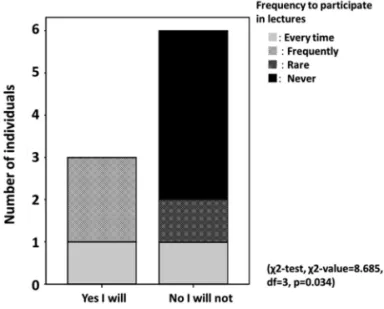
future participated in traininglectures related to nursery school education more frequently than those who wanted to continue their current non-permanent position (Fig. 1). No correlation was seen between age and index of frequency to participate in traininglectures related to nursery school education (Fig. 2a). Although we could not do statistical analysis because of limited number of data, two non-permanent teachers with a nine-year-longcareer exhibited a low desire to participate in such lectures (Fig. 2b).
DISCUSSION
In Japan, there are not enough nursery schools to cover the number of children aged 0-5 years old requiring childcare, because the number of workingmothers is increasing. Many youngchildren are on nursery school waitinglists because their mothers have to continue workingin order to receive salary increases and promotions. They are referred to
as“Taiki-jidoo” in Japanese, which literally means ‘waitingchildren’
and number 23,553 in all of Japan (with 2.46 million children in nursery schools in 2016; Maeda, 2017). Ueno (2014) reported that 75 among159 (47.5%) students majoringin a nursery school teacher trainingcourse at a women’s junior college wanted to be homemakers after marriage and then work as non permanent nursery school teachers after their children grow up.
In this situation, re-education for nursery school teachers returningto the educational scene after beinga homemaker for some years is critical to maintain high quality of education at preschools. The study showed that there is a positive correlation amongnon-permanent nursery school teachers between high frequency to participate intraining lectures related to nursery school education and desire for a permanent position as a nursery school teacher. To ensure high quality of pre-school education, it is necessary for the Japanese government to increase the number of opportunities for non-permanent nursery school teachers to participate in trainingto attain permanent positions in the near future.
ACKNOWLEDGEMENTS
We would like to thank all the participants at the three nursery schools in Fukuoka prefecture in Japan for answering the questionnaire. Thanks are also due to Ms Laura Sato (Professional English Editor) for English editorial work on this study.
Reference
Józsa K., Török B., Stevenson C. (2018) Preschool and kindergarten in Hungary and the United States: A comparison within transnational development policy. International Journal of Educational Development 62: 88-95.
Kakiuchi K. and Obi H. (2015) Japanese nursery school teachers: increases in salary and nursery skills. Hitonaru-Shobo (In Japanese)
Kamiya T. (2014) Analysis on the emotional labour and relationships between nursery school teachers and parents: Based on their employment status. Journal of Japan Society of Research on Early Childhood Care and Misako Kawamata and Tetsuo Harada
51
Fig. 1. Relationship between frequency to participate in
lectures related to nursery school education and whether they want to shift their jobs from non-permanent to permanent. (Fisher’s exact probability test: p = 0.048).
Fig. 2. Correlative presentation between index of frequency to
participate in lectures related to nursery school education and age (A) or length of career as a nursery school teacher in years (B).
Education 51: 83-93. (In Japanese)
Kukimoto M. (2016) Problems in childcare support for young families with small children in rural areas. Geographical Sciences 71: 133-143. (In Japanese)
Maeda M. (2017) The needs of multiple polity approach to solve the daycare overcapacity problems. Medical Service and Society 27: 77-88.
Nakazono K. (2014) The actual situation of labor, the childcare of the parent usinga nursery in Kushiro-city. Journal of Labor Sociology 15: 1-20. (In Japanese) Obi H. (2009) Workingdetails and conditions for workingby
non-tenure employees of a Japanese Local Government. Journal of Japanese Society for the Study of Social Policy 1: 75-86. (In Japanese)
Portaluppi F., Smolensky M.H., and Touitou Y. (2010) Effects and Methods for BiologicalRhythm Research on Animals
and Human Beings. Chronobiology International27, 1911-1929. https: //doi. org/10. 3109/07420528. 2010. 516381
Sakai K. and Yamamoto C. (2015) Careers and resignation of nursery school teachers: Viewpoints of former directors of public nursery schools. Journal of Japanese Research Association of Psychological Science 36: 44-55. (in Japanese)
Takahashi M (2014) Work family balance in Japan from view point of gender-Comparative study with EU countries-Forum Modern Social Sciences 13: 75-84. (In Japanese). Ueno J. (2014) Attitude of college students majoring in nursery school teachers course, to gender problem for workingas nursery school teachers. Abstract Proceeding of 56th Meetingof Japanese association of Educational
Psychology 2014 (PG089) p. 829. (In Japanese) Correlation between desire for permanent employment and frequency of participation in traininglectures on nursery school education in non-permanent Japanese nursery school teachers