Female Informal Caregivers in Sweden and
Implications for Japan : A Feminist
Perspective
journal or
publication title
Kwansei Gakuin University social sciences
review
volume
18
page range
15-33
year
2014-02-18
Female Informal Caregivers in Sweden and Implications for Japan:
A Feminist Perspective
***Li-Mei CHEN*, Konomi IMAI**
Provision of long-term care (LTC) for older adults has been a pressing issue for developed countries with a growing aging population. Moreover, no country has been able to avoid addressing the issue of LTC without discussing the significant role of family caregivers, who are mostly women. To lessen this burden, countries such as Sweden and Japan have socialized LTC for older adults, but family caregivers continue to be involved in the provision of care for their elders.
In Sweden, as the number of people over 80 is expected to increase by 50% over the next 15 years (Statistics Sweden, 2010), it is predicted that there will be fewer potential caregivers available to care for them. Today, many working caregivers need support as they manage caregiving and employment. However, as most family caregivers were traditionally assumed to be older spouses, this image has guided much of the support development for family caregivers in Sweden (Sand, 2012). Hence, compared to other entitlements, such as those that benefit family caregivers of children, the entitlements for family caregivers of older adults are rather exiguous in today’s Sweden.
Simultaneously, there are few studies examining the role of caregivers in Sweden and it has only been within the past decade that there has been a rediscovery of the role of informal caregivers in Sweden (Fukushima, Adami, & Palme, 2010; L. Johansson, Long, & Parker, 2011; Socialstyrelsen, 2002; ────────────────────────────────────────── * Associate Professor, Doctor of Philosophy in Arts and Social Sciences, School of Human Welfare
Studies, Kwansei Gakuin University
** Professor, Doctor of Philosophy in Social Welfare, School of Human Welfare Studies, Kwansei Gakuin University.
***This study was supported by Grants-in-Aid for Scientific Research C, Japan Society for the Promotion of Science, Japan. All correspondence regarding this article must be addressed to Li-Mei Chen, PhD, MSW. 1−155 Ichibancho, Uegahara, Nishinomiya, Japan, 662−8501. Email. [email protected]
Kwansei Gakuin University Social Sciences Review
Vol. 18, 2013 Nishinomiya, Japan
Sundstrom, 1994). Current research is incomplete and more is needed on informal caregivers and the support available to them. This study will include an overview of existing national policies and programs as well as their local implementation. It will also look at how these policies are currently affecting informal caregivers in Sweden. Interviews with two older adults, a next of kin consultant, a government official, a researcher, and a non-governmental elder care provider in Sweden shed further light on the current situation surrounding informal caregivers. Of particular focus is how informal and alternative care in Sweden remains a gendered activity, and how existing policies and programs may affect women, especially working female family caregivers. Based on the findings from Sweden, this study will discuss the implications for Japan, a country with a public LTC system, but similar to Sweden, the bulk of elder care is provided by female family caregivers.
Analyzing the Welfare State from a Feminist Perspective
The feminist approach to the welfare state analysis criticized mainstream research as ignoring gender and sought “to bring women and gender into the picture” (Sainsbury, 1999). In particular, Esping-Andersen’s (1990) three welfare typologies were revised to include gender for developing welfare models in response to feminist scholars. One dimension of the analysis, decommodification−which is the effort by the government to reduce individuals’ reliance on the market and their labor to maintain their livelihood−was questioned by feminist scholars for its male bias. Feminists argued that it overlooked the treatment of household work and caring responsibilities in social policies. Ann Orloff (1993) argued that decommodification as a measure of the quality of social rights needs to be complemented by two additional dimensions: “access to paid work” and “the capacity to form and maintain an autonomous household.”
Jane Lewis (1992) established criteria to see how far different countries had moved from the traditional male breadwinner model by evaluating the country’s treatment of women in the social security system; the level of social-service provision, particularly child care; and married women’s position in the labor market. Lewis pointed to three types of welfare states: strong male breadwinner models (e. g., Germany, the UK, and the Netherlands), moderate male breadwinner models (e. g., Belgium and France), and weak male breadwinner or dual breadwinner models (e.g., Denmark and Sweden) (Lewis & Ostner, 1994). The shortcoming of this model is that it focuses on what a country’s policies are not, rather than what they are (Sainsbury, 1996), and the authors themselves have acknowledged that many diverse countries can be classified as strong male breadwinner states.
Lister (1994) introduced defamilialization as an alternative criterion for
Li-Mei CHEN, Konomi IMAI
evaluating social rights instead of Esping-Andersen’s decommodification. She mentioned that defamilialization is “the degree to which individual adults can uphold a socially acceptable standard of living, independently of family relationships, either through paid work or social security provision.” Sainsbury (1996) called it a “clumsy vocabulary” because it “conjures up associations of weakening or abolishing the family; . . . what is at stake is remaking the patterns of family relationships and bestowing social rights upon family members.” Sainsbury took the concept of social rights and created three gender policy regimes: the male-breadwinner regime, separate gender roles regime, and individual earner-carer regime (Sainsbury, 1999). In the male-breadwinner regime, men have entitlements stemming from the principle of maintenance, while married women’s entitlements are primarily as wives. The separate gender roles regime highlights a strict division of labor between the sexes, but attaches weight to both the principle of maintenance and the principle of care. The individual earner-carer regime envisions greater equality between women and men, and the “transformation of the traditional division of labor between the sexes, so that each individual is involved in both caring and earning” (Sainsbury, 1999). She identified four major dimensions of variations in these models: whether the rights are individualized or familialized, the degree to which gendered differentiation in entitlements is based on the traditional division of labor between women and men, whether employment and wage policies give priority and access to paid work for only men or for both sexes, the scope of the state’s responsibility (whether care is primarily private or has strong state involvement), and whether caring work is unpaid or has a paid component (Kennett, 2004). These dimensions provide greater variation regarding the extent to which welfare states depart from Lewis’ strong, moderate, and weak male-breadwinner model.
Based on the previous discussions regarding the breadwinner model and care regimes, Nancy Fraser (1997) deconstructed the opposition between breadwinning and caregiving by creating three models, challenging the conventional gender division of labor. The universal breadwinner model promotes women’s employment activity (e.g., through public childcare provisions). The caregiver parity model− more European in character-supports women’s caring roles (e.g., through child and caregiver’s allowances or maternal leave). The universal caregiver model supports both women and men to combine paid employment with caring responsibilities− that is, that men should “become more like women are now”−and involves a flexible system of parental leave and financial support for caregivers.
The development of a feminist approach to welfare state analysis demonstrates that for post-industrial nations, such as Sweden and Japan, where women are a necessary part of the workforce and have been integrated into the social security
system, it is necessary to examine the attributes of gender in social policies. Furthermore, including gender in welfare state analysis has highlighted the complex dynamics between gender and the state. Gender and familial ideologies shape social policies in each country differently and women’s entitlements within the welfare state may be as wives, mothers, workers, or as citizens. A careful analysis is required to delineate these points. Based on the history of ideas and analyses of the welfare state from a feminist perspective, the following sections will highlight Sweden’s social policies, ideologies, and the current situation of informal caregivers by examining the role of women in unpaid care work.
Defining Informal Caregivers in Sweden
Informal caregivers are essentially relatives and friends who provide unpaid care; it is the dominant form of care for persons with a range of disabilities throughout the world (Wiener, 2003). As a country known to be at the forefront of socialized care among the EU nations, it seems that informal care in Sweden is obsolete. According to the Survey of Health, Ageing, and Retirement in Europe (SHARE), Sweden has only 34 potential caregivers per 100 persons aged 65 or older among the European Union states (Riedel & Kraus, 2011). However, data also shows that greater caring responsibilities are being performed by informal caregivers and that they are replacing public care (Larsson & Szebehely, 2006). Despite a general preference for public care, a decreasing number of older adults who live alone are using home care and their children are now the major providers of care. A study showed that a majority of older adults receiving personal care from an informal caregiver did not receive any help from the public care system or from voluntary organizations or for-profit-agencies (Jegermalm, 2004). Even those who were using the public services were relying on personal care from informal caregivers. Consequently, statistics show that public care in Sweden for those aged 65 years and older has declined from 40% in 1994 (Socialstyrelsen, 2002) to only 14% in 2010 (approximately 9% receive public home care and 5% receive care in institutions) (Socialstyrelsen, 2011). As shown in Table 2, public elder care use in Sweden is the second lowest amongst all Nordic countries, and has shown the most prominent decrease in the rate of use (Nordic Social Statistical Committee, 2011).
In Sweden, caregivers of adults aged 75 years and older are more likely to be an adult child or a spouse (Socialstyrelsen, 2002). Regarding adult children, daughters are twice as likely compared to sons; and, for spouses, approximately the same number of older men care for their spouses as female spouses (Socialstyrelsen, 2002). Involvement in caregiving differed by gender (Jegermalm, 2006). Women were more likely than men to be involved at the “heavy-end” of caring, such as
Li-Mei CHEN, Konomi IMAI
providing personal care in combination with a variety of other caring tasks undertaken across a large number of hours. They were more likely to be wives providing care for their husbands at home or daughters who were providing personal care for mothers who live alone. Men were more likely to provide some kind of practical help only for a mother, neighbor or friend.
Sweden’s Ideological Foundations and History of Women, Work, and Long-Term Care
Sweden’s approach to women, work, and care.
Sweden’s welfare state today owes its beginning to the Social Democrats in the 1930s. Policy formation has been shaped by two broad influences: populism and socialism (Ginsburg, 1992). Populism entails seeking a popular mandate, while socialism involves the development of economic democracy, political accountability,
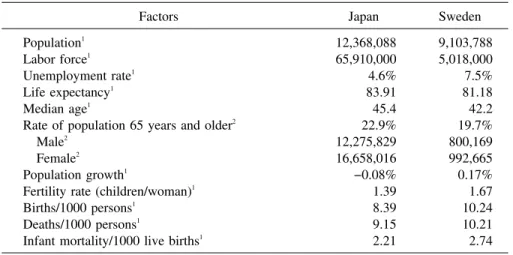
Table 1 Comparative Statistics on Japan and Sweden
Factors Japan Sweden
Population1
Labor force1
Unemployment rate1
Life expectancy1
Median age1
Rate of population 65 years and older2
Male2
Female2
Population growth1
Fertility rate (children/woman)1
Births/1000 persons1
Deaths/1000 persons1
Infant mortality/1000 live births1
12,368,088 65,910,000 4.6% 83.91 45.4 22.9% 12,275,829 16,658,016 −0.08% 1.39 8.39 9.15 2.21 9,103,788 5,018,000 7.5% 81.18 42.2 19.7% 800,169 992,665 0.17% 1.67 10.24 10.21 2.74 1
CIA World Fact Book (updated December 18, 2012). http://www.cia.gov
2
Index Mundi (updated July 26, 2012). Country profile. http://www.indexmundi.com
Table 2 Percentage of Public Help in the Nordic Countries
Country Total public care
Types of care
Home care Institution Iceland (2009) Denmark (2009) Norway (2008) Sweden (2008) Finland (2008) 28.3 22.5 20.5 15.6 15.2 20.1 17.6 10.8 9.2 6.3 8.2 4.9 9.7 6.4 8.9 Note. Adapted from the (Nordic Social Statistical Committee, 2011)
social equality, and the advancement of working class interests. According to Ginsburg (1992), the Social Democrats struggled to keep the socialist ideology and rhetoric as the rationale for the party’s existence, but populist pragmatism and political realism shaped much of the party’s government policies. Three ideologies arose in the 1930s. First, the people’s home, which implied that everyone would participate and share, and that no one would be ignored in the system of community provisions. Second, the people’s home was connected directly to the “solidaristic wage policy” as a limit to competition and inequality by emphasizing that workers’ wages were more related to worker’s performance than capital’s profitability, and that pay differentials between regions, industries, sexes, and age groups were to be minimized. Additionally, universal, flat rate benefits were also provided. Third, there was a commitment to Keynesian ideas, which was reflected in the use of infrastructural public employment and labor market policies to limit unemployment.
With the three ideological foundations engrained into Swedish society, Swedish policies for women were greatly influenced by Alva and Gunner Myrdal’s (1934), Crisis in the population question. In the 1930s, Sweden had the lowest birthrate in Europe, and the Myrdals suggested in their book that the government should subsidize the well-being of a family and promote policies that would improve all social classes, especially the working class. They suggested that pronatalist policy should be developed, not based on the individual woman, but rather society.
However, despite the establishment of formal rights for mothers, in the 1950s and early 1960s, women’s roles were seen to be sequential: first as a mother and then as a worker (Myrdal & Klein, 1957). In the people’s home, women’s roles were in the family; social policies did not support women as workers. It was not until the 1960s that today’s important feature of the Swedish welfare regime grew: women’s right to work as men improved. What furthered this ideology was the post-war economic boom, which increased the demand for labor. As with other European countries, foreign labor was introduced to meet the much needed demand, but they came with a tremendous cost regarding assimilation and other difficulties (Cousins, 1999). The government saw married women as an untapped resource for labor. With the rebirth of feminism and other radical social movements at the time, women were encouraged to enter the labor force. Simultaneously, women were promoted to political positions. This led to the introduction of progressive income tax, policies to support the combination of family and paid work, and expansion of services and staffing within the welfare state.
By the 1970s and 1980s, the Swedish model was defined by the following Swedish social structure characteristics: a strong labor movement with high unionization, a long period of rule by the Social Democratic Party, the extensive welfare state, and solidaristic wage policies. In the early 1970s, incentives for
Li-Mei CHEN, Konomi IMAI
women to work throughout their early adulthood were introduced including the Protection of Employment Act of 1974, Status at the Workplace Act (i.e., union workplace representation) in 1974, Co-determination in the Workplace Act in 1976, day care for children, and parental leave provisions.
As a result, women’s participation in paid work, and in particular part-time work, increased from this period onwards. Today, Sweden’s employment rates for females and males aged 20−64 are 77.2% and 82.8%, respectively, which is higher than the EU average (females 62.3%; males 75%). Moreover, the rate of women working part time in Sweden (39.6%) is higher than the EU average (32.1%) along with other Nordic countries such as Denmark (37.6%), Iceland (35.6%), and Norway (42.8%). The exception is Finland (19.6%). Part-time employment for women has steadily grown and has remained in the 40% range since 2005. However, unlike other countries, many part-time workers in Sweden work longer hours than time workers in other countries, reaching the EU’s definition of full-time employment of 30 hours per week. Moreover, in Sweden, part-full-time work carries the same benefits and job security provisions as full-time work (Lewis, 1992; Sundstrom, 1994).
These benefits for part-time work helped to realize the dual breadwinner model as the dominant form of family organization in Sweden, but not without the compromises between women and the state regarding work and care. In the 1970s, the women’s movement campaigned for a reduction in the working day from eight to six hours. “The demand for work time reduction was particularly important if women’s work was not be defined as ‘atypical’” (Mahon, 1996). However, the government resisted this and the compromise was an extension of parental leave in 1978 so that parents of young children could reduce their working day to six hours without compensation for the loss of pay. Mothers were the ones who reduced their working day, so the fathers were required, by default, to work continuously and full time. Today, women are counted as part of the active labor market but, in reality, they are often on temporary leave caring for children. As a result of the compromise, the two-adult household income became one and three quarters. Critics highlight that this has led women in Sweden to be less successful in the workforce (e.g., pay equality and holding top positions) than in the United States, where employed women are more likely to work full time (Rosenfeld & Kalleberg, 1990).
Therefore, Sweden’s approach to women, work, and care has evolved to a social democratic model that promotes gender equity in both paid and unpaid work via decommodification through welfare benefits untied to work and social gender roles. This approach did not waiver even amid the economic difficulties in the early 1980s; Sweden did not follow the United Kingdom or the United States’ neoliberalism, and took on the traditional Keynesian policies without giving up full
employment and a universal welfare state. It was only between 1991 and 1994 that Sweden shifted to neoliberalism for the first time as the Swedish business leaders were agitated with their compromise regarding domestic labor with the world became increasingly internationalized. However, this lead to a deep and long recession with loss of public sector jobs due to public expenditure retrenchments and the privatization of welfare services (Cousins, 1999). This also affected the LTC program for older adults, which is discussed in the following section. In addition to the contraction of LTC programs for older adults, women were adversely affected by the contraction of public expenditure as they dominate the public LTC workforce. Moreover, the gap in elder care was filled by families (Hobson, 1993). As women continue to be major providers of informal caregiving, they shouldered the burden.
Sweden’s approach to long-term care.
In general, there are four main sectors within the economy for the provision of elder care: public, for-profit, not-for-profit or voluntary, and informal. All legal family obligations between generations were removed in 1956, and care for older adults was socialized with a heavy focus on a shared responsibility between family and the state (Jönsson, Daune-Richard, Odena, & Ring, 2009). The Government stressed that elder care is a public responsibility and that family care is voluntary for both next of kin and the person in need of care (Ulmanen, n.d.). However, some obligations still exist between spouses according to the marriage law. Elder care is provided as a universal entitlement with extensive public coverage. It is regionally based and publicly operated and financed system. In order to receive benefits, older adults are assessed by a public worker on their needs (Jönsson, et al., 2009).
The importance of publicly provided care can be described in three major points (Sand, 2012). First, it gives older adults the ability to receive care without being dependent on family members. Receiving good quality care for all older adults is an essential part of social and civil rights in Sweden. Moreover, older adults in Sweden, especially older women, prefer formal care over informal care (Ulmanen, n.d.). Second, public care allows family members to continue work even if an older adult requires care. According to the Eurostat’s European Statistics for 2011, the employment rate for women in Sweden was one of the second highest (77.2%) after Iceland (77.9%). The EU average was 62.3%. Sweden was also reported to have a lower probability of suffering labor problems in the presence of unmet caregiver needs along with countries such as Denmark, France, Ireland, and Portugal (Jiménez-Martín & Sánchez, 2012). Third, public care provides employment for many Swedes. In other European countries, occupational segregation by gender is a major characteristic, but Sweden has one of the highest
Li-Mei CHEN, Konomi IMAI
levels of gender segregation in the advanced world (Ruggie, 1988). The situation that has remained unchanged since the 1960s was that women more likely to work in feminized occupations horizontally and vertically. In particular, Sweden’s policy commitment to full employment provided jobs through the expansion of the public sector, which has drawn women in disproportionate numbers. In Sweden, the majority of men are employed in the private sector while the majority of women are concentrated in the welfare state, especially in health and social work, and these fields are also characterized by low wages (S. Johansson & Andersson, 2008).
Experiencing an economic slowdown with an increasingly aging population, Sweden found it difficult to secure the extensive LTC system for older adults (L. Johannson, 1993). Government-led initiatives called the Adel Reform led to the decentralization of certain elder care services from acute care settings and consolidation of responsibility to the local municipalities for administrating, financing, deciding, and delivering services in January 1992. However, this power came with a major barrier by the national government to freeze tax increases in 1992 and 1993. This tax freeze, coupled with a declining economy, left the local municipalities with the decision to abolish or minimize certain programs via such methods as tightening the eligibility criteria for the needs of older adults (L. Johannson, 1993).
This led to two developments. First, as the quality and volume of care for older adults decreased, families were increasingly expected to fill the gaps (Hobson, 1993). As the role of informal caregivers grew as predicted, services to support caregivers were emphasized in the new initiatives. To increase support for informal caregivers, the national government revised the Social Service Act in 1998 to include a new paragraph, as follows: “. . . the local municipalities should support families and next of kin, when caring for elderly, sick, and dependent family members.” Subsequently, the Act was revised again to raise the level of expectation for support from the municipalities by changing the word in the Act from “should” to “obliged.” It now reads, “. . . the local municipalities are obliged to offer support” to informal caregivers (L. Johansson, et al., 2011). The revision was also accompanied by a national project called Project Anhörig 300, which provided 300 million Swedish kroners (SEK) for three years (1999−2001) to the local municipalities for strengthening family caregiver support.
Second, the new initiatives allowed municipalities to enter contracts with private providers, including for-profit companies−which had earlier been explicitly forbidden by law−as long as they provided the needed services and had their costs remain within the framework of the locally established contracts and the law (Henning, Ahnby, & Osterstrom, 2009).
The implications of the ideological shift have been dramatic. The ideology of
equality has been replaced by class differentials as well as gender inequalities (S. Johannson, 2000). Services have become more costly and, in particular, LTC for older adults has become extremely expensive in some municipalities. This adds a class dimension to the question of care for older adults. Furthermore, the changes for caregivers are severe. Due to tradition and a more limited private labor market for women, cuts in the public sector can be expected to be difficult for female wage earners. Loss of control and limited equality in the labor market will be the price many wage-earning women will have to pay for more consumer choice, which may exist in theory but not necessarily in practice.
Support for family caregivers.
According to the World Health Organization (2003), five types of caregiver support programs have been identified: (1) respite care; (2) providing education and counseling; (3) tax benefits, supplemental income, or payments to the persons with disabilities or directly to the caregivers; (4) coordination with employers, such as paid or unpaid leave; and (5) pension credits to caregivers.
Regarding (1) respite care, Jegermalm’s (2003) study showed that the most frequent forms of support in Sweden’s LTC system are respite services and day care centers. Two types of municipality-offered respite services were short-term breaks at an elder institution and home respite services. Ninety-eight percent of the municipalities reported that they could offer short-term breaks at an institution, and 84% replied that they offered carer support as home relief services. All municipalities reported that they have day care centers. The content of the programs differs by municipality as each municipality has a high degree of autonomy when it comes to financing, administrating, and delivering elder care. As Kroger (1997) states, Sweden cannot be described as a one welfare state, but rather many different welfare states due to the decentralization of elder care to each local municipality.
Regarding (2) education and counseling, there are also different types of support groups and training for caregivers run by the Red Cross and other caregiving organizations (Jegermalm, 2003). There are two recent initiatives worth mentioning: the next-of-kin consultants and the Swedish Family Care Competence Center. From 1999−2001, SEK 300 million for three years were dedicated to family caregiver support services, such as respite care, staff training, caregiving support groups, and raising awareness (Socialstyrelsen, 2002). One of the areas that received funding was to establish a position dedicated to supporting family caregivers called family consultants (or project managers or family supporters). Priority of the local municipalities in offering caregivers support can be measured by whether there is a position, such as the family consultant, which is dedicated to supporting family caregivers. The position is more likely to exhibit higher volume of activity when its
Li-Mei CHEN, Konomi IMAI
job description is clear. The Swedish Family Care Competence Center was commissioned by the national government in 2007 and was implemented in January 2008. The Center explores and collects existing research and development in the area, disseminates research results and provides examples of best practice, and supports development work within municipalities and voluntary organizations (Hanson & Magnusson, 2008). The Center has a focus on gender as an underlying perspective, along with ethnicity, to examine caregiving in Sweden. Gender and ethnicity are common, intertwined themes for the following four major prioritized areas: (1) individualization, evaluation, and development of family care support; (2) cooperation and partnership working within family care support; (3) eservices and new technology for caregivers; and (4) working caregivers, and how to combine care and work. Additionally, caregivers for persons with multiple disabilities as well as young caregivers were new, prioritized areas added in the summer of 2012 (Sand, 2012). For each area, a Learning Network is created at a national and local level. Learning Networks consist of caregivers, older adults requiring care, practitioners, managers, and politicians. The local Learning Networks exist in six different areas in Sweden. A coordinating network exists to facilitate between the local and national level discussions on the prioritized areas, and gathers and disseminates information via the website and videophones. It aims to assist caregivers with mutual learning and sharing of knowledge and experiences, developing educational material and practical guidelines for caring issues, and applying relevant research within everyday practice and the organizational work (Hanson & Magnusson, 2008). Regarding (3) income replacements, (4) unpaid or paid leave, and (5) pension credits, there are four types of direct and indirect transfers that are either given to the care recipient or directly to the caregiver. The first two programs−the Carer’s Allowance and Personal Assistance Allowance−are income replacement programs with pension credits, while the third program−the Compassionate Care Benefit−is a paid leave program with pension credits, and the fourth program−the Attendance Allowance−is a lump sum payment program with no pension credits. None of these programs are income-tested.
First, the income replacement program with pension credits is the Carer’s Allowance. This pays a family member who is under 65 years old by employing him or her as a formal caregiver by the local municipality. As the family member must be employed as any other formal caregiver, he or she must be assessed as suitable for the job. Payment to the caregiver is a taxable wage and the caregiver is entitled to pension credits. According to Sand (2012), this program has existed since the 1950s, and today, there are only 40 municipalities out of 100 that provide this program. The number of recipients of this program has also declined over the years. In 1975, there were 24,000 recipients; this has declined to 1,800 recipients in 2006.
Another income replacement program with pension credits is the Personal Assistance Allowance that started in 1994 for persons with disabilities under 65 years of age, who need personal attention or assistance for more than 20 hours per week. Payment is based on the number of hours of care needed and is taxable. Approximately 15,000 persons with disabilities receive the benefit for an average of less than 100 hours per week. Family members provide one-fourth of the personal assistance.
The paid leave program with pension credits is the Compassionate Care Benefit. It is a program for caregivers who are caring for terminally ill family members. This is temporary secured care leave for working caregivers to attend to a terminally ill relative based on the 1989 Care Leave Act. Sixty days of paid leave for end-of-life care is available under the social insurance system. It compensates 80% of lost income for up to 12 weeks and is taxable. The sixty days can also be shared with other family members. The program remained mostly unknown at the start, but it has increased over the years with approximately 10,000 recipients and an average of 10 compensated days.
Finally, a payment program without pension credits is the Attendance Allowance. It has existed since the 1940s, and is an untaxed payment that goes to the care recipient to pay the family caregiver. The amount is based on the care recipient’s level of need and the number of caregiving hours per week provided by the caregiver. The amount varies by municipality, but on an average, it pays !100− 400 per month. Program recipients have declined from 21,000 in 1980 to 5,000 today (Sand, 2012).
In addition to the public LTC system and benefits, alternative forms of care have become a growing market in Sweden over the last 20 years. Although the main trend is towards informal care (Szebehely, 1998), there has been an increase in the purchasing of private care from the market. According to the Swedish Institute (2012), the number of private companies in the social services sector has grown fivefold between 1995 and 2005. In 2011, private care provided services for 18.6% of all older adults receiving home help services, comprising approximately 3% of all forms of care, and it is partially subsidized by taxes (Sand, 2012). The municipality is responsible for the quality and the control of this (Jönsson, et al., 2009). Private providers must follow the same rules and regulations as public providers. However, the reliance on the market has increased among groups of older persons other than those targeted as most in need of care and services. Much of these types of care are purchased only among middle and upper income households, with lower income households unable to access the full breadth of care available (Sand, 2012).
The other important outcome of the Adel Reform initiatives was the Local Government Act of 1992, which led to the local municipalities relinquishing their
Li-Mei CHEN, Konomi IMAI
responsibilities to private entities for providing elder care services. Local municipalities have two possibilities when relinquishing responsibility for these services to private organizations. They can either outsource services to external providers after a process of competitive tendering or develop a system of consumer choice to allow older adults to choose the organization, public or private, from which they will receive their publicly subsidized services. In several municipalities, there are other organizations providing elder care services that are commissioned by the municipality to promote efficiency and quality of care (Henning, et al., 2009).
In addition to the for-profit providers, Sweden also has a small, but growing, sector of not-for-profits or voluntary organizations providing elder care services. The size of the Swedish voluntary sector is comparable with other similar countries (Lundstrom & Svedberg, 2003). For a country with only 9.3 million inhabitants, the number of voluntary organizations are somewhere between 150,000 and 200,000 (Svedberg, von Essen, & Jegermalm, 2010). As a case study, the Joshua Kristna Center in Gamleby, Sweden reflects this new wave of social welfare provision by a not-for-profit organization. Gamleby is the second largest locality situated in the Vastervik Municipality, Kalmar County, with approximately 2,780 inhabitants in 2010. A local Pentecostal Congregation runs the facilities that bear its name. Approximately 45 staff members run the Joshua Kristna facilities and programs, such as a children’s day care center and rehabilitation facility for various addictions. Since 1995, the facility owns senior housing, which is also known as sheltered housing. Private enterprises mainly run such housing compared to other types of elder care. The 33 rooms are furnished, one to three bedroom dwellings with kitchens. Unlike other public senior housing with one or two bedrooms, it is rare for senior housing to have an option of three bedrooms. Older adults who are able to reside in this facility are those who require higher medical attention, which is decided on an individual basis. The rooms cost SEK 3500−6000 per month. As the majority of the residents have only basic pensions, they receive a housing supplement. The housing supplement for pensioners (bostadstillägg till pensionärer) is income tested: 91% of the housing supplement costs up to SEK 4,500 (!485) per month. Originally, this senior housing tried to offer their own home help services to their residents and get funding to start their on-site home help care services. The municipality did not allow them to open their own services because of their obligation to protect the already existing public care workers. Opening a new on-site home care service station was taken as a threat by the labor unions. Today, the facility’s residents receive home help services from public care workers.
Discussion
This study’s concern is that, despite being a social democratic welfare state with a highly socialized public elder care system, Sweden is increasingly experiencing a reliance on informal family caregivers to provide basic care services. As mentioned earlier, the reasons seem to stem from a slowing economy influenced by the global economic crisis and an increasingly aging population. Public expenditures have contracted, especially in elder care. As women comprise most of the public sector’s care work, they lost their jobs due to budget cuts. Therefore, women in Sweden are experiencing losses both as consumers and as workers, and are burdened as primary informal caregivers. Similar situation existed in the early 1990s, and is occurring again today.
Therefore, it is a concern for a country such as Japan that a similar trajectory may occur in the future. Japan has had a public LTC system since 2000, which is run by the local municipalities, as it is in Sweden. Although the goal of the public LTC system was to lessen the burden of family members who were traditionally responsible for the care of their older adults, much of the care is still provided by female family caregivers. Japan is also challenged by a rapidly growing aging population; the demands for LTC are expected to grow as the baby boomer generation ages (Ohwa & Chen, 2012). Moreover, Japan has been experiencing a stagnant economy for the past 20 years and is slowly minimizing their LTC benefits. Hence, Japan is in a very similar situation to Sweden.
As for caregiver support, Japan’s public LTC system does not explicitly offer public support programs for caregivers. The system offers respite and day care, which indirectly provide relief for the older adult’s family. Unlike Sweden, Japan does not have any institutionalized paid leave or cash transfers for informal caregivers. Therefore, if Japan was to create support for caregivers, what could Japan learn from Sweden’s experience? First, Sweden has compensatory programs that are cash transfers (Carer’s Allowance, Personal Assistance Allowance, and Attendance Allowance) and one paid leave program (Compassionate Care Benefit). All of the four programs for caregivers are not fully compensated for care provision, but are remunerated by pay through the respective programs. With the exception of the Attendance Allowance, the other three programs are regulated as their services are taxed. Caregivers depend on how far their income is subject to taxation, their contracted hours, and their guaranteed social rights. Regarding Ann Orloff’s (1993) argument on “access to paid work,” the Personal Assistance Allowance, Carer’s Allowance, and Compassionate Care Benefit guarantee access to paid work−the first two allow a fully commodified care, while the latter is secured and paid temporary care leave−that will be indirectly compensated as pension credits along
Li-Mei CHEN, Konomi IMAI
with other types of income. These programs are also individualized and not familialized, as they are neither benefits given only to male breadwinners nor through marriage.
However, we argue that these benefits reflect a strong “separate gender role’s regime” as in Sainsbury’s model (1999) and “caregiver’s parity model” as in Fraser’s model (1997). The Carer’s Allowance and Personal Assistance Allowance can fully commodify care by employing the informal caregiver as a paid caregiver, but they only compensate or supplement paid labor, which is hardly a living wage for the majority of Swedish citizens. In fact, far more female caregivers than male caregivers work part time or quit work due to caregiving than the number of caregivers receiving payments for care (Sand, 2012). Furthermore, as benefits constitute a greater portion of women’s income package than they do for men, the cuts in these caregiver’s benefits have a greater effect on women. Interestingly, approximately 70% of the recipients for the Carer’s Allowance are used by immigrants, in particular non-Europeans, as it has become a way for local municipalities to manage the care for older immigrants who speak a foreign language by having their family members care for them rather than use publicly available care (Sand, 2012). As with the Carer’s Allowance, the payment through the Attendance Allowance is also thought to be used mainly by immigrant families. Results from a peer support group of working caregivers in Sweden do show that they preferred cash benefits when caring for a relative, which is similar to what a parent receives for caring for sick children, as well as job security and employer support when needing to reduce work hours or take a leave of absence due to caring for older family members (Sand, 2012). However, as the current benefits pay very little, they do not attract non-immigrant families who are fully employed. With the exception of the Compassionate Care Benefit, there has been a decrease in caregivers who have benefited from these programs over the years.
The Compassionate Care Benefit does replace 80% of informal caregivers’ income and is subjected to pension credits, but it is limited to 12 weeks and mainly used for caring for older adults who are terminally ill. If Japan decides to create similar caregiving benefits, they will lessen dependence by women on marital status or work status, and still enjoy the same benefits as men. These benefits may reduce some insecurity for female caregivers with respect to income loss, irregular and extraordinary expenditures, or even poverty in their old age via indirect transfers, such as accumulating pension credits. Women predominantly take these benefits, so these benefits create inequality between men and women. Moreover, as we find that the Carer’s Allowance and Personal Assistance Allowance are unattractive because they do not compensate women’s expectations for reasonable earnings. In other words, they do not reduce inequality between caregivers and non-caregivers. If
Japan were to create income transfers, they should not only reduce the insecurity of income loss and access to pension credits, but also reduce inequality.
What Japan can learn from Sweden’s experience is that although Sweden’s welfare state has liberated women by introducing the dual breadwinner model, care has (re)produced inequalities between women and men in new forms (Nyberg, 2004). Sweden is a society with high gender segregation by occupations; women often have lower paid jobs and work part time. Their positions in the labor force encourage them to take on the informal care of children and older adults to a greater extent compared to their male counterparts. Japan is also gender segregated, but due to a different reason: Japan’s society and its social security system is based on the male breadwinner model. Therefore, men are more likely to be full-time employees and women are more likely to be homemakers who work in a limited, part-time basis. The lesson learnt from Sweden is that the true dual breadwinner model cannot be achieved without emancipating women from gender-segregated occupations. Both the public and the private sectors must be equally attractive to both women and men.
A helpful lesson from Sweden may be the implementation of the solidaristic wage policy. Sweden implemented solidaristic wage policies across occupations and allowed women to enter the labor force and be compensated for their performance, rather than according to their sex and age. However, as the European economic climate declined in the early 1990s, Swedish business leaders were agitated with their compromise to domestic labor and solidaristic wage policies and they disregarded these policies as unfit for a competitive, internationalized economy. However, ending solidaristic wage policies in Sweden led to a deep recession. This lesson teaches us that minimizing pay gaps through solidaristic wage policies does worsen economic conditions and does not necessarily lessen competitiveness. For Japan, during a slowing economy with a fragmented middle class, such lessons from Sweden may help Japan to become more manageable as a nation in creating solidarity among its people, helping the slowing economy, and becoming the key to gaining better gender equity in work and care.
Sweden’s deregulation to create alternative forms of care has provided more choices for LTC consumers; however, middle and upper-income families mainly purchase these. Non-profit and voluntary entities, although minimal, have grown over the years. However, we have discovered through local interviews that Swedish citizens believe that they are supplementary to the publicly available services, and that citizens trust the public sector to continue to be the frontline force behind the provision of care. The same applies for Japan. Japan’s not-for-profit agencies have grown since the late 1990s, but are highly regulated by the government. Similar to Sweden, both the private and not-for-profit agencies provide choices for informal
Li-Mei CHEN, Konomi IMAI
caregivers, but the choices are limited in what they can do for the caregiver and who can actually purchase them. From Sweden’s experience, having diverse choices is not necessarily needed to lessen the burden of informal caregivers. Rather than deregulating the LTC sector, greater efforts should be made to increase the quality and quantity of public care services available to all.
Finally, education and counseling are important aspects of providing support for informal caregivers. However, the difficulty in Sweden was that as the national development funds to develop support for family caregivers started in 1999, almost every fifth place in day care was removed, and there were no major changes in short term care (Socialstyrelsen, 2007). Working female caregivers in Sweden were not actually gaining but rather losing the quantities of services for their older family members, which also meant more dependence on informal caregivers.
Perhaps it is inevitable that when the economy is in decline, the nation as a whole must experience a decrease in public expenditure. However, as for cuts in LTC, the burden is greater on women since they are engaged in care-related occupations as well as engaged as informal caregivers to older family members. At the very least, this lopsided situation must be ameliorated.
As Nancy Fraser envisioned in her model, the ideal is the universal caregiver model, which supports both women and men to combine paid employment with caring responsibilities-that is, that men should “become more like women are now.” Japan should not repeat the same challenges experienced by Sweden but rather learn from their experiences, adopt what is working, adapt to achieve gender equity in care, and create better solutions for their citizens.
Reference
Cousins, C. (1999). Society, Work and Welfare in Europe. New York: St. Martin’s Press. Esping-Andersen, G. (1990). The Three Worlds of Welfare Capitalism. Princeton: Princeton
University Press.
Fraser, N. (1997). Justice Interruptus: Critical Reflections on the “Postsocialist” Condition. London: Routledge.
Fukushima, N., Adami, J., & Palme, M. (2010). The long-term care system for the elderly in Sweden ENEPRI Research Report (Vol.89). Brussels: CEPS.
Ginsburg, N. (1992). Divisions of Welfare: A Critical Introduction to Comparative Social
Policy. London: Sage.
Hanson, E., & Magnusson, L. (2008). Working together to improve family support. Swedish
Family Care Competence Centre [powerpoint material]. Stockholm.
Henning, C., Ahnby, U., & Osterstrom, S. (2009). Senior housing in Sweden: New concept for aging in place. Social Work in Public Health, 24, 235−254.
Hobson, B. (1993). Feminist strategies and gendered discourses in welfare states: Married
women’s right to work in the U.S. and Sweden during the 1930’s. In S. Koven & S. Michel (Eds.), Mothers of a New World: Maternalist Politics and the Origins of Welfare
States. New York: Routledge.
Jönsson, I., Daune-Richard, A.-M., Odena, S., & Ring, M. (2009). Becoming dependent: How is
eldercare implement in France and Sweden?. Paper presented at the Le Comité de
recherche sur la pauvreté, les politiques sociales et l’État-Providence (RC 19) de l’Association internationale de sociologie a tenu son colloque annuel à Montréal (Québec) au Canada, Montreal.
Jegermalm, M. (2003). Direct and indirect support for carers. Journal of Gerontological Social
Work, 38(4), 67−84.
Jegermalm, M. (2004). Informal care and support for carers in Sweden: Patterns of service receipt among informal caregivers and care recipients. European Journal of Social Work, 7 (1), 7−24. doi: 10.1080/136919145042000217465
Jegermalm, M. (2006). Informal care in Sweden: A typology of care and caregivers. International Journal of Social Welfare, 15, 332−343. doi: 10/1111/j.1468−2397.2006. 00400.x
Jiménez-Martín, S., & Sánchez, R. V. (2012). Availability and choice of care ENEPRI Policy
Brief (Vol.9). Brussels: CEPS.
Johannson, L. (1993). Swedes test new strategies. Ageing International, 20(2), 42−45.
Johannson, S. (2000). In B. Hobson (Ed.), Gender and Citizenship in Transition (pp.336). London: Routledge.
Johansson, L., Long, H., & Parker, M. G. (2011). Informal caregiving for elders in Sweden: An analysis of current policy developments. Journal of Aging Social Policy, 23(4), 335−353. Johansson, S., & Andersson, K. (2008). Diversity−A challenge to the Scandinavian care
regime? Paper presented at the Forum on Public Policy. http://forumonpublicpolicy.com/
archivespring08/johanesson.pdf
Kennett, P. (Ed.). (2004). A Handbook of Comparative Social Policy. Bristol University of Bristol.
Kroger, T. (1997). The dilemma of municipalities: Scandinavian approaches to child day-care provision. Journal of Social Policy, 26, 485−507.
Larsson, K., & Szebehely, M. (2006). Äldreomsorgens förändringar under de senaste
!
decennnierna. In J. Vogel (Ed.), Äldres levnadsförhallanden. Arbete, ekonomi, hälsa och
sociala nätverk 1989−2003. Stockholm: SCB.
Lewis, J. (1992). Gender and the development of welfare regimes. Journal of European Social
Policy, 2(159−173).
Lewis, J., & Ostner, I. (1994). Gender and the evolution of European social policies. Zentrum für Sozialpolitik der Universität Bremen. Bremen.
Lister, R. (1994). ’She has other duties’−Women, citizenship and social security. In S. Baldwin & J. Falkingham (Eds.), Social Security and Social Change: New Challenges to the
Beveridge Model. Hemel Hempstead: Harvester Wheatsheaf.
Lundstrom, T., & Svedberg, L. (2003). The voluntary sector in a social democratic welfare state −The case of Sweden. Journal of Social Policy, 32(2), 217−238.
Mahon, R. (1996). Women wage earners and the future of Swedish Union. Economic and
Li-Mei CHEN, Konomi IMAI
Industrial Democracy, 17(4), 545−586.
Nordic Social Statistical Committee. (2011). Social Protection in the Nordic Countries. Copenhagen: Retrieved from http://nososco−eng.nom−nos.dk/.
Nyberg, A. (2004, April 19−20). Parental leave, public childcare and the dual earner/ dual
carer-model in Sweden. Discussion Paper. Swedish National Institute for Working Life.
Ohwa, M., & Chen, L. (2012). Balancing long-term care in Japan. Journal of Gerontological
Social Work, 55(7), 659−672.
Orloff, A. S. (1993). Gender and the social rights of citizenship: The comparative analysis of gender relations and welfare states. American Sociological Review, 58(3), 303−328.
Riedel, M., & Kraus, M. (2011). Analysis of informal care provision across Europe: Regulation and profile of providers ENEPRI Research Report (Vol.96). Brussels: CEPS.
Rosenfeld, R. A., & Kalleberg, A. L. (1990). A cross-national comparison of the gender gap in income. The American Journal of Sociology, 96, 69−106.
Ruggie, M. (1988). Gender, work, and social progress: Some consequences of interest aggregation
in Sweden. In M. F. Katzenstein & C. M. Mueller (Eds.), The Women’s Movement in the U. S.
and Western Europe: Feminist Consciousness, Political Opportunity and Public Policy.
Philadelphia: Temple University Press.
Sainsbury, D. (1996). Gender, Equality and Welfare States. Cambridge: Cambridge University Press.
Sainsbury, D. (1999). Gender and Welfare State Regimes. Oxford: Oxford University Press. Sand, A.-B. (2012). How to combine work and family care in Sweden?, Stockholm University. Socialstyrelsen. (2002). Anhörig 300−Slutrapport. Stockholm: Kopie Center.
Socialstyrelsen. (2007). Kommunernas anhörigstöd. Utvecklingsläget 2006. Stockholm.
!
Socialstyrelsen. (2011). Äldre−vard och omsorg den 1 november 2010 (Care and services to
elderly persons 1 november 2010). Retrieved from www.socialstyrelsen.se
Statistics Sweden. (2010). Population Retrieved July 14, 2012, from http://www.scb.se/
Sundstrom, G. (1994). Care by Families: An Overview of Trends. In P. Hennessy (Ed.), Caring
for Frail Elderly People: New Directions in Care (pp.15−55). Paris: Organisation for
Economic Co-operation and Development.
Svedberg, L., von Essen, J., & Jegermalm, M. (2010). Stabiliy and variations in civic
engagement: Sweden in prosperity and recession ISTR Working Paper Series.
Swedish Institute. (2012). Facts about Sweden: Elderly Care, from http://www.sweden.se/ Szebehely, M. (1998). Changing Divisions of Carework: Caring for Children and Frail Elderly
People in Sweden. In J. Lewis (Ed.), Gender, social care and welfare state restructuring in
Europe. Aldershot: Ashgate.
Ulmanen, P. (n.d.). Next of kin in Swedish elder care policy: Prolem representations and
outcomes. Paper presented at the Transforming Elderly Care at Local, National and
Transnational Levels.
Wiener, J. (2003). The role of informal support in long-term care. In J. Brodsky, J. Habib & M. J. Hirschfeld (Eds.), Key policy issues in long-term care (Vol.1, pp.3−24). Geneva: World Health Organization.