The Relationship between Global Brand and
Country of Origin in Chinese Consumption
Market
journal or
publication title
International review of business
number
13
page range
87-112
year
2013-03
1. Introduction
Consumers may perceive many different types of risks in buying and consuming a product (Keller, 2008). Purchasing a product is considered a process of processing information. Consumers depend on information which is intrinsic, such as tastes or design, or extrinsic, such as price or brand, to evaluate or purchase a product or brand (Nes & Bilkey, 1993; Samiee, 1994). When consumers lack intrinsic product information, extrinsic information becomes more essential. According to prior research, consumers rely mostly on the extrinsic information of the product’s country of origin (COO) and the global brand before declaring their intent to purchase the product in global markets.
Although global brands are recognized in the business world as assets that have a sustainable competitive advantage in global markets, research on brand globalness is relatively new. Most of the studies are dated after the early 2000s, and the research on international consumer behavior is insufficient. Research on COO, in contrast, dates back to 1965, and a majority of those studies focused on consumer behavior in developed countries, in particular, the United States and countries in Western Europe. However, major markets around the world have now shifted from developed countries, like the U.S., to emerging
in Chinese Consumption Market
Ling LEE
Abstract
This study aims to investigate the relationship between brand knowledge and informational cues including macro country-of-origin (COO) image, micro country-of-origin (COO) image and globalness of brand, and the effect of cues on purchase intention using three brand origin countries or regions: The United States, Japan, and Europe. A cross-city survey was conducted in three major cities: Beijing, Shanghai and Guangzhou in China. Results reveal that in the low brand knowledge group, there is no statistical significance related to cues. Although brand knowledge influences macro COO image positively, the influence of macro COO image on purchase intention did not reach a significant level for the respondents in this study. The findings suggest, however, that brand globalness has a direct influence on purchase intention, and ethnocentrism does not affect purchase intention negatively. Keywords: Global Brand, Country of Origin Image, Brand Knowledge, Purchase
markets, namely China. Along with this change, there is a clear need to carry out market and consumer research in emerging countries.
Consumers’ perception of a brand or product may vary according to their race, traditions or cultural background, or economic status. For instance, U.S. consumers prefer domestic products to the ones made in developing countries because they trust the quality. In contrast, consumers in developing countries favor brands from developed countries because they consider those brands as a tool to express their social status or prestige. Namely, the same brand or product could be perceived completely different by consumers from different nations or even different backgrounds or experiences. Thus, a deep understanding or use of the contexts of local markets is a vital global business strategy (Kawabata, 2009).
This study aims to analyze Chinese consumer behavior from an information processing perspective. The extrinsic information of a product’s country of origin (COO) and the global brand are meaningful informational cues for international consumers to evaluate or predict a brand or product, which originated in a foreign country. Country of origin is divided into macro which results from a country’s stereotype, and micro which is related to the image of a certain category about brands or products. Perceived brand globalness is positively related to perceived brand quality and prestige, and it provides a positive effect on purchase likelihood (Steenkamp et al., 2003). And Sai’s (2006) research indicate that Chinese consumers perceive a foreign high-grade brand as a signal to show their social prestige. Thus, brand globalness can be seen as a more essential component of a global brand, and as a more useful cue to influence consumer’s behavior in global markets. The dimension of globalness is investigated.
Keller (1993) argued that knowledge is a core factor for establishing brand equity. In this study, it is speculated that the amount of brand knowledge stored in a consumer’s mind may influence their behavior when selecting available informational cues. The majority of research on COO has been limited to investigating cues for evaluating certain products or brands and has not included the influence of cues related to purchase intention (Hui & Zhou, 2002). Some social or environmental factors, like ethnocentrism, could alter consumers’ perceptions of products, and the influence of available cues associated with purchase intention might diminish (Peterson & Jolibert, 1995; Verlegh & Steenkamp, 1999). It indicates that the measurement related to purchase intention is more important and realistic than which only associate with product evaluation. And ethnocentrism, which is considered a negative component that warps the purchase decision-making process, were included in the questionnaire. The inclusion of ethnocentrism in this study was deemed necessary because the author believes that China has a patriotic culture based on her insights and experiences.
2. Literature Review
2.1 Global Brand
2.1.1 The Definition and Advantages of Global Brand
There are many researchers who use the term of “global brand” without defining it (e.g., Holt et al., 2004; Kapferer, 2005). Three definitional perspectives are found in the literature. Barron & Hollingshead (2004), defining global brand from a producer’s perspective, state that a global brand “expresses the same values in all of its markets and owns a similar position vis-a-vis its competitors around the world” (p.9). While Cateora and Graham (2007) use a consumer’s perspective to define global brand as “the worldwide use of name, term, sign, symbol (visual and/or auditory), design or combination therefore intended to identify goods or services of one seller and to differentiate them from those of competitors” (p.360). In addition, Townsend et al. (2009) take a geographic perspective to define global brand. In their framework, a global brand acts as “an anchor for the portfolio, with coat-tail effects for all related brands, and is in the mature stage of the globalization process. Additionally, it is sold across multiple country markets on three major continents (North America, Europe, and Asia)” (Townsend et al., 2009, p.541).
In contrast, Dimofte et al.(2008), Rosenbloom and Haefner (2009), and Steenkamp et al. (2003) assert that the criterion for interpreting whether a product can be labeled as a ‘global’ brand or not is not only how it is defined but also the consumers’ perception. The most important point is “if consumers believe the brand is marketed in multiple countries and is generally recognized as global in these countries” (Steenkamp et al., 2003). Based on the various definitions discussed in the literature review, the framework of a global brand in this study refers to a name, term, sign, symbol, design or combination that is employed to identify goods or services of one seller and to differentiate them from those of other global competitors, and local consumers who use the brand have perceived brand globalness.
Based on prior research, a strong global brand has provided several critical advantages not only for companies but also for consumers. Companies benefit from economies of scale, a foundation of brand extensions, and cost efficiency for new product development, including research and development. In addition, company identity is established around the world, and a solid customer franchise can be developed. Also a strong global brand, especially in the packaged goods sector, is a valid weapon to counter the globalizing the retail industry. Fourthly, efficient alignment across the organization is improved and opportunities for learning increase. Finally, capable personnel can be obtained and maintained.
On the other hand, a strong global brand is also important for consumers. Firstly, a global brand is a signal of quality. Consumers tend to perceive global brand products as being higher in quality than other products, and consumers tend to believe that owners of
global brand products can enjoy respect, prestige, and status. In short, a strong global brand is an essential key to win international consumers.
2.1.2 Brand Research Related to International Marketing
Along with globalization, international trade and foreign direct investment have expanded at remarkable speed. It is now common knowledge that a firm’s branding policy is a major issue in its overall marketing strategy, and the firm’s branding strategy plays an important role in integrating the firm’s activities worldwide. As a result, the research focused on international marketing has also increased greatly, but the majority of those studies first focused on marketing mix and buyer behavior before shifting to the marketing organization and strategy, entry/operational mode; however, no studies have focused on international branding (Nakata & Huang, 2005). A variety of marketing policies and standardization vs. localization about strategies has been the subject for discussion in global marketing for a long time. Oishi (2004) has summarized the controversy of branding during the years from 1960 to the first half of 2000s. Brand had been treated as solely a part of marketing policy or product policy in the discussion of standardization vs. localization before the first half 2000s (Oishi, 2004). Thus, despite an increased number of studies done on brand in the late 1980s, the research was mostly limited to domestic markets instead of international markets. 2.1.3 The Research of Global Branding
According to Whitelock and Fastoso’s (2007) review of the literature related to international branding, there are only 40 articles on Brand found from 1975 to 2005. While global branding is thought to be essential to a firm’s overall global marketing strategy, the studies concerned with global brand are limited.
Barron and Hollingshead (2004) and Kapferer (2005) have indicated that the local population’s perceptions are important factors when implementing a brand strategy. This is logical because even if a company implemented the same brand strategy around the world, the results would be different because consumers’ life stages differ (Fournier, 1998) and group dynamics influence brand meanings (Cova et al., 2007), which could change the meanings the brand symbolizes. For example, resulting from complicated factors of history or culture, consumers in different markets or contexts may interpret the same product as having different meanings or values (Kawabata, 2009). Likewise, despite perceived standardized global brand platforms, consumers develop divergent brand meanings abroad (Bengtsson et al., 2010). Thus, the number of studies concerned with the meanings of brand products is increasing recently.
Strizhakova et al.’s (2008) indicated that U.S. participants were able to discuss the ideals of companies and the values they ascribe to and/or promote, while Romanian and Ukrainian
informants found it difficult to do the same; thus, consumers in different areas might purchase the same brand but holding diverged meanings about that brand. Strizhakova et al. (2011) also found there is a correlation between the effects of brand signals about quality and self-identity. Both of the factors are effectual in developing countries. While consumers in developed countries who want to explain themselves are more willing to use the self-identity factor, they prefer the quality factor when purchasing global brands. Furthermore, consumers in developing countries like China or India view U.S. brands as a means for obtaining social prestige (Batra et al., 2000). Chinese consumers consume luxury brands for making a display of status (Sai, 2006).
In consequence, the same brand plays an entirely different role between developing and developed countries. To clarify that how a certain brand is perceived by local consumers in the target markets, or which signal of brands symbolized is most significant to local consumers is a crucial factor for ensuring the success of local strategy, which supports global strategy.
2.2 Country of Origin 2.2.1 Definition of COO
There were over 300 articles in mid-1997 while over 700 studies in 2005 (Rosenbloom& Haefner, 2009). COO definitions can be classified into three groups: overall country image, products classes related to a certain country, and a special product or brand related to a certain country (Hsieh, 2004; Reierson, 1966). Pappu et al. (2007) classified COO into two groups: macro COO and micro COO. Macro COO image is defined as “the total of all descriptive, inferential and informational beliefs one has about a particular country” (Martin & Eroglu, 1993, p.193). Micro COO image is “the picture, the reputation, the stereotype that businessmen and consumers attach to product of specific country” (Nagashima, 1970, p.68). In our framework, the country refers to the nation which the company’s headquarters is located or the brands are generated.
The majority of studies focus on only one side of macro or micro COO image. Both of the images effect perceived quality of products, and efficacy of perceived quality varies according to product classes or product knowledge held by consumers. Previous research indicated that both the macro COO image and the micro COO image could generate different results in various conditions. Thus, both of the images as important indicators will be employed into our framework.
2.2.2 Literature Review of COO
The comparison between U.S.-made products and Japan-made products was conducted frequently during the 1960s (Reierson,1966). Schooler (1965) is the first researcher to
publish an article related to COO (Samiee, 1994; Verlegh & Steenkamp, 1999). In a study that was carried out in countries that belong to the Central American Common Market, consumers’ attitudes toward the same product (product biases and predilections) changed when the name of the country of origin also changed (Schooler, 1965). During the 1960s when many foreign products were entering the U.S. market, research was done to provide suggestions for distributors or retailers. Since COO image is a single informational cue for estimating foreign product quality, it has a considerable influence on the quality perceptions of a product (Reierson, 1966; Bilkey &Nes, 1982). The effects on product evaluation were significant for consumer goods as well as industry goods (Verlegh & Steenkamp, 1999).
Since the 1980s, multi-attribute models have been developed. Those researchers found that COO image influences specific attributed products but not overall products (American cars were rated low on gas mileage) (Erickson et al., 1984; Johansson et al., 1985). Attitude is determined by beliefs, COO as an image variable affects beliefs but not attitudes (Erickson et al., 1984). The COO also appears to stimulate consumers to think more extensively about other product attribute information (Hong & Wyer, 1989).
Simultaneously, consumers’ patriotic feeling/ethnocentrism also as a factor discussed that influences the impact of COO on product evaluation from the late 1980s. Consumer ethnocentrism refers to “the beliefs held by consumers about the appropriateness, indeed morality, of purchasing foreign-made products” (Shimp & Sharma, 1987, p.280). Ethnocentric consumers take pride in their country’s brands, symbols and culture(Steenkamp et al., 2003), and consider that purchasing imported products would hurt the domestic economy, cause loss of jobs, and is plainly unpatriotic(Shimp & Sharma, 1987). Most studies argued that consumer ethnocentrism has a negative influence on foreign product evaluations and consumer’s purchasing intention.
Since the late of 1980s, particularly Foreign Direct Investment of Japanese firms increased drastically, and as a result, many manufacturers shifted their production location to the U.S. (Kim & Chung, 1997). Some products or brands that were associated with a single nation became associated with multiple countries. Product country association is no longer just a single country phenomenon (Chao, 1993). The research related to impacts on consumers, involving the change of production location and strategic suggestion for firms, was conducted during the late 1980s to the beginning of the 1990s.
Lastly, in review of the relationship between COO image and purchase intention, there are many studies that have shown that COO image influences product evaluation and quality adjustment. However, the research mentioned to clarify the relationship between COO image and purchase intention is not enough (Hui & Zhou, 2002). If a study does not link quality evaluation with purchase intention, it is difficult to understand whether COO image has an impact on consumers’ purchase behavior (Li & Dant, 1997). In fact, Peterson and Jolibert
(1995) and Verlegh and Steenkamp’s (1999) meta-analysis have confirmed that although COO image influenced product evaluation and purchasing intention, the effects are smaller for purchase intention.
In short, the majority of studies have emphasized the importance of COO image on product evaluation in COO studies. However, the research that focuses on purchase intention is insufficient. At the same time, most of the research on COO image has been done in developed countries such as the U.S. or Western Europe. Whereas more and more multinational corporations operate their business in developing countries, local market or consumer behavior research in those countries is becoming crucial.
2.3 The Relationship between Global Brand and COO Image
Since the late 1980s, there have been several studies which have focused on the comparison of the effects between COO/COM and brand. Han and Terpstra (1988) and Tse and Gorn (1993) suggested COM image held a stronger effects than brand image. Okechuku (1994) noted that both of COM image and brand image are important as an informational cue, whereas brand effects stand out in the situation of purchasing.
Recently researchers that focus on global brand have argued that global brands tend to be preferred as high involvement durable consumer goods, which promote less uncertainty or fewer purchasing risks (Rosenbloom & Haefner, 2009). Sound foreign corporate brands’ credibility strongly influence purchase intention (Li et al., 2011). Although most firms have shifted their production to foreign countries, especially developing countries, the brands are still acknowledged as global brands thanks to the strong brand equity, which promotes the brands’ asset value and competitive advantages (Pappu et al., 2007).
However, European consumers see Shiseido as a prestige brand. In fact, the company sells a wide range of products from high-grade cosmetics to shampoos. It is difficult to understand Shiseido’s position in the global market (Suyama, 2000). Similar to the case of Shiseido, most consumers around the world consider products that originated from developed countries, especially the U.S., Japan, and Western Europe, as high-class or prestige products.
The brand’s image and COO have a strong interrelationship. It is very difficult to separate one from the other when evaluating consumers’ purchase decision-making process (Samiee, 1994; Speece & Nguyen, 2005). With the evolution of global marketing, brand also is sold from domestic to overseas. The same brand can be perceived as a quite different one by consumers who come from different countries or hold different culture. Similarly, COO of a brand is also perceived differently according to the level of economic development.
foreign brand. The research on global brand has focused on firms’ perspective such as emphasizing the importance of global brand. The purpose of a firm creating a strong global brand is to obtain a sustainable competitive advantage for ensuring the firm’s volume of sales. It is more important to consider whether a brand is accepted by consumers, or whether consumers perceive the brand as having globalness of brand. In other words, there is a need to fill the gap in the published research on consumer behavior in order to create strong global brands.
3. The Development of Brand in China and Hypotheses Development
3.1 The Development of Brand
Chinese brand development has taken place in four very distinct stages or eras1. The first era (1949 to 1978) was dominated by a central planning system that found little use for branding. During this era, corporate branding was viewed as unnecessary or perhaps never even considered. The second era (1980s) has been labeled the “catching up” era. During this era, the demand for products was rapidly increasing and again there was little need to worry about building corporate brands. The emphasis was placed on finding capital and purchasing technology to increase production. It was only during the third era (1990s) that consumers became brand conscious and “hypercompetition” became the overriding theme. As many Chinese factories had the same levels and types of technology, the products are very similar. As a result, unbranded products have not been sold whereas branded products are sold rapidly. The consumers dissatisfied with the quality of domestic products began to turn toward Western goods for higher quality merchandise. The fourth era (2000 to present) has been labeled the post industrial era in which several large Chinese companies have begun to build strong brands both within the domestic market and in international markets. From the overview of brand development, we can observe that Chinese consumers have purchased brand products consciously since 1990s. Unlike developed countries, China places great importance on corporate brands.
The term “consumer” has been used in the same way as in Japan since the economic reform of 1978 in China(Miura, 2009). Compared with Tokyo consumers, the consumers living in Shanghai of China, can’t express a brand’s characteristics well but only in simple terms (Furukawa, 2006). In addition, consumers in developing countries prefer brands which have names that sound like foreign ones (Batra et al., 2000; Li et al., 2011), and lack knowledge which is necessary for selecting a local or foreign brand (Chan et al., 2011). Thus, it could be speculated that Chinese consumers are immature in their competence to identify brands.
An article from the People’s Daily online(2012) describes Chinese consumers’ consumption of brands below.
“There are 19 cities which GDP per capita excess 10,000 dollars last year. The total amount of social consumer goods in Beijing, Shanghai and Guangzhou surpassed $6,900,000, $6,777,000, $5,243,000 respectively in 2011. Although the population only 3.8% of entire population, the consumption power amount to 11% of all consumption”, “China has become world’s largest luxury goods consumption country”. Chinese luxury sales are increasing 20% every year”, and “Result in the increasing of wealthy and middle classes, a quarter of total luxury goods of world are purchased by Chinese”. In short, although consumers in both developed and developing countries most likely prefer purchasing brands, the purchasing process and consumer behavior can not to be treated similarly. For instance, Chinese consumers tend to get be enthusiastic about are get purchasing developed countries origin products, because they see a brand as a mark for showing their social position or existence value (Sai, 2006). As corporations can expect keen competition for their brand products, the importance of creating a strong brand that appeals to Chinese consumers in the Chinese market is clear. At the same time, the image of brand origin nation is also a critical factor which must be considered while testing Chinese consumers’ behavior.
3.2 Hypothesis Development
The relationship between brand knowledge and informational cues From the early of 19th
century, U.S. consumers have been familiar with brand products, whereas consumers in developing countries, which are at a period of transition such as Russia or China, have gotten to know about brand product quite recently (Strizhakova et al., 2008). Consumers in developing countries are learning about brands and becoming like consumers in developed countries. This trend indicates that developing countries’ consumers might still have less knowledge related to brand.
When consumers evaluate products but lack informational cues or have little knowledge about product categories, they often use COO image as a cue (Maheswaran, 1994). For instance, developed countries’ consumers do not prefer products that originated in developing countries (Reierson, 1966). In contrast, Indian or Chinese consumers prefer foreign products and tend to pay stronger loyalty to them because they perceive foreign products as being higher in quality than local ones (Bhardwaj et al., 2010).
Thus, the country of origin’s level of economic development provides consumers with a cue to evaluate foreign products. For example, consumers, who have no brand knowledge about a product, might be willing to purchase the product if the stereotype image of the COO is positive. We hypothesize that:
H1a: when consumers have low brand knowledge, the knowledge will positively affect macro COO image.
COO image or brand is used as a summary construction in the case of holding knowledge about certain product, and the knowledge will be generalized in the same product or brand category(Pecotich & Ward, 2007). At the same time, consumers use their knowledge about a certain product or brand category to infer other products or brands from the same country (Kim & Chung, 1997). With increasing knowledge about products or brands, rather than macro COO image related to economy, knowledge of product categories arises to play a more important role in product evaluation. Thus, we hypothesize that:
H1b: when consumers hold medium brand knowledge, the knowledge will positively affect micro COO image.
Since information concerning price has a low reliability, developing consumers do not willing use price as an informational cue to evaluate products (Zhou et al., 2002). In the categories of high evolvement of durable consumer goods, in order to reduce purchasing risks or avoid uncertainty, many consumers tend to prefer purchasing a global brand (Rosenbloom & Haefner, 2009). Simultaneously, based on a survey of Chinese consumers’ intention of purchasing brands, 43% of the respondents who purchase high grade brands do so for status (Sai, 2006). Batra et al. (2000) also argued that brands that originated from developed countries are effective for people in developing countries to gain social prestige. Consumers enjoy brand’s quality and prestige through perceiving brand globalness (Steenkamp et al., 2003). However, consumers in China have lesser brand knowledge about brands than developed countries; therefore,
H1c: if consumers have high brand knowledge, their knowledge will positively affect globalness of brand.
Informational Cues and Purchase Intention
Since foreign brands symbolize social status, high quality and fashion, consumers in developing countries hold favorable impressions which result in preference to purchase the brands (Verlegh & Steenkamp, 1999). As a result, a brand which originated from a developed country may influence consumers in developing countries to purchase that brand. Similarly, Steenkamp et al. (2003) have proved a positive relationship between perceived brand globalness and both perceived brand quality and prestige. We suppose that perceived globalness of brand also influences Chinese consumers’ behavior positively. Therefore,
H2: both macro COO image (a) and micro COO image (b) influence purchase intention positively.
H3: corporate brand influences purchase intention positively.
As 58% people consider Samsung is Japanese brand (Weiss, 2007), most people link global brands with developed countries such as Japan and the U.S.. Li et al. (2011) showed that compared to COO image, brand credibility has a stronger effect on purchase intention. By enhancing the presence of brands’ perceived globalness, consumers tend to strengthen their intention to purchase the brands. Thus,
H4: compared with the direct effect of linking macro COO image(a) and micro COO image(b) to purchase intention, the total effect through globalness of corporate brand, as a modified variable, are larger.
Most studies argued that consumer ethnocentrism has a negative influence on foreign product evaluations and consumer’s purchasing intention. Consumer lifestyle such as a community-oriented one (Kaynak & Kana, 2002), culture such as in collective countries (Suh & Smith, 2008) could strengthen ethnocentrism and lower product evaluation. Klein et al. (1998) used data collected from adult consumers in the Chinese city of Nanjing to demonstrate that animosity2 has a significant impact on buying decisions above and beyond the effect of consumer ethnocentrism. In contrast, consumers in Dalian of China showed an open attitude to especially U.S. products, ethnocentrism or animosity have no impact on foreign product evaluation (Parker et al., 2011). Indian consumers tend to prefer U.S. products (Bhardwaj et al., 2010), and foreign perceived brands were modified by familiarity but not influenced by consumer ethnocentrism (Batra et al..2000). In short, consumer ethnocentrism effects may vary according to culture, histories, and attitudes toward foreign products. Developed nation’s consumers tend to hold stronger ethnocentrism whereas developing nation’s consumers prefer developed nation’s products and resulting ethnocentrism shows no impact on product evaluation. Sai (2006) argued that Chinese consumers are not influenced by ethnocentrism and show an open attitude when purchasing foreign brands, especially high-grade brands. Therefore, in China
2 Animosity defined as “the remnants of antipathy related to previous or ongoing military, political, or
economic events will affect consumers’ purchase behavior in the international marketplace” (Klein et al., 1998, p.90). Ethnocentric consumers believe that their own country produces the best products. In contrast, animosity consumers might be unwilling to buy these goods but might still believe that foreign products are of high quality (Klein et al., 1998).
H5: despite modifying by an ethnocentric variable, macro COO image(a) and micro COO image(b) will not affect purchase intention negatively.
H6: despite modifying an ethnocentric variable, globalness of brand will not affect purchase intention negatively.
4. Analysis and Results
4.1 Measures and Questionnaires
We have predicted that the influences of macro COO image, micro COO image, globalness of corporate brand3 will influence consumers differently depending on the amount of knowledge they have. Also, we have predicted that informational cues influence purchase intention and globalness of brand may have the strongest impact. The questionnaire incorporates demography items such as gender, age and city.
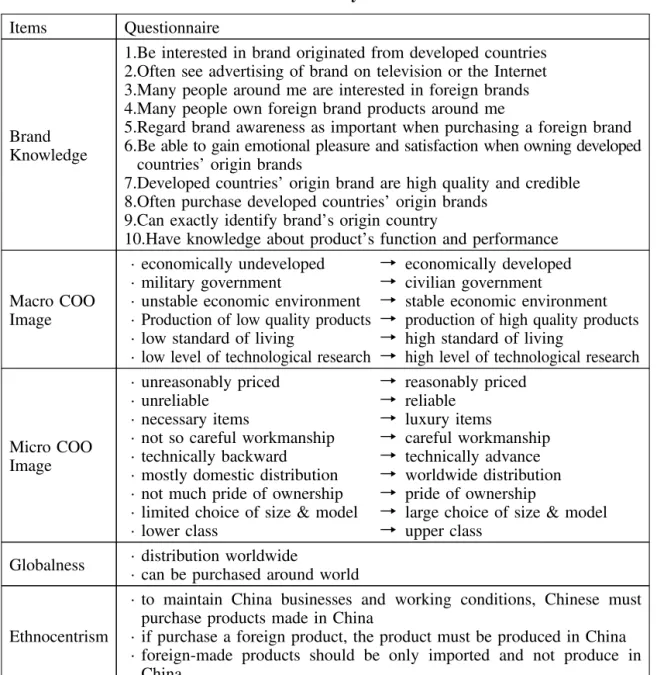
The following items are considered for measuring brand knowledge.
The factors such as effect of familiarity with specific nation’s products (Han & Terpstra, 1988), expert brand knowledge (Maheswaran, 1994; Pecotich & Ward, 2007), experience (Hong & Wyer, 1989; Johansson et al., 1985; Tse & Gorn, 1993), the need for cognition (Zhang, 1997) influence cues (such as brand or COO image) impact on evaluation of products. It can be considered that those factors affect consumers’ depth of knowledge.
Compared to a low involvement product, consumers hold more knowledge for high involvement products (Auger et al., 2010). International consumers are more favorable to purchase global brands in high durable goods categories (Rosenbloom & Haefner, 2009). Thus, the degree of involvement is also a factor to determine depth of brand knowledge. Here we conclude that brand knowledge can be measured by the degree of involvement, familiarity, and purchase experience. According to Samli (1995), involvement of brand decision is influenced by brand appeal, brand’s pleasure impact, and brand risks. Since Chinese consumers like to display their social statue to other people around, a similarity measure that incorporates the influence of environment around subjects was included.The questionnaires were written in English then translated into Chinese.
The degree of brand involvement measured was based on Samli’s (1995) study, whereas the brand similarity was based on Oliver and Bearden’s(1985) study. In addition, the brand’s origin country and knowledge of product’s function and performance was based on Aaker’s (1991) study. Macro and micro COO image measurements were adopted from Martin and Eroglu (1993) and Nakashima(1970) respectively, following prior research examples. The
3 Based on review conducted by Parker et al.(2011), in the history of Chinese brand development
process, compared to product brand which is researched most in developed countries, Chinese usually discuss brand on a corporate dimension. Since corporate brand has a higher recognition rate for consumers, we employed corporate brand to examine consumer behavior in this paper.
measurement of globalness followed Han and Terpstra (1988) and Steenkamp et al.’s (2003) studies. Also, Shimp and Sharma’s (1987) measurement of ethnocentrism, which was most frequently adopt by other studies, was employed. All of measure items employed a seven-point Likert scale. Table1 shows the details of the measure items. After conducting exploratory factory analysis, due to low factor loading, some of the factors were deleted.
Table 1. Survey Items Items Questionnaire
Brand Knowledge
1.Be interested in brand originated from developed countries 2.Often see advertising of brand on television or the Internet 3.Many people around me are interested in foreign brands 4.Many people own foreign brand products around me
5.Regard brand awareness as important when purchasing a foreign brand 6.Be able to gain emotional pleasure and satisfaction when owning developed
countries’ origin brands
7.Developed countries’ origin brand are high quality and credible 8.Often purchase developed countries’ origin brands
9.Can exactly identify brand’s origin country
10.Have knowledge about product’s function and performance
Macro COO Image
· economically undeveloped ! economically developed · military government ! civilian government
· unstable economic environment ! stable economic environment · Production of low quality products ! production of high quality products · low standard of living ! high standard of living
· low level of technological research ! high level of technological research
Micro COO Image
· unreasonably priced ! reasonably priced
· unreliable ! reliable
· necessary items ! luxury items
· not so careful workmanship ! careful workmanship · technically backward ! technically advance · mostly domestic distribution ! worldwide distribution · not much pride of ownership ! pride of ownership
· limited choice of size & model ! large choice of size & model · lower class ! upper class
Globalness · distribution worldwide
· can be purchased around world
Ethnocentrism
· to maintain China businesses and working conditions, Chinese must purchase products made in China
· if purchase a foreign product, the product must be produced in China · foreign-made products should be only imported and not produce in
Brand knowledge constructed by 10 questions and through factor analysis were divided into two groups (group1: questions1 to 7, group 2: questions 8 to 10). Group1 was labeled as indirect knowledge, and group 2 was labeled as direct knowledge. The reliability of each construct used was tested by using Cronbach’s coefficient alpha, which ranged from .667 to .887.
4.2 Data Collection and Sample
The survey was conducted in three major Chinese cities: Beijing, Shanghai, and Guangzhou which enjoy a higher income per capita and a better standard of living than other cities in China (Li et al., 2011). Thus, the percentage of people who have a stronger interest in brands or who share similar knowledge about brands might be higher than in other cities in China.
After China started participating in the World Trade Organization, many companies from the United States, Japan, and West Europe expanded businesses in China. Thus, Chinese consumers may have more familiarity with those countries’ generated brands. In general, though, most Chinese consumers lack brand knowledge(Chan et al., 2009; Furukawa, 2006). In order to increase research validity, U.S., Japan, and European brands were used to test the COO image factors. As the European Union is a single market, its presence as a region is stronger than just a single country, and many studies on Europe as a region have been done in China (e.g., Sai, 2006).
Kawabata (2009) argued that there is much difference in consumer behavior among Chinese cities. Thus, in this study, it is speculated that brand globalness perceived by consumers might vary across cities. As a result, certain brands were not designated for the survey used in this study, because some participants might not perceive any of the given brands as global ones. Instead of providing the participants with names of global brands, the participants were asked to write down brand names which they considered global brands. These data were used to observe the effect of perceived globalness of brand.
The first critical source for searching for information is the Internet in China. Recent research results indicate that there is little difference between the method of collecting data from answers collected from written samples and from those collected from web samples (De Jong et al., 2008). The questionnaire survey in this study was conducted via the Internet from late August to early September in 2012, and the effective answer rate was 64.1% (607/ 947). Table 2 shows the sample characteristics.
Table 2. Sample Characteristics
Items Degree Percentage (%)
Area Beijing Shanghai Guangzhou 203 201 203 33.4 33.1 33.4 Gender male female 258 349 42.5 57.5 Age born before 1979 born after 1980 born after 1990 149 362 96 24.5 59.6 15.8 Education
High school graduate University
Master and above
17 512 78 2.8 84.3 12.9 Income per household
Less than 10thousands 10 to 20thousands More than 20thousands
262 205 140 43.2 33.8 23.1 Overseas experience No experience Less than one year More than one year
313 191 103 51.6 31.5 17.0
4.3 Analysis and Results
The analysis was divided into three parts. At first, we examined knowledge effects overall. Then, we classified them into low, medium and high to test the interrelationship between knowledge and informational cues. Finally, we observed the relationship between informational cues and purchase intention. All tests adopted the structural equation modeling using Amos 20.
At first, we examined the total effect about the relationship between brand knowledge and informational cues. The result of analysis is reported in Table 3. The Model fit: n=607, χ2
(522)=1548.301, CMIN/DF=2.966, GFI=.942, CFI=.945, RMSEA=.033.
Compared to direct knowledge, indirect knowledge had a significant positive effect on the informational cues: macro COO image, micro COO image, and globalness of brand. While direct knowledge significantly affected the variable globalness of brand, it did not reach a significant level for the other informational cues. Thus, only the influence of indirect
knowledge was used for analysis. Multiple population simultaneous analysis was also conducted for comparing the results of each country or region. The results showed no significant effect between indirect knowledge and globalness of brand among three countries or regions. Whereas a significant difference on pathways associated indirect knowledge with macro COO image was observed which the estimate value of Janan(e=.576) was higher than of Europe’s(e=.530). While U.S.(e=.489) showed the lowest value. Similarly the relation between indirect knowledge and micro COO image was also significant. And Europe’s (e =.653) estimate was higher than Japan’s(e=.629) while U.S.(e=.563) showed the lowest value.
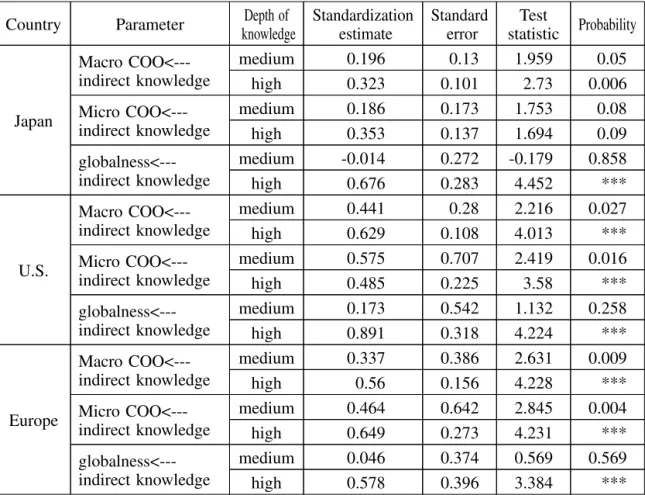
We used principal component analysis to calculate the total scores of each subject and divided them into three groups based on their depth of knowledge: low, medium, and high. The results of analysis showed no significant effect for low brand knowledge with all
Table 3. Standardized Coefficient Parameter Country Standardization
estimate Standard error Test statistic Probability macro COO <---indirect knowledge Japan 0.576 0.035 6.097 *** U.S. 0.489 0.027 5.814 *** Europe 0.530 0.047 6.907 *** micro COO <---indirect knowledge Japan 0.629 0.052 4.930 *** U.S. 0.563 0.066 6.671 *** Europe 0.653 0.071 8.152 *** globalness <---indirect knowledge Japan 0.888 0.079 11.331 *** U.S. 0.773 0.073 9.786 *** Europe 0.795 0.079 10.421 *** macro COO <---direct knowledge Japan -0.207 0.019 -2.690 0.007 U.S. -0.061 0.016 -0.839 0.401 Europe -0.132 0.030 -1.852 0.064 micro COO <---direct knowledge Japan -0.127 0.023 -1.550 0.121 U.S. -0.057 0.040 0.763 0.445 Europe -0.119 0.043 -1.685 0.092 globalness <---direct knowledge Japan -0.427 0.050 -5.910 *** U.S. -0.354 0.046 -4.852 *** Europe -0.388 0.050 -5.449 *** ***p<.001
informational cues; thus, low knowledge will not be discussed further. Table 4 reports the result and Table 5 shows the fit index.
Based on the results of analysis, the hypotheses were tested. The low knowledge group had no significant effect across informational cues, so H1a is unsupported. The relationship between medium and high knowledge groups and informational cues are summarized in
Table 4. Standardized Coefficient Country Parameter Depth of
knowledge Standardization estimate Standard error Test statistic Probability Japan Macro COO<---indirect knowledge medium 0.196 0.13 1.959 0.05 high 0.323 0.101 2.73 0.006 Micro COO<---indirect knowledge medium 0.186 0.173 1.753 0.08 high 0.353 0.137 1.694 0.09 globalness<---indirect knowledge medium -0.014 0.272 -0.179 0.858 high 0.676 0.283 4.452 *** U.S. Macro COO<---indirect knowledge medium 0.441 0.28 2.216 0.027 high 0.629 0.108 4.013 *** Micro COO<---indirect knowledge medium 0.575 0.707 2.419 0.016 high 0.485 0.225 3.58 *** globalness<---indirect knowledge medium 0.173 0.542 1.132 0.258 high 0.891 0.318 4.224 *** Europe Macro COO<---indirect knowledge medium 0.337 0.386 2.631 0.009 high 0.56 0.156 4.228 *** Micro COO<---indirect knowledge medium 0.464 0.642 2.845 0.004 high 0.649 0.273 4.231 *** globalness<---indirect knowledge medium 0.046 0.374 0.569 0.569 high 0.578 0.396 3.384 *** ***p<.001
Table 5. Models’ Goodness of Fit
Model df Probability CMIN CMIN/DF GFI CFI RMSEA
Japan 504 .000 797.507 1.582 .894 .904 .031
U.S. 501 .000 835.454 1.668 .883 .904 .033
Table 6. Significance about Relationship between Knowledge and Cues model Medium Brand Knowledge High Brand Knowledge
Macro COO Micro COO Globalness Macro COO Micro COO Globalness
Japan * n.s. n.s. ** n.s. ***
U.S. * * n.s. *** *** ***
Europe ** ** n.s. *** *** ***
***p<.001, **p<.01, *p<.05
Table 6. For H1b, the relationships between medium knowledge subjects and micro COO were significant for U.S. and European brand products, which supported the hypothesis, but Japanese brands were not significant. Thus, overall, H1b is also unsupported. And H1c is supported. It is worthy to note that in all conditions, the relationships between knowledge and macro COO are significant.
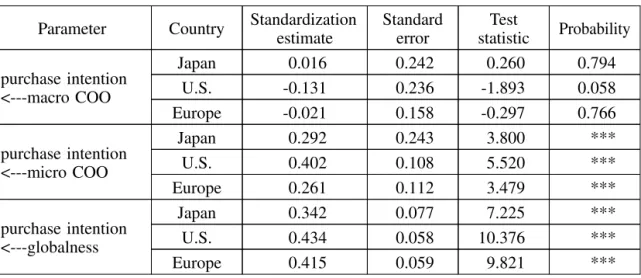
Finally, we tested the relationship between cues and purchase intention. Model goodness of fit: n=607, χ2
(243)=742.016, CMIN/DF=3.054, GFI=.947, CFI=.957, RMSEA=.034 was used. The results are reported in Table 7.
Although knowledge affects macro COO image positively, macro COO image has no significant effect related to purchase intention. The H2a that proposes association of macro COO image with purchase intention failed to reach statistical significance. Similarly, H4a and H5a which related to macro COO image were also rejected. However, both micro COO image and globalness associated with purchase intention were positive. Thus, H2b and H3
Table 7. Standardized Coefficient Parameter Country Standardization
estimate Standard error Test statistic Probability purchase intention <---macro COO Japan 0.016 0.242 0.260 0.794 U.S. -0.131 0.236 -1.893 0.058 Europe -0.021 0.158 -0.297 0.766 purchase intention <---micro COO Japan 0.292 0.243 3.800 *** U.S. 0.402 0.108 5.520 *** Europe 0.261 0.112 3.479 *** purchase intention <---globalness Japan 0.342 0.077 7.225 *** U.S. 0.434 0.058 10.376 *** Europe 0.415 0.059 9.821 ***
Table 8. Direct, Indirect and Total Effects (Standardized Coefficient)
Country Effect Micro COO Image Globalness
Japan direct 0.232 0.364 indirect 0.107 0.000 total 0.339 0.364 U.S. direct 0.311 0.437 indirect 0.067 0.000 total 0.378 0.437 Europe direct 0.215 0.420 indirect 0.114 0.000 total 0.330 0.420 are supported.
Multiple population simultaneous analysis was also conducted for comparing differences among countries or regions on relationship between informational cues and purchase intention. There was no statistical significant difference on the factor of globalness of brand. For the association of micro COO image and purchase intention, significant difference was found. Estimated value of Japan(e=.292) was stronger than Europe(e=.261).
The H4b proposes that the total effect is more important than the direct effect on association of micro COO image with purchase intention. Table 8 reported the total effect via globalness of brand. Compared with the direct effect, total effects were increased by the indirect effect. H4b is supported. It should be noted is that compared with total effects associated with micro COO image with purchase intention, direct effect associated with globalness of brand with purchase intention arises was stronger. This indicates that globalness of brand is an important informational cue for subjects for their purchase decision-making process.
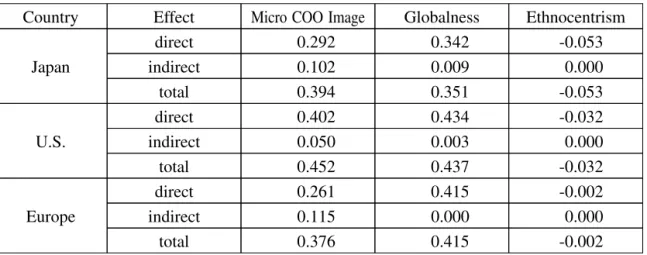
H5 and H6 propose that ethnocentrism does not affect purchase intention negatively. Based on the results in Table 9, ethnocentrism, as a moderating variable, has no significance on purchase intention. It indicates that ethnocentrism has no impact on purchase behavior of subjects. In addition, the total effects related to purchase intention are observed. Table 10 shows that the total effects are not reduced through a moderating variable. In sum, hypothesis (H5b and H6) are supported.
Table 9. Standardized Coefficient Country Standardization estimate Standard error Test statistic Probability Purchase intention <--- ethnocentrism Japan -0.053 0.044 -1.371 0.170 U.S. -0.032 0.034 -0.845 0.398 Europe -0.002 0.037 -0.056 0.956
Table 10. Direct, Indirect and Total Effects (Standardized Coefficient) Country Effect Micro COO Image Globalness Ethnocentrism
Japan direct 0.292 0.342 -0.053 indirect 0.102 0.009 0.000 total 0.394 0.351 -0.053 U.S. direct 0.402 0.434 -0.032 indirect 0.050 0.003 0.000 total 0.452 0.437 -0.032 Europe direct 0.261 0.415 -0.002 indirect 0.115 0.000 0.000 total 0.376 0.415 -0.002
5. Conclusion and Discussion
Especially since the late of 1980s, Brands, as critical important assets which provide sustainable competitive advantage, have been discussed by a large number of researchers. However, the majority of studies are restricted to domestic markets of developed countries. Along with economic development, developing countries have become crucial consumer nations for multinational corporations. This indicates that research on consumer behavior related to those countries is of critical importance. However, the studies remain insufficient.
After reviewing research related to global brand and COO, we tested the relationship between knowledge and informational cues, including macro COO image, micro COO image, and globalness of brand. In addition, the relationships between informational cues and purchase intention were also examined.
Brand Knowledge
In the low brand knowledge group, there was no significant effect found between the amount of knowledge and the informational cues. Almost all of the prior studies reviewed for this study on COO effect have presupposed that consumers have product knowledge
(Samiee, 1994). However, one finding from this study shows the importance of brand knowledge for purchase intent. Our finding also supports the theory of Keller’s (1993) consumer-based brand equity which highlights brand knowledge as a core component.
Direct knowledge and indirect knowledge show different effects on association with cues. Experts may have detailed knowledge about function or performance which is similar to the direct knowledge the participant were asked to respond to on the questionnaire. Experts use COO as a limited summary construct or to process and recall attribute information selectively in a circumspect manner, whereas novices used COO as a halo regardless of brand name and physical quality for interpreting subsequent attribute information (Maheswaran, 1994; Pecotich & Ward, 2007). Similar to Maheswaran (1994) and Pecotich & Ward’s (2007) studies, this study indicated that the type of knowledge (direct or indirect) may influence the effects of informational cues. We argue that COO image effects may change according to the situation, such as which informational cues’ types are present or the consumer’s depth of knowledge.
Linking With Purchase Intention
This survey is one of minority researches associated cues with purchase intention. Although COO image pay an impact on product evaluation, the influence related to purchase intention may lesser than on product evaluation (Lin&Darley, 1997; Peterson& Jolibert, 1995; Verlegh&Steenkamp, 1999). Based on our result, there was no significance between macro COO image and purchase intention. The results supported some prior studies which related product evaluation to purchase intention. It should be noted is that despite informational cues may have an impact on product or its value evaluation, the link between cues and purchase intention shows no effect sometimes. It indicates that companies must pay more efforts on providing cues to consumers during their purchasing process. Whereas globalness shows strongest impact on purchase intention.
It demonstrated that consumer ethnocentrism have not affected purchase intention negatively in our tested cities. The same opinion also confirmed by Sai(2006). However the test of ethnocentrism and animosity conducted in Nanjing have revealed a negative impact on product evaluation (Klein et al., 1998). Due to historic factor, consumers in Nanjing may hold prejudice to oppose products come from certain country. Compared with ethnocentrism, animosity may play stronger negative impact on product evaluation. Therefore, except Nanjing consumers in multitude of areas of China may not be influenced by ethnocentrism negatively.
Implication and Iimitation
for the low brand knowledge group. This result indicates that it is important to increase consumers’ knowledge about brand or product in order to increase global presence and awareness, which is critical for gaining international consumers in global markets.
The globalness of brand was also confirmed through our survey. Since the importance of global brands is becoming common knowledge, many corporations have made a great effort to establish well-known brands in markets around the world. Whereas Barron&Hollingshead (2004) asserted that many companies attempt to analyze their brand from a global perspective without first analyzing their consumers from a global perspective. They also emphasized the difference of analyzing consumers form a global perspective because of many companies only could use local research firm to conduct market or consumer research. Any brand might or might not be accepted and could stimulate various functional images and symbolic images, according to the population, location, or timing. As a result, it is crucial to conduct a survey to gain an understanding of local consumers’ perceptions and knowledge before establishing a global brand, which could provide sustainable competitive advantage for firms in global markets.
There are several limitations. As brand knowledge influences consumer behavior, it is necessary to investigate consumers’ knowledge further. For instance, through comparing with the amount and quality of knowledge that consumers have in developed countries with consumers in developing countries, the results could be helpful for predicting consumer behavior in other emerging countries.
Our survey was conducted in high standard of living areas. It expresses only a small part of Chinese consumer behavior. Research focused on emerging markets which hold lower per capital within China are also important for exploring Chinese markets. This study confirmed that Chinese consumers are more likely to select globalness of brand as an informational cue during purchasing decision-making process. However, only brands which originated from developed countries were investigated in this study. The powerful globalness derives from only developed country’s brands or not has not been tested. In particular, to compare developed country origin brand with China origin global brand is indispensable for investigating the effects of globalness.
References
Aaker, D. A. (1991). Managing brand equity: Capitalizing on the value of a brand name. New York: Free Press.
Auger, P., Devinney, T.M., Louviere, J.J. & Burke, P.(2010). The importance of social product attributes in consumer purchasing decisions: A multi-country comparative study.International Business Review, 19, 140-159.
Barron, J. & Hollingshead, J.(2004). Brand globally, market locally. Journal of Business Strategy, 25(1), 9-15.
Batra, R., Ramaswamy, V., Alden, D.L., Steenkamp, J-B.E.M. & Ramachander, S.(2000). Effects of brand local and nonlocal origin on consumer attitudes in developing countries. Journal of Consumer Psychokogy, 9(2), 83-95.
Bengtsson, A., Bardhi, F. & Venkatraman, M., (2010). How global brands travel with consumers. International Journal Review, 27(5), 519-540.
Bhardwaj, V., Kumar, A & Kim, Y-K.(2010). Brand analyses of U.S. global and local brands in India. Journal of Global Marketing, 23, 80-94.
Bilkey, W.J. & Nes, E.(1982). Country-of-Origin Effects on Product Evaluations. Journal of International Business Studies, (Spring/Summer), 89-99.
Cateora, P.R. & Graham, J.L.(2007). International marketing. Boston: McGraw-Hill Irwin.
Chan, T-S., Cui, G. & Zhou, N.(2009). Competition between foreign and domestic brands: A study of consumer purchases in China. Journal of Global Marketing, 22(3), 181-197.
Chao, P.(1993). Partitioning country-of-origin effects: Consumer evaluations of a bi-national product. Journal of International Business Studies, 24(2), 291-306.
Chugoku shakai gakuin, Chugoku keizai sentaa, Chugoku jinbun kagaku hatten seisaku(2012). Chugoku maaketexingu deeta souran. Tokyo: Chinese business information center of JMA Research Institute Inc..
Cova, B., Pace, S. &Park, D.(2007). Global brand communities across borders: The warhammer case. International Marketing Review, 24(3), 313-329.
Dimofte, C., Johansson, J.&Ronkainen, I.(2008). Cognitive and affective reactions to global brands. Journal of Marketing, 16(4), 113-135.
De Jong, M.G., Steenkamo, J.-B.E., Fox, J.-P. & Baumgartner, H.(2009). Using item theory to measure extreme response style in marketing research: A global investigation. Journal of Marketing Research, 45, 104-115.
Erickson, C.M., Johansson, J.K. & Chao, P.(1984). Image variables in multi-attribute product evaluations. Journal of Consumer Research, 11(2), 694-699.
Fournier, S.(1998). Consumers and their brands: Developing relationship theory in consumer research. Journal of Consumer Research, 24(March), 343-373.
Furukawa, I.(2006). Chugoku no shohishijo-Burando no kanten kara mita kyodaishijo-. In Yamashita, H. & Hitotsubashi Univ. BIC Project team. burandeingu in chaina. Tokyo: Toyo Keizai Inc.
Han, C.M. & Terpstra, V.(1988). Country-of-origin effects for uni-national and bi-national produxts. Journal of International Business Studies, 19(2), 235-255.
Holt, D., Quelch, J. & Taylor, E.(2004). How global brands compete. Harvard Business Review, 82(9), 68-75.
Hong, S-T. & Wyer, R.S.(1989). Effects of country-of-origin and product-attribute information on product evaluation: An information processing perspective. Journal of Consumer Research, 16(2), 175-187. Hsieh, M.H.(2004). An investigation of country-of-origin effect using correspondence analysis: A
cross-national context. Intercross-national Journal of Market Research, 46(3), 267-295.
Hui, M. & Zhou, L.(2002). Linking product evaluations and purchase intention for country-of-origin effects. Journal of Global Marketing, 15(3/4), 95-101.
Johansson, J.K., Douglas, S.P. & Nonaka, I.(1985). Assessing the impact of country of origin on product evaluations: A new methodological perspective. Journal of Marketing Research, 22(November), 388-396.
Kapferer, J-N.(2005). The post-global brand. Journal of Brand Management, 12(5), 319-324. Kawabata, M.(2009). Ajia shijo no kontekisuto [higashihen]. TOKYO: Shinhyoron.
Kaynak, E. & Kara, A.(2002). Consumer perceptions of foreign products. European Journal of Marketing, 36(7/8), 928-949.
Keller, K.L.(1993). Conceptualizing, measuring, and managing customer-based brand equity. The Journal of Marketing, 57(1), 1-22.
Keller, K.L.(2008). Strategic Brand Management. Upper Saddle River, N.J.: Prentice Hall.
Kim,C.K. & Chung, J.Y.(1997). Brand popularity, country image and market share: An empirical study. Journal of International Business Studies, 28(2), 361-387.
Klein, J.G., Ettenson, R.E. & Morris, M.D.(1998). The animosity model of foreign product purchase. Journal of Marketing, 62(1), 89-100.
Li, Y., Wang, X. & Yang, Z.(2011). The effects of corporate-brand credibility, perceived corporate-brand origin, and self-image congruence on purchase intention: Evidence from China’s auto industry. Journal of Global Marketing, 24(1), 58-68.
Li, Z.G. & Dant, R.P.(1997). Dimensions of product quality and country-or-origin effects research. Journal of International Consumer Marketing, 10(1/2), 93-114.
Maheswaran, D.(1994). Country of origin as a stereotype: Effects of consumer expertise and attribute strength on product evaluations. Journal of Consumer Research, 21(Sep), 355-365.
Martin, I.M. & Eroglu, s.(1993). Measuring a multi-dimensional construct: Country image. Journal of Business Research, 28(3), 191-210.
Miura, T.(2009). Chogoku shohisha no kihanishiki to koubaikoudou. In Tanzawa, Y., Chogoku niokeru kigyo to shijo no dainamikusu, Hachioji: Chuou Daigaku Shuppanbu. 155-177.
Nagashima, A.(1970). A comparison of Japanese and U.S. attitudes toward foreign products. Journal of marketing, 34(January), 68-74.
Nakata, C & Huang, Y.(2005). Progress and promise: the last decade of international marketing research. Journal of Business Research, 58(5), 611-618.
Nes, E. & Bilkey, W.(1993). A multi-cue test of country-of-origin theory. In Papadopoulos, N. & Heslop.L. A. Products-country images: Impact and role in international marketing. New York: International Business Press. 179-196.
Oishi, O.(2004). gurobaru burando kanri. Yokyo: Hakuto Shobou.
Okechuku, c.(1994). The importance of product country of origin: A conjoint analysis of the United Stated, Canada, Germany and The Netherlands. European Journal fo Mmarketing, 28(4), 5-19.
Pappu, R., Quester, P.G. & Cooksey, R.W.(2007). Country image and consumer-based brand equity: Relationships and implications for international marketing. Journal of International Business Studies, 38, 726-745.
Parker, R.S., Haytko, D.L. & Hermans, C.M.(2011). Ethnocentrism and its effect on the Chinese consumer: A threat to foreign goods?. Journal of Global Marketing, 24, 4-17.
Pecotich, A. & Ward, S.(2007). Global branding, country of origin and expertise. International Marketing Review, 24(3), 271-296.
People’s Daily Online(2012/06/21). zeitakuhin shohi, nen 20% no peesu de kakudai. http://j.people.com.cn/ 94476/7853692.html (2012/10/20access).
People’s Daily Online(2012/09/11). Chugokujinno kankoukyaku, seikainozeitakuhinno yaku 4bunno1 o kounyu.http://j.people.com.cn/94476/7945209.html(2012/10/20 access).
Peterson, R.A. & Jolibert, A.P.(1995). A meta-analysis of country-of-origin effects. Journal of International Business Studies, 26(4), 883-899.
Reierson, C.C.(1966). Are foreign products seen as national stereotypes?. Journal of Retailing, 42(Fall), 33 -40.
Rosenbloom, A. & Haefner, J.E.(2009). Country-of-origin effects and global brand trust: A first look. Journal of Global Marketing, 22(4), 267-278.
Sai, R.(2006). Kyodaishijo to minzokushugi. Tokyo: Nihon keizai hyouronsya.
Samiee, S.(1994). Customer evaluation of products in a blobal market. Journal of International Business Studies, 25(3), 579-604.
Samli, A.C.(1995). International consumer behavior. Westport, Conn.: Quorum Books.
Schooler, R.D.(1965). Product bias in central American product market. Journal of marketing Research, 2 (November), 394-397.
Shimp, T.A. & Sharma, S.(1987). Consumer ethnocentrism: Construction and validation of the CETSCALE. Journal of Marketing Research, 24(August), 280-289.
Speece, M. & Nguyen, D.(2005). Countering negative country-of-origin with low prices: A conjoint study in Vietnam. Journal of Product & Brand Management, 14(1), 39-48.
Steenkamp, J-B.EM., Batra, R. & Alden, D.L.(2003). How perceived brand globalness creates brand value. Journal of International Business Studies, 34, 53-65.
Strizhakova, Y., Coulter, R.A. & Price, L.L.(2008). The meanings of branded products: A cross-national scale development and meaning assessment. International Journal of Research in Marketing, 25, 82-93. Strizhakova, Y., Coulter, R.A. & Price, L.L.(2011). Branding in a global marketplace: The mediating effects of quality and self-identity brand signals. International Journal of Research in Marketing, 28, 342-351.
Suh, T. & Kwon, I-W.G.(2002). Globalization and reluctant buyers. International Marketing Review,19(6), 663-680.
Suyama, K.(2000). Maruchi burando senryaku to chaneru. In Suyama, K. & Umemoto, H., Nihongata burando yuisenryaku. Tokyo: daiyamondo Sha. 153-179.
Townsend, J.D., Yeniyurt, S. & Talay, M.B.(2009). Getting to global: An evolutionary perspective of brand expansion in international markets. Journal of International Studies, 40, 539-558.
Toyota, H.(2007). Kyoubunsan kouzou bunseki[Amos hen]. Tokyo: Tokyo tosho Co., Ltd.
Tse, D.K & Gorn, G.J.(1993). An experiment on the salience of country-of-origin in the era of global brands. Journal of International Marketing, 1(1), 57-76.
Verlegh, P.W. & Steenkamp, J-B.E.M.(1999). A review and meta-analysis of country- of-origin research. Journal of Economic Psychology, 20, 521-546.
Weiss, T.(2007). US students hold misbelieves concerning brands origin country: Online survey. http:// www.trendsspotting.com/blog/?p=131(2012/02/20access).
Whitelock, J. & Fastoso, F.(2007). Understanding international branding: Defining the domain and reviewing the literature. International Marketing Review, 24(3), 252-270.
Zhang, Y.(1997). Country-of-origin effect the moderating function of individual difference in information processing. International Marketing Review, 14(4), 266-287.
Zhou, K.Z., Su, C. & Bao, Y.(2002). A paradox of price-quality and market efficiency: A comparative study of the US and China markets. International Journal of Research in Marketing, 19(4), 349-365.