T
he chief complaints of patients who visit a clinic or a general medicine department in a hospital and undergo medical interviews are often diverse [1].There have been several studies of the chief complaints reported in clinics in remote areas, in small and medi- um-sized hospitals, and in university hospitals [2-4].
The representative complaints always include cough, fever, headache, and general fatigue as main com- plaints in all of these medical settings.
We recently reported the results of our analysis of chief complaints (including pain, fever, cough, dizzi-
ness, fatigue, and appetite loss) reported by 843 patients who visited Okayama University Hospital’s Department of General Medicine [5]. The most fre- quent complaint was pain, including both somatic pain and visceral pain. The frequencies of the chief com- plaints of pain, cough, dizziness, fatigue, edema, and appetite loss were higher in female patients [5]. Most of the patients with appetite loss were elderly patients, whereas most of the febrile patients were relatively young.
The roles and sizes of general medicine departments and the complaints and symptoms of patients including
CopyrightⒸ 2019 by Okayama University Medical School.
http ://escholarship.lib.okayama-u.ac.jp/amo/
Original Article
Correlations between Depressive Condition and Gastroesophageal Reflux Symptoms in Patients Visiting a Department of General Medicine
Yu Suganamia,b, Kosuke Okaa, Yoshihisa Hanayamaa, Hiroyuki Hondaa,b,
Jun Hamaharaa,b, Mikako Obikaa, Kazuya Kariyamab, Masayuki Kishidaa,b, and Fumio Otsukaa*
aDepartment of General Medicine, Okayama University Graduate School of Medicine, Dentistry and Pharmaceutical Sciences, Okayama 700-8558, Japan and bDepartment of General Medicine, Okayama City Hospital, Okayama 700-8557, Japan To clarify the potential relevance of patients’ chief complaints at a general medicine department to their self-rating depression scale (SDS) and frequency scale for symptoms of gastroesophageal reflux disease (GERD) (FSSG) scores, we analyzed data of 478 patients who visited our general medicine department. The chief com- plaints (553 symptoms of 447 patients) were categorized into major symptom-based groups: respiratory (31%), circulatory (3%), gastrointestinal (GI) tract (26%), neurology (8%), orthopedic and skin (10%), and systemic (22%) symptoms. The SDS score tended to be higher in females and younger patients. The FSSG score did not differ by gender but was higher in younger patients. The patients receiving social welfare had higher SDS and FSSG scores. A close inter-relationship between the FSSG (including both degrees of reflux and dysmotility) and SDS was observed in all patients. Although the averages of the SDS and FSSG scores were not significantly different among the symptom-based categories, we observed significantly positive correlations between the FSSG and SDS in each category, suggesting that depressive status may be closely related to GERD-related symp- toms regardless of the patients’ chief complaints. An initial checkup of patients’ psychological condition and/or GERD-like symptoms could help screen for latent disorders in outpatients with uncertain complaints.
Key words: chief complaints, frequency scale for the symptoms of gastroesophageal reflux disease (FSSG), self-rat- ing depression scale (SDS), welfare
Received March 11, 2019 ; accepted June 18, 2019.
*Corresponding author. Phone : +81-86-235-7342; Fax : +81-86-235-7345
E-mail : [email protected] (F. Otsuka) Conflict of Interest Disclosures: No potential conflict of interest relevant to this article was reported.
their severity, acuteness, and emergency status are often diverse, but more rapid and more efficient screen- ing approaches are needed to achieve accurate final diagnoses in general medicine departments.
We conducted the present study to clarify the poten- tial inter-relationships among patients’ main complaints and their physical and psychological conditions as assessed by scores on a self-rating depression scale (SDS) and a frequency scale for symptoms of gastro- esophageal reflux disease (GERD) (FSSG) at the patients’ first visit to a general medicine outpatient clinic. The SDS scale that was administered in this study is widely used to assess the severity of depression [6-8], and the FSSG score is commonly used to assess symptoms of GERD [9].
The correlations between the SDS and FSSG scores were analyzed in patients who had a variety of chief complaints. The results of our analyses could be helpful for diagnosing latent disorders based on the many uncertain complaints of patients visiting a general med- icine department.
Subjects and Methods
Study subjects. The epidemiologic records for 478 patients who had visited Okayama City Hospital’s Department of General Medicine during the period from July 17, 2014 to April 22, 2015 were retrospec- tively investigated. Six asymptomatic patients with only a laboratory abnormality after an annual health check-up and 25 patients with insufficient medical records were excluded from the study. The data for 447 patients with 553 chief complaints (including 45 welfare
recipients with 60 chief complaints) who underwent SDS and FSSG scoring tests at their first visit were included in the analyses (Fig.1).
The patients were divided into 6 groups according to their chief complaints, and their SDS and FSSG scores were determined. The data for each patient were also statistically analyzed with a focus on age, gender, and welfare conditions. The patients were 206 males and 241 females with a mean age of 47.7±19.2 years (mean±SD; range 16-90 years).
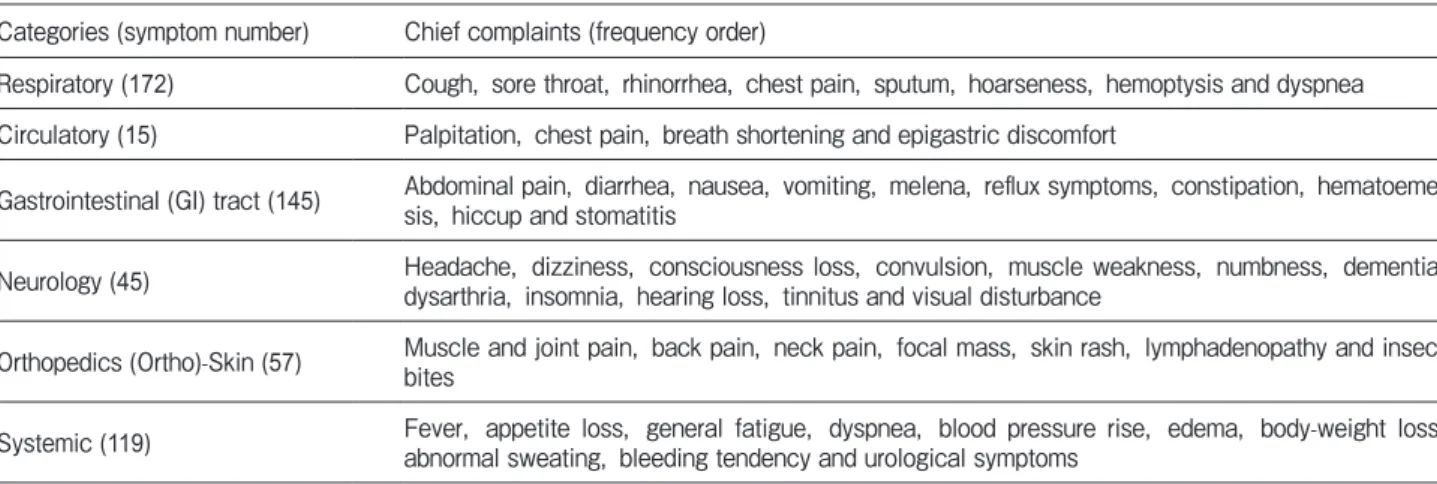
The 6 groups based on the patients’ individual symptoms (chief complaints) are shown in Table 1.
When a patient had multiple chief complaints across the
Table 1 Categorization of chief complaints
Categories (symptom number) Chief complaints (frequency order)
Respiratory (172) Cough, sore throat, rhinorrhea, chest pain, sputum, hoarseness, hemoptysis and dyspnea Circulatory (15) Palpitation, chest pain, breath shortening and epigastric discomfort
GastrointestinaI (GI) tract (145) Abdominal pain, diarrhea, nausea, vomiting, melena, reflux symptoms, constipation, hematoeme- sis, hiccup and stomatitis
Neurology (45) Headache, dizziness, consciousness loss, convulsion, muscle weakness, numbness, dementia, dysarthria, insomnia, hearing loss, tinnitus and visual disturbance
Orthopedics (Ortho)-Skin (57) Muscle and joint pain, back pain, neck pain, focal mass, skin rash, lymphadenopathy and insect bites
Systemic (119) Fever, appetite loss, general fatigue, dyspnea, blood pressure rise, edema, body-weight loss, abnormal sweating, bleeding tendency and urological symptoms
Total number of patients: 478
Laboratory abnormalities 6 cases
Number of analyzed patients: 447 Chief complaints: 553
Insufficient records 25 cases
Fig. 1 Selection of study patients. Data for all of the 478 patients were obtained from medical records. Six patients who had no symptoms and had only a laboratory abnormality after an annual health checkup and 25 patients whose records were insufficient were excluded. Data for 447 patients with 553 chief complaints were analyzed.
categories, 1-3 complaints per each patient were counted. The 6 categories of 553 chief complaints in the 447 patients were: (1) respiratory (31%), (2) circula- tory (3%), (3) gastrointestinal (GI) tract (26%), (4) neurology (8%), (5) orthopedic and skin (ortho-skin) (10%), and (6) systemic (22%) symptoms. The protocol of this study (RIN-2038) was approved by the Institutional Review Board (IRB) of Okayama University Graduate School of Medicine, Dentistry and Pharmaceutical Sciences.
The scoring of the SDS and FSSG. Patients visit- ing the outpatient department of Okayama City Hospital’s Department of General Medicine are rou- tinely asked to complete questionnaires including a questionnaire for SDS scoring to assess depressive status [6] and a questionnaire for FSSG scoring to assess GERD symptoms [9]. The SDS has been recognized as a representative scale for clarifying depressive status with a score of ≥60 indicating a depressive condition [7,8]. The questionnaire for the FSSG scoring consists of 12 questions (seven questions assessing acid reflux symptoms and five questions assessing dysmotility-re- lated symptoms). An FSSG score of ≥8 has generally been considered to indicate probable GERD [9,10].
Statistical analyses. The results are shown as the mean±SEM of the data. The data were analyzed by the Kruskal-Wallis test and Mann-Whitney U-test to deter- mine significant differences between groups. If differ- ences were detected by the Kruskal-Wallis test, the Steel-Dwass post-hoc test was used to determine which means differed. The data were also subjected to a linear regression analysis, and Spearman’s rank correlation coefficients were obtained to determine inter-relation- ships between parameters. P-values <0.05 were consid- ered significant. All statistical analyses were performed using EZR (Saitama Medical Center, Jichi University, Saitama, Japan), a graphical user interface for R (The R Foundation for Statistical Computing, Vienna, Austria, ver. 3.1.1) [11].
Results
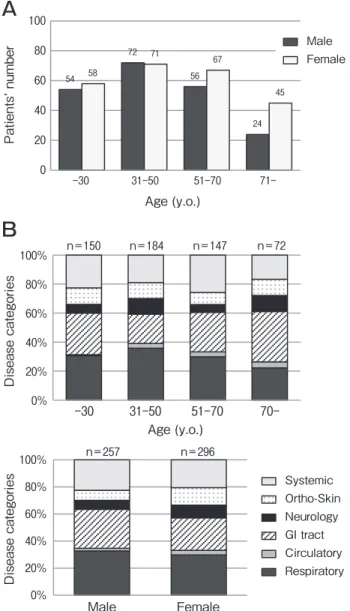
Patients’ profile. Figure 2 provides the age-de- pendent distribution of patients for each gender. As shown in Fig.2A, the proportion of patients aged 31-50 years was largest for both genders. Among the patients aged ≥71 years, the number of female patients was about twice the number of male patients. Figure 2B
shows the age-dependent ratios of symptoms and the gender-dependent ratios of symptoms for all patients.
SDS and FSSG scores for all patients. Figure 3A shows the SDS and FSSG scores for each gender. In the entire patient cohort, the SDS scores for female patients were significantly higher than those for the male patients, but the FSSG score was not significantly dif- ferent. As shown in Fig.3B, the SDS scores of the patients ≤30 years old and the patients aged 31-50 years were significantly higher than the scores of the patients aged 51-70 years, and the FSSG scores of the patients
54
72
56
24 58
71 67
45
0 20 40 60 80 100
-30 31-50 51-70 71-
Patients’ number
Age (y.o.)
Male Female
A
B
Age (y.o.)
n=150 n=184 n=147 n=72
Disease categories
0%
20%
40%
60%
80%
100%
-30 31-50 51-70 70-
n=257 n=296
Disease categories
Systemic Ortho-Skin Neurology GI tract Circulatory Respiratory 0%
20%
40%
60%
80%
100%
Male Female
Fig. 2 Characteristics of the enrolled patients. A, Age- dependent distributions of patients and gender in all patients; B, Age- and gender-dependent chief complaints of all patients.
≤30 years old were significantly higher than those of the patients ≥51 years old.
Figure 3B also shows the FSSG-reflux and FSSG- dysmotility scores according to age. The FSSG- dysmotility scores of the patients ≤30 years old were
significantly higher than those of the patients ≥31 years old, and the FSSG-dysmotility scores of the patients aged 31-50 years were significantly higher than those of the patients aged 51-70 years and those of the patients
≥71 years old. In contrast, the FSSG-reflux score
0 2 4 6 8 10
-30 31-50 51-70 71- 20
30 40 50
Male Female 0
5 10 15 20
Male Female
20 30 40 50
-30 31-50 51-70 71- 0
5 10 15 20
-30 31-50 51-70 71-
0 2 4 6 8 10
-30 31-50 51-70 71-
SDS FSSG
SDS FSSG
Age (y.o.) Age (y.o.)
FSSG-reflux FSSG-dysmotility
A
B
*
**
**
**
**
**
*
* **
*
20 30 40 50 60
Welfare recipients
0 10 20 30
Welfare recipients
SDS FSSG
**
**
C
Non-recipients Non-recipients
Age (y.o.) Age (y.o.)
Fig. 3 The SDS and FSSG scores of all patients. A, Comparison of SDS and FSSG scores by gender; B, Distributions of SDS and FSSG scores, including FSSG-reflux and -dysmotility scores, by age; C, Comparison of SDS and FSSG scores by welfare condition.
Bars:means±SEM. The data were analyzed with the Mann-Whitney U-test or Kruskal-Wallis test, and when a significant effect was indi- cated, comparisons of group means were conducted. *p<0.05, **p<0.01 between the indicated groups.
showed no significant differences among the age groups (Fig.3B).
As shown in Fig.3C, both the SDS score and the FSSG score were significantly higher for the welfare recipients compared to the patients not receiving wel- fare.
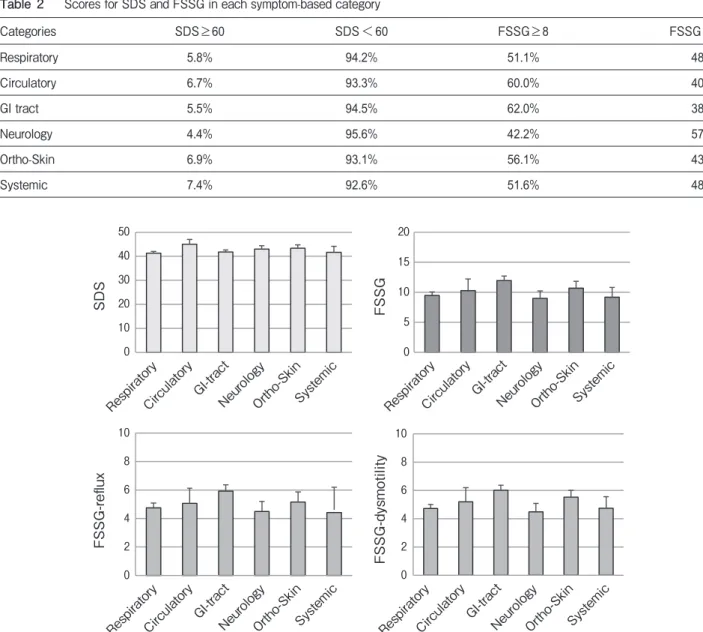
The SDS and FSSG scoring for the symptom-based categories. As shown in Table 2, the largest propor- tions of patients with an SDS score of ≥60 were in the systemic group (7.4%), ortho-skin group (6.9%), and circulatory group (6.7%). The largest proportions of
patients with an FSSG score of ≥8 were in the GI tract group (62%), circulatory group (60%), and ortho-skin group (56.1%) (Table 2). The SDS and FSSG scores in each symptom-based category are shown in Fig.4:
the averages of the SDS or FSSG scoring including reflux and dysmotility values were not significantly dif- ferent among the six groups of symptom-based catego- ries, although the FSSG scoring was increased in the group with GI-tract symptoms, as expected (Fig.4).
Inter-relationships between the SDS and FSSG scores. Figure 5A illustrates the results of our linear
Table 2 Scores for SDS and FSSG in each symptom-based category
Categories SDS≥60 SDS<60 FSSG≥8 FSSG<7
Respiratory 5.8% 94.2% 51.1% 48.9%
Circulatory 6.7% 93.3% 60.0% 40.0%
GI tract 5.5% 94.5% 62.0% 38.0%
Neurology 4.4% 95.6% 42.2% 57.8%
Ortho-Skin 6.9% 93.1% 56.1% 43.9%
Systemic 7.4% 92.6% 51.6% 48.4%
FSSG-reflux FSSG-dysmotility
0 5 10 15 20
0 10 20 30 40 50
0 2 4 6 8 10
0 2 4 6 8 10
SDS FSSG
RespiratoryCirculatory GI-tract
NeurologyOrtho-SkinSystemic
RespiratoryCirculatoryGI-tract
NeurologyOrtho-SkinSystemic RespiratoryCirculatory GI-tract
NeurologyOrtho-SkinSystemic RespiratoryCirculatoryGI-tract
NeurologyOrtho-SkinSystemic
Fig. 4 The SDS and FSSG scores in the symptom-based categories. The SDS and FSSG scores, including the FSSG-reflux and -dys- motility scores, were compared among the 6 symptom groups. Bars: means±SEM. The data were analyzed by the Kruskal-Wallis test.
regression analysis of the correlations between SDS scores and FSSG scores. Significant correlations were detected between the FSSG and SDS scores (R=0.417,
p<0.01). The SDS scores were also correlated with the FSSG-reflux scores (R=0.364, p<0.01) and the FSSG- dysmotility scores (R=0.404, p<0.01) (Fig.5A). We
A
R=0.417, P<0.01 (n=447)FSSG
SDS
y=0.5387x+36.047 0
20 40 60 80
0 10 20 30 40 50
y=0.7951x+37.502 0
20 40 60 80
0 10 20 30
y=1.1078x+35.881 0
20 40 60 80
0 10 20 30
R=0.404, P<0.01 (n=447) R=0.364, P<0.01 (n=447)
Respiratory
y=0.4607x+36.954 0
20 40 60 80
0 10 20 30 40 50
R=0.364, P<0.01 (n=172)
y=0.524x+35.548 0
20 40 60 80
0 10 20 30 40 50
R=0.396, P<0.01 (n=145) y=0.5324x+39.534
0 20 40 60 80
0 10 20 30 40 50
R=0.531, P<0.05 (n=15)
y=0.6945x+35.914 0
20 40 60 80
0 10 20 30 40 50
y=0.628x+36.345
0 20 40 60 80
0 10 20 30 40 50
R=0.444, P<0.01 (n=57) R=0.412, P<0.01 (n=119) y=0.532x+38.224
0 20 40 60 80
0 10 20 30 40 50
R=0.482, P<0.01 (n=45)
FSSG-reflux FSSG-dysmotility
B
Neurology Ortho-Skin Systemic
Circulatory GI-tract
FSSG
SDS
FSSG FSSG
SDS
FSSG FSSG FSSG
SDSSDSSDS SDSSDSSDS
Fig. 5 Inter-relationships between the SDS and FSSG scores including reflux and dysmotility scores were compared (A) in all of the patients, and (B) among the symptom-based categories. The data were analyzed by a linear regression analysis.
analyzed the correlations between individual SDS and FSSG scores in the six categories of chief complaints (Fig.5B), and significant positive correlations were detected in all 6 categories: respiratory (R=0.364, p<0.01), circulatory (R=0.531, p<0.01), GI-tract (R=0.396, p<0.01), neurology (R=0.482, p<0.01), ortho-skin (R=0.444, p<0.01), and systemic symp- toms (R=0.412, p<0.01) (Fig.5B).
Discussion
Our analyses of outpatients’ chief complaints revealed that the SDS scores tended to be higher in the females and the younger patients, whereas the FSSG score did not show a gender-related difference but was higher in the younger patients. Of interest, a close inter-relationship between the FSSG (including the degrees of both reflux and dysmotility) and the SDS was uncovered, and positive correlations between the FSSG and SDS were demonstrated in each of the symp- tom-based categories.
The first interesting finding of this study is that the FSSG score, especially the FSSG-dysmotility score, tended to be higher in the younger patients. Our search of the relevant literature did not identify any report regarding GERD symptoms with a focus on the age of the patients. There are five questions in the FSSG ques- tionnaire for assessing gastrointestinal dysmotility-re- lated symptoms. These questions may assess not only GERD symptoms but also functional dyspepsia (FD) and postprandial distress syndrome (PDS). Functional dyspepsia is clinically characterized by chronic symp- toms such as recurrent postprandial fullness, early sati- ety, and epigastric pain or burning despite normal endoscopic findings [12]. Functional dyspepsia com- prises 2 syndromes — PDS and epigastric pain syn- drome — and PDS involves early satiety or postprandial fullness [12]. Data for the age-dependent distribution of FD in Japan are not available, but the prevalence of FD is thought to be higher in young people than in elderly people [13-15].
Although the possibility of latent esophageal diseases could not be strictly excluded in the present study, the tendency of a high FSSG-dysmotility score may reflect the prevalence of FD in younger patients. The relevance of the FSSG and FD scores was reported, suggesting that scores for FSSG-dysmotility can be useful for the detection of FD and/or PDS [9].
We also observed that the SDS and FSSG scores were significantly higher in the welfare recipients compared to the patients not receiving welfare. A report issued in 2010 by Japan’s Ministry of Health, Labor and Welfare indicated that the proportion of patients with mental diseases including depression among social welfare recipients (16.9%) was much higher than the national average (2.5%) [16]. Since mental conditions such as depression and anxiety are linked to the development of FD [17,18], it is likely that SDS scores indicating depressive status are strongly associated with FSSG scores affected by FD-related symptoms.
The results of our analyses demonstrated positive correlations between the FSSG reflux and dysmotility scores and the SDS scores in all patients, and the FSSG- dysmotility score had a stronger positive correlation than the FSSG-reflux score with the SDS score. FSSG- dysmotility scores are calculated from the assessment of dysmotility-related symptoms based on five questions, and these symptoms can greatly affect the psychological and psychiatric conditions of patients in clinical situa- tions. In this regard, we recently reported the impor- tance of reflux symptoms for detecting male andro- pause, the so-called late-onset hypogonadism (LOH) in male patients [19]. LOH syndrome includes erectile dysfunction, a decrease in muscle strength, obesity, osteoporosis, anemia, depression, and the deteriora- tion of insulin resistance due to a decreased level of male testosterone [20-22]. We showed that the FSSG score was inversely correlated to the serum free testos- terone level, indicating that reflux symptoms could be a clue for the detection of latent LOH syndrome [19].
Thus, the FSSG-dysmotility score might be helpful for screening and detecting psychological and psychiatric disorders in outpatients with various chief complaints.
In our study, the largest proportions of patients with SDS scores ≥60 were in the patients with systemic (7.4%), ortho-skin (6.9%), and circulatory (6.7%) symptoms, whereas the largest proportions of patients with FSSG scores ≥8 were in the patients with GI-tract (62%), circulatory (60%), and ortho-skin (56.1%) symptoms. However, the positive correlations between the SDS and FSSG scores were not significantly different among the six categories of chief complaints (respira- tory, circulatory, GI-tract, neurology, ortho-skin, and systemic symptoms). These results suggest that depres- sive status may be closely linked to GERD-related symptoms regardless of the patients’ chief complaints.
An initial checkup regarding patients’ psychological condition and/or GERD-like symptoms would be useful for screening for latent disorders in patients with uncer- tain complaints. Nevertheless, since our results were obtained using retrospective data from a general medi- cine department in a city hospital, a multicenter study with a larger population is necessary.
Collectively, the entire diagnostic process including a detailed medical interview based on the patient’s symptoms, physical examination, and laboratory workup results [5,23] is very important, but it is often difficult to complete these procedures within the limited time at an outpatient clinic. Our present findings indi- cate that obtaining a patient’s profile when a psycholog- ical condition is suggested by key symptoms related to GERD, plus information about the patient’s social sup- port, will contribute to the diagnostic process in patients visiting a general medicine department.
Acknowledgments. We thank all of the physicians and medical staff who contributed to the patient care at Okayama University Hospital’s Department of General Medicine and Okayama City Hospital’s Department of General Medicine.
References
1. Hebert I: Continuity of care in family medicine: From clinical clerkship to practice. Can Fam Physician (2012) 58: e308-309, 628-309.
2. Yamada T, Yoshimura M, Nago N, Asai Y, Koga Y, Inoue Y, Hamasaki K, Mise J, Lamberts H and Okkes I: What is the com- mon diseases and common health problems?: The use of icpc in the community-based project. Nihon Primary Care Gakkaishi (Jpn J Prim Care) (2000) 23:80-89 (in Japanese).
3. Takeshima T, Kumada M, Mise J, Ishikawa Y, Yoshizawa H, Nakamura T, Okayama M and Kajii E: Reasons for encounter and diagnoses of new outpatients at a small community hospital in japan: An observational study. Int J Gen Med (2014) 7: 259-269.
4. Okamoto T: Common clinical problems in general medicine outpa- tients: Target analysis of residency training. Nihon Primary Care Gakkaishi (Jpn J Prim Care) (2007) 30:197-204 (in Japanese).
5. Omura D, Sato A, Oka K, Hanayama Y, Ogawa H, Obika M and Otsuka F: Changes in serum biochemical markers in relation to chief complaints and aging in general medicine. Acta Med Okayama (2018) 72: 553-562.
6. Zung WW: A self-rating depression scale. Arch Gen Psychiatry (1965) 12:63-70.
7. Fukuda K and Kobayashi S: [a study on a self-rating depression scale (authorʼs transl)]. Seishin Shinkeigaku Zasshi (1973) 75:
673-679 (in Japanese).
8. Miura A, Tu TTH, Shinohara Y, Mikuzuki L, Kawasaki K, Sugawara S, Suga T, Watanabe T, Watanabe M, Umezaki Y, Yoshikawa T, Motomura H, Takenoshita M, Maeda H and
Toyofuku A: Psychiatric comorbidities in patients with atypical odontalgia. J Psychosom Res (2018) 104: 35-40.
9. Kusano M, Shimoyama Y, Sugimoto S, Kawamura O, Maeda M, Minashi K, Kuribayashi S, Higuchi T, Zai H, Ino K, Horikoshi T, Sugiyama T, Toki M, Ohwada T and Mori M: Development and evaluation of fssg: Frequency scale for the symptoms of gerd. J Gastroenterol (2004) 39:888-891.
10. Nonaka T, Kessoku T, Ogawa Y, Yanagisawa S, Shiba T, Sakaguchi T, Atsukawa K, Takahashi H, Sekino Y, Iida H, Endo H, Sakamoto Y, Koide T, Takahashi H, Yoneda M, Maeda S, Nakajima A, Gotoh E and Inamori M: Comparative study of 2 dif- ferent questionnaires in japanese patients: The quality of life and utility evaluation survey technology questionnaire (quest) versus the frequency scale for the symptoms of gastroesophageal reflux disease questionnaire (fssg). J Neurogastroenterol Motil (2013) 19: 54-60.
11. Kanda Y: Investigation of the freely available easy-to-use software ʻezrʼ for medical statistics. Bone Marrow Transplant (2013) 48:
452-458.
12. Tack J, Talley NJ, Camilleri M, Holtmann G, Hu P, Malagelada JR and Stanghellini V: Functional gastroduodenal disorders.
Gastroenterology (2006) 130:1466-1479.
13. Olafsdottir LB, Gudjonsson H, Jonsdottir HH and Thjodleifsson B:
Natural history of functional dyspepsia: A 10-year population-based study. Digestion (2010) 81: 53-61.
14. Okumura T, Tanno S, Ohhira M and Tanno S: Prevalence of func- tional dyspepsia in an outpatient clinic with primary care physi- cians in japan. J Gastroenterol (2010) 45:187-194.
15. Chang FY, Chen PH, Wu TC, Pan WH, Chang HY, Wu SJ, Yeh NH, Tang RB, Wu L and James FE: Prevalence of functional gas- trointestinal disorders in taiwan: Questionnaire-based survey for adults based on the rome iii criteria. Asia Pac J Clin Nutr (2012) 21: 594-600.
16. “A survey on the number of suicides in welfare recipients”.
Ministry of Health, Labor and Welfare (2010): (in Japanese).
17. Wilhelmsen I, Tangen Haug T, Sipponen P and Berstad A:
Helicobacter pylori in functional dyspepsia and normal controls.
Scand J Gastroenterol (1994) 29:522-527.
18. Javadi S and Shafikhani AA: Anxiety and depression in patients with gastroesophageal reflux disorder. Electron Physician (2017) 9:5107-5112.
19. Harada K, Hanayama Y, Yasuda M, Hasegawa K, Obika M, Kataoka H, Itoshima K, Okada K and Otsuka F: Clinical relevance of low androgen to gastroesophageal reflux symptoms. Endocr J (2018) 65: 1039-1047.
20. Lunenfeld B, Mskhalaya G, Zitzmann M, Arver S, Kalinchenko S, Tishova Y and Morgentaler A: Recommendations on the diagnosis, treatment and monitoring of hypogonadism in men. Aging Male (2015) 18: 5-15.
21. Bassil N, Alkaade S and Morley JE: The benefits and risks of tes- tosterone replacement therapy: A review. Ther Clin Risk Manag (2009) 5: 427-448.
22. Wang C, Nieschlag E, Swerdloff R, Behre HM, Hellstrom WJ, Gooren LJ, Kaufman JM, Legros JJ, Lunenfeld B, Morales A, Morley JE, Schulman C, Thompson IM, Weidner W and Wu FC:
Investigation, treatment and monitoring of late-onset hypogonadism in males. Int J Androl (2009) 32:1-10.
23. Tai-Seale M, McGuire TG and Zhang W: Time allocation in pri- mary care office visits. Health Serv Res (2007) 42: 1871-1894.