Sexual Dimorphism and Reproductive Status of
the Red Swamp Crayfish Procambarus clarkii
著者
Hamasaki Katsuyuki, Osabe Naoko, Nishimoto
Sota, Dan Shigeki, Kitada Shuichi
journal or
publication title
Zoological Studies
volume
59
page range
7
year
2020-02
権利
(c) 2020 Academia Sinica. This is the author's
version of the work. It is posted here for
your personal use. Not for redistribution. The
definitive Version of Record was published in
https://dx.doi.org/10.6620/ZS.2020.59-07
URL
http://id.nii.ac.jp/1342/00001943/
Sexual Dimorphism and Reproductive Status of the Red Swamp Crayfish
1
Procambarus clarkii
2 3
Katsuyuki Hamasaki*, Naoko Osabe, Sota Nishimoto, Shigeki Dan, and Shuichi Kitada
4 5
Department of Marine Biosciences, Tokyo University of Marine Science and Technology,
6
Konan, Minato, Tokyo 108-8477, Japan.
7
*Correspondence: E-mail: [email protected] (Hamasaki).
8 9
The red swamp crayfish Procambarus clarkii is native to northeastern Mexico and the south-10
central USA, and it has expanded its distribution worldwide and negatively impacted the 11
ecosystems in the invaded regions. The dynamics of the P. clarkii populations have been 12
studied as the basis for the development of effective control measures against this invasive 13
alien species. Adult males of P. clarkii exhibit a cyclical dimorphism between two sexual 14
morphotypes; reproductive form I has large chelae and non-reproductive form II has small 15
chelae. However, whether P. clarkii females have two sexual morphotypes and exhibit form 16
alternation has not been resolved, and little is known about the degree of intra-sexual 17
dimorphism of the chelae even among males. We employed allometric growth analysis for the 18
chelae dimensions of P. clarkii females and males that were collected from a small pond in 19
Yokohama, Japan. Our analysis demonstrated the existence of form I, which has larger chelae, 20
and form II, which has smaller chelae, in P. clarkii females and highlighted the intra- and 21
inter-sexual dimorphisms in the chelae of this species. The reproductive cycle of the 22
population was successfully traced by the reproductive status of P. clarkii based on the 23
occurrence patterns of each sexual morphotype; the form I crayfish occurred throughout the 24
sampling period from April to December, while the occurrences of form I females and males 25
were highly correlated, peaking in October. Our results suggested that alternation of sexual 26
forms occurs in P. clarkii females. The ability to discriminate between the sexual 27
morphotypes based on chelae allometric growth would allow us to evaluate the female 28
reproductive status more easily and precisely in invasive P. clarkii populations. 29
30
Key words: Form alternation, Reproductive ecology, Allometric growth, Sexual maturity,
31
Invasive alien species. 32
BACKGROUND
34 35
Red swamp crayfish Procambarus clarkii (Girard 1852) (Decapoda; Cambaridae) is 36
native to northeastern Mexico and south-central USA (Hobbs 1972); it inhabits various 37
freshwater environments, including swamps and marshes that are periodically flooded and 38
drained (Huner and Barr 1991). This species has been introduced into several states in the 39
continental USA and into many other countries in Asia, Africa and Europe for aquaculture 40
purposes (Hobbs et al. 1989; Loureiro et al. 2015), and now its aquaculture industry is 41
growing in the USA, China and Spain (Souty-Grosset et al. 2016). Procambarus clarkii has 42
also been introduced outside its native range as prey for aquaculture organisms such as 43
bullfrogs (Sako 1987; Kawai and Kobayashi 2005). 44
Procambarus clarkii exhibits rapid growth rates, early maturation at a small body size,
45
year-round egg production, and extended maternal care in which hatchlings and juveniles are 46
attached to the mother’s pleon (Suko 1953, 1956, 1961; Huner and Barr 1991; Paglianti and 47
Gherardi 2004; Scalici and Gherardi 2007). Thus, the life history characteristics of P. clarkii 48
may promise a high potential for rapid increases in population size in new available habitats; 49
indeed, P. clarkii has successfully established self-sustaining populations after escaping into 50
freshwater bodies from aquaculture ponds in much of the introduced range (Loureiro et al. 51
2015; Souty-Grosset et al. 2016). This crayfish species has also become a popular ornamental 52
animal and has expanded its populations through releases of pets from aquariums in some 53
regions (Chucholl 2011, 2013; Souty-Grosset et al. 2016). 54
Procambarus clarkii has exerted negative impacts on the ecosystems of newly colonized
55
environments through the consumption of aquatic plants and algae and predation on several 56
aquatic species, including amphibians, molluscs, and macroinvertebrates, leading to 57
biodiversity loss (Souty-Grosset et al. 2016). Additionally, native crayfish populations have 58
been seriously damaged due to the crayfish plague caused by the parasitic oomycete that is 59
derived from vector P. clarkii (Souty-Grosset et al. 2016; Martín-Torrijos et al. 2018). In 60
regions invaded by P. clarkii, control measures such as trapping; biocontrol with indigenous 61
fish predators; sterile male release techniques, which use sterile but sexually active males; and 62
the use of pheromones as bait for traps have been applied to manage populations of this 63
invasive alien species (Aquiloni et al. 2009, 2010; Aquiloni and Gherardi 2010; Gherardi et 64
al. 2011; Loureiro et al. 2015). To manage the populations of biological resources, 65
information on population structure and dynamics is crucial; therefore, population ecology, 66
such as growth and reproduction, has been extensively studied for P. clarkii populations in 67
introduced regions (Scallici and Gherardi 2007; Alcorlo et al. 2008; Anastácio et al. 2009; 68
Chucholl 2011). 69
After reaching sexual maturity, crayfish males that belong to the family Cambaridae, 70
which originates in North America, exhibit a cyclical dimorphism between the reproductive 71
phenotype (form I) and the non-reproductive phenotype (form II); after breeding season, form 72
I males moult to form II and then, upon return of the breeding season, form II males moult 73
and return to form I (Scudamore 1948; Stein 1976; Taketomi et al. 1990; Payne 1996; McLay 74
and van den Brink 2016; Kawai 2017). Form I males have longer and wider chelae, hooks on 75
the ischia of the third and fourth pereiopods for holding females during copulation, and more 76
calcified copulatory pleopods (gonopods); form II males lack these morphological characters 77
(Suko 1953; Stein et al. 1977; Taketomi et al. 1990, 1996; Huner and Barr 1991; McLay and 78
van den Brink 2016; Kawai 2017). In contrast to males, the form alternation of cambarid 79
females has only been reported for some species of the genus Orconectes Cope 1872 (Wetzel 80
2002; Wetzel et al. 2005; Buřič et al. 2010a) and for the species Cambarus elkensis Jezerinac 81
and Stocker 1993 (Jones and Eversole 2011). The classification of these Orconectes species 82
has been updated (Crandall and De Grave 2017), and here we use the reclassified genus name, 83
Faxonius Ortmann 1905. In these Faxonius and Cambarus species, form I females exhibit
84
larger chelae and wider pleons than the form II females. In P. clarkii, form alternation is 85
evident in males (Taketomi et al. 1990), but it has been assumed that females do not exhibit 86
form alternation (Oluoch 1990; Loureiro et al. 2015). Consequently, the reproductive phase of 87
males has been assigned by identifying either sexual form I or II, whereas that of females is 88
assigned by examining gonad maturation; active glair glands of the ventral pleon, uropods and 89
telson; and the eggs, juveniles and egg-remains on the pleopods (Scallici and Gherardi 2007; 90
Alcorlo et al. 2008; Anastácio et al. 2009; Chucholl 2011). Suko (1953), however, 91
documented the presence of different sexual morphotypes with longer (form I) or shorter 92
(form II) chelae and the occurrence of form alternation in P. clarkii females, although he did 93
not show the actual measurements of the body parts. Thus, previous reports of intra-sexual 94
dimorphism in P. clarkii females have been contradictory. If P. clarkii females exhibit 95
different sexual forms, their reproductive status would be more easily assessed based on the 96
chela morphology. 97
The present study therefore aimed to elucidate the existence of different sexual forms in 98
P. clarkii females by allometric growth analyses of some body parts with reproductive
99
information, such as the gonad maturity condition and the presence of eggs and juveniles on 100
the pleopods, and to highlight the intra- and inter-sexual dimorphisms in P. clarkii. The 101
reproductive status of a P. clarkii population was then evaluated by the occurrence of sexually 102
active form I females and males. 103
104
MATERIALS AND METHODS
105 106
Crayfish samples
107 108
In Japan, P. clarkii was imported from the USA as bait for culturing bullfrogs in 1927, 109
and approximately 20 individuals were stocked into a pond in Kamakura, Kanagawa 110
Prefecture (Sako 1987); since then, this species has expanded its range in the whole country 111
(Kawai and Kobayashi 2005; Kawai 2017). Procambarus clarkii is listed in the “100 of 112
Japan's Worst Invasive Alien Species” (Ecological Society of Japan 2002), and removal 113
campaigns using fishing gear such as traps and nets have been practised in an effort to 114
eradicate the populations (Nakata 2018). In the present study, we used P. clarkii samples that 115
were collected during the period from April to December 2011 through removal campaigns at 116
the public natural park in Yokohama, Kanagawa Prefecture, Japan (35°32'22–23''N, 117
139°34'44–46''E). The crayfish were eliminated from a pond (~1900 m2, maximum depth ~
118
1.5 m) with fishing gears such as bait traps (mesh size, 9–13 mm) and scoop nets (mesh size, 119
4 mm). The number of days that were taken to collect the crayfish and the number of crayfish 120
collected are summarized for each month in Table 1. The total numbers of female and male 121
specimens were 566 and 476, respectively. 122
123
Crayfish measurements
124 125
The crayfish samples were brought to the laboratory and stocked in the refrigerator at 126
4 °C. The samples were sexed based on the morphology of the pleopods (Suko 1953) (see Fig. 127
S1A, B). Several body parts of the intact specimens were then measured to the nearest 0.01 128
mm as follows (see Fig. S1C–E): for both sexes, the postorbital carapace length (POCL, from 129
the edge of the eye socket to the posterior margin of the carapace) (Fig. S1C), and the 130
propodus width (the widest part of the propodus) and length (from the tip of the propodus to 131
the carpal joint) of the right and/or left chelipeds were measured (Fig. S1D); for males, the 132
first gonopod length (from the base to the tip of the right gonopod) was also measured (Fig. 133
S1E), while for the females, the pleon width (the widest part of the second pleonite) was 134
assessed (Fig. S1C). Males were assigned as either form I or form II morphotypes based on 135
the presence of hooks on the ischia of the third and fourth pereiopods and calcified whitish 136
gonopods (see Fig. S2) with developed and cornified apical lobe (Taketomi et al. 1990, 1996; 137
Kawai 2017). Females were checked for eggs or juveniles on their pleopods. All male and 138
female specimens were dissected, and the gonads were removed and weighed to the nearest 1 139
mg. Some minute gonads could not be removed from the specimens (36 females and 6 males). 140
To represent the gonad maturity condition in crayfish species including P. clarkii, the 141
gonadosomatic index (GSI) was used and calculated as [gonad weight / body weight] × 100 142
(Alcorlo et al. 2008; Chucholl 2011; McLay and van den Brink 2016; Jin et al. 2019). In the 143
present study, there were specimens that lost both chelipeds (13 females and 7 males) or one 144
cheliped (54 females and 34 males), and form I crayfish with larger chelipeds may be heavier 145
than same-sized form II, leading to the bias in the calculations of the weight-based GSI 146
values. Therefore, we calculated the GSI as [gonad weight / POCL3] × 1000. Alcorlo et al.
147
(2008) reported that oocyte diameter increased with increasing GSI values in P. clarkii 148
females. To examine the oocyte development in accordance with GSI values, the gonads of 14 149
females, which had GSI values ranged from 0.9 to 13.6, were preserved in 10% formalin 150
solution. The maximum diameters of oocytes were then measured to the nearest 1 μm using a 151
Nikon stereomicroscope (MZ-800; Nikon Corp., Tokyo, Japan) equipped with a digital 152
camera and an image analysing system (Nikon Digital Sight and NIS-Elements software). 153
Number of oocytes measured for each gonad specimen ranged between 153 and 291, and 154
frequency distributions of the diameters of oocytes were illustrated for respective gonads. 155
The carapace length (CL, from the tip of the rostrum to the posterior margin of the 156
carapace) or the total length (TL, from the tip of the rostrum to the posterior margin of the 157
telson) are often measured as body size of P. clarkii (Fig. S1C). To allow the comparison of 158
the present study, which employed the POCL, and other studies that employed the CL or TL 159
measurements, the POCL, CL and TL were measured for additional specimens (50 males and 160
50 females) collected in October and November 2019 from the same pond as the 2011 161
collections. The liner regression equations used to convert from the POCL to CL and TL 162
values were as follows (Fig. S3): CL = −0.5871 + 1.321 POCL (R2 = 0.9832, F
1, 98 = 5726, P
163
< 0.0001); and TL = 3.6814 + 2.4523 POCL (R2 = 0.9757, F
1, 98 = 3935, P < 0.0001). In the
164
present study, the statistical analyses were performed with R statistical software (R3.5.2; R 165
Core Team 2018) at a 5% significance level. 166
167
Intra- and inter-sexual dimorphisms
168 169
The intra- and inter-sexual dimorphisms were evaluated based on an allometric growth 170
analysis. The relative growth of the body dimensions to a reference dimension (POCL) was 171
examined using the following allometric growth equation (Huxley 1932): y = axb, where x is 172
POCL, y is the measurement for another body-part (chela propodus width and length, pleon 173
width, and gonopod length), b is the allometric growth coefficient, and a is the initial growth 174
constant. The relative growth patterns were defined as follows: b > 1 indicates positive 175
allometric growth, or faster growth of y than x; b = 1 indicates isometric growth, or the same 176
growth rate for y and x; and b < 1 indicates negative allometric growth, or slower growth of y 177
than x. The parameters were estimated by applying a general linear model (lm function) to the 178
log-transformed equation lny = lna + blnx. The right and left chelae were basically 179
symmetrical, and some specimens appeared to have regenerating smaller right or left 180
chelipeds, as shown in figure S4. Therefore, we selected the larger measurement between the 181
right and left chelae as chela dimensions. 182
Suko (1953) stated that in P. clarkii females, the reproductive form I has longer chelae 183
than those of form II of the same body size. In the present study, two different morphotypes 184
with larger or smaller chelae were distinguished by the allometric growth equations with the 185
aid of the information about reproductive status, such as the gonad maturity condition 186
represented by the GSI values and the presence of eggs and juveniles on the pleopods. The 187
GSI values of the P. clarkii females increased in accordance with the oocyte development, and 188
the oocyte diameter particularly increased after the gonad reached the GSI value of 3, as 189
shown in figure S5. Therefore, we considered females with GSI values > 3 to be candidates 190
for the reproductive morphotype (form I). Additionally, one ovigerous female and five 191
females carrying juveniles were found in the collected specimens. The chela propodus widths 192
and lengths were plotted against the POCL in these potentially or actively reproductive 193
females, with the exception of one ovigerous female that had lost both chelipeds, and are 194
shown in figure S6. The allometric growth equations between the POCL and chelae 195
dimensions were estimated as follows: chela propodus width, y = 0.0725x1.4043 (statistics
196
between lny and lnx: n = 41, R2 = 0.8756, F
1, 39 = 274.5, P < 0.0001); and chela propodus
197
length, y = 0.2408x1.3752 (statistics between lny and lnx: n = 41, R2 = 0.9373, F
1, 39 = 582.7, P
198
< 0.0001). Our female samples appeared to have two morphological groups with relatively 199
large or small chelae, and the chela dimensions of the potentially or actively reproductive 200
females were scattered within the larger chela group (see the RESULTS section). Here, the 201
above mentioned allometric growth curves of these potentially or actively reproductive 202
females were lowered in parallel by reducing the intercept values so that the lowest data plots 203
for these females just matched the adjusted allometric growth curves (see figure S6) (chela 204
propodus width, y = 0.0633x1.4043; chela propodus length, y = 0.2184x1.3752); these adjusted
205
allometric growth curves successfully discriminated between the larger and smaller chelae 206
groups (see the RESULTS section). We assigned a female as form I when either the chela 207
propodus width or chela propodus length were beyond the discriminant value calculated by 208
substituting its POCL into the adjusted allometric growth equation or form II when both the 209
chela propodus width and chela propodus length were below the discriminant values. 210
To statistically infer the intra- and inter-sexual dimorphisms in females and males, we 211
applied three models that included a continuous explanatory variable (POCL) and a 212
categorical explanatory variable (sexual morphotype (MT), form I or II; Sex, female or male) 213
with the lm function as follows: model 1, lny ~ lnPOCL + MT or Sex + lnPOCL × MT or Sex; 214
model 2, lny ~ lnPOCL + MT or Sex; and model 3, lny ~ lnPOCL, where y is the 215
measurement for another body-part; then, we selected the best model with the lowest AIC 216
value (Akaike 1973; Burnham and Anderson 2002). The models showed whether the 217
allometric growth equation had different intercepts and slopes (model 1), different intercepts 218
and the same slope (model 2), or same intercept and slope (model 3) between the sexual 219
morphotypes or sexes. When model 1 or 2 was selected, intra- and inter-sexual dimorphisms 220
are detected. The allometric growth analysis was also applied to the gonad weight and GSI 221
values in each sex. 222
223
Reproductive status
224 225
To statistically evaluate the seasonal changes in the reproductive status of the P. clarkii 226
population, a generalized linear model (GLM) (glm function with a Gaussian error 227
distribution) was performed to evaluate the differences in GSI values (response variable) 228
among the months (April–December) and the sexual morphotypes (form I and II) (categorical 229
explanatory variables) of each sex. Next, the numbers of form I and II crayfish after reaching 230
the size of onset of sexually maturity (females, 22 mm POCL; males, 21 m POCL) (see the 231
RESULTS section) were summarized for the different body size groups (22–25.99 mm 232
(female), 21–25.99 mm (male), 26–29.99 mm, 30–33.99 mm, 34–37.99 mm, 38–41.99 mm 233
(both sexes) POCL) and months (April–December) (see Table S1 for the number of crayfish 234
and figures S7 and S8 for the size frequency distributions of crayfish). Then, differences in 235
the proportions form I (response variable) among the different body size groups and months 236
(categorical explanatory variables) were evaluated for each sex using the GLM analysis (glm 237
function with a quasibinomial family (logit link), taking into account the overdispersion of the 238
data). All females with ≥ 22 mm POCL were form I in October, and all females and males 239
were form I in the body size class with ≥ 38 mm POCL; these data were excluded from the 240
analyses because reliable coefficients could not be estimated by the GLM analysis. The 241
statistical significance of the explanatory variables in the GLM analysis was evaluated with 242
an F-test using the Anova function (Type II) (Fox and Weisberg 2011). Pearson’s product 243
moment correlation coefficient (r) was used with a t-test to evaluate the relationship between 244
the overall monthly proportions of form I females and males. The sex ratio was calculated as 245
the [number of males / number of total crayfish], and a binomial test was used to test the null 246
hypothesis for the sex ratio in each month (H0; sex ratio = 0.5).
247 248
RESULTS
249 250
Intra- and inter-sexual dimorphisms
251 252
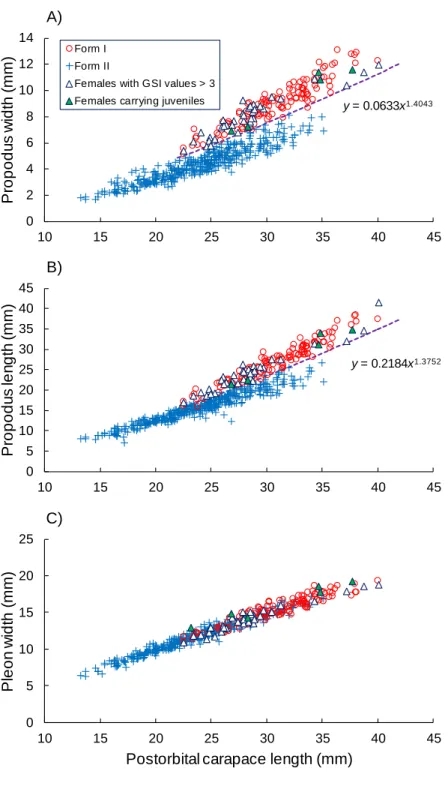
The females could be divided into two morphotypes with relatively large or small chelae 253
by the discriminant allometric growth equations between the POCL and chela propodus width 254
or length that were derived from the potentially reproductive and sexually active females (Fig. 255
1A, B). These females with larger or smaller chela should correspond to form I or II because 256
potentially or actively reproductive females were included in the group with larger chela. 257
Form I occurred in females that had grown to POCL of 22 mm or greater. Among the three 258
log-transformed allometric growth equation models applied for the chela dimensions, model 1 259
and model 2 were selected as the best models (Table 2), indicating the existence of intra-260
sexual dimorphism in the chelae of P. clarkii females. Although model 1 was also the best for 261
pleon width (Table 2), the differences in the intercept and slope were small between the 262
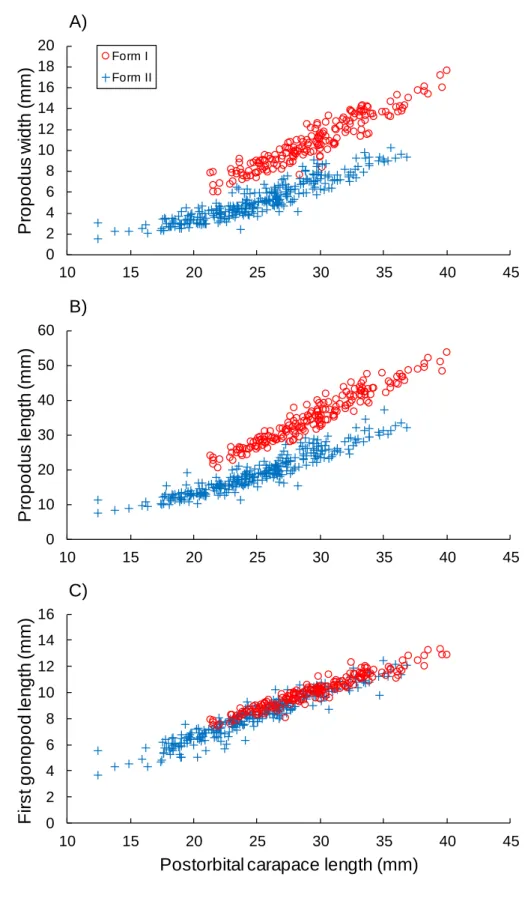
morphotypes (Table 2, Fig. 1C). Males were assigned as either form I or II based on their 263
external reproductive characteristics, and form I occurred in males that had grown to POCL of 264
21 mm or larger (Fig. 2A, B). The form I and II males had relatively large and small chelae, 265
respectively. As seen in the females, the allometric growth analyses detected intra-sexual 266
dimorphism among the males, and there was distinct dimorphism in the chelae (Table 2, Fig. 267
2A, B) but small dimorphism in the first gonopod (Table 2, Fig. 2C). The chelae showed 268
positive allometric growth (b = ~1.2–1.5) regardless of the sexual morphotype in both sexes, 269
and the pleon widths and gonopod lengths showed approximately isometric growth (b = ~0.9– 270
1.1) (Table 2). 271
When the allometric growth models were tested for the chela dimensions between the 272
sexes in each sexual morphotype, model 1 and model 2 were selected as the best models 273
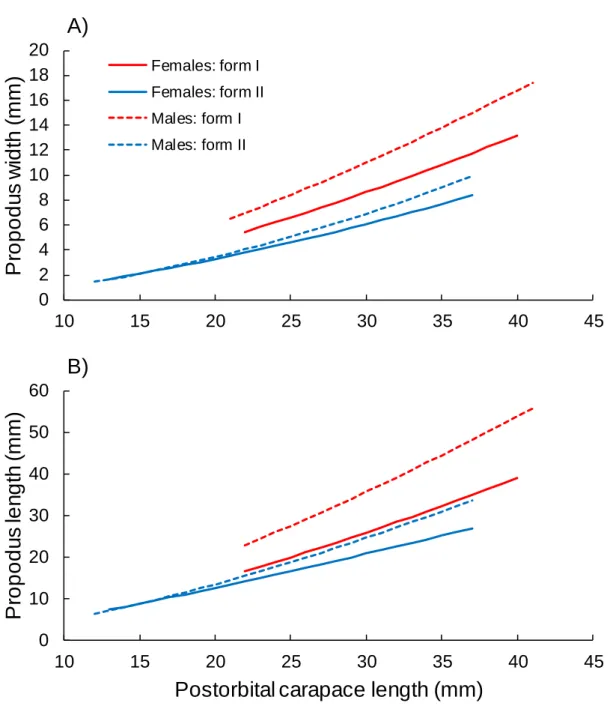
(Table 3), indicating the existence of inter-sexual dimorphism in the chelae of P. clarkii. In the 274
comparison of the chela dimensions among crayfish with the same POCL, the form I males 275
were found to have wider and longer chelae than the form I females, the form I females had 276
wider chelae than the form II males, and the form II males showed wider and longer chelae 277
compared with the form II females after reaching the size at onset of sexual maturity (~21–22 278
mm POCL) (Fig. 3). 279
The allometric growth of the gonad weight and GSI were best described by model 1 for 280
both sexes (Table 2); however, these values varied widely in form I females (Fig. 4). In males, 281
the gonad weight tended to increase with increasing body size, whereas the GSI values tended 282
to decrease in larger males (Fig. 5). The gonad weight and GSI values of the males tended to 283
be larger in form I than those in form II (Table 2), but the scatter plots of these values against 284
the POCL largely overlapping between the form I and II males. 285
286
Reproductive status
287 288
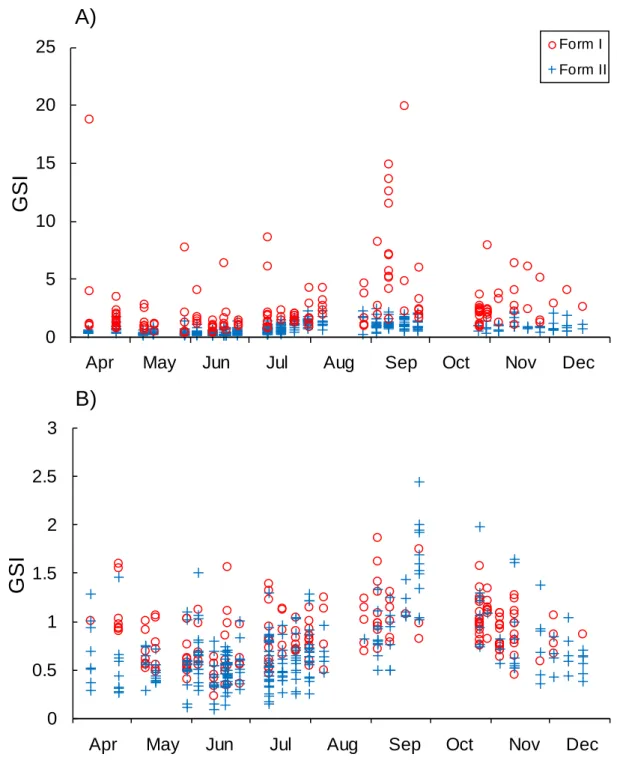
The GSI values significantly varied among the months and sexual morphotypes for both 289
females (month, F = 9.5279, df = 8, P < 0.0001; morphotype, F = 157.77, df = 1, P < 0.0001) 290
and males (month, F= 26.697, df = 8, P < 0.0001; morphotype, F = 28.316, df = 1, P < 291
0.0001). The form I females showed higher GSI values than the form II females, and the form 292
I females with higher GSI values were found in April and September (Fig. 6A). One 293
ovigerous female (23.2 mm POCL) and five females carrying juveniles (26.8–37.7 mm 294
POCL) were found in the specimens collected in April 24, 2011. The differences in the GSI 295
values between form I and II males were small, and the GSI values tended to slightly decrease 296
or vary less from April to July then increase until September and decrease again until 297
December (Fig. 6B). 298
The proportions of form I crayfish significantly varied among the months and body size 299
groups in the females (month, F = 3.1070, df = 7, P = 0.0248; body size, F = 23.653, df = 3, P 300
< 0.0001) and males (month, F= 6.6543, df = 8, P = 0.0003; body size, F = 12.0611, df = 3, P 301
< 0.0001). The proportions of form I crayfish tended to increase with increasing body size, 302
and the largest group (≥ 38 mm POCL) comprised all form I females and males (Fig. 7). The 303
monthly proportions of form I females and males were significantly correlated (r = 0.7743, t = 304
3.2369, df = 7, P = 0.0143) (Fig. 8). The overall proportions of form I females and males 305
fluctuated around 50% from April to September, and then the proportions increased to 83– 306
100% in October. The proportion of form I was higher in males (76%) than in females (50%) 307
in November and decreased to the same level in both sexes in December (Fig. 8). The sex 308
ratio fluctuated around 0.5, but significant unbalanced sex ratios that favoured the females 309
and males were detected in April (P = 0.0161) and November (P = 0.0275), respectively (Fig. 310
8). The sex ratio appeared to be male biased in December but was not statistically significant 311
due to the small sample size (n = 8, P = 0.7266). 312
313
DISCUSSION
314 315
Intra- and inter-sexual dimorphisms
316 317
Males of the American cambarid crayfish could be assigned as either sexually active 318
form I or sexually inactive form II morphotypes based on the presence of hooks on the ischia 319
of the third and fourth pereiopods and more calcified rigid gonopods (Suko 1953; Stein et al. 320
1977; Taketomi et al. 1990, 1996; Huner and Barr 1991; McLay and van den Brink 2016; 321
Kawai 2017), and form I males have longer and wider chelae than form II males (Suko 1953; 322
Stein et al. 1977; Huner and Barr 1991; McLay and van den Brink 2016; Buřič et al. 2010b). 323
Sexually active females (form I) of the American cambarids have been identified based on the 324
presence of developed glair glands, oocytes in the gonopores, and/or eggs and juveniles on the 325
pleopods (Wetzel 2002; Buřič et al. 2010a; Jones and Eversole 2011), the architecture of 326
annulus ventralis (Wetzel et al. 2005; Jones and Eversole 2011) and the occurrence of mating 327
with males (Wetzel 2002; Buřič et al. 2010a); then, the body dimensions such as chela size 328
and pleon width were compared between form I and form II females. Wetzel et al. (2005) 329
documented that form I and form II females of Faxonius pardalotus (Wetzel, Poly and Fetzner 330
2005) exhibited different morphologies of annulus ventralis: form I females have a corneous 331
sternum and strongly convoluted structures, whereas those of form II females are less 332
cornified and convoluted. Kawai (2017) found these two characters in the annulus ventralis of 333
P. ckarkii and suggested the existence of form I and form II morphotypes in P. clarkii females.
334
In the present study, based on the documentation by Suko (1953) that different sexual 335
morphotypes with longer (form I) or shorter (form II) chelae were found in P. clarkii females, 336
we attempted to elucidate the existence of different sexual forms in P. clarkii females by 337
allometric growth analyses of some body parts with reproductive information, such as the 338
gonad maturity condition and the presence of eggs and juveniles on the pleopods. Females 339
could be assigned into two morphotypes with relatively large or small chelae, corresponding 340
to form I or II because potentially or actively reproductive females were included in the 341
morphotype with larger chela. We also identified the sexual morphotypes of males based on 342
the external morphological characteristics and conducted the allometric growth analyses of 343
some body parts. Our analyses demonstrated the existence of different sexual morphotypes in 344
P. clarkii females and highlighted the intra- and inter-sexual dimorphisms in the chelae of this
345
species (Figs. 1–3); the chelae were largest in the form I males, followed by the form I 346
females and form II males, and were the smallest in the form II females (Fig. 3). To further 347
elucidate the reproductive characteristics of form I and form II females of P. clarkii, 348
architecture of annulus ventralis should be examined in relation to the sexual morphotypes 349
revealed by the present study and confirm the occurrence of mating of these females with 350
form I males. 351
Suko (1953) illustrated the relative growth patterns between the TL and chela propodus 352
length of P. clarkii females and males collected from Urawa (35°52'N, 139°35'E), Saitama 353
Prefecture, Japan as similar to those listed in figure 3 of the present study, while the actual 354
measurements and allometric growth coefficients are not shown. Suko (1953) stated that the 355
form I females and males occurred from 56 mm TL (21.3 mm POCL) and 54 mm TL (20.5 356
mm POCL), respectively, which corresponded to the size at onset of sexual maturity of the 357
males (21 mm POCL) and females (22 mm POCL) in the present study. To evaluate the 358
reproductive potential of the decapod crustacean populations, the size at which 50% of the 359
animals reach maturation has been evaluated (Pescinelli et al. 2016; Waller et al. 2019). In P. 360
clarkii, form alternation is evident in males (Taketomi et al. 1990) and it might also occur in
361
females as discussed below, so that in our crayfish specimens, the form II crayfish might 362
include the subadults that have never moulted to the sexually active form I and adults that 363
have moulted and returned to the sexually inactive form II. To determine the size at which 364
50% of the crayfish reach their first maturation in P. clarkii populations, the characteristics of 365
the subadults and form II adults need to be clarified. 366
Stein (1976) suggested that chelae of crayfish may be used for (1) prey capture and 367
manipulation, (2) defence against predators, (3) inter- and intraspecific interactions, and (4) 368
reproductive activities. Faxonius propinquus (Girard 1852), which have large chelae, are less 369
vulnerable to predation by fish and superior competitors in intraspecific interactions (Stein 370
1976). Ueno and Nagayama (2015) reported that large P. clarkii with smaller chelae were 371
beaten by small ones with larger chelae. Thus, selection might favour large chelae in P. 372
clarkii, resulting in the positive allometric growth of the chelae regardless of the sex or the
sexual morphotype, as demonstrated by our allometric growth analyses. The shift of the 374
chelae to large sizes in form I cambarid males suggests that the chelae of sexually active 375
males might be under stronger directional selection. Large chelae should provide an 376
advantage for males in competition to acquire receptive females. In F. propinquus, males with 377
larger chelae more successfully mate with females than similar-sized males with smaller 378
chelae (Stein 1976). The P. clarkii form I females also had larger chelae than form II 379
conspecifics (Figs. 1, 3), which is known to occur in Faxonius limosus (Rafinesque 1817) 380
(Buřič et al. 2010a) and C. elkensis (Jones and Eversole 2011). Reproductive P. clarkii 381
females remain in the burrows to lay and brood eggs (Huner and Barr 1991). Laboratory 382
experiments demonstrated that in P. clarkii, maternal (carrying eggs or juveniles) female 383
residents won a significantly higher proportion of their contests for shelters than did non-384
maternal residents, regardless of whether the intruders were males or non-maternal females 385
(Figler et al. 1995; Peeke et al. 1995). Large chelae might also be advantageous for defence of 386
offspring by maternal P. clarkii females. The males of P. clarkii use their chelae to grasp and 387
hold female chelae during copulation (Ameyaw-Akumfi 1981). Selection might favour larger 388
chelae of sexually active females to match the chelae size of males for successful courtship. 389
Form I females have wider pleons than form II females in some Faxonius species 390
(Wetzel 2002; Buřič et al. 2010a) and C. elkensis (Jones and Eversole 2011), and wider pleons 391
in females is believed to provide more space for egg incubation (Buřič et al. 2010a; Jones and 392
Eversole 2011). In P. clarkii, however, form I and II females with identical POCLs appeared 393
to have a similar-sized pleons with near isometric growth (Fig. 1). Pleopods of crayfish 394
females are used to carry eggs and juveniles, and the pleopod length of P. clarkii females 395
showed positive allometric growth (Kato and Miyashita 2003), suggesting that pleopods 396
rather than pleons might be under directional selection for the ability to carry more offspring. 397
Buřič et al. (2010b) reported that form I males of F. limosus possess longer gonopods than 398
form II males. However, the length of the first gonopod was similar between the sexual 399
morphotypes of the P. clarkii males with the same POCL, and the gonopod showed 400
approximately isometric growth (Fig. 2). Kato and Miyashita (2003) reported similar 401
allometric growth coefficients for the gonopods of P. clarkii form I males as were shown in 402
the present study, and they suggested that gonopods have been under stabilizing selection to 403
allow copulation with females of various sizes. 404
The gonad weight and GSI were correlated with the male body size (Fig. 5). The gonads 405
were slightly heavier in the form I males than in the form II males with the same POCL and 406
largely overlapped between the sexual morphotypes (Figs. 4, 5). Taketomi et al. (1996) 407
classified P. clarkii males into five developmental stages, A–E, based on the gonopod 408
morphology and the histologically examined testis development. They revealed that the 409
development of gonopods was complete and hooks (reversed spines) were present on the 410
ischia of the third and fourth pereiopods in stage E, which is identical to form I, and that testes 411
became sexually mature in stage D before reaching the morphologically mature stage E. 412
Because of this, some form II males in the present study may have shown similar gonad 413
weights to the form I males with the same POCL. The GSI values tended to increase in 414
smaller males (Fig. 5), suggesting that smaller males might invest in gonads to fertilize more 415
eggs when they mate with larger females. 416
417
Reproductive status
418 419
The sexually active form I females and males occurred throughout a sampling period 420
from April to November, while the occurrences of form I females and males were highly 421
correlated, peaking in October in our P. clarkii population in Yokohama, Japan (Figs. 7, 8). 422
Although there were few females with high GSI values, probably because the females with 423
mature gonads may be less active in their burrows during egg laying, one female and five 424
females with GSI values > 10 were detected in April and September, respectively (Fig. 6), and 425
one ovigerous female and five females carrying juveniles were found in April. The GSI values 426
of the form I males appeared to fluctuate in conjunction with those of the form I females (Fig. 427
6). The reproductive cycle in the Yokohama P. clarkii population generally agreed with that of 428
a previously investigated population in Urawa, Saitama Prefecture, Japan, which showed 429
continuous copulation and spawning incidences throughout the year with two seasons of high 430
reproduction; the most prolific season was from September to October (autumn) and the other 431
was from May to June (spring) (Suko 1956, 1958). The synchronization of reproductive 432
cycles between females and males has also been shown in European P. clarkii populations 433
(Alcorlo et al. 2008; Anastácio et al. 2009). 434
Suko (1958) summarized the main reproductive cycles of the Urawa P. clarkii population 435
but did not show population dynamics data, such as growth or proportions of sexual 436
morphotypes; the crayfish hatched in the late autumn of the main reproductive season rapidly 437
grow after the warm spring, moult to the sexually active form I in early autumn, copulate and 438
spawn, and then moult and return to the sexually inactive form II during the long period from 439
November to June; crayfish born in spring do not mature within the year and overwinter as 440
juvenile stage and moult to form I in the next spring, and after breeding, they moult and return 441
to form II in autumn. In the present study, the occurrence of form I crayfish varies among 442
different body size groups, and the proportions of form I individuals in the smaller groups 443
showed higher values in spring (April) and autumn (October) in both sexes (Fig. 7). Changes 444
in the proportions of the sexual morphotypes in smaller crayfish of the Yokohama population 445
appeared to support the form alternation events of the autumn- and spring-born crayfish of the 446
Urawa population. In the Yokohama population, the overall proportions of form I crayfish 447
peaked and reached >80% in October, and the proportion of form I females decreased in 448
November, whereas that of the form I males was still high at 76% in November (Fig, 8). The 449
form I males might be actively seeking receptive females and might be more likely to be 450
collected by bait traps than females; therefore, the sex ratio might be biased in favour of the 451
males in November (Fig. 8). However, the reason for the female-biased sex ratio in April is 452
not known. Many females exhibited a form I phenotype in October, but their GSI values were 453
not as high in the Yokohama population (Figs. 6–8). In the autumn season, female P. clarkii 454
require approximately 1.5 months to incubate the eggs and hatchlings to rear stage 3 juveniles 455
that depart from mother’s pleopods (Suko 1956, 1961). Almost all form I females of P. clarkii 456
laid eggs once during the intermoult period and they require several months for gonad 457
development before oviposition, and the females that copulated with males in early winter 458
spawned in the next spring in the Urawa population (Suko1958). In the Yokohama population, 459
the form I females that were collected after late October might include females that had 460
already bred and females that would oviposit in the next spring as females carrying eggs and 461
juveniles were found in April. 462
Buřič et al. (2010a, b) examined the moulting events in relation to form alternation in F. 463
limosus for 8–10 months in captivity and reported that the majority of females (58%) and
464
males (84%) moulted twice and showed form alternation (form I → form II → form I); the 465
remainder of the females (42%) and males (9%) moulted once without form alternation (form 466
I → form I), and some males (7%) did not moult. They also documented that the initial body 467
size was smallest in the twice moulted crayfish, followed by the once moulted or not moulted 468
crayfish. Taketomi et al. (1990) documented that the proportions of form I males tended to 469
increase with increasing body size in P. clarkii collected from Kumamoto (32°46'N, 470
130°45'E), Japan. They also stated that many of the form I males with 25–30 mm POCL 471
changed to form II at their autumn/winter moult and returned to form I at the next 472
spring/summer moult, whereas form I males greater than 30 mm POCL did not undergo an 473
autumn/winter moult, but they did not refer to the next spring/summer moult of these crayfish. 474
In general, the intermoult periods increased with increasing body size, and thus, the moulting 475
events during the year decrease with growth in decapod crustacean species (Kurata 1962). In 476
the Yokohama P. clarkii population, the body size groups became larger and higher and less 477
variable proportions of form I occurred (Fig. 7), suggesting less form alternation occurs in 478
larger crayfish. Cambarid crayfish may exhibit size-dependent moulting and form 479
alternations. This hypothesis should be tested by laboratory culture experiments for P. clarkii 480 populations. 481 482 CONCLUSIONS 483 484
Our allometric growth analyses demonstrated the existence of two sexual morphotypes 485
in the females of the red swamp crayfish Procambarus clarkii and highlighted the inter-sexual 486
dimorphism of the chela dimensions in this species. In P. clarkii populations, the reproductive 487
status of males is evaluated by determining the sexual morphotypes, whereas that of females 488
has historically been conducted by examining gonad maturation; active glair glands; and the 489
eggs, juveniles and egg-remains on the pleopods (Scallici and Gherardi 2007; Alcorlo et al. 490
2008; Anastácio et al. 2009; Chucholl 2011). If we relied on only the traditional criteria using 491
GSI values for evaluating the female reproductive status, we would not have been able to 492
follow the reproductive cycle among the different body size groups in the Yokohama P. clarkii 493
population. The discrimination of the sexual morphotypes based on chela allometric growth 494
would allow us to evaluate the female reproductive status more easily and precisely in 495
conjunction with the traditional reproductive criteria, and this might help us to understand the 496
P. clarkii population dynamics as a basis for developing control measures for this invasive
497
alien species. 498
499
Acknowledgements: We would like to acknowledge the people who participated in
500
elimination campaigns of red swap crayfish in the public natural park, Yokohama, Japan. We 501
thank Keisuke Morimoto and Naoki Ishiyama for helping with the field and laboratory works. 502
We are grateful to two anonymous reviewers for their valuable comments and suggestions, 503
which have improved the manuscript substantially. 504
505
Authors’ contributions: KH designed the study. NS and NI performed the sample collections
506
and measurements. KH, SD, and SK analysed the data and prepared the manuscript. All 507
authors approved the final manuscript. 508
Competing interests: The authors declare that they have no conflicts of interest.
510 511
Availability of data and materials: All data are provided within the manuscript and
512
supplementary materials. 513
514
Consent for publication: Not applicable.
515 516
Ethics approval consent to participate: The present study complies with current Japanese
517 laws. 518 519 REFERENCES 520 521
Akaike H. 1973. Information theory and an extension of the maximum likelihood principle. 522
In: Petrov BN, Csaki F (eds) 2nd international symposium on information theory,
523
Tsahkadsor, Armenia, USSR, September 2-8, 1971. Akadémiai Kiadó, Budapest, pp. 524
267-281. 525
Alcorlo P, Geiger W, Otero M. 2008. Reproductive biology and life cycle of the invasive 526
crayfish Procambarus clarkii (Crustacea: Decapoda) in diverse aquatic habitats of 527
South-Western Spain: implications for population control. Fundam Appl Limnol 528
173:197-21. doi:10.1127/1863-9135/2008/0173-0197.
529
Ameyaw-Akumfi C. 1981. Courtship in the crayfish Procambarus clarkii (Girard) (Decapoda, 530
Astacidea). Crustaceana 40:57-64. doi:10.1163/156854081X00408. 531
Anastácio PM, Leitão, Boavida MJ, Correia AM. 2009. Population dynamics of the invasive 532
crayfish (Procambarus clarkii) at two marshes with different hydroperiods. Ann Limnol 533
Int J Lim 45:247-256. doi:10.1051/limn/2009025. 534
Aquiloni L, Becciolini A, Trunfio C, Berti R, Gherardi F. 2009. Managing invasive crayfish: 535
use of X-ray sterilization of males. Freshw Biol 54:1510-1519. doi:10.1111/j.1365-536
2427.2009.02169.x. 537
Aquiloni L, Brusconi S, Cecchinelli E, Tricarico E, Mazza G, Paglianti A, Gherardi F. 2010. 538
Biological control of invasive populations of crayfish: the European eel (Anguilla 539
anguilla) as a predator of Procambarus clarkii. Biol Inv 12:3817-3824.
540
doi:10.1007/s10530-010-9774-z. 541
Aquiloni L, Gherardi F. 2010. The use of sex pheromones for the control of invasive 542
populations of the crayfish Procambarus clarkii: a field study. Hydrobiologia 649: 249-543
254.doi:10.1007/s10750-010-0253-4. 544
Burnham KP, Anderson DR. 2002. Model selection and multimodel inference: a practical 545
information–theoretic approach, 2nd edn. Springer-Verlag, New York, NY, USA. 546
Buřič M, Kouba A, Kozák P. 2010a. Intra-sex dimorphism in crayfish females. Zoology 547
113:301-307. doi:10.1016/j.zool.2010.06.001.
548
Buřič M, Kouba A, Kozák P. 2010b. Molting and growth in relation to form alternations in the 549
male spiny-cheek crayfish Orconectes limosus. Zool Stud 49:28-38. 550
Chucholl C. 2011. Population ecology of an exotic “warm water” crayfish (Procambarus 551
clarkii) in a new cold habitat. Knowl Manag Aquat Ecosyst 401:29.
552
doi:10.1051/kmae/2011053. 553
Chucholl C. 2013. Invaders for sale: trade and determinants of introduction of ornamental 554
freshwater crayfish. Biol Inv 15:125-141. doi:10.1007/s10530-012-0273-2. 555
Ecological Society of Japan 2002. Handbook of alien species in Japan, Chijin-shokan, Tokyo. 556
(in Japanese) 557
Figler MH, Blank GS, Peeke HVS. 1995. Maternal territoriality as an offspring defense 558
strategy in red swamp crayfish (Procambarus clarkii, Girard). Aggr Behav 27:391-403. 559
doi:10.1002/ab.1024. 560
Fox J, Weisberg S. 2011. An R companion to applied regression, 2nd edn. Sage Publications, 561
Thousand Oaks, CA, USA. 562
Gherardi F, Aquiloni L, Diéguez-Uribeondo J, Tricarico E. 2011. Managing invasive crayfish: 563
is there a hope? Aquat Sci 73:185-200. doi:10.1007/s00027-011-0181-z. 564
Hobbs HH. 1972. Biota of freshwater ecosystems, identification manual 9. Crayfishes 565
(Astacidae) of North and Middle America. Water Pollution Control Research Series, US 566
Environmental Protection Agency, Washington DC, USA. 567
Hobbs HH, Jass JP, Huner JV. 1989. A review of global crayfish introductions with particular 568
emphasis on two North American species (Decapoda, Cambaridae). Crustaceana 56:299-569
316. doi:10.1163/156854089X00275. 570
Huner JV, Barr JE. 1991. Red swamp crayfish: biology and exploitation. The Louisiana Sea 571
Grant College Program, Center for Wetland Resources, Louisiana State University, 572
Baton Rouge, LA, USA. 573
Huxley JS. 1932. Problems of relative growth. Dial Press, New York, NY, USA. 574
Jones DR, Eversole AG. 2011. Life history characteristics of the Elk River crayfish. J Crust 575
Biol 31:647-652. doi: 10.1651/10-3436.1. 576
Jin S, Jacquin L, Xiong M, Li R, Lek S, Li W, Zhang T. 2019. Reproductive pattern and 577
population dynamics of commercial red swamp crayfish (Procambarus clarkii) from 578
China: implications for sustainable aquaculture management. PeerJ 7:e6214. 579
doi:10.7717/peerj.6214. 580
Kato N, Miyashita T. 2003. Sexual difference in modes of selection on the pleopods of 581
crayfish (Decapoda: Astacoidea) revealed by the allometry of developmentally 582
homologous traits. Can J Zool 81:971-978. doi:10.1139/z03-083. 583
Kawai T. 2017. A review of the spread of Procambarus clarkii across Japan and its 584
morphological observations. Freshw Crayfish 23:41-53. doi:10.5869/fc.2017.v23-1.41. 585
Kawai T, Kobayashi Y. 2005. Origin and current distribution of the alien crayfish, 586
Procambarus clarkii (Girard, 1852) in Japan. Crustaceana 78:1143-1149.
587
doi:10.1163/156854005775361034. 588
Crandall KA, De Grave S. 2017. An updated classification of the freshwater crayfishes 589
(Decapoda: Astacidea) of the world, with a complete species list. J Crust Biol 37:615-590
653. doi:10.1093/jcbiol/rux070. 591
Kurata H. 1962. Studies on the age and growth of Crustacea. Bull Hokkaido Reg Fish Res 592
Lab 24:1-115. 593
Loureiro TG, Anastácio PMSG, Araujo PB, Souty-Grosset C, Almerão MP. 2015. Red swamp 594
crayfish: biology, ecology and invasion – an overview. Nauplius 23:1-19. 595
doi:10.1590/S0104-64972014002214. 596
Martín-Torrijos L, Kawai T, Makkonen J, Jussila J, Kokko H, Diéguez-Uribeondo J. 2018. 597
Crayfish plague in Japan: a real threat to the endemic Cambaroides japonicus. PLoS 598
ONE 13(4):e0195353. doi:10.1371/journal.pone.0195353. 599
McLay CL, van den Brink AM. 2016. Crayfish growth and reproduction. In: Longshaw M, 600
Stebbing P (eds) Biology and ecology of crayfish. CRC Press, Boca Raton, FL, USA. 601
Nakata K. 2018. Effective capturing methods of an invasive crayfish species Procambarus 602
clarkii in relation to its ecology. Cancer 27:139-141. (in Japanese)
603
Oluoch AO. 1990. Breeding biology of the Louisiana red swamp crayfish Procambarus 604
clarkii Girard in Lake Naivasha, Kenya. Hydrobiologia 208:85-92.
605
doi:10.1007/BF00008447. 606
Paglianti A, Gherardi F. 2004. Combined effects of temperature and diet on growth and 607
survival of young-of-year crayfish: a comparison between indigenous and invasive 608
species. J Crust Biol 24:140-148. doi:10.1651/C-2374. 609
Payne JF. 1996. Adaptive success within the cambarid life cycle. Freshw Crayfish 11:1-12. 610
Pescinelli RA, Carosia MF, Pantaleão JAF, Simões SM, Costa RC. 2016. Population biology 611
and size at the onset of sexual maturity of the amphidromous prawn Macrobrachium 612
olfersii (Decapoda, Palaemonidae) in an urban river in southeastern Brazil. Invert Rep
613
Dev 60: 254-262. doi: 10.1080/07924259.2016.1202338. 614
Peeke HVS, Twum M, Finkelstein JE, Figler MH. 1995. Maternal aggression in red swamp 615
crayfish (Procambarus clarkii, Girard): the relation between reproductive status and 616
outcome of aggressive encounters with male and female conspecifics. Behaviour 617
132:107-125. doi:10.1163/156853995X00324.
618
R Core Team. 2018. R: A language and environment for statistical computing. R Foundation 619
for Statistical Computing, Vienna. https://www.R-project.org/. Accessed 20 December 620
2018. 621
Sako, N. 1987. Procambarus clarkii and Rana catesbeiana in Japan: a history. Collect Breed 622
49:363-397. (in Japanese).
623
Scalici M, Gherardi F. 2007. Structure and dynamics of an invasive population of the red 624
swamp crayfish (Procambarus clarkii) in a Mediterranean wetland. Hydrobiologia 625
583:309-319. doi:10.1007/s10750-007-0615-8.
626
Scudamore HH, 1948. Factors influencing molting and the sexual cycles in the crayfish. Biol 627
Bull 95:229-237. doi:10.2307/1538027. 628
Souty-Grosset C, Anastácio PM, Aquiloni L, Banha F, Choquer J, Chucholl C, Tricarico E. 629
2016. The red swamp crayfish Procambarus clarkii in Europe: impacts on aquatic 630
ecosystems and human well-being. Limnologica 58:78-93. 631
doi:10.1016/j.limno.2016.03.003. 632
Stein RA. 1976. Sexual dimorphism in crayfish chelae: functional significance linked to 633
reproductive activities. Can J of Zool 54:220-227.doi:10.1139/z76-024. 634
Stein RA, Murphy ML, Magnuson JJ. 1977. External morphological changes associated with 635
sexual maturity in the crayfish (Orconectes propinquus). Am. Midl. Nat. 97:495-502. 636
doi:10.2307/2425115. 637
Suko T. 1953. Studies on the development of the crayfish. I. The development of secondary 638
sex characters in appendages. Sci Rep Saitama Univ B 1:77-96. 639
Suko T. 1956. Studies on the development of the crayfish. IV. The development of winter 640
eggs. Sci Rep Saitama Univ B 2:213-219. 641
Suko T. 1958. Studies on the development of the crayfish. VI. The reproductive cycle. Sci 642
Rep Saitama Univ B 3:79-91. 643
Suko T. 1961. Studies on the development of the crayfish. VII. The hatching and hatched 644
young. Sci Rep Saitama Univ B 4:37-42. 645
Taketomi Y, Murata M, Miyawaki M. 1990. Androgenic gland and secondary sexual 646
characters in the crayfish Procambarus clarkii. J Crust Biol 10:492-497. 647
doi:10.2307/1548339. 648
Taketomi Y, Nishikawa S, Koga S. 1996. Testis and androgenic gland during development of 649
external sexual characteristics of the crayfish Procambarus clarkii. J Crust Biol 6:24-34. 650
doi:10.1163/193724096X00243. 651
Ueno R, Nagayama T. 2015. Interlocking of chelae is a key factor for dominance hierarchy 652
formation in crayfish. J Exp Biol 215:2841-2848. doi:10.1242/jeb.072520. 653
Waller JD, Reardon KM, Caron SE, Masters HM, Summers EL, Wilson CJ. 2019. Decrease in 654
size at maturity of female American lobsters Homarus americanus (H. Milne Edwards, 655
1837) (Decapoda: Astacidea: Nephropidae) over a 50-year period in Maine, USA. J 656
Crust Biol 39:509-515. doi:10.1093/jcbiol/ruz021. 657
Wetzel JE. 2002. Form alternation of adult female crayfishes of the genus Orconectes 658
(Decapoda: Cambaridae). Am Midl Nat 147:326-337. doi:10.1674/0003-659
0031(2002)147[0326:FAOAFC]2.0.CO;2. 660
Wetzel JE, Poly WJ, Fetzner Jr JW. 2005. Orconectes pardalotus, a new species of crayfish 661
(Decapoda: Cambaridae) from the lower Ohio River, with notes on its life history. Aqua, 662
J Ichthyol Aquat Biol 10:57-72. 663
664 665
666 667
Fig. 1. Growth of the chela propodus width (A), chela propodus length (B) and pleon width
668
(C) relative to the postorbital carapace length in female red swamp crayfish Procambarus 669
clarkii. Data are shown for the different sexual morphotypes, reproductive form I and
non-670
reproductive form II, the potentially reproductive females with GSI values > 3 and the 671
reproductive females carrying juveniles. Allometric growth curves discriminating the different 672
sexual morphotypes are shown for chela propodus width and length. See figure S4 for 673 discriminant functions. 674 0 2 4 6 8 10 12 14 10 15 20 25 30 35 40 45 P ro p o d u s w id th ( m m ) Carapace length (mm) A) Form I Form II
Females with GSI values > 3 Females carrying juveniles
0 5 10 15 20 25 30 35 40 45 10 15 20 25 30 35 40 45 P ro p o d u s le n g th ( m m ) Carapace length (mm) B) 0 5 10 15 20 25 10 15 20 25 30 35 40 45 P le o n w id th ( m m )
Postorbital carapace length (mm) C)
y = 0.0633x1.4043
675 676
Fig. 2. Growth in the chela propodus width (A), chela propodus length (B) and first gonopod
677
length (C) relative to the postorbital carapace length in male red swamp crayfish 678
Procambarus clarkii. Data are shown for the different sexual morphotypes, reproductive form
679
I and non-reproductive form II. 680 0 2 4 6 8 10 12 14 16 18 20 10 15 20 25 30 35 40 45 P ro p o d u s w id th ( m m ) Carapace length (mm) A) Form I Form II 0 10 20 30 40 50 60 10 15 20 25 30 35 40 45 P ro p o d u s le n g th ( m m ) Carapace length (mm) B) 0 2 4 6 8 10 12 14 16 10 15 20 25 30 35 40 45 F ir s t g o n o p o d le n g th ( m m )
Postorbital carapace length (mm) C)
681 682
Fig. 3. Inter-sexual dimorphism of the chela propodus width (A) and chela propodus length
683
(B) in red swamp crayfish Procambarus clarkii. Allometric growth curves were calculated 684
based on the equations estimated for females and males in the respective sexual morphotypes 685 shown in Table 3. 686 687 0 2 4 6 8 10 12 14 16 18 20 10 15 20 25 30 35 40 45
P
ro
p
o
d
u
s
w
id
th
(
m
m
)
Carapace length (mm)
A)
Females: form I Females: form II Males: form I Males: form II 0 10 20 30 40 50 60 10 15 20 25 30 35 40 45P
ro
p
o
d
u
s
le
n
g
th
(
m
m
)
Postorbital carapace length (mm)
B)
688 689
Fig. 4. Relationships between the postorbital carapace length and gonad weight (A) and the
690
gonadosomatic index (GSI) (B) in female red swamp crayfish Procambarus clarkii. Data are 691
shown for the different sexual morphotypes, reproductive form I and non-reproductive form 692 II. 693 0 100 200 300 400 500 10 15 20 25 30 35 40 45
G
o
n
a
d
w
e
ig
h
t
(m
g
)
Carapace length (mm)
A)
Form I Form II 0 5 10 15 20 25 10 15 20 25 30 35 40 45G
S
I
Postorbital carapace length (mm)
B)
694 695
Fig. 5. Relationships between the postorbital carapace length and gonad weight (A) and the
696
gonadosomatic index (GSI) (B) in male red swamp crayfish Procambarus clarkii. Data are 697
shown for the different sexual morphotypes, reproductive form I and non-reproductive form 698 II. 699 700 0 10 20 30 40 50 60 10 15 20 25 30 35 40 45
G
o
n
a
d
w
e
ig
h
t
(m
g
)
Carapace length (mm)
A)
Form I Form II 0 0.5 1 1.5 2 2.5 3 10 15 20 25 30 35 40 45G
S
I
Postorbital carapace length (mm)
B)
701 702
Fig. 6. Changes in the gonadosomatic index (GSI) in red swamp crayfish Procambarus clarkii
703
females (A) and males (B) from April to December 2011. Data are shown for the different 704
sexual morphotypes, reproductive form I and non-reproductive form II. 705 0 5 10 15 20 25
Apr-11 May-11 Jun-11 Jul-11 Aug-11 Sep-11 Oct-11 Nov-11 Dec-11
G
S
I
A) Female
0 5 10 15 20 25Apr-11 May-11 Jun-11 Jul-11 Aug-11 Sep-11 Oct-11 Nov-11 Dec-11
G
S
I
A)
0 0.5 1 1.5 2 2.5 3Apr-11 May-11 Jun-11 Jul-11 Aug-11 Sep-11 Oct-11 Nov-11 Dec-11
G S I
B)
0 0.5 1 1.5 2 2.5 3Apr-11 May-11 Jun-11 Jul-11 Aug-11 Sep-11 Oct-11 Nov-11 Dec-11
G
S
I
Apr May Jun Jul Aug Sep Oct Nov Dec
Apr May Jun Jul Aug Sep Oct Nov Dec
Form I Form II
706 707
Fig. 7. Changes in the proportions of reproductive form I females (A) and males (B) in
708
different body size groups (postorbital carapace length, POCL) after sexual maturity (females, 709
> 22 mm POCL; males, > 21 mm POCL) in red swamp crayfish Procambarus clarkii. 710 0 20 40 60 80 100
Apr May Jun Jul Aug Sep Oct Nov Dec
P
ro
p
o
rt
io
n
o
f
fo
rm
I
f
e
m
a
le
s
(
%
)
A)
22-25.99 26-29.99 30-33.99 34-37.99 38-41.99 mm 0 20 40 60 80 100Apr May Jun Jul Aug Sep Oct Nov Dec
P
ro
p
o
rt
io
n
o
f
fo
rm
I
m
a
le
s
(
%
)
B)
21-25.99 26-29.99 30-33.99 34-37.99 38-41.99 mm711 712
Fig. 8. Changes in the proportions of reproductive form I females and males after sexual
713
maturity (females, > 22 mm POCL; males, > 21 mm POCL) and the sex ratio [number of 714
males / number of total crayfish] in red swamp crayfish Procambarus clarkii. 715 716 0.0 0.1 0.2 0.3 0.4 0.5 0.6 0.7 0.8 0.9 1.0 0 10 20 30 40 50 60 70 80 90 100
Apr May Jun Jul Aug Sep Oct Nov Dec
S
e
x
r
a
ti
o
P
ro
p
o
rt
io
n
o
f
fo
rm
I
c
ra
y
fi
s
h
(
%
)
Females Males Sex ratioTable 1.
Collection records of red swamp crayfish Procambarus clarkii from a small pond in Yokohama, Japan, in 2011.
Month Number of days collecting crayfish
Number of crayfish
Female Female (ND) Male
April 2 43 2 26 May 3 56 3 54 June 5 117 2 105 July 4 130 2 122 August 2 30 0 15 September 4 97 1 54 October 2 28 1 34 November 4 34 0 46 December 3 18 2 20
ND: The sexual maturity of some females could not be determined because of the loss of both chelipeds.
717 718
Table 2.
Intra-sexual dimorphism evaluated with a general linear model for some body parts of red swamp crayfish Procambarus clarkii. Three models were applied: model 1, lny ~ lnPOCL + MT + lnPOCL × MT; model 2, lny ~ lnPOCL + MT; and model 3, lny ~ lnPOCL, where POCL is the postorbital carapace length and MT is the sexual morphotype (form I, reproductive type; form II, non-reproductive type). The coefficient estimates of the categorical explanatory variable including the MT were outputted for form I and it represents the change in the response variable relative to the baseline category (form II).
Coefficient estimates
Sex Response
variable Model Intercept lnPOCL MT-Form I lnPOCL × MT-Form I AIC R
2 F df1 df2 P
Female Chela propodus
width 1 −3.3995 1.5293 0.6040 −0.0737 −981.9 0.9486 3374 3 548 <0.0001 2 −3.3622 1.5175 0.3561 - −982.7 0.9485 5059 2 549 <0.0001 3 −4.6273 1.9418 - - −384.9 0.8474 3055 1 550 <0.0001 Chela propodus length 1 −1.2164 1.2489 −0.3876 0.1787 −1476.8 0.9642 4921 3 548 <0.0001 2 −1.3066 1.2775 0.2135 - −1461.0 0.9630 7151 2 549 <0.0001 3 −2.0651 1.5319 - - −919.0 0.9010 5004 1 550 <0.0001 Pleon width 1 −0.7177 1.0039 0.2013 −0.0573 −1988.9 0.9645 4976 3 549 <0.0001 2 −0.6882 0.9945 0.0087 - −1986.2 0.9642 7411 2 550 <0.0001 3 −0.7190 1.0049 - - −1984.2 0.9640 14740 1 551 <0.0001 Gonad weight 1 −8.8117 3.4061 10.6352 −2.7842 1230.3 0.6235 283.7 3 514 <0.0001 2 −6.9706 2.8283 1.2888 - 1254.8 0.6037 392.3 2 515 <0.0001 3 −12.1032 4.5324 - - 1426.9 0.4454 414.4 1 516 <0.0001 GSI 1 −1.9039 0.4061 10.6352 −2.7842 1230.3 0.3782 104.2 3 514 <0.0001 2 −0.0628 -0.1717 1.2888 - 1254.8 0.3455 135.9 2 515 <0.0001 3 −5.1955 1.5324 - - 1426.9 0.0841 47.37 1 516 <0.0001 Male Chela propodus
width 1 −3.9124 1.7184 1.2432 −0.2287 −618.8 0.9364 2283 3 465 <0.0001 2 −3.7314 1.6619 0.4815 - −611.7 0.9352 3361 2 466 <0.0001 3 −5.2405 2.1807 - - 20.0 0.7496 1398 1 467 <0.0001 Chela propodus
2 −1.8203 1.4755 0.3760 - −922.2 0.9525 4674 2 466 <0.0001 3 −2.9988 1.8806 - - −231.0 0.7918 1776 1 467 <0.0001 First gonopod length 1 −1.3167 1.0637 0.6268 −0.1782 −1341.8 0.9263 1977 3 472 <0.0001 2 −1.1779 1.0203 0.0334 - −1319.2 0.9224 2811 2 473 <0.0001 3 −1.2825 1.0563 - - −1293.7 0.9178 5291 1 474 <0.0001 Gonad weight 1 −5.4075 2.3708 2.7552 −0.6876 540.5 0.6405 276.8 3 466 <0.0001 2 −4.8662 2.2017 0.4652 - 545.5 0.6351 406.4 2 467 <0.0001 3 −6.3169 2.7008 - - 639.9 0.5520 576.6 1 468 <0.0001 GSI 1 1.5002 −0.6292 2.7552 −0.6876 540.5 0.2095 41.18 3 466 <0.0001 2 2.0415 −0.7983 0.4652 - 545.5 0.1977 57.52 2 467 <0.0001 3 0.5908 −0.2992 - - 639.9 0.0149 7.076 1 468 0.0081 The bold AIC value is the lowest among the three models for each body part.
719 720
Table 3.
Inter-sexual dimorphism evaluated with a general linear model for the chelae of red swamp crayfish Procambarus clarkii. Three models were applied: model 1, lny ~ lnPOCL + Sex + lnPOCL × Sex; model 2, lny ~ lnPOCL + Sex; and model 3, lny ~ lnPOCL, where POCL is the postorbital carapace length and Sex is female or male. The coefficient estimates of the categorical explanatory variable including the Sex is outputted for male and it represents the change in the response variable relative to the baseline category (female).
Coefficient estimates
Form Response
variable Model Intercept lnPOCL Sex-Male lnPOCL × Sex-Male AIC R
2 F df1 df2 P I Chela propodus width 1 −2.7954 1.4556 0.1263 0.0342 −814.2 0.8994 1025 3 344 <0.0001 2 −2.8620 1.4751 0.2421 - −815.8 0.8993 1540 2 345 <0.0001 3 −2.4061 1.3777 - - −368.9 0.6341 599.6 1 346 <0.0001 Chela propodus length 1 −1.6040 1.4276 0.2932 0.0083 −1049.0 0.9528 2316 3 344 <0.0001 2 −1.6202 1.4324 0.3214 - −1051.0 0.9528 3483 2 345 <0.0001 3 −1.0149 1.3030 - - −247.4 0.5223 378.3 1 346 <0.0001 II Chela propodus width 1 −3.3995 1.5293 -0.5129 0.1892 −871.4 0.8662 1444 3 669 <0.0001 2 −3.6608 1.6119 0.0894 - −859.6 0.8635 2119 2 670 <0.0001 3 −3.6928 1.6340 - - −785.2 0.8471 3716 1 671 <0.0001 Chela propodus length 1 −1.2164 1.2489 -0.6455 0.2396 −1381.3 0.9107 2273 3 669 <0.0001 2 −1.5473 1.3536 0.1173 - −1337.3 0.9043 3167 2 670 <0.0001 3 −1.5893 1.3826 - - −1103.1 0.8641 4266 1 671 <0.0001 The bold AIC value is the lowest among the three models for each body part.