Mass transportation monitored by trace level radioactivity
著者 Komura Kazuhisa, Inoue Mutsuo, Murata Yoshimasa, Manikandan N., Abe Takuya, Yamaguchi Y., Tanaka K.
journal or
publication title
金沢大学21世紀COEプログラム主催国際シンポジ ウム「東アジアの大気環境汚と健 康・生態系への 影響」講演要旨集(金沢)
year 2006‑09‑25
URL http://hdl.handle.net/2297/2442
Mass Transportation monitored by trace level radioactivity
K. Komura, M. Inoue, Y. Murata, M. Manikandan N, T. Abe, Y. Yamaguchi, K. Tanaka
Low Level Radioactivity Laboratory, Institute of. Nature and Environmental Technology, Kanazawa University
Abstract
In the environment, there are many kinds of natural and artificial radionuclides as well as cosmic ray produced (CP) nuclides. Concentration levels of these nuclides are in general extremely low, therefore, not easy to measure without special efforts in the sampling and measurement. These nuclides are very attractive because they have potential to be utilized as geochemical tracers to investigate mass transportation occurring in the environment. Time scale of analyses applicable to natural environmental depends on the half-life and geochemical properties of radionuclides. Recently, it became possible to detect extremely low levels of radionuclides using ultra low background counting system equipped in Ogoya Underground Laboratory (OUL).
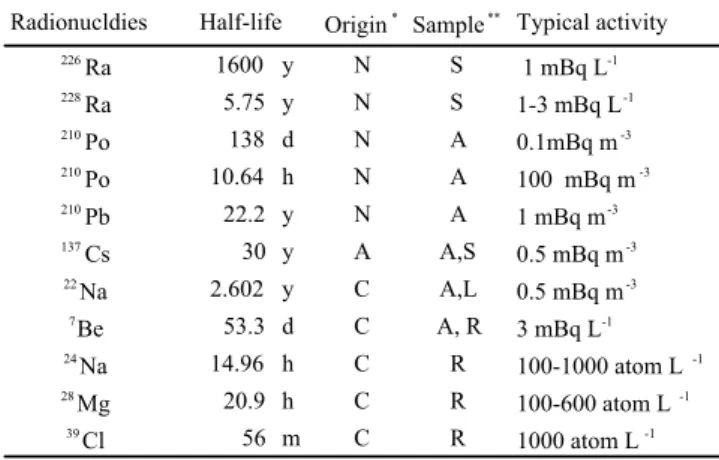
(1)In the COE program, we decided to start new project, namely, high-resolution measurements of airborne radionuclides at 1~3 hours of intervals simultaneously at 3 points as shown in Fig. 1. This kind of measurements could never been performed because dozens of low background counting system are needed to measure great number of samples within short time after sampling. The second project performed in the COE program is the measurements of short-lived CP nuclides in rain sample to open new application field in hydrology. The third one is to measure seasonal and spatial variation of
228
Ra/
226Ra ratio in coastal water of the Sea of Japan. Radionuclides measured in these projects are summarized in Table. 1.
Table 1. Environmental radionuclides measured in this study.
Radionucldies Origin* Sample** Typical activity
226Ra 1600 y N S 1 mBq L-1
228Ra 5.75 y N S 1-3 mBq L-1
210Po 138 d N A 0.1mBq m-3
210Po 10.64 h N A 100 mBq m-3
210Pb 22.2 y N A 1 mBq m-3
137Cs 30 y A A,S 0.5 mBq m-3
22Na 2.602 y C A,L 0.5 mBq m-3
7Be 53.3 d C A, R 3 mBq L-1
24Na 14.96 h C R 100-1000 atom L-1
28Mg 20.9 h C R 100-600 atom L-1
39Cl 56 m C R 1000 atom L-1
* N: Natural, A: Artificial, C: Cosmic ray produced Fig. 1. Sampling points of airborne radionuclides. ** S: Sea water, A: Air, L: Lak water, R: Rain
Half-life
Hegura
LLRL Shishiku
OUL 50 km
- 17 -
1. High resolution analyses of airborne radionuclides
Airborne radionuclides were collected on a silica fiber filter at 700-900 L min
-1of flow rate by using Sibata 1000F high volume air sampler at three points, LLRL, Hegura Island located 50 km from Noto Peninsula and Shishiku Plateau at 640 m point above sea level (Fig. 1). Two kinds of sampling were conducted in this study. The first one was aimed to investigate diurnal variations of
210Pb,
7Be and
212Pb (from 2005). The second one aimed for the analysis of seasonal variations of
210Pb and
7Be by 1-2 days of sampling at LLRL and Shishiku and 1 week sampling at Hegura Island. All of the measurements except some of
212Pb samples were made at OUL.
Results of measurements are summarized as follows
:(1) Concentrations of
210Pb,
7Be and
212Pb activities varied rapidly comparable to that of
222
Rn, however, variation patterns are quite different from that of radon and closely related to meteorological circumstances.
(2) Activity levels of both
210Pb and
7Be showed drastic decrease before and during the approach of typhoon or cold front.
(3) Activity level of
212Pb became order of magnitude lower at high altitude (Shishiku Plateau) when ground surface was covered by snow.
(4) Phase shift of variation pattern was observed for
212Pb activity measured at LLRL and Shishiku Plateau.
Details of the results are published together with seasonal variations of cosmogenic
22Na and artificial
137Cs.
(2)2. Short-lived cosmic ray produced nuclides in rain samples
Short-lived CP nuclides in freshly precipitated rain were measured using large volume (40-50L) of rain samples collected through a downpipe from the rooftop of LLRL building. Immediately after the sampling the rain sample was subjected to chemical treatments to enrich CP nuclides by ion exchange technique. Within 90 min after the sampling, gamma ray measurement was performed at OUL located some 20 km from LLRL. The CP nuclides detected were
38Cl,
39Cl,
18F,
24Na,
28Mg and
22Na. More than 50 measurements have been made since June of 2004. Part of the results is reported in science journal.
(3)3. Spatial and temporal variations of
228Ra/
226Ra ratio in coastal water of the Sea of Japan
Studies were made for spatial distribution of
228Ra/
226Ra activity ratio of 28 coastal water samples of the Sea of Japan collected in May-June 2004 and temporal variation of
228
Ra/
226Ra activity ratio for 64 coastal water samples of the Noto Peninsula from April 2003 to December 2004. During the migration of coastal water along the Sea of Japan coast, activities of
226Ra and
228Ra and
228Ra/
226Ra ratio monotonously increased from 0.9
- 18 -
to 1.4 mBq L
-1, 0.5-1.4 mBq L
-1and 0.6-1, respectively. On the other hand, the
228Ra/
226Ra ratio of all coastal water in the Noto Peninsula exhibited seasonal variation with minimum values in summer (
228Ra/
226Ra = 0.7) and maximum values in winter, which was mainly governed by the change in the
228Ra activity (0.7-3 mBq L
-1).
References
1). Y. Hamajima, K. Komura: Background components of Ge detectors in Ogoya underground laboratory.
Applied Radiation and Isotopes, 61, 179-183 (2004).
2) K. Komura et al.: Levels of airborne radionuclides at Hegura Island, Japan. In Radionuclides in the Environment”, Intern. Conf. on Isotopes in Environmental Studies, 2004. 25-29 Oct. Monaco. 554-561 (2006).
3) K. Komura et al.: Measurements of short-lived cosmogenic nuclides in rain samples. J. Radioanal. Nucl.
Chem. 269 (3), 311-316 (2006).
4) M. Inoue et al.: Seasonal and spatial variations of
228Ra/
226Ra ratio in coastal water of the Sea of Japan:
implications for water circulation p;attern in coastal areas. J. Environ. Radioactivity, 89, 138-149 (2006).
- 19 -