九州大学学術情報リポジトリ
Kyushu University Institutional Repository
銀行業のグローバル化とリテール業務:信用情報機 関と情報技術の役割
ブルワー, ダスティン
https://doi.org/10.15017/1806803
出版情報:Kyushu University, 2016, 博士(経済学), 課程博士 バージョン:
権利関係:Fulltext available.
The Globalization of Retail Banking:
The Role of Credit Information Service Providers and Information Technology
九州大学大学院経済学府 経済システム専攻 ダスティン・ブルワー
Dustin J. Brewer
Table of Contents
List of Tables and Figures ... iii
Introduction ... 1
Chapter 1 Previous Literature, Problem Definition, and Methodology ... 6
1.1 Literature Review ... 6
1.1.1 Theories of Financial Intermediation ... 6
1.1.2 Global Banks and Foreign Bank Presence ... 9
1.1.3 Retail Banking ... 13
1.1.4 Technology in Banking ... 14
1.2 Problem Definition ... 17
1.3 Methodology ... 19
Chapter 2 Defining and Identifying Global Banks ... 22
2.1 Previous Discussions on International, Multi-National, and Global Banks... 22
2.2 Revisiting the Concept of a Global Bank ... 25
2.3 Establishing Size and Duration ... 28
2.4 Geographic Distribution ... 29
... 30
2.5 Differentiating Between Global and Multi-National Banks ... 31
2.6 Historical Backdrop... 33
2.7 How Have Global Banks Ventured Abroad? ... 37
2.8 Motivation for Foreign Expansion ... 39
2.9 Asset Structure... 41
2.10 Liability Structure ... 44
2.11 The Rise of Retail Banking ... 49
2.12 Summary ... 52
Chapter 3 Global Banks and the Retail Segment... 54
3.1 Retail Takes The Lion’s Share ... 54
3.1.1 Loans ... 54
3.1.2 Income ... 55
3.2 The Geographic Distribution of Global Bank’s Retail Activities ... 58
3.2.1 Loans ... 58
3.2.2 Income ... 60
3.3 Comparing Foreign Owned Subsidiary Performance ... 66
3.3.1 Cost-to-Income Efficiency ... 66
3.3.2 Return on Assets Comparison ... 70
3.4 Improving Cost Structures ... 72
3.5 Retail Banking Services ... 78
3.6 Reasons for Retail’s Rise ... 80
3.7 Summary ... 82
ii
Chapter 4 The Increasing Importance of Globalized Credit Information Services for
Global Banks ... 84
4.1 Information Service Providers ... 87
4.2 Globalization Process of Information Service Providers ... 89
4.3 ISP Services ... 92
4.4 Connections With Global Banks ... 96
4.5 Summary ... 99
Chapter 5 Information Technology and Global Banking ... 100
5.1 Changing Bank Channels ... 101
5.1.1 Phase One ... 102
5.1.2 Phase Two ... 105
5.1.3 Phase Three ... 108
5.2 The Evolution of Competition for Retail Financial Services ... 116
5.2.1 Lowering Barriers to Bank Entry ... 116
5.2.2 New Retail Financial Service Provider Types ... 117
5.2.3 Big Data ... 119
5.3 Summary ... 122
Chapter 6 Impact on Host Countries ... 124
6.1 Countries With Significant Global Bank Entry ... 125
6.2 Macroeconomic Developments ... 127
6.3 Banking System Developments and Stability ... 131
6.3.1 The Rise of Retail Lending ... 132
6.3.2 Overall Credit Conditions ... 136
6.3.3 Domestic Institution’s Response to Foreign Entry ... 141
6.3.4 The Stability of Retail Banking ... 144
... 149
6.4 Informational Availability ... 149
6.5 Summary ... 152
Conclusions ... 154
References ... 166
iii
List of Tables and Figures
Figure 2-2.1 Bank for International Settlements (BIS) Foreign Claim Statistics, 1983-2012
... 27
Table 2-3.1 Statistics on Major Global Bank Foreign Subsidiaries ... 28
Table 2-4.1 Countries Where Global Banks Held Major Foreign Subsidiaries – as of July 2011 ... 30
Figure 2-5.1 Global Bank Subsidiaries by Region ... 32
Figure 2-5.2 Global Bank Subsidiary Assets by Region ... 33
Table 2-7.1 Major Foreign Bank Acquisitions by Global Banks ... 38
Figure 2-9.1 Structure of HSBC‘s Assets 2006-2011 ... 42
Figure 2-9.2 Structure of Santander‘s Assets 2006-2011 ... 43
Figure 2-9.3 Geographic Structure of HSBC‘s Loans 2006-2011 ... 43
Figure 2-9.4 Geographic Structure of Santander‘s Loans 2006-2011 ... 44
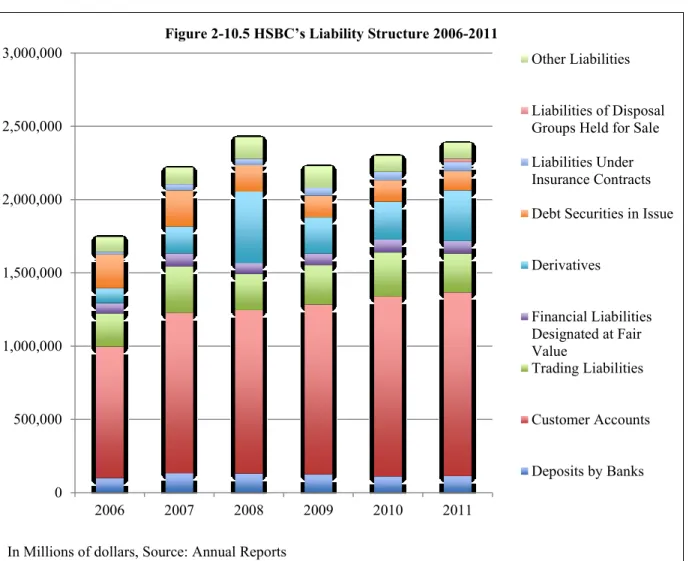
Figure 2-10.5 HSBC‘s Liability Structure 2006-2011 ... 45
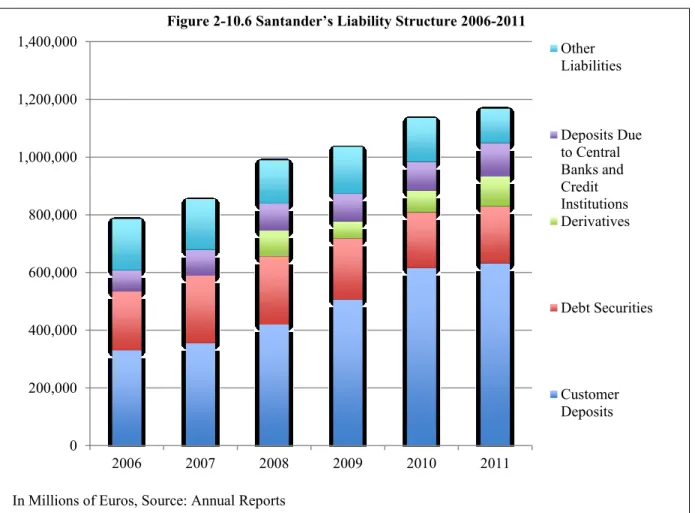
Figure 2-10.6 Santander‘s Liability Structure 2006-2011 ... 46
Figure 2-10.7 Geographic Structure of HSBC‘s Deposits 2006-2011 ... 47
Figure 2-10.8 Geographic Structure of Santander‘s Deposits 2006-2011 ... 48
Figure 2-11.1 Retail's Importance As a Banking Segment Worldwide ... 51
Figure 2-11.2 Share of Worldwide Retail Banking Revenues in 2006 and 2017 Forecast .. 51
Table 2-11.1 Worldwide Retail Banking Revenues in 2006 and 2017 Forecast ... 52
Table 3-1.1 Global Bank Retail Loans as a Share of Total Loans 2001-2011 ... 55
Figure 3-1.1 HSBC Operating Income by Business Segment at Year-End 2000-2011 ... 56
Figure 3-1.2 Santander Operating Income by Business Segment at Year-End 2003-2011 . 57 Figure 3-1.3 Citibank Revenue by Business Segment at Year-End ... 57
Figure 3-1.4 Unicredit Operating Income by Business Segment at Year-End ... 58
Figure 3-2.1 Retail Loans by Geographic Distribution ... 59
Figure 3-2.2 HSBC Total Profit/Loss by Geographic Segment at Year-End 2002-2011 .... 62
Figure 3-2.3 Santander Operating Income by Geographic Segment at Year-End 2005-2011 ... 63
Figure 3-2.4 Citibank Revenue by Geographic Segment at Year-End ... 64
Figure 3-2.5 Unicredit Operating Income by Geographic Segment ... 64
Figure 3-2.5 Continued ... 65
Figure 3-2.6 Domestic Revenue as a Percentage of Total Retail Banking Net Revenues, 2002-2006 ... 65
Table 3-3.1 Global Bank Cost-to-Income Ratios at Year-End ... 67
Table 3-3.2 Cost-to-Income Ratios at Global Bank‘s Foreign Subsidiaries at Year-End ... 68
Table 3-3.3 Global Bank Return On Assets in Home and Major Host Markets ... 71
Figures 3-4.1 HSBC‘s Total Operating Expenses, 2004-2012 ... 73
Figures 3-4.2 Santander‘s Total Operating Expenses, 2004-2012 ... 74
Figure 3-4.3 Income Generated per HSBC Employee 2000-2012 ... 74
Figure 3-4.4 Income Generated per Santander Employee 2000-2012 ... 75
Figures 3-4.5 Breakdown of Santander Non-Personnel Operating Expenses, 1998-2012 ... 76
Table 3-5.1 Examples of HSBC‘s Retail Segment Products ... 79
iv
Table 3-5.2 Examples of Santander‘s Retail Segment Products ... 79
Figure 3-7.1 Global Bank Average Return-On-Assets 2007-2011 (%) ... 83
Figure 4-1.1 ISP International Revenue Source Comparison ... 88
Table 4-2.1 Main ISP Operating Countries ... 89
Table 4-2.2 Major Global Acquisitions, Joint Ventures, and Partnerships ... 90
Table 4-3.1 ISP Main Service Segments and Breakdown of Total Revenue ... 93
Table 4-4.1 Main Customer‘s by Industry ... 97
Table 4-4.2 Major ISP Shareholders at Latest Possible Date ... 98
Figure 5-1.1 Retail Banking Channel Evolution ... 102
Figure 5-1.2 ATMs per 100,000 Adults 2004-2009 ... 103
Figure 5-1.3 Percentage of American Internet Users Who Bank Online ... 105
Figure 5-1.4 Percentage of Individuals (Adults) Using the Internet to Access Banking Services ... 106
Table 5-1.1 Internet Banking Information Gathering Capabilities ... 107
Figure 5-1.5 Global Mobile Banking Usage Statistics 2005-2015 ... 109
Figure 5-1.6 Mobile Banking Device Shipments in Millions ... 110
110 Figure 5-1.7 Installed Mobile Phone Base in Millions by Country or Region in 2010... 110
Figure 5-1.8 Estimated Global Mobile Payment Transactions in $USD Billion 2009-2014 ... 111
Table 5-1.2 Citibank Mobile Banking Information Permissions ... 112
Table 5-1.3 HSBC Bank Mobile Banking Information Permissions ... 113
Table 5-1.4 Unicredit Mobile Banking Information Permissions ... 114
Table 5-1.5 Santander Mobile Banking Information Permissions ... 114
Table 5-2.1 Big Data Information Collection ... 121
Table 6-1.1 Countries with Significant Foreign Owned Bank Presence ... 126
Table 6-2.1 Subject Countries GDP Growth Rates 2000-2011 ... 128
Table 6-2.2 Subject Countries GDP Per Capita Growth Rates (%) and Constant 2000USD 2000-2011 ... 128
Table 6-2.3 Household Final Consumption Expenditure Per Capita Constant 2000 U.S. Dollars ... 130
Figure 6-3.1 Retail Lending as a Share of Total Bank Lending In Subject Countries ... 133
Figure 6-3.2 Domestic Credit Provided by Banking Sector (% of GDP) 2000 to 2011 .... 137
Figure 6-3.3 Subject Countries Bank Loan Interest Rates (%) 2000-2011 ... 138
Figure 6-3.4 Subject Countries Bank Interest Rate Spread Developments (%) 2000-2010 ... 140
Table 6-3.1 Retail Loans as Percentage of Total Loans for Selected Domestic Banks at Year-End ... 142
Table 6-3.2 Selected Domestic Banks Cost-to-Income Ratios (%) at Year-End ... 144
Figure 6-3.5 Bank Nonperforming Loans to Total Gross Loans (%) 2000 to 2011 ... 145
Figure 6-3.6 Nonperforming Retail Loans (%) ... 148
Figure 6-4.1 Private Credit Bureau Coverage in Select Countries 2004-2012 ... 151
Table 6-4.1 Depth of Credit Information Index for Select Countries 2004-2012 ... 152
1
Introduction
The term global bank functions somewhat like a catchphrase in the modern financial lexicon. Perhaps it is due to a knock-on effect from the rise in the use of the term
‗globalization‘. Or, perhaps the ‗global financial crisis‘ served as a natural lead-in to discussions concerning global banks. Whatever the reason, or reasons, no definition exists to clearly establish what a global bank actually is. Using that as a starting point, this paper examines global banking by first laying out characteristics for identifying a global bank.
Later we draw on those characteristics to identify the global banks we analyze in depth. We uncover the following during the course of that analysis: we describe where global banks operate; what banking activities they engage in; explain what support system aids their operations; investigate the latest technologies they employ; examine the influence they have on local banking systems; and theorize how these banks have been able to grow into globally operating institutions.
Below we will take steps to sort through three important terms, international, multi- national, and global bank. After laying out the differences for each, we introduce one of the most significant changes in the structure of bank‘s foreign claims over the last three decades: the localization of credit. Simply, banks‘ foreign claims to local residents in countries outside of their home markets are increasingly conducted via local subsidiaries in local currency. Following from that, we lay out this paper‘s criteria for selecting global banks. We also consider another important feature of today‘s banking system: the retail banking segment. Retail banking has undeniably become one of, if not the most, salient banking segments, especially since the onset of the 2008 global financial crisis. Indeed, even if non-retail banking segments recover in years to come, worldwide revenues from retail banking are still expected to experience very strong growth over the next decade. A significant portion of which, will occur in emerging markets such as China, India, Latin America, Emerging Europe, and Emerging Asia. As a result, the share of total retail banking revenues originated in the developed countries of Western Europe, North America, and Japan will likely fall. Throughout this paper we refer to the retail segment‘s surge in
2
global prominence as the Rise of Retail because the future of banking hinges at least partially on retail. Therefore, we think a discussion on global banks and the globalization of retail banking is absolutely imperative.
Reviewing previous literature, we find a number of cases where research is very reluctant to accept the retail banking segment can be successful on a global level. Given retail‘s increased weight in revenues though, we think an objective analysis on global banks‘
most recent developments will make an essential contribution to the existing literature.
Thus this paper‘s main aim is to question the notion that global banks will likely be unsuccessful in globalized retail. In doing so, we seek to not only uncover whether global banks are participants in the rise of retail, but we also consider the crucial question of how they would be able to participate in retail on a global level. This research is particularly meaningful because in addition to contributing to global bank literature, and theories on multi-national banking, our analysis statistically demonstrates concrete examples of global banks. As will be stated below, we emphasize both overall size and geographic reach to provide examples of such institutions.
Reviewing developments within global banks, we find retail is not only an important part of global banking activities, indeed we find it may be the most important segment. Furthermore, we find that, for certain banks, retail revenues generated from retail activities in host markets are more significant than those in their home markets. In fact, it might be said that the global retail banking segment is the lifeblood of some banks.
Moreover, we consider some crucial reasons retail has become such an important segment, not least of which has been the role of credit information service providers.
Similar to global banks, consumer credit information service providers are also undergoing a globalization process. We identify major players in information provision, and demonstrate where and how they have expanded globally. Also, we show the services they provide to banks are evolving by becoming more sophisticated than consumer credit information. Decision analytics, fraud detection, data warehousing, and software services are all extremely important types of services within their activities. We refer to these institutions as information service providers below (abbreviated ISP). Moreover, the
3
relationship banks and information service providers share is very tight, and as we demonstrate below, for most ISP, banks (and other financial institutions) are their most important customer type. In fact, an important conclusion this paper makes is to state the information production function is being partially transferred from financial intermediaries to information service providers on a global scale.
We also assess technology‘s impact on banking, finding it is not only deep, but also intensifying. Bank channels, the ways banks and customers interact, are evolving rapidly.
An important feature of more recently developed channels is information collection. In addition to offering the same services, newer channels permit banks to gather more detailed information from their customers. In fact, another conclusion we make is that increased ease of information collection is perpetuating the bank-customer relationship, pushing forward deeper relationships which make retail possible. At the same time, technology is reshaping the competitive landscape. Admittedly, new entrants in retail financial service provision are miniscule when compared to established banking institutions such as the global banks we analyze in this paper. And further, new entrants are not always capable of providing precisely substitutable services. Nonetheless, we show that a result of changing bank channels is the opening of a new window through which customers can connect to competitors, implying the platform on which banks and customers interact is ripe for drastic change.
Host markets appear to be profoundly impacted by the entry of both global banks and credit information service providers. We find that impact to be more in the form of deepening informational availability and quality, and less in the form of a reduction in financial stability. Indeed, we suggest that the entry of global banks may be an important impetus to also attracting foreign-owned information service providers. In combination, their activities are producing a rapid expansion of information coverage on adults and improving the quality of credit information available in a number of countries where they are present. By comparison, we find that countries where foreign-owned banks and credit information service providers do not have significant operations, there is a lag effect in credit information. Indeed, this may have an important implication for countries trying to
4
shift away from export-led economic growth strategies, and towards expanding internal consumption. Since, information is more readily available, banks (domestic and foreign alike) can lend to wider segments of the population, which in turn may produce stronger demand for consumer durable goods. Thus, as a policy implication, we suggest allowing foreign-owned banks and information service providers to enter an economy in tandem might be important factors in increasing overall access to credit.
In conclusion we do however heed a crucial warning. As is well-known the roots of the 2008 global financial crisis, which gripped the world economy, come from voluminous loans extended to uncreditworthy individuals that produced housing bubbles. Some of the global banks and information service providers we highlight in the analysis that follows are domiciled in the very countries where those housing bubbles occurred.
In fact, since the IMF has recently predicted a shift away from a two-speed world economy -- developed economies experiencing slow growth while emerging markets achieve high economic growth -- towards a worldwide economy where even 'emerging markets' experience waning economic growth, there is even more reason to focus on developments and trends in global banking. Despite benefits from global bank and information provider entry, knock-on effects to host markets are a real possibility. If prudent financial regulation of both banking practices and credit information provision does not accompany global bank entry, the consequences could be another crisis; this time taking shape mostly in emerging markets. Host market regulators must be aware that while benefits to global bank entry are likely, their entry alone is not a panacea for permanently securing the overall financial system.
5
6
Chapter 1 Previous Literature, Problem Definition, and Methodology
1.1 Literature Review
1.1.1 Theories of Financial Intermediation
Banks, and other financial intermediaries, are vital to financial markets. Over decades, various analyses have attempted to explain reasons why financial intermediaries emerge in the first place. Much of the theoretical discussion has surrounded transaction services on the one hand, and informational asymmetries on the other. The transaction services-side asserts financial intermediaries provide the service of converting illiquid assets (in the form of comparatively long-term loans) into liquid assets (mostly in the form of deposits). Essentially, this side claims, even if lenders and borrowers could find each other, they would not be able to enact the loan process amongst themselves because lenders would be unwilling to forfeit liquidity. Financial intermediaries step in to fulfill this role, ultimately shouldering risks involved with managing the maturity mismatch inherent in providing liquidity to depositors. The costs shouldered by financial intermediaries are thus referred to as transaction costs (sometimes also referred to as transformation costs due to the process of transforming assets), and explain why an intermediary forms.
Those entrusting the answer of financial intermediation to information production, highlight their role in overcoming informational asymmetries. This side of the debate asserts that ultimate lenders and borrowers are unable to enact the loan process because they are unable to locate one another. The overall inexistence of direct informational exchange between potential lenders and potential borrowers permits intermediaries to emerge. Banks and other intermediaries fulfill a role as mediator by producing information.
As stated by Heffernan (2005), ―[i]nformation plays an important role in banking; the presence of information costs helps to explain why banks act as intermediaries‖ (p. 38).
Leland and Pyle (1977) stated, ―[t]ransaction costs could explain intermediation, but their magnitude not in many cases appear sufficient to be the sole cause. We suggest that informational asymmetries may be a primary reason that intermediaries exist‖ (pp. 382- 383).
7
They point out that by expending resources, firms can obtain information which is not typically available publicly. However, firms especially devoted to buying and selling this information may emerge. Such firms and buying/selling of information give rise to problems concerning the information‘s quality and free-riding information collection (or re- selling). In conclusion, Leland and Pyle (1977) state that both of those problems ―can be overcome if the firm gathering the information becomes an intermediary, buying and holding assets on the basis of its specialized information‖ (p. 383). The reason an intermediary solves any issues related to the sale of information is because the firm‘s information is ‗embodied in a private good.‘ ―While information alone can be resold without diminishing its returns to the reseller, claims to the intermediary‘s assets cannot be‖
(p. 383). Therefore, by increasing the value of its portfolio through the creation of assets based upon information it has produced, banks and other financial intermediaries are able to earn returns.
Turning back towards transaction services though, literature on this side includes Diamond and Dybvig (1986), Berger et al. (2012), and Mishkin (2006 & 2013). Diamond and Dybvig (1986) explained that of all the valuable services banks perform the transformation service, ―converting illiquid assets into liquid assets‖, is ―probably the most important function of banks‖ (p. 62). In conclusion they state, the transformation service
―seems to be provided almost exclusively by banks, and, consequently, it is particularly important to preserve the ability of banks to create liquidity‖ (p. 67). Furthermore, Berger et al. (2012) state how important banks are to supplying deposits and loans as well as providing liquidity to the economy ―by transforming relatively small liquid deposits into larger illiquid loans‖ (p.1).
Mishkin (2006 & 2013) indicates the reason banks are able to provide liquidity and asset transformation services to customers is because they are able to achieve lower relative costs by realizing economies of scale. "The presence of economies of scale in financial markets helps explain why financial intermediaries developed and have become such an important part of our financial structure" (Mishkin, 2006, p. 173). That is because
"[t]ransaction costs, the time and money spent in carrying out financial transactions, are a
8
major problem for people who have excess funds to lend" (Mishkin, 2013, p. 79). In addition to providing liquidity, "[a]nother benefit made possible by the low transaction costs of financial institutions is that they can help reduce the exposure of investors to risk -- that is, uncertainty about the returns investors will earn on assets … This process of risk sharing is also sometimes referred to as asset transformation, because in a sense, risky assets are turned into safer assets for investors" (Mishkin, 2013, p. 81). Thus, for this school of thought, banks and other financial intermediaries are what enable the circulation of funds from savers into productive uses within an economy.
Campbell and Kracaw (1980), though criticize the idea that explaining financial intermediaries is as simple as an either ‗transaction services‘ or ‗information production‘
argument. They stress that it is the efficiency of information production that is the key determining factor in the formation intermediaries, stating, ―intermediaries prosper when they simultaneously produce information and provide other services‖ (Campbell & Kracaw, 1980, p. 881). Furthermore they conclude:
The problem is not that the market is unable to produce information which leads to the identification of the true value of assets. Rather, it is that this production of information will not be done efficiently or at least cost. The underlying reason for this is that efficient information producers may not have a sufficient stake in the market to persuade the market of their reliability. Each investor-information producer's initial wealth endowment acts as a constraint on reliability and as a barrier to entry in the information production industry. (Campbell & Kracaw, 1980, p. 881)
Even if firms which produce information emerge, they will likely be unable to convince banks that the information they produce is credible because they do not have a financial stake in the outcome of the asset. Since only the information producer knows the true accuracy of the information, the only agent in a position to provide financial services is the information producer. Therefore, according to Campbell and Kracaw, the theory of financial intermediation cannot be dichotomized into an ‗information producer‘ camp and a
‗transaction services‘ camp. Instead the two function in tandem.
9 1.1.2 Global Banks and Foreign Bank Presence
A fair portion of research devoted to foreign bank entry and global banking has tended to focus on the general characteristics of foreign entry. Research specific to global banks‘ international retail banking activities is to yet gain widespread popularity. To the extent previous research has discussed global retail banking, it has mostly viewed that banking segment in a negative light.
Smith and Walter (1990, 1996, 1997, and 2012 with Gayle DeLong) highlighted shifts in corporate finance, deregulation, and technological development as important to the expansion of domestic retail banking. Internationally, they stress the role of globalization in the financial industry, hastening the pace at which financial innovation takes place. On one hand, globalization and rapid innovation allow global banks to transfer retail approaches to foreign markets. On the other hand however, since financial products and services can easily be copied, maintaining that advantage is extremely difficult, even for large banks.
Additionally, Smith and Walter discuss difficulties in understanding the retail banking market in foreign countries. Grasping cultural and customary intricacies in a vast number of countries‘ banking sectors is an undeniably ambitious endeavor. Therefore, Smith and Walter (1997) concluded, ―failures in international retail banking are perhaps more common than successes‖ (p. 110). Ultimately, they view these two obstacles – local intricacies of retail banking markets and the ease of copying financial products – as being insurmountably high hurdles preventing global banks from being successful in global retail banking.
Research statistically demonstrating global banks find it difficult to compete includes Roberts and Amits (2003), Sturm and Williams (2004), and Fachada (2008), whom all provide evidence showing domestic banks copied global banks in some capacity, or at the very least made concerted efforts to improve operating efficiencies in the face of increased competition. Roberts and Amits (2003) confirm domestically owned Australian banks copied foreign bank financial innovations. ―Of the numerous documented major innovations, none were conceived (in whole or in part) within Australia. Rather, the ideas tended to come from banking industries in other countries‖ (Roberts & Amits, 2003, p.111).
Furthermore, Sturm and Williams (2004) state global bank entry was an important source
10
of improvements in technology and operating efficiencies within the Australian banking system. Focusing on Brazil‘s banking system; Fachada (2008) discusses the impact of foreign entry to the Brazilian banking industry over a 10-year period from 1996 to 2006.
Fachada shows domestic banks responded to foreign entry by improving operating efficiencies. As a result, some global banks that entered Brazil found it difficult to compete, and withdrew from the market in the mid-2000s.
Other research that falls into a similar camp on international retail banking is not in short supply. Heffernan (2005) indicated multinational banks focused more on wholesale banking than retail, and that in the 21st century, many financial markets will internationalize, but the retail banking market will likely be an exception (p. 56). Grant and Venzin (2009) emphasize the complexity of local markets:
In retail banking, given that regulations and customer preferences vary greatly from county to country, the dominant feature is the need to adapt to national markets, and the potential to access cost economies from the international integration of function and activities is therefore limited. (p. 571)
Tschoegl (2005) takes issue with the duration global banks would be able to conduct international retail. Tschoegl asserted, ―[f]oreign banks have not displayed any long-term comparative advantage in retail banking vis-à-vis host country banks‖ (Tschoegl, 2005, p.
9). And furthermore, ―[a]s the banks, foreign and domestic-owned alike, become more competitive and adept, the foreign owners will no longer have a comparative advantage in general retail‖ (Tschoegl, 2005, p. 39). And Grubel (1977), made a similar assertion over thirty five years ago, ―[r]etail banking by foreign-owned firms is a relatively unimportant phenomenon quantitatively‖, later pointing out foreign retail operations were ―declining rapidly in Latin America‖ at the time (p. 351). He goes on to note,
Multinational retail banking in developing countries has diminished sharply as policies motivated by economic nationalism led to restrictive legislation and takeover by nationals. Competitive advantage based purely on product differentiation is rather precarious and can easily be curtailed by innovative responses from the domestic industry. (Grubel, 1977, p. 351)
11
More generally, Buch and Delong (2004) and Berger et al. (2001) held this view with respect to the entire financial services industry. ―The infrequency of international mergers is likely due to their limited success‖ (Buch & Delong, 2004, p. 2078). Berger et al.
(2001) stated that efficiency barriers in language, culture, currency, regulatory or supervisory structure, act as prohibiting factors in cross-border bank mergers even within Europe, implying even higher barriers on a global scale.
Contrastingly, a relatively early article on the subject, Guillén and Tschoegl (1999), insinuated international retail banking had ‗at last‘ arrived. They pointed out that large Spanish banks were attracted to countries in Latin America because they ―provided the possibility of growth with the development of the banking sector‖ (Guillén & Tschoegl, 1999, p. 17). Later, in a 2008 publication, Guillén and Tschoegl specifically discuss the Spanish bank Santander‘s development into a global bank. They emphasize differences between various countries‘ retail banking markets as making competition in host country banking markets difficult. But, as they explain, global banks realize two important benefits from acquiring local banks. First, the global bank is able to not only achieve entry into the foreign market, but also it is a relatively fast means of obtaining market share, especially in highly concentrated banking markets. Second, by acquiring local banks, global banks are able to obtain vital knowledge on the local banking market. In other words, international retail banking activities can proceed only if, global banks are both able and willing to purchase locally owned banks.
Various research has sought to describe the impact foreign bank entry has on host countries. Perhaps one of the most famous articles on this topic was Claessens, Demirguc- Kunt, and Huizinga (2001), which provided empirical evidence for declining domestic bank profitability after foreign bank entry. They implied that foreign bank entry has a positive effect on the local banking market, stating, ―in the long run, foreign bank entry may improve the functioning of national banking markets, with positive welfare implications for banking customers‖ (Claessens, Demirguc-Kunt, & Huizinga, 2001, p. 908). However, they heeded an important warning, asserting that foreign banks may have a destabilizing effect on banking systems ―if the domestic prudential regulations and supervision are not strong‖
12
(Claessens, Demirguc-Kunt, & Huizinga, 2001, p. 909). Thus, while foreign entry may have a positive impact, without the necessary framework, undesired outcomes may emerge.
In another earlier work, Goldberg, Dages, and Kinney (2000) assessed the impact of foreign banks on Mexico and Argentina. They suggested foreign bank participation brought more stability to the banking systems of those two countries. They concluded, ―in both Mexico and Argentina, foreign banks exhibited stronger loan growth compared to all domestic-owned banks, with lower associated volatility, contributing to greater stability in overall financial system credit‖ (Goldberg, Dages, & Kinney, 2000, p. 23). Furthermore, they insisted that rather than focusing on bank ownership, bank health should be the main focus for promoting stability.
Other articles have echoed similar notions about foreign bank involvement. Crystal, Dages, and Goldberg (2002) found that foreign ownership contributes ―to sounder and more stable banking systems in emerging markets‖ (Crystal, Dages, & Goldberg, 2002, p.
5). Tschoegl (2005) extended the idea to the whole economy. ―Foreign banks tend to have a stabilizing effect on the economy to the degree that they are present‖ (Tschoegl, 2005, p.
20). Cull and Pería (2010) examined the consequences of foreign bank participation on financing conditions. ―Overall,‖ they state, ―foreign bank entry has enhanced competition and stability in developing countries‖ (Cull & Pería, 2010, p. 19). Galindo, Micco, and Powell (2004) stated a ―combination of domestic and foreign banks may be an optimum for host countries‖ (Galindo, Micco, & Powell, 2004, p. 27). Furthermore, ―[g]lobal banks are often an important source of new capital for a devastated banking sector following a crisis, and many are among the most efficient in their own country‖ (Peek & Rosengren, 2000, p.
48). Results by Arena, Reinhard, and Vazquez (2007) also ―indicate that foreign bank participation in emerging markets has not led to increased stability in credit markets‖, and the ―response of credit to economic activity and monetary conditions seems to be roughly similar across domestic and foreign banks‖ (p.19).
13 1.1.3 Retail Banking
As far as the author could determine, one of the earliest works to use the term retail banking was Morison and Frazer (1982). They asserted, as economies grow, so too do individual and household incomes, and consequently, their demand for retail financial services. A determining factor in whether financial institutions are able to meet the demands they face rests with strategies they employ in approaching retail activities, which may lead to the copying of strategies. This makes it ―difficult for any one institution to monopolize a successful idea for very long‖ (Morison & Frazer, 1982, p. 114). So even if banking institutions implement profitable strategies, successful approaches soon become industry-wide staples.
With respect to recent developments within banking, there has been a renewed focus on the retail segment. Famously, Clark et al. (2007) drew attention to the ―return to retail‖ banking that took place in the United States banking industry during the 2000s. They indicated retail ―does cycle in relatively predictable ways with the performance of nonretail banking and financial market activities‖ (Clark et al., 2007, p. 14). Since, retail may be vulnerable to the same shocks as other banking segments; in conclusion, they make clear that grasping retail banking‘s impact on the banking system is imperative. Hirtle and Stiroh (2005) suggested that increased intensity with respect to retail had somewhat counterintuitive results. The renewed focus on retail in the U.S. banking industry exhibited signs of lower equity market returns and volatility, which as they point out, would be
―completely reasonable if consumer-driven retail banking is simply a low-risk, low-return business‖, but that contrasts with ―the perception of some that retail banking offers the advantages of both higher returns and higher risk‖ (Hirtle & Stiroh, 2005, p. 23). Indeed, in conclusion they offer a reason for the return to retail in the U.S., stating, ―the current level of focus may well be temporary as banks react to the turbulence in capital markets since 2000‖ (p. 23). Thus, retail‘s rise may be less about retail and more about capital markets have been seen as too volatile, prompting banks to evade that volatility with a ‗sit-and-wait‘
approach with retail. However, Obermann (2006) pointed out retail is rising in developing nations as well, labeling developments in Latin America a ‗revolution‘ in consumer finance.
Though, in the same vein as other research, Obermann emphasizes the importance of
14
understanding the macroeconomic impact of retail‘s rise. Obermann suggests the establishment of regulatory institutions, or a ‗safety net‘, to protect the future of retail banking in the region (Obermann, 2006, p. 13).
Puri, Rocholl and Steffen (2011a) and Anderloni, Llewellyn, and Schmidt (2009) make two additional points about the retail segment. First, Puri, Rocholl and Steffen (2011a) stress the importance of customer-bank relationships in preventing defaults. Their results suggest,
relationships even in the form of simple transaction and savings account are economically important, even after controlling for detailed borrower characteristics and their internal and external credit scores. Hence, from a practical viewpoint, our results suggest that having people open simple savings or checking accounts can enable banks to make better credits. (Puri, Rocholl & Steffen, 2011a, p. 43)
Second, Anderloni, Llewellyn, and Schmidt (2009), suggest that the retail segment of banking is a driving force in financial innovation. ―Overall, the most frequent targets for innovation appear to be retail customers and, to a lesser degree, SMEs‖ (Anderloni, Llewellyn, & Schmidt, 2009, p. 53). Thus, the retail segment likely impacts financial stability, and thus the macroeconomy, as well as promotes financial innovations and the use of sophisticated technologies throughout the banking industry.
1.1.4 Technology in Banking
Research on technology‘s impact on banking and financial intermediation is still ongoing, perhaps mostly due to the fact that technology is constantly changing. In fact, reviewing literature from the past two decades on technology in banking, two relatively recent papers, Frame and White (2009) and Wilson, Casu, Girardone, and Molyneux (2010), recognize the dire need for more research. Nevertheless, both studies certainly leave a clear impression that technology is completely changing the banking industry. Frame and White (2009) explain advances in telecommunications and information technology have
―transformed many of the relationship-focused intermediaries of yesteryear into data- intensive risk management operations of today‖ (p. 1).
15
Other researchers share the opinion technology has had a transformational impact in shaping the modern banking industry. Hunter, Bernhardt, Hughes, and Skuratowicz (2000) pointed out, ―[n]ew technologies profoundly changed the ways in which banks conducted their business‖ (p. 33). Lapavitsas and Dos Santos (2008) describe the impact as so profound that ―[c]ommercial banks today hardly fit the traditional image of deposit-taking intermediaries that collect information on borrowers and make advances for industrial and other projects‖ (p. 52).
One group of research highlights technology‘s impact as being largely in altering the geographic structure of banking. Berger (2003) was an influential work that pointed out how technology lowers barriers created by geographic distances. Berger (2003) noted,
―new services created by technological progress may be delivered with fewer distance- related diseconomies than traditional services‖ (p. 25). Berger (2003) further explained, by reducing significant ‗distance-related diseconomies‘, technological progress consequently alters banking in four ways: (i) it enhances banks‘ abilities to create new services; (ii) it improves loan monitoring and management from greater distances; (iii) it assists banks in assessing and offering traditional banking services through improvements in credit scoring;
(iv) and makes monitoring and evaluating staff more efficient (p. 22-23).
Degryse and Ongena (2004) also looked into the impact technology has on the geographical scope of banking. They indicated, ―spectacular advances over recent decades in information processing and communication technology‖ have probably ―expanded the geographical reach of financial institutions‖ (Degryse & Ongena, 2004, p. 571).
Specifically, Degryse and Ongena sought to separate the discussion on technology by banking segment: SME, consumer, and large corporate. In their view, corporations and consumers share at least one characteristic: observability. Corporations are observable through ―accounting statements and public track record‖, while consumers ―can be readily scored on the basis of observable characteristics, such as age, income, and marital status‖
(Degryse & Ongena, 2004, p. 573). SMEs on the other hand, are much more opaque. Thus, as banks want to keep close watch over SMEs, the SME banking market will remain relatively local in nature. Their conclusion, differs slightly from Berger (2003),
16
retail banking markets remain to a large extent local: pricing and availability of credit hinges on local market conditions. The most recent deregulatory steps and the recent technological developments will most likely not remove the remaining exogenous and endogenous economic borders. (Degryse & Ongena, 2004, p. 586)
So, according to Degryse and Ongena, retail banking is less bound by geographical limitations than before because of technological advancements, but retail is still more local in nature than wholesale banking.
However, Berger and DeYoung (2006) showed that the impact of technology not only lowered geographic barriers within any one country; technology also facilitated the physical geographic expansion of banks. Signifying a monumental shift in the structure of the banking industry, they point out,
[a]t one time, nearly all customers were served by locally based institutions. In contrast, it is now much more likely that the bank or branch providing services is owned by an organization headquartered a substantial distance away, perhaps in another state, region, or nation. (Berger & DeYoung, 2006, p. 1483)
They emphasize technology allows executives to monitor decisions made by loan officers and managers at subsidiary, or affiliate, banks from great distances more easily. They conclude, ―technological progress has allowed banking organizations to reduce the agency costs that arise when nonlead affiliate banks are located far away from headquarters‖
(Berger & DeYoung, 2006, p. 1510). Furthermore, Berger (2007) explained banks from developed countries are likely to take advantage of superior technology when expanding into emerging markets. Berger (2007) stressed their advantages are ―significant and differ substantially depending on whether the host nation is a developed or developing nation‖, and that this may ―explain in part why foreign organizations have often taken significant market share in relative short time periods in some developing nations‖ (p. 136). Thus, technology likely lowers geographic barriers in banking, but there may be limitations to how low those barriers can be lowered.
Literature focusing on technology‘s impact on efficiencies and processes raises other issues. Perhaps somewhat counterintuitively, technological progress may not have a
17
substantially positive impact on operational efficiencies. Research such as Prasad and Harker (1997), Furst, Lang, and Nolle (1998), and Lapavitsas and Dos Santos (2008), point out that through the use of technology, costs per transaction have indeed been reduced.
However, banks have not realized lower overall costs because customers quickly grow accustomed to sophisticated transaction and contact methods. As a result, transactions per customer increase over time and banks are forced to make investments to support increasing customer transaction demand.
Furthermore, Autor, Levy, and Murnane (2000) suggest managerial decisions are as important as the technology itself. They underline a specific example where technology initially improved check processing in the United States. Banks used to process checks by hand, a very laborious and costly process that sometimes produced mistakes. Using a computer with a built-in high-speed camera, many banks replaced some workers and switched to image processing. However, they point out, internal reorganization required by the new technology, canceled some benefits. They suggest real cost benefits banks realize from the implementation of newly developed technologies may thus be less the result of the technology, and more the result of superior management capabilities in its implementation process. Essentially, even if a technology‘s implementation is initially cost-effective, whether it produces competitive advantages over time is still debatable.
1.2 Problem Definition
The literature makes clear challenging obstacles might prevent the retail segment of banking from truly globalizing. Acquiring local institutions may provide an opportunity to overcome prohibiting factors, but even if at first global banks are successful, over longer periods of time, they may eventually lose their advantages through competition with domestically-owned institutions. Plus, the specific customs and cultures existing in various banking sectors are an extremely difficult, if not insurmountable, task facing global banks.
Locally owned banks should naturally have deeper knowledge of their home markets, putting global banks at a significant disadvantage. Furthermore, as Morison and Frazer (1982) pointed out, competing institutions can easily copy retail financial products and strategies. Even with advantages such as superior products and cost efficiencies, global
18
banks may find it extremely arduous to compete and distinguish services from the domestic competition that quickly introduces similar financial products. Thus, the general consensus seems to be global banking institutions will find the retail banking segment too difficult, and as a result will likely be unsuccessful. An analysis on global banks and their international retail banking activities is therefore warranted to determine whether or not this indeed the case.
This paper takes aim at that notion by analyzing specific global banks‘ international retail banking activities. We actually show the contrary to be true: global banks can indeed be successful in retail banking on a global level. We begin by identifying global banks for analysis, and then demonstrate the role international retail banking activities plays in their activities. While stating global banks can be successful in global retail is a significant contribution to the literature in and of itself, we continue our analysis to illustrate how global banks have been able to achieve success and the impact they have on host markets.
Tackling the issue of how global banks have been successful we examine their performance, support structure, and technological breakthroughs. The examination on performance details how global banks have improved operating efficiencies at home and abroad. When considering the support structure aiding them, we look into credit information from third parties, such as credit bureaus, and how it is available on a global level. While the literature made clear technology is transforming the banking industry, an important issue remains with respect to technology. If, as suggested by some of the literature, technological investments do not offer a true cost advantage, perhaps banks have other motivation for technological implementation. Below, we show that in addition to cost-per-transaction considerations, banks have another incentive for technological implementation.
Furthermore, the literature noted the presence of global, and foreign-owned, banks may have the benefit of improving host-country banking sector stability. Hardly any of that literature though paid specific attention to the retail segment. Many of the countries into which global banks have expanded, have experienced economic growth. As indicated by previous research, retail expands as economies grow. Hence we should expect the retail
19
banking segment is also growing in those countries. If retail banking strategies are copied by domestic banks, quickly becoming industry-wide staples though, the possibility exists for excessive expansion. If that were the case, retail banking could possibly have a destabilizing effect. Since we already know a major crisis occurred in the United States, with origins in the allocation of numerous loans to uncreditworthy individuals; whether a similar outcome is possible in countries where global banks operate, is worthy of examination. Thus, a final question we seek to answer is whether global banks‘ retail banking activities have had a negative impact on financial systems in host countries.
Lastly, we incorporate the latest developments in global banking into a theoretical discussion with the aim of adding new insight into why financial services offered to households and individuals are globalizing.
1.3 Methodology
This study analyzes a wide range of data on global banks, and the host markets where they operate. As chosen by the criteria outlined above, the global banks we observe are HSBC and Santander, in addition to Citibank and Unicredit as data availability permits.
Statistical data employed in analyzing these global banks derive from the following sources.
Data comparing assets, returns on assets (ROA), and operating efficiency is derived from The Banker1. Data on the structure of loans and bank earnings were originated from annual reports and financial statements published by each individual bank. In discussing the method and reasons for global entry we also draw on previous literature.
To understand what support system exists for global banks we examine major credit information service providers. The credit information service providers (ISP) we observe are the largest in the industry by revenues, and crucial suppliers of services to financial institutions. Data on these institutions is taken directly from their annual reports and websites, and in addition, we make use of data available through the United States Securities and Exchange Commission (SEC) to make important observations about their respective relationships with global banks.
1 This paper refers to efficiency as the ratio of cost to income.
20
Our analysis on technology uses a somewhat unique approach by observing developments in banking through the lens of what has occurred in non-financial industries.
Specifically, we observe bank channels, or the way customers and banks connect, to understand what is changing about access to retail financial services. And, we observe competitive transformation since technology is lowering barriers to entry. A discussion on technology is, by nature, shaped by recent developments in any given industry. When possible we employ data from the World Bank Databank, the IMF, the OECD, the World Retail Banking report, and the academic literature. At times, the most recent data and statistics are not available from these sources. Thus, we also utilize information and statistics from very recent relevant finance-related publications. In addition, we employ information directly from bank websites, as well as other service providers when applicable.
When observing global bank impact, we take a country-by-country approach in analyzing both economic and financial developments. We describe the host country selection process at the beginning of chapter 6. In comparing macroeconomic developments, we observe indicators such as overall gross domestic product (GDP) growth rates, GDP per capita rates of growth, in addition to GDP per capita and household consumption levels per capita in constant 2000 U.S. dollars. Then, we examine financial developments by comparing the share of retail loans in total loans, bank credit as a percent of GDP, loan interest rates, and interest rate spreads. We also examine select domestic banking institutions in order to make more detailed financial observations. In analyzing stability we consider both total nonperforming loans (NPLs) and nonperforming loans granted to individuals (and households). Data derives from the World Bank, respective national banking authorities, annual reports, and The Banker.
This approach is not without caveats. Statistics from The Banker may eliminate smaller institutions during the bank and country selection processes, altering banks and countries presented in the analysis below. Nonetheless, we feel that since the discussion is focused on retail activities by global banks, selecting a threshold to preserve relative size is appropriate. Clark et al. (2007) explained some of the most important retail banking changes have occurred in the largest commercial banks. ―Although there have been other
21
periods in the past few decades when retail banking has been an important area of strategic focus, the recent cycle is particularly significant because of the role of the very largest banks‖ (Clark et al., 2007, p. 16).
Also, there may be slight discrepancies between various definitions of borrower and customer type. The author has made every attempt to ensure that borrowers indicated below are individuals, or households, and has indicated that information accordingly. When necessary we make the proper distinctions as to whether statistics include SMEs.
22
Chapter 2 Defining and Identifying Global Banks
2.1 Previous Discussions on International, Multi-National, and Global Banks An important first step is to select a definition for global banks. As has been pointed out in some of the earlier literature, definitions concerning international banking operations have a history of being quite ambiguous (Kawamoto, 1995). Below we present previous definitions for international banking and multi-national banks, and then global banking.
Using these previous explanations as a starting point, we then present our criterion for arriving at a new definition for global banks.
International banking and Multi-national banks have been the subject of research for decades. Aliber (1984) conducted a survey of international banking, noting that
―international banks are a subset of domestic banks with significant numbers of foreign branches and subsidiaries‖, later adding, ―there are few uniquely international banking activities; although foreign exchange trading may seem to be one‖ (p. 661). Aliber describes three forms international banking: (i) the geographic view whereby banks conduct business through foreign branches or subsidiaries; (ii) the currency view, which holds that services conducted in non-domestic currencies constitute international banking;
(iii) the nationality view that said international banking occurs when the borrower and depositor have different nationalities. Thus, it seems, the notion of what international banking is, has at least been complex to define since the early 1980s.
Aliber (1984) concluded, ―[b]anks participate in international banking transactions when they sell deposits and buy loans denominated in a currency other than that of the country where they are headquartered‖ (p. 677). Suggesting that foreign currency is what classifies banking activities as international, and not the geographic location of depositor or borrower.
More recently a 2010 paper by The Bank for International Settlements (BIS) provided an updated definition. They focused on the geographic nature of credit extension by referring to international banking services as:
The extension of credit by a bank headquartered in a particular country to residents of another country can occur via: (i) cross-border lending; (ii) local lending by affiliates
23
established in the foreign country; (iii) lending booked by an affiliate established in a third country. (Bank for International Settlements, 2010, pp. 4-5)
Gone from this definition is the idea of defining international banking purely based upon the use of foreign currency. Instead, we see that the banks‘ headquarters and country of residence are the determining factors. While credit may occur in various forms, the participants‘ locations are the primary factors.
The tendency to stress geographic location of participants is evident when considering definitions for multi-national banks as well. In addition to location, size is also an important determining factor in previous research. Brimmer‘s (1973) framework for identifying multi-national banks, (banks with at least one foreign branch or subsidiary) demonstrated a correlation between bank size (as determined by assets), and multi-national expansion. In fact, ―[a]ll but one of the multi-national banks‖ in Brimmer‘s study ―were drawn from the 20 largest banks‖ in the United States (Brimmer, 1973, p. 440).
According to Grubel (1977), ―[m]ultinational banking involves the ownership of banking facilities in one country by the citizens of another‖ (p. 349). From this perspective we can see that the term ‗ownership of banking facilities‘ again suggests the idea that a subsidiary, or branch, exists physically within the host country‘s borders. In this same paper, Grubel analyzed multinational banking from three vantage points, one of which was retail.
Grubel highlights the fact that Canadian, British and Japanese banks opened banks in California offering the same products and services to local customers.
Works by Ingo Walter and Roy C. Smith are crucial pieces to the previous literature.
Walter and Smith (1997) indicate that "[m]ost financial businesses are now effectively global" (p. 14). They do not provide however, any real justification or distinction between a global financial business, and international or multi-national ones. Somewhat earlier on, they did offer an idea for what that process might look like:
If the only place where such integration existed was between the United States and, say, Canada, then the whole subject might be represented by a different, more narrow expression such as North Americanization. But it is not -- integration is in evidence currently among the capital markets of North America and those of Europe and Japan.
24
So we refer to the globalization of capital markets, and the term seems to have become accepted as a new buzzword in the lingua franca of finance. Apparently it was preferred to ‗worldwidization‘ or even to internationalization...the process that individual firms must go through in order to become effective competitors in the globalized marketplace. (Smith & Walter, 1989, p. 49)
Thus, for Smith and Walter, international financial integration between North America, Europe, and Japan warranted the use of the specific term global.
Walter and Smith do shed light on the types of services provided by global banks.
"International commercial banking services closely parallel those offered in purely domestic markets" (Smith & Walter, 1990, pp. 24). They indicate products offered fall into six categories: 1) deposit taking (in off and onshore markets these include demand and time deposits and Euro-deposits); 2) international trading and dealing activities (foreign currencies, foreign exchange contracts, financial futures, options, gold and other commodities); 3) international trade and cash management services (international documentary collections, letters of credit, acceptance financing); 4) international lending 5) underwriting and trading/dealing in domestic and international securities (foreign bonds, Eurobonds, and notes); 6) international personal banking and investment services (fiduciary trust, investment activities for institutional clients, and retail banking abroad) (1990, pp. 24- 27). Also, the types of institutions providing these services are numerous. "If the variety and complexity of the kinds of international financial services are impressive, so too are the types of institutions that provide them. They range from enormous private and government- owned financial supermarkets" ... "to small specialist houses or boutiques that have carved out a position in international markets for a limited range of services." (Walter & Smith, 1990, p. 27).
Eventually, Smith and Walter admit the very idea of global banking is extremely complex. Their research attempts to "wade into the chaos and confusion of today's global banking capital market environment"..."to gain a better understanding of the evolution of international banking and finance." (1997, p. 15). Nonetheless, a truly concrete definition of global banking, or multi-national for that matter, does not emerge from their analysis.
25
Alternatively, Berger, Qinglei, Ongena, and Smith (2003) refer to global banks as being "headquartered in a few financial centers, but with offices in many nations around the world" (p. 384). Furthermore, they add, "[b]ank reach refers to the geographic scope and size of the chosen bank. A global bank operates in many nations and is among the world‘s largest institutions, a local bank operates in a single nation, and a regional bank lies between these extremes" (Berger, Qinglei, Ongena, & Smith, 2003, p. 385).
2.2 Revisiting the Concept of a Global Bank
Essentially there is no clear-cut definition for a global bank. An imperative task facing financial academic literature on an international level is establishing a theory to constitute what a truly global bank actually is. Drawing from previously mentioned research, we operate on the assumptions that (i) internationalization is a process that produces multi-national and global banks; (ii) as a result, multi-national and global banks have a physical presence in countries and regions outside their domiciled nation; (iii) in addition to physical presence, institutional size is significant to identifying institutions as global.
Above, BIS (2010) offered three notions for considering international banking. This paper focuses on the second type: financial activities conducted by local affiliates inside a foreign country. We do so for the following two reasons. First, as we will indicate below, a major aspect of our analysis centers on retail banking. Both the first and third types of banking from BIS (2010) are somewhat problematic because of issues with exchange rate vulnerability and difficulties monitoring large quantities of transactions with many individuals across borders, essentially rendering both of the other types of international banking ill-suited to a discussion on retail banking. Second, local banking activities have become increasingly important over the last three decades, particularly since the 2008 global financial crisis. Figure 2-2.1 shows local lending is on the rise as a percentage of total foreign claims on non-residents; and in total value, local lending has recovered, surpassing 2007 levels whereas cross-border lending has not2. We emphasize local presence
2 Figure 2-2.1 statistics represent claims on non-residents of the bank‘s reporting country on an immediate borrower basis in millions of US dollars (and percent on right scale).
26
because, as mentioned, figure 2-2.1 indicates the localization of bank credit to non- residents has been an important feature of banking in recent years3. These statistics point out at least four further reasons to justify our emphasis on local operations. First, local claims have been continuously rising as a percentage of total foreign claims for nearly 30 years, which suggests a continual localization of bank credits. Second, the overall dollar- value growth, from 1983 to 2012, is hugely different. Local credits grew 221 times their 1983 value, while cross-border credits grew just 27 times. Third, even though cross-border claims are still larger in total; they have been declining since 2007. Fourth, in the meantime, local claims have recovered, surpassing 2007 levels, and approaching 40 percent of total foreign claims. These developments suggest any growth that has taken place in global credits over the last 6 years has been almost entirely local in nature. Placing a local presence criterion into our analysis thus ensures we grasp truly global banking developments. In short, we seek to find banks that operate foreign owned subsidiaries on a wide scale, engaging local residents in local currency because that area of international banking is much more important than at any point in the last thirty years.
Moreover, the ownership of multiple major foreign subsidiaries has become quite common in recent years. We select banks for analysis below by applying statistics from The Banker‘s Top 1,000 World Banks publications. Specifically, we seek to analyze banks that share three characteristics. First, we capture geographic breadth by observing banks that are present in multiple countries and regions. Below we observe banks with a major presence in more than five countries as of 20114, including both developed and developing nations.
Second, banks should measure up to a certain asset size. Thus, below we establish a threshold for total major foreign subsidiary assets in order to separate regional players from global ones5. Third, we seek to observe banks with relatively longer international
3 Here localization refers not only to having a physical presence in the host country, but specifically to local currency claims made to local residents.
4 Aliber (1984) highlighted The United Nations measure of ‗five or more different countries‘ as a significant level for international presence. The Banker‘s statistical information allows us to confirm we observe major subsidiaries, and thus banks with substantial global presence.
5 This paper focuses on the asset side of banking operations for two primary reasons: 1) assets provide an extremely valuable measure for bank size, and 2) below we examine retail loans as a