
トップページ - 横浜国立大学学術情報リポジトリ
7
0
0
全文
(2) 40( 40 ). 横浜経営研究 第36巻 第1号(2015). Indonesia. The essence of Japanese subsidiary control system in Indonesia will be shown later. As. mentioned, all interviews were implemented in Indonesia. Based on these interviews, a qualitative analysis is employed in this paper. The essence of subsidiary control systems in Japanese companies and its critical issue will be discussed.. 3. Basic control system structure. In management accounting, control system is referred in the context of management control. Anthony. and Welsch (1981) notice, there are three different types of planning and control processes. They are (1)strategic planning, (2)management control and (3)operational control. This management control is. defined as the process by which management assures that the organization carries out its strategies. effectively and efficiently . This management process is applicable to the relationship between Japanese 1). headquarter and foreign subsidiaries in this multinational corporation. This group of headquarter and. subsidiaries is consolidated into corporate group. Management in Japanese headquarter must affect the manager of foreign subsidiary toward the right direction in which MNC’ s overall strategy is realized. If this is possible, each subsidiary can attain high financial performance of MNC as a whole. This relationship is as follows.. top management. Management control. manager of subsidiary lower manager Figure1. Management Control Structure in MNC Top management shows top management in Japanese headquarter and middle shows foreign subsidiary manager. Like this figure, top management controls manager of subsidiary by many management tools.. For management control, many management tools are used. As management tool, many types of. management accounting information can be used to subsidiary. For example, budget is the most typical management accounting tool for subsidiary. This budget is used as one of principal performance measures. for subsidiary manager. This budget is compared to actual result. In this situation, there are four.
(3) Foreign Subsidiary Control Systems of Japanese Companies in Indonesia(Hiroyuki Nakamura). ( 41 )41. responsibility centers which can be applied to analyze budget variance. (1) Cost center …Cost budget is compared to actual result of cost.. (2) Revenue center …Revenue budget is compared to actual result of revenue. (3) Profit center …Profit budget is compared to actual result of profit.. (4) Investment center …Profit is compared to actual result in relation to investment.. This comparison between budget and actual result is basis of performance evaluation but there are. some different ways of comparison. Based on the interviews in Japanese subsidiaries, foreign subsidiary control systems of Japanese Companies will be shown in the next section.. 4. Data. As mentioned, I visited many Japanese subsidiaries in Asia with my colleagues for research. We visited. 7 subsidiaries in China, 1 in Vietnam, 7 in Indonesia. In this paper, I focus on the data of Indonesia because these interviews were lately implemented in 2010. Others are older than these. In relation to Indonesia, many Japanese companies start business here recently and rapidly. Indonesia is very. prospective market and manufacturing base,too. This is very good model case of foreign subsidiary control systems of Japanese MNCs.. In 2010, I and my 2 colleagues visited industrial park near Jakarta in Indonesia. About 100 companies 2). located there. We could interview the essence of control system structure to subsidiary managers there. In. the almost of the subsidiaries, we held these interviews with the president directors of these subsidiaries. It took about one hour to finish the interview with them. Real opinions of local subsidiary managers could be verified, not headquarter managers. This interview style has great contribution to the research insight.. As this research was a part of the international joint research with French colleagues, we asked the. same questions for Japanese and French subsidiary in Asia.. In this interview, our questions consist of 5 parts as follows. Totally, this includes 19 questions.. (1) Company profile. (2) The role of long term expatriate (3) Formalization (4) Budget. (5) The role of short term expatriate. Control system is regarded as performance evaluation system in management accounting. Like this,. performance evaluation system of subsidiary is critical issue of this paper.. Part (4) must be considered enough. In part (4) Budget, we asked this control structure in detail as. follows:. a. Is there a rigorous preparation of estimated budgets and an estimated income statement each year?. b. Is the system of development of the budgets and their control system the same one as that of head office?. c. The indicator are value only, or also in quantities and quality?. d. How are decided new investments? At the level of the subsidiary or at the head office? How?. e. How do you decide on the new equipment investment? Do you decide on it based on the same investment analysis model as headquarter?.
(4) 42( 42 ). 横浜経営研究 第36巻 第1号(2015). Through these questions, we want to clarify the control systems on which Japanese headquarters depend for high financial performance. As the constitution of interview shows, two aspects are important. To. control performance, it is necessary to pay attention to both human factor and performance evaluation. These two factors become effective management tools for high performance. And also, excellent human. resource management is a cause of high financial performance. Excellent performance evaluation system is a cause of high financial performance. High financial performance is the effect of this excellent human. resource management and performance evaluation system. High performance companies deploy these excellent human resource and performance evaluation system bilaterally. This can be shown as follows:. high financial performance. excellent human resource management. excellent performance evaluation system. Figure2. Relationship between Control system and financial performance In this paper, research focus is on the performance evaluation system for control. In relation to this, I. will show the performance evaluation systems of Japanese subsidiaries. Particularly I emphasize the performance evaluation measures which include financial and nonfinancial ones. Recently, not only financial measures but nonfinancial measures are regarded as important for continuous growth. It seems. that traditionally Japanese firms accept these measures as important. This is one remarkable attribute of Japanese management.. As interview results, I summarize some elements of 7 subsidiaries in Indonesia like this table.1..
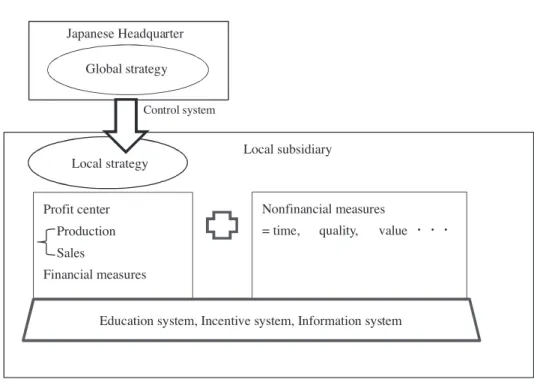
(5) Foreign Subsidiary Control Systems of Japanese Companies in Indonesia(Hiroyuki Nakamura). S1 S2 S3 S4. Share of capital by. Industry. Financial measure. Nonfinancial measure. 60%. Service. No answer. No answer. Japanese headquarter 85%. Manufacturing. 95%. Logistics. 100%. Manufacturing. Operating profit rate Net Profit After Tax ROA. S5. 66%. Manufacturing. Dividend. S7. 83.4%. Manufacturing. Operating profit,. S6. ( 43 )43. 90%. Manufacturing. Profit rate. Spoilage rate, Delivery, claims. Safety, Compliance Inventory, Loan, Financing. No answer No answer. KPI(Key Performance. Contribution margin etc. Indicator), Inventory level. Table 1. Summary of performance measures in subsidiaries. As financial measures of this Table 1 show, Japanese subsidiaries are responsible for profit mainly. This. means that many Japanese subsidiaries are authorized as profit centers. In addition, these subsidiaries. must pay attention to nonfinancial factors, too. These characteristics in Japanese subsidiary will be considered in the next section.. 5. Discussion. As previous section shows, Japanese subsidiary is organized as local profit center in the world network. of corporate group. And also, these subsidiaries can’ t decide on large scale manufacturing investment.. Headquarter has a great authority over subsidiary on it. In the case of Japanese subsidiary, headquarter. shares high percentage of capital. Due to this, it has a huge controllability on foreign subsidiary. Japanese. subsidiary can require not only attainment of high financial performance but also nonfinancial performance to local subsidiary. At the same time, headquarter delegate many expatriates in accordance with business issues which must be solved in the subsidiary.. In addition to management control, Japanese subsidiary is eager in social contribution activity and. human development activity of lower employees. This is an interesting characteristic of Japanese subsidiary. This characteristic can contribute to effective management control indirectly. For example, scholarship is offered for young student in local country. Family day for employees is held in subsidiary. site and short trip for employees is provided. Also, employee can study Japanese language free. They. have an opportunity to study business in Japan, too. These are fringe benefits for employees in Japanese subsidiary.. This management control relationship between headquarter and subsidiary in Indonesia can be shown. as this figure 3..
(6) 44( 44 ). 横浜経営研究 第36巻 第1号(2015). Japanese Headquarter Global strategy Control system. Local strategy. Local subsidiary. Profit center. Production Sales. Nonfinancial measures = time,. quality,. value ・・・. Financial measures Education system, Incentive system, Information system. Figure 3. Subsidiary Control relationship of Japanese MNCs in Indonesia This control system consists of two elements, financial measures and nonfinancial measures. Financial. measures are effective with nonfinancial measures because these nonfinancial measures are the cause of. financial results. For example, high quality brings customer reputation. High quality is competitive advantage. As a result, Japanese headquarter require not only effect but also cause to the subsidiary at the same time.. To make this control system effective, infrastructure is necessary. This infrastructure includes education. system, incentive system, information system and so on. This infrastructure plays an important role for. employee. Owing to these systems, most of the employees want to stay there at work. Infrastructure. underlies management control system for performance evaluation of subsidiary. Japanese MNCs are apt to emphasize this infrastructure in Figure 3.. 6. Conclusion. In this paper, I show the essence of management control systems in Japanese MNCs. Mainly Japanese. subsidiaries disperse into Asian countries. Manufacturing subsidiaries are located in not only China but Asian emerging countries rapidly. I visited 7 Indonesian subsidiaries and implemented interviews with top management in subsidiaries. This paper is a result of qualitative analysis on these interviews. To show this. result as basic control relationship between headquarter and subsidiary, I build management control relationship model of Japanese MNCs in Indonesia.. Indonesia is very attractive location for Japanese MNCs. This management control model suggests. important control systems of subsidiaries in emerging countries. I’ m sure that these Japanese subsidiaries.
(7) Foreign Subsidiary Control Systems of Japanese Companies in Indonesia(Hiroyuki Nakamura). ( 45 )45. can contribute to economic development in Indonesia greatly for the future.. This study shows many critical issues for the future. But I prepared management control model based. on only 7 interviews. Very narrow industrial park was visited for the research. I must visit more. subsidiaries in other countries extensively. This is necessary to build general management control model of MNCs subsidiary.. *This work was supported by JSPS KAKENHI Grant Number 25380594.. Notes. 1) Anthony, R.N. and G. A. Welsch(1981);p.421.. 2) Professor Shuji Mizoguchi and Professor Masaru Takahashi in Yokohama National University.. References. Anthony, R.N. and G. A. Welsch(1981) Fundamentals of Management Accounting, Ill: John Wiley & Sons. Ferdows, K. (1997)“Making the Most of Foreign Factories,”Harvard Business Review, Vol.75 Issue2, pp.73-88. Geringer, J.M. and L. Hebert (1989)“Control and Performance of International Joint Venture,”Journal of International Business Studies, Vol.20 Issue2, pp.235-254. Ghoshal, S. and C.A. Bartlet (1990)“The Multinational Corporation as an Interorganizational Network,”Academy of Management Review, Vol.15, No.4, pp. 603-625. Gray, S.J., S. B. Salter and L. H. Radebaugh (2001) Global Accounting and Control: A Managerial Emphasis, New York: John Wiley & Sons. Jaussaud, J. and J. Schaaper (2006)“Control Mechanisms of their Subsidiaries by Multinational Firms: A Multinational Perspective,”Journal of International Management, Vol.12, pp.23-45. Mizoguchi, S. and H. Nakamura (2007)“Management control systems of Japanese subsidiaries in China: a management accounting viewpoint,”in B. Andreosso-O’ Callaghan, J.-P. Bassino, S. Dzever and J. Jaussaud, eds., The Economic Relations Between Asia and Europe: Organizations, Trade and Investment, Oxford: Chandos Publishing. Mogaki, H. (2001) Global Senryaku Keiei, Tokyo:Gakubunsha. Yamakura, K. (1993) Soshikikan Kankei, Tokyo:Yuhikaku.. 〔Hiroyuki Nakamura, Professor, Faculty of International Social Sciences, Yokohama National University〕 〔2015年9月18日受理〕.
(8)
図

関連したドキュメント
[r]
In case of any differences between the English and Japanese version, the English version shall
In case of any differences between the English and Japanese version, the English version shall
In case of any differences between the English and Japanese version, the English version shall
In case of any differences between the English and Japanese version, the English version shall
In case of any differences between the English and Japanese version, the English version shall
In case of any differences between the English and Japanese version, the English version shall
In case of any differences between the English and Japanese version, the English version shall
