Determination of Oxalic Acid in Urine by Ion Chromatography
Yoshihiro Shimada
Urinary oxalic acid was measured after meals in order to examine the possibility of biological monitoring using ion chromatography. Urinary excretion of oxalic acid reached maximum values in four hours after meals. In this experiment the relationship between the amount of oxalic acid intake and the amount of urinary oxalic acid is not been discussed. However, it was shown that monitoring of oxalic acid intake could be possible by urinary oxalic acid. Further research in to the monitoring of oxalic acid intake by creatinine adjustment is needed in the future.
Key Words : oxalic acid, biological monitoring, ion chromatography, urine, creatinine
Introduction
Leafy vegetables such spinach are known to moderate amounts of soluble and insoluble oxalic acid.
Soluble oxalic acid, when consumed, has the ability to bind to calcium in the spinach and any calcium in foods consumed with the spinach, reducing the absorption of soluble oxalic acid [1].
A high oxalic acid uptake from the diet is thought to play a role in hyperoxaluria, a documented risk factor in the formation of calcium oxalic acid kidney stones [2]. Absorptive or dietary hyperoxaluria is generally thought to be a direct consequence of oxalic acid bioavailability. Therefore, people with an increased risk of calcium oxalic acid stone formation are commonly advised to avoid consuming oxalic acid rich foods.
A number of foods such as spinach, rhubarb, beets, nuts, chocolate, wheat bran, and strawberries
are known to contain high oxalic acid levels [2]. These are foodstuffs that have a high ratio of oxalic acid to calcium and are thought to have a big effect on calcium availability from other foods consumed at the same time.
Until recently, there was little interest in food oxalic acid values because the dominant paradigm was that dietary oxalic acid contributed only 10オ of daily oxalic acid excretion. This changed in 2001 when Holmes and colleagues showed that 24オ to 53オ of urinary oxalic acid originated from dietary oxalic acid at typical intakes of 10 to 250mg per day [3].
The present study was undertaken to examine the possibility that the amount of oxalic acid intake can be estimated by determining the concentration of urinary oxalic acid using ion chromatography.
Materials and Method
All chemicals were analytical grade and the water was deionized prior to distillation.
One male subject (59 year-old) who had experienced ン CHUGOKUGAKUEN J. 2013 Vol. 12, pp. 9ン12 Copyright© 2013 by Chugokugakuen http://www.cjc.ac.jp/ Corresponding author. Yoshihiro Shimada, PhD.
Department of Human Nutrition, Faculty of Contemporary Life Science, Chugokugakuen University, 83, Niwase, Nakaku, Okayama 701ン0197, Japan Tel & Fax ; + 1 86 293 0247
suffering from ureteral calculi ate daily meals or a single meal. Urine was collected thereafter.
The subject had meals at seven, twelve noon and six p.m.. The urine was collected at every 1-hour interval thereafter.
A single meal was ingested at seven oclock. The urine was collected at every 1-hour interval after the single meal.
All urine samples were diluted 10-fold in distilled water and injected to ion chromatography through a 0.45サm pore size cellulose acetate filter.
The ion chromatography system used in this study consisted of a Dionex 2000i/SP ion chromatograph,
a Dionex HPIC-AS4A column (4×250 mm) with
an IonPac AG4A guard column (4×50mm) and a Chromatocorder 12 integrator. The mobile phase was composed of 1.8mM sodium carbonate, 1.7mM sodium hydrogencarbonate at a flow rate of 1.0ml/min at 30℃. Oxalic acid contents were calculated from the standard curve prepared with standard oxalic acid solution.
[4]
Urine was diluted 100 times with 4 distilled water and 20サl of the diluted urine was subjected to high-performance liquid chromatography. Separation of urinary creatinine was achieved with a Shodex DS-4 liquid chromatography apparatus equipped with a Rheodyne Model 7125 injector. Column effluents were monitored at 265nm with a Shodex UV-41 variable-wavelength detector. A Shodex RSpak DE-413 column (6×150mm) was used. The mobile phase was composed of 8mM phosphate buffer, pH 6.8, containing 3mM tetra-n-butylammonium bromide. The flow rate was 0.8ml/min. Creatinine contents were calculated with SICサ7 Data Station.
Results and Discussion
The contents of a single meal are shown in Table 1. All plant foods contain some oxalic acid, but these have high amounts of oxalic acid and have been shown to increase urinary oxalic acid after eating. A number of foods such as spinach, wheat, cucumber and black tea are known to contain high oxalic acid levels. In this experiment, the amount of oxalic acid in the meal
has not been measured.
A typical ion chromatogram of urine after a meal is shown in Fig. 1. Oxalic acid was eluted at 11.5 minutes and was completely separated from other peaks. This ion chromatography was a very useful method for the analysis of urinary oxalic acid. It can be expected that another direct technique for analyzing oxalic acid, gas chromatography, would also be suitable for the analysis of oxalic acid, but it would require a derivatization step to make oxalic acid volatile, thus increasing the assay time.
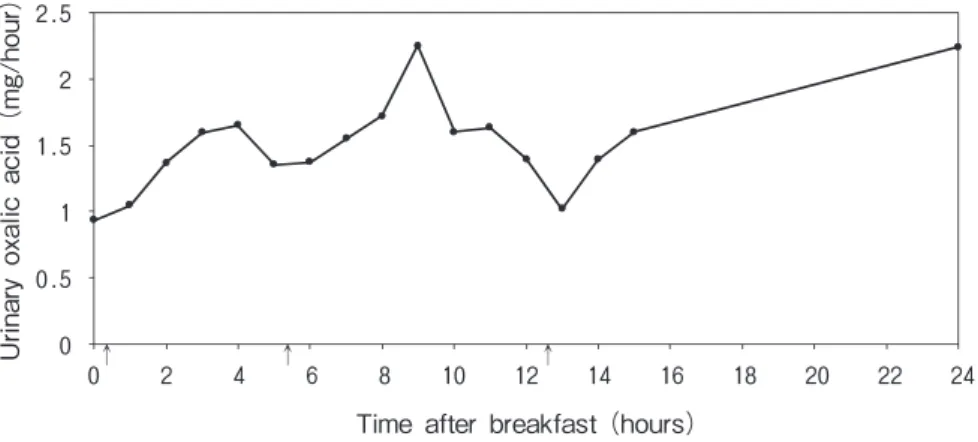
Fig. 2 shows the time-dependent curve of oxalic acid excretion in the urine in the daily meal pattern. Urinary oxalic acid excretion increased gradually after breakfast, the peak of excretion was observed at four hours after breakfast. In excretion after lunch, with the peak observed at four hours after the meal. It is thought that there was more oxalic acid excretion after lunch than after breakfast because of larger amount of food ingested at lunch. Excretion at 24 hours after the start of measurement, i.e. the next days breakfast, represents an average of values from
10 Shimada CHUGOKUGAKUEN J. Vol. 12
Table 1 Contents of a single meal
Bread 120 g Ham 15 g Cucumber 15 g Spinach (boiled) 200 g Apple 30 g Yogurt 20 g Coffee 180 ml Black tea 180 ml Tomato juice 100 ml Oxalic acid
Fig. 1 A typical ion chromatogram of urine diluted 10 times with
two hours to 11 hours after dinner. Therefore, the peak of excretion is not known, but it can be inferred as occurring at four hours after breakfast and likewise after lunch. The amount of excretion after dinner can be inferred as being more than for after lunch.
Fig. 3 shows the time-dependent curve of urinary oxalic acid excretion after administration of a single meal. Measured values represented the amount of oxalic acid excreted per hour.
The peak of excretion was four hours after the meal. Excretion in urine decreased gradually after peaking.
With a sufficient oral load, plasma oxalic acid can be shown to increase within one hour, and to peak at four to six hours [5]. Because oxalic acid is not significantly metabolized in human beings, urinary excretion also begins almost immediately, with peaks
between three and six hours [5, 6]. Eighty percent to 90オ of an oral oxalic acid load is excreted within eight to 11 hours, with 95オ to 100オ excretion at the completion of 24 hours [7, 8]. Therefore, increases in urinary excretion of oxalic acid after a load can be assumed to be equal to the absorption of oxalic acid from that load.
Results of this experiment were also almost the same as in other resarch. This indicates that there is a major uptake of oxalic acid from the small intestine in humans. The relationship between soluble and insoluble oxalic acid in the small intestine seems to have a major effect on oxalic acid bioavailability, since ingestion of calcium together with oxalic acid rich foods has been shown to lower the uptake of both calcium and oxalic acid [9]. This indicates that insoluble calcium oxalic acid has a much lower
2013 Determination of Oxalic Acid in Urine by Ion Chromatography 11
0 0.5 1 1.5 2 2.5 0 2 4 6 8 10 12 14 16 18 20 22 24
Time after breakfast (hours)
↑ ↑ ↑
Urinary oxalic acid (mg/hour)
Fig. 2 Time-dependent curve of urinary oxalic acid in the daily meal pattern. Arrows indicate meal times.
Urinary oxalic acid (mg/hour) 0 1 2 3 4 5 6 7 0 2 4 6 8 10 12
Time after a single meal (hours)
↑
bioavailability than the soluble form of oxalic acid, and that an oxalic acid rich/low calcium diet leads to a greater uptake of oxalic acid.
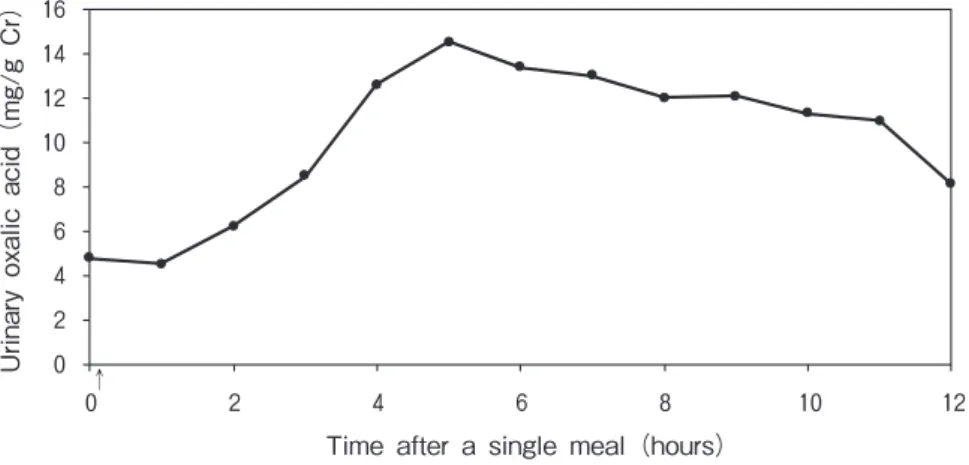
Fig. 4 shows the time-dependent curve of urinary oxalic acid excretion corrected for creatinine after administration of single meal. Creatinine adjustment has been thought to be an effective measure in cases of spot urine sampling, which is very concentrated or diluted. Urinary oxalic acid excretions corrected for creatinine reached their maximum values five hours after the meal. In this measurement, the peak time for urinary oxalic acid excretion corrected for creatinine was different from oxalic acid excretion without creatinine correction. Further monitoring by creatinine adjustment is needed in the future.
The source of this oxalic acid is endogenous synthesis from protein and carbohydrates as well as ascorbate metabolism. Although the exact metabolic pathways in human beings are not fully understood, the major sources of oxalic acid are from amino acids through glyoxylate and from carbons 1 and 2 of ascorbate [10].
Dietary oxalic acid appears to contribute only about 10オ of the urinary oxalic acid in healthy non-stone-forming individuals who eat Western-type diets [11]. However, the increase in urinary oxalic acid can be quite substantial when the dietary oxalic acid load is high and bioavailability or absorption is greater than normal.
In this experiment, the relationship between the amount of oxalic acid intake and the amount of urinary
oxalic acid has not been discussed, however, it was shown that monitoring oxalic acid intake could be possible by measuring urinary oxalic acid.
References
1. Madelene B and Geoffrey PS: Bioavailability of soluble oxalic acid from spinach eaten with and without milk products. Asia Pac. J. Clin. Nutr. (2003) 12, 219-224.
2. Noonan SC and Savage GP: Oxalic acid content of foods and its effect on humans. Asia Pac. J. Clin. Nutr. (1999) 8, 64-67. 3. Holmes RP, Goodman HO and Assimos DG: Contribution of dietary
oxalic acid to urinary oxalic acid excretion. Kidney Int. (2001) 59, 270-276.
4. Shimada Y. and Ko S: Simultaneous determination of urinary ascorbic acid and creatinine by high-performance liquid chromatography. J. Chugoku Junior College (1996) 27, 89-95. 5. Holmes RP, Ambrosius WT and Assimos DG: Dietary oxalic acid
loads and renal oxalic acid handling. J. Urol. (2005) 174, 943-947.
6. Hautmann RE: The Stomach, A new and powerful oxalic acid absorption site in man. J. Urol. (1993) 149, 1401-1404. 7. Prenen JAC, Boer P and Mees EJD: Absorption kinetics of oxalic
acid from oxalic acid-rich food in man. Am. J. Clin. Nutr. (1984) 40, 1007-1010.
8. Chai W, Liebman M, Kynast-Gales S and Massey L: Oxalic acid absorption and endogenous oxalic acid synthesis from ascorbate in calcium oxalic acid stone formers and non-stone formers. Am. J.Kidney Dis. (2004) 44, 1060-1069.
9. Savage GP, Vanhanen L, Mason SL and Ross AB: Effect of cooking on the soluble and insoluble oxalic acid content of some New Zealand foods. J. Food Comp. Anal. (2000) 13, 201-200. 10. Linda KM, Helen RS and Roger AL: Effect of dietary oxalic acid
and calcium on urinary oxalic acid and risk of formation of calcium oxalic acid kidney stones. (1993) 93, 901-906.
11. Williams HE and Wandzilak TR: Oxalic acid synthesis, transport and the hyperoxaluric syndromes. J. Urol. (1989) 141, 742-747.
12 Shimada CHUGOKUGAKUEN J. Vol. 12
Urinary oxalic acid (mg/g Cr) 0 2 4 6 8 10 12 14 16 0↑ 2 4 6 8 10 12
Time after a single meal (hours)
Fig. 4 Time-dependent curve of urinary oxalic acid corrected for creatinine (Cr) after a single meal time. Arrow indicates meal time.