L13
The Astrophysical Journal, 526:L13–L16, 1999 November 20
q1999. The American Astronomical Society. All rights reserved. Printed in U.S.A.
GLOBULAR CLUSTER FORMATION TRIGGERED BY THE INITIAL STARBURST IN GALAXY FORMATION Yoshiaki Taniguchi,1 Neil Trentham,2 and Satoru Ikeuchi3
Received 1999 June 29; accepted 1999 September 9; published 1999 October 21
ABSTRACT
We propose and investigate a new formation mechanism for globular clusters in which they form within molecular clouds that are formed in the shocked regions created by galactic winds driven by successive supernova explosions shortly after the initial burst of massive star formation in the galactic centers. The globular clusters have a radial distribution that is more extended than that of the stars because the clusters form as pressure- confined condensations in a shell that is moving outward radially at high velocity. In addition, the model is consistent with existing observations of other global properties of globular clusters, as far as comparisons can be made.
Subject headings: galaxies: formation — galaxies: starburst — globular clusters: general — stars: formation
1. INTRODUCTION
Globular clusters (GCs) provide important clues as to how galaxies formed. The very old ages of the GCs in our Galaxy suggest that they were formed when the Galaxy formed. This, combined with the fact that GCs are normally found in the halos of big galaxies, where the dark matter dominates the gravitational potential, implies that the formation mechanism of GCs is related intimately to the formation of the galaxies themselves. Therefore, understanding the formation of GCs has been a major area of study (e.g., van den Bergh 1996; VandenBerg, Bolte, & Stetson 1996; Harris, Harris, & Mc- Laughlin 1998).
Globular clusters probably form within giant molecular clouds, in the same way that we see star cluster formation happening today in the Galactic disk (Harris & Pudritz 1994; McLaughlin & Pudritz 1996; Elmegreen & Efremov 1997). Indeed, there is considerable observational support for such an approach, and the specific model of McLaughlin & Pudritz (1996) has the strong attraction of correctly reproducing the GC mass distribution function. Therefore, the most important question now becomes the following: How were such giant molecular clouds formed earlier on in the history of the gal- axies, well away from the galaxy centers, which is where most of the stars are being made? Proposed mechanisms for making molecular clouds include (1) the gravitational instability, shortly after recombination, that arises from isothermal per- turbations in the early universe (Peebles & Dicke 1968; Ro- senblatt, Faber, & Blumenthal 1988); (2) instabilities during contraction of a protogalactic gas cloud (e.g., Fall & Rees 1985, who investigate thermal instabilities); and (3) high-velocity col- lisions of giant gas clouds in the halos of young galaxies (Gunn 1980; Kang et al. 1990; Kumai, Basu, & Fujimoto 1993).
Recent observations show evidence for candidate-forming GCs, which presumably formed out of molecular clouds, in some galaxy mergers, suggesting that the third possibility is the most attractive (Ashman & Zepf 1992; Holtzman et al. 1992; Zepf & Ashman 1993; Kumai et al. 1993; Whitmore et
1Astronomical Institute, Graduate School of Science, Tohoku University, Aramaki, Aoba, Sendai 980-8578, Japan.
2Institute of Astronomy, University of Cambridge, Madingley Road, Cam- bridge, England, CB3 0EZ, UK.
3Physics Department, Graduate School of Science, Nagoya University, Chi- kusa, Nagoya 464-8602, Japan.
al. 1993; Surace et al. 1998). Such a scenario is further sup- ported by the bimodal metallicity distributions of the globular cluster populations in elliptical galaxies (Zepf & Ashman 1993) and by the fact that mergers are thought to produce elliptical galaxies by violent relaxation (Schweizer 1982) in conjunction with the result that elliptical galaxies have a higher specific frequency ( ) of GCs than do disk galaxies (Zepf & AshmanSN 1993). However, the newly formed clusters are usually ob- served in the central regions of mergers (the exception is in VII Zw 031, where star clusters have been seen at ultraviolet wavelengths in a coherent pattern at ∼5 kpc from the galactic center; Trentham, Kormendy, & Sanders 1999), so that the mechanism producing these particular objects is presumably not responsible for making most of the old globular cluster populations located in the outer regions of galaxies. While these observations suggest that halo GCs did not form in the current merger, they do not rule out the possibility that they formed in high-velocity cloud-cloud collisions early in the histories of the progenitor galaxies, and therefore they do not address di- rectly the question highlighted in the previous paragraph.
In the context of the models that we characterize in the proposed mechanisms 2 and 3 above, it is plausible that any intense star formation that is happening in the galaxy centers can have significant effects on the physical processes respon- sible for the formation of the molecular clouds. Recently, Harris et al. (1998) argued for the importance of a superwind driven by an initial starburst in order to explain the observed higher of GCs in bright cluster member galaxies; the superwind is SN
necessary to reduce the mass of cold gas in which star formation occurs, leading to the higher SN (Blakeslee 1997). In such a scenario, the GCs would form as condensations in material shocked by supernovae. This concept is not new (Mestel 1965; Elmegreen & Lada 1977; Elmegreen & Elmegreen 1978; Elmegreen 1989; Whitworth et al. 1994; Taniguchi, Trentham,
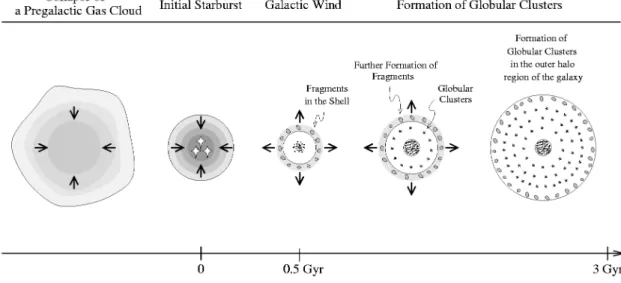
& Shioya 1998; Mori, Yoshii, & Nomoto 1999), and we now consider its application to the GC problem (see Fig. 1). In this kind of model, the GCs end up in the outer parts of the galaxy because they form as pressure-confined condensations within a shell of shocked material that is moving radially outward at high velocity. This model exploits some of the features of mechanisms 2 and 3, but it differs fundamentally from those listed above in that the formation of the halo GCs is related to the formation of the dense stellar core of the galaxy and in that
L14 GLOBULAR CLUSTER FORMATION Vol. 526
Fig.1.—Schematic illustration of the initial starburst-driven formation of globular clusters
the core forms early in the history of the galaxy, at least in elliptical galaxies. A similar approach has been undertaken by Brown, Burkert, & Truran (1991, 1995), in which they consider GC formation in supershells produced by the collective be- havior of the supernovae remnants generated by the initial star- burst. These models have had some success at reproducing the properties of Milky Way GCs.
In the context of disk galaxies like the Milky Way, this model ties halo globular cluster formation to bulge formation (note that bulges lie on the same fundamental plane as the elliptical galaxies; see Kormendy & Djorgovski 1989). Whether the spheroidal stellar population (whether an elliptical galaxy or the bulge of a disk galaxy) forms by isolated dissipative col- lapse (Blumenthal et al. 1984) or by a merger-induced collapse (e.g., Kormendy & Sanders 1992) the physics is essentially the same.
2. GC FORMATION IN SHOCKED SHELL DRIVEN BY SUPERWINDS
2.1. Model
First, we investigate whether or not GCs could form in the shocked shell driven by a superwind that is caused by the initial starburst in a galaxy. We adopt the dissipative collapse picture for the formation of elliptical galaxies and bulges (e.g., Larson 1974) and follow the galactic wind model proposed by Arimoto
& Yoshii (1987). In this model, intense star formation (i.e., a starburst) occurs at the epoch of galaxy formation in the galaxy center, producing a galactic wind that lasts for a characteristic time tGW(∼0.5 Gyr for an elliptical galaxy with a stellar mass of 1011 M,). Since infalling gas is accreting onto the galaxy at timest ≥ tGW, the wind interacts with this gas, and shocked gaseous shells form in the outer regions of the galaxy. If the shells are unstable gravitationally (e.g., Ostriker & Cowie 1981; Ikeuchi 1981; Umemura & Ikeuchi 1987), clumps may be formed within them. Here we investigate the possibility that the clumps may end up as present-epoch GCs.
Let us suppose that the supernovae responsible for shocking the gas occur continuously over a timescale longer than or comparable to the dynamical timescale of the initial gas cloud and that the evolution of the shocked material can be described by a superbubble model (McCray & Snow 1979; Koo & McKee
1992a, 1992b; Heckman et al. 1996; Shull 1995 and references therein). The radius and velocity of the shocked shells at time t (in units of 0.5 Gyr) are then
1/5 21/5 3/5
rshell∼29Lmech, 43nH, 1t0.5 kpc (1) and
1/5 21/5 22/5 21
vshell∼34Lmech, 43nH, 1t0.5 km s , (2)
whereLmechis the mechanical luminosity released collectively from the supernovae in the central starburst in units of 1043 ergs s21andnHis the average hydrogen number density of the interstellar medium, which is assumed constant in units of 1 cm . The derivation of23 rshellrequires that the baryonic com- ponent dominates the gravitational potential. This is always true for the relevant scales in this Letter. However, the presence of a dark matter halo requires that this estimate ofrshellnot be valid at arbitrarily large radii. We can estimateLmech directly from Arimoto & Yoshii (1987). For an elliptical galaxy with a stellar mass Mstars= 1011 M,, radiusr . 10 kpc, and n ∼H cm23(see Saito 1979 and Arimoto & Yoshii 1987), we expect 1
stars that explode as supernovae. Therefore, NSN∼3 # 109
since most of these massive stars were formed during the first 0.5 Gyr (=tGW), Lmech∼hE N /tSN SN GW∼1043 ergs s21, where is the total energy of a single supernova (1051ergs) and h ESN
is the efficiency of the kinetic energy deposited in the ambient gas (∼0.1; Dyson & Williams 1980, p. 152).
Condensations that form within the shells experience a net inward acceleration due to self-gravity and a net outward ac- celeration due to the internal pressure. Whitworth et al. (1994) investigate the balance between these two accelerations and show that the timescale for the growth of the fastest growing condensations istfastest∼2c /(GS)s , wherecsis the sound speed in the shell and S is its surface density. Nonlinear fragmentation in the shell then happens first at a timet = tfastest. Noting that the surface densityS = Cn m rH H shell, where C is a constant de- termined by the geometry (C = 1/3for a sphere) andmHis the hydrogen atom mass, we then find from the estimates of rshell andvshellthat fragmentation within the shell first happens at a
No. 1, 1999 TANIGUCHI, TRENTHAM, & IKEUCHI L15 timet . 57Cc 0.3321/2n21/2H, 1M21/2c, 10 Myr at a radiusr . 8Lc 1/5mech, 43#
kpc. Here is the Mach number in units
23/10 21/2 23/10
C0.33 nH, 1Mc, 10 Mc, 10
of 10 when these condensations first appear, equal to vshell/cs (here it is assumed thatMck1; Whitworth et al. 1994). Es- timating cs is difficult because the turbulent pressure in the shell is much greater than the thermal pressure. The shell is moving outward at a velocityvcwhen the fragments first appear, wherevc. 81L1/5mech, 43C1/50.33M1/5c, 10km s . Thus,21 vcis almost in- dependent of cs, so that our lack of knowledge of the sound speed is unimportant in determining the velocity of the shell when the condensations form.
Following Whitworth et al. (1994), we can estimate the mass and size of the fragments:Mfrag∼c7/2s /(G n m3 H H cv)1/2∼3.8#
and #
6 21/2 3 27/2 3/2 1/2
10 nH, 1vc, 81Mc, 10 M, lfrag∼cs /(Gn mH Hvc) ∼247 pc, where is in units of 81 km s .
21/2 23/2 21
nH, 1vc, 81Mc, 10 vc, 81
Now we consider the evolution of the fragments within the shocked shell. Since the cooling timescale of neutral gas clouds istcool∼1n21H, 1Myr (Spitzer 1978, p. 131), once fragmentation has occurred, the fragments will cool and can form stars. It is not clear, however, whether such stars really evolve to form a star cluster or whether they become smoothly distributed throughout the galaxy (e.g., Fall & Rees 1985). But one of the most important results found by Whitworth et al. (1994) was that the fragmentation of the shocked layer occurs while the fragments are still confined within the layer by ram pressure. Subsequent fragmentation within a fragment could occur and could result in the formation of sub-GC clouds with Jeans (1929) masses ofm ∼ l rJ 3J frag∼3 # 10 M4 , forl = cJ locals #
pc and /
1/2 local 21
(p/Grfrag) ∼37(cs /1 km s ) rfrag= Mfrag/[(4p 3)(lfrag/2) ] ∼ 4 # 103 223g cm . The number of such sub-GC23 clouds is Nsub= Mfrag/m . 14J . The lack of strong clustering among GCs in the halo suggests that these sub-GC clouds merge within a condensation to form a single GC. Such merging happens on a dynamical timescale of Tdyn∼Nsub fragl3/2 # yr, where is the
21/2 21/2 8 3/2 21/2
G Mfrag ∼8.3 # 10 lfrag, 250Mfrag, 6 lfrag, 250 original size of the fragment in units of 250 pc andMfrag, 6 is the mass of the fragment in units of 106 M,. Since typical masses of GCs in the present-day galaxies are MGC∼
and since these GCs are gas-poor, about 90% of the 10 M5 ,
gas must have been removed from the initial fragments before virialization (such a large fraction of gas being lost would unbind the system, if it happens after virialization). Supernova- driven winds could be an important mechanism in achieving this over the lifetime of the GC; note that stars with masses above 0.8 M,in GCs have all evolved from the main sequence by the present day.
Finally, we estimate the location of GCs. The shocked shell is confined on opposite sides by the ram pressure of the in- flowing ambient gas and by the hydrostatic pressure of the expanding bubble. This results in the fragments being carried out in the shocked layer well beyond rc. Pressure confinement ceases when the external pressure becomes less thanGS2, i.e., whent . 0.18C210.33n21/2H, 1 Gyr and the maximum radial distance kpc. Therefore, the condensation leaves the shell at rmax. 16
some radius r where
1/5 23/10 21/2 23/10
8Lmech, 43C0.33 nH, 1Mc, 10 kpc!r
1/5 23/5 21/2
! 16Lmech, 43C0.33nH, 1 kpc. (3) This is much larger than the stellar half-light radii of elliptical galaxies and bulges (Kormendy & Djorgovski 1989). The sub- sequent dynamical evolution of the GCs will depend on the
gravitational potential at these large radii, which progressively becomes more dark matter–dominated as the halo virializes.
2.2. Confrontation with Observation
The main result following from the previous section is that the remnant stellar clusters have galactocentric radii between 8 and 16 kpc, for an initial starburst luminosity of 1043 ergs s . These numbers are approximately consistent with the Ga-21 lactocentric radii of globular clusters in our Galaxy (5–10 kpc; Harris 1991 and Harris et al. 1998). The radii in our Galaxy could be lower than those inferred from the model for various reasons: for example, dynamical friction might reduce the size of the orbits of the GCs, or the initial starburst in our Galaxy might have generated a luminosity lower than 1043ergs s .21
The following comparisons with observation can also be made. The model is highly idealized, and it is probably too simplistic to merit some of the more detailed comparisons. Nevertheless, some useful constraints on the model parameters and some important extensions to the model can be inferred:
1. Since the GCs are formed in the shocked shell that is the interface between the metal-enriched galactic wind and the metal-poor accreting gas, the most obvious scenario would be that the metallicity of the GCs would be metal-poor but slightly more metal-rich than the lowest metallicity stars in the galaxy centers (the first ones to form in the starburst that generated the superwind). Alternatively, if supernovae from the central starburst inject many metals into the expanding shell (Brown et al. 1991, 1995), then the metallicity of the GCs will be much higher. This comparison can only be made in the case of the Galaxy. The median metallicity for halo GCs is about 21.5 in logarithmic solar units. The metallicities of stars in the bulge range from about 22 to 1 (Geisler & Friel 1992; McWilliam
& Rich 1994). This would suggest that the enrichment of the shell is not a highly efficient process. Furthermore, the for- mation epoch of GCs is shortly after that of galaxy formation so that the ages of the globular cluster stars should be nearly the same as the ages of the oldest stars in the galaxies. This also appears to be true for the Galaxy.
2. If the infalling gas has no angular momentum, the GCs form in this model with highly radial orbits. Were this the case, and were these orbits to survive until the present day, this would be inconsistent with observation, at least for the Galaxy (van den Bergh 1993; Cohen & Ryzhov 1997). However, collisions with other condensations early in the history of the fragments will randomize the orbits. This, combined with out lack of knowledge about the distribution of angular momenta of the infalling gas, means that a detailed comparison with obser- vation is not possible.
3. One further consequence of our model is that if, in all galaxies, the efficiency of GC formation in the shocked shells is the same, then the number of globulars NGC scales as the luminosity L of the galaxy as NGC∼r r Mc3 c frag21 ∼rc3v1/2c ∼L1/2, where rc is the mass density of the GC clouds. Most data suggest a scaling law steeper than this (Harris 1991). This may be due to the fact that other physical processes may well be at work—e.g., mergers and accretion events (Djorgovski & Santiago 1992; Ashman & Zepf 1992; van den Bergh 1993; Zepf, Ashman, & Geisler 1995) and the destruction of GCs as a result of evaporation, disk shocking, or dynamical friction (Fall & Rees 1977; Okazaki & Tosa 1995).
4. Local density variations (i.e., different values of S in different regions) within the shell might mean that there may
L16 GLOBULAR CLUSTER FORMATION Vol. 526 be a radial (and possibly age) spread among the globulars that
form by the mechanism described in the previous section. In regions of high S, the condition oftfastest∼2c /(GS)s is satisfied sooner, so that the condensations begin to form within the shell earlier. These systems also leave the shell earlier, and so we expect them to exist at systematically smaller Galactocentric radii than systems that form in the low-S regions of the shell. Observations seems to indicate (Harris 1991) that halo GCs tend to be smaller with increasing distance from the galactic centers. In the context of the current model, this would suggest
that the efficiency at which gas is converted into stars is higher in the high-S regions.
We would like to thank N. Arimoto, T. Murayama, Y. Ohyama, T. Okazaki, H. Saio, Y. Shioya, and M. Tosa for their useful discussions and comments. This work was supported by the Ministry of Education, Science, and Culture (07044054, 10044052, and 10304013). N. T. thanks the PPARC for finan- cial support.
REFERENCES
Arimoto, N., & Yoshii, Y. 1987, A&A, 173, 23 Ashman, K. M., & Zepf, S. E. 1992, ApJ, 384, 50 Blakeslee, J. P. 1997, ApJ, 481, L59
Blumenthal, G. R., Faber, S., Primack, M., & Rees, M. J. 1984, Nature, 311, 517
Brown, J. H., Burkert, A., & Truran, J. W. 1991, ApJ, 376, 115
———. 1995, ApJ, 440, 666
Cohen, J. G., & Ryzhov, A. 1997, ApJ, 486, 230 Djorgovski, S., & Santiago, B. X. 1992, ApJ, 391, L85
Dyson, J. E., & Williams, D. A. 1980, Physics of Interstellar Matter (Man- chester: Manchester Univ. Press)
Elmegreen, B. G. 1989, ApJ, 340, 786
Elmegreen, B. G., & Efremov, Y. N. 1997, ApJ, 480, 235 Elmegreen, B. G., & Elmegreen, D. M. 1978, ApJ, 220, 1051 Elmegreen, B. G., & Lada, C. 1977, ApJ, 214, 725
Fall, S. M., & Rees, M. J. 1977, MNRAS, 181, 37P
———. 1985, ApJ, 298, 18
Geisler, D., & Friel, E. D. 1992, AJ, 104, 128
Gunn, J. E. 1980, in Globular Clusters, ed. D. Hanes & P. Hodge (Cambridge: Cambridge Univ. Press), 301
Harris, W. E. 1991, ARA&A, 29, 543
Harris, W. E., Harris, G. L. H., & McLaughlin, D. E. 1998, AJ, 115, 1801 Harris, W. E., & Pudritz, R. E. 1994, ApJ, 429, 177
Heckman, T. M., Dahlem, M., Eales, S. A., Fabbiano, G., & Weaver, K. 1996, ApJ, 457, 616
Holtzman, J. A., et al. 1992, AJ, 103, 691 Ikeuchi, S. 1981, PASJ, 33, 211
Jeans, J. H. 1929, Astronomy and Cosmogony (2d ed.; Cambridge: Cambridge Univ. Press)
Kang, H., Shapiro, P. R., Fall, S. M., & Rees, M. J. 1990, ApJ, 363, 488 Koo, B.-C., & McKee, C. F. 1992a, ApJ, 388, 93
———. 1992b, ApJ, 388, 103
Kormendy, J., & Djorgovski, S. 1989, ARA&A, 27, 235
Kormendy, J., & Sanders, D. B. 1992, ApJ, 390, L53 Kumai, Y., Basu, B., & Fujimoto, M. 1993, ApJ, 404, 144 Larson, R. B. 1974, MNRAS, 169, 229
McCray, R., & Snow, T. P. 1979, ARA&A, 17, 213 McLaughlin, D. E., & Pudritz, R. E. 1996, ApJ, 457, 578 McWilliam, A., & Rich, R. M. 1994, ApJS, 91, 749 Mestel, L. 1965, QJRAS, 6, 161
Mori, M., Yoshii, Y., & Nomoto, K. 1999, ApJ, 511, 585 Okazaki, T., & Tosa, M. 1995, MNRAS, 274, 48 Ostriker, J. P., & Cowie, L. L. 1981, ApJ, 243, L127 Peebles, P. J. E., & Dicke, R. H. 1968, ApJ, 154, 891
Rosenblatt, E. I., Faber, S. M., & Blumenthal, G. R. 1988, ApJ, 330, 191 Saito, M. 1979, PASJ, 31, 181
Schweizer, F. 1982, ApJ, 252, 455
Shull, M. J. 1995, in ASP. Conf. Ser. 73, Airborne Astronomy Symposium on the Galactic Ecosystem: From Gas to Stars to Dust, ed. M. R. Haas, J. A. Davidson, & E. F. Erickson (San Francisco: ASP), 365
Spitzer, L., Jr. 1978, Physical Processes in the Interstellar Medium (New York: Wiley)
Surace, J. A., Sanders, D. B., Vacca, W. D., Veilleux, S., & Mazzarella, J. M. 1998, ApJ, 492, 116
Taniguchi, Y., Trentham, N., & Shioya, Y. 1998, ApJ, 504, L79 Trentham, N., Kormendy, J., & Sanders, D. B. 1999, AJ, 117, 2152 Umemura, M., & Ikeuchi, S. 1987, ApJ, 319, 601
VandenBerg, D. A., Bolte, M., & Stetson, P. B. 1996, ARA&A, 34, 461 van den Bergh, S. 1993, ApJ, 411, 178
———. 1996, PASP, 108, 986
Whitmore, B. C., Schweizer, F., Leitherer, C., Borne, K., & Robert, C. 1993, AJ, 106, 1354
Whitworth, A. P., Bhattal, A. S., Chapman, S. J., Disney, M. J., & Turner, J. A. 1994, A&A, 290, 421
Zepf, S. E., & Ashman, K. M. 1993, MNRAS, 264, 611 Zepf, S. E., Ashman, K. M., & Geisler, D. 1995, ApJ, 443, 570