Improving Chinese Grammatical Error Correction using Corpus
Augmentation and Hierarchical Phrase-based Statistical Machine
Translation
Yinchen Zhao
Mamoru Komachi Hiroshi Ishikawa
Graduate School of System Design, Tokyo Metropolitan University, Japan
[email protected]
[email protected]
[email protected]
Abstract
In this study, we describe our system submitted to the 2nd Workshop on Natu-ral Language Processing Techniques for Educational Applications (NLP-TEA-2) shared task on Chinese grammatical error diagnosis (CGED). We use a statistical machine translation method already ap-plied to several similar tasks (Brockett et al., 2006; Chiu et al., 2013; Zhao et al., 2014). In this research, we examine cor-pus-augmentation and explore alternative translation models including syntax-based and hierarchical phrase-syntax-based models. Finally, we show variations us-ing different combinations of these fac-tors.
1
Introduction
The concept of “translating” an error sentence into a correct one was first researched by Brock-ett et al. (2006). They proposed a statistical ma-chine translation (SMT) system with noisy chan-nel model to correct automatically erroneous sen-tences for learners of English as a Second Lan-guage (ESL).
It seems that a statistical machine translation toolkit has become increasingly popular for grammatical error correction. In the CoNLL-2014 shared task on English grammatical error correction (Ng et al., 2014), four teams of 13 par-ticipants each used a phrase-based SMT system. Grammatical error correction using a phrase-based SMT system can be improved by tuning using evaluation metrics such as F0.5
(Kunchukuttan et al., 2014; Wang et al., 2014) or even a combination of different tuning
algo-rithms (Junczys-Dowmunt and Grundkiewicz, 2014). In addition, SMT can be merged with oth-er methods. For example, the language model-based and rule-model-based methods can be integrated into a single sophisticated but effective system (Felice et al., 2014).
For Chinese, SMT has also been used to cor-rect spelling errors (Chiu et al., 2013). Further-more, as is shown in NLP-TEA-1, an SMT sys-tem can be applied to Chinese grammatical error correction if we can employ a large-scale learner corpus (Zhao et al., 2014).
In this study, we extend our previous system (Zhao et al., 2014) to the NLP-TEA-2 shared task on Chinese grammatical error diagnosis, which is based on SMT. The main contribution of this study is as follows:
We investigate the hierarchical phrase-based model (Chiang et al., 2005) and determine that it yields higher recall and thus F score than does the phrase-based model, but is less accurate.
We increase our Chinese learner corpus by web scraping (Yu et al., 2012; Cheng et al., 2014) and show that the greater the size of the learner corpus, the better the performance.
We perform minimum error-rate training (Och, 2003) using several evaluation met-rics and demonstrate that tuning improves the final F score.
2
Hierarchical phrase-based model
A hierarchical phase-based model for SMT was first suggested by Chiang et al. (2005). The sys-tem first achieves proper word alignment, and instead of extracting phrase alignment, the
tem extracts rules in the form of synchronous context-free grammar (SCFG) rules. In a Chinese error correction task, such error-correction rules are extracted as follows:
X → (X1一好消息 X2, X1 一个好消息 X2)
(a piece of good news) X → (我有, 我有)
(I have)
X → (告诉你, 告诉你)
(to tell you)
The symbols X and Xi here are non-terminal
and represent all possible phrases. In addition, glue rules are used to combine a sequence of Xs to form an S.
The glue rules are given as: S → (X1, X1)
S → (S1X2, S1X2)
A complete derivation of this simple example can then be written:
To determine a weight of a derivation, this model utilizes features such as generation proba-bility, lexical weights, and phrase penalty. In ad-dition, to avoid too many distinct yet similar translations, rules are constrained by certain fil-ters that, for example, limit the length of the ini-tial phrase the number of non-terminals per rule.
3
Chinese Learner Corpora
3.1 Lang-8 Learner CorpusThe Lang-8 Chinese Learner Corpus was built by extracting error-correct sentence pairs from the Internet (Mizumoto et al., 2011; Zhao et al., 2014). We use it as a training corpus for our SMT-based grammatical error diagnosis system in NLP-TEA-1.
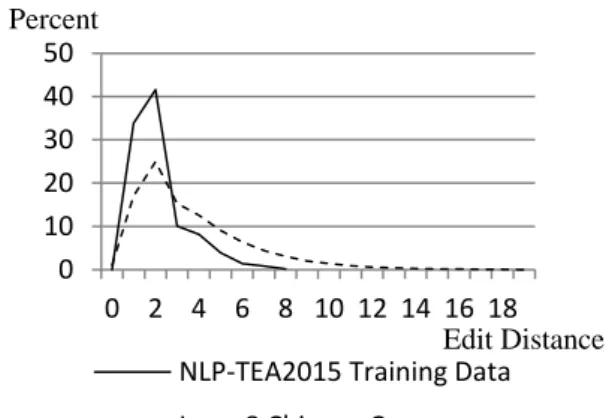
However, after we analyzed edit distance (ED) between error-correct sentence pairs based on word level, we determined it may not be suitable for training our translation model. As Figugre 1 shows, NLP-TEA-2 training data has ED mostly from 1 to 3 whereas Lang-8 Chinese Corpus has many ED longer than 4.
This is reasonable because the NLP-TEA-2 training data are extracted from essays written by high-level Chinese learners and, in most cases, these learners produce only one- or two-word-mistakes. By contrast, Lang-8 is a language ex-change social networking website where sen-tences are written by language learners of any level. If we use this corpus as it currently exists, sentences having too long ED may confuse the SMT system.
Therefore, we cleaned the Lang-8 Chinese Learner Corpus by randomly sampling sentence pairs whose ED is between 4 and 8 and deleting sentences pairs whose ED is longer than 8. This ensures it has a similar ED distribution to that of the NLP-TEA-2 training data. After cleaning, the number of sentences in the corpus decreased from 95,000 to approximately 58,000.
Figure 1: Distribution of ED in different data sets. The distribution of ED in the Lang-8 Chinese Learner Corpus shown here is prior to cleaning.
3.2 HSK Dynamic Essay Corpus
In this shared task, we augment the Chinese learner corpus with another learner corpus ex-tracted from the Internet (Yu et al., 2012; Cheng et al., 2014). The HSK Dynamic Essay Corpus1 is one such corpus built by Beijing Language and Culture University. In this corpus, approximately 11,000 essays are collected from HSK Chinese tests taken by foreign Chinese language learners, and error sentences are annotated with special marks.
For example:
这就{CQ 要}由有关部门和政策管理制度来控制。
1
http://nlp.blcu.edu.cn/online-systems/hsk-language-lib-indexing-system.html
0 10 20 30 40 50
0 2 4 6 8 10 12 14 16 18
NLP-TEA2015 Training Data
Lang-8 Chinese Corpus S → (X1, X2)
→ (X3一好消息 X4, X3 一个好消息 X4)
→ (我有一好消息 X4, 我有 一个好消息 X4) → (我有一好消息告诉你, 我有 一个好消息 告诉你)
(I have a piece of good news to tell you)
Percent
where {CQ 要} refers to a redundant word and is
revised with the word that follows it.
可是这两个问题同时{CJX}要解决非常不容易。
where {CJX} refers to a reordering error.
However, detaching an erroneous sentence and a corresponded correction sentence from an annotated one as above is not easy because we don’t know the position information of the reor-dering error. Moreover, such detachment is also difficult when dealing with some more complex errors, for example, a “ba (把)” error (a special
preference of active voice in Chinese) or “bei (被)” error (a special preference of passive voice
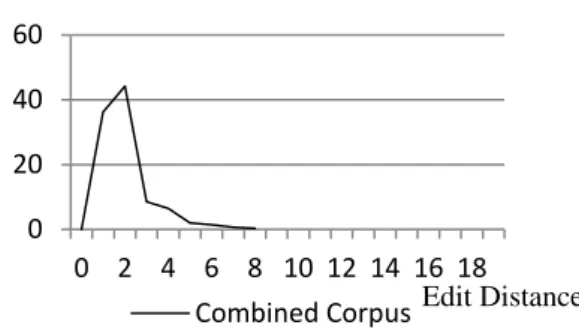
in Chinese), if we depend only on such marks. Thus, we extracted sentences having only in-sertion, deletion, or replacement errors. We also cleaned the HSK corpus by deleting sentences pairs having too long ED as described. As a re-sult, the corpus now contains approximately 59,000 sentences. The distribution of ED in the combined corpus is shown in Figure 2.
Figure 2: Distribution of ED in combined corpus.
4
Tuning
As previously described, an SMT system with tuning is proved to perform better than one with-out tuning. Because this shared task uses several evaluation metrics such as accuracy, F1 score, and FP rate, we tune our system using all these metrics with minimum error rate training (MERT) (Och, 2003) at identification level1. Our linear evaluation score is computed according to the following:
1
Detection level: All error types will be regarded as incor-rect. Identification level: All error types should be clearly identified, i.e., Redundant, Missing, Disorder, and Selection. Position level: The system results should be perfectly iden-tical with the quadruples of gold standard.
We tried to tune in position level but we omit these results since this attempt mostly failed.
Score = *Accuracy+ * F0.5+ *(1-FP_rate)
where + + = 1.0.
We conducted a series of preliminary experi-ments to discover the most effective set of pa-rameters. We followed Kunchukuttan et al. (2014) and Wang et al. (2014) in using F0.5
in-stead of F1. In other words, we expected our sys-tem to have high accuracy because, as Ng et al. say in CoNLL-2014, “it is important for a gram-mar checker that its proposed corrections are highly accurate in order to gain user acceptance.” However, we discovered that even when we used a parameter set of =0.0, =1.0, and =0.0, we still failed to reach a satisfactory correction rate.
Finally, we use =0.5, =0.0, and =0.5 as a final parameter set for phrase-based and hierar-chical phrase-based systems because it produces the greatest number of corrections at identical level among our in-house experiments. In addi-tion, our in-house experiments revealed that an improper parameter set could produce a reasona-ble but unacceptareasona-ble result. We discuss this as-pect with reference to an experiment regarding a syntax-based system in the next section.
5
Experiment and Results
5.1 Official Runs
We followed the WAT20152 baseline system to build based and hierarchical phrase-based SMT systems. This involves segmenting words using Stanford Word Segmenter version 2014-01-04, running GIZA++ v1.07 on training corpus in both directions, and parsing Chinese sentences with Berkeley parser (for java 1.7). We ran Moses v2.11 for decoding using the same parameters with the WAT2015 baseline. We trained two hierarchical phrase-based systems using different sized corpora according to wheth-er the HSK corpus is included. For wheth-error classifi-cation, we followed Zhao et al. (2014) to identify error types and locate the positions of errors.
All three runs we submitted are shown in Ta-ble 1. In addition, the results of our runs at posi-tion level are shown in Table 2. RUN3 produced more corrections and obtained a higher F1 score at position level than did the other runs. However,
2
http://orchid.kuee.kyoto-u.ac.jp/WAT/ 0
20 40 60
0 2 4 6 8 10 12 14 16 18
Combined Corpus Edit Distance
it is inferior in terms of accuracy and FP rate compared to RUN2.
At position level, the phrase-based system generated only 15 correct predictions and among them only one Disorder and no Selection types appeared. By contrast, the hierarchical system performed much better, as it successfully pre-dicted seven Disorder and five Selection types. In addition, it produced more correct predictions on Missing and Redundant types.
TMU-RUN1 Lang-8 + hierarchical
TMU-RUN2 Lang-8 + HSK + phrase-based TMU-RUN3 Lang-8 + HSK + hierarchical
Table 1: Three RUNs submitted by TMU (Tokyo Metropolitan University) team.
FP rate Accuracy Precision Recall F1 RUN1 0.478 0.270 0.0363 0.0180 0.0241 RUN2 0.134 0.449 0.1928 0.0320 0.0549 RUN3 0.350 0.362 0.1745 0.07400 0.1039 Table 2: Final test result of TMU RUNs at position
level.
5.2 Hierarchical Phrase-based Model
We provide an example of the official test set to explain why hierarchical phrase-based systems appear to be more effective than those that are phrase-based. The following Chinese sentence is used:
B1-1033: 其中有一个人丢护照了。
(One of them lost his passport.)
In a hierarchical-phrase-based system and ac-cording to the synchronous CFG rule, the partial derivation of the phrase “丢 护照 了 (lost his
passport)” is:
(X, X)→(丢 X1 , 丢X1) →(丢 X2了, 丢了 X2)
→(丢护照了, 丢了护照)
where X denotes any phrase. Because “X 了”
wrongly written as “了 X” is a typical Disorder
error in Chinese sentences, the hierarchical phrase-based system extracts the rule X→(X 了,
了X) and weighs it highly when training on the
corpus. This means the model actually examined syntax errors in sentences. By contrast, the phrase-based system lacks the ability to identify syntax errors. Therefore, this translation model is less effective than the hierarchical phrase-based system, as it failed to select a correct translation such as “丢了 X.”
5.3 Corpus Augmentation
According to the results shown in Table 4, ex-panding the corpus has a beneficial effect. In RUN1, the F1 score of 0.024 means it nearly failed to produce any correction prediction. However, after we increased the corpus size, the F1 score increased to 0.10. The improved F1 score with corpus augmentation is illustrated in Figure 3. Among F1 scores, our RUN3 ranks exactly in the middle of 15 RUNS of all teams.
Figure 3: F1 score improved with corpus aug-mentation. The solid line represents results of our in-house test. The Xs represent results of this open task.
5.4 Tuning
To determine the effect of tuning for improv-ing the two systems, we developed a test on the NLP-TEA-1 training set offered by organizers. Table 3 shows a contrast between tuned and untuned systems. As with the English grammati-cal error correction task, MERT clearly boosts the F1 score in this task. We tuned the system using the Z-MERT toolkit (Zaidan, 2009).
F1 Score
Phrase-based Hierarchical-phrase-based
Untuned 0.0513 0.0868
Tuned 0.0701 0.1080
Table 3: F1 score of SMT-based grammatical error correction system on NLP-TEA-1 dataset, with and without tuning.
To compare different syntax-based systems, we also developed a string-to-tree (s2t) SMT system. However, in our attempt to tune it, we failed to obtain a best set of parameters. We first tried a parameter set of (0.5, 0.0, 0.5), which performs most effectively with the phrase-based model. However, it failed to improve the F1 score, as is shown in Table 4.
RUN2
RUN3
0 0.02 0.04 0.06 0.08 0.1 0.12
58 73 88 103 117
FP_Rate Accuracy Precision Recall F1 Untuned 0.3973 0.4087 0.1042 0.0787 0.0896
Tuned 0.1029 0.4747 0.0480 0.0057 0.0102 Table 4: Tuning result suitable to an evalua-tion score but unacceptable for its low precision and recall.
The system is clearly optimized to achieve the best performance in terms of FP rate and accura-cy. However, this is because, as experiments showed, the system produces nearly all negative predictions, which causes low precision and re-call, as increasing true negatives improves both the accuracy and FP rate. We determined that =0.5, =0.0, =0.5 may not be a “good” pa-rameter set in this situation, even though it seemed acceptable for a preliminary experiment. Unfortunately, we did not identify any parameter sets that can generate more acceptable results than can the s2t system without tuning.
6
Conclusion
We have described a Chinese grammatical error correction system based on SMT for the TMU-NLP team. First, we examined hierarchical phrase-based and string-to-tree translation mod-els of SMT on CGED. Second, we constructed an error-correction parallel corpus based on the HSK Dynamic Essay Corpus, which is nearly
equal in size to the Lang-8 Chinese Learner Cor-pus. We then cleaned and combined the two into a single expanded corpus. Third, we tuned the system with a linear combination of evaluation metrics using MERT. Finally, we showed that the augmented corpus considerably improved performance. In addition, the hierarchical phrase-based translation model generated a higher F1 score than did the phrase-based model.
For future research, we will attempt to expand the corpus further. A possible direction in build-ing a large-scale parallel corpus is to introduce errors artificially to correct sentences. This has already been applied in an English error correc-tion task of Yuan and Felice (2013). In addicorrec-tion, we confirmed that our system produces correct predictions in generated N-best output. However, oracle predictions were not selected during de-coding. To solve this, we will employ a much more powerful language model such as the Google n-gram model as well as a re-ranking approach on the N-best output.
Acknowledgments
We would like to thank Xi Yangyang for grant-ing use of extracted texts from Lang-8.
Reference
Chris Brockett, William Dolan, Michael Gamon. (2006). Correcting ESL Errors Using Phrasal SMT Techniques. Proceedings of the 21st Inter-national Conference on Computational Linguis-tics and the 44th Annual Meeting of the Associa-tion for ComputaAssocia-tional Linguistics, pages 249– 256. Sydney, Australia.
Shuk-Man Cheng, Chi-Hsin Yu, Hsin-Hsi Chen. (2014). Chinese Word Ordering Errors Detection and Correction for Non-Native Chinese Lan-guage Learners. Proceedings of COLING 2014, the 25th International Conference on Computa-tional Linguistics: Technical Papers, pages 279– 289, Dublin, Ireland.
David Chiang. (2005). A Hierarchical Phrase-Based Model for Statistical Machine Translation. Pro-ceedings of the 43rd Annual Meeting of the As-sociation for Computational Linguistics
(ACL’05), pages 263–270, Ann Arbor, Michi-gan.
Hsun-wen Chiu, Jian-cheng Wu, Jason S. Chang. (2013). Chinese Spelling Checker Based on
Sta-tistical Machine Translation. Proceedings of the Seventh SIGHAN Workshop on Chinese La n-guage Processing (SIGHAN-7), pages 49–53, Nagoya, Japan.
Mariano Felice, Zheng Yuan, Øistein E. Andersen, Helen Yannakoudakis, Ekaterina Kochmar. (2014). Grammatical Error Correction using Hy-brid Systems and Type Filtering. Proceedings of the Eighteenth Conference on Computational Natural Language Learning: Shared Ta sk, pages 15–24, Baltimore, Maryland.
Marcin Junczys-Dowmunt, Roman Grundkiewicz. (2014). The AMU System in the CoNLL-2014 Shared Task: Grammatical Error Correction by Data-Intensive and Feature-Rich Statistical Ma-chine Translation. Proceedings of the Eighteenth Conference on Computational Natural Lan-guage Learning: Shared Task, pages 25–33, Bal-timore, Maryland.
Tomoya Mizumoto, Mamoru Komachi, Masaaki Na-gata, Yuji Matsumoto. (2011). Mining Revision Logs of Language Learning SNS for Automated Japanese Error Correction of Second Language Learners. Proceedings of the 5th International Joint Conference on Natural Language Pro-cessing, pages 148–155, Chiang Mai, Thailand. Hwee Tou Ng, Siew Mei Wu, Ted Briscoe, Christian
Hadiwinoto, Raymond H. Susanto, Christopher Bryant. (2014). The CoNLL-2014 Shared Task on Grammatical Error Correction. Proceedings of the Eighteenth Conference on Computational Natural Language Learning: Shared Task, pages 1–14, Baltimore, Maryland.
Franz J. Och. (2003). Minimum Error Rate Training in Statistical Machine Translation. Proceedings of the 41st Annual Meeting of the Association for Computational Linguistics, pages 160–167. Sap-poro, Japan.
Yiming Wang, Longyue Wang, Derek F. Wong, Lidia S. Chao, Xiaodong Zeng, Yi Lu. (2014). Fac-tored Statistical Machine Translation for Gram-matical Error Correction. Proceedings of the Eighteenth Conference on Computational Natu-ral Language Learning: Shared Task, pages 1– 14, Baltimore, Maryland.
Chi-Hsin Yu, Hsin-Hsi Chen. (2012). Detecting Word Ordering Errors in Chinese Sentences for Learn-ing Chinese as a Foreign Language. ProceedLearn-ings of COLING 2012: Technical Papers, pages 3003–3018, Mumbai, India.
Zheng Yuan, Mariano Felice. (2013). Constrained grammatical error correction using statistical machine translation. Proceedings of the Seven-teenth Conference on Computational Natural Language Learning: Shared Task, pages 52–61, Sofia, Bulgaria.
Omar F. Zaidan. (2009). Z-MERT: A Fully Configu-rable Open Source Tool for Minimum Error Rate Training of Machine Translation Systems. The Prague Bulletin of Mathematical Linguistics, pages 79–88