表 題 ICU における早期離床プロトコールの導入に関する研究 論 文 の 区 分 論文博士 著 者 名 劉 啓文 所 属 前橋赤十字病院 高度救命救急センター 集中治療科・救急科 2019年 8月15日申請の学位論文 紹 介 教 員 地域医療学系 専攻 救急医学 職名・氏名 教授 間藤 卓
1 目次 Ⅰ. 背景と目的 ・・・・・・・・・・・・・・・・・・・・・・・・・・・・・・・・・・・・・・・・・・・・・・・・・・・・・P. 1-3 Ⅱ. 研究 1:早期離床プロトコールの開発と安全性評価 ・・・・・・・・・・・・・・・・・・・P. 4-15 [研究1-A:自施設 ICU の障壁調査をもとにした前橋早期離床プロトコールの開発] ・・・・・・・・・・・・・・・・・・・・・・・・・・・・・・・・・・・・・・・・・・・・・・・・・・・・・・・・・・・・・・・・P. 4-9 [研究1-B:前橋早期離床プロトコールの安全性評価] ・・・・・・・・・・・・・・・・・・・・・・・・・・・・・・・・・・・・・・・・・・・・・・・・・・・・・・・・・・・・・・・P. 9-15 Ⅲ. 研究 2:前橋早期離床プロトコールの効果検証 ・・・・・・・・・・・・・・・・・・・・・P. 16-29 Ⅳ. 考察 ・・・・・・・・・・・・・・・・・・・・・・・・・・・・・・・・・・・・・・・・・・・・・・・・・・・・・・・P. 30-33 Ⅴ. 課題と今後の展望 ・・・・・・・・・・・・・・・・・・・・・・・・・・・・・・・・・・・・・・・・・・・・・・・P. 34 Ⅵ. 結語 ・・・・・・・・・・・・・・・・・・・・・・・・・・・・・・・・・・・・・・・・・・・・・・・・・・・・・・・・・・P. 35 引用文献 ・・・・・・・・・・・・・・・・・・・・・・・・・・・・・・・・・・・・・・・・・・・・・・・・・・・・・・・P. 36-49
2 Ⅰ. 背景と目的
医療技術の向上により、intensive care unit (ICU) を代表とする敗血症、多発
外傷、重症呼吸不全といった重症疾患の死亡率は十数年前と比較し低下してきてい る[1-6]。一方で、重症疾患から生存した後も、身体機能障害、認知機能障害、メンタ ルヘルス障害といった機能障害のために、activities of daily living (ADL) や quality of life (QOL) が著しく低下し社会復帰できない患者が増えていることが報告され、大き な注目を集めている[7, 8]。Post-Intensive Care Syndrome (PICS) と呼ばれる ICU 生
存退室後も続く機能障害は患者、家族、そして社会に大きな臨床的・経済的影響を与 えており[9-13]、救命だけでなく、救命の先にあるよりよい社会復帰を目指した医療の 形が求められている[14, 15]。対策のひとつとして、ICU 入室中の不必要な安静と廃 用が原因で起こる身体的機能障害を防ぐために入室後早期から理学的リハビリテー ションを中心とした離床プログラム(早期離床)を行うことが提案されている[16]。早期 離床をICU に導入した結果、ICU 在室期間や病院在院期間の短縮[17, 18]、人工呼 吸器時間の減少[19]、退院時身体機能の向上[20]、自宅退院率の改善[19]、せん 妄発生率の減少[19]、医療費の軽減[21, 22]、や QOL の改善[23]など PICS だけで なく様々な臨床の有効性があることが報告されている。各種ガイドラインでは、早期離 床は強いエビデンスをもって、ICU 入室後早期からの開始が推奨されている[24-26]。 しかしながら、早期離床の安全性や有効性に関する研究は、専門離床チー
3 ムを有し、ICU で通常ケアの一環として早期離床を行い、すでに文化が形成されてい る欧米の大学病院や市中病院からの報告が中心となっている[10, 18, 27-33]。専門チ ームがなく早期離床文化が育っていない日本の ICU で早期離床に取り組むことが安 全なのか、患者に害(死亡率上昇など)を与えないのか、そして臨床的・経済的な効果 が得られるのかといった報告は皆無であった。また、日本のICU は早期離床について 報告してきた各国のICU と比べて体制やシステムが異なり、早期離床を進める上での 障壁も異なる可能性があることから、諸外国の報告をそのままの形で日本に導入する ことはできないと思われた。日本のICU の現状にあった早期離床のロールモデルを提 示する必要があると考えた。 本研究の目的は、(Ⅰ)自施設 ICU の特徴に沿った早期離床プロトコールの開 発プロセスを示し、プロトコールの安全性を検証すること[34]、および(Ⅱ)同プロトコー ルを ICU に導入した後、得られれた臨床的・経済的効果の検討を行うこと[35]、この 二つのプロセスにより日本で早期離床を推進するためのロールモデルを示すことにあ る。なお、早期離床プロトコールに関するすべての研究は、前橋赤十字病院院内倫理 審査委員会の承認のもと実施され、研究の解析については、自治医科大学の間藤卓 教授やAlan Kawarai Lefor 教授の指導を受けながら、救急医学講座研究室で行われ た。統計学的処理はすべてR (Vienna, Austria)または EZR (Saitama, Japan)で行った。
4 Ⅱ. 研究 1: 早期離床プロトコールの開発と安全性評価 [34] (倫理委員会承認番号 28-31) [研究1-A:自施設 ICU の障壁調査をもとにした前橋早期離床プロトコールの開発] 《早期離床を推進していく病院・ICU の背景》 前橋赤十字病院は全病床 560 床、ドクターヘリ・ドクターカーを有し、県内唯 一の高度救命救急センターとして県内全域から重症患者を受け入れている地域の中 核を担う3 次救急病院である。院内には 1 つの ICU があり、closed mixed ICU として 12 床のベッドを運営している。日勤帯の ICU スタッフは、1 人の上級集中治療科医、3 人の後期レジデント、1 人の初期研修医、そして看護師(看護師:患者=1:2)で構成さ れている。レジデントと初期研修医は適切なレベルの指導と助言を上級集中治療科医 から常に受けられる体制となっている。全ての医師と看護師は、今までに ICU の早期 離床を専攻したことはなかった。理学療法士は ICU 専従・専任ではなく、リハビリテー ションオーダーの出された患者1 人に対し 1 人の理学療法士が付く担当制である。院 内に早期離床の専門チームや専門家は1 人もいなかった。 《早期離床プロトコール開発プロセス》 はじめに、集中治療科医、リハビリテーション科医、ICU 看護師、理学療法士 から成る早期離床推進ワーキンググループを結成した。ワーキンググループが主導し
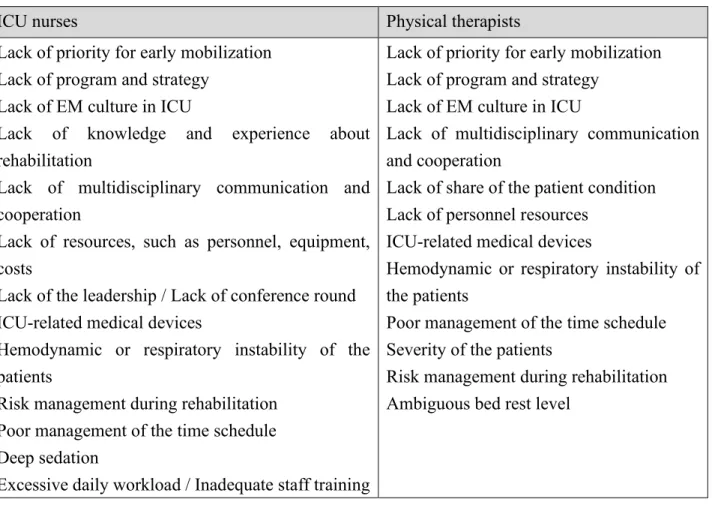
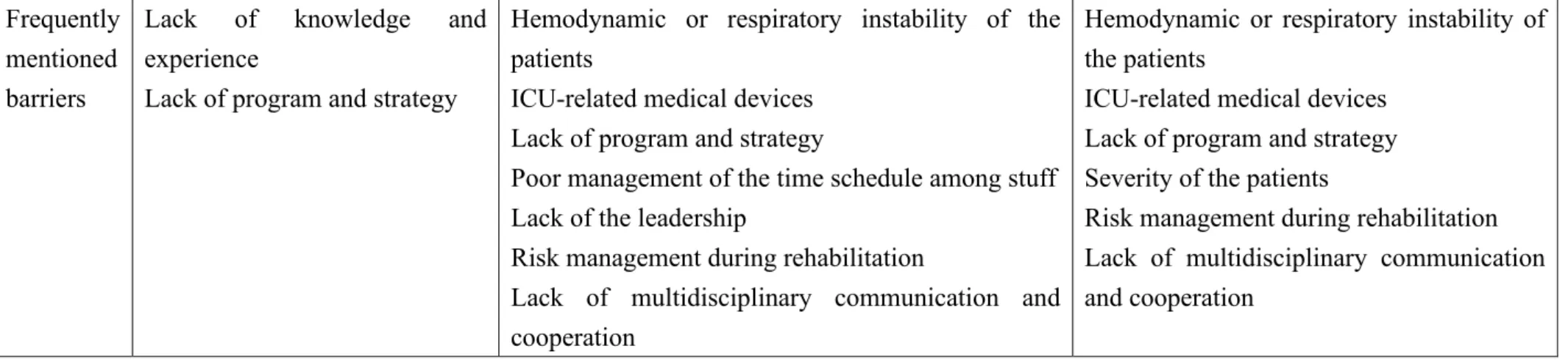
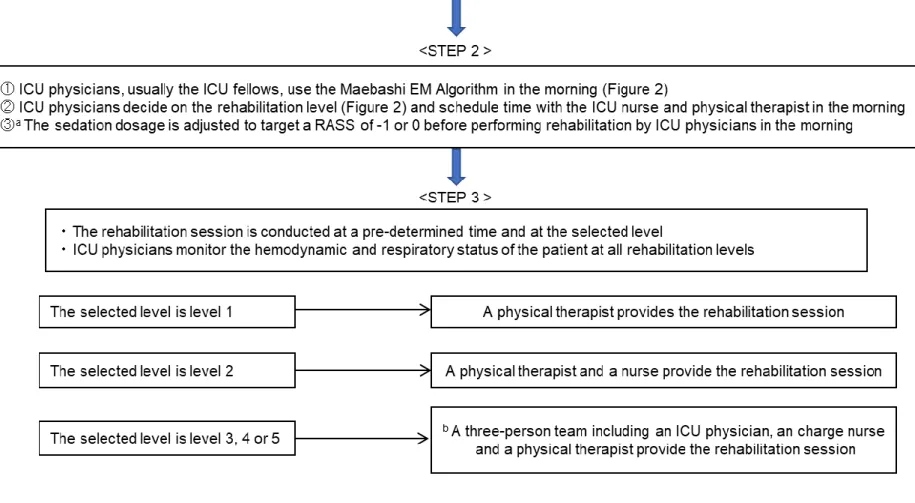
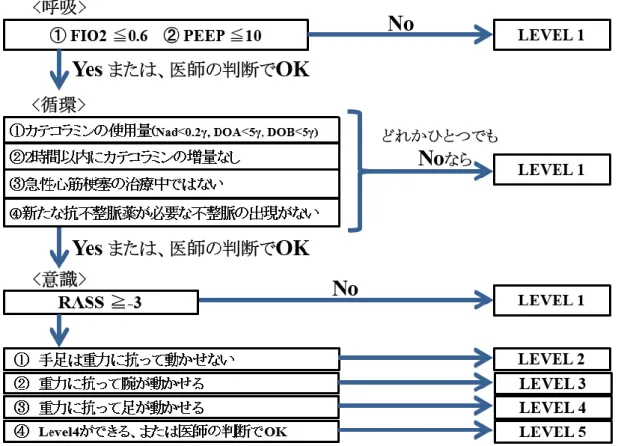
5 て、全ICU スタッフ(医師、看護師)と全理学療法士を対象に自施設 ICU で早期離床 を行う上での障壁についてアンケート調査を行った。結果、重症患者の不安定な循環 呼吸動態、人工呼吸器などの医療デバイス、離床システムがなく多職種間での協力 関係がないことなどが離床を妨げる障壁として高頻度に認められた(Table 1.)。その後、 早期離床推進ワーキンググループのメンバーで討論を行い、各障壁の克服ができるよ うに、先行研究を参考とした(Table 2.)前橋早期離床プロトコールおよび前橋早期離 床アルゴリズムを作成した(Figure 1.2.)[34, 35]。前橋早期離床システムは、3つのス テップから成る。(1)入室時の自動リハビリテーションオーダー、(2)医師主導のアルゴ リズムを用いた適切な患者評価と適度なリハビリテーション強度の選択、および多職種 との情報共有とタイムスケジュールの調整、(3)端坐位以上の離床強度の場合、医師、 看護師、理学療法士の3名を基本チームとし離床介入を行う。その際、医師の役割は、 離床前後と離床介入中のリーダーシップ、循環呼吸動態とバイタルサインのモニタリン グ、医療デバイスの管理とした。2015 年 5 月の 1 ヶ月間を教育期間とし、全 ICU スタ ッフに対し早期離床の必要性、意義、プロトコールについての理解を深めるための勉 強会とシミュレーショントレーニングを複数回行い、6 月に同プロトコールを ICU に正式 導入した。
6
Table 1. ICU スタッフを対象とした早期離床推進に対する障壁の調査結果 (文献 34 より引用)
ICU physicians ICU nurses Physical therapists
List Lack of knowledge and experience about rehabilitation Lack of program and strategy Lack of EM culture in ICU Lack of multidisciplinary communication and cooperation Limited stuff, time constrains
Lack of priority for early mobilization Lack of program and strategy
Lack of EM culture in ICU
Lack of knowledge and experience about rehabilitation
Lack of multidisciplinary communication and cooperation
Lack of resources, such as personnel, equipment, costs
Lack of the leadership / Lack of conference round ICU-related medical devices
Hemodynamic or respiratory instability of the patients
Risk management during rehabilitation Poor management of the time schedule Deep sedation
Excessive daily workload / Inadequate staff training
Lack of priority for early mobilization Lack of program and strategy
Lack of EM culture in ICU
Lack of multidisciplinary communication and cooperation
Lack of share of the patient condition Lack of personnel resources
ICU-related medical devices
Hemodynamic or respiratory instability of the patients
Poor management of the time schedule Severity of the patients
Risk management during rehabilitation Ambiguous bed rest level
7 Frequently
mentioned barriers
Lack of knowledge and experience
Lack of program and strategy
Hemodynamic or respiratory instability of the patients
ICU-related medical devices Lack of program and strategy
Poor management of the time schedule among stuff Lack of the leadership
Risk management during rehabilitation
Lack of multidisciplinary communication and cooperation
Hemodynamic or respiratory instability of the patients
ICU-related medical devices Lack of program and strategy Severity of the patients
Risk management during rehabilitation Lack of multidisciplinary communication and cooperation
ICU intensive care unit, EM early mobilization
Table 2. 前橋早期離床プロトコールを開発する際に参考とした引用文献 (文献 34 より引用) Contents of the protocol Reference number
<STEP 1> Automatic rehabilitation order 18, 36, 37 <Algorithm> Respiratory Criteria 16, 28 <Algorithm> Cardiac Criteria; dosage of the catecholamine 30
<Algorithm> Cardiac Criteria: other items 16, 18, 38 <Algorithm> Consciousness Criteria 18
<Algorithm> Rehabilitation contents at each level 18, 39
Adverse events lists 18, 19, 38, 31, 40
8 Figure 1. 前橋早期離床プロトコール (文献 34 より引用)
a The sedation adjusting strategy depends on ICU physicians without any sedation protocol
9
Figure 2. 前橋早期離床アルゴリズム (文献 34 より引用、日本語に翻訳)
PEEP positive end expiratory pressure, RASS Richmond Agitation-Sedation Scale Level 1: No mobilization, bed exercise such as passive range of motion, passive transfer
to chair
Level 2: sitting position in bed, including using cycling ergometer and active range of motion
Level 3: sitting on edge of bed Level 4: active transfer to chair
10
[研究1-B:前橋早期離床プロトコールの安全性評価]
《方法》
本研究は、単施設前向き観察研究である。プロトコールを導入した 2015 年 6 月から 2016 年 6 月までの1年間で、前橋赤十字病院 ICU(12 床、closed mixed ICU) に、緊急入室した 18 歳以上の全ての患者を対象とした。術後早期の退室が予想され る予定術後患者、積極的な離床が困難と思われる心血管疾患、脳血管疾患、進行性 神経筋疾患、心肺停止後症候群、不安定型骨盤骨折などの安静が必要な疾患を有 する患者は除外した。全ての対象となった患者、または家族(対象患者に意識障害が 認められる場合)からインフォームドコンセントを得た。主要評価項目は、プロトコール に基づいた全離床介入における有害事象(Table 3.)が発生した回数、有害事象発生 率とした。また、発生した有害事象の種類、各離床強度(Figure 2.)における有害事象 発生率、各医療デバイス装着時の有害事象発生率も調査した。副次評価項目として、 各離床強度が達成できた患者の割合と、達成までの日数を調査した。有害事象が発 生した場合は、離床介入を一時中断し、安静臥位とした。患者状態が回復した場合 は、離床に参加している医師の判断で同じ離床強度または低い強度で離床介入を開 始した。状態が回復しない、または患者から離床介入の中止の訴えがあった場合はそ の日の離床介入を直ちに中止とした。安静だけでなく治療介入が必要であった場合、 重篤な有害事象として記録した。
11
Table 3. 離床介入中の発生しうる有害事象リスト (文献 34 より引用) a fall to the knees or ground
tachycardia (>130/min) or bradycardia(<40/min) hypertension (systolic blood pressure >180 mmHg) hypotension (systolic blood pressure <80 mmHg) symptomatic orthostatic hypotension
arrhythmias except a pre-existing arrhythmia myocardial infarction associated symptoms
desaturation (peripheral capillary oxygen saturation <88%) abnormal respiratory rate (>40/min or <5/min)
asynchrony with mechanical ventilation
patient’s intolerance to request to stop rehabilitation cardiopulmonary arrest / bleeding
unexpected or inadvertent removal of medical devices
Table 4. 対象患者の背景 (文献 34 より引用)
Variable Values Median [IQR] or Number (%)
Age (years), median [IQR] 69.0 [55.8-80.0]
Gender (male), n (%) 156 (67%)
Body Mass Index: BMI (kg/m2), median [IQR] 21.1 [18.8-24.2]
Ambulatory prior to admission, n (%) 208 (90%) Admitted from: Emergency Room, n (%) 181 (78%)
Hospital ward, n (%) 51 (22%)
ICU admission diagnosis: Sepsis, n (%) 92 (40%) Gastrointestinal, n (%) 49 (21%) Respiratory failure, n (%) 29 (13%)
Trauma, n (%) 28 (12%)
Drug abuse, n (%) 12 (5%)
Others, n (%) 22 (9%)
APACHE II score, median [IQR] 16 [10-22] SOFA on admission, median [IQR] 4 [2-7] Patients undergoing mechanical ventilation, n (%) 72 (31%) Patients receiving Extracorporeal Membrane
Oxygenation, n (%)
6 (2.6%)
IQR interquartile range, ICU intensive care unit, APACHE Acute Physiology and Chronic Health Evaluation, SOFA Sequential Organ Failure Assessment,
12 《結果》 (1) 有害事象の発生率と種類 研究対象となった 232 人(Table 4.)に対して合計 587 回の離床介入が行わ れた。このうち 13 回の離床介入で各1回の有害事象を認め、有害事象発生率は 2.2%(95%信頼区間 1.2-3.8%)であった。13 回の有害事象のうち患者が耐えられず 中止の訴えが 7 回(5 回:極度の疲労、2 件:腹痛の増悪)、起立性低血圧の症状が 6 回であった(Table 5.)。合計 10 人が 13 回の有害事象を経験し、8 人が各 1 回、1 人 が 2 回(Level2 と 3、どちらも起立性低血圧)、1 人が 3 回(全て Level5、全て極度の 疲労)であった。治療介入を要する重篤な有害事象の発生は 1 回も認めなかった。 Table 5. 有害事象の種類と頻度 (文献 34 より引用)
Events list Adverse events
(n=13)
Event rate per 1000 rehabilitation sessions
Patient intolerance a 7 (54%) 12
Symptomatic orthostatic hypotension 6 (46%) 10
Fall to knees or ground 0 (0%) 0
Asynchrony with mechanical ventilation 0 (0%) 0
Tachycardia or bradycardia 0 (0%) 0
Arrhythmia 0 (0%) 0
Myocardial infraction associated symptom 0 (0%) 0
Tachypnea or bradypnea 0 (0%) 0
Desaturation 0 (0%) 0
Cardiopulmonary arrest 0 (0%) 0
Bleeding 0 (0%) 0
Inadvertent Removal of medical devices 0 (0%) 0
a Patient’ intolerance includes five episodes of extreme exhaustion and two episodes of
13 (2) 有害事象と離床強度の関係
各離床強度(Level 1-5)と有害事象発生の関係を Table 6 に示す。Level 1 (拘縮予防など)と Level 2(ベッド上能動的リハビリテーション)を合わせたベッド上レ ベルの離床強度における有害事象発生率(200 回の離床介入、2 回の有害事象、
1.0%, 95%信頼区間: 1.0-3.6%)と Level 3(端坐位)、Level 4(端坐位から椅子移乗)、 Level 5(立位、足踏み、歩行)を合わせた強い離床強度(active rehabilitation)の有害 事象発生率(387 回の離床介入、11 回の有害事象、2.8%, 95%信頼区間: 1.4-5.0%) に有意差は認めなかった(カイ二乗検定、P 値=0.15)。 Table 6. 離床強度と有害事象の関係 (文献 34 より引用) Total number of sessions performed Adverse events, n (%) Total number of patients (n=232) a Rehabilitation level Level 1, n 154 1 (0.60%) 73 Level 2 total, n 46 1 (2.2%) 26 ergometer, n 10 0 (0%) 4 Level 3, n, 169 7 (4.1%) 74 Level 4, n 54 0 (0%) 18 Level 5 total, n, 164 4 (2.4%) 83
Standing / marching at bedside, n 103 4 (3.9%) 42 Ambulating in the ICU, n 61 0 (0%) 49 Active rehabilitation (Level 3-5), n 387 11 (2.8%) 143 Total Rehabilitation sessions, n 587 13 (2.2%)
Data are presented as number (%), ICU: Intensive care unit
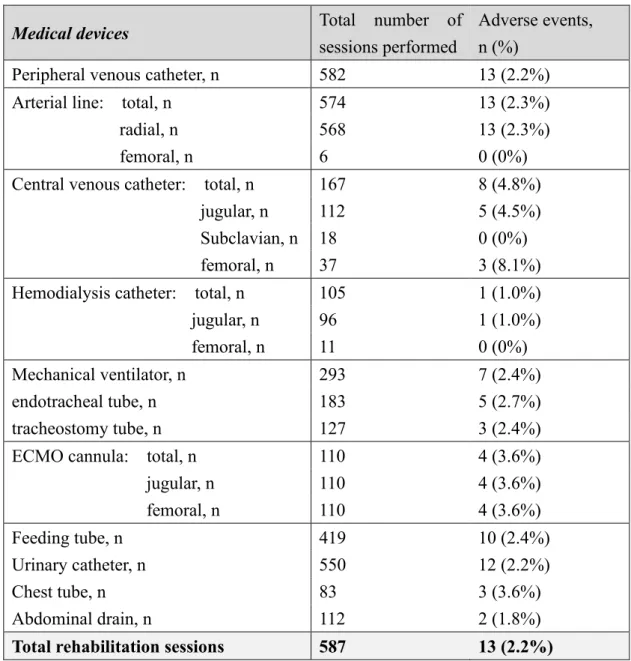
14 (3) 有害事象と医療デバイスの関係
静脈ルート(99%)、動脈ライン(98%)、尿道カテーテル(94%)が高頻度で使 用されていた(Table 7.)。587 回の離床介入のうち、293 回(50%)が人工呼吸器中、 110 回(19%)が extracorporeal membrane oxygenation(ECMO)中で、有害事象発生率
はそれぞれ2.4%、3.6%であった。医療デバイス関連の有害事象は認めなかった。
Table 7. 有害事象と医療デバイスの関係 (文献 34 より引用)
Medical devices Total number of
sessions performed
Adverse events, n (%)
Peripheral venous catheter, n 582 13 (2.2%) Arterial line: total, n 574 13 (2.3%)
radial, n 568 13 (2.3%)
femoral, n 6 0 (0%)
Central venous catheter: total, n 167 8 (4.8%) jugular, n 112 5 (4.5%) Subclavian, n 18 0 (0%) femoral, n 37 3 (8.1%) Hemodialysis catheter: total, n 105 1 (1.0%) jugular, n 96 1 (1.0%)
femoral, n 11 0 (0%)
Mechanical ventilator, n 293 7 (2.4%)
endotracheal tube, n 183 5 (2.7%)
tracheostomy tube, n 127 3 (2.4%)
ECMO cannula: total, n 110 4 (3.6%)
jugular, n 110 4 (3.6%) femoral, n 110 4 (3.6%) Feeding tube, n 419 10 (2.4%) Urinary catheter, n 550 12 (2.2%) Chest tube, n 83 3 (3.6%) Abdominal drain, n 112 2 (1.8%)
Total rehabilitation sessions 587 13 (2.2%) ECMO: extracorporeal membrane oxygenation
15 (4) プロトコール導入後の ICU における離床状況 ICU 入室後から離床介入までの期間は 0.7 日(四分位範囲 0.0-0.9 日)であっ た。ICU 滞在中に 62%の患者が端坐位(Level 3)の離床強度を達成し、入室から端坐 位達成までは1.2 日(四分位範囲 0.1-2.0 日)であった。 Table 8. プロトコール導入後の離床状況 (文献 34 より引用) Variable
All study patients (n=232) a
Values Median [IQR] or Number (%) Patients who could get out of bed, n (%) 143 (62%) Patients who could stand during ICU stay, n (%) 82 (35%) Patients who could ambulate during ICU stay, n (%) 49 (21%) Days to first rehabilitation session (days), median [IQR]a 0.7 [0.0-0.9]
Days to first out of bed (days), median [IQR]a 1.2 [0.1-2.0]
Days to first standing (days), median [IQR]a 1.2 [0.8-2.1]
Days to first ambulating (days), median [IQR]a 1.0 [0.7-1.7] IQR interquartile range
a Days counted from the time of ICU admission ICU: Intensive care unit
《小括》 ワーキンググループ結成後、自施設 ICU スタッフを対象とした障壁アンケート を経て、早期離床プロトコールを開発した。導入前には1ヶ月間のスタッフ教育を行っ た。プロトコール導入後、有害事象の発生率は 2.2%であった。離床強度を上げても有 害事象発生率は上昇せず、医療デバイス関連の有害事象も認めなかった。重症疾患 の急性期においても多くの患者が 2 日以内の端坐位以上の離床強度を達成できた。
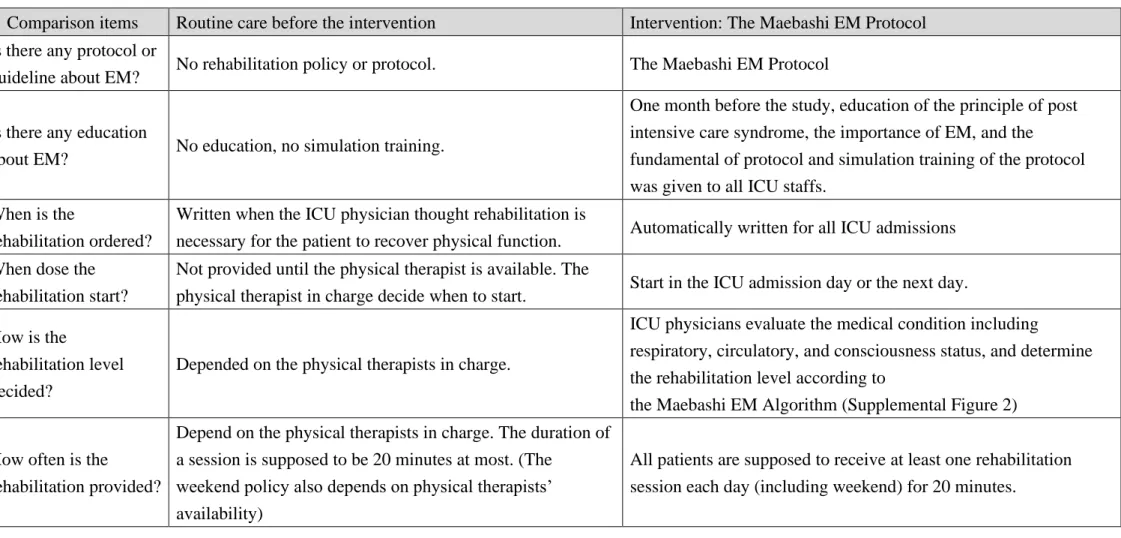
16 Ⅲ. 研究 2:前橋早期離床プロトコールの効果検証[35](倫理委員会承認番号 27-17) 《対象》 本研究は、単施設後ろ向き前後比較研究である。前橋赤十字病院ICU に、 緊急入室した18 歳以上の全ての患者を対象とした。ICU 入室後 2 日以内に退室し た軽症患者、積極的な離床が困難と思われる心血管疾患、脳血管疾患、進行性神経 筋疾患や心肺停止後症候群、不安定型骨盤骨折などの安静が必要な疾患を有する 患者は除外した。2014 年 1 月から 2015 年 5 月をプロトコール導入前群(Group A)、 2015 年 6 月から 2016 年 12 月までをプロトコール導入後群(Group B)とした。プロトコ ール導入前後で、日勤帯におけるICU スタッフ(集中治療科医、ICU 看護師)の人数 (集中治療科医4-5 名、看護師:患者=1:2)や体制に変わりはなかった。理学療法士 については、患者1 人に理学療法士が 1 人つく担当制であり、プロトコール導入前後 で変わりはなかった。ICU に常駐する専任・専従理学療法士はおらず、離床介入時に 得られるICU スタッフのマンパワーや器具などにも変わりはなかった。ICU 退室後の 一般病棟における離床体制はプロトコール導入前後で変わりはなく、人工呼吸器、鎮 痛鎮静、せん妄といった、早期離床以外の結果に影響を与えうるプロトコール作成や 治療方針の抜本的改革も研究期間中は行われなかった。早期離床に関する体制の 前後比較表を載せた(Table 9)。早期離床プロトコール導入のために、金銭的支援や 離床器具の設備投資などは行われなかった。
17 Table 9. 早期離床に関する体制の前後比較 (文献 35 より引用)
Comparison items Routine care before the intervention Intervention: The Maebashi EM Protocol Is there any protocol or
guideline about EM? No rehabilitation policy or protocol. The Maebashi EM Protocol
Is there any education
about EM? No education, no simulation training.
One month before the study, education of the principle of post intensive care syndrome, the importance of EM, and the
fundamental of protocol and simulation training of the protocol was given to all ICU staffs.
When is the
rehabilitation ordered?
Written when the ICU physician thought rehabilitation is
necessary for the patient to recover physical function. Automatically written for all ICU admissions When dose the
rehabilitation start?
Not provided until the physical therapist is available. The
physical therapist in charge decide when to start. Start in the ICU admission day or the next day. How is the
rehabilitation level decided?
Depended on the physical therapists in charge.
ICU physicians evaluate the medical condition including
respiratory, circulatory, and consciousness status, and determine the rehabilitation level according to
the Maebashi EM Algorithm (Supplemental Figure 2)
How often is the
rehabilitation provided?
Depend on the physical therapists in charge. The duration of a session is supposed to be 20 minutes at most. (The
weekend policy also depends on physical therapists’ availability)
All patients are supposed to receive at least one rehabilitation session each day (including weekend) for 20 minutes.
18 Who are the providers
of rehabilitation session?
a Principally the physical therapist, seldom ICU physician or
nurse.
b Multidisciplinary team consists of an ICU physician, a nurse, and
a physical therapist. If a physical therapist is not available, an ICU physician and nurses would provide rehabilitation. The day-shift ICU staff provides EM in the ICU.
Who monitor the patient during rehabilitation
The physical therapist in charge
The ICU physician monitor the hemodynamic and respiratory status of the patient and maintain vigilance over the central venous catheter, endotracheal tube, or ECMO cannula.
Who decide to stop the
rehabilitation? The physical therapist in charge without criteria
The ICU physician could decide whether to stop or continue the session based on discontinuous criteria (Supplemental table 1) or the patient’s medical condition.
The rehabilitation system on the general wards
No specific rehabilitation protocols. The frequency and degree of subsequent rehabilitation depended on the physical therapist in charge. There is seldom help from nurses and doctors.
Same as the routine care before the intervention.
ICU intensive care unit, EM early mobilization, ECMO extracorporeal membrane oxygenation, RASS Richmond Agitation-Sedation Scale
a When physical therapists want to mobilize a patient at an active rehabilitation level, such as sitting on edge of bed, standing, or
ambulating, they could request help to a nurse or ICU physician, but whether they could attend depended on the burden of their work on that day.
19 《調査項目》 主要評価項目は、院内死亡率と入院総医療費を前後比較し、院内死亡率を 最も重要なアウトカムとした。入院総医療費の算出は入院期間の総診療報酬点数を 基に行った。副次評価項目は、離床に関する効果検討として、各離床強度の達成率 と ICU 入室から各離床強度達成までの日数、臨床効果の検討として、人工呼吸器期 間、ICU 在室期間、入院期間、退院時自立歩行の割合、退院先、退院時身体機能に ついて前後比較検討を行った。また、ICU 入室時、入室中の最高値、退室時の
Sequential Organ Failure Assessment (SOFA)と各測定間の変化量について前後比較 を行った。
《統計解析》
患者背景因子の単純二群間比較には Mann-Whitney U-test または Fisher’s exact test を用いた。院内死亡率は、単純二群間比較(Fisher’s exact test)、および多変 量ロジスティック回帰分析を用いた多変量解析を行った。説明変数は、10%の欠損値
がある入室時身体機能を除いてすべての患者背景因子からAIC によるステップワイズ
方法を用いて選択し最終モデルを作成した。その際、早期離床プロトコール導入は強 制投入として固定した。入院総医療費については、単純二群間比較(Mann-Whitney U-test)と、分割間隔を 1 ヶ月とした平均入院総医療費の時系列を多重線形回帰分析
20 を用いてトレンド解析を行った。説明変数は院内死亡率と同様にAIC によるステップワ イズ方法で選出し最終モデルを作成した。2015 年 6 月はラグタイムまたは教育期間と し解析から除外した。入院総医療費は多変量解析モデル投入前に対数変換された。 最終モデルをもとに、予測入院医療費と実際の入院総医療費、そしてモデルから計算 されるプロトコールを導入していなかった場合のプロトコール導入後群(Group B)の入 院総医療費を1 ヶ月ごとの時系列として図で表した。 副次評価項目は、本研究の最重要アウトカムである院内死亡率の解析と同じ 説明変数を用いて多変量解析(多重線形回帰分析または多変量ロジスティック回帰 分析)を行った。SOFA については、中央値と四分位範囲および平均値と標準偏差で 示し、単純二群間比較(Mann-Whitney U-test、Fisher’s exact test)を行った。
《結果》
(1) 患者背景の比較 (Table 10.)
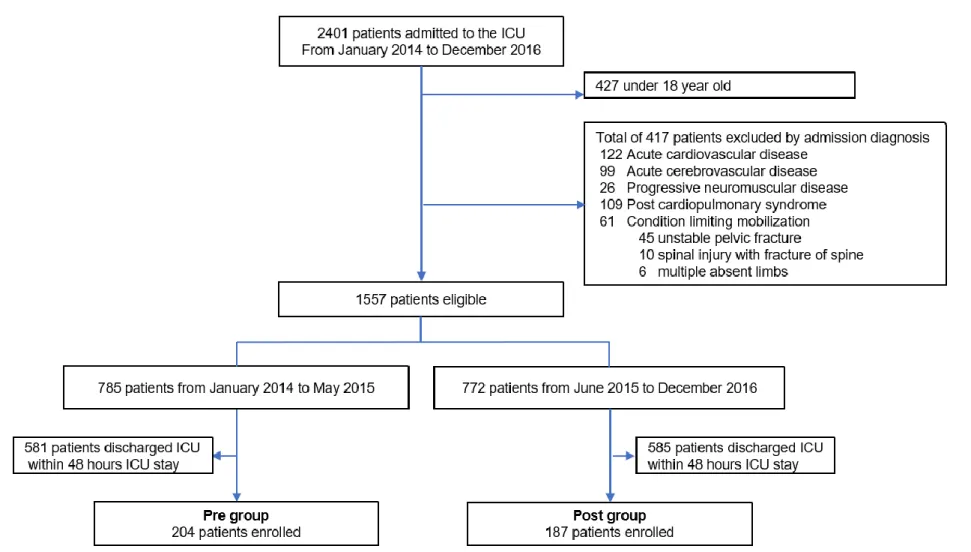
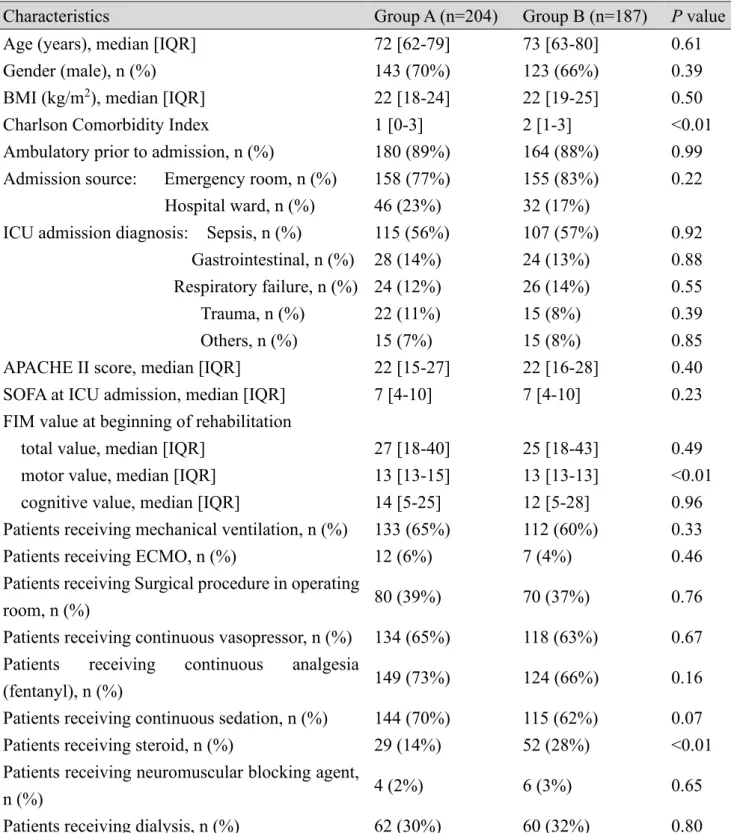
Group A に 204 名、Group B には 187 名の患者が登録された(Figure 3)。年 齢、性別、Body Mass Index (BMI)、入室時疾患背景、入室時 APACHEⅡ、入室時 SOFA、人工呼吸器や ECMO の使用率、昇圧薬、鎮痛剤、鎮静剤、透析の使用率と いった背景因子に有意差は認められなかった。ただし、Charlson Comorbidity Index
21 Figure 3 患者登録フローチャート (文献 35 より引用)
22
Table 10. 患者背景因子の比較 (文献 35 より引用)
Characteristics Group A (n=204) Group B (n=187) P value Age (years), median [IQR] 72 [62-79] 73 [63-80] 0.61
Gender (male), n (%) 143 (70%) 123 (66%) 0.39
BMI (kg/m2), median [IQR] 22 [18-24] 22 [19-25] 0.50
Charlson Comorbidity Index 1 [0-3] 2 [1-3] <0.01 Ambulatory prior to admission, n (%) 180 (89%) 164 (88%) 0.99 Admission source: Emergency room, n (%) 158 (77%) 155 (83%) 0.22
Hospital ward, n (%) 46 (23%) 32 (17%)
ICU admission diagnosis: Sepsis, n (%) 115 (56%) 107 (57%) 0.92 Gastrointestinal, n (%) 28 (14%) 24 (13%) 0.88 Respiratory failure, n (%) 24 (12%) 26 (14%) 0.55 Trauma, n (%) 22 (11%) 15 (8%) 0.39 Others, n (%) 15 (7%) 15 (8%) 0.85 APACHE II score, median [IQR] 22 [15-27] 22 [16-28] 0.40 SOFA at ICU admission, median [IQR] 7 [4-10] 7 [4-10] 0.23 FIM value at beginning of rehabilitation
total value, median [IQR] 27 [18-40] 25 [18-43] 0.49 motor value, median [IQR] 13 [13-15] 13 [13-13] <0.01 cognitive value, median [IQR] 14 [5-25] 12 [5-28] 0.96 Patients receiving mechanical ventilation, n (%) 133 (65%) 112 (60%) 0.33 Patients receiving ECMO, n (%) 12 (6%) 7 (4%) 0.46 Patients receiving Surgical procedure in operating
room, n (%) 80 (39%) 70 (37%) 0.76
Patients receiving continuous vasopressor, n (%) 134 (65%) 118 (63%) 0.67 Patients receiving continuous analgesia
(fentanyl), n (%) 149 (73%) 124 (66%) 0.16
Patients receiving continuous sedation, n (%) 144 (70%) 115 (62%) 0.07 Patients receiving steroid, n (%) 29 (14%) 52 (28%) <0.01 Patients receiving neuromuscular blocking agent,
n (%) 4 (2%) 6 (3%) 0.65
Patients receiving dialysis, n (%) 62 (30%) 60 (32%) 0.80 IQR interquartile range, BMI body mass index, ICU intensive care unit, APACHE Acute Physiology and Chronic Health Evaluation, SOFA Sequential Organ Failure Assessment, FIM functional independence measure, ECMO extracorporeal membrane oxygenation, Group A= pre-intervention, Group B=post intervention
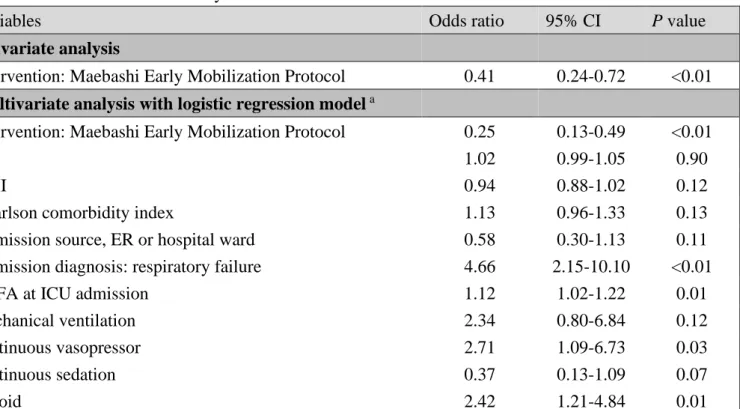
23 (2) 主要評価項目: 院内死亡率 (Table 11.)
プロトコール導入前後の院内死亡率は24%(Group A)から 11%(Group B)へ
低下し(調整P 値<0.01)、前橋早期離床プロトコールの導入が院内死亡率の低下と
有意に相関していた(調整P 値<0.01)。最終モデルの詳細を Table 11-B に示した。
Table 11. 院内死亡率の解析 (文献 35 より引用) A. The historical comparison of hospital mortality
Clinical and financial outcomes Group A (n=204) Group B (n=187) P value Adjusted P value In-hospital mortality, n (%) a 48 (24%) 21 (11%) <0.01 <0.01
B. The details of the analysis
Variables Odds ratio 95% CI P value
Univariate analysis
Intervention: Maebashi Early Mobilization Protocol 0.41 0.24-0.72 <0.01 Multivariate analysis with logistic regression model a Intervention: Maebashi Early Mobilization Protocol 0.25 0.13-0.49 <0.01
age 1.02 0.99-1.05 0.90
BMI 0.94 0.88-1.02 0.12
Charlson comorbidity index 1.13 0.96-1.33 0.13
Admission source, ER or hospital ward 0.58 0.30-1.13 0.11 Admission diagnosis: respiratory failure 4.66 2.15-10.10 <0.01
SOFA at ICU admission 1.12 1.02-1.22 0.01
mechanical ventilation 2.34 0.80-6.84 0.12
continuous vasopressor 2.71 1.09-6.73 0.03
continuous sedation 0.37 0.13-1.09 0.07
steroid 2.42 1.21-4.84 0.01
a Covariates were selected through a stepwise method with Akaike’s Information
Criterion: age, body mass index, Charlson comorbidity index, admission source, admission diagnosis: respiratory failure, Sequential Organ Failure Assessment score on admission, mechanical ventilation, continuous vasopressor, continuous sedation, and steroid use
24 (3) 主要評価項目: 入院総医療費 (Table 12.) 入院総医療費は29220 ドルから 22706 ドルに減少した(調整 P 値<0.01)。 患者一人につき5167 ドル(95%信頼区間: 1069-8304 ドル)、27%の医療費削減を 達成した。多変量解析の最終モデルをもとにFigure 4 を作成。プロトコール導入前 は、入院総医療費は有意差のない上昇傾向にあった(P 値=0.08)。プロトコール導入 直後より、有意に減少し(P 値=0.02)、その後 1.5 年間もの研究期間において有意に 持続的な減少を認めた(P 値=0.02)。最終モデルの詳細を Table 12-B に示す。 Figure 4. 多変量解析モデルによる入院総医療費の時系列変化 (文献 35 より引用)
25
Table 12. 入院総医療費の解析 (文献 35 より引用) A. The historical comparison of total hospital costs
Clinical and financial outcomes Group A (n=204) Group B (n=187) P value Adjusted p value Total hospital costs ($)
median [IQR] a 29220 [20021-47988] 22706 [12971-39256] <0.01 <0.01
a Covariates were selected in the same way as the analysis of mortality: body mass
index, ambulatory prior to admission, admission source, admission diagnosis: Sepsis, admission diagnosis: Trauma, extracorporeal membrane oxygenation, surgical, continuous vasopressor, continuous analgesia, and dialysis
B. Details of the final model
Variables Coefficient Standard error t-statistic P value VIF a. Segmented regression model before adjustment
Intercept β0 4.46 0.046 96.45 <0.01
Trend in the pre-period β1 0.003 0.005 0.64 0.52 Level change soon after the intervention β2 -0.190 0.07 -2.73 <0.01 Trend in the post-period β3 -0.003 0.006 -0.46 0.64 b. Final segmented regression model
Intercept β0 4.268 0.102 41.723 <0.01
Trend in the pre-period β1 0.007 0.004 1.776 0.08
Level change soon after the intervention β2 -0.142 0.059 -2.396 0.02
Trend in the post-period β3 -0.013 0.005 -2.430 0.02
BMI -0.006 0.003 -2.072 0.04 1.13
Ambulatory prior to admission 0.096 0.043 2.221 0.03 1.15 Admission source (ER) -0.181 0.035 -5.222 <0.01 1.09 ICU admission diagnosis: Sepsis 0.082 0.032 2.539 0.01 1.49 ICU admission diagnosis: Trauma 0.120 0.052 2.307 0.02 1.30 APACHE Ⅱ at ICU admission 0.003 0.002 1.417 0.16 1.99
ECMO 0.162 0.072 2.240 0.03 1.40
Surgical 0.064 0.029 2.198 0.03 1.15
vasopressor 0.087 0.034 2.511 0.01 1.58
analgesia 0.093 0.031 2.970 <0.01 1.20
Neuromuscular blocking agent 0.128 0.091 1.408 0.16 1.26
dialysis 0.150 0.033 4.558 <0.01 1.36
26 (4) 副次評価項目 (Table 13.) リハビリテーションを受けた患者の割合、端坐位、立位、歩行を達成した患者 の割合はGroup B で有意に増加していた。ICU 入室から各離床強度達成までの日数 もGroup B で有意に短縮し、プロトコール導入後 Group B では 78%の患者が 3 日以 内の端坐位を達成できた。また、Group B では、人工呼吸器時間の 40%減少、ICU 在室期間の17%短縮、生存患者における病院在院期間の 17%短縮を認めた。退院 時に自立歩行可能な患者はGroup B で有意に増加し、ICU 入室してから退院時まで
のFunctional Independence Measure の改善度合い(変化量)は Group B で有意に大 きかった。
(5) 臓器障害スコア(SOFA)の変化 (Table 14.)
ICU 入室時および ICU 入室中の最高値は両群で有意差は認めなかった。 ICU 退室時において、Group B で SOFA が低く(3.0 vs 2.0, P 値<0.01)、特に循環と呼 吸の値が低かった。ICU 入室時から最高値までの変化量は Group B で有意に低く、
入室時と退室時の変化量、最高値と退室時の変化量は共にGroup B で有意に大き
かった。ICU 入室から最高値までの変化量、最高値から ICU 退室時までの変化量、 ICU 入室から退室時までの変化量すべてにおいて、前橋早期離床プロトコールの導 入が有意に相関していた(Table 15.)。
27 Table 13. 副次評価項目 (文献 35 より引用) Outcomes Group A (n=204) Group B (n=187) Adjusted P value Rehabilitation Outcomes
Patients who received rehabilitation, n (%)a 122 (60%) 171 (91%) <0.01 Patients who could get out of bed, n (%)a 62 (30%) 146 (78%) <0.01 Patients who could stand during ICU stay, n (%)a 28 (14%) 83 (44%) <0.01 Patients who could ambulate during ICU stay, n (%)a 7 (3.4%) 40 (21%) <0.01 Days from ICU admission to first rehabilitation session (days), median [IQR]a 2.9 [2.0-4.0] 1.2 [0.8-2.0] <0.01 Days from ICU admission to first out of bed (days), median [IQR]a 5.1 [3.7-8.1] 2.0 [1.3-2.9] <0.01 Days from ICU admission to first standing (days), median [IQR]a 4.8 [3.8-7.1] 2.2 [1.5-3.7] <0.01
Days from ICU admission to first ambulating (days), median [IQR]a 4.7 [3.8-5.5] 2.0 [1.5-3.0] 0.09
Clinical and financial outcomes
Mechanical ventilation period (days), median [IQR]a 5.0 [2.7-8.9] 3.0 [1.9-6.0] <0.01
ICU Length of stay (days), median [IQR]a 6.5 [4.6-10.3] 5.4 [4.3-7.8] <0.01 Hospital Length of stay of all patients including death (days), median [IQR]a 32.6 [18.5-57.1] 25.4 [15.8-46.2] 0.53 Hospital Length of stay among survivors (days), median [IQR]a, b 34.4 [20.4-57.4] 27.3 [16.2-46.2] 0.02 Patients who ambulate independently without assistance at hospital discharge, n (%)a 106 (52%) 124 (66%) <0.01 Discharged destination: Home, n (%)a 83 (53%) 86 (52%) 0.20 Another hospital and rehabilitation center, n (%)a 63 (40%) 70 (42%) 0.07
Nursing home, n (%)a 10 (6.4%) 10 (6.0%) 0.51
28
FIM motor value at hospital discharge, median [IQR]a 56 [23-76] 68 [30-84] 0.05 FIM cognition value at hospital discharge, median [IQR]a 29 [19-35] 30 [19-35] 0.70
The gap of FIM sum value between the beginning of rehabilitation and hospital
discharge 48 [13-69] 57 [21-80] <0.01
The gap of FIM motor value between the beginning of rehabilitation and hospital
discharge 37 [7-57] 46 [17-67] <0.01
The gap of FIM cognitive value between the beginning of rehabilitation and hospital
discharge 8 [0-17] 6 [0-17] 0.26
IQR interquartile range, ICU intensive care unit, FIM functional independence measure
a P values were adjusted with the same covariates in the multiple analysis of the hospital mortality, the most clinical important outcome,
including age, body mass index, Charlson comorbidity index, admission source, admission diagnosis: respiratory failure, Sequential Organ Failure Assessment score on admission, mechanical ventilation, continuous vasopressor, continuous sedation, and steroid use
Table 14. Sequential Organ Failure Assessment の前後比較 (文献 35 より引用)
Variables Group A (n=204) Group B (n=187) P value Group A (n=204) Group B (n=187) P value At ICU admission SOFA sum 7.0 [4.0-10.0] 7.0 [4.0-10.0] 0.23 7.0 (3.9) 7.5 (4.0) 0.19 SOFA respiratory system 2.0 [1.0-3.0] 2.0 [1.0-3.0] 0.61 2.0 (1.3) 2.1 (1.2) 0.58 SOFA cardiovascular system 2.0 [0.0-4.0] 1.0 [0.0-4.0] 0.73 1.9 (1.8) 1.8 (1.8) 0.52 SOFA liver 0.0 [0.0-1.0] 0.0 [0.0-1.0] 0.72 0.4 (0.7) 0.4 (0.8) 0.65 SOFA kidneys 0.0 [0.0-2.0] 0.0 [0.0-2.0] 0.34 0.9 (1.3) 1.2 (1.5) 0.13
29
SOFA coagulation 0.0 [0.0-2.0] 1.0 [0.0-2.0] 0.38 0.9 (1.1) 1.0 (1.2) 0.32 SOFA nervous system 0.0 [0.0-1.0] 1.0 [0.0-2.0] 0.03 0.9 (1.3) 1.1 (1.2) 0.09
Maximum SOFA score during ICU stay
SOFA sum 8.0 [5.0-11] 8.0 [5.0-11] 0.87 8.4 (4.3) 8.3 (4.3) 0.89 SOFA respiratory system 2.0 [1.0-3.0] 2.0 [1.0-3.0] 0.53 2.2 (1.2) 2.2 (1.2) 0.53 SOFA cardiovascular system 3.0 [0.0-4.0] 3.0 [0.0-4.0] 0.56 2.2 (1.7) 2.0 (1.8) 0.35 SOFA liver 0.0 [0.0-1.0] 0.0 [0.0-1.0] 0.23 0.7 (1.0) 0.5 (0.9) 0.21 SOFA kidneys 0.0 [0.0-2.0] 0.0 [0.0-2.0] 0.95 1.1 (1.4) 1.2 (1.5) 0.66 SOFA coagulation 1.0 [0.0-2.0] 1.0 [0.0-2.0] 0.51 1.1 (1.2) 1.2 (1.3) 0.33 SOFA nervous system 1.0 [0.0-2.0] 1.0 [0.0-2.0] 0.16 1.2 (1.4) 1.3 (1.3) 0.37
At ICU discharge
SOFA sum 3.0 [2.0-5.0] 2.0 [1.0-4.0] <0.01 3.8 (2.8) 3.1 (2.4) <0.01 SOFA respiratory system 1.0 [1.0-2.0] 1.0 [0.0-1.0] <0.01 1.3 (1.0) 0.8 (0.8) <0.01 SOFA cardiovascular system 0.0 [0.0-0.0] 0.0 [0.0-0.0] 0.04 0.3 (0.9) 0.1 (0.6) 0.04 SOFA liver 0.0 [0.0-1.0] 0.0 [0.0-0.0] 0.38 04 (0.8) 0.4 (0.8) 0.55 SOFA kidneys 0.0 [0.0-1.0] 0.0 [0.0-1.0] 0.64 0.7 (1.3) 0.6 (1.3) 0.77 SOFA coagulation 0.0 [0.0-1.0] 0.0 [0.0-2.0] 0.16 0.6 (0.9) 0.8 (1.2) 0.04 SOFA nervous system 0.0 [0.0-1.0] 0.0 [0.0-1.0] 0.07 0.6 (0.9) 0.4 (0.8) 0.04
Change in SOFA score
between at ICU admission and at maximum 0.0 [0.0-2.0] 0.0 [0.0-1.0] <0.01 1.5 (2.2) 0.9 (1.6) <0.01 between at ICU admission and at ICU discharge 3.0 [0.0-5.0] 4.0 [2.0-6.0] <0.01 3.0 (3.3) 4.2 (3.0) <0.01 between at maximum and at ICU discharge 4.0[2.0-6.0] 5.0[2.0-7.0] <0.01 4.2 (3.1) 5.0 (3.0) <0.01
30
Table 15. 臓器障害と前橋早期離床プロトコール導入の関係 (文献 35 より引用)
Variables Coefficient 95% Confidence interval Standard error t-statistic P value A. Multiple linear regression analysis of the change in SOFA sum score between at ICU admission and at maximum
Univariate analysis
Intervention: Maebashi Early Mobilization Protocol -0.59 -0.97- -0.2 0.20 -3.01 <0.01
Multivariate analysis with regression modela
Intervention: Maebashi Early Mobilization Protocol -0.47 -0.85- -0.10 0.19 -2.48 0.01 B. Multiple linear regression analysis of the change in SOFA sum score between at ICU admission and at ICU discharge
Univariate analysis
Intervention: Maebashi Early Mobilization Protocol 1.28 0.64-193 0.33 3.91 <0.01
Multivariate analysis with regression modela
Intervention: Maebashi Early Mobilization Protocol 0.95 0.51-1.39 0.23 4.21 <0.01 C. Multiple linear regression analysis of the change in SOFA sum score between at maximum and at ICU discharge
Univariate analysis
Intervention: Maebashi Early Mobilization Protocol 0.85 0.23-1.47 0.32 2.68 <0.01
Multivariate analysis with regression modela
Intervention: Maebashi Early Mobilization Protocol 0.66 0.25-1.08 0.21 3.16 <0.01 SOFA sequential organ failure assessment, ICU intensive care unit
a the same covariates in the multiple analysis of the hospital mortality, the most clinical important outcome, was used: age, body mass
index, Charlson comorbidity index, admission source, admission diagnosis: respiratory failure, Sequential Organ Failure Assessment score on admission, mechanical ventilation, continuous vasopressor, continuous sedation, and steroid use
31 Ⅳ. 考察 (1) 研究 1 (早期離床プロトコールの開発と安全性評価)について 研究1 は、早期離床の専門チームや専門家が存在せず、また早期離床を通 常ケアとして行っていないICU で早期離床システムを立ち上げるまでのプロセスを提 示し、その安全性を評価した日本から発信された初めての早期離床に関する研究で ある。医師が主導し、離床に直接かかわることを特徴とする前橋早期離床プロトコール に沿って離床を行うことで、重症疾患の急性期で、医療デバイス使用下においても、 早期離床の専門チームが行う離床と同じ水準の有害事象発生率・安全性で離床を行 うことができた。日本の多くの病院が前橋赤十字病院と同様のICU 背景を有してお り、本研究結果は、他病院のICU で早期離床を推進する際にのロールモデルとなる 可能性がある。 前橋赤十字病院ICU で早期離床を推進するために、一番最初に行ったこと は、自施設の早期離床に対する障壁調査である。現在まで、非常に多くの障壁とその 対処法が報告されてきたが[41-44]、その全てに対応することは、多大な労力と費用を 必要とし困難である。そこで、実際にICU の離床に関わるスタッフを対象に障壁調査 を行うことで、自施設で離床を推進する際の最も克服すべき障壁を抽出することが可 能となる。それらに対処したシステムを考案することによって、最も効率よくICU で早 期離床を確立し推進できると考えられた。
32 前橋早期離床プロトコールは、障壁調査で明らかになった、重症患者の不安 定な循環呼吸の管理、医療デバイス、多職種間の協力やリーダーシップの欠如、人員 不足といった問題に対処するために、医師が離床を主導し、直接参加することが特徴 である。集中治療科医は、トレーニングの過程で、重症患者のバイタル管理や医療デ バイスの扱いに特化し、またICU における多職種連携の中心的役割を担う必要があ る[45, 46]。その臨床能力と管理能力をプロトコールに組み入れることで早期離床を 安全かつ円滑に推進できるのではないかと考えた。集中治療科医を含めた医師が関 わることでICU 業務の合併症が減り、安全性の向上につながったという報告もある [47-49]。結果として、前橋早期離床プロトコールは重篤な治療を必要とする有害事象 の発生なく、離床専門チームが主導する離床の報告(有害事象発生率:2.6%)[34]と 同水準の安全性)(研究1 の有害事象発生率:2.2%)で離床を行うことができた。ま た、重症疾患の急性期においても、循環呼吸の不安定さを増大することなく62%もの 患者がICU 入室後 2 日以内に端坐位以上の離床強度を達成することができた。ま た、離床強度に関わらず安全性は保たれ、人工呼吸器やECMO といった早期離床 の障壁と考えられている医療デバイス[40, 50]を装着している中でも有害事象発生率 の上昇なく安全な離床を行うことができた。
33 (2) 研究 2 (前橋早期離床プロトコールの効果検証)について 前橋早期離床プロトコール導入後、院内死亡率および入院総医療費の減少 を認め、入院総医療費減少効果は持続的であった。ICU の離床状況は激的に変化 し、前橋早期離床プロトコールは有意に患者アウトカム改善と相関していた。 院内死亡率の比較をする際、両群の比較可能性を最大限高めるために、文 献上死亡率に影響を与えうる因子[51-56]を説明変数とし多変量解析を行ったが、前 橋早期離床プロトコールの導入は院内死亡率減少と有意に相関していた。院内死亡 率が減少した原因として、導入後の臓器障害の改善、SOFA の低下が挙げられる。過 去の文献では、ICU 入室時と入室中の最高値の変化量、または入室時と退室時の変 化量が死亡率低下と相関し、SOFA の変化量が死亡率または治療効果の予測因子と なりえることを報告している[57, 58]。特に、循環の値の改善が最も予後改善に寄与す るとされ[59]、これらの報告と本研究の結果は一致していた。多変量解析では、前橋 早期離床プロトコールの導入はSOFA の改善と有意に相関することがわかった。早期 離床がSOFA を改善させるメカニズムは本研究からは明らかにはなっていない。しか し、いくつかの研究では全身性炎症における保護作用や、抗炎症性サイトカインの導 入といった効果が早期離床にあることが指摘されている[60, 61]。今後、早期離床と死 亡率改善や臓器障害改善との因果関係を検討するためには多施設ランダム化研究が 必要である。
34 入院総医療費の解析では、多変量解析を用いて入院医療費の予測モデル を作成し、経時的な入院医療費の推移を検討した。結果、前橋早期離床プロトコール の導入は有意に入院総医療費を減少させ、減少効果はプロトコール導入後持続的に 認められた。以前の費用対効果を検討した研究では、2時点または3時点での比較が 中心であり[21, 22]、早期離床の経時的な経済的影響を検証したのは本研究が初め てであった。早期離床の経済的効果は、様々なアウトカム改善の組み合わせで得られ るものと考えられている[22, 62-64]。本研究でも、人工呼吸器期間の短縮、ICU 入室 期間・病院在院期間の減少、退院時身体機能の向上といったアウトカムの改善が認め られており、このような経済的効果が得られたと思われる。 前橋早期離床プロトコールの導入は、ICU の離床状況を劇的に変化させた。 ICU 入室中にリハビリテーションを受けた患者の割合、端坐位、立位、歩行を達成した 患者の割合は有意に増加し、また各離床強度までの日数も有意に短縮した。早期離 床の効果を最大限にするために3日以内の端坐位以上の離床強度達成が推奨され ているが[19, 26]、本研究のプロトコール導入後群(Group B)では、多くの患者が3日 以内の端坐位を達成できており、様々なアウトカム改善につながったと思われる。重症 疾患の急性期から早期離床を導入することは、患者のより良い、そしてより早い回復と 相関することが示された。
35 Ⅴ. 課題と今後の展望 本研究の共通課題として、どちらも小規模単施設研究であることが挙げられ る。研究結果の外的妥当性を確認するには、より大きなサンプルサイズで前向き多施 設研究を行う必要がある。また、対象患者選択における除外基準が多いことから、本 研究結果がICU 患者全体に適応できるかどうかを検討する必要がある。ICU 全体を 対象とした場合と、本研究結果が異なる場合、早期離床プロトコールを導入することで 得られる効果を最大化する適切な対象患者層を調査することが必要となる。 効果を検討した研究[35]は、後ろ向き非ランダム化前後比較研究であり、両 群の比較可能性という観点で多くの問題が残っている。未調整・未測定の交絡因子、 時間経過における診療レベルの向上、診療報酬改定による入院医療費算出への影 響といった検討すべき事項が存在する。これらの問題を解決するためには、本プロトコ ールを用いた多施設前向きランダム化研究を行う必要がある。 本研究では、退院時を中心とした短期アウトカムが主評価対象であった。今 後の展望として、早期離床が患者に与える長期的効果や影響を検証するため、長期 的予後に加えて、ADL、QOL、PICS(身体・認知・メンタル障害)といったアウトカムを 病院退院後も経時的に評価し、年単位での経過をフォローしていく予定である。その 過程で、ICU 退室患者とその家族の長期フォローシステムを確立し、ICU 退室患者の データベース構築を目指す。
36 Ⅵ. 結語 自施設 ICU の早期離床に対する障壁を調査した結果をもとに前橋早期離床 プロトコールを開発した。医師主導という特徴をもつ前橋早期離床プロトコールに基づ いた離床は、人工呼吸器や ECMO などの医療デバイスが装着された重症患者の急 性期においても重篤な有害事象の発生なく安全に行うことできた。前橋早期離床プロ トコールの導入後、院内死亡率の低下や入院総医療費の減少が観察された。プロトコ ール導入は院内死亡率低下と有意に相関していた。また、プロトコールの導入直後か ら入院総医療費の有意な減少が認められ、効果は持続的であった。今後、前橋早期 離床プロトコールの外的妥当性および早期離床とアウトカムの更なる因果関係の検討 のために、多施設前向きランダム化研究が必要である。
37 【引用文献】
1. Friedman G, Silva E, Vincent JL. Has the mortality of septic shock changed with time. Crit Care Med. 26:2078-86. 1998.
2. Levy MM, Dellinger RP, Townsend SR, Linde-Zwirble WT, Marshall JC, Bion J, Schorr C, Artigas A, Ramsay G, Beale R, Parker MM, Gerlach H, Reinhart K, Silva E, Harvey M, Regan S, Angus DC; Surviving Sepsis Campaign. The Surviving Sepsis Campaign: results of an international guideline-based performance improvement program targeting severe sepsis. Crit Care Med. 38:367-74. 2010.
3. Burch JM, Ortiz VB, Richardson RJ, Martin RR, Mattox KL, Jordan GL Jr. Abbreviated laparotomy and planned reoperation for critically injured patients. Ann Surg. 215:476. 1992.
4. Gutierrez G, Reines HD, Wulf-Gutierrez ME. Clinical review: hemorrhagic shock. Crit Care. 8:373-81. 2004.
5. Brun-Buisson C, Minelli C, Bertolini G, Brazzi L, Pimentel J, Lewandowski K, Bion J, Romand JA, Villar J, Thorsteinsson A, Damas P, Armaganidis A, Lemaire F; ALIVE Study Group. Epidemiology and outcome of acute lung injury in European intensive care units. Results from the ALIVE study. Intensive Care Med. 30:51-61. 2004.
38
respiratory distress syndrome: nationwide changes in incidence, treatment and mortality over 23 years. Acta Anaesthesiol Scand. 57:37-45. 2013.
7. Herridge MS, Cheung AM, Tansey CM, Matte-Martyn A, Diaz-Granados N, Al-Saidi F, Cooper AB, Guest CB, Mazer CD, Mehta S, Stewart TE, Barr A, Cook D, Slutsky AS; Canadian Critical Care Trials Group. One-year outcomes in survivors of the acute respiratory distress syndrome. N Engl J Med. 348:683-93. 2003.
8. Kamdar BB, Huang M, Dinglas VD, Colantuoni E, von Wachter TM, Hopkins RO, Needham DM; National Heart, Lung, and Blood Institute Acute Respiratory Distress Syndrome Network. Joblessness and lost earnings after ARDS in a 1-year national multicenter study. Am J Respir Crit Care Med. 196:1012-20. 2017.
9. Harvey MA, Davidson JE. Postintensive Care Syndrome: Right Care, Right Now… and Later. Crit Care Med. 44:381-5. 2016.
10. Iwashyna TJ, Ely EW, Smith DM, Langa KM. Long-term cognitive impairment and functional disability among survivors of severe sepsis. JAMA. 304:1787-94. 2010.
11. Griffith J, Hatch RA, Bishop J, Morgan K, Jenkinson C, Cuthbertson BH, Brett SJ. An exploration of social and economic outcome and associated health-related quality of life after critical illness in general intensive care unit survivors: a 12-month follow-up study. Crit Care. 17:R100. 2017.
39
12. Hill AD, Fowler RA, Pinto R, Herridge MS, Cuthbertson BH, Scales DC. Long-term outcomes and healthcare utilization following critical illness –a population-based study. Crit Care. 20:76. 2016.
13. Kahn JM, Le T, Angus DC, Cox CE, Hough CL, White DB, Yende S, Carson SS; ProVent Study Group Investigators. The epidemiology of chronic critical illness in the United States. Crit Care Med. 43:282-287. 2015.
14. Oeyen SG, Vandijick DM, Benoit DD, Annemans L, Decruyenaere JM. Quality of life after intensive care: a systematic review of the literature. Crit Care Med. 38:2386-2400. 2010.
15. Needham DM, Davidson J, Cohen H, Hopkins RO, Weinert C, Wunsch H, Zawistowski C, Bemis-Dougherty A, Berney SC, Bienvenu OJ, Brady SL, Brodsky MB, Denehy L, Elliott D, Flatley C, Harabin AL, Jones C, Louis D, Meltzer W, Muldoon SR, Palmer JB, Perme C, Robinson M, Schmidt DM, Scruth E, Spill GR, Storey CP, Render M, Votto J, Harvey MA. Improving long-term outcomes after discharge from intensive care unit: report from a stakeholders’ conference. Crit Care Med. 40:502-9. 2012.
16. Hodgson CL, Stiller K, Needham DM, Tipping CJ, Harrold M, Baldwin CE, Bradley S, Berney S, Caruana LR, Elliott D, Green M, Haines K, Higgins AM, Kaukonen KM,
40
Leditschke IA, Nickels MR, Paratz J, Patman S, Skinner EH, Young PJ, Zanni JM, Denehy L, Webb SA. Expert consensus and recommendations on safety criteria for active mobilization of mechanically ventilated critically ill adults. Crit Care. 18:658. 2014.
17. Schaller SJ, Anstey M, Blobner M, Edrich T, Grabitz SD, Gradwohl-Matis I, Heim M, Houle T, Kurth T, Latronico N, Lee J, Meyer MJ, Peponis T, Talmor D, Velmahos GC, Waak K, Walz JM, Zafonte R, Eikermann M; International Early SOMS-guided Mobilization Research Initiative. Early, goal-directed mobilisation in the surgical intensive care unit: a randomised controlled trial. Lancet. 388:1377-1388. 2016.
18. Morris PE, Goad A, Thompson C, Taylor K, Harry B, Passmore L, Ross A, Anderson L, Baker S, Sanchez M, Penley L, Howard A, Dixon L, Leach S, Small R, Hite RD, Haponik E. Early intensive care unit mobility therapy in the treatment of acute respiratory failure. Crit Care Med. 36:2238-2243. 2008.
19. Schweickert WD, Pohlman MC, Pohlman AS, Nigos C, Pawlik AJ, Esbrook CL, Spears L, Miller M, Franczyk M, Deprizio D, Schmidt GA, Bowman A, Barr R, McCallister KE, Hall JB, Kress JP. Early physical and occupational therapy in mechanically ventilated, critically ill patients: a randomized controlled trial. Lancet. 373:1874-1882. 2009.
41
20. Tipping CJ, Harrold M, Holland A, Romero L, Nisbet T, Hodgson CL. The effects of active mobilization and rehabilitation in ICU on mortality and function: a systematic review. Intensive Care Med. 43:171-183. 2017.
21. Hester JM, Guin PR, Danek GD, Thomas JR, Titsworth WL, Reed RK, Vasilopoulos T, Fahy BG. The Economic and Clinical Impact of Sustained Use of a Progressive Mobility Program in a Neuro-ICU. Crit Care Med. 45:1037-1044. 2017.
22. Lord RK, Mayhew CR, Korupolu R, Mantheiy EC, Friedman MA, Palmer JB, Needham DM. ICU early physical rehabilitation programs: financial modeling of cost savings. Crit Care Med. 41:717-724. 2013.
23. Kayambu G, Boots R, Paratz J. Physical therapy for the critically ill in the ICU: a systematic review and meta-analysis. Crit Care Med. 41:1543-1554. 2013.
24. Barr J, Fraser GL, Puntillo K, Ely EW, Gélinas C, Dasta JF, Davidson JE, Devlin JW, Kress JP, Joffe AM, Coursin DB, Herr DL, Tung A, Robinson BR, Fontaine DK, Ramsay MA, Riker RR, Sessler CN, Pun B, Skrobik Y, Jaeschke R; American College of Critical Care Medicine. Clinical practice guidelines for the management of pain, agitation, and delirium in adult patients in the intensive care unit. Crit Care Med. 41:263-306. 2013.
42
Fisher B, Harvey RL, Lang CE, MacKay-Lyons M, Ottenbacher KJ, Pugh S, Reeves MJ, Richards LG, Stiers W, Zorowitz RD; American Heart Association Stroke Council, Council on Cardiovascular and Stroke Nursing, Council on Clinical Cardiology, and Council on Quality of Care and Outcomes Research. Guidelines for Adult Stroke Rehabilitation and Recovery: A Guideline for Healthcare Professionals From the American Heart Association/American Stroke Association. Stroke. 47:e98-e169. 2016.
26. Denehy L, Lanphere J, Needham DM: Ten reasons why ICU patients should be mobilized early. Intensive Care Med. 43:86-90. 2017.
27. Needham DM, Korupolu R, Zanni JM, Pradhan P, Colantuoni E, Palmer JB, Brower RG, Fan E. Early physical medicine and rehabilitation for patients with acute respiratory failure: a quality improvement project. Arch Phys Med Rehabil. 91:536-42. 2010.
28. Baily P, Thomsen GE, Spuhler VJ, Jewkes J, Bezdjian L, Veale K, Rodriquez L, Hopkins RO. Early activity is feasible and safe in respiratory failure patients. Crit Care Med. 35:139-45. 2007.
29. Klein K, Mulkey M, Bena JF, Albert NM. Clinical and psychological effects of early mobilization in patients treated in a neurological ICU: a comparative study. Crit Care
43 Med. 43:865-73. 2015.
30. Burtin C, Clerckx B, Robbeets C, Ferdinande P, Langer D, Troosters T, Hermans G, Decramer M, Gosselink R. Early exercise in critically ill patients enhances short-term functional recovery. Crit Care Med. 37:2499-505. 2009.
31. Sricharoenchai T, Parker AM, Zanni JM, Nelliot A, Dinglas VD, Needham DM. Safety of physical therapy interventions in critically ill patients: a single center prospective evaluation of 1110 intensive care unit admissions. J Crit Care. 29:395-400. 2014.
32. Bourdin G, Barbier J, Burle JF, Durante G, Passant S, Vincent B, Badet M, Bayle F, Richard JC, Guérin C. The Feasibility of Early Physical Activity in Intensive Care Unit Patients: A Prospective Observational One-Center Study. Respir Care. 55:400-7. 2010.
33. Zanni JM, Korupolu R, Fan E, Pradhan P, Janjua K, Palmer JB, Brower RG, Needham DM. Rehabilitation therapy and outcomes in acute respiratory failure: an observational pilot project. J Crit Care. 25:254-62. 2010.
34. Liu K, Ogura T, Takahashi K, Nakamura M, Ohtake H, Fujiduka K, Abe E, Oosaki H, Miyazaki D, Suzuki H, Nishikimi M, Lefor AK, Mato T. The safety of a novel early mobilization protocol conducted by ICU physicians: a prospective observational
44 study. J Intensive Care. 6:10. 2018.
35. Liu K, Ogura T, Takahashi K, Nakamura M, Ohtake H, Fujiduka K, Abe E, Oosaki H, Miyazaki D, Suzuki H, Nishikimi M, Komatsu M, Lefor AK, Mato T. A Progressive Early Mobilization Program Is Significantly Associated With Clinical and Economic Improvement: A Single-Center Quality Comparison Study. Crit Care Med. 47. 2019. In press.
36. Cameron S, Ball I, Cepinskas G, Choong K, Doherty TJ, Ellis CG, Martin CM, Mele TS, Sharpe M, Shoemaker JK, Fraser DD. Early mobilization in the critical care unit: A review of adult and pediatric literature. J Crit Care. 30:664-72. 2015.
37. Jolley SE, Regan-Baggs J, Dickson RP, Hough CL. Medical intensive care unit clinician attitudes and perceived barriers towards early mobilization of critically ill patients: a cross-sectional survey study. BMC Anesthesiol. 14:84. 2014.
38. Pohlman MC, Schweickert WD, Pohlman AS, Nigos C, Pawlik AJ, Esbrook CL, Spears L, Miller M, Franczyk M, Deprizio D, Schmidt GA, Bowman A, Barr R, McCallister K, Hall JB, Kress JP. Feasibility of physical and occupational therapy beginning from initiation of mechanical ventilation. Crit Care Med. 38:2089-2094. 2010.
45
the acute exercise response between passive and active sitting in critically ill patients. BMC Anesthesiol. 15:1. 2015.
40. Lee H, Ko YJ, Yang JH, Park CM, Jeon K, Park YH, Chung CR. Safety profile and feasibility of early physical therapy and mobility for critically ill patients in the medical intensive care unit: Beginning experiences in Korea. J Crit Care. 30:673-7. 2015.
41. Costa DK, White MR, Ginier E, Manojlovich M, Govindan S, Iwashyna TJ, Sales AE. Identifying Barriers to Delivering the Awakening and Breathing Coordination, Delirium, and Early Exercise/Mobility Bundle to Minimize Adverse Outcomes for Mechanically Ventilated Patients: A Systematic Review. Chest. 152:304-311. 2017.
42. Parry SM, Knight LD, Connolly B, Baldwin C, Puthucheary Z, Morris P, Mortimore J, Hart N, Denehy L, Granger CL. Factors influencing physical activity and rehabilitation in survivors of critical illness: a systematic review of quantitative and qualitative studies. Intensive Care Med. 43:531-542. 2017.
43. Parry SM, Remedios L, Denehy L, Knight LD, Beach L, Rollinson TC, Berney S, Puthucheary ZA, Morris P, Granger CL. What factors affect implementation of early rehabilitation into intensive care unit practice? A qualitative study with clinicians. J Crit Care. 38:137-143. 2017.
46
44. Dubb R, Nydahl P, Hermes C, Schwabbauer N, Toonstra A, Parker AM, Kaltwasser A, Needham DM. Barriers and Strategies for Early Mobilization of Patients in Intensive Care Units. Ann Am Thorac Soc. 13(5):724-30. 2016.
45. Guidelines for the definition of an intensivist and the practice of critical care medicine. Guidelines Committee; Society of Critical Care Medicine. Crit Care Med. 20:540-2. 1992.
46. Gutche JT, Kohl BA. Who should care for intensivist care unit patietns? Crit Care Med. 35:S18-S23. 2007.
47. Pronovost PJ, Jenckes MW, Doman T, Garrett E, Breslow MJ, Rosenfeld BA, Lipsett PA, Bass E. Organizational characteristics of intensive care units related to outcomes of abdominal aortic surgery. JAMA. 281:1310-7. 1999.
48. Pronovost PJ, Angus DC, Dorman T, Robinson KA, Dremsizov TT, Young TL. Physician staffing patterns and clinical outcomes in critically ill patients: A systematic review. JAMA. 288:2151–62. 2002.
49. Young MP, Birkmeyer JD. Potential Reduction in Mortality Rates Using an Intensivist Model To Manage Intensive Care Units. Eff Clin Pract. 6:284–9. 2000.
50. Jolley SE, Moss M, Needham DM, Caldwell E, Morris PE, Miller RR, Ringwood N, Anders M, Koo KK, Gundel SE, Parry SM, Hough CL; Acute Respiratory Distress
47
Syndrome Network Investigators. Point prevalence study of mobilization practices for acute respiratory failure patients in the United States. Crit Care Med. 45:205-15. 2017.
51. Pun BT, Balas MC, Barnes-Daly MA, Thompson JL, Aldrich JM, Barr J, Byrum D, Carson SS, Devlin JW, Engel HJ, Esbrook CL, Hargett KD, Harmon L, Hielsberg C, Jackson JC, Kelly TL, Kumar V, Millner L, Morse A, Perme CS, Posa PJ, Puntillo KA, Schweickert WD, Stollings JL, Tan A, D'Agostino McGowan L, Ely EW. Caring for Critically Ill Patients with the ABCDEF Bundle: Results of the ICU Liberation Collaborative in Over 15,000 Adults. Crit Care Med. 47:3-14. 2019.
52. Pavon A, Binquet C, Kara F, Martinet O, Ganster F, Navellou JC, Castelain V, Barraud D, Cousson J, Louis G, Perez P, Kuteifan K, Noirot A, Badie J, Mezher C, Lessire H, Quantin C, Abrahamowicz M, Quenot JP; EPIdemiology of Septic Shock (EPISS) Study Group. Profile of the risk of death after septic shock in the present era: an epidemiologic study. Crit Care Med. 41:2600-2609. 2013.
53. Wilkman E, Kaukonen KM, Pettilä V, Kuitunen A, Varpula M. Association between inotrope treatment and 90-day mortality in patients with septic shock. Acta Anaesthesiol Scand. 57:431-442. 2013.