Original
Association between Recovery Experience and Mental Health in
Firefighters as Compared with Clerical Staff: A Cross-sectional Study
Tsubasa Iwasa1) , Tomoko Takamiya1) , Yuko Odagiri1) , Noritoshi Fukushima1) , Toshio Hayashi1) , Makiko Kitabayashi1)2)
and Shigeru Inoue1)
1)Department of Preventive Medicine and Public Health, Tokyo Medical University
2)Faculty of Health Sciences, Kyorin University
(Received: October 6, 2017)
Abstract
Objectives: Recovery experiences are the way that workers spend their off-time to recover from work-related stress. Recovery experiences were reported to be associated with favorable mental health. In firefight-ers who are exposed to unique stressors, the significance of recovery experiences in maintaining mental health may differ from that of other occupations. However, few studies have examined the associations between re-covery experiences and mental health in firefighters. Therefore, we examined the associations between recov-ery experiences and depressive symptoms in firefighters, in comparison with clerical staff.
Methods: This cross-sectional study was conducted in November 2013. Subjects were male firefighters and clerical staff working in a local municipality. Depressive symptoms were assessed using the Japanese ver-sion of the Center for Epidemiologic Studies Depresver-sion Scale. Those with a score of 16 points or higher were regarded as having depressive symptoms. Recovery experiences were assessed with the Japanese Version of the Recovery Experience Questionnaire (REQ-J). REQ-J has four subscales: psychological detachment, relaxa-tion, mastery, and control. Each subscale score was calculated independently. Multiple logistic regression analysis was performed for each occupation with depressive symptoms as the dependent variable, and each recovery experience subscale as the independent variables. Adjusted odds ratios (AdjORs) and 95% confi-dence intervals (95% CI) were calculated.
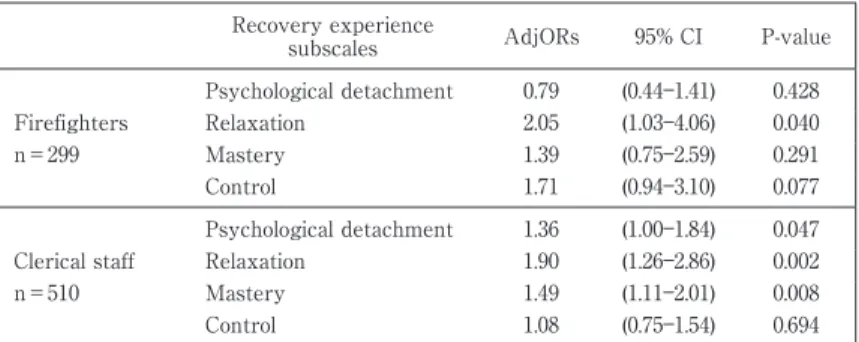
Results: A total of 299 firefighters and 510 clerical staff were included in the analysis. The absence of de-pressive symptoms was significantly associated with a high relaxation score [AdjORs (95% CI) 2.05 (1.03―4.06)] in firefighters. Whereas, the absence of depressive symptoms was significantly associated with psychological detachment [1.36 (1.00―1.84)], relaxation [1.90 (1.26―2.86)], and mastery [1.49 (1.11―2.01)] in clerical staff.
Conclusions: Relaxation was the only dimension that was significantly associated with the absence of de-pressive symptoms in firefighters, whereas relaxation as well as psychological detachment and mastery were significant in clerical staff, showing a possible difference in the associations between firefighters and clerical staff. Therefore, measures focusing on relaxation to prevent depressive symptoms may be useful for firefight-ers.
(JJOMT, 66: 404―412, 2018)
―Key words―
firefighters, recovery experiences, depressive symptoms
Introduction
Recently, the number of ambulance dispatches has been rapidly increasing in Japan and an emergency car, such as an ambulance, is dispatched once every 5.3 seconds, according to the report of the Ministry of
In-ternal Affairs and Communications of Japan1)
. Firefighters are required to be ready for emergency calls and to take on various responsibilities, such as firefighting, emergency care, and/or rescue work. These
responsibili-ties often come with the exposure to life-threatening situations and emotionally traumatic experiences.
Fire-fighters are thus continuously exposed to both physical burden and psychological stress2)3)
, and therefore,
burn-out among firefighters is a concern, particularly due to increases in their workload2)
.
These stressful situations cannot be avoided in view of the work mission of firefighters, and hence they
need to be adequately managed. One strategy is to intervene in stressors, such as variance in workload4)
, inter-group conflict4)
, role conflict4)
, and organization system5)
among firefighters.
Another strategy is to focus on how to spend their off-time to recover from work-related stress. Recovery in this situation refers to the recovery process during which an individual s psychobiological systems that have
been taxed during a stressful experience return to their baseline levels6)7)
. Recovery can also be seen as a proc-ess opposite to the strain procproc-ess, during which the detrimental effects of strproc-essful situations are alleviated or eliminated7)8)
. Sonnentag et al.7)
called this process recovery experiences , and demonstrated that recovery ex-periences have the following four dimensions: psychological detachment, relaxation, mastery, and control. Psy-chological detachment means physically and mentally distancing oneself from work and being in a state of not
thinking about work7)9)
. Relaxation is characterized by a state of low activation and associated with a positively toned affect7)10)
. Mastery is personal development of leisure time7)
. Control is the degree to which a person can
decide which activity to pursue during leisure time, as well as when and how to pursue this activity7)
.
According to a previous study, recovery is regarded as an explanatory mechanism in the relationship
be-tween acute stress reactions and chronic health impairment11)
. Particularly, psychological detachment is
consid-ered to be a significant dimension for maintaining mental health in work settings12)13)
. High psychological
de-tachment scores are associated with good psychological well-being7)8)14)
. These studies suggest that achieving psychological detachment from work during off-time can weaken the negative impact of stress during work.
However, for firefighters who have a prolonged period of preparation for emergency on a regular basis3)
, it may be difficult to psychologically detach from work during their off-times. In the aforementioned studies, the relationship between recovery experiences and mental health has been examined among subjects with vari-ous occupations, such as transport and postal services, whole sale and retail trade, accommodation, food indus-try8)
, social workers and psychiatric staff15)
, or teachers and hotel staff together16)
, but not firefighters who are
exposed to unique stressors3)17)
.
Among the four dimensions of the recovery experience, the dimension that significantly affects health status may differ among occupations. Although psychological detachment has been examined in various stud-ies7)8)11)13)14)
, the other dimensions has been examined in only a few studies to our knowledge12)16)18)
. For example, a previous study by de Bloom et al. on knowledge-intensive workers, such as media, information technology, en-gineering, medical staff, education, etc., showed that self-rated health was strongly associated with relaxation,
although they did not stratify a large sample by occupational characteristics18)
. A previous study on various oc-cupational workers, such as teachers and hotel staff, showed that ococ-cupational well-being was associated with
mastery16)
. However, findings of mastery and control were less consistent compared with psychological
detach-ment as detach-mentioned in a review study12)
. Elucidation of a significant dimension among firefighters may lead to the development of effective stress management strategies for firefighters.
We therefore examined the associations between all four dimensions of recovery experience and depres-sive symptoms in firefighters, to identify the dimensions that significantly affected their depresdepres-sive symptoms.
In order to compare with firefighters who are exposed to unique stressors3)17)
, we also examined the association among clerical staff as a representative of a general occupation and examined the interactions between these two occupations.
Methods Subjects and procedures
This cross-sectional study was conducted in November 2013. Self-administered questionnaires were dis-tributed to all 3,115 employees aged 18 to 65 in a Japanese municipality with a population of about 470,000, and were collected 1 week after the distribution. As more than 90% of the firefighters were men, we decided to in-clude only male firefighters and clerical staff in the analysis. The study was approved by the ethics committee
of Tokyo Medical University (study approval no. 2506) before commencement and has been carried out in com-pliance with the Declaration of Helsinki.
Depressive symptoms
Depressive symptoms were assessed using the Japanese version of the Center for Epidemiologic Studies
Depression Scale (CES-D)19)20)
. The scale is composed of 20 items. All items were scored on a four-point Likert scale ranging from 0 (less than 1 day during the past week) to 3 (5―7 days during the past week), and scores were summed. Persons with a score of 16 points or higher were regarded as having depressive symptoms
ac-cording to a previous study20)
. Recovery experiences
Recovery experiences were assessed using the Japanese Version of the Recovery Experience
Question-naire (REQ-J) developed by Shimazu et al.21)
. This scale was translated from the original version created by Son-nentag et al.7)
. Participants were asked about how they spend their time after their day s work is over. All items were scored on a five-point Likert scale ranging from 1 (do not agree at all) to 5 (fully agree). The items are grouped into four subscales that reflect the underlying dimensions of recovery experience: psychological de-tachment (4 items) (e.g., I distance myself from my work ), relaxation (4 items) (e.g., I do relaxing things ), mastery (4 items) (e.g., I do things that challenge me ), and control (4 items) (e.g., I determine for myself how I will spend my time ). Responses for each item were summed and divided by item number to get an average score for each subscale. Higher scores indicate positive experiences.
Subject attributes and other questions
Participants were asked their age, marital status (yes or no to the presence of a spouse), presence of
chronic diseases (yes or no), smoking status (yes or no), alcohol consumption status (<20 g, 20 to 40 g, or!40
g), sleep time (<6 hours, 6 to 7.5 hours, or!7.5 hours), exercise (yes or no to exercising two or more days a
week), job position (managerial or non-managerial), and amount of overtime work hours. For chronic diseases, participants were asked if they had a history of high-blood pressure, stroke, heart attack, or diabetes. The re-sponse was yes if the participant had one or more illnesses and no if they had none of those illnesses. Smok-ing status was yes for current smokers and no for past and non-smokers. For alcohol consumption status,
daily alcohol consumption was calculated using the brief-type self-administered diet history questionnaire22)
.
Respondents were divided into three groups, <20 g, 20 to 40 g, and!40 g, based on 20 g as the cutoff for the
appropriate amount of alcohol23)
and 40 g as the cutoff for the amount of alcohol that increases the risk of devel-oping lifestyle diseases24)
. For sleep time, participants were asked how long they slept each day on average in hours and minutes. About 7 hours is said to be the cutoff for the amount of sleep with low health risks for healthy adults25) 27)
, so sleep time was divided into <6 hours, 6 to 7.5 hours, or!7.5 hours. For exercise,
partici-pants were asked how many days a week they exercised, and responses were dichotomized at 2 days a week
(yes or no to!2 days/week) that is the recommendation for all generations in Japan28)
. For overtime work, par-ticipants were asked how many hours of overtime they had worked during the past month.
Statistical analysis
To assess internal consistency reliability of recovery experiences among this study sample, Cronbach sα
coefficients were calculated. To compare firefighters and clerical staff, chi-squared tests were performed on marital status, chronic diseases, smoking status, alcohol consumption status, sleep time, exercise, job position, and depressive symptoms and Mann-Whitney U tests were performed on age, overtime work, and recovery experience scores. Spearman s rank correlation coefficient analyses were performed to compare recovery ex-periences by occupation (firefighters or clerical staff). Multivariate logistic regression analyses were performed for each occupation with the absence of depressive symptoms as the dependent variable and the recovery ex-perience subscales (psychological detachment, relaxation, mastery, and control) as the independent variables, and the adjusted odds ratios (AdjORs) of the absence of depressive symptoms and 95% confidence interval (95% CI) were calculated. We adjusted for age, marital status, chronic diseases, smoking status, alcohol con-sumption status, sleep time, exercise, job position, overtime work, and each of the recovery experience subscales. The goodness-of-fit of the models were confirmed with the Hosmer-Lemeshow test. In addition, we checked the multicollinearity of each subscale by calculating the variance inflation factor (VIF) for each
recov-Fig. 1 Flowchart of participant recruitment
Employees from a municipality (n = 3,115)
Consented and submitted a response (2,665; response rate: 85.6%) Included: 434 male firefighters and 739 male clerical staff
Did not give consent or submit a response (n = 450)
Included in analysis: 299 male firefighters, and 510 male clerical staff
Excluded
Treatment for depression or insomnia (9 firefighters, 45 clerical staff) Did not complete required questions (126 firefighters, 184 clerical staff)
ery experience subscale. We also calculated the interaction terms of each recovery experience with occupation (firefighters and clerical staff) adjusted for all the variables, combining the data of firefighters and clerical staff. Statistical analyses were performed using IBM SPSS Statistics ver. 22.
Results
A total of 2,665 employees consented to the study and submitted responses (response rate: 85.6%). Among these, 434 male firefighters and 739 male clerical staff were included in the study. Of these, 9 firefighters and 45 clerical staff under treatment for depression or insomnia and 126 firefighters and 184 clerical staff who did not complete the required questions were excluded. Finally, 299 firefighters and 510 clerical staff were in-cluded in the analysis (Fig. 1).
The mean age was 40.4±10.5 years for firefighters and 43.3±11.5 years for clerical staff. The prevalence of depressive symptoms was 15.1% for firefighters, which was significantly less than the 23.3% for clerical staff (P=0.005). The mean scores for psychological detachment were 3.30±0.83 and 3.38±0.90 for firefighters and clerical staff, respectively. The means scores for relaxation were 3.77±0.77 and 3.70±0.79, for mastery 3.19± 0.80 and 3.00±0.92, for control were 3.86±0.82 and 3.96±0.76. The detachment score and the control score of firefighters were marginally lower than those of clerical staff (P=0.099 for the detachment score and P=0.074 for the control score, respectively) and the mastery score of firefighters was significantly higher than that of clerical staff (P=0.002) (Table 1).
Correlation analyses among the four recovery experience subscales revealed weak or moderate
correla-tions (<0.7). Cronbach sα coefficients for each subscale were within an acceptable range (0.82―0.89) (Table 2).
Logistic regression analyses demonstrated that relaxation was the only subscale significantly associated with the absence of depressive symptoms in the firefighters [AdjORs (95% CI) 2.05 (1.03―4.06)]. On the other hand, significant associations were observed between the absence of depressive symptoms and psychological detachment, relaxation, and mastery in clerical staff [psychological detachment AdjORs (95% CI) 1.36 (1.00― 1.84), relaxation 1.90 (1.26―2.86), and mastery 1.49 (1.11―2.01)] (Table 3). Hosmer-Lemeshow goodness-of-fit tests demonstrated an adequate model fit (P>0.05). VIF values were all in an acceptable range (1.58 to 2.64 in fire-fighters and 1.38 to 2.26 in clerical staff). The interaction terms were not significant between relaxation and oc-cupation (P=0.749), mastery and ococ-cupation (P=0.700), and control and ococ-cupation (P=0.109), but marginally sig-nificant between psychological detachment and occupation (P=0.090) (data not shown).
Discussion
In the present study, we investigated the association between each dimension of recovery experiences and absence of depressive symptoms in firefighters compared with clerical staff working for a local municipal-ity. We demonstrated the absence of depressive symptoms to be significantly associated only with relaxation in firefighters but with psychological detachment, relaxation, and mastery in clerical staff, showing a difference in the associations between firefighters and clerical staff. Furthermore, calculation of interaction terms of each recovery experience with occupation suggested the differences in association between psychological detach-ment and depressive symptoms.
Table 1 Characteristics of the study participants Firefighters n=299 Clerical staff n=510 Pa n % n %
Age (years; mean±SD) 40.4±10.5 43.3±11.5 <0.001 Marital status Yes 237 79.3 337 66.1 <0.001 No 62 20.7 173 33.9 Chronic diseasesb Yes 30 10.0 99 19.4 <0.001 No 269 90.0 411 80.6 Smoking status Yes 122 40.8 143 28.0 <0.001 No 177 59.2 367 72.0
Alcohol consumption status (g/day)
<20 187 62.5 331 64.9 0.286
20 to 40 64 21.4 87 17.1
>_ 40 48 16.1 92 18.0
Sleep time (hours/day)
<6 53 17.7 83 16.3 0.444 6 to 7.5 207 69.2 373 73.1 >_ 7.5 39 13.0 54 10.6 Exercise (>_ 2 days/week) Yes 202 67.6 150 29.4 <0.001 No 97 32.4 360 70.6 Job position Managerial 49 16.4 142 27.8 <0.001 Non-managerial 250 83.6 368 72.2
Overtime work (hours/month; mean±SD) 7.2±7.7 20.2±22.4 <0.001 Recovery experience score (mean±SD)
Psychological detachment 3.30±0.83 3.38±0.90 0.099 Relaxation 3.77±0.77 3.70±0.79 0.372 Mastery 3.19±0.80 3.00±0.92 0.002 Control 3.86±0.82 3.96±0.76 0.074 Depressive symptomsc Yes 45 15.1 119 23.3 0.005 No 254 84.9 391 76.7
a P values were assessed by the Mann-Whitney U test or chi-square test b Chronic diseases: high-blood pressure, stroke, heart attack, or diabetes c Depressive symptoms: Center for Epidemiologic Studies Depression Scale >_ 16
Table 2 Cronbach s α and Spearman s rank correlation coefficients of recovery experience subscales
Subscale (range) Cronbach s α 1 2 3 4
Firefighters n=299 1 Psychological detachment (1―5) 0.85 1.000 2 Relaxation (1―5) 0.88 0.571* 1.000 3 Mastery (1―5) 0.85 0.185* 0.444* 1.000 4 Control (1―5) 0.86 0.441* 0.692* 0.530* 1.000 Clerical staff n=510 1 Psychological detachment (1―5) 0.86 1.000 2 Relaxation (1―5) 0.86 0.555* 1.000 3 Mastery (1―5) 0.89 0.204* 0.348* 1.000 4 Control (1―5) 0.82 0.301* 0.584* 0.405* 1.000 *P<0.05
The detachment score was marginally lower, meaning less detached, in firefighters compared to clerical staff, and there was no association of psychological detachment with depressive symptoms in firefighters. This
might be due to the characteristics of firefighter-work, such as being on-call for emergencies3)
, suggesting that it may be more difficult for firefighters to psychologically detach from work compared with other occupations, such as clerical staff.
Table 3 Adjusted odds ratios of recovery experience subscales for absence of depressive symptoms
Recovery experience
subscales AdjORs 95% CI P-value
Firefighters n=299 Psychological detachment 0.79 (0.44―1.41) 0.428 Relaxation 2.05 (1.03―4.06) 0.040 Mastery 1.39 (0.75―2.59) 0.291 Control 1.71 (0.94―3.10) 0.077 Clerical staff n=510 Psychological detachment 1.36 (1.00―1.84) 0.047 Relaxation 1.90 (1.26―2.86) 0.002 Mastery 1.49 (1.11―2.01) 0.008 Control 1.08 (0.75―1.54) 0.694
Adjusted by age, marital status, chronic diseases, smoking status, alcohol consump-tion status, sleep time, exercise, job posiconsump-tion, and recovery experiences (psychological detachment, relaxation, mastery, and control)
AdjORs: Adjusted odds ratios 95% CI: 95% confidence interval
Hosmer-Lemeshow goodness-of-fit test demonstrated an adequate model fit in both firefighters and clerical staff (P>0.05).
among both firefighters and clerical staff. A previous study on knowledge-intensive workers showed that
self-rated health was strongly associated with relaxation rather than detachment18)
. Thus, measures focusing on re-laxation may be useful not only for knowledge-intensive workers but also for firefighters to maintain their psy-chological health.
No association was found between mastery and depressive symptoms among firefighters, which was in contrast with the significant association among clerical staff. Because mastery requires expending more physi-cal and cognitive resources, mastery may not necessarily promote recovery or result in depressive symp-toms17)
. Mastery in this study was evaluated through items such as the following: I seek out intellectual
chal-lenges, or I do things that challenge me7)21)
. The percentage of those who exercise in their leisure time as well as mastery score were significantly higher in firefighters than clerical staff. Firefighters are required to be
physi-cally fit because of their occupational characteristics3)17)
. Previous studies as to recovery activities (e.g. watch-ing TV, meetwatch-ing friends, and physical exercise) showed that the amount of time spent on job-related activities
in their off-time is negatively associated with well-being12)29)
. In this instance, mastery experience is not fully
independent from mastery activity 12)
. Therefore, many of the participants, with or without depressive symp-toms, may be doing mastery activities, including exercise, as an element of their occupation, which could lead to no statistical association of mastery with depressive symptoms among firefighters observed in this study. In addition, the sample size of firefighters in this study was nearly one-half that of clerical staff, and this may have led to the lack of statistical significance.
A marginal association between control and depressive symptoms was found only in firefighters, and the reason for this remains unclear. However, control during their off-time may be important for maintaining men-tal health among firefighters, and more research on control is warranted.
In the present study, we found that the prevalence of depressive symptoms in firefighters (15.1%) was lower than in clerical staff (23.3%), and the difference was statistically significant. Workers in emergency care
teams have strong stress-coping skills30)
. Moreover, it is generally known that firefighters experience strong
so-cial bonding, referred to as a brotherhood5)31)
. Low levels of social bonding were correlated with poor mental well-being31)
. Although we did not assess stress-coping and social bonding in this study, these factors may con-tribute to differences in the prevalence of depressive symptoms.
Previous studies on firefighters found a higher prevalence (22.3%)4)
and similar prevalence (17.3%)32)
of de-pressive symptoms, compared with our subjects. Previous studies also reported that the prevalence of depres-sive symptoms differed by job type among firefighters, such as firefighting, ambulance work, rescue work, etc4)32)
. Differences in the composition ratio of job types may be the reason for the differences in the prevalence of depressive symptoms between previous studies and this study.
This study has some limitations. First, no causal relationships can be determined as the study was a cross-sectional survey. For example, it is possible that a non-depressed mood is not caused by performing self-development (high mastery), but rather that a depressed mood actually disables workers from engaging in self-development. Therefore, longitudinal or intervention studies are needed for further clarification. Second, we did not investigate occupational stress factors, such as job demands, control, or dimensions of the
effort-reward imbalance model33)34)
. Although we used overtime work as a factor, we did not investigate any other stress factors. As a result, we could not confirm whether or not occupational stress factors are confounding variables. Thirdly, as all data were from employees in one particular municipality, it is unclear whether these results can be generalized, and we should take caution in extrapolating the data to other municipalities. Lastly, as previous stated, the small sample size of firefighters in this study may be also one of limitations. However, this is the first study in which the associations between each dimension of recovery experiences and psycho-logical health were examined in firefighters.
Conclusion
Among the recovery experience dimensions, relaxation was the only dimension significantly associated with the absence of depressive symptoms in firefighters, whereas relaxation as well as psychological detach-ment and mastery were significant in clerical staff, showing a possible difference in the associations between firefighters and clerical staff. These results indicate that measures focusing on relaxation to prevent depres-sive symptoms may be useful for firefighters.
Acknowledgement
This study was supported by a Grant-in-Aid for Scientific Research (C) (25350145 to Tomoko Takamiya) from the Ministry of Education, Culture, Sports, Science and Technology, Japan.
利益相反:
Conflicts of interest
The authors declare that they have no conflicts of interest associated with this study.
References
1) Ministry of Internal Affairs and Communications. Current status of emergency and rescue in 2015. 2015-12-22. https://www.f dma.go.jp/neuter/topics/houdou/h27/12/271222_houdou_2.pdf (accessed 2017-10-3).
2) Mitani S, Fujita M, Nakata K, Shirakawa T: Impact of post-traumatic stress disorder and job-related stress on burnout: a study of fire service workers. J Emerg Med 31: 7―11, 2006.
3) Guidotti TL: Firefighters, Stress in, Encyclopedia of Stress. 2nd edition. George Fink, editor. Cambridge, Massachusetts, Aca-demic Press, 2007, pp 64―67.
4) Saijo Y, Ueno T, Hashimoto Y: Job stress and depressive symptoms among Japanese fire fighters. Am J Ind Med 50: 470― 480, 2007.
5) An SJ, Chung YK, Kim BH, et al: The effect of organisational system on self-rated depression in a panel of male municipal firefighters. Ann Occup Environ Med 27: 1, 2015.
6) Meijman TF, Mulder G: Psychological aspects of workload, A handbook of work and organizational psychology: Volume 2: Work Psychology. 1st edition. Drenth PJD, Thierry H, de Wolff CJ, editors. Hove, Psychology Press, 1998, pp 5―33.
7) Sonnentag S, Fritz C: The Recovery Experience Questionnaire: development and validation of a measure for assessing recu-peration and unwinding from work. J Occup Health Psychol 12: 204―221, 2007.
8) Shimazu A, Matsudaira K, Jonge JD, et al: Psychological detachment from work during non-work time: linear or curvilinear relations with mental health and work engagement? Ind Health 54: 282―292, 2016.
9) Etzion D, Eden D, Lapidot Y: Relief from job stressors and burnout: reserve service as a respite. J Appl Psychol 83: 577―585, 1998.
10) Stone AA, Kennedy-Moore E, Neale JM: Association between daily coping and end-of-day mood. Health Psychol 14: 341―349, 1995.
11) Geurts SAE, Sonnentag S: Recovery as an explanatory mechanism in the relation between acute stress reactions and chronic health impairment. Scand J Work Environ Health 32: 482―492, 2006.
Health Psychol 22: 365―380, 2017.
13) Sonntag S, Fritz C: Recovery from job stress: The stressor-detachment model as an integrative framework. J Organ Behav 36: S72―S103, 2015.
14) Fritz C, Yankelevich M, Zarubin A, Barger P: Happy, healthy, and productive: the role of detachment from work during non-work time. J Appl Psychol 95: 977―983, 2010.
15) Sonnentag S, Binnewies C, Mojza EJ: Staying well and engaged when demands are high: the role of psychological detach-ment. J Appl Psychol 95: 965―976, 2010.
16) Siltaloppi M, Kinnunen U, Feldt T: Recovery experiences as moderators between psychosocial work characteristics and oc-cupational well-being. Work & Stress 23: 330―348, 2009.
17) Sawhney G, Jennings KS, Britt TW, Sliter MT: Occupational stress and mental health symptoms: examining the moderating effect of work recovery strategies in firefighters. J Occup Health Psychol 2017. https://doi.org/10.1037/ocp0000091 (accessed 2017-10-3)
18) de Bloom J, Kinnunen U, Korpela K: Recovery processes during and after work: associations with health, work engagement, and job performance. J Occup Environ Med 57: 732―742, 2015.
19) Radloff LS: The CES-D scale: a self-report depression scale for research in the general population. Appl Psychol Measure-ment 1: 385―401, 1977.
20) Shima S, Shikano T, Kitamura T, Asai M: New self-rating scale for Depression. Jpn J Clin Psychiatry 27: 717―723, 1985. 21) Shimazu A, Sonnentag S, Kubota K, Kawakami N: Validation of the Japanese version of the recovery experience
question-naire. J Occup Health 54: 196―205, 2012.
22) Kobayashi S, Murakami K, Sasaki S, et al: Comparison of relative validity of food group intakes estimated by comprehensive and brief-type self-administered diet history questionnaires against 16 d dietary records in Japanese adults. Public Health Nutr 14: 1200―1211, 2011.
23) Holman CD, English DR, Milne E, Winter MG: Meta-analysis of alcohol and all-cause mortality: a validation of NHMRC recom-mendations. Med J Aust 164: 141―145, 1996.
24) Iso H, Baba S, Mannami T, et al: Alcohol consumption and risk of stroke among middle-aged men: the JPHC Study Cohort I. Stroke 35: 1124―1129, 2004.
25) Tamakoshi A, Ohno Y, JACC Study Group: Self-reported sleep duration as a predictor of all-cause mortality: results from the JACC study, Japan. Sleep 27: 51―54, 2004.
26) Ohayon MM, Carskadon MA, Guilleminault C, Vitiello MV: Meta-analysis of quantitative sleep parameters from childhood to old age in healthy individuals: developing normative sleep values across the human lifespan. Sleep 27: 1255―1273, 2004. 27) Kaneita Y, Ohida T, Uchiyama M, et al: Excessive daytime sleepiness among the Japanese general population. J Epidemiol
15: 1―8, 2005.
28) Japan Ministry of Health Labour and Welfare. Physical activity standards for health in 2013 and Physical activity guide-lines for health ( active guide ) ( Healthy Japan 21 ) 2013-3-18. http://www.mhlw.go.jp/stf/houdou/2r9852000002xple.html(ac-cessed 2017-10-3).
29) Sonnentag S: Work, recovery activities, and individual well-being: A diary study. J Occup Health Psychol 6: 196―210, 2001. 30) Jonsson A, Segesten K, Mattsson B: Post-traumatic stress among Swedish ambulance personnel. Emerg Med J 20: 79―84,
2003.
31) Carey MG, Al-Zaiti SS, Dean GE, et al: Sleep problems, depression, substance use, social bonding, and quality of life in profes-sional firefighters. J Occup Environ Med 53: 928―933, 2011.
32) Okamoto H, Kamiyama M, Hosoda T, et al: Job stress, burnout and depression among command-control operators (CCOs) in urban fire bureau of Japan. Jpn J Health Hum Ecol 80: 184―198, 2014.
33) Karasek RA: Job demands, job decision latitude, and mental strain: Implications for job redesign. Administrative Science Quarterly 24: 285―308, 1979.
34) Siegrist J: Adverse health effects of high-effort/low-reward conditions. J Occup Health Psychol 1: 27―41, 1996.
Reprint request:
Tsubasa Iwasa
Department of Preventive Medicine and Public Health, Tokyo Medical University, 6-1-1, Shinjuku, Shinjuku-ku, Tokyo, 160-8402, Japan.
別刷請求先 〒160―8402 東京都新宿区新宿 6―1―1
東京医科大学公衆衛生学分野