Synthesis and Biological Investigation of New Compounds Aiming at Immunomodulators:
Development of Novel Peptide Nucleic Acids and New Topoisomerases Inhibitors
(新規イミュノモジュレーターの開発:新規ペプチド核酸なら びにトポイソメラーゼ阻害剤の合成および生物活性研究)
Mohamed Abdel-Aziz Mohamed Osman
March - 2004
Synthesis and Biological Investigation of New Compounds Aiming at Immunomodulators:
Development of Novel Peptide Nucleic Acids and New Topoisomerases Inhibitors
(新規イミュノモジュレーターの開発:新規ペプチド核酸なら びにトポイソメラーゼ阻害剤の合成および生物活性研
究)
Thesis presented by
Mohamed Abdel-Aziz Mohamed Osman
for the degree of
Doctor of Philosphy in Pharmaceutical Sciences
(Pharmaceutical Medicinal Chemistry)
March – 2004
医療薬科学専攻 医薬品化学研究室
Bioorganic Medicinal Chemistry Department Graduate School of Pharmaceutical Sciences
Kumamoto University
Kumamoto- Japan
To my parents, my
wife and my dear
children Hagar, Omar
and Sarah
Abstract
The flow of genetic information starting from DNA passing through RNA, finally leads to the formation of protein which have important and inevitable roles in metabolism and anabolism. Damaged DNA and or RNA developed either due to oxidation, virus, cancer, mutation, and infection lead to severe undesired side reactions (diseases). Several methods were developed affecting on protein synthesis all over its stages of synthesis, from these candidates the antisense methodology which have been observed to bind to DNA and RNA and inhibit their functions. Another candidate is the use of the strategy of enzyme inhibitors which have been attracted much attention in medicinal chemistry.
In this thesis we tried to use both mechanisms, the antisense strategy through preparing novel PNAs, and the strategy of enzyme inhibitors through developing of new topoisomerase inhibitors.
C O O H NH
H N
N O
O
C H 3
O
F m o cH
N COOH
NH H N
N O
O
C H 3
O
F m o cH N
1 2
In order to assess the hybridization properties of these monomers to complementary DNA and RNA, thymine isogaPNA monomers 1 (T
R) and 2 (T
S) were designed and synthesized. The two monomers were individually introduced into aegPNA sequences in different positions to form different thymine dodecamers. The results illustrated in Table 1, show good binding properties to both DNA and RNA.
Table 1. Tm values of some complexes formed between various PNA oligomers and its complementary DNA and RNA.
Tm (
oC) Tm (
oC)
PNA sequences Complex with dA
12Complex with rA
12PNA sequences Complex with dA
12Complex with rA
12H-T
12-Lys-NH
2H-T
11-T
R-Lys-NH
2H-T
R-T
11-Lys-NH
2H-T
9-T
RT
RT
R-Lys-NH
265 65 65 60
73 67 67 67
H-T
11-T
S-Lys-NH
2H-T
S-T
11-Lys-NH
2H-T
9-T
ST
ST
S-Lys-NH
2H-T
ST
ST
S-T
9-Lys-NH
261 64 56 58
67 68 63 64
Various acetylgalloylbenzamides 3a-f, galloylbenzamides 4a-f, acetylgalloylamino-
benzothiazoles 5a-b, galloylaminobenzothiazoles 6a-b, acetylgalloylaminothiazole 7 and galloyl- aminothiazole 8 derivatives were prepared. Most of these compounds showed high inhibitory activity against topoisomerase I and topoisomerase II (Table 2).
N S
N H
n (A cO )
O N
S N H
n (H O )
O N
S N H
(A cO )
O N
S N H
(H O )
O
5a-b 6a-b
7 8
3 3 N
H O
(O A c)m
2
N H
O
(O H )m
2
3a-f 4a-f
Table 2. Topoisomerases I and II inhibitory activities of compounds 3a-f, 4a-f, 5a-b, 6a-b, 7 and 8.
Comp.
#
# of acetyl
position topo I inhibition (IC
50, µM)
Comp.
#
# of hydroxy
topo I inhibition (IC
50, µM)
(topo II) 3a (o)
3b (o) 3 2
3,4,5- 3,4-
4.7 88.0
4a (o) 4b (o)
3 2
0.9 (0.09) 6.4 3c (m)
3d (m) 3 2
3,4,5- 3,4-
11.2 43.2
4c (m) 4d(m)
3 2
1.6 (0.08) 10.0 3e (p)
3f (p)
3 2
3,4,5- 3,4-
8.6
> 100.0
4e (p) 4f (p)
3 2
1.4 (0.08) 2.6 (0.14) 5a
5b 7
3 2 3
3,4,5 3,4-
7.7
> 100.0
> 100.0
6a 6b 8
3 2 3
8.2
16.9
34.4
Preface
This thesis is the outcome of my four years and half research as a graduate student at the Bioorganic Medicinal Chemistry Department, Graduate School of Pharmaceutical Sciences, Kumamoto University, Japan. It is based on the following publications:
1) Synthesis and Hybridization Property of Novel 2’,5’-isoDNA Mimic Chiral Peptide Nucleic Acids.
Mohamed Abdel-Aziz, Tetsuo Yamasaki and Masami Otsuka, Bioorg. Med. Chem.
Lett., 2003, 13, 1041.
2) New Strategy to Antiviral Agents from Peptide Nucleic Acid Derivatives.
Tetsuo Yamasaki, Mohamed Abdel-Aziz, Naotoshi Kiyota, Tokumi Maruyama and Masami Otsuka, Heterocycles, 2003, 60, 1561.
3) Inhibitory Activities against Topoisomerase I & II by Polyhydroxybenzoyl Amide Derivatives and Their Structure-Activity Relationship.
Mohamed Abdel-Aziz, Kazuya Matsuda, Masami Otsuka, Masaru Uyeda, Tadashi Okawara and Keitarou Suzuki, Bioorg. Med. Chem. Lett., 2004, 14,1669.
4) Synthesis of New Peptide Nucleic Acid Monomer with GlycylGlycine Backbone.
Tetsuo Yamasaki, Mohamed Abdel-Aziz, Takuji Iwashita, Tokumi Maruyama and
Masami Otsuka, in preparation.
Abbreviations
PNA ………
isogaPNA ………
aegPNA ………...
APNA ………..
isoggPNA ………
Boc ………..
Bn ………
Bz ………
DEAD ………..
DMF……….
DMSO ………
Fmoc ………
Ac ………
TEA ……….
TFA ……….
THF ……….
DIEA ………...
Gly. ………..
Ala. ………..
HOBt………
TBTU ……….
DCHA ……….
HATU ………..
NMP ………
Tm ………...
TFMSA ………...
DMS ………
HIV ………
HSV ………
HTLV-III ………...
RT ...
R
t………...
AGBA ………
GBA ………
AGABT ………...
GABT ……….
AGAT ……….
GAT ……….
o-GPD ……….
SDS..………
Peptide nucleic acid.
Isoglycylalanine peptide nucleic acid.
Aminoethylglycine peptide nucleic acid.
Aromatic peptide nucleic acid.
Isoglycylglycine peptide nucleic acid.
tert-Butoxycarbonyl.
Benzyl.
Benzoyl.
Diethyl azodicarboxylate.
Dimethylformamide.
Dimethylsulfoxide.
9-Fluorenylmethoxycarbonyl.
Acetyl.
Triethylamine.
Trifluoroacetic acid.
Tetrahydrofuran.
N-Ethyldiisopropylamine.
Glycine.
Alanine.
1-Hydroxybenzotriazole.
2-(1H-Benzotriazole-1-yl)-1,1,3,3-tetramethyluronium tetrafluoroborate.
Dicyclohexylamine.
O-(7-azabenzotriazol-1-yl)-1,1,3,3-tetramethyluronium hexafluorophosphate.
N-Methylpyrrolidone.
Melting temperature.
Trifluoromethanesulfonic acid.
Dimethylsulfide.
Human immunodeficiency virus.
Herpes simplex virus.
Human T-lymphotropic virus type III.
Reverse transcriptase.
Retention time.
Acetylgalloylbenzamide.
Galloylbenzamide.
Acetylgalloyl-2-aminobenzothiazole.
Galloyl-2-aminobenzothiazole.
Acetylgalloyl-2-aminothiazole.
Galloyl-2-aminothiazole.
o- galloylphenylenediamine.
Sodium dodecylsulfate.
MEM ………...
Km………
EDTA ………..
CD ………...
Minimum essential medium.
Michaelis constant.
Ethylene diamine tetraacetic acid.
Circular dichroism.
Table of contents
I- General Introduction ………. 1
II- Development of novel PNAs
2.1. Introduction ………...
2.1.1. Strategies for chemical modification of aegPNA ………
2.1.2. Construction of bridged PNA structures ………..
2.1.3. PNA with five-membered nitrogen hetereocycles ………...
2.1.3.1. Aminoprolyl PNA ……….
2.1.3.2. Gly-pro-peptide PNA ………
2.1.3.3. Aminoethylprolyl PNA, aepPNA ……….
2.1.3.4. Pyrrolidinone PNA ………
2.1.3.5. Pyrrolidine PNA-II with β-α'-methylene bridge ………...
2.1.3.6. Aminomethylthiazolidine PNA, amtPNA ……….
2.1.4. PNA with six-membered ring structures ………...
2.1.4.1. Glucosamine nucleic acids, GNAs ………
2.1.4.2. Piperidinone PNA ……….
2.1.4.3. Morpholino PNA ………...
2.1.5. APNA and PNA-APNA chimera ……….
2.2. Scope of investigation ………
2.3. Results and discussion
2.3.1. Synthesis of glycyl-β-alanine isoPNA (isogaPNA) monomers ………...
2.3.2. Synthesis of glycylglycine isoPNA (isoggPNA) monomer ……….
2.3.3. Solid-phase synthesis of thymine isogaPNA oligomers …………...
2.3.4. Hybridization property of thymine isogaPNA oligomers ………
2.3.5. Solid-phase synthesis of adenine isogaPNA oligomers ………...
2.3.6. Synthesis and evaluation of isogaPNA derivatives tested as anti-HIV and anti-HSV……….
2.3.6.1. Synthesis of isogaPNA derivatives tested as anti-HIV and anti-HSV ……..
2.3.6.2. Evaluation of isogaPNA derivatives as anti-HIV and anti-HSV …… ……
III- Development of new inhibitors of topoisomerases
3.1. Introduction ………...
3.1.1. Mechanism of action of topoisomerase I ……….. ………..
3.1.2. Mechanism of action of topoisomerase II ………
3.1.3. Topoisomerase inhibitors that stabilize the cleavable complex and intercalate into DNA ………...
3.1.4. Topoisomerase inhibitors that stabilize the cleavable complex without intercalation into DNA ………...
3.1.5. Cleavable complex-nonforming type topoisomerase inhibitors ………..
3.1.5.1. Synthetic cleavable complex-nonforming type topoisomerase inhibitors … 3.1.5.2. Natural cleavable complex-nonforming type topoisomerase inhibitors …...
3.2. Scope of investigation ………
3.3. Results and discussion
3.3.1. Synthesis of acetyl and acid chloride derivatives of gallic acid, 3,4- 6 8 9 9 10 11 11 12 12 13 13 13 14 14 15 17 20 23 24 26 29 30 30 32
35 36 37
38
38
39
40
41
43
dihydroxybenzoic acid and 4-hydroxybenzoic acid ………..
3.3.2. Synthesis of acetylgalloylbenzamide and galloylbenzamide derivatives ……
3.3.3. Synthesis of acetylgalloylaminobenzothiazole, galloylaminobenzothiazole, acetylgalloylaminothiazole and galloylaminothiazole derivatives …………..
3.3.4. Topoisomerases inhibitory activities ………
3.3.4.1. Topoisomerase I inhibitory activities of acetylgalloylbenzamide
derivatives ………...
3.3.4.2. Topoisomerase I inhibitory activities of galloylbenzamide derivatives ……
3.3.4.3. Topoisomerase I inhibitory activities of acetylgalloylaminobenzothiazole derivatives ………
3.3.4.4. Topoisomerase I inhibitory activities of galloylaminobenzothiazole derivatives ………..
3.3.5. Inhibitory property ………...
3.3.5.1. Inhibition of topoisomerase I and II by o-GPD ………
3.3.5.2. Stabilization of topo-cleavable complex by o-GPD ……….
3.3.5.3. DNA interaction by o-GPD ………...
3.3.5.4. Effect of o-GPD on the growth and cell cycle of Hela cells ……….
IV- General conclusion
4.1. General conclusion of peptide nucleic acid chapter ………
4.2. General conclusion for the topoisomerases inhibitors chapter ………...
V- Experimental
5.1. Development of novel peptide nucleic acids ………...
5.1.1. Synthesis of isogaPNA thymine monomer (R) ………
5.1.2. Synthesis of isogaPNA thymine monomer (S) ………
5.1.3. Synthesis of isogaPNA adenine monomer ………...
5.1.4. Synthesis of isoggPNA thymine monomer ………...
5.1.5. Synthesis of some derivatives of isogaPNA thymine monomer (R) ………...
5.1.6. Synthesis of some derivatives of isogaPNA thymine monomer (S) …………
5.1.7. Synthesis of PNA oligomers ………
5.1.7.1. Synthesis of thymine PNA oligomers ………...
5.1.7.2. Synthesis of adenine PNA oligomers ………
5.1.8. Melting experiments ………
5.1.9. Biological procedures for anti-HSV ………...
5.1.10. HIV cytopathic effect inhibiton assay ………
5.2. Development of novel topoisomerases inhibitors ………...
5.2.1. Synthesis of acetyl and acid chlorides of gallic acid, 3,4-
dihydroxy benzoic acid and 4-hydroxybenzoic acid ………..
5.2.2. Synthesis of acetylgalloylbenzamide derivatives ……….
5.2.3. Synthesis of galloyl benzamide derivatives ……….
5.2.4. Synthesis of acetylgalloylaminobenzothiazole and acetylgalloylamino- thiazole derivatives ………
5.2.5. Synthesis of galloylaminobenzothiazole and galloylaminothiazole derivatives ………
5.2.6. Biological evaluation of topoisomerases inhibitors ……….
5.2.6.1. DNA relaxation and cleavage assays of topoisomerase I ……….
5.2.6.2. DNA relaxation and cleavage assays of topoisomerase II ………
5.2.6.3. Cell cycle and cell growth analysis ………...
46 46 48 50 50 52 55 56 58 58 60 61 62
65 66
69
70
73
77
79
84
86
89
90
92
93
93
94
95
96
97
102
106
108
110
5.2.6.4. DNA intercalation ……….
VI- Refrences ………
VII- Acknowledgment ………...
110
111
111
112
114
122
List of Tables
Table # Title Page #
1
2
3 4
5 6 7 8
9 10
Various oligomers of aegPNA and isogaPNA thymine monomers
………..
UV thermal melting data (Tm values) of complexes between PNAs 25-38 and complementary DNA and RNA ………
Various oligomers of aegPNA and isogaPNA adenine monomers Acetyl and acid chloride derivatives of gallic acid, 3,4- dihydroxybenzoic acid and 4-hydroxybenzoic acid ………...
Various derivatives of AGBA and GBA ………...
Various derivatives of AGBAT, GBAT, AGAT and GAT ……….
Topoisomerase I inhibitory activities of AGBA derivatives …….
Topoisomerase I and topoisomerase II inhibitory activities of GBA derivatives ………
Topoisomerase I inhibitory activities of AGABT derivatives …..
Topoisomerase I inhibitory activities of GABT derivatives …….
24
27 29
46 47 49 50
52
55
56
List of Schemes
Scheme # Title Page #
1 2 3 4 5
6 7 8
Synthesis of thymine isogaPNA monomers (R and S) ………..
Synthesis of adenine
BzisogaPNA monomer ………..
Synthesis of serine PNA monomer ………
Synthesis of some isogaPNA derivatives ………...
Synthesis of various acetyl and acid chloride derivatives of gallic acid, 3,4-dihydroxybenzoic acid and 4-hydroxybenzoic acid ...
Synthesis of AGBA and GBA derivatives ………
Synthesis of AGABT and GABT derivatives ………
Synthesis of AGAT and GAT derivatives ………..
21 22 23 31
46
47
48
49
List of Figures
Figure # Title Page #
1 2 3 4 5 6 7 8 9 10 11 12 13 14 15 16 17 18 19 20 21 22 23 24 25 26 27 28 29
30 31 32
The central dogma of molecular biology ………...
Control of gene expression ……….
Waston-Crick base pairing ……….
Schematic illustration of (a) normal gene expression (b) antisense inhibition (c) antigene inhibition ………
Sugar-phosphate DNA/RNA and aminoethylglycyl PNA backbones ………..
Possible position for introduction of methylene or ethylene bridges ………
a) Locked 3’-endo conformation in LNA; b) frozen 3’-endo conformation in hexitol and altritol nucleic acids …………
PNA analogues with five-membered pyrrolidine rings ……….
Prolyl PNA with α’’-β-methylene bridge ……….
Prolylglycyl PNA with a α’’-β’-methylene bridge ……...
Aminoethylprolyl PNA with a α’’-β’-methylene bridge ……..
Pyrrolidinone PNA with α - β ’-methylene bridge ………..
Pyrrolidine PNA-II with α’-β-methylene bridge ………..
Aminomethylthiazolidine PNA, amtPNA ……….
A six-membered cyclic PNA derived from glucosamine ……..
Piperidinone PNA with α-β’-methylene bridge ………
PNA with morpholino amide and ester backbones ………
Aromatic peptide nucleic acid, APNA-I ………....
APNA-II-PNA chimera ………..
Design of 2’,5’-isoDNA mimic peptide nucleic acids ………...
Various isoPNA monomers ………
Structures of some derivatives of isogaPNA tested as antiviral agents ………..
PNA synthesis cycle ………...
MALDI-TOF mass analysis of PNA oligomers ……….
Job plots of absorbance at 25
oC compound 31 and dA
12at 260 nm ………
Comparison between isogaPNA, aegPNA, aciclovir and AZT . The reversible nicking reaction catalyzed by DNA topoisomerase I enzyme ………
Mechanism of action of topoisomerase II ………..
Examples of cleavable complex-forming types with DNA intercalation topoisomerase inhibitors ………..
Examples of cleavable complex-forming types without DNA intercalation topoisomerase inhibitors ………..
Examples of synthetic cleavable-nonforming type topoisomerase inhibitors ………
1 2 6 7 8 9 9 10 10 11 11 12 12 13 13 14 14 15 15 17 18 18 25 25 28 30
36 37 38
39
40
33 34 35 36 37 38 39 40
41 42 43 44
Examples of natural cleavable-nonforming type topoisomerase inhibitors ………
Various examples of polyhydroxyphenyl compounds which have strong topoisomerases inhibitory activity ……….
Designed o-, m-, p- and 2-aminobenzothiazole derivatives ....
Various AGBA derivatives ……….
Various GBA derivatives ………
Various AGABT derivatives ………..
Various GABT derivatives ……….
Inhibitory activities of o-GPD against topoisomerase I (A) and topoisomerase II (B) ……….
Lineweaver-Burk plots of substrate (supercoiled pBR322 DNA) concentrations against rate of relaxation by (A) topoisomerase I (B) topoisomerase II with and without o-GPD Stabilization of topoisomerase I and II cleavable complexes by o-GPD, camptothecin and etoposide ……….
CD spectral changes of DNA by addition of o-GPD and doxorubicin ……….
Inhibitory effects of o-GPD, camptothecin and etoposide on cell growth ……….
Effects of o-GPD, camptothecin and etoposide on cell cycle of HeLa cells ………..
41 43 44 50 52 55 56 58
59
60
61
62
63
I. General Introduction
The information that enables a cell to live and to divide, giving rise to two identical daughter cells, is coded on genes. The chemical material of a gene is deoxyribonucleic acid (DNA) (in some viruses it is RNA). The genetic information for the synthesis of a particular protein is contained in a gene, a specific stretch of nucleotide sequence in DNA. DNA must be duplicated in a process called replication before a cell divides. The replication of DNA allows each daughter cell to contain a full complement of chromosomes (Fig. 1). DNA replication occurs at polymerization rates of about 500 nucleotides per second in bacteria and about 50 nucleotides per second in mammals.
Several enzymes can affect on the process of replication including DNA polymerase I, DNA polymerase III and some helicases enzymes such as DNA ligase. For the genetic information to be expressed, a DNA sequence must first be copied into a strand of RNA.
In this process called transcription in which the antisense (nontemplate) strand used as a
Fig. 1. The central dogma of molecular biology.
template for the synthesis of a messenger RNA (mRNA) strand that is complementary to the antisense strand but identical to the information in the sense (template) strand.
Each gene gives rise to many identical mRNA molecules. The mRNA is then transported from the nucleus to the cytoplasm, where it is translated into the amino acid sequence of a protein in a process called translation. This unidirectional flow of genetic information transfer is sometimes called central dogma of molecular genetics
(1-3)and this lead to the formation of protein which have important and inevitable roles in metabolism and anabolism. Gene expression can be regulated at many of the steps in the pathway from DNA to RNA to protein
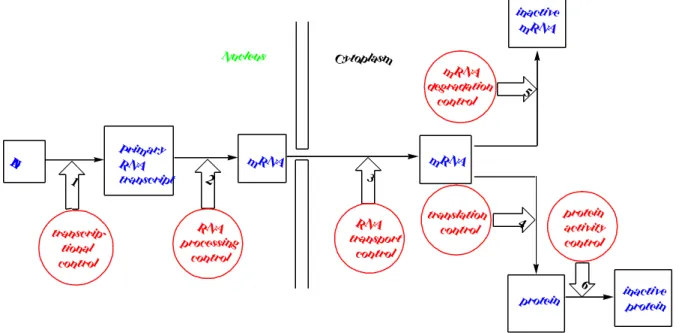
(4)as shown in Fig. 2.
D N A
P rim ary R N A transcript
m R N A m R N A
N ucleus C y toplasm
inactive m R N A
protein inactive
protein transcrip-
tional control
R N A processing control
m R N A degradation control
R N A transport control
translation control
protein activity control
1 3
4 5
2
6
Fig. 2. Control of gene expression.
Damaged DNA and / or RNA caused by either oxidation, virus, cancer, mutation, and infection have received much attention of medicinal chemistry in order to repair the undesired side reactions (diseases) caused by these damage agents. The RNA component of ribosomes (rRNA) is essential for protein synthesis
(5)and therefore is an attractive target for antimicrobial drugs. Indeed, many natural antibiotics disrupt protein synthesis and most of these appear to act by binding rRNA.
(6)Several methods were developed affecting on protein synthesis all over its stages of synthesis including;
antisense strategy (e.g. PNAs), intercalator (e.g. actinomycin D), alkylating agents of
nucleobase (e.g. nitrosoureas) and inhibition of enzymes (e.g. topoisomerase I and II
inhibitors), etc….especially in the antisense methodology, there is a potent ability for
various genetic therapy because of the direct inhibition of abnormal nucleic acid
sequences by antisense molecules with the complementary sequences. Peptide nucleic
acid (PNA) which is one of the artificial antisense molecules, is a DNA mimic that has shown considerable promise as a lead compound for developing gene therapeutic drugs.
PNA is characterized by its ability to block DNA and RNA polymerases and ribosome progression when bound to DNA or RNA templates
(7-9)as well as its high potency to inhibit the activity of telomerase by binding to its RNA component.
(10)Antisense has been observed to bind to DNA and RNA and inhibit their functions. Some of them have been showed to inhibit cell growth of cancer and to give effect on cancer mouse and rat in vivo. A few of them has been applied clinically to cancer patients under phase II.
When artificial antisense agents show no effect on such diseases, the next candidates come to the strategy of enzyme inhibitors. Inhibition of enzyme functions have been received much attention so far and many types of such drugs have been developed and explored to lead to various kinds of inhibitors which are commercially available. On the other hand, topoisomerases I and II are essential nuclear enzymes that catalyze the concerted breaking and rejoining of DNA strands. In addition to their normal cellular functions, both topisomerase I and II enzymes have recently emerged as important cellular targets for chemical intervention in the development of antitumor drugs.
Examples of these topoisomerase inhibitors are camptothecin, etoposide and doxorubicin. This year the human genome project has been sequenced and become more clear.
(11)From these background we started our research which was focused on targeting at DNA, RNA and protein, and inhibit their functions. One is to inhibit the expression of DNA and RNA by artificial antisense, through developing of new PNA antisense. Another way is inhibition of enzymatic function by binding small molecules to them, through the preparation of galloyl derivatives as new topoisomerase inhibitors.
By these two ways we can develop potent drugs which can inhibit the replication of
DNA, transcription of DNA into RNA, translation of RNA and certain enzymes.
II. Development of Novel PNAs
2.1. Introduction
The antisense and antigene strategy for treatment of diseases at the level of gene expression has attracted wide attention in medicinal chemistry. On transcription, every gene gives rise to a relatively large number of copies of messenger ribonucleic acid (mRNA), which is translated into a large number of protein molecules. This is why inhibition of gene expression ought to be more efficient than inhibition of the resulting protein product. There are already a number of drugs on the market whose activity is based on direct interaction with deoxyribonucleic acid (DNA). Many of these compounds, which are mainly used for chemotherapy, intercalate or bind specifically only to DNA. On the other hand, it is possible to achieve sequence-specific recognition of nucleic acids using synthetic oligonucleotides that bind specifically by hydrogen bonding to complementary nucleic acids. These compounds are called antisense oligonucleotides based on their binding to the target sequence (sense strand). Zamecnik and Stephenson were the first to propose in 1978, the use of synthetic antisense oligonucleotides for therapeutic purposes.
(12)With a 13-mer oligonucleotide that was complementary to the RNA of Rous sarcoma virus they were able to inhibit the growth of this virus in cell culture. The specific inhibition is based on the specific Watson-Crick base pairing (Fig. 3) between the heterocyclic bases of the antisense oligonucleotide and of the viral nucleic acid. The process of binding of the oligonucleotides to a complementary nucleic acid is called hybridization.
N N N
N N
N
N H O
H
O Sugar S
u g a r
A T
N N N
N N
N H
N S
u g a r
H H
N H
H
S u g a O r
C
OA ---T base pairing
G
G ---C base pairing
Fig. 3. Watson-Crick base pairing.
Various cellular processes can be inhibited depending on where the oligonucleotide
hybridizes on single stranded regions of the DNA or mRNA. A simple model describes
the inhibition of protein biosynthesis by an antisense oligonucleotide being bound to the
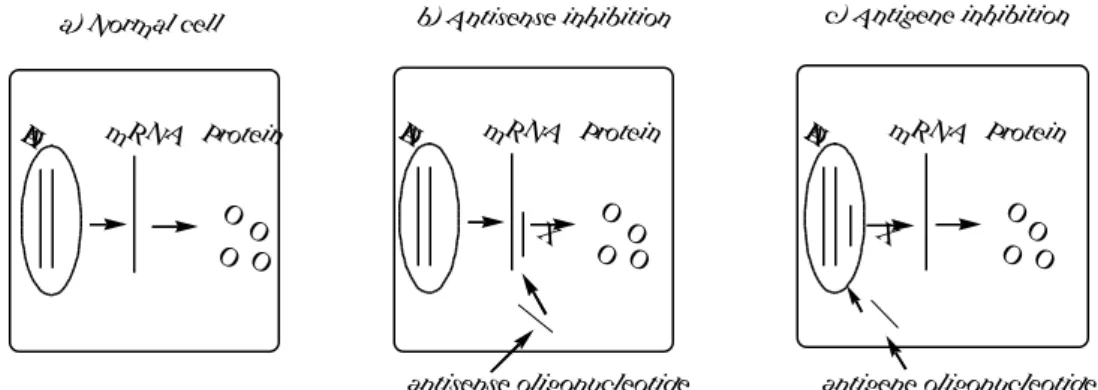
mRNA (Fig. 4).
O O
O O D
N
A m R N A Protein a) N orm al cell
O O O
O D
N
A m R N A Protein
X
b) Antisense inhibition
O O O
O D
N
A m R N A Protein
X
c) Antigene inhibition
antisense oligonucleotide antigene oligonucleotide
Fig. 4. Schematic illustration of (a) Normal gene expression. DNA is transcribed into mRNA followed by translation to give multiple copies of the protein gene product; (b) Antisense inhibition. An antisense oligonucleotide binds specifically to mRNA via Waston-Crick hydrogen bonding whereby it inhibits translation of mRNA into protein; (c) Antigene inhibition. Transcription is inhibited by the binding of an antigene oligonucleotide to DNA.
Several requirements needed for the antisense oligonucleotide to be able to inhibit translation including; (1) stability of the oligonucleotide toward extra- and intra- cellular enzymes, (2) specific interaction between the oligonucleotide and its target sequences, (3) stability of the complex formed between the oligonucleotides and its complementary target sequences under physiological conditions and (4) the ability to penetrate through the cell membrane.
Once it has reached the cytoplasm, it must bind specifically and with sufficient affinity to the target mRNA to inhibit its translation into the corresponding protein. Natural oligonucleotides have been shown to exhibit both antisense and antigene properties in vitro.
(13-15)However, both DNA and RNA are rapidly degraded by nucleases in vivo and in attempts to overcome this serious obstacle an impressive number of oligonucleotide analogues have been synthesized during the last two decades including; backbone modification
(16-28), base modification
(29-34)and sugar modification.
(35-40)Chemical modifications generally improve the biological stability of oligonucleotides to nucleases and improve the passage through membranes. On the other hand, these chemical modifications have an adverse effects on the specificity and binding affinity.
Three practical problems block the application of a modified oligonucleotide as a therapeutic agent:-
1) Poor uptake into cells.
2) Digestion by cell nucleases.
3) Short life time of the duplex formed.
The recent invention of peptide nucleic acids, PNAs
(41), as strong and specific DNA and
RNA binding agents has attracted much attention because of the ease and simplicity of
the scale-up methods for peptide chemistry, in comparison with the synthetic
procedures used for other modified sugar-phosphate backbones. The N-
aminoethylglycine backbone of the polyamide aegPNA (Fig. 5), carrying nucleobases through an acetyl linker, was designed from molecular modeling studies as the result of atom-by-atom replacement of the sugar-phosphate DNA backbone by a polyamide backbone.
(42)PNAs act as excellent structural mimics of DNA/RNA and exhibit strong sequence specific binding with complementary oligonucleotide sequences following Watson-Crick base pairing rules, and thus fulfill the primary condition for their biological application. The relatively high binding affinity of PNAs towards the natural oligonucleotides is attributed to the lack of the electrostatic repulsion between the uncharged PNA backbone and the negatively charged sugar-phosphate backbone of the DNA and RNA
(42)and the rigidity of the peptide backbone of PNA which arises from the SP
2hybridization as well as the presence of tertiary amide linkage.
O
O
P O
H /O H O
O B
N
O O
B H
N
-
1 2
3 4 5
6
3 4 5
6 α
β α'
β'
α''
aegPN A D N A /R N A
2 1
Fig. 5. Sugar-phosphate DNA/RNA and aminoethylglycyl PNA backbones.
The main drawbacks of aegPNA are; the relatively poor water solubility(43), poor cellular uptake of PNAs(44), and that the mixed purine/pyrimidine PNA oligomers bind to both parallel and antiparallel DNA target sequences with almost equal ability(45,46), but with the antiparallel binding mode slightly preferred over the parallel mode (the C- terminus of the PNA is conventionally taken to be analogous to the 3’ end of DNA/RNA). PNA oligomers bind strongly with highest sequence discrimination to complementary oligomers of DNA, RNA or PNA itself, and in general the hybrid thermal stability (Tm) for identical sequences in the following order; PNA-PNA > PNA- RNA > PNA-DNA (> RNA-DNA) > DNA-DNA.
2.1.1. Strategies for chemical modification of aegPNA
Various attempts for the modifications/substitutions in the PNA backbone, in the
aminoethyl, glycyl or the acetyl segment carrying the nucleobase have been made,
results in chiral PNA and is aimed to achieve selective binding with target
DNA/RNA.(47) PNAs are suffixed with negatively charged DNA or positively charged
polypeptide sequences at either the C- or the N-terminus. This modification results in
PNA-DNA(44) or PNA-peptide chimeras(48) that have favorable aqueous solubility,
cellular uptake and DNA binding/recognition properties. The PNA sequences have also
been appended with polyamines
(49)to increase the aqueous solubility and improve binding to the target DNA. Some of these modified PNAs show improved water solubility, cellular uptake and/or directional binding selectivity relative to pure aegPNAs, but in most cases exhibit a reduced binding towards the target sequences.
2.1.2. Construction of bridged PNA structures
The reduced entropy loss upon complex formation, can be achieved if the conformational freedom in aegPNA is constrained by bridging the aminoethyl or glycyl acetyl linker arms (Fig. 6) to give rise to cyclic analogues with pre-organized structures without affecting the nucleobase recognition ability through hydrogen bonding.
Additionally, the introduction of chemical bridges into aegPNA to provide cyclic structures may help in controlling the rotameric populations by fixing the nucleobase orientation and also in directional selective binding by virtue of the chirality in the backbone. Such a structural pre-organization approach using additional conformational constraint has been extremely successful in the case of DNA analogues. Prominent examples are conformationally locked nucleic acids
(50)or conformationally frozen hexitol
(51)and altritol nucleic acids
(52)(Fig. 7), which have pre-organized 3’-endo sugar conformations as prevalent in highly stable DNA-RNA duplexes.
N
O B N
H
O
Fig. 6. Possible positions for introduction of methylene or ethylene bridges.
O B
O O
P O
O H O
O
B
O
P O
O O
O
B
O
P O
O O
O H
LNA Hexitol N A A ltritol N A
a- Locked 3'-endo conform ation b. frozen 3'-endo conform ation
Fig. 7. a) Locked 3’-endo conformation in LNA; b) Frozen 3’-endo conformation in hexitol and altritol nucleic acids.
2.1.3. PNA with five-membered nitrogen heterocycles
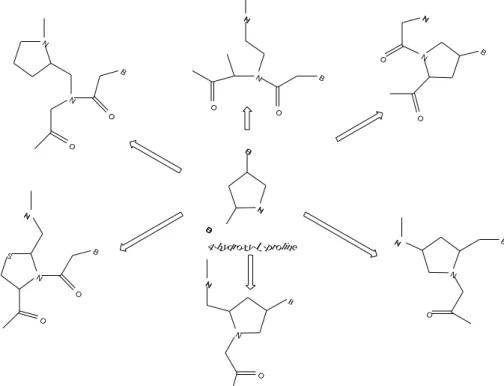
Many researchers have exploited trans-4-hydroxy-L-proline for the synthesis of wide
variety of chiral, constrained and structurally pre-organized PNAs (Fig. 8). Depending
on the construction strategy and the presence or absence of tertiary amine group in the monomers, the modifications afford either positively charged or uncharged cyclic PNA analogues.
N
O B N
H
N H H
O O C
O H O
N
O N
H
B N
N O
O
B
S N H N
N
O O
N H
B
N H
N
O
4-hydro xy-L-pro line B B
O
O
Fig. 8. PNA analogues with five-membered pyrrolidine rings.
2.1.3.1. Aminoprolyl PNA
The introduction of a methylene bridge between the β-carbon atom of the aminoethyl segment and the α’’-carbon atom of the glycine segment of the aegPNA resulted in 4- aminoprolyl PNA, with the introduction of two chiral centers (Fig. 9).
(53)The incorporation of single chiral D-trans- and L-trans-prolyl PNA monomeric units in the PNA oligomers at the N-terminus resulted in discrimination in parallel/antiparallel binding orientation preferences towards the target DNA sequences. A backbone combining aegPNA alternating with L-trans-4-aminoprolyl PNA was later shown to bind to the target sequences with higher affinity than the pure aegPNA oligomers.
(54)N O
B
O H
N
N
B O
O H
N
N
B O
O H
N
α'' β
*
*
4-am inoprolyl PN A
aegPN A B = A/T /G/C
Fig. 9. Prolyl PNA with α’’-β-methylene bridge.
2.1.3.2. Gly-pro-peptide PNA
4-Hydroxyproline was used by Lowe et al. for the synthesis of a novel chiral prolylglycyl PNA. The methylene bridge was inserted between the α’’-carbon atom of the glycine unit and the β’-carbon atom of the nucleobase linker of aegPNA (Fig. 10).
(55-57)
The tertiary amide bond in the backbone between proline and glycine units replaced the aminoethylglycyl backbone. The backbone thus comprised alternate glycine-proline units, the nucleobase was directly attached to the proline ring by alkylation through the 4-hydroxy function. The oligomer with such a backbone did not bind to the target sequences and this may be due to the rigidity of the system which may lead to disfavored recognition for the target sequences. The sequences with aegPNA alternating with the proline-glycine PNA unit showed reduced binding to the target sequences, unlike the 4-aminoproline PNA.
(54)N
B O N H
O
N N H
O
O
B N
N H
O O B α''
β'
*
*
aegPN A gly-pro-peptide PN A
Fig. 10. Prolylglycyl PNA with a α’’-β’-methylene bridge.
2.1.3.3. Aminoethylprolyl PNA, aepPNA
In this type of PNA the α’’-carbon atom of the glycine unit and the β’-carbon atom of the nucleobase linker were joined through a methylene bridge (Fig. 11).
(58)The flexibility in the aminoethyl segment of aegPNA was retained, unlike that in the proline-glycine PNA. The nucleobase attachment to the pyrrolidine ring was fixed by virtue of the chirality of C-4, thus removing the possibility of any rotameric populations.
The oligomers comprising 4-(S)-2-(S/R) aepPNA thymine units showed very favorable binding properties towards the target sequences without compromising the specificity.
N
O
O
B N
H H N
N O
B
O
H N H
N
B
O β'
α''
+
*
*
aepPN A aegPN A
Fig. 11. Aminoethylprolyl PNA with a α’’-β’-methylene bridge.
2.1.3.4. Pyrrolidinone PNA
Another conformationally restricted cyclic PNA analogue was derived from a pyrrolidinone ring system.
(59)A methylene bridge was inserted between the α-carbon atom of the aminoethyl segment and the β’-carbon atom of the acetyl linker to the nucleobase of aegPNA (Fig. 12). The carbonyl group of the nucleobase linker was retained and was forced to point towards the carboxy terminus of the backbone. The bridge prevented rotation around the C-N bond of the acetyl segment connecting the nucleobase residue to the backbone, and pre-organized PNA in a rotameric conformation prevailing in complexes of PNA with nucleic acids.
(60)The oligomers incorporating the (3S,5R) isomer carrying adenine as a base were shown to have highest affinity towards RNA in comparison with DNA.
N O
B
O N H
N O O
N H
B
N O O
N H
B
α β' * *
aegP N A P yrrolidininone P N A
Fig. 12. Pyrrolidinone PNA with α-β’-methylene bridge.
2.1.3.5. Pyrrolidine PNA-II with - ’-methylene bridge
Introduction of a β-α’-methylene bridge, resulting in another pyrrolidine based PNA modification (Fig. 13).
(61)This should probably ease the rigidity of the direct attachment of the nucleobase to the pyrrolidine ring, as in the case of the α-β’-methylene-bridged pyrrolidine PNA-I or aepPNA. Incorporation of (2R,4S) pyrrolidine PNA monomer in the center of the aegPNA T
8sequence, was able to bind to the target DNA better than pure aegPNA, while incorporation of the other isomer (2S,4S) was found to make destabilization with DNA.
N O N H
B N
O B H
N
H N
O B H
N
O
α' β
*
*
+
Pyrrolidine PN A -II aegPN A
Fig. 13. Pyrrolidine PNA-II with α’-β-methylene bridge.
2.1.3.6. Aminomethylthiazolidine PNA, amtPNA
A thiomethylene bridge was inserted between the α-carbon atom in the aminoethyl segment and the α’’-carbon atom of the glycine segment of the aegPNA, providing aminomethylthiazolidine PNA, amtPNA.
(62)The amtPNA thus constructed restricts movement in both the aminoethyl and the glycyl segments of the aegPNA (Fig. 14).
The syn and anti isomers of the amtPNA were incorporated into aegPNA sequences in the central position, the triplex formed with this PNA with both DNA and RNA were significantly destabilized.
N
O O H
N
B
S N
N H
O B
O
S N
N H
O B
O α
α''
*
*
am tPN A aegPN A
Fig. 14. Aminomethylthiazolidine PNA, amtPNA.
2.1.4. PNA with six-membered ring structures 2.1.4.1 Glucosamine nucleic acids, GNAs
The binding affinities and selectivities of the oligomers containing GNAs indicated selective recognition of RNA, the entropy changes were found to be smaller for GNA- DNA/RNA than for DNA-DNA/RNA
(63)(Fig. 15).
O
O
N H
O H
O H O H
O H O O
B
B
N H
Fig. 15. A six-membered cyclic PNA derived from glucosamine.
2.1.4.2. Piperidinone PNA
Introduction of an ethylene bridge between the α- and β’-carbon atoms in the ethylenediamine and acetyl linkers resulting in a six-membered ring structure as in pipridinone PNA (Fig. 16).
(64)Incorporation of these monomers containing adenine nucleic acid base into the aegPNA resulted in a large decrease in the duplex stability.
N O
B
O H N
N H
N
O
O
B
N H
N
O
O
B
a egP N A
α β' * *
p ip erid in on e P N A
Fig. 16. Piperidinone PNA with α-β’-methylene bridge.
2.1.4.3. Morpholino PNA
The attractive morpholino antisense oligomers
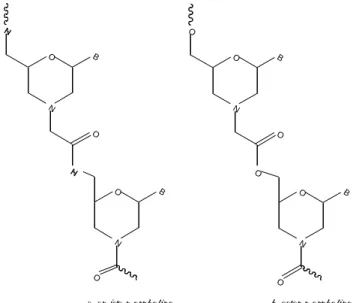
(65), with high sequence specificity, water solubility and low production cost, have sparked research into further modifications in morpholino-based DNA analogues. Set of morpholino analogues with phosphonate ester, amide or ester linkages between the morpholino nucleoside residues was synthesized (Fig. 17).
(66)Preliminary evaluation indicated that the uridine homo- oligomer with either amide or ester linkage stabilized the complex with the DNA targets relative to the DNA-DNA complexes. The adenine homo-oligomers showed destabilizing effects when complexed with the target homo-thymidine DNA sequences. The amide-linked morpholino PNAs were better accommodated in the complexes than the ester- or the phosphonate-linked oligomers.
N O
O
N H
O
N B N
H
O
B
N O
O
O O
N B O
O
B
a. am ide-m orph olin o b. ester-m orph olin o
Fig. 17. PNA with morpholino amide and ester backbones .
2.1.5. APNA and PNA-APNA chimera
An aromatic PNA analogue in which the backbone o-aminophenylbutanoic acid derivative carries the nucleobase through an ether linkage has been synthesized (Fig.
18).
(67)These analogues were designed in order to investigate possible π stacking interactions and their stabilizing effects on duplex-triplex structures.
(68)O
B
N H O
*
Fig. 18. Aromatic peptide nucleic acid, APNA-I.
The aromatic PNA was subjected to further modification by replacing it with another aromatic N-(2-aminobenzyl)glycine backbone (Fig. 19).
(69)The optimum distance of six σ bonds between the nucleobases along the backbone was extended to seven σ bonds in this modification. The direct incorporation of aromatic rings in the backbone renders at least three bonds in the backbone coplanar. Furthermore, the internucleobase distance was altered by additional methyl substitution in the glycyl segment, affording N-(2- aminobenzyl)-(R-or S)-alanine or by replacing it with β-alanine, as in N-(2-amino- benzyl)-β-alanine backbones. The incorporation of these modified units in aegPNA produced PNA-APNA chimera. The modified oligomers exhibited decreased binding affinities relative to the pure PNA.
N H N
B
R O
O
*
Fig. 19. APNA-II-PNA chimera .
2.2. Scope of Investigation
A large variety of structural modifications of oligonucleotides have been investigated as an exciting new concept for drug design to modulate the expression of genetic information by antisense and antigene oligonucleotide. Aminoethylglycine peptide nucleic acids (aegPNAs) developed by Nielsen and co-workers are oligonucleotide analogues in which the sugar phosphate backbone is replaced by a peptide chain.
(41,43,45,70a-c)PNA is a very potent DNA mimic capable of hybridization to
complementary DNA, RNA or PNA itself. Therefore many types of nucleotides with
peptide backbone have been synthesized in order to improve the limited solubility and
to investigate the structural flexibility and requirements for nucleic acid recognition
(e.g., introduction of a certain side chain
(60a-c)and double bond
(72)to peptide backbones,
conversion of carbonyl group to sulfonyl group
(73), and construction of ethereal and /or
cyclic structural peptide backbones).
(58,74a-c)However, there is no report on the peptide
nucleic acids corresponding to the ‘non-genetic’ 2’,5’-linked oligonucleotide (2’,5’-
isoDNA)
(75), which is one of the important candidates to search the effective antisense
oligonucleotides due to the intrinsic selective RNA-binding activity of 2’,5’-isoDNA
(although the hybridization affinity of 2’,5’-DNA or -RNA/ 3’,5’-RNA is somewhat
inferior to that of the 3’,5’-DNA/ 3’,5’-RNA duplex, despite 2’,5’-DNA or -RNA shows
binding selectivity for 3’,5’-RNA over 3’,5’-ssDNA) (Fig. 20). The favorable RNA- and
DNA- binding properties of PNA and the selective binding affinity of 2’,5’-isoDNA to
RNA have led us to design 2’,5’-isoDNA mimic chiral PNAs (isoPNAs) in order to
develop novel PNAs with higher affinity to complementary RNA sequences. An
antisense strategy in which the antisense molecules binding strongly and more
selectively to RNA seems to be one of the most effective gene targeting therapy. This is
attributed to that the selective binding to a specific region in the RNA sequences can
alter several characters in the structure of RNA such as loop and turn forms of the RNA.
O
O P O O
O
O B
B H
O
O P O O
O
O B
O H n
2', 5'-isoD N A
H2N
H N O
N H
H N O
N H O
B B
O
N H
N H 2 O
B n
G ly -G ly isoP N A (isoggP N A )
G ly - -A la isoP N A (isogaP N A )
B : N ucleic A cid B ase H
N
H N O H2N
B
O
H N
O
B
N H
H N
O
B
O H2N
O n
O
Fig. 20. Design of 2’,5’-isoDNA mimic peptide nucleic acids.
The sugar phosphate backbone of 2’, 5’-isoDNA consists of a repeating unit of seven atoms, configurationally and conformationally constrained by the 3’-deoxy-D-ribose ring. If these seven atoms could be replaced by an isostructural dipeptide unit that consists of repeating of six atoms glycyl-glycine isoPNA (isoggPNA) or seven atoms glycyl-β-alanine isoPNA (isogaPNA) (Fig. 20), the new backbone would be amenable for preparation by automated peptide synthesizer and this may be lead to structural analogues of isoDNA. In this context, we examined the synthesis and hybridization properties of PNAs containing novel isogaPNA monomers with glycyl-β-alanine backbone derived from D and L-aspartic acid, together with the synthesis of isoggPNA monomer with glycyl-glycine backbone derived from L-serine (Fig. 21).
C O O H N
H O
F m o cH N
B
C O O H N
H O
F m o cH N
B
N H O
F m o cH N
TBz
Fm oc protected isogaPN A (R form ) Fm oc protected isogaPN A (S form ) Fm oc protected isoggPN A
B :
H N
N O
O
N
N N
N N H B z
or
C O O H
Fig. 21. Various isoPNA monomers.
We also studied on the strategy to antiviral agents from some derivatives of PNA
monomers, which are potent isosters of natural nucleoside, in our effort of developing
new PNAs (Fig. 22).
N N H
O H
O
N H B o c
O
N N H
O H
O
N H B o c
O
Fig. 22. Structures of some derivatives of isogaPNA tested as antiviral agents.
2.3. Results and Discussion
2.3.1. Synthesis of glycyl- -alanine isoPNA (isogaPNA) monomers
The synthesis of glycyl-β-alanine isoPNA (isogaPNA) monomers proceeds through D- or L-aspartic acids protected with Boc and benzyl groups.
Thymine monomers were prepared as follows (Scheme 1). Compounds 1 and 7 could be reduced in a rapid and convenient method under mild conditions to its corresponding alcohols 2 and 8.
(76)Treatment of compounds 1 and 7 with equimolar amounts from N- methylmorpholine and ethylchloroformate in dry THF at –10
oC for 5-10 minutes under argon gas gave the corresponding mixed anhydrides as intermediate. Treatment of these mixed anhydrides with sodium borohydride in MeOH at 0
oC for 10 minutes followed by another 10 minutes at room temperature gave the corresponding alcohols 2 and 8 in 60% and 62% yields, respectively. Coupling between alcohols 2 and 8 with N
3- benzoylthymine under Mitsunobu condition
(77,78)in the presence of N,N-diethyl azodicarboxylate and triphenylphosphine in dry THF under argon gas at 0
oC for 1 hour followed by overnight stirring at room temperature afforded compounds 3 and 9 in 45%
and 44% yields, respectively. Treatment of compounds 3 and 9 with 3N HCl in EtOAc at room temperature for 2 hours
(79)afforded the HCl salt of compounds 4 and 10, respectively. In this reaction removal of both Boc and benzoyl groups was observed, neutralization of the HCl salt with 5% NaHCO
3gave compounds 4 and 10 in 70% and 75% yields, respectively. Coupling between compounds 4 and 10 with equimolar equivalent from Fmoc-glycine, in the presence of TBTU, HOBt and DIEA in DMF afforded compounds 5 and 11 in 65% and 66% yields, respectively. Finally deprotection of the benzyl group of compounds 5 and 11 was carried out using 1,4-cyclohexadiene and 10% Pd/C in MeOH successfully gave Fmoc-glycyl-β-alanine(thymine) PNA monomers (R and S form) 6 and 12 in 65% and 62% yields, respectively (Scheme 1).
(80)Adenine monomer was also prepared in a similar method for the preparation of thymine monomer 6 (Scheme 2). Coupling of the alcohol 2 with N
6-benzoyladenine under Mitsunobu condition in the presence of N,N-diethyl azodicarboxylate and triphenyl- phosphine in dry THF under argon gas at 0
oC for 1 hour followed by overnight stirring at room temperature afforded compound 13 in 45% yield.
(77)Removal of the Boc moiety from compound 13 was carried out by stirring with TFA/CH
2Cl
2(1:1) at 0
oC for 1 hour followed by stirring at room temperature for 6 hours.
(81)Neutralization of the TFA salt with 5% NaHCO
3gave a crude compound which was used directly for the next step without purification. Coupling between this crude compound and Fmoc-glycine in the presence of TBTU and TEA in CH
3CN afforded compound 14 in 65% yield.
(82)Finally debenzylation of compound 14 was carried out using hydrogen gas and 10% Pd/C provided the Fmoc-glycyl-β-alanine(adenine
Bz) PNA monomer 15 in 50% yield (Scheme 2).
(83)All of the prepared compounds were identified by their melting points, IR,
1H-NMR,
13
C-NMR, mass spectrum, elemental analysis and angle of optical rotation.
C O O H
B o cH N
O M e
N , ClCOOEt
B o cH N
C O O C O O E
t NaBH 4, MeOH B o cH N
O H
B zN
NH O
O P
h 3P, THF BocHN H2N
H N
N O
O
F m oc-G ly, T B T U
H N
N O
O
NH H N
N O
O M
eO H
B o cH N
C O O H
O M e
N , ClCOOEt
B o cH N
C O O C O O E t
N aB H 4, MeOH
B o cH N
O H
B zN
NH O
O P h 3P, THF
B o cH N
N B zN
O
O
H2N H N
N O
O Fmoc-Gly, TBTU
H N
N O
O
H N
N O
O M
eO H
(44% ) H O B t, D IE A, D M F
TH F, -10oC
, D E AD
(60% )
(45% )
3N H C l, E tO Ac 1)
2) 5% N aH C O3
(70% ) (65% )
, 10% Pd-C (65% )
1 2
3 4
5 6
TH F, -10oC
, D E AD
(62% )
3N H C l, E tO Ac 2) 5% N aH C O3
(75% ) (66% )
, 10% Pd-C (62% )
7 8
9 10
11 12
1)
H O B t, D IE A, D M F
O F
m o cH N NH
O F
m o cH
N COOBn COOH
NH O F
m o cH
N COOH
NH O F
m o cH
N COOBn
C O O B C n
O O B n
C O O B C n
O O B C n
O O B n
C O O B n C
O O B n
C O O B n C
O O B n C
O O B n
N B zN
O
O
Scheme 1. Synthesis of thymine isogaPNA monomers (R and S) .
2 N
N N
H N N H B z
, D E AD , Ph3P,
T HF (45% ) BocHN
C O O B n N
N N
N N H B z
13
1) T FA/C H2C l2
2) 5% N aHC O3 H2N
C O O B n N
N N
N N H B z
Fm oc-Gly, T BT U , T E A
C H3C N (65% )
H N
C O O B n N
N N
N N H B z
F m o cH N
O
14
H N
C O O H N
N N
N N H B z
F m o cH N
O
15 H2 gas, 10% Pd-C
M eO H (50% )
Scheme 2. Synthesis of adenine
BzisogaPNA monome r.
2.3.2. Synthesis of glycyl-glycine isoPNA (isoggPNA) monomer
The synthesis of thyminylmethylglycine 21 is the key step for the preparation of thymine isoggPNA monomer 24. Attempts for the coupling of L-serine with N
3- benzoylthymine
(84)under the Mitsunobu conditions, previously applied to the coupling between hydroxymethylalanine and N
3-benzoylthymine in the preparation of isogaPNA monomers, were proven to be unsuccessful (the starting material N
3-benzoylthymine was recovered). The coupling using the tosylated compound 19, prepared by the reaction of 18 with p-toluenesulfonyl chloride in pyridine
(85)and N
3-benzoylthymine under basic conditions but unfortunately, did not proceed well (tosylation of Boc-ser methyl ester underwent facile β elimination at the tosylated position to give methyl acrylate compound). To this extent, compound 19 was converted to the corresponding iodide 20 using sodium iodide in dry acetone.
(85)The iodide compound 20 was further reacted with N
3-benzoylthymine under basic conditions, afforded compounds 21 and 22 in 68 % and 11 % yields successfully after flash silica gel chromatography and subsequent recrystallyzation. Removal of the Boc group of 21 using conc. HCl in dioxane
(86)followed by coupling with Fmoc-glycine in the presence of TBTU gave compound 23 in 74% yield. Finally reductive cleavage of the benzyl ester of 23 was carried out using H
2gas and 10% Pd-C gave thymine isoggPNA monomer 24 in 87%
yield (Scheme 3).
(83)BocH N CO OH O H
D C HA C
H 2Cl 2:MeOH BocH N CO OH O H
B n Br D
M F BocH N CO OBn O
H Bz N NH O
O D M F
BocH N CO OBn O T os B
z N NH O
O
D M F
, K 2CO 3
BocH N CO OBn I Bz N
NH O
O , K 2CO 3
D
M F BocH N CO OBn BocH N CO OBn B
z N N O
O
H N N O
O
NH C O OBn B z N
N O
O F
m ocH N O
M
e OH (87% ) N
H C O OH B z N O N F
m ocH N O
O . D C H A
, D EA D , P h3P
TosC l, P yridine, - 10oC
N aI, acetone
+
(i) C onc. H C l, dioxane (ii) F m oc-G ly, TB TU , H O B t, D M F
H2 gas, 10% P d-C
16 17 18
19
20 21 22 (11%)
21
21
23 24
(74% ) (68% ) (72% )
//
//
(65% )
(75% )
(68% )