Pseudomonas aeruginosaは 近 年 , ESKAPE (Enterococcus faecium,Staphylococcus aureus,
Klebsiella spp., Acinetobacter baumannii, P. aeruginosa,及びEnterobacter spp.)とも称され る病院環境において耐性菌を生じやすい微生物の 一つである1)。また集中治療室において,本菌は 抗菌薬,特にmeropenem(MEPM)などカルバペ ネム剤の曝露により耐性化のリスクが上がると報 告されている2)。 当地区は30万人規模の医療圏であり,公的4病院 (病床数315⬃430)が各々にほぼ固定した患者集団 を診療している。P. aeruginosaの国内文献上,多剤 耐性について7広域で比較した報告3)や某県3病院 のカルバペネム系抗菌薬に対する感受性についての 報告4)はあるが,多年次にわたり多数の抗菌薬につ いて地域内の多施設を観察した報告は見当たらない。 われわれは,その4病院において2002年からP. aeruginosaについて抗菌薬の最小発育阻止濃度
〈資 料〉
地域
4
病院における
Pseudomonas aeruginosa
の薬剤耐性:
抗菌薬使用密度の影響
吉田順一
1,2)・赤木香織
2,3)・石丸敏之
1,2)・大下 昇
2,4)・小畑秀登
2,3)・
菊池 勉
2,4)・菊池哲也
1,2)・佐藤 穣
2,5)・縄田涼平
2,4)・林 弘人
2,5)・
福岡義久
2,5)・松原伸夫
1,2)・南 佳秀
2,3)(共著者は五十音順) 1)下関市立中央病院 2)下関耐性菌研究会 3)山口県済生会下関総合病院 4)社会保険下関厚生病院 5)国立病院機構関門医療センター (2011 年 6 月 29 日受付)Pseudomonas aeruginosaの最小発育阻止濃度(MIC)と抗菌薬使用密度(AUD)との関 連について地域4病院において比較調査した。材料は2002⬃2005年及び2008⬃2010年の 尿・喀痰・膿などから得られた476株であり,8剤(meropenem,imipenem,ceftazidime, cefepime,ciprofloxacin,piperacillin,tazobactam/piperacillinとamikacin)のMIC50, MIC90を得た。8剤のMIC50,MIC90は恒常的に推移した。一方MIC値(476株)は5剤 で有意差があり,B病院が全5剤で最高値,D病院が4剤で最低値をとった。3病院で 15剤のAUDが得られ,うち9剤で有意差があり,B病院ではmeropenem,flomoxefと sulbactam/cefoperazoneが最高値,D病院ではmeropenem,ceftazidime,cefotaximeと sulbactam/cefoperazoneが最低値だった。よってP. aeruginosaにおけるMICの調査から, 広域抗菌薬のAUDが高いと耐性化する可能性が示された。
(minimum inhibitory concentration, MIC)の推移 と,その間の抗菌薬の使用状況を抗菌薬使用密度 (antimicrobial use density, AUD)にて把握するよ うに努めてきた。このたび,MICの経年推移と病 院単位におけるAUDの関連について検討したの で報告する。
対象および方法
2002⬃2005年,各病院から得られたP. aeruginosa の15株を凍結保存して回収し, 三菱化学ビー シーエル(東京)にて8剤(MEPM, imipenem [IPM],ceftazidime[CAZ],cefepime[CFPM],ciprofloxacin[CPFX],piperacillin[PIPC], tazobactam/piperacillin[TAZ/PIPC]とamikacin [AMK])のMICを測定した。2008⬃2010年は各 病院20株を凍結保存し,キューリン(北九州市)に て同8剤のMICを測定した。全期間,日本化学療 法学会標準法の微量液体希釈5)(単位mg/mL)に 従った。耐性度の指標として,MIC50とMIC90を 求めた。薬剤感受性は,米国Clinical Laboratory and Standards Institute(CLSI)がP. aeruginosaに ついて定める基準6)に従った。よってIPMでは
imipenem/cilastatin[IPM/CS]ではなく,IPM自 体の基準により判定した。
なお病院が移転した場合,当該年は検体を移転 後から採取した。またカルバペネム系抗菌薬の処 方について,これを届出制とするか,許可制にす るかの判断は,各病院が独自に決定した。
またAUDについて15剤(MEPM,IPM/CS, CAZ,CPFX,cefazolin[CEZ],cefmetazole [CMZ],cefotiam[CTM],cefotaxime[CTX],
flomoxef[FMOX],ceftriaxone[CTRX],CFPM, panipenem/betamipron[PAPM/BP],sulbactam/ ampicillin[SBT/ABPC],sulbactam/cefoperazone [SBT/CPZ]とclindamycin[CLDM])の抗菌薬 投与量(T[g/年])とのべ入院数(Adm[人・日
/年])から求めた。その計算方法としては世界保 健機関(WHO)によるdefined daily dose(DDD [g/日])から AUD⫽T/(Adm⫻DDD)⫻1000 に て 求 め た 。な おDDDはWHO(http://www. whocc.no/atc_ddd_index)及び論文7)から引用し た。統計学的に比較する際,量的データはノンパ ラメトリック手法(SPSS Inc.,米国)を用い,多 群間はKruskal-Wallis検定を行った。また質的 データはc2検定を行った。P⬍0.05をもって有意 とした。
結果
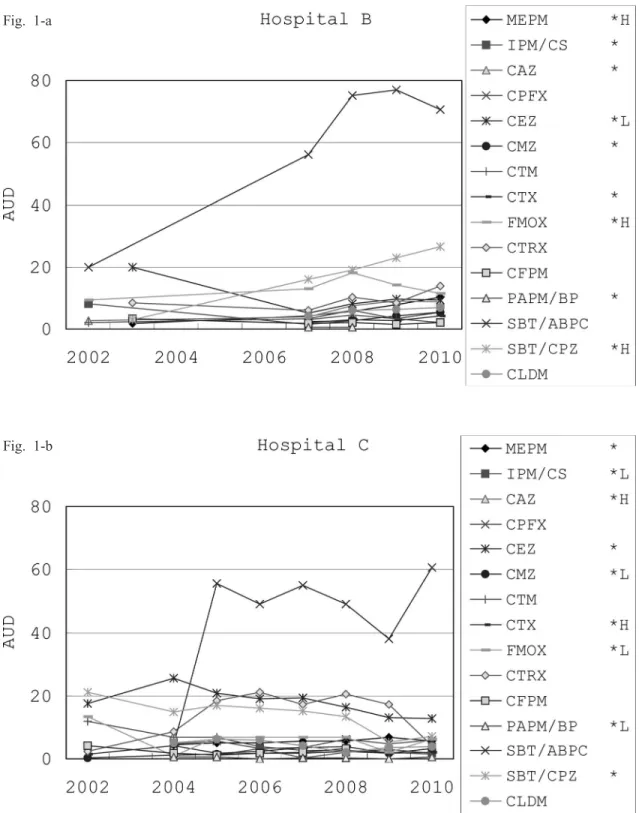
保存株のうちD病院の4株が死滅し,合計476 株を検査した。検体別(喀痰/尿/膿など)の株 数は各々A病院(52/23/45株),B病院(44/36/ 40株),C病院(58/27/35株)及びD病院(65/21/ 30株)にてP⫽0.050(c2検定)だった。 MIC値(476株)について病院間で有意だった の は5剤 (A M K[P⫽0.049],C F P M[P⫽ 0.033],CPFX[P⫽0.049],TAZ/PIPC[P⫽ 0.002]とPIPC[P=0.001])だった。その全5 剤で平均値はB病院が最も高く,4剤(CFPM以 外)でD病院が最も低かった(Table 1)。 AUDはB,C及びD病院で(B病院は2004⬃ 2006年欠損)得られた(Fig. 1)。病院差が9剤で 有意(IPM/CS[P⫽0.002],MEPM[P⫽0.037], PAPM/BP[P⫽0.001],CAZ[P⫽0.004],CEZ [P⫽0.004],CMZ[P⬍0.001],SBT/CPZ[P⫽ 0.001],CTX[P⫽0.001]とFMOX[P⫽0.024]) だった。B病院でMEPM,FMOXとSBT/CPZが 最高値,D病院でMEPM,CAZ,CTXとSBT/ CPZが最低値だった。 A病院は2000年春に敷地内移転した。敷地を B病院は2005年春に移転,C病院は2009年春に移転した。A,B及びC病院について,移転前後 のMIC50,MIC90は恒常的に推移した。
考察
梅村ら8)は2010年P. aeruginosaのカルバペネム 系薬耐性率と同系薬使用量(DDD⫻延べ入院患 者数)で関係はなかったと報告したが,対象は2 年のみと短期間であった。本研究はさらに長期を 分析し,AUDの平均値は広域抗菌薬3剤でB病 院が最高値を示したことと対比的に,CEZや CMZ等でD病院が最高値を示した。つまり広域 Table 1. Minimum inhibitory concentration (MIC) and susceptibility of Pseudomonas aeruginosaisolated from four community hospitals.
Among the four hospitals, the multiple-group Kruskal-Wallis analysis (K-W) showed significance (*, P⬍0.05; H, the highest; L, the lowest).
Fig. 1. Mean values of antimicrobial use density (AUD) in three hospitals, B (1-a), C (1-b), and D (1-c) out of four.
Fig. 1-a
スペクトラム抗菌薬が多く用いられた病院におい てMIC値が高く,狭域の抗菌薬が多く用いられ た病院でMIC値が低い傾向があった。よって広域 抗菌薬のAUDの高い場合に,P. aeruginosaの耐性 度が影響を受ける可能性があると考えられた。 またP. aeruginosaを含めた病院感染について, 2009年LEEら9)は病院移転により変化なかったと する一方,田村ら10)は一時的に減少したという。 逆に2007年VONDOLINGER DEBRITOら11)は新生児 集中治療室が手洗い場の少ない場所に移転後,増 加したとする。本研究において,移転した3病院 における薬剤感受性は,移転の前後で変化は見ら れなかった。したがって,薬剤感受性の推移は施 設環境より広域抗菌薬のAUDの影響が大きいこ とが示唆された。 地域医療圏における4病院の,あしかけ9年間 のデータであるが,MICに2年間の休止があり, 背景因子である抗菌薬投与データが完全に収集で きていない問題があるものの,長期にわたるデー タは重要であると思われる。 以上のようにP. aeruginosaにおいては,広域抗 菌薬のAUDが高いと耐性化が促される可能性が 示唆された。
文献
1) RICE, L. B.: Federal funding for the study of
antimicrobial resistance in nosocomial patho-gens: No ESKAPE. J. Infect. Dis. 197: 1079⬃ 1081, 2008
2) ONG, D. S.; I. P. JONGERDEN, A. G. BUITING, et
Among the three hospitals, the multiple-group Kruskal-Wallis analysis showed significance (*, P⬍0.05; H, the highest; L, the lowest).
MEPM: meropenem; IPM/CS: imipenem/cilastatin; CAZ: ceftazidime; CPFX: ciprofloxacin; CEZ: cefa-zolin; CMZ: cefmetazole; CTM: cefotiam; CTX: cefotaxime; FMOX: flomoxef; CTRX: ceftriaxone; CFPM: cefepime; PAPM/BP: panipenem/betamipron; SBT/ABPC: sulbactam/ampicillin; SBT/CPZ: sul-bactam/cefoperazone; CLDM: clindamycin
al.: Antibiotic exposure and resistance devel-opment in Pseudomonas aeruginosa and En-terobacter species in intensive care units. Crit. Care Med. 2011, Jun 23.[Epub ahead of print]
3) TSUJI, A.; I. KOBAYASHI, T. OGURI, et al.: An
epidemiological study of the susceptibility and frequency of multiple-drug-resistant strains of Pseudomonas aeruginosa isolated at medical institutes nationwide in Japan. J. Infect. Chemother. 11: 64⬃70,2005 4) 大石 毅,人見重美,鴨下昌晴,他:茨城県 南3施設におけるカルバペネム系抗菌薬の AUD比較と緑膿菌の薬剤感受性の検討。臨 床病理56: 570⬃576, 2008 5) 永山在明,山口惠三,渡邉邦友,他:抗菌薬 感受性測定法検討委員会最終報告(2007年)。 日本化学療法学会雑誌56: 49⬃57, 2008 6) Clinical and Laboratory Standards Institute:
Performance Standards for Antimicrobial Susceptibility Testing; Seventeenth Informa-tional Supplement. M100-S17. Wayne, PA, 2007
7) 野田久美子, 上田 晃, 黒沼博史, 他: Antimicrobial Use Density を用いた注射用抗
菌薬および抗真菌薬の使用動向変化の長期 的解析とその要因―診療科別の解析―。環 境感染24: 332⬃336, 2009
8) 梅 村 拓 巳 , 望 月 敬 浩 , 村 木 優 一 , 他 : Anatomical therapeutic chemical classifica-tion/defined daily dose systemを利用した注 射用抗菌薬の使用量と緑膿菌耐性率。環境 感染25: 376⬃313, 2010
9) LEE, C. Y.; P. Y. CHEN, F. L. HUANG, et al.:
Microbiologic spectrum and susceptibility pattern of clinical isolates from the pediatric intensive care unit in a single medical cen-ter—6 years’ experience. J. Microbiol. Im-munol. Infect. 42: 160⬃165, 2009
10) 田村 隆,青木寿成,内山正子:ICT活動 下における耐性緑膿菌の検出状況とカルバ ペネム系抗菌薬が耐性化に及ぼす影響。環 境感染24: 337⬃341, 2009
11) VON DOLINGER DE BRITO, D.; H. DE ALMEIDA
SILVAA, E. JOSE OLIVEIRA, et al.: Effect of
neonatal intensive care unit environment on the incidence of hospital-acquired infection in neonates. J. Hosp. Infect. 65: 314⬃318, 2007
Drug resistance of Pseudomonas aeruginosa in four community
hospitals: Influence of antimicrobial use density
J
UNICHIY
OSHIDA1,2), K
AORIA
KAGI2,3), T
OSHIYUKII
SHIMARU1,2),
N
OBORUO
SHITA2,4), H
IDETOO
BATA2,3), T
SUTOMUK
IKUCHI2,4),
T
ETSUYAK
IKUCHI1,2), Y
UTAKAS
ATO2,5), R
YOHEIN
AWATA2,4),
H
IROHITOH
AYASHI2,5), Y
OSHIHISAF
UKUOKA2,5),
N
OBUOM
ATSUBARA1,2)and Y
OSHIHIDEM
INAMI2,3)1)Shimonoseki City Central Hospital
2)Shimonoseki Study Group for Drug Resistant Organisms 3)
Yamaguchi-ken Saiseikai Shimonoseki General Hospital
4)
Social Security Shimonoseki Kosei Hospital
5)National Health Organization Kanmon Medical Center
We investigated the relation between hospital antimirobial use density (AUD) and minimum in-hibitory concentrations (MIC) for Pseudomonas aeruginosa in four community hospitals. Subjects were a total of 476 strains isolated from urine, sputum, and pus during a total of seven years since 2002, for which 50- and 90-percentile MICs were analyzed. Hospitals A, B, and C moved in 2000, 2005, and 2009, respectively, but MIC50and MIC90were stable. MIC values showed significance in five drugs, in which Hospital B showed maximal values in five and Hospital D showed minimal val-ues in four drugs. AUD valval-ues were different in nine drugs, Hospital B showing the highest data in meropenem, flomoxef, and sulbactam/cefoperazone while Hospital D having the lowest data in meropenem, ceftazidime, cefotaxime, and sulbactam/cefoperazone. Thus MIC for P. aeruginosa may show resistance in the presence of high AUD with wide antimicrobial spectrum.