• 検索結果がありません。

2次元/3次元スーパーインポーズ法による顔画像鑑 定の問題点への取り組み

N/A
N/A
Protected

Academic year: 2021

シェア "2次元/3次元スーパーインポーズ法による顔画像鑑 定の問題点への取り組み"

Copied!
24
0
0

読み込み中.... (全文を見る)

全文

(1)

九州大学学術情報リポジトリ

Kyushu University Institutional Repository

2次元/3次元スーパーインポーズ法による顔画像鑑 定の問題点への取り組み

厚地, 将

https://doi.org/10.15017/1441336

出版情報:Kyushu University, 2013, 博士(医学), 論文博士 バージョン:

権利関係:Public access to the fulltext file is restricted for unavoidable reason (2)
(2)

Elsevier Editorial System(tm) for Legal Medicine Manuscript Draft

Manuscript Number: LEGMED-D-13-00049R1

Title: Assessment of some problematic factors in facial image identification using a 2D/3D superimposition technique

Article Type: Original Article

Keywords: Facial image identification Superimposition

2D and 3D

Forensic identification

Corresponding Author: Prof. Noriaki IKEDA, MD,PhD Corresponding Author's Institution: Kyushu University First Author: Masaru Atsuchi

Order of Authors: Masaru Atsuchi; Akiko Tsuji; Yosuke Usumoto; Mineo Yoshino; Noriaki Ikeda, Professor

Abstract: The number of criminal cases requiring facial image identification of a suspect has been increasing because a surveillance camera is installed everywhere in the city and furthermore, the intercom with the recording function is installed in the home. In this study, we aimed to analyze the usefulness of a 2D/3D facial image superimposition system for image identification when facial aging, facial expression, and twins are under consideration. As a result, the mean values of the average distances calculated from the 16 anatomical landmarks between the 3D facial images of the 50s groups and the 2D facial images of the 20s, 30s, and 40s groups were 2.6, 2.3, and 2.2 mm, respectively (facial aging). The mean values of the average distances calculated from 12 anatomical landmarks between the 3D normal facial images and 4 emotional expressions were 4.9 (laughter), 2.9 (anger), 2.9 (sadness), and 3.6 mm (surprised), respectively (facial expressions). The average distance obtained from 11 anatomical landmarks between the same person in twins was 1.1 mm, while the average distance between different person in twins was 2.0 mm (twins). Facial image identification using the 2D/3D facial image superimposition system demonstrated adequate statistical power and identified an individual with high accuracy, suggesting its usefulness. However, computer technology concerning video image processing and superimpose progress, there is a need to keep familiar with the

morphology and anatomy as its base.

(3)

Assessment of some problematic factors in facial image identification using a 2D/3D superimposition technique

Masaru Atsuchi a,b , Akiko Tsuji a , Yosuke Usumoto a , Mineo Yoshino c , Noriaki Ikeda a,*

a Department of Forensic Pathology and Sciences, Graduate School of Medical Sciences, Kyushu University, Japan

b Forensic Science Laboratory, Fukuoka Prefectural Police Headquarters, Japan

c National Research Institute of Police Science, Japan

*Title page

(4)

gn ls ch

al en ・

go ・

・ ex

sto en’

sn

li

Fig. 1.

Figure(s)

(5)

Fig. 2.

(6)

Fig. 3.

(7)

Fig. 4.

(8)

Fig. 5.

(9)

Fig. 6.

(10)

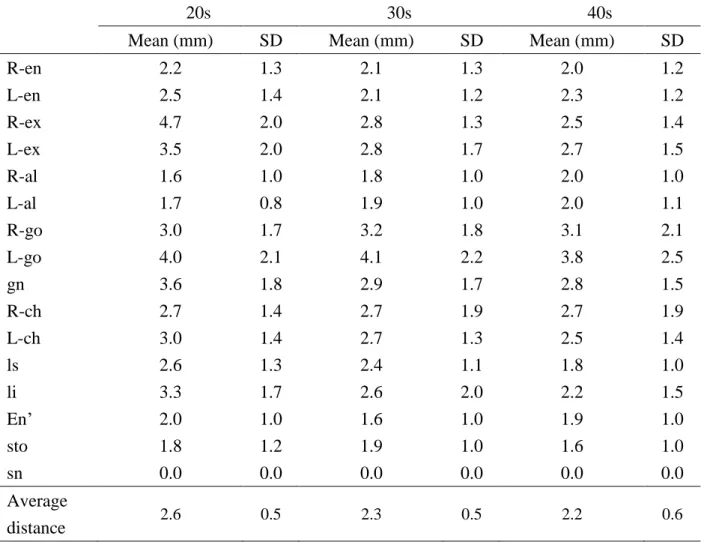
Table 1. Mean and SD values for the reciprocal point-to-point difference and average distance obtained from 16 reciprocal points between the 3D facial images of the subjects in their 50s and the 2D facial images of subjects in their 20s, 30s, and 40s, obtained from the same person.

20s 30s 40s

Mean (mm) SD Mean (mm) SD Mean (mm) SD

R-en 2.2 1.3 2.1 1.3 2.0 1.2

L-en 2.5 1.4 2.1 1.2 2.3 1.2

R-ex 4.7 2.0 2.8 1.3 2.5 1.4

L-ex 3.5 2.0 2.8 1.7 2.7 1.5

R-al 1.6 1.0 1.8 1.0 2.0 1.0

L-al 1.7 0.8 1.9 1.0 2.0 1.1

R-go 3.0 1.7 3.2 1.8 3.1 2.1

L-go 4.0 2.1 4.1 2.2 3.8 2.5

gn 3.6 1.8 2.9 1.7 2.8 1.5

R-ch 2.7 1.4 2.7 1.9 2.7 1.9

L-ch 3.0 1.4 2.7 1.3 2.5 1.4

ls 2.6 1.3 2.4 1.1 1.8 1.0

li 3.3 1.7 2.6 2.0 2.2 1.5

En’ 2.0 1.0 1.6 1.0 1.9 1.0

sto 1.8 1.2 1.9 1.0 1.6 1.0

sn 0.0 0.0 0.0 0.0 0.0 0.0

Average

distance 2.6 0.5 2.3 0.5 2.2 0.6

Table(s)

(11)

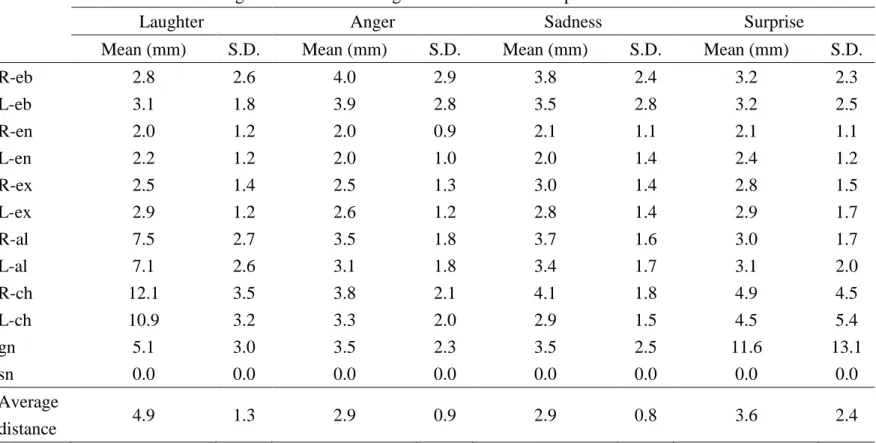
Table 2. Mean and SD values for the reciprocal point-to-point difference and average distance of 12 reciprocal points between the 3D normal facial images and 2D facial images with 4 emotional expressions

Laughter Anger Sadness Surprise

Mean (mm) S.D. Mean (mm) S.D. Mean (mm) S.D. Mean (mm) S.D.

R-eb 2.8 2.6 4.0 2.9 3.8 2.4 3.2 2.3

L-eb 3.1 1.8 3.9 2.8 3.5 2.8 3.2 2.5

R-en 2.0 1.2 2.0 0.9 2.1 1.1 2.1 1.1

L-en 2.2 1.2 2.0 1.0 2.0 1.4 2.4 1.2

R-ex 2.5 1.4 2.5 1.3 3.0 1.4 2.8 1.5

L-ex 2.9 1.2 2.6 1.2 2.8 1.4 2.9 1.7

R-al 7.5 2.7 3.5 1.8 3.7 1.6 3.0 1.7

L-al 7.1 2.6 3.1 1.8 3.4 1.7 3.1 2.0

R-ch 12.1 3.5 3.8 2.1 4.1 1.8 4.9 4.5

L-ch 10.9 3.2 3.3 2.0 2.9 1.5 4.5 5.4

gn 5.1 3.0 3.5 2.3 3.5 2.5 11.6 13.1

sn 0.0 0.0 0.0 0.0 0.0 0.0 0.0 0.0

Average

distance 4.9 1.3 2.9 0.9 2.9 0.8 3.6 2.4

(12)

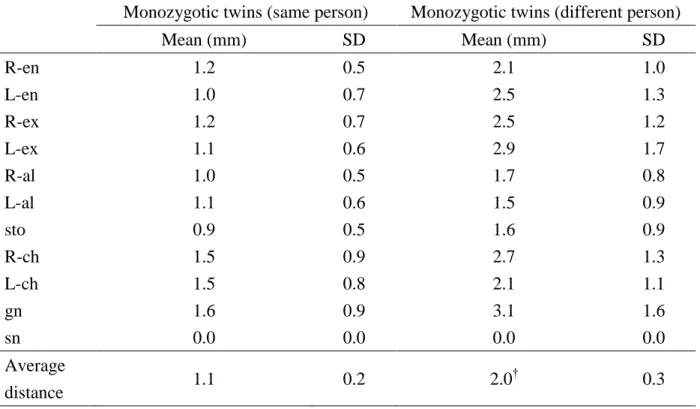
Table 3. Mean and SD values of the average distance of 11 reciprocal points between the 3D and 2D facial images in twins.

Monozygotic twins (same person) Monozygotic twins (different person)

Mean (mm) SD Mean (mm) SD

R-en 1.2 0.5 2.1 1.0

L-en 1.0 0.7 2.5 1.3

R-ex 1.2 0.7 2.5 1.2

L-ex 1.1 0.6 2.9 1.7

R-al 1.0 0.5 1.7 0.8

L-al 1.1 0.6 1.5 0.9

sto 0.9 0.5 1.6 0.9

R-ch 1.5 0.9 2.7 1.3

L-ch 1.5 0.8 2.1 1.1

gn 1.6 0.9 3.1 1.6

sn 0.0 0.0 0.0 0.0

Average

distance 1.1 0.2 2.0 0.3

† P<0.01, t-test

(13)

1 2 3 4 5 6 7 8 9 10 11 12 13 14 15 16 17 18 19 20 21 22 23 24 25 26 27 28 29 30 31 32 33 34 35 36 37 38 39 40 41 42 43 44 45 46 47 48 49 50 51 52 53 54 55 56 57 58 59 60 61 62 63 64 65

Assessment of some problematic factors in facial image identification using a 2D/3D superimposition technique

Masaru Atsuchi a,b , Akiko Tsuji a , Yosuke Usumoto a , Mineo Yoshino c , Noriaki Ikeda a,*

a Department of Forensic Pathology and Sciences, Graduate School of Medical Sciences, Kyushu University, Japan

b Forensic Science Laboratory, Fukuoka Prefectural Police Headquarters, Japan

c National Research Institute of Police Science, Japan

*Manuscript

Click here to view linked References

(14)

1 2 3 4 5 6 7 8 9 10 11 12 13 14 15 16 17 18 19 20 21 22 23 24 25 26 27 28 29 30 31 32 33 34 35 36 37 38 39 40 41 42 43 44 45 46 47 48 49 50 51 52 53 54 55 56 57 58 59 60 61 62 63 64 65

Abstract

The number of criminal cases requiring facial image identification of a suspect has been increasing because a surveillance camera is installed everywhere in the city and furthermore, the intercom with the recording function is installed in the home. In this study, we aimed to analyze the usefulness of a 2D/3D facial image superimposition system for image identification when facial aging, facial expression, and twins are under consideration. As a result, the mean values of the average distances calculated from the 16 anatomical landmarks between the 3D facial images of the 50s groups and the 2D facial images of the 20s, 30s, and 40s groups were 2.6, 2.3, and 2.2 mm, respectively (facial aging). The mean values of the average distances calculated from 12 anatomical landmarks between the 3D normal facial images and 4 emotional expressions were 4.9 (laughter), 2.9 (anger), 2.9 (sadness), and 3.6 mm (surprised), respectively (facial expressions). The average distance obtained from 11 anatomical landmarks between the same person in twins was 1.1 mm, while the average distance between different person in twins was 2.0 mm (twins). Facial image identification using the 2D/3D facial image superimposition system demonstrated adequate statistical power and identified an individual with high accuracy, suggesting its usefulness. However, computer technology concerning video image processing and superimpose progress, there is a need to keep familiar with the morphology and anatomy as its base.

1. Introduction

The surge of the restraint of the crime and the security consciousness increases for past several years. In the passage of such times, the cases that a criminal was left as "a picture"

into a surveillance camera in a part of the crime scene had increased. The crimes that most frequently involve facial image examination include robbery and theft, forgery and fraud, illegal immigration, and homicide. Therefore, identification between the facial image taken with a surveillance camera at the crime scene and mug shots of suspects increases, too. In general, the following 3 approaches to facial image identification are used: morphological comparison of facial features (facial outline, eyebrows, eye, nose, lip, and ear) [1-4], anthropometric analysis [2-5], and face-to-face superimposition [3, 4, 6-15].

However, there are some problems on carrying out the facial image identification which

is caused by the samples itself including the photography angles and the clearness of the

images. Moreover in a courtroom, face-to-face superimposition provides the jury with a clear

basis for a definite judgment; however, it requires that a suspect’s facial image be taken in

exactly the same orientation as that of the facial image seen during the crime. To solve these

problems, the 2D/3D facial image superimposition system was developed [9, 13]. Although

some problems associated with the use of the technique, such as blurred [11] and disguised

images [15], have been investigated, the more problematic factors such as facial aging,

(15)

1 2 3 4 5 6 7 8 9 10 11 12 13 14 15 16 17 18 19 20 21 22 23 24 25 26 27 28 29 30 31 32 33 34 35 36 37 38 39 40 41 42 43 44 45 46 47 48 49 50 51 52 53 54 55 56 57 58 59 60 61 62 63 64 65

emotional expressions, and monozygotic twins have not yet been examined. These problems make more difficult to identify because they are participate in the facial form itself.

Especially about the facial aging, according to report of FBI [16], hundreds of thousands of individuals are reported missing in the United States each year. Therefore, law enforcement agencies are charged with the task of locating these individuals, expending time and manpower in searches because of facial aging. Not only the United States but in our country, a similar matter is happening. A request for make a current face get the aging in the old photograph of the face of the missing person and utilize in the investigation is increasing.Therefore, the authors aimed to assess the effect of these factors on facial image identification using the 2D/3D facial image superimposition technique.

2. Materials and Methods

2.1. Effect of facial aging on facial image identification

The 3D facial images of 20 Japanese male subjects who were in their 50s were obtained using a 3D physiognomic range finder (Fiore, (NEC Co., Japan). The 2D facial images of subjects who were in their 20s, 30s, and 40s were obtained as snapshots (approximately frontal view). For evaluating the match of the 3D and 2D facial images of the same parson, the 3D facial image of each subject (age, 50s) was compared with the 2D facial images of 3 generation groups (ages, 20s, 30s, and 40s) 3 times using the 3D-Rugle3 software (Medic Engineering, Japan), yielding 180 superimpositions. As shown in Fig. 1, 16 anatomical landmarks, including the subnasale as a standard point, were used in the experimental study.

After the superimposition of the 2D and 3D facial images, the average distance calculated from 16 reciprocal point-to-point differences between both images was used as a matching criterion [13, 14].

2.2. Effect of emotional expression on facial image identification

The 3D normal face images of the 20 Japanese male subjects were obtained by Fiore.

The 2D facial images of the subjects were obtained by a digital still camera (Canon,

PowerShot G10, Japan) under the condition of 4 different emotional expressions, that is,

laughter, anger, sadness, and surprise. The 3D facial image of each subject was compared

with the 2D facial images of 4 emotional expressions of the same subject, obtained using the

same method described earlier. A total of 80 superimpositions were performed. The effect

of each emotional expression on facial image identification was evaluated using the

movement distance obtained from the following anatomical landmarks: the innermost point of

the left and right eyebrows, left and right entocanthion, left and right ectocanthion, left and

(16)

1 2 3 4 5 6 7 8 9 10 11 12 13 14 15 16 17 18 19 20 21 22 23 24 25 26 27 28 29 30 31 32 33 34 35 36 37 38 39 40 41 42 43 44 45 46 47 48 49 50 51 52 53 54 55 56 57 58 59 60 61 62 63 64 65

right alare, left and right cheilion, gnathion, and subnasale.

2.3. Individualization of facial images of twins

Nine sets of Japanese adult monozygotic twins (6, men and 3, women) were enrolled as experimental subjects. The 3D facial images of the subjects were acquired by Fiore and their 2D facial images were obtained by the digital still camera (Figs. 2 and 3). For assessing the match of the 3D and 2D facial images of the same person in twins, the 3D facial image of each subject was compared with the 2D facial image of the same subject (Fig. 2), yielding 18 superimpositions (Fig. 4). When, assessing the match of the facial images of another person in twins, the 3D facial image of each subject was compared with the 2D facial image of another person in twins (Fig. 3), yielding 18 superimpositions (Fig.5). As a matching criterion, the average distance of 11corresponding anatomical landmarks (left and right entocanthion, left and right ectocanthion, left and right alare, stomion, left and right cheilion, gnathion, and subnasale) in the superimposition images was calculated.

Furthermore, the ear in the 2D facial images obtained from the twins was morphologically examined.

3. Results

3.1. Effect of facial aging process on facial image identification

As shown in Table 1, the reciprocal point-to-point difference on the ectocanthion (4.7 and 3.5 mm) and gnathion (3.6 mm) in the subjects in their 20s was larger than that on the ectocanthion (2.5-2.8 mm) and gnathion (2.8 and 2.9 mm) in the subjects in their 30s and 40s, respectively. The reciprocal point-to-point difference on the gonion and cheilion was not found in the 3 generation groups. The mean values of the average distances calculated from the 16 anatomical landmarks between the 3D facial images of the 50s groups and the 2D facial images of the 20s, 30s, and 40s groups were 2.6, 2.3, and 2.2 mm, respectively.

3.2. Effect of emotional expression on facial image identification

Table 2 presents the reciprocal point-to-point difference and the average distance of 12

reciprocal points between the 3D normal face image and 2D facial images, revealing the

emotional expressions of laughter, anger, sadness, and surprise. In the laughing facial image,

the largest difference between the reciprocal points was found on the cheilion (12.1 and 10.9

mm) followed by the alare (7.5 and 7.1 mm) and gnathion (5.1 mm). However, the

reciprocal point-to-point difference on the other anatomical landmarks was approximately 3

mm. The reciprocal point-to-point difference in the angry and sad facial images was less

(17)

1 2 3 4 5 6 7 8 9 10 11 12 13 14 15 16 17 18 19 20 21 22 23 24 25 26 27 28 29 30 31 32 33 34 35 36 37 38 39 40 41 42 43 44 45 46 47 48 49 50 51 52 53 54 55 56 57 58 59 60 61 62 63 64 65

than 4.1 mm. In the surprised facial image, the reciprocal point-to-point difference on the gnathion showed the largest value (11.6 mm), but the difference on the other anatomical landmarks was approximately 3 mm, except on the cheilion (4.5-5.4 mm). The mean values of the average distances calculated from 12 anatomical landmarks between the 3D normal facial images and 4 emotional expressions were 4.9 (laughter), 2.9 (anger), 2.9 (sadness), and 3.6 mm (surprised), respectively.

3.3. Individualization of facial images in twins

As shown in Table 3, the reciprocal point-to-point difference in the same person was less than 1.6 mm (gnathion). In another person of monozygotic twins, the largest difference between the reciprocal points was found on the gnathion (3.1 mm), followed by that on the ectocanthion (2.9 and 2.5 mm) and cheilion (2.7 and 2.1 mm). The average distance obtained from 11 anatomical landmarks between the same person in twins was 1.1 mm, while the average distance between different person in twins was 2.0 mm. These data do not clarify whether 2 facial images in monozygotic twins are obtained from the same person though there was significantly difference on average distance between monozygotic twins (same person) and monozygotic twins (different person) (table 3). However, ear morphological differences were observed in 6 of 9 sets of twins. As shown in Fig. 6, the fossa triangularis, antihelix, and ear lobe were useful portions for individualizing monozygotic twins.

Discussion

The 2D/3D facial image superimposition system [13] was proven to be a useful tool for facial image identification because the superimposition of 2 facial images can be performed under the same facial orientation by rotating the 3D facial image, and then the shape and positional relationships of the facial outlines and components can be compared with each other in the same condition. In addition to this advantage, this superimposition system enables morphometric matching using anatomical landmarks, giving objective results based on numerical data [11-15]. The purpose of this study was to assess the effects of some problematic factors in facial identification, using this superimposition system.

In general, facial aging is primarily due to a progressive loss of muscle tone and skin

elasticity, with a corresponding deepening of creases in the face [16]. In the present study,

the ectocanthion moved downward in the facial images of the subjects in their 50s compared

to the facial images of those in their 20s, suggesting that the outer part of the eye slit moved

downward with the aging process. Meanwhile, the alare showed the smallest value

throughout each generation, suggesting that the nasal area almost did not change even in the

older subjects. In this experiment, the average distance obtained from 16 anatomical

(18)

1 2 3 4 5 6 7 8 9 10 11 12 13 14 15 16 17 18 19 20 21 22 23 24 25 26 27 28 29 30 31 32 33 34 35 36 37 38 39 40 41 42 43 44 45 46 47 48 49 50 51 52 53 54 55 56 57 58 59 60 61 62 63 64 65

landmarks between the 3D facial images of the older generation and 2D facial images of the younger and middle generations ranged from 2.2 to 2.6 mm. In the previous study investigating techniques of identifying whether 2 facial images are of the same person or not [14], the average distance obtained from 16 reciprocal point differences and its percentage error at the false-positive/negative crossover point were 3.1 mm and 4.2%, respectively. To avoid false-positive identification, the threshold of the average distance must be shorter than 2.5 mm. The average distance in the 30s (2.3 mm) and 40s groups (2.2 mm) in this study was shorter than the 2.5 mm threshhold, but the average distance in the 20s groups (2.6 mm) was slightly longer than the threshold. Although basic morphological examination should be performed, the 2D/3D facial image superimposition is suggested to support facial image identification in facial aging.

Emotional expressions move the anatomical landmarks. In the present study, 4 expressions, that is, laughter, anger, sadness, and surprise, were examined. In the laughing facial image, the reciprocal point-to-point difference on the cheilion, alare, and gnathion showed large values (5.1-12.1 mm). These landmarks are not suitable indicators for facial image identification and should be excluded. The same is true for the cheilion (4.5 and 4.9 mm) and gnathion (11.6 mm) in the surprised facial images. The reciprocal point-to-point difference in the angry and sad face images was less than 4.1 mm; hense, the values obtained for the 2 facial expressions were not used as supporting data for facial image identification.

Although the average distance in 4 emotional expressions was obtained from 12 reciprocal point differences, each value was higher than that obtained for anger (2.9 mm threshold) [14].

Based on our results, the superimposition system is difficult to apply in image identification when emotional facial expressions are involved.

In our experiment on the individualization of facial images in monozygotic twins, the reciprocal point-to-point differences of each landmark in the same persons of monozygotic twins are smaller than those in different persons of monozygotic twins. The average distance in the same (1.1 mm) and different (2.0 mm) persons was shorter than the threshold [14], suggesting that that it is difficult to distinguish the facial images of monozygotic twins by the morphometric analysis based on the 2D/3D facial image superimposition though there was significantly difference on average distance between monozygotic twins (same person) and monozygotic twins (different person). Facial image identification of monozygotic twins is generally difficult by morphological examination alone. However, ear morphological characteristics were useful for individualizing monozygotic twins.

In conclusion, morphometric analysis based on the 2D/3D facial image superimposition

can provide some supporting data for facial image identification in facial aging but cannot

provide informative data for facial image identification in emotional expressions and

monozygotic twins. Combined use of morphological and morphometric examinations using

2D/3D facial image superimposition may help in facial image identification under the

condition of these problematic factors.

(19)

1 2 3 4 5 6 7 8 9 10 11 12 13 14 15 16 17 18 19 20 21 22 23 24 25 26 27 28 29 30 31 32 33 34 35 36 37 38 39 40 41 42 43 44 45 46 47 48 49 50 51 52 53 54 55 56 57 58 59 60 61 62 63 64 65

References

[1] Vanezis P, Lu D, Cockburn J, Gonzalez A, McCombe G, Trujillo O, Vanezis M.

Morphological classification of facial features in adult Caucasian males based on an assessment of photographs of 50 subjects. J Forensic Sci 1996; 41:786-791.

[2] Iscan MY. Introduction to Techniques for Photographic Comparison: Forensic Analysis of the Skull. Wiley-Liss, NY, 1993; 57-70.

[3] Yoshino M. Conventional and novel methods for facial image identification.

Forensic Sci Rev 2004; 16-02:92-102.

[4] Yoshino M. Recent advances in facial image identification. Jpn J Sci Tech Iden 2002;

7:1-17

[5] Catterick T. Facial measuremens as an aid to recognition. Forensic Sci Int 1992; 23-27.

[6] Iscan MY, Loth SR. Photo image identification. Encyclopedia of Forensic Science. Vol 2; Academic Press: London, U.K.; 2000; 795-807.

[7] Majumder T, Shinha P. Photographs of the human face and broken projective symmetry. J Forensic Sci Soc 1989; 29: 387-395.

[8] Maples WR, Austin D E. Photo/video superimposition in individual identification of the living. Am Acad Forensic Sci Prog 1992; 170-171.

[9] Yoshino M, Kubota S, Matsuda H, Imaizumi K, Miyasaka S, Seta S. Face-to-face video superimposition using three-dimensional physiognomic analysis. Jpn J Sci Tech Iden 1996; 1:11-20.

[10] Vanezis P, Brierley C. Facial image comparison of crime suspects using video superimposition. Sci Justice 1996; 36:27-33.

[11] Atsuchi M, Noguchi K, Kubota S, Imaizumi K, Sakurada K, Yoshino M, Fraser NL, Thomas CDL, Clement JG. Evaluation of morphometric matching for the identification of Caucasian faces from blurred images. Jpn J Sci Tech Iden 2002; 6:135-138.

[12] Fraser NL, Yoshino M, Imaizumi K, Blackwell SA, Thomas CDL, Clement JG. A Japanese computer-assisted facial identification system successfully identifies non Japanese faces. Forensic Sci Int 2003; 135:122-128.

[13] Yoshino M, Matsuda H, Kubota S, Imaizumi K, Miyasaka S. Computer-assisted facial image identification system using a 3-D physiognomic range finder. Forensic Sci Int 2000; 109, 225-237.

[14] Yoshino M, Matsuda H, Kubota S, Imaizumi K, Miyasaka S. Assessment of

computer-assisted comparison between 3D and 2D facial images. Jpn J Sci Tech Iden 2000; 5:9-15.

[15] Yoshino M, Noguchi K, Atsuchi M, Kubota S, Imaizumi K, Thomas CDL, Clement JG.

Individual identification of disguised faces by morphometrical matching. Forensic Sci

Int 2002; 127:97-103.

(20)

1 2 3 4 5 6 7 8 9 10 11 12 13 14 15 16 17 18 19 20 21 22 23 24 25 26 27 28 29 30 31 32 33 34 35 36 37 38 39 40 41 42 43 44 45 46 47 48 49 50 51 52 53 54 55 56 57 58 59 60 61 62 63 64 65

[16] Taister MA, Hollidays SD, Borrman HIM. Comments on facial aging in law enforcement investigation. Forensic Sci Commun (2000; 2).

http://www.fbi.gov/about-us/lab/forensic-science-communications/fsc/april2000/index.ht

m/taister.htm

(21)

1 2 3 4 5 6 7 8 9 10 11 12 13 14 15 16 17 18 19 20 21 22 23 24 25 26 27 28 29 30 31 32 33 34 35 36 37 38 39 40 41 42 43 44 45 46 47 48 49 50 51 52 53 54 55 56 57 58 59 60 61 62 63 64 65

Legends to Figures

Fig. 1. The 16 anatomical landmarks used in the study. en: entocanthion, ex: ectocanthion, en’: the middle point between the left and right entocanthion, al: alare, sn: subnasale, ch:

cheilion, sto: stomion, go: gonion, gn: gnathion, ls: labrale superius, and li: labrare inferius.

Fig. 2. The 3D (left) and 2D facial images (right) of the elder brother in monozygotic twins.

Fig. 3. The 3D facial image of the elder brother (left) and 2D facial image of the younger brother (right) in monozygotic twins.

Fig. 4. Superimposition image of the 3D and 2D facial images of the elder brother in Fig. 2.

Fig. 5. Superimposition image of the 3D facial image of the elder brother and 2D facial image of the younger brother in Fig. 3.

Fig.6. Ear morphological differences in the monozygotic twins.

(22)

Editor-in-Chief for Legal Medicine

29 May, 2013

Re: Legal Medicine. LEGMED-D-13-00049

Assessment of some problematic factors in facial image identification using a 2D/3D superimposition technique

Dear Editor,

We would like to thank the reviewers for their critical and instructive comments. We thoroughly read the comments, and revised the manuscript in accordance with the reviewer’s comments, as follows.

With my best regards,

Prof. N. IKEDA, M.D.

Department of Forensic Pathology and Sciences

Graduate School of Medical Sciences, Kyushu University 3-1-1, Maidashi, Higashi-ku, Fukuoka 812-8582, JAPAN

E-mail: [email protected] (NoriakiIKEDA)

*Response to reviewers

(23)

Answers to Reviewer #1: This paper is quite interesting, and will provide useful information for personal intification. However, unfortunately, the section of References is absent probably because of authors' mistake. Thus,the section of Reference should be included. Moreover, the section of Abstract should include more informative results obtained from the present study.

I am sorry. I have forgotten to attach references. I’ve attached them Abstract was corrected and retouched completely.

Answers to Reviewer #2: A request for facial image identification of a suspect has increased. However, there are many cases in which the existing superimposition technique may not be applicable because some important factors such as facial aging are not enough investigated. This paper offers very useful knowledge to overcome these problems. Minor comments are provided below.

1.First, the authors forget to attach some sheets for references in the paper.

2.Abstract is likely to be monotonous and poor in content. I think that it should be more attractively described if possible, for example by adding raw data obtained.

3.Introduction also may be too short and lacking of interesting. For example, isn't it possible to add any stories relating to facial aging, emotional expression or twins?

I am sorry. I have forgotten to attach references. I’ve attached them Abstract was corrected and retouched completely.

Introduction was rewrote according to the advise.

4.In Results, why do the authors not statistically analyze the numerical values obtained?

We tried statistical analysis on twins (table 3) and add sentence in Results and

Discussion, but could not analyze on facial aging data and facial expression data.

(24)

Editor-in-Chief for Legal Medicine

29 May, 2013

Re: Legal Medicine. LEGMED-D-13-00049

Assessment of some problematic factors in facial image identification using a 2D/3D superimposition technique

Dear Editor,

We would like to thank the reviewers for their critical and instructive comments.

We thoroughly read the comments, and revised the manuscript. in accordance with the reviewer’s comments.

With my best regards,

Prof. N. IKEDA, M.D.

Department of Forensic Pathology and Sciences Graduate School of Medical Sciences, Kyushu University 3-1-1, Maidashi, Higashi-ku, Fukuoka 812-8582, JAPAN

E-mail: [email protected] (NoriakiIKEDA) Phone: +81-92-642-6121

Fax: +81-92-642-6126

Cover Letter

Table  1.  Mean  and  SD  values  for  the  reciprocal  point-to-point  difference  and  average  distance  obtained  from  16  reciprocal  points  between the 3D facial images of the subjects in their 50s and the 2D facial images of subjects in their 20s,
Table 2. Mean and SD values for the reciprocal point-to-point difference and average distance of 12 reciprocal points    between the 3D normal facial images and 2D facial images with 4 emotional expressions
Table 3. Mean and SD values of the average distance of 11 reciprocal points between the 3D and    2D facial images in twins

参照

関連したドキュメント

4 10 本時の目標

2009

本研究ではこの考え方を発展させ,仮想カメラで撮影 された正面顔画像を作る際に,多視点画像を用いた超解

Ⅰ.中期経営計画の進捗状況 1.主要経営指標 2.中計2年目の主な取組み 3.株主還元

〔学会発表〕 (計 4 件) ① Toshihiro Shinohara, Expression of Individual Yarn for Structure Analysis of Textile Fabric Based on Segmentation of Three Dimensional CT