資源環境と人類
Natural Resource
Environment
and Humans
N
R
E
H
明治大学黒耀石研究センター紀要
2014. 3
No.
4
■
論文
追平 B 遺跡出土石器群の再検討
―
愛鷹山麓における後期旧石器時代初頭の石器石材利用― 中村雄紀・金成太郎
1
ウクライナ,トランスカルパチア地方における黒曜石の記載岩石学的特徴(英文)
隅田祥光・山田昌功・S. リゾフ・V. ステパンチューク
21
削片系両面調整石器 ―
男女倉・東内野型有 尖頭器の再構築―
須藤隆司
39
■
総説
前期更新世における黒曜石
山田昌功
57
■
資料報告
中ッ原遺跡群第 5 遺跡 B 地点および第 1 遺跡 G 地点における削片系細石刃石器群の産地推定
堤 隆・望月明彦
73
長野県下諏訪町和田峠西黒曜石原産地の調査報告
及川 穣・宮坂 清・隅田祥光・堀 恭介・今田賢治
川井優也・河内俊介・角原寛俊・藤川 翔
83
黒曜石製遺物の原産地推定結果(2010 ∼ 2013 年度未公開分)
金成太郎
99
■
書評
完新世チロル地方の人類と環境 第 1 巻,D. シェーファー編『中石器時代プロジェクト
―ウラーフェルゼン』(第1部),A4 判 560 頁,フィリップ・フォン・ツァーベルン書店,
インスブルック,2011 年刊
小野 昭 105
■
黒耀石研究センター活動報告 2013
113ISSN 2188-3483
1.はじめに
静岡県東部の愛鷹山麓では,後期旧石器時代初頭から 黒曜石が石器石材として利用されていることが分かって いる.後期旧石器時代初頭については,黒曜石原産地開 発が日本列島への現代人の拡散や現代人的行動の発現と 関連して議論されている(島田 2009).中でも信州産黒 曜石は,後期旧石器時代には中部・関東地方とその周辺 を含む広い地域で利用された石材であるが,後期旧石器 時代初頭からその利用の詳細が明らかになっているのは ほぼ愛鷹山麓に限られるといってよい.信州をはじめ原 産地側の状況については,資料が十分でなく,また関東 地方では当該時期にまでさかのぼる信州産黒曜石の利用 を示す資料は限定的である.1 つの地域で連続的に黒曜 石利用の変化を追うことができるという点で愛鷹山麓の 資料は重要な意味をもっている. 2005 年に調査された追平 B 遺跡でも後期旧石器時代 初頭に位置づけられる石器群が出土し,特に黒曜石製石 器を含むまとまった資料が出土したことから注目され た.そのため,同遺跡の黒曜石利用を明らかにすること は愛鷹山麓の石器群の変遷をより明確にするために必要 であると考える.本稿ではまず,追平 B 遺跡の石器群 について,黒曜石原産地推定等の再検討を実施し,その 編年的位置づけを示す.次に再検討の結果を受けて原産 地推定結果に基づく当該期の石材利用について考察する ことを目的とする.なお,今回の原産地推定の成果は中 村(2011)でその一部1) を報告したものと同一のもの である. 本稿の内容は執筆者による討議の上,3 及び 6-1 につ いては金成が,それ以外の部分については中村が最終的 な取りまとめを行った.2.追平 B 遺跡の概要
追平 B 遺跡は静岡県駿東郡長泉町東野八分平に所在 する後期旧石器時代から縄文時代の遺跡で,長泉町教育 委員会によって調査され報告書が刊行されている(長追平 B 遺跡出土石器群の再検討
―愛鷹山麓における後期旧石器時代初頭の石器石材利用―
中村雄紀
1*・金成太郎
2 要 旨 愛鷹山麓の追平 B 遺跡の第 II 文化層の石器群について,遺物分布,器種分類等の再検討と黒曜石製石器の蛍光 X 線分析 法による原産地推定を実施した.そして,他の石器群との比較からその編年的位置づけを検討し,後期旧石器時代初頭の石 材利用の変遷について考察した.追平 B 遺跡の第 II 文化層の石器群は第 1 ~ 5 号石器ブロックと第 6 号石器ブロックとの 2 つの石器群に分けられる.前者は愛鷹山麓では最も古い第 IV スコリア層~第 VII 黒色帯下部に位置づけられ,黒曜石は 利用されていたものの限定的な消費にとどまる.後者は前者より新しい第 VII・VI 黒色帯に位置づけられ,信州産黒曜石 の本格的な利用が始まる.さらにこれに続く第 V 黒色帯では利用石材が多角化し,後期旧石器時代の主要な石材がこの時 期までに開発されることが明らかになった. キーワード:黒曜石,石器石材,後期旧石器時代初頭,愛鷹山麓 1 公益財団法人かながわ考古学財団 〒 232-0033 神奈川県横浜市南区中村町 3-191-1 2 明治大学黒耀石研究センター 明治大学黒耀石研究センター猿楽町分室 〒 101-8301 東京都千代田区神田駿河台 1-1 * 責任著者:中村雄紀([email protected]) 資源環境と人類 第 4 号 1-20 頁 2014 年 3 月 Natural Resource Environment and Humans No. 4.pp. 1-20.March 2014.― 2 ―
図 1 愛鷹山麓の後期旧石器時代の遺跡と層序
泉町教育委員会 2006).地形的には愛鷹山南東麓,標高 150m の東西を谷で区切られた尾根上に位置する(図 1). 愛鷹山南東麓は後期旧石器時代の遺跡が密集する地域で あり,追平 B 遺跡から尾根伝いに北西に向かうと富士 石遺跡がある他,細尾遺跡,向田 A 遺跡,梅ノ木沢遺 跡など後期旧石器時代初頭の遺跡も多い. 愛鷹山麓の後期旧石器時代の堆積層に当たる愛鷹ロー ム上部ローム層は黒色帯とスコリア層とが交互に重なっ た様相を示し,層位的編年対比の基準となっている.愛 鷹山の南麓側と,追平 B 遺跡が立地する南東麓側とで は層序に差異があり,上部ローム層最下部の第 IV スコ リア層は南東麓側では観察されない(愛鷹ローム団研グ ループ 1969).また,第 IV ~ VII 黒色帯を画するスコ リア層の幾つかも,しばしば分層できない場合がある. 報告書では追平 B 遺跡でも第 V ~ VII 黒色帯について はスコリア層によって分離することができず,「第 V ~ VII 黒色帯相当層」とされている.この第 V ~ VII 黒色 帯相当層は a ~ c の 3 層に細分できるとのことであるが, これと第 V ~ VII 黒色帯の各層との対応関係は明らか ではない. 追平 B 遺跡では大きく分けて休場層及び第 V ~ VII 黒色帯相当層から後期旧石器時代の石器群が出土してお り,それぞれ第 I 文化層,第 II 文化層として報告され ている.このうち本稿で扱う第 II 文化層の石器群は石 器 773 点,礫 8 点から成り,石器のうち 121 点が黒曜石 製である.
3.追平 B 遺跡第 II 文化層の黒曜石製石器の
原産地推定分析
追平 B 遺跡第 II 文化層の黒曜石製石器について,蛍 光 X 線分析法による原産地推定を実施した.黒曜石製 石器の総数は 121 点であるが,接合資料については基本 的にその一部を分析対象としたため,実際に測定した資 料は 108 点であった. 蛍光 X 線の測定にはエネルギー分散型蛍光 X 線分析 装置 JSX-3100s(日本電子株式会社製)を用いた.X 線 管球はターゲットが Rh(ロジウム)のエンドウインド ウ型を使用した.管電圧は 30kV,電流は抵抗が一定と なるよう自動設定とした.X 線検出器は Si(ケイ素) / Li(リチウム)半導体検出器を使用した.試料室内の状 態は真空雰囲気下とし,X 線照射面径は 15mm とした. 測定時間は 240sec である.測定元素は,主成分元素は ケイ素(Si), チタン(Ti),アルミニウム(Al),鉄(Fe), マンガン(Mn), マグネシウム(Mg),カルシウム(Ca), ナトリウム(Na),カリウム(K)の計 9 元素,微量元 素はルビジウム(Rb),ストロンチウム(Sr),イット リウム(Y),ジルコニウム(Zr)の計 4 元素の合計 13 元素とした.また,X 線データ解析ソフトには,明治大 学文化財研究施設製 ; JsxExt を使用した. 原産地推定の方法は望月(1997)に準拠し,原産地推 定のパラメータに Rb 分率{Rb 強度× 100/(Rb 強度+ Sr 強度+ Y 強度+ Zr 強度)},Sr 分率{Sr 強度× 100/(Rb 強度+ Sr 強度+ Y 強度+ Zr 強度)},Mn 強度× 100/ Fe 強度,Log(Fe 強度 /K 強度)を用いた.判別図{Rb 分率 vs Mn × 100/Fe と Sr 分率 vs Log(Fe/K)}の作 製,および判別分析を行った.1 σは霧ヶ峰地区西霧ヶ 峰系黒曜石の繰り返し測定による.分析用ソフトウェア には明治大学文化財研究施設製 ; MDR1.02 を使用した. 日本の黒曜石産出地データベースは杉原・小林(2004, 2006)を使用し,この中から,既存の文献・資料を参考 にして現地調査を行い,石器石材に利用可能と思われる 黒曜石の産出地を選択した.表 1 に中部・関東地方にお ける黒曜石産出地のなかで石器石材を採取(採掘)した と推定できる原産地を示す.表 2 に基準試料の測定強度 比,表 3 に各原産地(重点)間のマハラノビス距離を示 した.中部・関東地方における詳細な黒曜石原産地の産 出状況については明治大学古文化財研究所(2011)を参 照していただきたい. 測定した遺物 108 点のうち,原産地が判別できた遺物 は 107 点であった(図 2; 付表).原産地推定の結果は,霧ヶ 峰地区和田峠・鷹山系が 80 点(75%)であり,天城地 区柏峠系が 25 点(23%)であった.他に箱根地区畑宿 系が 1 点,神津島地区恩馳島系が 1 点認められた.4.追平 B 遺跡第 II 文化層の石器群の再検討
4-1 追平 B 遺跡第 II 文化層の石器群の構成
石器群は分布から第 1 号~第 6 号の 6 つの石器ブロッ 追平 B 遺跡出土石器群の再検討― 4 ―
表 1 関東・中部地方における黒曜石原産地の区分 表 2 関東・中部地方における黒曜石の測定値(強度比)
表
3 判別分析における群間距離(マハラノビス距離)
― 6 ―
図 2 追平 B 遺跡の判別図(上:Rb 分率,下:Sr 分率)
クに分けて報告されている.第 1 号~第 5 号石器ブロッ クは隣り合って分布し,その東側に約 40m 離れて第 6 号石器ブロックが分布する.第 1 号~第 5 号石器ブロッ クの石器群はホルンフェルスが主体であり,第 6 号石器 ブロックの石器群は黒曜石が主体と利用石材の構成が異 なっている.第 1 号~第 5 号石器ブロックにおいてはブ ロック間の接合が認められる一方,第 6 号石器ブロック はブロック内で完結する接合しか確認されていない. 以上のことから,第 II 文化層の石器群は第 1 号~第 5 号石器ブロックと第 6 号石器ブロックとの 2 つに分けて 捉えることができる.この 2 つの石器群について石器の 器種別,石材・原産地別組成を示すと表 4・5 の通りで ある.器種分類については本稿の作成に当たり再検討を 実施したため報告書とは異なる器種に分類した石器があ る.該当する石器はのうち,黒曜石製石器については付 表中の器種に「*」付きで示し,非黒曜石製石器につい ては以下の本文・註で記載している2) .
4-2 第 1 号~第 5 号石器ブロックの石器群
第 1 号~第 5 号石器ブロックの石器群は 602 点の石器 から成る.石器の分布は,5 つのブロックのうち第 1 号・ 第 2 号石器ブロックと第 4 号・第 5 号石器ブロックとを それぞれ 1 つの集中部として捉えて,径 5 ~ 7m の範囲 を核とする 3 つの石器集中部から成ると見なすこともで きそうである.接合資料はホルンフェルス製石器で 32 個体確認されており,集中部間に及ぶ接合も少なくない ことから比較的近い時期に残された一括資料として捉え てよいと考えられる(図 3). 二次加工のある石器の割合が低く,石核と合わせても 全体の 3%に満たない(表 4).但しこれは表面が風化・ 劣化しやすいホルンフェルスが主たる石器石材となって いることも影響すると考えられる.基部加工尖頭形石器 とした石器(図 4-1)は黒曜石の縦長剥片を素材とし, 左側縁基部に二次加工(但しこの部分には新たな欠損に よる可能性が高い剥離もある)があり,右側縁には刃毀 れ状の微細剥離が認められる.台形様石器とした石器 (2)は左側縁に裏面側への二次加工が認められるが,右 側縁上部が欠損するなど全体形は不明瞭である.ホルン フェルス製の石器としては掻器・削器類(3 ~ 7)があり, 厚手の剥片を素材とする掻器(3)や鋸歯縁削器(4)と, 比較的薄手のものとがある(5 ~ 7).また,円礫を端部 から剥離した石核がある(8・9).8 は両端から剥離が 行われているが,いずれの剥離面も鋭角を成し,礫器の 可能性もある.なお,剥片剥離はこうした単設打面から の剥離に限られるわけではなく,90 度の打面転位など も認められる(10・11)3) . 石器石材の構成を見ると,大部分にあたる 583 点がホ ルンフェルス製で,黒曜石製は残りの 19 点にとどまる. 図 3 第 1 ~ 5 号石器ブロックの遺物分布と接合関係 追平 B 遺跡出土石器群の再検討― 8 ―
表 4 第 1 ~ 5 号石器ブロック組成表
図 4 追平 B 遺跡第 II 文化層第 1 ~ 5 号石器ブロックの出土石器
黒曜石の半数以上は柏峠産で,類似した外見的特徴の剥 片がまとまって出土しており,柏峠産黒曜石については 遺跡内で剥片剥離が行われた可能性も考えられる.和田 峠・鷹山系黒曜石は 5 点出土しているが,最大長 2cm 以下の小型の資料に限られる.石核とした石器が 1 点あ るが,小型の角礫片から長さ 1cm 程度の剥片が剥離さ れているもので,石器素材製作に関わるものかは疑問で ある.畑宿産,恩馳島産黒曜石とともに遺跡内での石材 消費の証拠が乏しい.
4-3 第 6 号石器ブロックの石器群
第6号石器ブロックの石器群は171点の石器から成る. 接合資料は和田峠・鷹山系黒曜石 4 個体,柏峠系黒曜石 3 個体,ホルンフェルス 2 個体,ガラス質黒色安山岩, 凝灰岩各 1 個体確認されている.遺物分布は径 8m の範 囲に大部分がまとまりつつその周囲にも散漫に分布する 状況を示し,接合資料も含めて径 15m 程度の範囲内に 収まる(図 5). 二次加工のある石器は全体の約 13%である(表 5). 台形様石器は,整った平坦加工による斜刃のもの(図 6-1),縦長の素材の両側縁を錯向調整したもの(2・3) と,矩形の剥片の一部を加工したもの(4 ~ 6)とがある. また,打製石斧に分類される石器(15)が 1 点ある.風化・ 劣化が激しい資料であるが両側縁がゆるやかに開き,厚 みのある形態を呈する.この他,掻器(7),削器(8・9), 錐形石器(10・11),楔形石器(12)などが出土している. 石材では黒曜石が 102 点を占め,そのうち 81 点が和 田峠・鷹山系である.第 1 ~ 5 号石器ブロックと異なり 黒曜石の接合資料(16 ~ 18)が複数存在し,ある程度 の剥片剥離が行われていたことは確実であろう. 図 5 第 6 号石器ブロックの遺物分布と接合関係 表 5 第 6 号石器ブロック組成表 追平 B 遺跡出土石器群の再検討― 10 ―
5.愛鷹山麓の後期旧石器時代初頭の石器群と
追平 B 遺跡第 II 文化層
追平 B 遺跡第 II 文化層の石器群は全て第 V ~ VII 黒 色帯相当層から出土したものとして報告されているが, それ以上の細かい層位的位置づけ(第 V ~ VII 黒色帯 相当層 a ~ c の各細分層との対応関係など)は示されて おらず,厳密な層位的位置づけや,第 1 ~ 5 号石器ブロッ クと第 6 号石器ブロックとの層位的関係などは明らかで はない.そこで,周辺の遺跡の石器群と対比して石器群 の時期を示しておく. 愛鷹山麓の第 V 黒色帯までの石器群の変遷は,おお よそ 3 つに区分して捉えられる(中村 2012). 現在,愛鷹山麓で最古に位置づけられるのは井出丸 山遺跡第 I 文化層の石器群(図 7-1 ~ 6; 沼津市教育委員 会 2011)で,第 VII 黒色帯の下位の第 IV スコリア層を 出土層位とする.定型的な石器は少なく,基部加工尖頭 形石器(図 7-1, 2),台形様石器(3),鋸歯縁削器(4・ 5)など削器類,及びホルンフェルスの円礫を端部から 打ち割った礫器あるいは石核(6)などが見られる.追 平 B 遺跡第 II 文化層第 1 ~ 5 号石器ブロックはこの石 器群に近いものとして位置づけることが可能であろう. 井出丸山遺跡,追平 B 遺跡以外では量的にまとまった 資料がないが,ホルンフェルス円礫の礫器あるいは石 核や剥片類などは第 VII 黒色帯下部の出土とされる秋 葉林遺跡第 I 文化層(図 7-7; 静岡県埋蔵文化財調査研 究所 2009b)や的場遺跡(静岡県埋蔵文化財調査研究所 2010b)などでも出土している.井出丸山遺跡第 I 文化 層では放射性炭素年代測定により 38000-37000 cal BP 前 後と,愛鷹山麓で最古となる年代値が得られている. 図 6 追平 B 遺跡第 II 文化層第 6 号石器ブロックの出土石器 中村雄紀 ほか図 7 第 IV スコリア層~第 VII 黒色帯の石器群 井出丸山遺跡第 I 文化層 (1 ~ 6)、秋葉林遺跡第 I 文化層 (7) 図 8 第 VII・VI 黒色帯の石器群 富士石遺跡第 I 文化層石器集中 1(1 ~ 5),中見代第 I 遺跡 BBVI(6・7). 富士石遺跡第 I 文化層石器集中 2・3(8 ~ 10) 図 9 第 V 黒色帯の石器群 中見代第 I 遺跡第 I 文化層 (1 ~ 7)、西洞遺跡 b 区 BBVI 直上文化層 (8 ~ 15) 追平 B 遺跡出土石器群の再検討
― 12 ―
これらに続いて現れたと考えられる第 2 の石器群は第 VII 黒色帯~第 VI 黒色帯を出土層位とするもので,代 表的なものとしては富士石遺跡第 I 文化層(図 8-1 ~ 5, 8 ~ 10; 静岡県埋蔵文化財調査研究所 2010c)の石器群 がある.基部加工尖頭形石器(8・9)や台形様石器(1 ~ 4, 10)が出土しており,台形様石器については平坦 剥離が発達したものが認められる.また,一部では斧形 石器も出土する.その他,富士石遺跡第 II 文化層(静 岡県埋蔵文化財調査研究所 2010b)や中見代第 I 遺跡第 VI 黒色帯(図 8-6・7; 高尾 1994)などの石器群がある. 第 3 は第 V 黒色帯を出土層位とする石器群である. 出土層位としては第 V 黒色帯下部からその下位のスコ リア層にまとまる傾向がある4) .台形様石器には平坦 加工の発達した整った形態のものが見られるようにな る.また,斧形石器がほとんどの遺跡で出土する.扁平 な形態が基本であり,破損品が多いが刃部磨製のもの の割合が高いようである.中見代第 I 遺跡第 V 文化層 (図 9-1 ~ 7; 沼津市教育委員会 1989a),西洞遺跡 b 区第 VI 黒色帯直上文化層(図 9-8 ~ 15; 沼津市教育委員会 1999),西洞遺跡第 I 文化層(静岡県埋蔵文化財センター 2012a),土手上遺跡(沼津市教育委員会 1998)などが 挙げられる.台形様石器には I 類(佐藤 1988)の精製 品にあたる,比較的大型で両側縁からの平坦加工が発達 した型のもの(図 9-1・2・8・9)がしばしば見られる. また,扁平な形態の打製石斧(7)や刃部磨製石斧(15) もこの時期の石器群では一般的な石器である. 追平 B 遺跡第 II 文化層第 6 号石器ブロックの石器群 は上記の第 2・第 3 のグループに近い内容をもつ.錯向 調整による台形様石器は第 2 のグループに見られるのと 類似する点,打製石斧は第 3 のグループの石器群で多く 出土している扁平な形態のものではなく,第 2 のグルー プの一部の遺跡で出土している厚みのある形態のもので あることから,第 2 のグループすなわち第 VII ~ VI 黒 色帯に対比される可能性が高い.6.愛鷹山麓における後期旧石器時代初頭の石
器石材利用
6-1 愛鷹山麓の後期旧石器時代初頭の石器群に
見られる黒曜石
今回提示した追平 B 遺跡の石器群の分析結果を他の 石器群のデータと合わせて,愛鷹山麓の後期旧石器時代 初頭における石材利用について考察を行う.表 6 は第 IV スコリア層から第 V 黒色帯にかけての石器群の石材 組成を集成したものである.追平 B 遺跡の場合と同様に, 同一文化層として報告されている資料群でも,分布や接 合関係などから一まとまりの資料として捉えられる場合 以外は分離して集計した(「石器集中外」,「石器集中な し」とした資料を除く).また,一部の零細な石器群を 割愛する一方で,同時期の箱根山麓の資料である初音ヶ 原 A 遺跡(望月 1999)と生茨沢遺跡(静岡県埋蔵文化 財調査研究所 1999)とを加えて示した. ここに関係する遺跡の黒曜石原産地分析は追平 B 遺 跡が明治大学古文化財研究所,井出丸山遺跡が沼津市文 化財センター,それ以外が望月明彦・沼津工業高等専門 学校名誉教授によるものである.いずれもエネルギー分 散型蛍光 X 線分析によるものであるが,分析者または 分析が実施された時期により産地の区分や名称が異な る.表 6 に示した産地名はそれを適宜読み替えて集約し たものであり,それらの対応関係を示すと表 7 の通りで ある.例えば明治大学古文化財研究所の分析で「西霧ヶ 峰系」としているものは望月氏らの「諏訪星ヶ台群」に 対応し,「和田峠 I 系」としたものは望月氏らの分析で は和田小深沢群や和田土屋橋北群に分けられている.こ の中で問題となるのは「箱根系」として集計したもので, 望月氏による箱根黒岩橋群(旧・箱根系 A 群)及び「箱 根系不明」とされたもの(土手上遺跡 BBV 第 I 地点の 石器 12 点)を含めている.明治大学古文化財研究所の 原石サンプルには望月氏らの箱根黒岩橋群に記載岩石学 および岩石化学的に類似する原石は採用されていない. 明治大学古文化財研究所(2011)に記載している黒岩橋 産の黒曜石は,畑宿のものと同一のテフラ層(真鶴軽石 層 ; 町田ほか 1974,高橋ほか 2006)である可能性が高 い軽石凝灰岩中に含まれ,畑宿産黒曜石とほぼ同一の化 中村雄紀 ほか表 6 愛鷹・箱根山麓の後期旧石器時代初頭(第 IV スコリア層~第 V 黒色帯)石器群の石材組成 追平 B 遺跡出土石器群の再検討
― 14 ―
学組成を示す(長井ほか 2011)ものである.そのため 望月氏らの箱根黒岩橋群とは異なるものと考えられる. 望月氏らの分析に類似する結果としては,飛田給北遺跡 第 9 地点の分析結果(杉原ほか 2011)が挙げられ,原 産地推定の判別図上で畑宿系,鍛冶屋系とは異なる領域 にプロットされる原産地不明の一群がある.よって,現 時点での明治大学古文化財研究所の分析では箱根黒岩橋 群と 1 対 1 で対応する結果が出ることはない.このため 「箱根系」とした黒曜石は表 6・7 では別個に示してある.6-2 愛鷹山麓の後期旧石器時代初頭における石
材利用の変遷
6-2-1 愛鷹山麓の後期旧石器時代初頭の石器群にお ける利用石材 分析によって産地が判明している黒曜石を含めて,愛 鷹山麓の後期旧石器時代の遺跡群で利用されている石材 を愛鷹山麓との位置関係で分類すると,おおよそ以下の 3 つに分けることができる.第 1 に,愛鷹山麓周辺で採 取される石材で,これには富士川系ホルンフェルス,箱 根山の黒色安山岩や黒曜石(畑宿産),伊豆の黒色安山 岩や黒曜石(柏峠産)などが含まれる5) .第 2 に北方の 中部高地方面から持ち込まれる石材があり,信州中部高 地の各産地(和田峠・鷹山,西霧ヶ峰,麦草峠・冷山な ど)の黒曜石がこれに当たる.第 3 に南方から持ち込ま れる石材があり,神津島(恩馳島)産黒曜石がこれに当 たる.第 1 の石材が産地から遺跡までが比較的短距離の ものであり,第 2・3 の石材は長距離の移動を経て遺跡 に持ち込まれたものである. 表 6 の石材組成を,これら 3 つの地域に分けて捉える と,第 IV スコリア層から第 V 黒色帯までの各時期を通 して多数を占めるのは第 1 の愛鷹山麓周辺地域の石材で あり,それに対して愛鷹山麓からは遠隔地に当たる第 2・ 3 の地域の石材の利用状況により大きな変化が窺える. 以下では,第 5 節で述べた石器群の変遷に対応する形で 石材利用の変遷についてまとめる. 6-2-2 第 IV スコリア層~第 VII 黒色帯の石器群 第 IV スコリア層~第 VII 黒色帯下部の石器群につい ては,石器石材は基本的には愛鷹山麓周辺で採取可能な ホルンフェルスが主体である.黒曜石が出土している石 器群としては井出丸山遺跡第 I 文化層,追平 B 遺跡第 II 文化層第 1 ~ 5 号石器ブロック,元野遺跡第 IV スコ リア層・第 VII 黒色帯の石器群があり,ホルンフェルス 主体の石器群に黒曜石が少数伴っている.黒曜石は信州, 畑宿,柏峠,神津島といった産地のものがあり,愛鷹山 麓に後期旧石器時代の遺跡が出現する時点で主要な黒曜 石原産地がすでに利用されていたことが分かる.しかし, 第 IV スコリア層から第 VII 黒色帯下部ではいずれの石 器群でも黒曜石の利用は限定的である.信州産あるいは 神津島産黒曜石や井出丸山遺跡第 I 文化層で 1 点出土し た下呂石など,これらの遠隔地からもたらされた石材は 単独あるいは少数ずつの出土であり,遺跡内で剥片剥離 等が行われた痕跡が乏しく,消費の最終段階の状態と言 える.その後の時期の利用状況から見ても愛鷹山麓から 恒常的に石材獲得が行われていた可能性が低い下呂石6) の存在が解釈を困難にしているが,信州方面や神津島方 表 7 原産地区分の対応関係 中村雄紀 ほか面からの石材の搬入がありながらも石器製作は富士川系 ホルンフェルスをはじめとする愛鷹山麓周辺の石材で行 われている状況である. 6-2-3 第 VII ~ VI 黒色帯の石器群 この時期の石器群は,追平 B 遺跡第 II 文化層第 6 号 石器ブロックのように,1 か所の石器集中にまとまり, 出土石器は多くても 200 点超程度に収まる.信州産黒曜 石により剥片剥離が行われたと見なせる遺跡が複数認め られ,富士石遺跡第 I 文化層石器集中 1,同・石器集中 2・3, 追平遺跡第 II 文化層第 6 号石器ブロックなどで和田峠・ 鷹山系の黒曜石が利用されている.また,中見代第 I 遺 跡第 VI 黒色帯の石器群のように神津島産黒曜石が主体 となる石器群も存在する.消費途上の石核や素材剥片な どが搬入され,石材の消費が行われたものと捉えられる. 但し,多くの遺跡で愛鷹山麓周辺の石材が半数かそれ以 上を占め,石器石材の主体となっている点は変わらない. 6-2-4 第 V 黒色帯の石器群 第 V 黒色帯では遺跡規模が大きくなり,第 VII ~ VI 黒色帯の石器群では見られなかった石器点数が 300 点を 超す遺跡が多数見られるようになる.利用石材について は全体として愛鷹山麓周辺の石材の比率が高い一方で信 州産黒曜石や神津島産黒曜石により剥片剥離が行われた と見なせる遺跡が存在するという状況である.但し,遺 跡規模が大きくなったにもかかわらず信州産黒曜石は, 1 遺跡あたり多くても 100 点を少し超える程度と見込ま れ 7),第 VII ~ VI 黒色帯の石器群と大差ない量しか消 費されていない.また信州産黒曜石は西霧ヶ峰系や麦草 峠・冷山系が利用され,第 VII ~ VI 黒色帯の石器群で 利用されていた和田峠・鷹山系の黒曜石はほとんど見ら れなくなる.一方,畑宿系や柏峠系といった愛鷹山麓近 傍に産する黒曜石については数百点出土する事例が見ら れる.神津島系黒曜石についても土手上遺跡第 III 地点 など,出土数が多い遺跡が認められる.その他,ガラス 質黒色安山岩や水晶,凝灰岩類など,第 VII ~ VI 黒色 帯の石器群では僅かまたはほとんど見られなかった石材 の利用も増加している.愛鷹山麓周辺の石材を中心に, 利用石材の多角化が進んでいる状況と言える. 石器群の大規模化からは遺跡の利用頻度の増加が推定 され,また箱根山麓にも確実に遺跡の分布が広がるのも この時期である.利用石材の多角化は愛鷹山麓周辺地域 の資源開発が強化された結果として捉えられる可能性が 高い.
7.まとめ
愛鷹山麓の後期旧石器時代初頭の石器群の利用石材 は,石器群の変遷とともに以下の 3 段階で変遷している ことが確認された. 現時点で愛鷹山麓最古段階と考えられる第 IV スコリ ア層~第 VII 黒色帯下部の石器群では信州や神津島など 各産地の黒曜石がすでに利用されていたが,その量は非 常に限られていた.追平 B 遺跡第 II 文化層第 1 ~ 5 号 石器ブロックの石器群はこの時期の様相を代表する石器 群の 1 つである. 第 VII ~ VI 黒色帯では愛鷹山麓の遺跡で信州産黒曜 石や神津島産黒曜石によって剥片剥離が行われるように なり,これら愛鷹山麓外からの石材が本格的に利用され るようになったものと考えられる.追平 B 遺跡第 II 文 化層第 6 号石器ブロックの石器群はこの時期に位置づけ られ,信州産(和田峠・鷹山系)黒曜石による剥片剥離 が行われた石器集中が残されている. 第 V 黒色帯では,石器群の規模が大きくなるととも に,ガラス質黒色安山岩,畑宿産黒曜石,柏峠産黒曜石 といった愛鷹山麓周辺の石材,及び神津島産黒曜石など の利用が増加しており,利用石材の多角化が進んでいる. 第 IV スコリア層から第 V 黒色帯までに見られる石材 利用の変化は石材産地の開発に連動した変化と考えられ る.早くから信州や神津島を含む黒曜石が利用されてい る一方,ガラス質黒色安山岩をはじめ様々な石材が本格 的に開発されるのは遺跡が増え,規模も大きくなる第 V 黒色帯期まで下ることが分かった.特にガラス質黒色安 山岩は黒曜石,ホルンフェルスと並んでこの後石器石材 として主要な位置を占める石材である.後期旧石器時代 の石器群の基盤となる石材が本格的に開発されて出そろ うのが第 V 黒色帯であり,追平 B 遺跡第 II 文化層の 2 つの石器群はそこまでの移行過程を示す資料として位置 追平 B 遺跡出土石器群の再検討― 16 ―
づけられる.愛鷹山麓においては石材利用から見ると後 期旧石器時代的石器群の形成が第 IV スコリア層から第 V 黒色帯にかけて漸移的に進展したと評価できる. 謝 辞 長泉町教育委員会の廣瀬高文氏には資料の分析・観察の機 会を与えていただいた.明治大学名誉教授の杉原重夫氏には 分析に関してご配慮いただいた.同大学文化財研究施設の佐 藤裕亮・弦巻千晶・峯崎智美の各氏には蛍光 X 線分析装置 の操作をお願いした.また,査読者からは原稿の改善に有益 なコメントをいただいた.末筆ながらここに感謝の意を表し ます. なお,本研究では文部科学省私立大学戦略的研究基盤形成 支援事業(平成 23 年度~平成 27 年度)「ヒト-資源環境系 の歴史的変遷に基づく先史時代人類誌の構築」(研究代表者: 小野 昭)からの助成を受けた. 註 1)中村(2011)では産地ごとの点数集計結果と台形様石器 等の主な石器の分析結果とを報告している. 2)追平 B 遺跡第 II 文化層の石器群の分類については廣瀬 ほか(2006),岩宿博物館(2006: pp.14-15)の記述も参 考にした. 3)報告書では図 4-4・6 の鋸歯縁削器は鋸歯縁石器,7 の削 器はノッチとされている.また報告書第 28 図 42 の鋸歯 縁石器は本稿では削器に分類している. 4)西洞遺跡 b 区(沼津市教育委員会 1999)の石器群は「第 VI 黒色帯直上」出土と記載されているが,これは遺物 が第 VI 黒色帯のすぐ上の層から出土したことを示すも のである.この場合も実際には第 V 黒色帯下部からそ の下位のスコリア層から石器群が出土しており,「第 V 黒色帯」から出土したとされる石器群とは層位的な差は ない.少なくとも「第 VI 黒色帯」出土の石器群よりは 層位的に新しく位置づけられるべきものである. 5)愛鷹山麓周辺で利用された主要石材であるガラス質黒色 安山岩やホルンフェルスの産地については池谷・望月 (1998),前嶋・森嶋(2003, 2005)などにまとめられている. 6)下呂石は井出丸山遺跡以外の愛鷹山麓の遺跡では塚松遺 跡(4 点) (静岡県埋蔵文化財調査研究所 2008b),富士 石遺跡(3 点) (静岡県埋蔵文化財センター 2012b),丸 尾北遺跡(1 点)(静岡県埋蔵文化財調査研究所 2009c) で出土したとされている.これらはいずれも縄文時代の 包含層からの出土である. 7)産地不明とされる資料があるため正確な点数は不明であ る.仮に産地が分かっている資料の産地別比率から類推 すると,例えば土手上遺跡第 I 地点では産地が判明した 資料のうち信州産黒曜石が約 7.9%でこれを黒曜石の総 数と掛けると約 111 点,清水柳北遺跡では信州産黒曜石 が約 92.2%で黒曜石の総数と掛けると約 119 点と見込ま れる. 引用文献 愛鷹ローム団研グループ 1969「愛鷹山麓のローム層 : 東名 高速道路工事現場を中心として」『第四紀研究』8(1): 10-21 廣瀬高文・岩名健太郎・高尾好之 2006「静岡県内の岩宿時 代 I 期初頭の石器群」『岩宿フォーラム 2006 /シンポジ ウム「岩宿時代はどこまで遡れるか : 立川ローム層最下 部の石器群」予稿集』岩宿博物館・岩宿フォーラム実行 委員会 , pp. 14-21, 群馬 池谷信之・望月明彦 1998「愛鷹山麓における石材組成の変 遷」『静岡県考古学研究』30: 21-44 岩宿博物館 2006『第 42 回企画展「岩宿時代はどこまで遡 れるか」展示図録』, 53p., 群馬 町田 洋・新井房夫・村田明美・袴田和夫 1974「南関東に おける第四紀中期のテフラの対比とそれに基づく編年」 『地学雑誌』83: 302-338 前嶋秀張・森島富士夫 2003「ホルンフェルスの入手先を明 らかにする」『静岡県考古学研究』35: 1-12 前嶋秀張・森島富士夫 2005「ガラス質黒色安山岩の入手先 を明らかにする」『研究紀要』11: 1-13 明治大学古文化財研究所 2011『蛍光 X 線分析装置によ る黒曜石製遺物の原産地推定 : 基礎データ集< 2 >』, 294p., 東京 三島市教育委員会 1999『初音ヶ原遺跡』,444 p., 静岡 望月明彦 1997「蛍光 X 線分析による中部・関東地方の黒 曜石産地の判別」『X 線分析の進歩』28: 157-168 望月明彦 1999「蛍光 X 線分析による初音ヶ原遺跡群出土 の黒曜石製石器の産地推定」『初音ヶ原遺跡』,三島市教 育委員会 , pp.419-430, 静岡 長井雅史・荻津 達・柴田 徹・杉原重夫 2011「箱根地域 産黒曜石の記載岩石学的・岩石化学的検討 : 黒曜石製遺 物の原産地推定法に関する基礎的研究」『環境史と人類』 4: 67-89 長泉町教育委員会 2006『追平 B 遺跡』, 142p., 静岡 中村雄紀 2011「愛鷹山麓最古の石器群の諸問題 : 第 VII 黒 色帯付近の石器群」『石器文化研究』17: 76-94 中村雄紀 2012「愛鷹・箱根山麓の後期旧石器時代前半期前 葉の石器群の編年」『旧石器研究』8: 105-122 沼津市教育委員会 1988『土手上・中見代第 II・第 III 遺跡 発掘調査報告書(足高尾上 No.1・6・7 遺跡)』,361p., 静岡 沼津市教育委員会 1989a『中見代第 I 遺跡発掘調査報告書』, 284p., 静岡 沼津市教育委員会 1989b『清水柳北遺跡発掘調査報告書そ の 2』,873 p., 静岡 沼津市教育委員会 1998『土手上遺跡(d・e 区 -2)発掘調 査報告書』,294 p., 静岡 沼津市教育委員会 1999『西洞遺跡(b 区 -1)発掘調査報告書』, 333 p., 静岡 沼津市教育委員会 2011『井出丸山遺跡発掘調査報告書』, 134 p., 静岡 中村雄紀 ほか佐藤宏之 1988「台形様石器研究序論」『考古学雑誌』73(3): 1-37 島田和高 2009「黒耀石利用のパイオニア期と日本列島人類 文化の起源」『駿台史学』135: 51-70 静岡県埋蔵文化財センター 2012a『西洞遺跡 II 第二東名 No.8 地点 旧石器時代・縄文時代編』,254p., 静岡 静岡県埋蔵文化財センター 2012b『富士石遺跡 III 第二東 名 No.142 地点 縄文時代以降編』,333p., 静岡 静岡県埋蔵文化財調査研究所 1999『生茨沢遺跡』,55p., 静 岡 静岡県埋蔵文化財調査研究所 2007『向田 A 遺跡 第二東 名 No.140 地点』,260 p., 静岡 静岡県埋蔵文化財調査研究所 2008a『元野遺跡 第二東名 No.19 地点』,394 p., 静岡 静岡県埋蔵文化財調査研究所 2008b『裾野市富沢・桃園の 遺跡群』,362p.,静岡 静岡県埋蔵文化財調査研究所 2009a『梅ノ木沢遺跡 II(旧 石器時代編)第二東名 No.143-2 地点,CR-35 地点』,212 p., 静岡 静岡県埋蔵文化財調査研究所 2009b『秋葉林遺跡 I 第二東 名 No.25 地点(旧石器時代~縄文時代草創期編)』,532 p., (全 2 分冊), 静岡 静岡県埋蔵文化財調査研究所 2009c『丸尾北遺跡』,258p., 静岡 静岡県埋蔵文化財調査研究所 2010a『細尾遺跡 第二東名 No.141 地点』,311 p., 静岡 静岡県埋蔵文化財調査研究所 2010b『的場古墳群・的場遺 跡 第二東名 NO.26 地点』,502 p., 静岡 静岡県埋蔵文化財調査研究所 2010c『富士石遺跡 I 第二東 名 No.142 地点 旧石器時代(AT 下位)編』,480p.(全 2 分冊), 静岡 杉原重夫・金成太郎・弦巻千晶・弦巻賢介・佐藤裕亮・金木 利憲 2011「調布市飛田給北遺跡出土黒曜石製遺物の原 産地推定」『調布市飛田給北遺跡第 9 地点』,東京都埋蔵 文化財センター , pp.180-191, 東京 杉原重夫・小林三郎 2004「考古遺物の自然科学的分析に関 する研究 : 黒耀石産出地データベース」『明治大学人文 科学研究所紀要』55: 1-83 杉原重夫・小林三郎 2006「文化財の自然科学的分析による 文化圏の研究」『明治大学人文科学研究所紀要』59: 43-94 高橋正樹・内藤昌平・中村直子・長井雅史 2006「箱根火山 前期・後期中央火口丘噴出物の全岩化学組成」『日本大 学文理学部自然科学研究所研究紀要』41: 151-186 高尾好之 1994「愛鷹山南麓・箱根西麓の後期旧石器時代石 器群編年試案」『向坂鋼二先生還暦記念論集 地域と考 古学』, pp.1-29, 浜松 , 向坂鋼二先生還暦記念論集刊行会 (2013 年 11 月 20 日受付/ 2014 年 1 月 14 日受理) 追平 B 遺跡出土石器群の再検討
― 18 ―
付表 追平 B 遺跡第 II 文化層の黒曜石製石器の原産地推定分析結果
― 20 ―
Oudaira B Revisited: Lithic raw material exploitation
at the foothills of Mt. Ashitaka
during the Initial Upper Palaeolithic
Yuuki Nakamura
1* and Tarou Kannari
2Abstract
Oudaira B is an Upper Palaeolithic site at the foothills of Mt. Ashitaka in the Shizuoka Prefecture, central Japan. This paper revisits the distribution and classification of stone tools, as well as the obsidian provenance using X-ray fluorescence analysis (XRF). The lithic industries of Oudaira B Cultural Layer II are divided in two assemblages based on their technological characteristics and location in the field: the lithic concentrations No.1-5 and No.6.
At the foothills of Mt. Ashitaka, scoria and Black Band layers (humic soil layers) were alternatively deposited, a geological phenomenon that helped to establish the chronology of the lithic assemblages. The lithic concentrations No. 1-5 are attributed to the first phase of the Upper Palaeolithic, which ranges from scoria layer IV to the lower part of Black Band VII. A few types of obsidian were already being exploited during this phase. The lithic concentration No. 6 is presumed to be contemporaneous with the second phase, i.e. industries from Black Band VII and VI. Obsidian from the Central Highlands (Nagano Prefecture) was transported to the foothills of Mt. Ashitaka and used intensively. Thereafter, during the third phase, the industries from Black Band V contained a wide variety of lithic raw materials. Almost all kinds of lithic raw materials used in the Upper Palaeolithic in the region of Mt. Ashitaka were exploited during this phase.
Keywords: obsidian; lithic raw materials; Initial Upper Palaeolithic; the foothills of Mt. Ashitaka
(Received 20 November 2013 / Accepted 14 January 2014)
1 Kanagawa Archaeology Foundation, 3-191-1 Nakamura-cho, Kanagawa 232-0033, Japan
2 Sarugakucho Branch, Center for Obsidian and Lithic Studies, Meiji University, 1-1 Kanda Surugadai, Tokyo 101-8301, Japan * Corresponding author: Y. Nakamura ([email protected])
Natural Resource Environment and Humans No. 4.pp. 1-20.March 2014.
Abstract
This paper reports the field occurrence, mineralogy, and whole-rock chemistry of the obsidian from the Neogen Carpathian volcanic arc area. The study area encompasses the Transcarpathian (Zakarpattia) region in Ukraine. A mafic xenolith comprising of a plagioclase, amphibole, and olivine mineral assemblage was found from the obsidian in this area. SEM-EDS analysis indicates that the olivine has high magnesium content. The forsterite (Mg2SiO4) content varies from 77% to 80%. The chemical composition of plagioclase remains constant, and is enriched in calcium. The anorthite (CaAl2Si2O8) content varies from 89% to 94%. The amphibole is classified into the tschermakite following the nomenclature of Leake et al. (1997). Based on the compositions of the amphibole and the plagioclase, pressure and temperature conditions of the mafic xenolith were estimated to be 4.5–7.9kbar and 1185–1358°C respectively. These results indicate that this mineral aggregate is not genetically associated with the rhyolitic magma from which the obsidian was derived, but is considered to be of an exotic xenolith originated from the gabbroic rocks of the lower crustal level of the Carpathian volcanic arc. The finding of mafic xenolith will help in characterizing the obsidian from this area, and is a key in understanding the tectonic and evolutionary history of the Carpathian volcanic arc.
Keywords: obsidian; Transcarpathian; Ukraine; geology; petrography; geochemistry
1 Center for Obsidian and Lithic Studies, Meiji University, 3670-8 Daimon, Nagawa-machi, Nagano 386-0601, Japan 2 Sarugakucho Branch, Center for Obsidian and Lithic Studies, Meiji University, 1-1 Kanda Surugadai, Tokyo 101-0064, Japan
3 Taras Shevchenko National University of Kiev, Department of Archaeology and Museum Studies, Volodymirska St, 64. Kyiv 01601, Ukraine 4 Institute of Archaeology, National Ukrainian Academy of Sciences, Geroiv Stalingrada ave., 04210, Kyiv-210, Ukraine
* Corresponding author: Y. Suda ([email protected])
Natural Resource Environment and Humans No. 4.pp. 21-37.March 2014.
1. Introduction
The Carpathian mountain range in Ukraine is located in the northeastern part of the Alpine orogenic belt (Rosenbaum and Lister 2002; Schmid et al. 2004, 2008) (Figure 1a). The subduction of the European Plate beneath the Pannonian Plate formed the Carpathian arc and Pannonian Basin during the Mesozoic era (Mason et al. 1998; Seghedi et al. 2004; Pecskay et al. 2006, 2009; Rasser and Harzhauser 2008). The Carpathian mountain range is generally composed of molasses and flysch belts. The components are the equivalents of an accretionary complex that formed by the subduction of the European Plate (Foldvary 1988).
The Carpathian volcanic arc is situated between the
Pannonian Basin and the Carpathian mountain range, and it is characterized by the occurrence of the Neogene calc-alkaline volcanic rocks with andesitic to rhyolitic composition (Pecskay et al. 2009; Lexa 2010). The Pannonian basin is the back-arc basin that formed by the upwelling of the upper mantle due to the subduction of the European Plate (Konecuy et al. 2002). Most of this basin region is covered by volcaniclastic deposits and sediments (Foldvary 1988; Oszczypko 2004).
Pecskay et al. (2000) indicated that the Carpathian volcanic arc in the Transcarpathian (Zakarpattia Oblast) region is divided into the three areas: 1) outer arc volcanic area, 2) inner arc volcanic area, and 3) intermediate area (Figure 1b). The outer arc volcanic area is composed of a chain of volcanic mountains. The whole-rock K-Ar age of 13.4–9.1Ma is reported from this area (Pecskay et al., 2000).
Preliminary report on obsidian petrography from the
Transcarpathian region in Ukraine
Yoshimitsu Suda
1*, Masayoshi Yamada
2,
― 22 ―
In August 2013, we performed a geological and archaeological field survey targeting the obsidian sources at the Tolstoy-Tupoi volcanic mountain (Pecskay et al. 2000). This mountain is a part of the outer arc volcanic area, and is located in the northwestern part of the Khust City (Figure 1b). Whole-rock K-Ar age of 10.6 ± 0.5Ma (Pecskay et al., 2000) is determined from the pyroxene dacite in this volcanic mountain.
Previous studies have revealed that a cluster of obsidian sources can be found in this mountain area (e.g. Rosania et al. 2008). The obsidian in this area has been widely used as the lithic raw material for the production of obsidian
artefacts in the Central Europe and Mediterranean region (e.g. Yamada 2012, 2013). Furthermore, Lower, Middle and Upper Paleolithic occupations at the archaeological sites Malyj Rakovets IV and Rokosovo V seem to be closely associated with this cluster of obsidian sources (e.g. Gladilin and Sitlivyj 1990; Sitlivyi and Ryzhov 1992; Ryzhov et al. 2005, 2009; Stepanchuk et al. 2010; Ryzhov 2012).
Therefore, the geological characterization of the obsidian source in this mountain is significant for the provenance identification of the lithic raw material used in the manufacture of obsidian artefacts found in European archeological sites. This paper reports the preliminary results of field survey, and
Figure 1 (a) Map of Alpine orogenic belt in Europe. Modified after Rosenbaum and Lister (2002). (b) Geological map of Transcarpathian region in the study area (Pecskay et al. 2000).
petrological analysis for the Carpathian obsidian in this area. Obsidian is defined as “a black or dark-colored volcanic glass, usually of rhyolitic composition, characterized by conchoidal fracture” after the definition by Jackson ed. (1997: p.441).
2. Specimens
2-1 Field occurrences
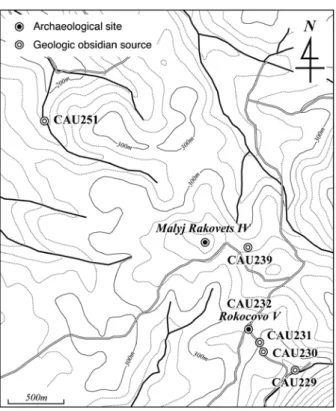
We collected obsidian samples from six sources in the study area (Figure 2: CAU229, 230, 231, 232, 239 and 251). Obsidian in the study area occurs naturally in the form of nodules within clayey loess (Figure 3). Their specific locations (i.e. longitude and latitude) are listed in Table 1.
All of the specimens collected are rounded in shape and their size varies from a few centimeters to several tens of centimeters. The specimens of larger size are found around a mountain ridge (the site of CAU239). The smaller nodules are mostly found around a valley (the sites of CAU229, 230 and 251).
2-2 Appearance and texture
The specimens collected are shown in Figure 4. Their surface is somewhat white due to hydration. The banded texture becomes even more distinct by the uneven weathering. Underneath their weathered surface the samples are completely lustrous or glassy with the characteristic black color.
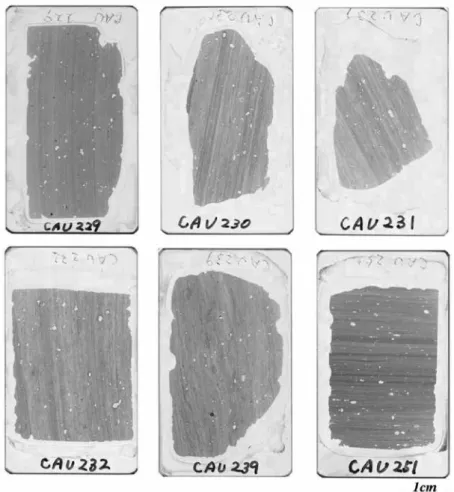
Thin sections of all samples were prepared and observed under a petrologic microscope (Figure 5). The texture of all specimens is characterized by the foliation or the banded texture, in which minute phenocrysts (measuring some millimeters) are observed.
Figure 2 Topographic map showing the exact locations where the specimens were collected.
Figure 3 In situ specimen from the CAU239 site in the study area.
Preliminary report on obsidian petrography from the Transcarpathian region in Ukraine
― 24 ―
3. Mineralogy
3-1 General components
The obsidian samples are composed of the matrix glass, crystallite (microphenocryst), and phenocryst. The major components for each of the specimens can be found in Table 1. Modal composition of the matrix glass is 95–96%, that of crystallite is 3–4%, and that of phenocryst reaches 1.1–1.6% for all of the specimens.
3-2 Matrix glass
The matrix glass is the most abundant component in the specimens. When observed under a polarized microscope, it is possible to see that the glassy matrix is characterized by colorless with high transparency under plane-polarized light conditions, and dark non-transparent under crossed polars. These results indicate the characteristics of the optically isotropic body.
3-3 Microphenocrysts
According to the glossary of geology (Jackson ed. 1997: p.155), crystallite is “a broad term applied to a minute body of unknown mineralogical composition or crystal form that does
not polarize light. Crystallites represent the initial stage of crystallization of a magma and of a glass”. On the other hand, the microlite is defined as a “microscopic crystal that polarizes light and has some determinable optical properties” (Jackson ed. 1997: p.407).
These definitions indicate that the microlite is relatively larger in size than the crystallite, and the microlite can be identified as a mineral with the help of polarized microscopy. The microphenocrysts that occur in the specimens cannot assign them as any type of a mineral under the polarized microscopy. Therefore, the microphenocrysts found in the specimens are all classified as “crystallites” following the definitions of the abovementioned glossary (Jackson ed. 1997). The occurrence of crystallite in the specimens takes the form of fine needles of a few microns in length. The foliated or banded texture developing in the specimens is characterized by the alignment and aggregate of these crystallites.
3-4 Phenocrysts
3-4-1 Occurrence
The occurrence of phenocrysts in the specimens is roughly classified into 1) isolated crystal, and 2) glomeroporphyritic
Figure 4 The specimens used in the present study.
aggregates (i.e. clot of crystals). Both types are found in all specimens. The mineral components of the phenocrysts are shown in Table 1.
3-4-2 Isolated crystal
The phenocryst formed by an isolated crystal includes plagioclase, orthopyroxene, amphibole and opaque minerals. The plagioclase phenocryst is found in all specimens, and it has a characteristic euhedral shape with a length of 0.5–2.0 mm. The orthopyroxene phenocrysts are also found in all specimens and have a euhedral shape with 0.5–1.0 mm in length, and it sometimes coexists with fine grains of ilmenite. Euhedral amphibole is found in the CAU229 specimen. The grain size is 10–100 µm in length. The opaque mineral is composed of ilmenite and pyrite. Their grain sizes are several tens of microns. Ilmenite can be found in all specimens, while pyrite is found predominantly in the CAU229 specimen.
3-4-3 Glomeroporphyritic aggregate
The glomeroporphyritic aggregate is divided into three types on the basis of their mineralogical composition: 1) olivine + plagioclase + amphibole (Figure 6a: ol-bearing aggregate), 2) orthopyroxene + plagioclase + ilmenite
(Figure 6b: opx-bearing aggregate), and 3) multiple grains of plagioclase (i.e. plagioclase aggregate).
The olivine-bearing aggregate occurs in the CAU230, 232, 239 and 251 specimens (Table 1). This aggregate is <2.0 mm in diameter, and composed of euhedral and subdural olivine, plagioclase and amphibole grains. The modal composition of the olivine in this aggregate reaches up to 40%; whereas amphibole and plagioclase are ca. 30%. These occurrences indicate that this aggregate corresponds to mafic rocks with ultramafic composition (SiO2 <45wt.%). According to the classification of the gabbroic rocks (Streckeisen 1976), this aggregate is classified into the amphibole-bearing troctolite.
The opx-bearing aggregate occurs in all specimens (Table 1). This aggregate is <2.0 mm in diameter, and it is composed of euhedral to subdural grains of plagioclase and orthopyroxene. The mineralogical composition of this aggregate relates to a norite according to the classification of the gabbroic rocks (Streckeisen 1976).
The plagioclase aggregate is also found in all specimens. The aggregate is 0.1–0.3 mm in diameter, and it is composed of the aggregate of several euhedral plagioclase grains with of 10–100 µm in length.
Figure 5 Thin sections of the specimens used in the present study.
― 26 ―
4. Mineral chemistry
4-1 Analytical method
SEM-EDS (Scanning Electron Microscopy Energy Dispersive Spectroscopy) analysis was performed to determine the elemental composition of the minerals in the specimens. The analysis was carried out with the non-standard method using the software of the JED Series Analysis Station. Accuracy and reliability of the results generated with this method are approximately estimated by the comparison with the results of analysis by the EPMA (Electron Probe Micro Analyzer) method (Appendix 1). The representative composition of plagioclase, clinopyroxene, olivine, amphibole and ilmenite in the specimens are shown in Tables 2–4.
SEM-EDS analysis was carried out using a JEOL JSX-3100II housed at the Center for Obsidian and Lithic Studies (COLS), Meiji University. EPMA analysis was carried out using a JEOL JXA-8200 at the National Institute of Polar
Research (NIPR), Japan.
4-2 Crystallite
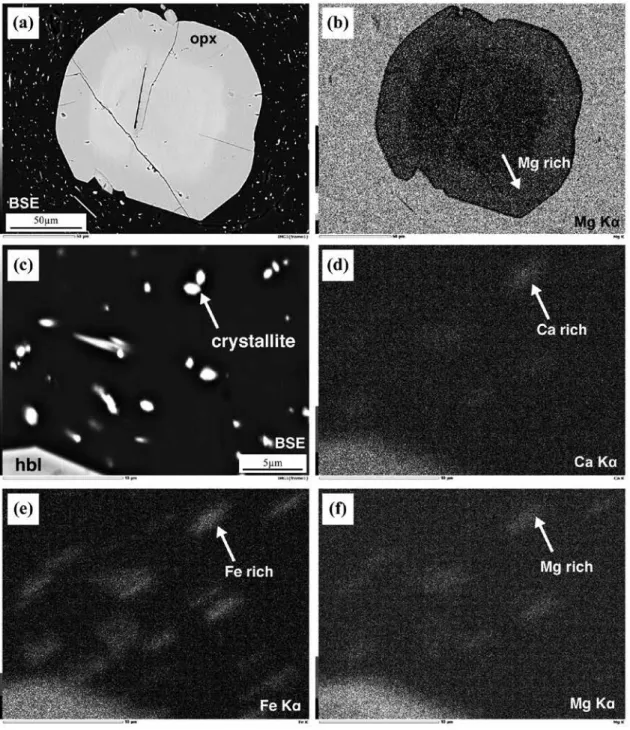
The crystallites are distinguished in the backscattered electron (BSE) image by its brightness, while the matrix glass is darker, because of the chemical contrast between these portions (Figure 9c). The crystallites are relatively rich in heavy elements with respect to the matrix glass (Figures 9d-f). From this BSE image, the modal composition of crystallite in the specimens was estimated to be ca. 3.0%.
The result of element mapping further indicated that calcium, iron and magnesium are enriched in crystallites with respect to the matrix glass. The results of element mapping suggest that the crystallite analyzed in the present study would be the equivalent of the Ca-pyroxene or clinopyroxene crystallite.
4-3 Plagioclase
4-3-1 Occurrence
The BSE images of the plagioclase in the specimens indicate two types: 1) the plagioclase with zonal structure, and 2) the plagioclase without zonal structure (i.e. compositionally uniform). Both types are found in all specimens. The zonal structure type can also be identified by means of a polarization microscope.
4-3-2 Plagioclase with zonal structure
The plagioclase with zonal structure occurs as isolated phenocrysts, within opx-bearing aggregates, and plagioclase aggregates. The zonal structure type is completely absent in the ol-bearing aggregate.
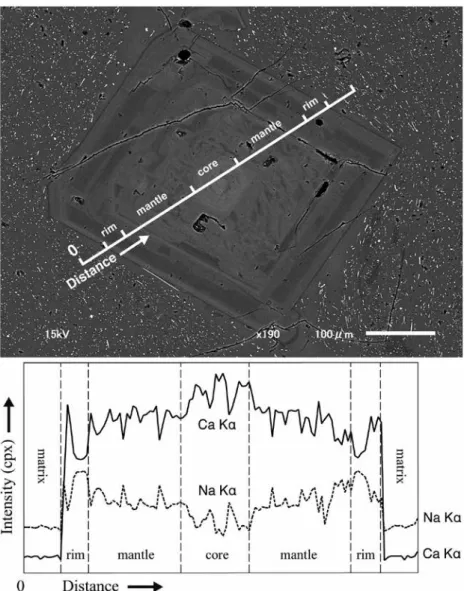
Results of BSE imagery indicate that some plagioclase with zonal structure have distinct core, mantle and rim portions. The core is several microns in size and it is characterized by its irregular shape, or edges with inhomogeneous compositional texture. The mantle completely surrounds the core, which is also of irregular shapes or with inhomogeneous compositional texture at its edges. On the other hand, the rim is characterized by the distinct texture of oscillatory zonal structure. Occurrences of these kinds of structures suggest that the core and mantle portions experience the dissolution and chemical diffusion processes, while the rim portion experiences the normal crystal growth from molten magma or melt (e.g. Shcherbakov et al. 2011).
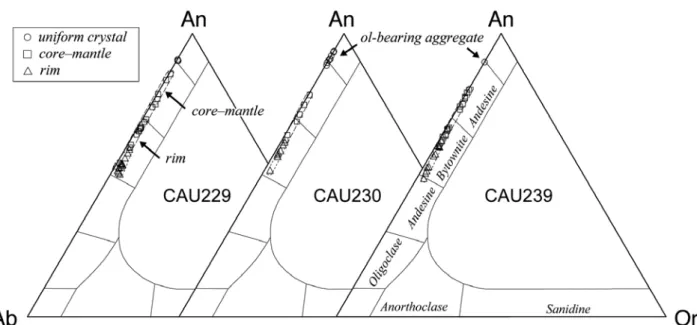
The results of elemental mapping can be found in Figure 7. The results indicate that the concentration of sodium (Na) is clearly decreasing from the core to the rim. On the other hand, the concentration of calcium is increasing from the core to the rim. The elemental analysis by means of SEM-EDS indicates that the anorthite (An: CaAl2Si2O8) and albite (Ab: NaAlSi3O8) content of plagioclase is varied from An60Ab40 to
Figure 6 Photomicrographs of the phenocryst of plagioclase (pl) + olivine (ol) + hornblende (hbl) aggregate in the CAU230 specimen (a), and that of plagioclase (pl) + ilmenite (ilm) + orthopyroxene (opx) aggregate in the CAU229 specimen (b).
An88Ab12 in the core–mantle portions, and from An49Ab51 to An62Ab38 in the rim portions (Figure 8; Table 2).
4-3-3 Plagioclase without zonal structure
The plagioclase without zonal structure occurs as isolated phenocrysts, and within ol-bearing aggregate. This type of plagioclase is completely absent in opx-bearing aggregate and the plagioclase aggregate.
Their BSE images indicate that this type of plagioclase does not show any compositional inhomogeneity, as it is completely uniform. Results of the SEM-EDS elemental analysis indicate that the composition the plagioclase grains are varied from An89Ab11 to An94Ab6 (Figure 8; Table 2). This means that the compositions of the plagioclase without zonal structure do not overlap with those of the plagioclase with the zonal structure. Namely, the plagioclases with diverse origins coexisted within a single specimen.
4-4 Orthopyroxene
Orthopyroxene occurs as isolated phenocryst, and in opx-bearing aggregate. BSE images indicate that some orthopyroxene occur as isolated phenocryst have zonal structure (Figure 9a). The core portion is relatively bright in comparison to the rim portion. The results of SEM-EDS elemental mapping support this conclusion as well, because the concentration of magnesium is increasing slightly from core to rim (Figure 9b).
Compositions of orthopyroxene are shown in the wollastonite (Wo: Ca2Si2O6)-enstatite (En: Mg2Si2O6)-ferrosilite (Fs: Fe2Si2O6) ternary diagram (Figure 10a). The compositions do not have a wide range. The compositions are varied from Wo42Fs55En3 to Wo49Fs49En2 (Table 3), which is classified into the ferrosilite (Figure 10a). The orthopyroxene with compositional zoning texture cannot be detected with the
Preliminary report on obsidian petrography from the Transcarpathian region in Ukraine
Figure 7 Backscattered electron (BSE) image and result of line analysis by SEM-EDS for the plagioclase with typical texture of oscillatory bands from the CAU239 specimen.
― 28 ―
SEM-EDS method of analysis. The reason for this may be the limited resolution of the EDS method.
4-5 Olivine
Olivine predominantly occurs in the ol-bearing aggregate. Compositions of the olivine are shown in the tephroite (Te: MnSiO4)-forsterite (Fo: Mg2SiO4)-faylaite (Fa: Fe2SiO4) ternary diagram (Figure 10b). The compositions of the olivine in all specimens are varied from Te0Fo77Fa23 to Te0Fo80Fa20 (Table 3). These are characteristically rich in magnesium contents.
4-6 Amphibole
The structural formulae of amphibole are calculated based on O=23 per unit cell, and the Fe2+/Fe3+ ratio was estimated
on the basis of total cations excluding Ca, Na and K (Leake et al. 1997). The results of this calculation can be found in Table 4. Amphibole occurs in the phenocryst of ol-bearing aggregate that was analyzed.
The results indicate that the Si [tetrahedral site] content varied from 6.04 to 6.21, while the Na + K [A site] content varied from 0.27 to 0.44 (Table 4). According to the
Figure 8 An (CaAl2Si2O8)-Ab (NaAlSi3O8)-Or (KAlSi3O8) ternary diagrams indicating the compositional variation of the plagioclase in the CAU229, CAU230 and CAU239 specimens.
Table 2. Representative compositions of plagioclase by SEM-EDS analysis
nomenclature developed by Leake et al. (1997), all of the analyzed amphiboles are classified into the “tschermakite”.
5. Whole-rock chemistry
5-1 Sample preparation methodology
The whole-rock chemistry for the specimens containing
ol-bearing aggregate (i.e. CAU230 and 239 specimens), and the specimens free from ol-bearing aggregate (i.e. CAU29 specimens) was analyzed by means of WDXRF (Wave-length Dispersive X-ray Fluorescence Spectrometer). The model Rigaku ZSX Primus III+, located in the Center for Obsidian and Lithic Studies, Meiji University, was used for this analysis. Following the methodology was developed by Suda (2013), where the fusion bead with dilution rate (flux
Preliminary report on obsidian petrography from the Transcarpathian region in Ukraine
Figure 9 (a) Backscattered electron (BSE) image of the orthopyroxene with zonal structure in the CAU230 specimen. (b) Results from the SEM-EDS elemental mapping for the orthopyroxene (a) with banded texture. Concentration of Mg is increasing from core to rim. (c) BSE image of the crystallite in the CAU229 specimen. (d–f) Results of elemental mapping for the crystallite in the CAU229 specimen. The composition of crystallite is rich in Ca, Fe and Mg with respect to the matrix glass.
― 30 ―
Figure 10 Ternary diagrams indicating the compositional variation of clinopyroxene (a) and olivine (b) in all specimens.
Table 3. Representative compositions of minerals by SEM-EDS analysis
weight/sample weight ratio) of 4.000 was applied for the measurement of the whole-rock concentrations of the major oxides (SiO2, TiO2, Al2O3, T-Fe2O3, MnO, MgO, CaO, Na2O, K2O and P2O5). The Merck Spectromelt A12 (di-lithium tetraborate 66% + lithium metaborate 34%) was used as the flux. The heating temperature was 120°C and the time for the absorbed water (H2O-) in samples to be removed was
12 hours. The pulverized samples were prepared using the methods detailed below.
Weathered and altered portions were removed with a rock-cutting saw (Maruto MC-420). The specimens were cut into a thin slab with ca. 2.0 mm in thickness using a precision rock-cutting saw (Struers Accutom-50). The cut surfaces were then
polished using a grinding machine (Maruto ML-110NT and 3M 400 mesh diamond disc). A total of 10–15g of the thin slabs were roughly pulverized using a vibratory micro mill (Fritsch P-0 with agate ball mill). The vibration time was ca. 3 minutes. Subsequently, the samples were further pulverized for ca. 3 minutes using the beat and mortar machine (Ishikawa AGB with agate bowl and agate beetle). The pulverized samples were kept in a glass bottle with 20 ml capacity. Additional description for the sample preparation can be found in Suda (2012, 2013, in press).
5-2 Results
The results of whole-rock analysis for the CAU229, 230
Preliminary report on obsidian petrography from the Transcarpathian region in Ukraine
Table 4. Representative compositions of hornblende in CAU230 specimen, and results of P-T calculation
― 32 ―
and 239 specimens are shown in Table 5. The methodology used to determine whole-rock composition with the WDXRF method has recently been described by Suda (2013). This analysis was performed to make the two fusion beads per one specimen. The measurements were repeated three times for each bead average value of all the results is used as the final result. Precision and errors in the final values were also estimated in order to calculate the standard deviation (2σ) for all results.
The compositional variation diagrams with respect to the concentration of SiO2 can be found in Figure 11. The Na2O+K2O versus SiO2 diagram (Figure 11a) indicates that the samples have rhyolitic composition, and can be classified under the subalkaline rock series (Miyashiro 1978; Le Maitre 2002). The SiO2 wt.% contents are quite uniform, ranging from 70.71 to 71.15. On the K2O versus SiO2 diagram (Figure 11b), these specimens are classified into the high-K calk-alkaline rock series (Le Maitre 2002). The K2O wt.% contents range from 3.70 to 3.76.
Whole-rock compositions of the mafic xenolith (ol-bearing aggregate) were estimated after the modal compositions of the olivine, plagioclase and amphibole, and the chemistry of these minerals (Appendix 2). The calculated compositions of the mafic xenolith, and the composition of Ukraine Transcarpathian obsidian (i.e. analyzed specimens) are plotted in the MgO+T-Fe2O3 versus SiO2 diagram (Figure 11c). The result indicates that the whole-rock composition of the MgO+T-Fe2O3 is slightly influenced by the modal composition of the mafic xenolith in the specimens. Indeed, the specimen with the most abundant quantity of mafic xenolith (CAU230 specimens) are relatively enriched in the MgO+T-Fe2O3 content and plotted on the mixing line with the mafic xenolith (Figure 11c).
6. Discussion
6-1 Origin of ol-bearing aggregate (mafic xenolith)
The compositional relation between olivine and orthopyroxene is expressed by the following chemical equilibria (Enami 2013: p.35):
(Mg, Fe)2SiO4 (olivine) + SiO2 (quartz) → (Mg, Fe)2Si2O6 (orthopyroxene)
This relation indicates that the olivine cannot generally coexist with the SiO2 phase. Therefore, the olivine will predominantly exist in basic and ultrabasic rocks (i.e. SiO2 poor rocks). On the other hand, the Fe-rich orthopyroxene becomes quite unstable under pressure and temperature
conditions that fall below the solidus line of general felsic magma. Such conditions are not favorable for the occurrence of orthopyroxene, but they provide a suitable environment for the Fe-rich olivine with quartz. Therefore, the occurrence of Mg-rich olivine in obsidian of rhyolitic composition is quite unusual in the context of it textural setting.
Microscopic analysis indicates that the olivine is found to occur predominantly in association with the Na-rich plagioclase and amphibole. Such occurrence and the composition of the olivine suggest that the ol-bearing aggregate is fundamentally an exotic material, or that the “xenolith” derived from the gabbroic rocks in the lowermost
Y. Suda et al.
Figure 11 Variations of Na2O+K2O (a), K2O (b), and MgO+T-Fe2O3 (c) contents with respect to the SiO2 content. Discrimination fields and nomenclatures in (a) and (b) are after Miyashiro (1978) and Le Maitre (2002).