for¥¥nadolescents in rural Tanzania
journal or
publication title
AFRICAN Journal of Midwifery and Women’s
Health
volume
10
number
1
page range
27-32
year
2016
URL
http://hdl.handle.net/10285/12890
Creative Commons : 表示 - 非営利 - 改変禁止 http://creativecommons.org/licenses/by-nc-nd/3.0/deed.ja© 2016 MA Healthc ar e Ltd
Overcoming barriers to inclusive
education: A reproductive health
awareness programme for
adolescents in rural Tanzania
By Tohi Aiko, Shigeko Horiuchi, Yoko Shimpuku, Frida Madeni and Sebalda Leshabari
Abstract
Aim: To evaluate a reproductive health awareness programme for
unmarried adolescent girls and boys in rural Tanzania.
Methods: A pre-test–post-test research design was used to
evaluate adolescents’ knowledge, attitude and behaviour towards reproductive health before and after participation in a 45-minute reproductive health awareness programme. The programme was conducted using a picture drama, reproductive health materials and group discussion. Data were collected using a 23-item structured questionnaire previously used in a similar programme conducted in an urban setting in Tanzania.
Results: Data were collected anonymously from 383 participants
aged 11–18 years (95.6% response rate). A significant increase was observed only in the girls’ mean score in the knowledge test (t=5.1, p=0.0). However, scores derived from the pre- and post-test attitude and behaviour tests showed no statistically significant differences for either girls or boys.
Conclusions: As compared with the study conducted in an
urban area of Tanzania using the same education programme and instrument, the impact of the programme in rural Tanzania was not as effective. Therefore, revisions must be made to the existing programme for adolescents living in rural areas, taking into account their specific culture, practices and learning needs.
Keywords: Reproductive health, Health awareness, Adolescent
A
dolescent pregnancy and childbirth often result in negative medical and social consequences, including lower educational attainment, poverty, limited career opportunities, lack of access to prenatal care, low birth weight/ preterm delivery, family conflict and depression (Unger et al, 2000). In Tanzania, pregnancy has been identified as a significant risk factor for adolescent girls dropping out of school (UNICEF, 2011). In 2009, more than 8000 girls in Tanzania dropped out of school, with an estimated 1760 (22%) girls who dropped out of primary school and over 6300 (78%) in secondary school (United Republic of Tanzania Ministry of Education and Vocational Training, 2013). Among students who dropped out of primary school, 2.6% were due to pregnancy. In comparison, secondary school dropout rates due to pregnancy was 20.4%—a sharp increase from 6.5% in 2006 (United Republic of Tanzania Ministry of Education and Vocational Training, 2013).The two main factors that have contributed to increasing adolescent pregnancy rates are:
Lack of adequate knowledge and skills about sexual and reproductive health among adolescent girls and boys
Paucity of sexual and reproductive health education in schools.
Mushi et al (2007) found that school-age children in a rural area of the Mtwara region in Tanzania lacked credible knowledge about safe sex. In spite of this, more than 32% of adolescents were sexually active, with about half indicating having first intercourse by the age of 18 years. It was further found that approximately 11% of girls aged 15–19 years had become sexually active before they were 15 years (National Bureau of Statistics and ICF Macro, 2011).
In the formal educational system in Tanzania, reproductive health education is only introduced at secondary school. Secondary schools incorporate topics such as HIV and the reproductive system as part of the curriculum. For example, the events leading to fertilisation are discussed only as part of a lesson in a Biology class. Thus, students have no opportunity to develop adequate knowledge of sexual and reproductive health in school. Further, not all schools have teachers who have been trained in teaching appropriate and comprehensive lessons on sexual and reproductive health.
Tohi Aiko, Nurse Midwife, College of Nursing, St Luke’s
International University, Tokyo; Shigeko Horiuchi,
Professor of Nursing and Midwifery, College of Nursing,
St Luke’s International University, Tokyo;
Yoko Shimpuku, Assistant Professor of Nursing and
Midwifery, College of Nursing, St Luke’s International
University, Tokyo; Frida Madeni, Midwifery Tutor, Korogwe
District Hospital, Tanga, Tanzania; Sebalda Leshabari,
Senior Lecturer in Midwifery, Muhimbili University of
Health and Allied Sciences, Tanzania
© 2016 MA Healthc ar e Ltd
Although many studies have been conducted in Tanzania on reproductive health among adolescents, with a focus on sexually transmitted diseases, HIV/AIDS, sexuality and motherhood (Todd et al, 2004; Mushi et al, 2007; Kazaura and Masatu, 2009), few studies have evaluated existing educational programmes to prevent adolescent pregnancy.
Aim
This study set out to evaluate a reproductive health awareness programme for adolescent girls and boys in rural Tanzania. Additionally, as the implementation of the health awareness
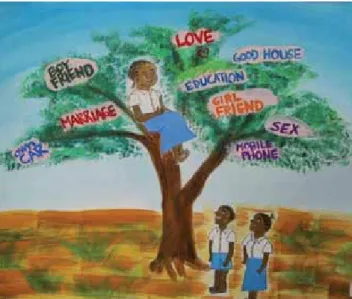
Figure 1. An adolescent girl has climbed up to the top of a tree and dreams about her future and the goals she hopes to achieve, such as succeeding in school, buying a house and car, love and marriage
Figure 2. Two adolescent girls sit on tree branches that are directly above deep holes in the ground. These holes contain bleak outcomes, such as HIV/AIDS, pregnancy complications, and suicide. Although both girls are cutting the branches they are sitting on, the girl on the left sits closer to the ‘tree of dreams’ and is in no danger of falling. However, the girl on the right is seated precariously on the edge of the branch, at risk of falling to harm once the branch has been cut
programme in this study replicates a previous study carried out by the authors in urban Tanzania (Madeni et al, 2011), a secondary aim was to draw comparisons between results obtained from the previous study.
Methods
Research design
This was a quasi-experimental pre-test–post-test one-group design for programme evaluation.
Setting and sample
Bagamoyo is a largely rural health district in the Pwani region and has one of the highest rates of poverty in Tanzania. Most (90%) of its 300 000 inhabitants live in rural villages, with limited access to care. Bagamoyo District has 110 primary schools (United Nations Human Settlements Programme, 2009), of which five schools were invited to participate in the study. Convenience sampling was used owing to time and distance limitations. The reproductive health awareness programme was implemented in August 2013.
Data were collected using a 23-item structured questionnaire previously used in a similar programme conducted in an urban setting in Tanzania (Madeni et al, 2011). When conducting statistical analysis, the number of subjects should be the larger of 5–10 times the number of variables, which would be 115–230 participants. Considering the follow-up rate to be 80%, the approximate sample size required needed to be no less than 300. The inclusion criteria were unmarried boys and girls between the ages of 11–16 years old, as the youngest reported age at which girls become sexually active in Tanzania was 11 years old (Mpangile et al, 1993).
Ethical considerations
The Tanzania National Institute for Medical Research Ethics Subcommittee and Tanzania Commission for Science and Technology provided ethical clearance to conduct this study. The Bagamoyo District Educational Officer also provided permission to conduct the study in the area. The headteacher and all school teachers of each participating school provided permission to conduct the survey.
Programme development
Objectives
The programme is called ‘For a Better Tomorrow’ (Kesho Iliyo Njeme) and its main objectives are to equip adolescent students with basic knowledge about the physical changes that occur in adolescence and to provide them with the opportunity to think about the decisions that they may have to make in the future.
Content
The 45-minute programme was conducted using reproductive health education materials and group discussion. Students were asked to complete a pre-test before the programme started. A lecture was then conducted in Kiswahili by one of the researchers (FM) using reproductive health education materials such as a picture drama and a Maggie apron. Madeni et al (2009) created a picture drama about sex activities and
© 2016 MA Healthc ar e Ltd
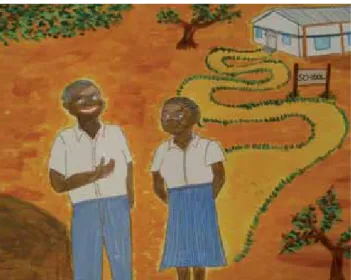
risk, as well as the problem and consequences of unwanted pregnancy (Figures 1–5). The picture drama tells the story of Tatu and Mbili and is depicted on a storyboard consisting of 15 illustrations measuring 30 cm by 42 cm. The Maggie apron that was developed by the Japanese Organization for International Family Planning was used to facilitate the demonstration of the male and female reproductive systems and related topics, including the structure of the womb, stages of pregnancy and contraceptive methods. A blackboard and posters were also used.
A guided discussion followed, providing students with the opportunity to learn more about and exchange views on puberty, pregnancy, peer pressure and the effects of unprotected sex. The discussion lasted for 10–20 minutes, depending on the number of students present. The post-test was conducted immediately after the discussion.
Instruments
The questionnaire that was used in Madeni et al (2011) was also used in this study. This questionnaire was developed to meet the study purpose. The questionnaire comprises three tests (knowledge, attitude and behaviour), and was translated into Kiswahili, as this language is familiar to most Tanzanian students. The questionnaires were only identified by gender.
The knowledge test consisted of 10 items, with 0 points awarded for items marked as ‘wrong’ and 1 for those marked as ‘correct’. Scores ranged from 0 to 10 points. The higher the score, the more knowledge the student had about reproductive health.
The attitude test consisted of seven items scored as strongly disagree (1) to strongly agree (5). For example, ‘Girls can say no when they don’t want to be touched by boys’, ‘Girls accept sex only because they want gifts or money’. The possible score range was from 7 to 35 points. High scores indicated that the girls understood how to avoid or escape from situations that put them at high risk of pregnancy or HIV/AIDS. Cronbach’s alpha coefficient was 0.45.
The behaviour test consisted of six items scored as strongly disagree (1) to strongly agree (5). For example, ‘A boy can avoid impregnating a girl if he can avoid sex or use condoms’, ‘I want to have sex with my boyfriend/girlfriend before marriage because I love him/her’. Possible scores ranged from 6 to 30 points. A high score meant good decision making for saying no to sex. Cronbach’s alpha coefficient was 0.43
Data analysis
The educational effects were compared using the average score in the pre-test and post-test in each group of girls and boys. Demographic data were compared between girls and boys. A t-test, chi-square test and McNemar’s test were used to test the significance of differences.
Results
Characteristics
A total of 400 questionnaires from five primary schools were evenly distributed to students in grades four, five and six. Among the returned questionnaires, 17 were excluded because of insufficient data, leaving 383 for the final analysis (95.6% response rate).
Figure 3. Schoolmates Tatu and Mbili develop a close relationship. They engage in sexual intercourse
Figure 4. After discovering she is pregnant, Tatu decides to tell Mbili about the pregnancy. Mbili is angered by the news and ends their relationship, saying: ‘I can’t take care of you and the baby, I’m just a student. I don’t want to see you again.’ Tatu is also forced to discontinue her studies when her teacher discovers she is pregnant
Figure 5. Tatu returns home to tell her parents about her pregnancy. Tatu’s parents leave her in tears, saying: ‘Go back to your boyfriend. Let him take care of you and your baby. You have brought such shame to us.’
© 2016 MA Healthc ar e Ltd
Participants reported that the duration of the programme was too short and they wanted further opportunities to learn about reproductive health. In addition, they gained new knowledge about pregnancy and learned better ways to communicate with male or female friends. For example, boys must not deceive or coerce girls into having sexual intercourse, and girls need to know that men may demand sexual intercourse in return for gifts. Furthermore, they felt that it is important to heed parental advice about how to behave with a boy/girlfriend.
They also evaluated the materials and the venue. The picture drama and the use of the Maggie apron assisted participants’ understanding. The venue did not have enough desks and chairs for all the students to sit comfortably.
Discussion
Knowledge test scores
Adolescent girls and boys in Tanzania have limited access to information about reproductive health. Use of the educational programme in an urban area in Tanzania by Madeni et al (2011) showed promise for increasing adolescents’ knowledge and behaviours toward crucial elements of reproductive health. This study replicated the programme in a rural area.
In the knowledge test, most girls and boys demonstrated an understanding of ‘signs of puberty in girls’ and ‘infection of HIV/AIDS’. However, understanding of ovulation and menstruation was low in both girls and boys. The lecture about ovulation and menstruation was approximately 30 minutes and used reproductive health education materials such as the Maggie apron. Post-test, the percentage of correct answers about ovulation and menstruation showed significant increases for all participants. However, the percentage of correct answers was still less than 80%.
Rao et al (2008) conducted a reproductive health education programme for 2 hours a day for 5 consecutive days with girls aged 16–19 years. After the programme, the percentages of correct answers about ovulation and menstruation increased to more than 90%. In addition, Klepp et al (1997) conducted an HIV/AIDS education programme for 20 school hours with Tanzanian primary school students, and reported a significant increase in AIDS knowledge scores as compared with the control group. These programmes were over 10 hours long, while the programme in this study was approximately 30 minutes. In this study, only the girls’ mean knowledge score significantly increased. Therefore, it is important to take into account the number of school hours involved in the programme of this study.
Madeni et al (2011) surveyed and reported a statistically significant difference between the pre- and post-test for both girls and boys (Table 2). The results from Madeni et al (2011) were different from this study. It is possible that the rural population responded differently to the programme owing to lower levels of educational attainment and cultural differences. The United Republic of Tanzania Ministry of Education and Vocational Training (2013) surveyed pass rates in primary school leaving examinations by region and found that the pass rate in Dar es Salaam was 79.8% compared to the lower pass rate of 61.8% in the Bagamoyo District, where this study was undertaken. In addition, Uwezo (2011) Respondents comprised 211 girls (mean age 12.3 ±1.1 years)
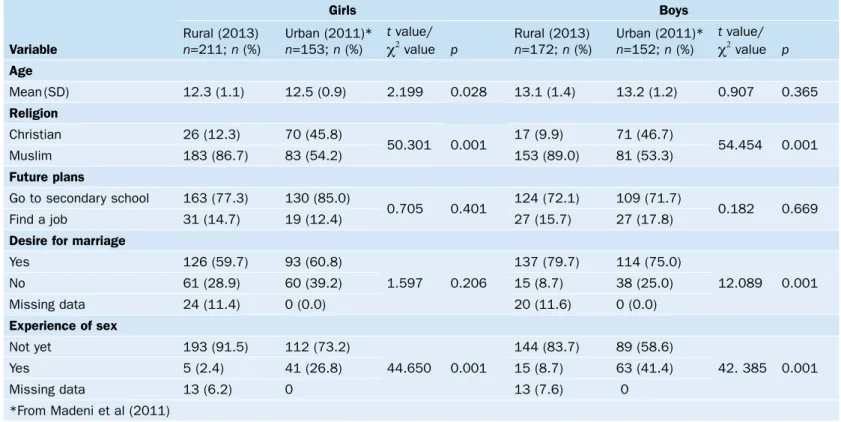
and 172 boys (mean age 13.1 ±1.2 years). Most of the girls (86.7%) and boys (89.0%) were Muslim. The distribution of future plans reported was similar between girls and boys; 77.3% of the girls and 72.1% of the boys planned to go to secondary school after completing primary education and 14.7% of the girls and 15.7% of the boys were planning to find a job. Approximately 28.9% of the girls did not want to get married, while only 8.7% of the boys did not want to get married. Five (2.4%) girls and 15 boys (8.7%) had sexual experience. Sexual experience in the girls and the boys differed significantly (c2(1) = 7.959, p = 0.005) (Table 1).
In comparison with the study carried out in urban Tanzania (Madeni et al, 2011), the girls from the rural and urban areas had significantly different mean ages, religious affiliations, desire for marriage and experience of sex.
Knowledge pre- and post-test scores
The girls’ mean score in the knowledge pre-test was 7.2 ±1.7 out of 10 points, and the boys’ mean score was 7.1 ±1.7. After the programme, the girls’ mean knowledge score increased significantly to 7.7 ±1.4 (t = 5.1, p = 0.000), while the boys’ mean score increased moderately to 7.2 ±1.6 (Table 2).
For both girls and boys, two items: ‘signs of puberty in girls’ and ‘protecting themselves from HIV/AIDS’, maintained a high percentage of correct answers in the post-test.
For the girls, five out of ten items: ‘signs of puberty in boys’ (89.6%), ‘boys at puberty can impregnate girls’ (82.5%), ‘condoms are used to avoid pregnancy and diseases’ (74.9%), ‘monthly vaginal blood’ (67.8%) and ‘girls at puberty ovulate’ (65.9%), showed significant increases after the programme (p <0.001). However, three items: ‘girls at puberty ovulate’, ‘monthly vaginal blood’ and ‘condoms are used to avoid pregnancy and diseases’, were less than 80% post-test.
For the boys, two out of ten items: ‘girls at puberty ovulate’ (56.4%) and ‘monthly vaginal blood’ (74.4%), showed a significant percentage increase of correct answers (p <0.001). These items remained less than 80% post-test.
Attitude pre- and post-test scores
The girls’ mean score in the attitude pre-test was 28.7 ± 4.6 out of 35 points, and the boys’ mean score was 27.9 ± 4.8. After the programme, the girls’ attitude mean score was 28.4 ± 5.2 and the boys’ mean score was 27.4 ± 5.5 (Table 2). For both girls and boys, there was no significant difference between the pre-and post-test scores.
Behaviour pre- and post-test scores
The girls’ mean score in the behaviour pre-test was 23.7 ± 4.3 out of 30 points and the boys’ mean score was 22.7 ± 4.3. After the programme, the girls’ behaviour mean score was 24.0 ± 4.3 and the boys’ mean score was 22.6 ± 4.6 (Table 2). For both girls and boys, there was no significant difference between the pre-and post-test scores.
Process evaluation
Process evaluation took approximately 20 minutes at each school. Participation was voluntary but all students chose to attend the process evaluation.
© 2016 MA Healthc ar e Ltd
reported that children in urban areas are twice as likely to meet proficiency standards as students living in rural areas in subjects such as Kiswahili, English and numeracy.
In view of this, the differences in academic achievement between children living in rural and urban areas may have influenced the knowledge acquisition of this programme. The World Health Organization (2009) reported that it is necessary to devise educational methods and materials in accordance with the academic achievements of students. Therefore, revisions must be made to the existing programme for adolescents living in rural areas, taking into account their specific culture, practices and learning needs.
Attitude and behaviour test scores
In this study, it was difficult to achieve changes in attitude and behaviour using the reproductive health education programme set out by Madeni et al (2011). Klepp et al (1997) conducted a longitudinal HIV/AIDS education programme in Tanzanian primary school students (mean age 14 years). They reported that AIDS knowledge significantly
increased after 1 year. However, while attitudes toward sexual intercourse become more conservative, as did behaviour, statistical significance was not reached. This further illustrates the challenge of changing the attitudes and behaviours of adolescents, which requires an extended induction period.
In addition, in a systematic review of 23 articles by Paul-Ebhohimhen et al (2008), it was noted that behaviour change was the most difficult to achieve compared to knowledge and attitude. These results support the results of this study. Therefore, improvements in the programme should be made in light of the complexities in achieving significant changes in attitude and behaviour.
However, it must be acknowledged that Madeni et al (2011) reported statistically significant differences pre- and post-test for both girls and boys in the behaviour test. One possible reason for the significant increase in behaviour scores in the urban area only could be that the programme on knowledge was more effective in the urban area than the rural area. Notably, the percentage of correct answers about ovulation and menstruation in the urban area was higher than
Table 1. Participant characteristics and pre-and post-test values by rural and urban area
Variable Girls Boys Rural (2013) n=211; n (%) urban (2011)* n=153; n (%) t value/
c2 value p Rural (2013)n=172; n (%) urban (2011)*n=152; n (%) t value/c2 value p
Age Mean (sd) 12.3 (1.1) 12.5 (0.9) 2.199 0.028 13.1 (1.4) 13.2 (1.2) 0.907 0.365 Religion Christian 26 (12.3) 70 (45.8) 50.301 0.001 17 (9.9) 71 (46.7) 54.454 0.001 Muslim 183 (86.7) 83 (54.2) 153 (89.0) 81 (53.3) Future plans Go to secondary school 163 (77.3) 130 (85.0) 0.705 0.401 124 (72.1) 109 (71.7) 0.182 0.669 Find a job 31 (14.7) 19 (12.4) 27 (15.7) 27 (17.8)
Desire for marriage
yes 126 (59.7) 93 (60.8) 1.597 0.206 137 (79.7) 114 (75.0) 12.089 0.001 No 61 (28.9) 60 (39.2) 15 (8.7) 38 (25.0) Missing data 24 (11.4) 0 (0.0) 20 (11.6) 0 (0.0) Experience of sex Not yet 193 (91.5) 112 (73.2) 44.650 0.001 144 (83.7) 89 (58.6) 42. 385 0.001 yes 5 (2.4) 41 (26.8) 15 (8.7) 63 (41.4) Missing data 13 (6.2) 0 13 (7.6) 0 *From Madeni et al (2011)
Table 2. Pre- and post-test values by rural and urban area
Questionnaire section Girls Boys Rural (2013) n=211; Mean (sd) urban (2011)* n=153; Mean (sd) Rural (2013) n=172; Mean (sd) urban (2011)* n=152; Mean (sd)
Pre-test Post-test Pre-test Post-test Pre-test Post-test Pre-test Post-test
Knowledge test 7.2 (1.7) 7.7 (1.4)** 7.1 (1.4) 9.0 (1.1)** 7.1 (1.7) 7.2 (1.6) 7.2 (1.3) 9.2 (1.0)* Attitude test 28.7 (5.6) 28.4 (5.2) 30.5 (4.4) 30.7 (4.4) 27.9 (4.8) 27.4 (5.5) 30.8 (3.9) 30.8 (4.2) Behaviour test 23.7 (4.3) 24.0 (4.3) 25.8 (3.6) 26.6 (3.4)** 22.7 (4.3) 22.6 (4.6) 25.6 (3.9) 26.3 (3.7)* *From Madeni et al (2011)
© 2016 MA Healthc ar e Ltd
that of the rural area. Lee et al (2013) reviewed 17 articles addressing factors related to sexual practices among adolescents and reported that the appropriate knowledge regarding sex and sexually transmitted infections and/or HIV is essential to reduce risky sexual behaviour. Therefore, acquired knowledge might have led to better sexual behaviour.
Conclusions
This study was conducted in five primary schools based in a rural area of Tanzania to improve the reproductive health of adolescent girls and boys. While the girls’ knowledge was shown to have increased significantly, the boys’ knowledge did not. For both girls and boys, the percentage of correct answers on knowledge items about ovulation and menstruation remained less than 80% post-test. In the attitude and behaviour tests, there were no differences between pre- and post-test scores for girls and boys.
As compared with the study conducted in an urban area of Tanzania using the same education programme and instrument, the impact of the programme in the rural area was not as effective. Revisions must be made to the existing programme for adolescents living in rural areas, taking into account their culture, practices and learning needs. AJM
Acknowledgements: This research was funded by JSPS Asia Africa Science Program and Grant-in-Aid for Exploratory Research (23660022). The authors would like to thank Sarah E Porter, Honorary Professor at Oregon Health and Science University, Portland for her editorial assistance.
Conflict of interest: None declared.
Kazaura MR, Masatu MC (2009) Sexual practices among unmarried adolescents in Tanzania. BMC Public Health 9: 373. doi:10.1186/1471-2458-9-373
Klepp KI, Ndeki SS, Leshabari MT, Hannan PJ, Lyimo BA (1997) AIDS education in Tanzania: Promoting risk reduction among primary school children. Am J Public Health 87(12): 1931–6
Lee YM, Dancy B, Florez E, Holm K (2013) Factors related to sexual practices and successful sexually transmitted infection/HIV intervention programs for Latino adolescents. Public Health Nurs 30(5): 390–401. doi: 10.1111/phn.12039
Madeni F, Horiuchi S, Jitsuzaki M (2009) Reproduction of maternal mortality rate in tanzania development of reproductive health awareness materials to prevent unwanted pregnancy to adolescent. St Luke’s College
of Nursing Bulletin 36: 74–85
Madeni F, Horiuchi S, Iida M (2011) Evaluation of a reproductive health awareness program for adolescence in urban Tanzania--A quasi-experimental pre-test post-test research. Reprod Health 8: 21. doi: 10.1186/1742-4755-8-21
Mpangile GS, Leshabari MT, Kihwele DJ (1993) Factors associated with induced abortion in public hospitals in Dar es Salaam, Tanzania. Reprod
Health Matters 1(2): 21–31. doi: 10.1016/0968-8080(93)90004-D
Mushi DL, Mpembeni RM, Jahn A (2007) Knowledge about safe mother-hood and HIV/AIDS among school pupils in a rural area in Tanzania.
BMC Pregnancy Childbirth 7: 5
National Bureau of Statistics, ICF Macro (2011) Tanzania Demographic
and Health Survey 2010. http://www.measuredhs.com/pubs/pdf/FR243/
FR243[24June2011].pdf (accessed 16 December 2015)
Paul-Ebhohimhen VA, Poobalan A, van Teijlingen ER (2008) A systematic review of school-based sexual health interventions to prevent STI/HIV in sub-Saharan Africa. BMC Public Health 8: 4. doi: 10.1186/1471-2458-8-4 Rao RS, Lena A, Nair NS, Kamath V, Kamath A (2008) Effectiveness of
reproductive health education among rural adolescent girls: A school based intervention study in Udupi Taluk, Karnataka. Indian J Med Sci 62(11): 439–43
Todd J, Changalucha J, Ross DA et al (2004) The sexual health of pupils in years 4 to 6 of primary schools in rural Tanzania. Sex Transm Infect 80(1): 35–42
Unger JB, Molina GB, Teran L (2000) Perceived consequences of teenage childbearing among adolescent girls in an urban sample. J Adolesc Health 26(3): 205–12
UNICEF (2011) Adolescence in Tanzania. http://www.unicef.org/info-bycountry/files/TANZANIA_ADOLESCENT_REPORT_Final.pdf (accessed 16 December 2015)
United Nations Human Settlements Programme (2009) Tanzania:
Bagamoyo Urban Sector Profile.
http://unhabitat.org/books/tanzania-bagamoyo-urban-profile/ (accessed 15 June 2015)
United Republic of Tanzania Ministry of Education and Vocational Training (2013) BEST 2008–2012 Data. http://www.moe.go.tz/index. php?option=com_docman&task=cat_view&gid=358&Itemid=619 (accessed 16 December 2015)
Uwezo (2011) Are our children learning? Annual learning assess-ment report. Tanzania 2011. http://www.uwezo.net/wp-content/ uploads/2012/08/TZ_2011_AnnualAssessment-Report.pdf (accessed 16 December 2015)
World Health Organization (2009) Promoting Adolescent Sexual and Reproductive Health Through Schools in Low Income Countries: An Information Brief. WHO, Geneva
Key Points
Pregnancy is a significant risk factor for adolescent girls dropping out of school in tanzania
A lack of adequate knowledge and skills about sexual and reproductive health among adolescent girls and boys contributed to increasing adolescent pregnancy rates
Most girls and boys demonstrated knowledge of the signs of puberty in girls and HIV/AIds infection. However, there was a low general understanding of ovulation and menstruation
Changes must be made to the reproductive health awareness programme for adolescents living in rural areas, taking into account their specific culture and learning needs.