第二言語教室におけるタスクのあり方について:タスクの概念とその構成要素 TakeoTANAKA(JointGraduateSchoolintheScienceofSchoolEducation atHyogoUniversityofTeacherEducation) 田中武夫(兵庫教育大学大学院連合学校教育学研究科) Theroleoftaskshasrecentlycomeintofocusinthefieldofsecondlanguageteaching. Althoughafullunderstandingoftheconceptoftask! maybeessentialforsuccessful secondlanguageteaching,variousresearchershavegivenitdifferentdefinitions. This paperintendstodisentanglethesituationbyclassifyingthediversifieddefinitionsinto twogroupsintermsofresearchtradition:thegroupofdefinitionspresentedinthefield ofsecondlanguageacquisitionandthegroupofdefinitionsproposedinsecondlanguage syllabusdesign. Followingthis,thispaperexaminesthetask-relatedfactorswhichhave beenidentifiedbyresearchers,andattemptstoshowacomprehensivesetoftask-related factors:languageteachingapproach,lesson/unit,content,procedure,setting,goal, outcome,andlearner/teacher. Finally,thispaperdiscussesthekeyfactorinthesetof task-relatedfactorswhichinfluencesthewayofthetaskdesigningandimplementation. KeyWords:Task,Definition,ComponentFactors,TeachingApproach 1. Introduction Thetermtaskhasbeenusedfrequentlyinsecondlanguageteachingwiththegeneral recognitionthatavarietyofdifferenttaskscanmaketeachingmorecommunicative. In spiteofthefrequentuseoftheterm,theconceptoftaskremainsdiversifiedduetoits variousdefinitions. Asaresult,bothteachersandresearchersoftenfinditdifficultto attaintheintegrateddevelopmentofefficienttasksforcommunication-oriented classrooms. Therefore,thispaperintendstoputinsomeorderthediversifieddefinitions oftask,andgivelanguageteachersinsightsintotheconceptoftaskanditscomponentsfor betterdesigningandimplementingataskinsecondlanguageteaching. Tothisend,this papergivesareviewoftheliteraturerelevanttothetask-relatedissues,withparticular considerationofdifferentwaysinwhichthetermtaskhasbeendefined. 2. Definitions of Task 2.1DiversifiedTaskDefinitions Thetermtaskhasbeendefinedbyanumberofresearchersinthedomainofsecond languageteaching(e. g.,Richards,PlattandWeber,1985;Long,1985;Crookes,1986; Wright,1987;Krahnke,1987;Breen,1987;Candlin,1987;Prabhu,1987;Nunan,1989; Richards,PlattandPlatt,1992;Skehan,1996). Sincetheseresearchersdefinetaskfrom differentperspectives,itmaybepointedoutthatthereisnoagreed-uponconceptoftaskat thismoment(Crookes,1986:1;Nunan,1989:5;Kumaravadivelu,1993:69).
兵庫教育大学教科教育学会紀要第12号平成11年3月 Threedefinitionsoftaskarecitedbelowasexamplestoshowthemultiplicityofits definitions. First,Long(1985:89)definesitinthemostgeneralterms: [ataskis]apieceofworkundertakenforoneselforforothers,freelyorforsomereward. Thus,examplesoftasksincludepaintingafence,dressingachild,fillingoutaform…. In otherwords,by"task"ismeantthehundredandonethingspeopledoineverydaylife,at work,atplay,andinbetween. 【emphasisinoriginal】 Second,Breen(1987:23)describestaskwithitscomponentialanalysis: thenotionof'task'isusedinabroadsensetorefertoanystructurallanguagelearning endeavorwhichhasaparticularobjective,appropriatecontent,aspecifiedworking procedure,andarangeofoutcomesforthosewhoundertakethetask. Third,Skehan(1996:38)restrictsthenotionoftasktoameaning-focusedactivity: ataskistakentobeanactivityinwhich:meaningisprimary;thereissomesortof relationshiptotherealworld;taskcompletionhassomepriority;andtheassessmentoftask performanceisintermsoftaskoutcome. Theproblemwiththismultiplicityofapproachestotaskisthatitcarries"the potentialtocloud,ifnotconfuse,task-relatedissuesthatneedtobeinvestigatedingreater detail'(Kumaravadivelu,1993:72). Toputitinanotherway,thevariousdefinitions maypreventteachersaswellasresearchersfromreachinganagreementonmoreeffective tasksforlanguagelearningandteaching. 2.2ClassificationoftheTaskDefinitions Ithasnotbeenarguedthatsomeresearchtraditionsinsecondlanguageteachinghave aninfluenceonthewaytaskisdefined. However,weobservethatthetermtaskhasbeen mainlyusedintwodifferentresearchtraditions:thefieldofsecondlanguageacquisition (SLA)studiesandthefieldofsecondlanguagesyllabusdesign. Theauthorcategorizes thevariousdefinitionsoftaskaccordingtothetwodifferentresearchfieldsbelow. ThefirstcategoryincludesdefinitionsinthefieldofSLAwhichseekstodescribeand explainthewayoftheacquisitionofasecondlanguage(L2). ThedefinitionsbyLong (1985),Crookes(1986),Prabhu(1987),andSkehan(1996)fallunderthiscategory. SLA researchbegantoquestiontheeffectofexplicitinstructionsuchasgrammarexplanation inSLAbylearners. Andsomeresearchersclaimedthatlanguageshouldbeacquired throughthenaturallanguageuse,thatis,byengaginginrealcommunicationratherthanby receivingexplicitinstruction. Consequently,itisnaturalthatthedefinitionoftaskin thisSLAtraditionshouldputmorestressonthemessageinthenaturallanguageuse・ ThesecondcategoryisconnectedwiththefieldofL2syllabusdesignwhichattempts todescribehowL2shouldbetaughtinacourseofinstruction. ThedefinitionsbyBreen (1987),Candlin(1987),Krahnke(1987),andRichards,PlattandPlatt(1992)fallunder thiscategory. Inthisfield,learners-activeinvolvementinthesyllabusdesignhasbeen consideredtobesignificant. Thatis,itisclaimedthatlearnersshouldbeinvolvedina designingprocessoftasksfromthebeginningstageofthesyllabus. Naturally,thenotion
oftaskinthisfieldfocusesonthecooperationbetweenateacherandhisorherlearnersin thetaskdesigning. Althoughitisdifficulttopositclear-cutcriteriaoftheclassification,thereviewof therelativeliteraturerevealedthatthedefinitionsoftaskhavebeenmadeinthetwo differentbackgrounds:thestudiesofSLAandL2syllabusdesign. Theformerfocuseson themeaningoflanguageincommunication,whilethelatterfocusesontheprocessof negotiationbetweenateacherandhisorherlearnersintaskdesigning. Therefore,itis possibletosaythatthetwodifferentbackgroundshaveaninfluenceonthemultiplicityof taskdefinitions、 3. Task-Related Factors Intheprevioussection,wehavee下aminedthemultiplicityofthetaskdefinitions. Multiplicityofdefinitions,however,doesnotnecessarilymeanthattherecanbeno commonfeaturesintheconceptoftask. Akeyquestionforteachersiswhetherornot thereisacertaincommonalityinthedifferentdefinitionsoftasksinceaframeworkof tasksisindispensabletotaskdesigningandimplementation. Inordertoimprovesecondlanguageteachingmethodologyfordailyclassroomuse, someresearchershaveclaimedwhatataskiscomposedof. Thispaperfocusesonthe researcherswhohaveanalyzedtask-relatedfactors(Breen,1987;Candhn,1987;Nunan, 1989;Richardsetal.,1992;Kumaravadivelu,1993;Ellis,1996). Andtheauthorintends tosummarizethesuggestedfactorsandtoprovideacomprehensivesetofthetask-related factors_ Intheattempttoexaminethetask-relatedfactorsmoreindetail,itishelpfultodivide themintotwogroupsoffactors,namely,macroandmicro. Figure、1presentsthe relationshipinthetask-relatedfactorswhichwillbeexaminedinthefollowingsections. Task-Related Factors MacroFactors LanguageTeachingApproach Lesson/Unit Micro Factors Content Procedure Setting Goal Outcome Learner/Teacher Figure1. Task-RelatedFactors 3.1MacroFactorsofTask Themacrofactorscanbeidentifiedasthetask-relatedfactorswhichcanhavean influenceonawholetaskratherthanaparticularpartofatask. Inthemacrofactors, therearetwofactors;thelanguageteachingapproachandlesson/unit.
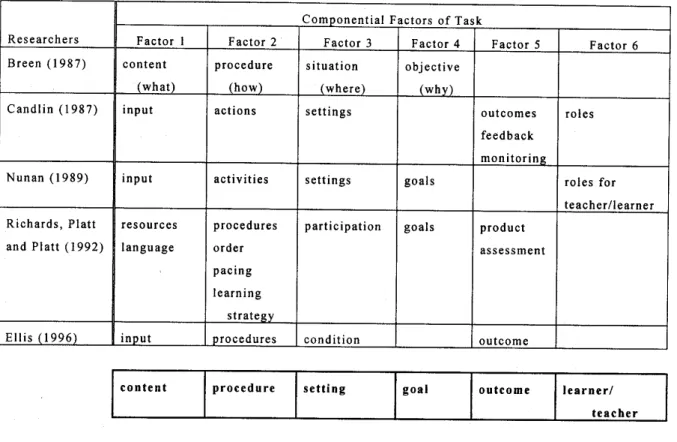
兵庫教育大学教科教育学会紀要第12号平成11年3月 3.1.1LanguageTeachingApproach. Thefirstfactoristhelanguageteachingapproach. AccordingtoKumaravadivelu (1993),thelanguageteachingapproachcanbeclassifiedintothreetypes:alanguage centered,learner-centered,andlearning-centeredapproach. Thelanguage・centeredapproachisprincipallyconcernedwithlinguisticforms. The contentsofthelinguisticforms,forexample,areprimarilygrammaticalstructuressuchas passives,conditionals,relativeclauses,andsoon. Thisapproachprovidesopportunities forlearnerstopracticethepreselected,presequencedlinguisticstructuresinform-focused ways,assumingthatthelearnerscanusetheselinguisticstructureswhenevertheywishto communicateinthetargetlanguageoutsidetheclassroom. Thelearner-centeredapproachisprincipallyconcernedwithlearner'scommunicative purposeoflanguage;greeting,requesting,apologizing,forexample. Thisapproach providesopportunitiesforthelearnerstopracticethepreselected,presequencednotions andfunctionsthroughcommunication,assumingthatthelearnerscanmakeuseofthemto fulfilltheircommunicativeneeds. Inthelearning-centeredapproach,thebasicconcernisthepsychohnguisticprocesses ofL2learners. Incontrasttothetwoapproachesabove,thisapproachdoesnotprovide preselected,presequencedsystematiclanguageinputbeforehand. Itprovides opportunitiesforlearnerstofullyusewhatevertheyhavelearnedinclass,assumingthat languagecanbedevelopedincidentallywhiletakingpartinmeaningfulinteractionin class. 3.1.2Lesson/Unit. Alessonorunitcanbeidentifiedasthesecondofthemacrofactors. Itappearsthat alessonorunithasaninfluenceontasksbecausealessonorunit''consistsofsequencesof tasks"(Nunan,1989:10)ineverydayclassroom. Toputitinanotherway,alessonorunit issignificanttotheconceptoftaskinthatthegoaloftasksshouldbecloselyrelatedtothe objectiveofthelessonorunit. 3.2MicroFactorsofTask Themicrofactorsrefertothecomponentsofatask. Table1presentsthetask componentsclaimedbyfiveresearchers(Breen,1987;Candlin,1987;Nunan,1989; Richards,PlattandPiatt,1992;Ellis,1996). Itshowsthateachoftheresearcher岳provides differenttaskcomponents. Itispossible,however,toidentifycommonfactorsamong them.InTable1,thecomponentialfactorsareplacedroughlyintheorderoffrequency
ofidentificationfromlefttoright. Forexample,whileFactor1(e. g.,input,content,and resource)isclaimedbyallofthefiveresearchers,Factor6(e. g.,roleforteachersand learners)isclaimedonlybytwoofthem. AswecanseeatthebottomofTable1,the
authorprovidedthesixfactorsastaskcomponentsandcategorizedthemintocontent, procedure,setting,goal,outcome,andlearner/teacher.
Table 1. Componential Factors of Task Claimed by Researchers
R esearchers
C om ponentialF actors of T ask
F actor 1 Factor 2 F actor 3 Factor 4 F actor 5 Factor 6 B reen (1987) content procedure situation objective
(w hat) (how l (w here) (w hy)
C andlin (1987) input actions settings outcom es feedback m onitoring
roles
N unan (1989) input activities settings goals roles for teacher/learner
R ichards, Platt resources procedures participation goals product and P latt (1992) langu age order
pacing learn ing
strategy
assessm ent
E llis (1996) input procedures cond ition outcom e
conten t proced ure setting goal outcom e learner/ teacher Tohaveabetterunderstandingoftheconceptoftask,wewilllookcloseratthesix componentialfactors. Asaresultofthereviewoftheliterature,theauthordescribesthe followingsixcomponentialfactorsusingthekeywordsappearedinthedefinitionsoftask byanumberofresearchers(Richards,PlattandWeber,1985;Long,1985;Crookes,1986; Wright,1987;Krahnke,1987;Breen,1987;Candlin,1987;Prabhu,1987;Nunan,1989; Richards,Plattand、Platt,1992;Skehan,1996;Ellis,1996). 3.2.1Content Contentdenoteswhateverdataarepresentedorselectedbytheteachersorthe learners.Inotherwords,itcanberecognizedasmaterials,resources,inputdatawhich thetaskfocuseson. Forexample,thefocusofataskcanbeonthewords,structures, notionsorfunctions,genreskills,topics,subject-matters,generalknowledge,andsoforth. 3.2.2Procedure Proceduremeanstheactionandordertobefollowedinthetask. Forexample,itcan beclassifiedasthetypeofworks(e. g.,activity,practice,exercise,anddrill),thetypeof learners'actions(e.g.,comprehend,produce,manipulate,recall,transfer,analyze,interact, operate,question,andusestrategies),andthecombination,sequence,andpaceofthese items.
兵庫教育大学教科教育学会紀要第12号平成11年3月
3.2.3Setting
Settingdesignatestheclassroomarrangementspecifiedforthetask. Forexample,it referstotheinteractionalform(i. e.,wholeclass,group,pair,individual),theformof
exchanginginformation(i. e.,one-wayvs. two-way),andtheextentofrelationstothereal worldoutsidetheclassroom.
3.2.4Goal
Goalmeansthespecificationoftheunderlyingpurposeorreasonwhythetaskis
undertaken(e. g.,learningoracquisitionofknowledgeorskill). Thegoalcanbe prescribedeitherexplicitlyorimplicitly. Thegoalcanbemoreadetaileddescriptionof exactlywhatalearnerisexpectedtodoasaresultofthetask,suchastopracticethe linguisticrules,toshareinformation,andtosolveaparticularproblem. 3.2.5Outcome Outcomedesignatestheperformancerequiredoflearnersinthetask. Itcan correspondwiththegoalofthetaskinthatthegoalissetforlearnerstoperformand achieveitwithacertaincriteria;forexample,accuracyorfluencyoflanguageuse, completionofthetask,andsoon. Theoutcomecanbeassessedintheformofreception
(i.e.,understandingofspokenorwritteninput)andproduction(i. e.,inspokenorwritten form)withreferencetothegoal. Then,feedbackormonitoringmaybeprovidedforthe improvementoflearners'performanceorknowledge. 3.2.6Learller/Teacher Learner/teacherimpliesthespecificationofparticipantsofthetask. Forexample, thisreferstorolesoftheparticipantsinthetaskimplementation(e. g.,whoassigns,who guides,andwhoevaluatesthetask? )andknowledgeandabilitiesoflearnersandteachers aswell, 4. ImplicationoftheTask-RelatedFactors Intheprevioussection,wehaveconfirmedtheexistenceoftask-relatedfactorsin spiteofthediversifieddefinitions. Wearenowledtoexploretheimplicationofthe task-relatedfactors. Itisnecessarytorecognizethatakeyfactorinthetask-relatedfactorsisthelanguage teachingapproachwhenweattempttodesigntasks. Thatis,taskdesigningisinfluenced bythechoiceofthethreeapproachesmentionedearlier:language-centered,learner centered,orlearning-centeredapproach. Therearetworeasonsforclaimingthe importanceofthelanguageteachingapproach. First,theplacementoftaskcomponents (i.e.,themricrofactorssuchasgoal,procedure,andsetting)isdeterminedbythenatureof theapproach. Second,itisnecessarytodesignandadjustthemicrofactorsofataskin accordancetotheaimofthelanguageteachingapproach. Letusnowtaketwotaskexamplesandillustratehowthetask-relatedfactorscanbe determinedbythelanguageteachingapproaches. Whenwetakethelanguage-centered
teachingapproachwhichfocusesmoreontheuseofaspecificlinguisticstructure,wemay haveatasklikeTaskExample1. TaskExample1 次の5つの品物を下の部屋の好きな場所に置きましょう. そのあと,となりの人と英語で対話してみましょう. 1.bag :三」 2.book *3s' 3. CD 5. clock
章
(Source: Original) Thistaskisatwo-wayinformationexchangetask,basedonoralinteractionexplainingthe placesofseveralitemsinthepicture. Itrequireslearnerstousestructuressuchas'There is-. 1and-Isthere Whenwetrythelearning-centeredapproachinwhichlearnersareexpectedtouse whatevertheyhavelearned,wemaydesignatasklikeTaskExample2. TaskExample2 グループで学級新聞にのせる広告を英語で作りましよう. (Source: Original) Thistaskisakindofclassroomprojectinwhichlearnersputadvertisementsintheir schoolnewspaper. Bydoingtheproject,theyarerequiredtotackletheprojectby themselvesorcooperatingwiththeirfriends. ThereareapparentdifferencesinthetaskcomponentsbetweenTaskExamples1and兵庫教育大学教科教育学会紀要第12号平成11年3月 2,asaresultofthechoiceofadifferentlanguageteachingapproach. InTaskExample1 whichtriesthelanguage-centeredapproach,apreselectedstructureispracticedwiththe goalofprecisemanipulationofthestructure. InTaskExample2whichtakesthe learning-centeredapproach,learnersarenotprovidedaspecificlinguisticitembeforehand, butexpectedtouseandintegratetheirknowledgeandskillstheyhavealreadylearned. Itshouldbenoted,therefore,thattaskdesigningcanberealizedbasedontheteachers choiceofthelanguageteachingapproach. Inaddition,lackofrecognitionofthe approachintasksmaynotonlyleadtoinadequatepreparationbutalsoineffective implementationoftasks,whichcanresultinminimallearner'sparticipationandpoor performanceinthetasks. Exploringaneffectiveimplementationoftasks,thus,requires closeattentionateverystageofatasktotherelationshipbetweenthelanguageteaching approachandthetaskcomponents. 5. Conclusion Thispaperhastriedtodisentanglethevagueconceptoftaskderivedfromitsvarious definitionssincebothteachersandresearchersneedtohaveaclearunderstandingofthe conceptoftask. Tothisend,wehaveconsideredwhytaskhasbeengivenvarious definitions,andexploredthecommonsetoftask-relatedfactorswhichcanbeauseful frameworkfortaskdesigningandimplementation. Figure2presentsthefeatures mentionedinthispaper. Figure2.RelationshipbetweentheConceptofTaskandItsComponents inSecondLanguageTeaching
Inthelightoftheaboveexposition,wehavethefollowingconclusions: (1)Thetermtaskhasbeenusedintwodifferentresearchtraditions,thestudytraditionsof secondlanguageacquisitionandsecondlanguagesyllabusdesign. Thetwotraditions seemtohavebroughtdifferentdefinitionsandinterpretationsoftask. (2)Thereisasetoftask-relatedfactors. Theconceptoftaskcanbegroupedintotwo groupsoffactors;namely,macroandmicro. Themacrofactorscontainlanguage teachingapproachandlessonorunit. Themicrofactorscanbeclassifiedintogoal, content,procedure,setting,outcome,andlearner/teacher. (3)Thewayoftaskdesigningandimplementationdependsonthelanguageteaching approachsincethelanguageteachingapproachislikelytohaveaninfluenceonthe microfactors. Theanalysisofthetaskconceptanditscomponentsisthefirststepforthefurther investigationontaskimplementation. Itishopedthatteachersandresearcherswill continuetoseektheintegrateddevelopmentoftasksinsecondlanguageteachingsince tasksaresignificantbasicbuildingblocksineverydayclassrooms. Note 1.'Task'initalicsreferstotheconceptoftaskwhilea-task'withoutitalicsreferstoan individualconcretetask. References
Breen,M. P.1987. --LearnerContributionstoTaskDesign,''inC. N. Candlin&D. F. Murphy(eds. )-23-46,
Candlin,C. N. 1987. "TowardsTask-BasedLanguageLearning,llinC. N. Candhn&D. F. Murphy(eds. ).5-22.
Candlin,C. N. &D. F.Murphy,(eds. )1987. LanguageLearningTasks. London:Prentice HallInternational.
Crookes,G. 1986. "TaskClassification,"TechnicalReport4. CenterforSecondLanguage ClassroomResearchSocialScienceResearchInstitute,Honolulu,Hawaii:University
ofHawaiiatManoa.
Crookes,G. andS. M. Gass. (eds. )1993. TasksinaPedagogicalContext:Integrating Theory&Practice. Clevedon:MultilingualMatters. Ellis,R. 1996. "Researching,TeachingandEvaluatingTasks,"PaperPresentedforthe DistinguishedLectureSeriesatTempleUniversityJapan,Osaka. Krahnke,K. 1987. ApproachestoSyllabusDesignforForeignLanguageTeaching. Englewood,NJ:PrenticeHall,Inc. Kumaravadivelu,B. 1993. ・'TheNameoftheTaskandtheTaskofNaming:Methodological AspectsofTask-BasedPedagogy,一一inG. CrookesandS. M. Gass(eds. )'69-96. Long,M. H. 1985. -・ARoleforInstructioninSecondLanguageAcquisition:Task-Based
兵庫教育大学教科教育学会紀要第12号平成11年3月
LanguageTeaching,tinK. HyltenstamandM. Plenemann(eds. )Modellingand AssessingSecondLanguageAcquisition. Clevedon:MultilingualMatters. 77-99. Long,M. H. andG. Crookes. 1993. "UnitsofAnalysisinSyllabusDesign:TheCasefor
士ask,・'inG. CrookesandS. M. Gass(eds. ).9-54.
Nunan,D. 1989. DesigningTasksfortheCommunicativeClassroom. Cambridge: CambridgeUniversityPress.
Prabhu,N. S. 1987. SecondLanguagePedagogy. Oxford:OxfordUniversityPress.
Richards,J. C,J. Platt,andH. Weber. 1985. DictionaryofAppliedLinguistics. Essex: Longman.
Richards,J. C,J. Platt,andH. Platt. 1992. DictionaryofLanguageTeaching&Applied Linguistics. Essex:Longman.
Skehan,P. 1996. ''AFrameworkfortheImplementationofTask-basedInstruction," AppliedLinguistics,17,38-62.
Wright,T. 1987. ''InstructionalTaskandDiscoursalOutcomeintheL2Classroom,''in CandhnandMurphy(eds. ).47-68.