Global bifurcation
and exact multiplicity
of
positive
solutions for
a
positone multiparameter problem
with cubic nonlinearity
Chih-Chun
Tzeng
Department of Applied Mathematics, National
Chiao-Tung
University
Kuo-Chih
Hung,
Shin-Hwa
Wang
Department of Mathematics, National Tsing Hua University
1.
Introduction
In thispaper westudythe globalbifurcationand exact multiplicity ofpositivesolutions of
$\{\begin{array}{l}u"(x)+\lambda f_{\epsilon}(u)=0, -1<x<1, u(-1)=u(1)=0,f_{\epsilon}(u)=-\epsilon u^{3}+\sigma u^{2}-\kappa u+\rho, \lambda, \epsilon>0,\end{array}$ (1.1)
where $\lambda,$$\epsilon$ aretwo bifurcationparameters. Moreover, we mainly
consider that
$\sigma, \rho>0$, (1.2)
and
$0<\kappa\leq\sqrt{\sigma\rho}$. (1.3)
If$f_{\epsilon}(u)$ satisfies $(1.1)-(1.3)$, forany$\epsilon>0$, it is easy toseethat cubic polynomial $f_{\epsilon}(u)$ has
a unique inflection point at $\gamma_{\epsilon}\equiv\sigma/(3\epsilon)>0$and has aunique positivezero at
some
$\beta_{\epsilon}>\gamma_{\epsilon}$such that $f_{\epsilon}$ satisfies
(i) $f_{\epsilon}(O)=\rho>0$ (positone), $f_{\epsilon}’(0)=-\kappa<0,$ $f_{\epsilon}(u)>0$ on $(0, \beta_{\epsilon})$ and $f_{\epsilon}(\beta_{\epsilon})=0,$
(ii) $f_{\epsilon}(u)$ is strictly
convex
on $(0, \gamma_{\epsilon})$ and is strictly concave on $(\gamma_{\epsilon}, \infty)$.
(So $f_{\epsilon}$ isconvex-concave
on $(0, \beta_{\epsilon}).)$Note that it is easy to see that $\beta_{\epsilon}$ is a continuous, strictly decreasing function of$\epsilon>0.$
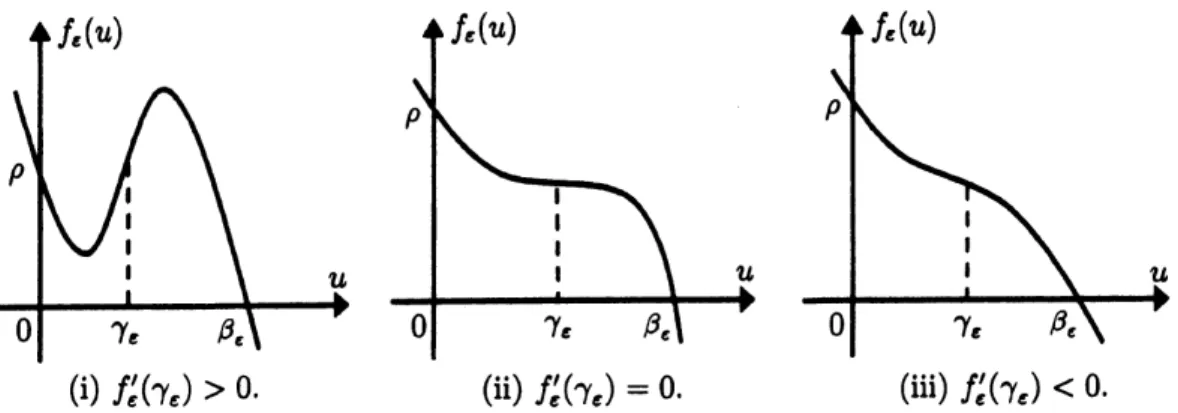
In addition, $\lim_{\epsilonarrow 0}+\beta_{\epsilon}=\infty$ and $\lim_{\epsilonarrow\infty}\beta_{\epsilon}=0$. Three possible graphs of$f_{\epsilon}(u)$ satisfying
(i) $f_{e}’(\gamma_{\epsilon})>0.$ (ii) $f_{e}’(\gamma_{e})=0.$ (iii) $f_{e}’(\gamma_{e})<0.$ Fig. 1. Three possible graphs of$f_{\epsilon}(u)$ satisfying $(1.1)-(1.3)$
.
For any $\epsilon>0$, on the $(\lambda, \Vert u\Vert_{\infty})$-plane, we study the shape and structure of bifurcation
curves $S_{\epsilon}$ ofpositive solutions of (1.1), defined by
$S_{\epsilon}\equiv$
{
$(\lambda, \Vert u_{\lambda}\Vert_{\infty}):\lambda>0$ and $u_{\lambda}$ is apositivesolution of (1.1)}.Wesaythat, onthe $(\lambda, \Vert u\Vert_{\infty})$-plane, the bifurcation
curve
$S_{\epsilon}$is -shaped if$S_{\epsilon}$is a continuouscurve
and there exist two positive numbers $\lambda_{*}<\lambda^{*}$ such that $S_{\epsilon}$ has exactly two turmngpoints at somepoints $(\lambda^{*}, \Vert u_{\lambda}\cdot\Vert_{\infty})$ and $(\lambda_{*}, \Vert u_{\lambda_{*}}\Vert_{\infty})$, and
(i) $\lambda_{*}<\lambda^{*}$ and $\Vert u_{\lambda}\cdot\Vert_{\infty}<\Vert u_{\lambda}.\Vert_{\infty},$
$(\ddot{u})$ at $(\lambda^{*}, \Vert u_{\lambda}\cdot\Vert_{\infty})$ the bifurcation
curve
$S_{\epsilon}$ turns to the left,(\"ui) at $(\lambda_{*}, \Vert u_{\lambda}.\Vert_{\infty})$the bifurcation
curve
$S_{\epsilon}$ turnsto the right.SeeFig. 2(i) depicted below for example.
Problem(1.1)wasfirst systematically studiedbyacelebratedpaperbySmoller and
Wasser-man [8]. In particular, they considered (1.1) with$\epsilon=1$ and that cubic nonlinearity $f_{\epsilon=1}(u)$
has three real zeros
$a<b<c$
.
In this paper we discuss the generalcase
with $\epsilon>0$ and $\sigma,$$\rho,$$\kappa\in \mathbb{R}$, so that $f_{\epsilon}(u)$ may have exactly one positive zero, two distinct positivezeros
or three distinct positive zeros. If $(\sigma\leq 0, \rho, \kappa\in \mathbb{R})$ or $(\rho\leq 0, \sigma, \kappa\in \mathbb{R})$, by applying themethods used in [8], we
can
prove that the structure of bifurcationcurve$S_{\epsilon}$ of (1.1) is oneofthe following cases:
(i) The bifurcationcurve $S_{\epsilon}$ of (1.1) is an emptyset (that is, (1.1) has nopositive solution
for all$\lambda>0$).
$(\ddot{u})$ Thebifurcationcurve $S_{\epsilon}$ of (1.1) is amonotone curveonthe $(\lambda, \Vert u\Vert_{\infty})$-plane.
(ui) The bifurcation
curve
$S_{\epsilon}$ of (1.1) has exactly one turning point where thecurve
turnsto the righton the $(\lambda, \Vert u\Vert_{\infty})$-plane.
Moreprecisely, we
can
giveaclassification oftotallythree qualitatively different bifurcationcurves
$S_{\epsilon}$ if $(\sigma\leq 0, \rho, \kappa\in \mathbb{R})$ or $(\rho\leq 0, \sigma, \kappa\in \mathbb{R})$.
In these cases, (1.1) has at most twopositive solutions for each $\lambda>0$
.
So we mainly consider the remainingcase (1.1), (1.2). In thiscase, it is more difficult to determin$e$ precisely theshape of the bifurcationcurve $S_{\epsilon}$ andtheexact multiplicityofpositivesolutions of (1.1), (1.2) since $S_{\epsilon}$may have two turnmingpoints
(i) $0<\epsilon<\tilde{\epsilon}$ (ii) $e=\tilde{\epsilon}$ (iii) $\epsilon>\tilde{\epsilon}$
Fig. 2. Global bifurcation ofbifurcation curves $S_{\epsilon}$ of (1.1), (1.2), and (either (1.3) or (1.4))
withvarying $\epsilon>0.$
Hung andWang [1] very recently developedsome time-maptechniquesto study theshape of the bifurcationcurve $S_{\epsilon}$ and the exact multiplicity of (1.1), (1.2) with
$\kappa\leq 0$. (1.4)
For (1.1), (1.2), (1.4), they [1, Theorem 2.1] proved that there exists apositive number $\tilde{\epsilon}=$ $\tilde{\epsilon}(\sigma, \kappa, \rho)$satisfying
$( \frac{25}{32}(\frac{\sigma^{3}}{27\rho}))^{1/2}<\tilde{\epsilon}<(\frac{\sigma^{3}}{27\rho})^{1/2}$
suchthat, onthe $(\lambda, \Vert u\Vert_{\infty})$-plane,
(i) For $0<\epsilon<\tilde{\epsilon}$, the bifurcationcurve $S_{\epsilon}$ of (1.1), (1.2), (1.4) is $S$-shaped (see Fig. $2(i)$).
(ii) For$\epsilon=\tilde{\epsilon}$, the bifurcationcurve$S_{\overline{\epsilon}}$of(1.1), (1.2), (1.4)is monotoneincreasing. Moreover,
(1.1), (1.2), (1.4) has exactly one (cusp type) degenerate positive solution $u_{\overline{\lambda}}$ (see Fig.
$2(\ddot{u}))$
.
(iii) For$\epsilon>\tilde{\epsilon}$, thebifurcationcurve$S_{\epsilon}$of(1.1), (1.2), (1.4) is monotoneincreasing. Moreover,
all positive solutions $u_{\lambda}$ of (1.1), (1.2), (1.4) are nondegenerate (see Fig. 2(iii)).
Our results in this paper are extensions ofthose of Hung and Wang [1] from $\kappa\leq 0$ to $\kappa\leq\sqrt{\sigma\rho}$
.
In Theorem 2.1 stated below for $(1.1)-(1.3)$ with varying$\epsilon>0$, weprove thesameglobal bifurcation results ofbifurcation curves $S_{\epsilon}$. Hence we are able to determine the exact
number ofpositive solutions by the values of $\epsilon$ and
$\lambda$
.
In addition, we give lower and upperbounds of the critical bifurcationvalue $\tilde{\epsilon}$. See Fig. 2.
While for any $\lambda>0$, on the $(\epsilon, \Vert u\Vert_{\infty})$-plane, it is interesting to study the shape and
structure of bifurcation
curves
$\Sigma_{\lambda}$ of positive solutions of(1.1), defined by$\Sigma_{\lambda}\equiv$
{
$(\epsilon, \Vert u_{\epsilon}\Vert_{\infty})$ : $\epsilon>0$ and$u_{\epsilon}$ is a positivesolution of (1.1)}.(Notethatwe allowthatbifurcationcurve$\Sigma_{\lambda}$consists oftwo (or more) connectedcomponents.)
Wesay that, onthe $(\epsilon, \Vert u\Vert_{\infty})$-plane, the bifurcation curve $\Sigma_{\lambda}$ is reversed $S$-shaped if$\Sigma_{\lambda}$ is a
continuous curve and there exist two numbers $\epsilon_{*}<\epsilon^{*}$ such that $S_{\epsilon}$ has exactly two tuming
points at some points $(\epsilon_{*}, \Vert u_{\epsilon_{*}}\Vert_{\infty})$ and $(\epsilon^{*}, \Vert u_{S^{*}}\Vert_{\infty})$, and (i) $\epsilon_{*}<\epsilon^{*}$ and $\Vert u_{\epsilon_{*}}\Vert_{\infty}<\Vert u_{\epsilon}\cdot\Vert_{\infty},$
(u) at $(\epsilon_{*}, \Vert u_{\epsilon_{*}}\Vert_{\infty})$thebifurcation
curve
$\Sigma_{\lambda}$ turns to the right,(m) at $(\epsilon^{*}, \Vert u_{\epsilon}\cdot\Vert_{\infty})$ thebifurcation
curve
$\Sigma_{\lambda}$ turns to thelefl.
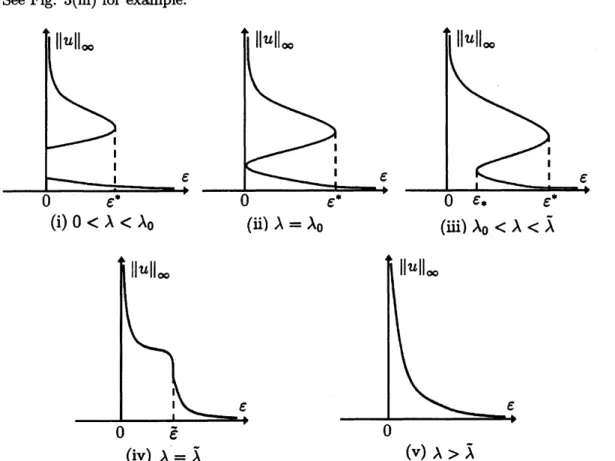
See Fig. 3(i\"u) for example.
($i$) $0<\lambda<\lambda_{0}$
$(\ddot{u})\lambda=\lambda_{0}$ ($m$) $\lambda_{0}<\lambda<\tilde{\lambda}$
$0 \tilde{\epsilon} 0$
(iv) $\lambda=\tilde{\lambda}$ (v)
$\lambda>\tilde{\lambda}$
Fig. 3. Global bifurcation of bifurcationcurves $\Sigma_{\lambda}$ of (1.1), (1.2), and (either (1.3) or (1.4))
with varying $\lambda>0.$
For (1.1), (1.2), (1.4), Hungand Wang [1, Theorem 2.3] proved that thereexisttwo positive numbers$\lambda_{0}(=\lambda_{0}(\sigma, \kappa, \rho))<\tilde{\lambda}(=\tilde{\lambda}(\sigma, \kappa, \rho))$suchthat, on the $(\epsilon, \Vert u\Vert_{\infty})$-plane,
(i) For$0<\lambda<\lambda_{0}$, the bifurcation
curve
$\Sigma_{\lambda}$ of (1.1), (1.2), (1.4) has twodisjointconnectedcomponents, theupperbranch is$\supset$-shapedwith exactlyoneturnming point, and the lower branch isa monotonedecreasing curve (see Fig. $3(i)$).
$(\ddot{u})$ For $\lambda=\lambda_{0}$, the bifurcation curve $\Sigma_{\lambda_{0}}$ of (1.1), (1.2), (1.4) has two disjoint connected components, theupperbranchis $\supset$-shaped withexactlyone turnin$g$point, and the lower
branch is a monotone decreasingcurve (seeFig. 3(ii)).
(m) For $\lambda_{0}<\lambda<\tilde{\lambda}$, the bifurcation
curve
$\Sigma_{\lambda}$ of (1.1), (1.2), (1.4) is reversed $S$–shaped (seeFig. $3(m))$
.
(iv) For $\lambda=\tilde{\lambda}$
, the bifurcationcurve $\Sigma_{\tilde{\lambda}}$ of (1.1), (1.2), (1.4) is monotone decreasing.
More-over, (1.1), (1.2), (1.4) has exactly one (cusp type) degenerate positive solution $u_{\overline{\epsilon}}$ (see
Fig. 3(iv)$)$.
(v) For $\lambda>\tilde{\lambda}$, the
bifurcation curve $\Sigma_{\lambda}$ of (1.1), (1.2), (1.4) is monotone decreasing.
InTheorem 2.2stated belowfor $(1.1)-(1.3)$ withvarying $\lambda>0$, we provethe same global bifurcation results of bifurcationcurve $\Sigma_{\lambda}$
.
Henceweareable to determinethe exactnumber
ofpositivesolutions bythe values of$\lambda$ and$\epsilon$
.
See Fig. 3.Westudy, in the $(\epsilon, \lambda, \Vert u\Vert_{\infty})$-space, the shape and stmcture of the
bifurcation surface
$\Gamma$ofpositive solutionsof (1.1), defined by $\Gamma\equiv$
{
$(\epsilon, \lambda, \Vert u_{\epsilon,\lambda}\Vert_{\infty}):\epsilon,$$\lambda>0$ and$u_{\epsilon,\lambda}$ is apositivesolution of
(1.1)}
whichhas theappearance ofafolded surface with the
fold
curve
$C_{\Gamma}\equiv\{(\epsilon, \lambda, \Vert u_{\epsilon,\lambda}\Vert_{\infty}):\epsilon,$$\lambda>0$and
$u_{\epsilon,\lambda}$ is a degenemte positivesolution of (1.1)$\}.$
Let $F_{q}$ denote the first quadrant of the $(\epsilon, \lambda)$-parameter plane. We also study, on
$F_{q}$, the
bifurcation
set$B_{\Gamma}\equiv$
{
$(\epsilon, \lambda):\epsilon,$$\lambda>0$ and$u_{\epsilon,\lambda}$ is a degenerate positive solution of (1.1)}
which is the projection of the fold
curve
$C_{\Gamma}$ onto $F_{q}$. Let $M$ denote the bounded, openconnected subset of$F_{q}$,which is ‘inside’ $B_{\Gamma}.$
For (1.1), (1.2), (1.4), Hung andWang[1, Theorem2.4] provedthat thefollowingassertions
$(i)-(iv)$ (seeFigs. 4 and 5):
(i) The fold curve $C_{\Gamma}$ of (1.1), (1.2), (1.4) is a continuous curve in the
$(\epsilon, \lambda, 1u\Vert_{\infty})$-space. Moreover, $C_{\Gamma}=C_{1}\cup C_{2}$ where
$C_{1}\equiv\{(\epsilon, \lambda_{*}(\epsilon), \Vert u_{\epsilon,\lambda.(\epsilon)}\Vert_{\infty}):0<\epsilon\leq\tilde{\epsilon}\}$ and $C_{2}\equiv\{(e, \lambda^{*}(\epsilon), \Vert u_{\epsilon,\lambda^{*}(\epsilon)}\Vert_{\infty}):0<\epsilon\leq\tilde{\epsilon}\}.$
(ii) Thebifurcation set $B_{\Gamma}$ of$(1.1),(1.2),(1.4)$ satisfies$B_{\Gamma}=B_{1}\cup B_{2}$ where
$B_{1}\equiv\{(\epsilon, \lambda_{*}(\epsilon)):0<\epsilon\leq\tilde{\epsilon}\}$ $a$皿$dB_{2}\equiv\{(\epsilon, \lambda^{*}(\epsilon)):0<\epsilon\leq\tilde{\epsilon}\}.$
(iii) $\lambda_{*}(\epsilon)$ and $\lambda^{*}(\epsilon)$ are both continuous, strictly increasing on $(0,\tilde{\epsilon}].$
(iv) Problem (1.1), (1.2), (1.4) has exactly three positive solutions for $(\epsilon, \lambda)\in M$, exactly
two positive solutions for $(\epsilon, \lambda)\in B_{\Gamma}\backslash \{(\tilde{\epsilon},\tilde{\lambda})\}$, and exactly one positive solution for
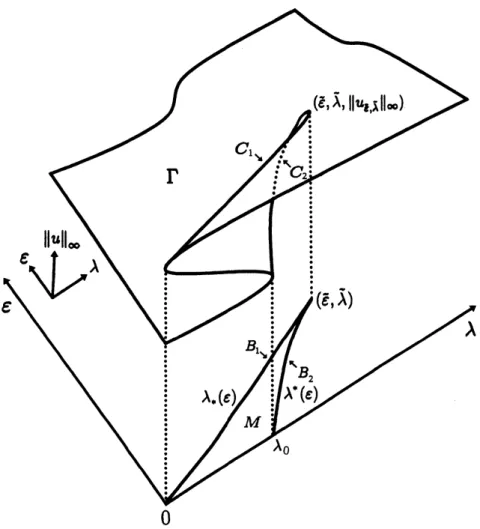
Fig. 4. The bifurcation surface$\Gamma$ withthefold
curve
$C_{\Gamma}=C_{1}\cup C_{2}$, andthe projectioof $\Gamma$ onto $F_{q}.$ $B_{\Gamma}=B_{1}\cup B_{2}$ is thebifurcation set and $(\tilde{\epsilon},\tilde{\lambda})$is the cusp point on
$F_{q}.$
Fig. 5. Theprojection ofthe bifurcation surface $\Gamma$onto $F_{q}.$ $B_{\Gamma}=B_{1}\cup B_{2}$ is the bifurcationset and $(\tilde{\epsilon},\tilde{\lambda})$ is the cusppoint on $F_{q}.$
In Theorem 2.3statedbelow for $(1.1)-(1.3)$, weprovethesamestructure of thebifurcation
set $B_{\Gamma}$ and the fold curve $C_{\Gamma}$
.
Henceweare
able to determine the exact number ofpositive solutions of $(1.1)-(1.3)$ by thevalues of$\epsilon$ and $\lambda$. See Figs. 4 and 5.Thepaper is organized asfollows. Section 2contains statements ofthemainresults:
The-orems 2.1-2.3. Section 3 containsseveral lemmas neededto prove Theorems 2.1-2.3. Section
4 contains the proofsof Theorems 2.1-2.3. Finally, in Section 5, wegive three conjectureson
the shape ofbifurcationcurves $S_{\epsilon}$ofpositivesolutionsof (1.1), (1.2) withevolutionparameter
$\kappa>\sqrt{\sigma\rho}.$
In this section, finally, we note that
our
main results (Theorems 2.1-2.3) in this paperextend those of Hung and Wang [1, Theorems 2.1, 2.3 and 2.4] from $\kappa\leq 0$ to $\kappa\leq\sqrt{\sigma\rho},$
and the proofs are more complicated. One ofthe main difficulties is that $f_{\epsilon}(u)$ can initially decrease, but then increases toapeakbefore falling tozero on $(0, \beta_{\epsilon}], see Fig. l(i)$
.
2. Main
results
Theorem 2.1. Consider $(1.1)-(1.3)$ with varying $\epsilon>0$
.
There exists a positive number $\tilde{\epsilon}=\tilde{\epsilon}(\sigma, \kappa, \rho)$ satisfying$( \frac{25}{32}(\frac{\sigma^{3}}{27\rho}))^{1/2}<\tilde{\epsilon}<(\frac{\sigma^{3}}{27\rho})^{1/2}$
such that the followingassertions $(i)-(iii)$ hold:
(i) (See Fig. $2(i).$) For $0<\epsilon<\tilde{\epsilon}$, the bifurcation
curve
$S_{\epsilon}$ is $S$-shaped on the $(\lambda, \Vert u\Vert_{\infty})-$ plane. Moreover, there exist two positive numbers $\lambda_{*}<\lambda^{*}$ such that $(1.1)-(1.3)$ hasexactlyonedegeneratepositivesolution$u_{\lambda_{*}}$ and$u_{\lambda}*$ for$\lambda=\lambda_{*}and$$\lambda=\lambda^{*}$, respectively.
More precisely, $(1.1)-(1.3)$ has:
(a) exactlythreepositive solutions$u_{\lambda},$ $v_{\lambda},$ $w_{\lambda}$ with $w_{\lambda}<u_{\lambda}<v_{\lambda}$for$\lambda_{*}<\lambda<\lambda^{*},$
$(b)$ exactly two positive solutions $w_{\lambda},$ $u_{\lambda}$ with $w_{\lambda}<u_{\lambda}$ for $\lambda=\lambda_{*}$, and exactly two
positivesolutions$u_{\lambda},$ $v_{\lambda}$ with $u_{\lambda}<v_{\lambda}$ for $\lambda=\lambda^{*},$
$(c)$ exactlyonepositive solution $w_{\lambda}$ for $0<\lambda<\lambda_{*}$, and exactlyonepositive solution
$v_{\lambda}$ for$\lambda>\lambda^{*}.$
Furthermore,
$(d) \lim_{\lambdaarrow 0+}\Vert w_{\lambda}\Vert_{\infty}=0$and$\lim_{\lambdaarrow\infty}\Vert v_{\lambda}\Vert_{\infty}=\beta_{\epsilon}.$
(ii) (See Fig. $2(ii).$) For $\epsilon=\tilde{\epsilon}$, the bifurcation curve $S_{\tilde{\epsilon}}$ is monotone increasing on the
$(\lambda, \Vert u\Vert_{\infty})$-plane. Moreover, $(1.1)-(1.3)$ has exactlyone (cusp type) degenerate positive
solution $u_{\overline{\lambda}}$
.
Moreprecisely, for $\partial 11\lambda>0,$ $(1.1)-(1.3)$ has exactly onepositive solution$u_{\lambda}$ satisfying$\lim_{\lambdaarrow 0+}\Vert u_{\lambda}\Vert_{\infty}=0$ and$\lim_{\lambdaarrow\infty}\Vert u_{\lambda}\Vert_{\infty}=\beta_{\epsilon}.$ (iii) (See Fig. $2(iii).$) For $\epsilon>\tilde{\epsilon}$, the bifurcation
curve
$S_{\epsilon}$ is monotone increasing on the
$(\lambda, \Vert u\Vert_{\infty})$-plane. Moreover, all positive solutions
$u_{\lambda}$ of $(1.1)-(1.3)$
are
nondegenerate. Moreprecisely, for all $\lambda>0,$ $(1.1)-(1.3)$ has exactlyonepositive solution $u_{\lambda}$ satisfying$\lim_{\lambdaarrow 0+}\Vert u_{\lambda}\Vert_{\infty}=0$ and$\lim_{\lambdaarrow\infty}\Vert u_{\lambda}\Vert_{\infty}=\beta_{\epsilon}.$
Theorem 2.2. $Consider\sim(1.1)-(1.3)$ with varying$\lambda>0$
.
There exist twopositive numbers(i) (SeeFig. $3(i).$) For$0<\lambda<\lambda_{0}$,
on
the$(\epsilon, \Vert u\Vert_{\infty})-pl_{\partial}ne$, thebifurcationcurve
$\Sigma_{\lambda}$ has twodisjointconnected components, the upper branch $is\supset$-shaped withexactlyoneturning
point, and the lower branch is a monotone decreasing
curve.
Moreover, there exists a positive number$\epsilon^{*}such$ that$(1.1)-(1.3)$ has exactlyonedegenerate positive solution$u_{\epsilon^{*}}$for$\epsilon=\epsilon^{*}$
.
Moreprecisely, $(1.1)-(1.3)$ has:(a) $ex\partial \mathcal{L}tly$threepositivesolutions $u_{\epsilon},$ $v_{\epsilon},$ $w_{\epsilon}$ with $w_{\epsilon}<u_{\epsilon}<v_{\epsilon}$ for$0<\epsilon<\epsilon^{*},$
$(b)$ exactlytwo positivesolutions$w_{\epsilon},$ $u_{\epsilon}$ with $w_{\epsilon}<u_{\epsilon}$ for$\epsilon=\epsilon^{*},$
$(c)$ exactly
one
positivesolution $w_{\epsilon}$ for$\epsilon>\epsilon^{*}.$
Furthermore,
$(d)0= \lim_{\epsilonarrow\infty}\Vert w_{e}\Vert_{\infty}<\lim_{\epsilonarrow 0+}\Vert w_{\epsilon}\Vert_{\infty}<\lim_{\epsilonarrow 0+}\Vert u_{\epsilon}\Vert_{\infty}<\lim_{\epsilonarrow 0+}\Vert v_{\epsilon}\Vert_{\infty}=\infty.$
(ti) (SeeFig. $3(ii).$) For $\lambda=\lambda_{0}$, on the $(\epsilon, \Vert u\Vert_{\infty})-pl\partial ne$, the bifurcation
curve
$\Sigma_{\lambda_{0}}$ has twodisjointcormected components, the upper branch $is\supset$-shaped withexactlyoneturning
point, and thelower branch is a monotonedecreasing
curve.
Moreover, there exists apositivenumber$\epsilon^{*}such$ that$(1.1)-(1.3)$ hasexactlyonedegenerate positive solution
$u_{\epsilon^{*}}$
for$\epsilon=\epsilon^{*}$
.
Moreprecisely, $(1.1)-(1.3)$ has:(a) exactlythreepositivesolutions $u_{\epsilon},$ $v_{\epsilon},$ $w_{\epsilon}$ vvith $w_{\epsilon}<u_{\epsilon}<v_{\epsilon}$ for$0<\epsilon<\epsilon^{*},$
$(b)$ exactly two positivesolutions$w_{\epsilon},$ $u_{\epsilon}$ with $w_{\epsilon}<u_{\epsilon}$ for$\epsilon=\epsilon^{*},$
$(c)$ exactly
one
positivesolution $w_{\epsilon}$ for$\epsilon>\epsilon^{*}.$ Furthermore,$(d)0= \lim_{\epsilonarrow\infty}\Vert w_{\epsilon}\Vert_{\infty}<\lim_{\epsilonarrow 0+}\Vert w_{\epsilon}\Vert_{\infty}=\lim_{\epsilonarrow 0+}\Vert u_{\epsilon}\Vert_{\infty}<\lim_{\epsilonarrow 0+}\Vert v_{\epsilon}\Vert_{\infty}=\infty.$
$(\ddot{u}i)$ (SaeFig. $3(iii).$) For $\lambda_{0}<\lambda<\tilde{\lambda}$, the bifurcation curve $\Sigma_{\lambda}$ is reversed $S-$-shapedon the
$(\epsilon, 1u\Vert_{\infty})$-plane. Moreover, there exist twopositive number $\epsilon_{*}<\epsilon^{*}$ such that $(1.1)-$ (1.3) has exactly
one
degenerate positive solution $u_{\epsilon}$.
and $u_{\epsilon}$.
for$\epsilon=\epsilon_{*}$ and$\epsilon=\epsilon^{*},$respectively. More precisely, $(1.1)-(1.3)$ has:
(a) exactlythreepositivesolutions$u_{\epsilon},$ $v_{\epsilon},$ $w_{\epsilon}$ with$w_{\epsilon}<u_{\epsilon}<v_{\epsilon}$ for$\epsilon_{*}<\epsilon<\epsilon^{*},$
$(b)$ exactly two positive solutions $u_{\epsilon},$ $v_{\epsilon}$ with $u_{\epsilon}<v_{\epsilon}$ for $\epsilon=\epsilon_{*}$, and exactly two
positivesolutions $w_{\epsilon},$ $u_{\epsilon}$ with $w_{\epsilon}<u_{\epsilon}$ for$\epsilon=\epsilon^{*},$
$(c)$ exactly
one
positivesolution $v_{\epsilon}$ for $0<\epsilon<\epsilon_{*}$, and exactlyone
positive solution$w_{e}$ for$\epsilon>\epsilon^{*}.$ FUrthermore,
$(d) \lim_{\epsilonarrow 0+}\Vert v_{\epsilon}\Vert_{\infty}=\infty$and$\lim_{\epsilonarrow\infty}\Vert w_{\epsilon}\Vert_{\infty}=0.$
(iv) (SeeFig. $3(iv).$) For $\lambda=\tilde{\lambda}$,
the bifurcation curve $\Sigma_{\overline{\lambda}}$ is monotone decreasing on the
$(\epsilon, \Vert u\Vert_{\infty})$-plane. Moreover, $(1.1)-(1.3)$ has exactlyone (cusp type) degenerate positive
solution $u_{\overline{\epsilon}}$
.
Moreprecisely, for all$\epsilon>0,$ $(1.1)-(1.3)$ has exactlyonepositivesolution$u_{\epsilon}$satisfying$\lim_{\epsilonarrow 0+}\Vert u_{\epsilon}\Vert_{\infty}=\infty$and$\lim_{\epsilonarrow\infty}\Vert u_{\epsilon}\Vert_{\infty}=0.$ (v) (See Fig. $3(v).$) For $\lambda>\tilde{\lambda}$, the bifurcation curve
$\Sigma_{\lambda}$ is monotone decreasing on the
$(\epsilon, \Vert u\Vert_{\infty})$-plane. Moreover, all positive solutions $u_{\epsilon}$ of $(1.1)-(1.3)$ are nondegenerate.
Moreprecisely, for $\epsilon 11\epsilon>0,$ $(1.1)-(1.3)$ has exactlyonepositive solution $u_{\epsilon}$ satisfying
Wegive next remark to Theorem 2.2.
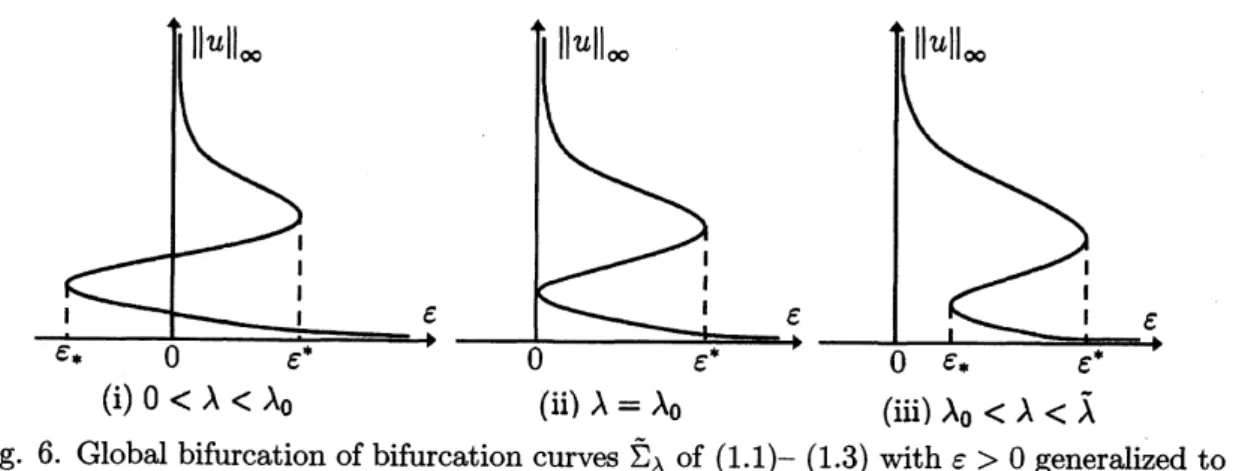
Remark 1. Considering $(1.1)-(1.3)$with$e>0$generalized to$\epsilon\in \mathbb{R}$, we define the bifurcation
curve
$\tilde{\Sigma}_{\lambda}\equiv$
{
$(\epsilon, \Vert u_{\epsilon}\Vert_{\infty})$: $\epsilon\in \mathbb{R}$ and$u_{\epsilon}$ is apositivesolution of (1.1)}.
Actually, it
can
beeasily proved that:(i) For$0<\lambda<\lambda_{0}$, the bifurcation curve$\tilde{\Sigma}_{\lambda}$ is reversed
$S$-shaped on the $(\epsilon, \Vert u\Vert_{\infty})$-plane.
Moreover, there exists $\epsilon_{*}<0$ such that $(1.1)-(1.3)$ has exaetly two positive solutions
$w_{\epsilon},$ $u_{\epsilon}$ with $w_{\epsilon}<u_{\epsilon}$ for$\epsilon_{*}<\epsilon\leq 0$, and exactlyonepositive solution
$u_{\epsilon}$ for$\epsilon=\epsilon_{*}$, and
nopositivesolution for$\epsilon<\epsilon_{*}$
.
See Fig. 6(i).(ii) For $\lambda=\lambda_{0}$, the bifurcation
curve
$\tilde{\Sigma}_{\lambda_{0}}$ is reversed $S$-shaped onthe $(\epsilon, \Vert u\Vert_{\infty})$-plane. Moreover, $(1.1)-(1.3)$ has exactly onepositive solution $u_{\epsilon}$ for$\epsilon=0$, and nopositive
solution for$\epsilon<0$
.
See Fig. 6(ii).(i) $0<\lambda<\lambda_{0}$ (ii) $\lambda=\lambda_{0}$ (iii) $\lambda_{0}<\lambda<\tilde{\lambda}$ Fig. 6. Global bifurcation of bifurcationcurves $\tilde{\Sigma}_{\lambda}$ of
$(1.1)-(1.3)$ with$\epsilon>0$ generalized to
$\epsilon\in \mathbb{R}$ andwithvarying $\lambda\in(0,\tilde{\lambda})$
.
Notice that, inTheorem 2.1, on the $(\lambda, 1u\Vert_{\infty})$-plane, the bifurcationcurve $S_{\epsilon}$ is $S$–shaped
for $0<\epsilon<\tilde{\epsilon}$,
see
Fig. 2. While in Theorem 2.2 and Remark 1,on
the$(\epsilon, \Vert u\Vert_{\infty})$-plane, the
bifurcation curve 2$\lambda$ is reversed
$S$–shaped for$0<\lambda<\tilde{\lambda}$, see Fig. 6.
Let $\tilde{\epsilon}=\tilde{\epsilon}(\sigma, \kappa, \rho),$ $\lambda_{0}=\lambda_{0}(\sigma, \kappa, \rho),\tilde{\lambda}=\tilde{\lambda}(\sigma, \kappa, \rho),$ $\lambda_{*}=\lambda_{*}(\epsilon),$ $\lambda^{*}=\lambda^{*}(\epsilon),$ $\epsilon_{*}=\epsilon_{*}(\lambda)$ and $\epsilon^{*}=\epsilon^{*}(\lambda)$ be the values in Theorems 2.1 and 2.2 for $(1.1)-(1.3)$. We study the structure of the bifurcation set $B_{\Gamma}$ inthenext theorem.
Theorem 2.3 (See Fig. 5). Consider $(1.1)-(1.3)$ with $(\epsilon, \lambda)\in F_{q}$. Then thebifurcationset
$B_{\Gamma}=B_{1}\cup B_{2}$ where
$B_{1}\equiv\{(\epsilon, \lambda_{*}(\epsilon)):0<\epsilon\leq\tilde{\epsilon}\}$ and $B_{2}\equiv\{(\epsilon, \lambda^{*}(\epsilon)):0<\epsilon\leq\tilde{\epsilon}\}.$
Moreover, $(1.1)-(1.3)$ has$exactly\sim$ three positivesolutionsfor$(\epsilon, \lambda)\in M$, exactly two positive
solutions for $(\epsilon, \lambda)\in B_{\Gamma}\backslash \{(\tilde{\epsilon}, \lambda)\}$, and exactlyonepositivesolution for $(\epsilon, \lambda)\in(F_{q}\backslash (B_{\Gamma}\cup$
$M))\cup\{(\tilde{\epsilon},\tilde{\lambda})\}$
.
More precisely, thefollowing assertions(i) and (ii) hold:
(i) Functions $\lambda_{*}(\epsilon)$ and $\lambda^{*}(\epsilon)$
are
both continuous, strictlyincreasing on $(0,\tilde{\epsilon}]$ and satisfy(ii) Fhnction$\epsilon^{*}(\lambda)$ iscontinuous, strictlyincreasing
on
$(0,\tilde{\lambda}] and$satisfies$\lim_{\lambdaarrow 0}+\epsilon^{*}(\lambda)=0$and $\epsilon^{*}(\tilde{\lambda})=\tilde{\epsilon}$
.
Function $\epsilon_{*}(\lambda)$ is continuous, strictlyincreasingon $(\lambda_{0},\tilde{\lambda}]$ andsatisfies$\lim_{\lambdaarrow\lambda_{0}^{+}}\epsilon_{*}(\lambda)=0$ and$\epsilon_{*}(\tilde{\lambda})=\tilde{\epsilon}.$
Innext remark, wegiveaprecise characterizationof the foldcurve $C_{\Gamma}$ inthe$(\epsilon, \lambda, \Vert u\Vert_{\infty})-$
space.
Remark 2 (See Fig. 4). Consider $(1.1)-(1.3)$
.
Then, by Theorem 2.3(i), the foldcurve
$C_{\Gamma}=C_{1}\cup C_{2}$ where$C_{1}\equiv\{(\epsilon, \lambda_{*}(\epsilon), \Vert u_{\epsilon,\lambda.(\epsilon)}\Vert_{\infty}):0<\epsilon\leq\tilde{\epsilon}\}$ and $C_{2}\equiv\{(\epsilon, \lambda^{*}(\epsilon), \Vert u_{\epsilon,\lambda^{*}(\epsilon)}\Vert_{\infty}):0<\epsilon\leq\tilde{\epsilon}\}.$ Moreover, byapplying $(4.4)-(4.7)$ stated below, $we$
are
able to prove that:(i) $\Vert u_{\epsilon,\lambda.(\epsilon)}\Vert_{\infty}>\Vert u_{\epsilon,\lambda^{*}(\epsilon)}\Vert_{\infty}$for$0<\epsilon<\tilde{\epsilon}$and $\Vert u_{\overline{\epsilon},\lambda.(\overline{\epsilon})}\Vert_{\infty}=\Vertu_{\overline{\epsilon},\lambda(\overline{\epsilon})}\Vert_{\infty}=\Vert u_{\tilde{\epsilon},\tilde{\lambda}}\Vert_{\infty}.$
(ti) $\Vert u_{\epsilon,\lambda.(\epsilon)}\Vert_{\infty}$ isacontinuous, strictlydecreasing function of$\epsilon\in(0,\tilde{\epsilon}]$ and
1
$u_{\epsilon,\lambda(\epsilon)}\Vert_{\infty}$is acontinuous, strictlyincreasing function of$\epsilon\in(0,\tilde{\epsilon}].$
$(\ddot{n}i)C_{\Gamma}$ isacontinuous curvein the $(\epsilon, \lambda, \Vert u\Vert_{\infty})$-space.
Observe that both $\lambda^{*}(\epsilon)$ and $\lambda_{*}(\epsilon)$ have continuous inverse functions
on
$(0,\tilde{\epsilon}]$.
Indeed, $\epsilon_{*}(\lambda)$ is the inverse function of $\lambda^{*}(\epsilon)$ on $(\lambda_{0},\tilde{\lambda}] and \epsilon^{*}(\lambda)$ is the inverse function of $\lambda_{*}(\epsilon)$ on$(0,\tilde{\lambda}].$
3. Lemmas
To prove
our
results (Theorems 2.1-2.3), weneed the following Lemmas 3.1-3.8 inwhichwedevelop newtimemap techmques different from thosedevelopedin [1]. Inparticular, Lemma
3.3 is akeylemma in the proofsof Theorems 2.1-2.3. InLemma 3.3, for any fixed $\epsilon>0$,
we
prove that the bifurcation
curve
$S_{\epsilon}$ is either monotone increasingor$S-$-shapedonthe$(\lambda, \Vert u\Vert_{\infty})-$ plane. Toapplythe timemap techmiques for $(1.1)-(1.3)$, inthefollowing, weconsider $\epsilon\geq 0.$Thetime map formula which weapply to study $(1.1)-(1.3)$ takes the form as follows:
$\sqrt{\lambda}=\frac{1}{\sqrt{2}}\int_{0}^{\alpha}[F_{\epsilon}(\alpha)-F_{\epsilon}(u)]^{-1/2}du\equiv T_{\epsilon}(\alpha)$ for $0<\alpha<\beta_{\epsilon}and\epsilon\geq 0$, (3.1)
where $F_{\epsilon}(u) \equiv\int_{0}^{u}f_{\epsilon}(t)dt$and $\beta_{\epsilon}$ the unique positive zero of cubicpolynomial$f_{\epsilon}(u)$ for$\epsilon>0,$
andwe let$\beta_{\approx-0}\equiv\infty$
.
Observethat positive solutions $u_{\epsilon,\lambda}$ for $(1.1)-(1.3)$ correspond to$\Vert u_{\epsilon,\lambda}\Vert_{\infty}=\alpha$ and $T_{\epsilon}(\alpha)=\sqrt{\lambda}$. (3.2) Thus, studying of the exact number of positive solutions of $(1.1)-(1.3)$ for fixed $\epsilon\geq 0$ is
equivalent to studying the shape of the timne map $T_{\epsilon}(\alpha)$
on
$(0, \beta_{\epsilon})$; and studying the exactnumberofpositivesolutions of$(1.1)-(1.3)$forfixed$\lambda>0$isequivalent to studyin$g$thenumber
ofroots of the equation$T_{\epsilon}(\alpha)=\sqrt{\lambda}$ on $(0, \beta_{\epsilon})$ for varying $\epsilon>0$
.
Note that itcan
be provedthat $T_{\epsilon}(\alpha)$ is athnice differentiable function of$\alpha\in(0, \beta_{\epsilon})$ for $\epsilon\geq 0$
.
The proof is easy buttedious; we omit it.
We call a positive solution $u_{\epsilon,\lambda}$ of $(1.1)-(1.3)$ is degenemte if $T_{\epsilon}’(\Vert u_{\epsilon,\lambda}\Vert_{\infty})=0$ and is
nondegenerate if$T_{\epsilon}’(\Vert u_{\epsilon,\lambda}\Vert_{\infty})\neq 0$
.
So tofind the degenerate positive solutions of $(1.1)-(1.3)$,positive solution $u_{\epsilon,\lambda}$ of $(1.1)-(1.3)$ is of cusp type if$T_{\epsilon}"(\Vert u_{\epsilon,\lambda}\Vert_{\infty})=0$ and $T_{\epsilon}"’(\Vert u_{\epsilon,\lambda}\Vert_{\infty})\neq 0,$
see Shi [6, p. 497] and [7, p. 214].
The main difficultyinproving
our
main results is to determine the exact number of criticalpoints of the time map $T_{\epsilon}(\alpha)$ on $(0, \beta_{\epsilon})$ for all $\epsilon>0$. This question is partially answered in
thefollowing Lemmas3.1 and3.2. Lemma3.1follows from [5, Theorems 2.6, 2.9and3.2] and Lemma3.2 mainlyfollows by applying [2, Theorem 2.1]; we omit the proofs.
Lemma 3.1. Consider $(1.1)-(1.3)$
.
For any fixed$\epsilon>0$, thefollowing assertions (i) and (ii)hold:
(i) $\lim_{\alphaarrow 0+}T_{\epsilon}(\alpha)=0$ and$\lim_{\alphaarrow\beta_{\epsilon}^{-}}T_{\epsilon}(\alpha)=\infty.$
(ii) If$T_{\epsilon}(\alpha)$ is not strictlyincreasing on $(0, \gamma_{\epsilon})$, then $T_{\epsilon}(\alpha)$ is strictlyincreasing on $(0,\tilde{\gamma}_{\epsilon})$
and strictlydecreasingon $(\tilde{\gamma}_{\epsilon}, \gamma_{\epsilon})$ forsome$\tilde{\gamma}_{\epsilon}\in(0, \gamma_{\epsilon})$.
Lemma 3.2. Consider $(1.1)-(1.3)$
.
Then the following assertions (i) and (ii) hold:(i) For any fixed$\epsilon\geq(\frac{\sigma^{3}}{27\rho})^{1/2},$ $T_{\epsilon}(\alpha)$ isastrictlyincreasing functionon $(0, \beta_{\epsilon})$
.
(ii) For any fixed positive$\epsilon\leq(\frac{7}{10}(\frac{\sigma^{3}}{27\rho}))^{1/2},$ $T_{\epsilon}(\alpha)$ has exactly onelocal maximum and one localminimumon $(0, \beta_{\epsilon})$
.
However, there is a gap, what about thecase where$\epsilon$is between $( \frac{7}{10}(\frac{\sigma^{3}}{27\rho}))^{1/2}$ and $( \frac{\sigma^{3}}{27})^{1/2}$?
$\rho$
First, in the next Lemma 3.3, we prove
Lemma 3.3. Consider $(1.1)-(1.3)$
.
For any fixed $\epsilon>0,$ $T_{\epsilon}(\alpha)$ is either astrictlyincreasingfunctionorhas exactly two critical points, alocal maximum and a localminimum, on $(0, \beta_{\epsilon})$
.
To prove Lemma 3.3, we develop some new timemap techniques. First, we define the auxiliaryfunction$G_{\epsilon}(\alpha)=8\sqrt{2}\alpha T_{\epsilon}(\alpha)$. (3.3)
Note that the auxiliary function $G_{\epsilon}(\alpha)=8\sqrt{2}\alpha^{\frac{5}{2}}T_{\epsilon}"(\alpha)$ used in this paper is different from the auxiliaryfunction $12\sqrt{2}T_{\epsilon}’(\alpha)+8\sqrt{2}\alpha T_{\epsilon}"(\alpha)$ used in Hung and Wang [1]. Moreover, the
techniquesusedin[1, Lemmas3.4-3.5] for$\kappa\leq 0$fails hereunder condition (1.3) $0<\kappa\leq\sqrt{\sigma\rho},$
though it isexpectedthat similarresultshold. So weneed to developnewtechniques toobtain
the following Lemma 3.4. The proofof Lemma3.4 is rather long and technical; we omit it. Lemma 3.4. Consider $(1.1)-(1.3)$
.
For any fixed $\epsilon\in[(\frac{7}{10}(\frac{\sigma^{3}}{27\rho}))^{1/2}, (\frac{\sigma^{3}}{27\rho})^{1/2}],$ $G_{\epsilon}’(\alpha)>0$ for$\alpha\in[\gamma_{\epsilon}, \beta_{\epsilon})$
.
For any fixed $\alpha>0$, let
$I_{\alpha}=\{\epsilon>0:\alpha\in(0, \beta_{\epsilon})\}.$
Since $\beta_{\epsilon}$ is a continuous, strictly decreasing function of $\epsilon>0$, and $\lim_{\epsilonarrow 0+}\beta_{\epsilon}=\infty$ and
$\lim_{\epsilonarrow\infty}\beta_{\epsilon}=0$, we obtain that $I_{\alpha}=(O, \epsilon(\alpha))$ where $\alpha=\beta_{\epsilon(\alpha)}$, and $\epsilon(\alpha)$ is strictly decreasing
in $\alpha.$
Lemma 3.5. Consider $(1.1)-(1.3)$
.
For any fixed$\alpha>0,$ $T_{\epsilon}’(\alpha)$isacontinuouslydifferentiable,Proof of Lemma3.5. First,for anyfixed$\alpha>0$,it
can
beprovedthat$T_{\epsilon}’(\alpha)$isacontinuously differentiable functionof$\epsilon\in I_{\alpha}\cup\{0\}$.
The proofis easy but tedious;we
onit it.Secondly, since$f_{\epsilon}(u)=-\epsilon u^{3}+\sigma u^{2}-\kappa u+\rho,$$F_{\epsilon}(u)= \int_{0}^{u}f_{\epsilon}(t)dt$andby (3.1),
we
computethat
$T_{\epsilon}’( \alpha) = \frac{1}{\sqrt{2}}\int_{0}^{1}\frac{1}{[F_{\epsilon}(\alpha)-F_{\epsilon}(\alpha v)]^{1/2}}dv-\frac{\alpha}{2\sqrt{2}}\int_{0}^{1}\frac{f_{\epsilon}(\alpha)-f_{\epsilon}(\alpha v)v}{[F_{\epsilon}(\alpha)-F_{\epsilon}(\alpha v)]^{3/2}}dv$
$= \frac{1}{2\sqrt{2}\alpha}\int_{0}^{\alpha}\frac{\epsilon\frac{(\alpha^{4}-u^{4})}{2}-\sigma\frac{(\alpha^{3}-u^{3})}{3}+\rho(\alpha-u)}{[-\epsilon\frac{(\alpha^{4}-u^{4})}{4}+\sigma\frac{(\alpha^{3}-u^{3})}{3}-\kappa\frac{(\alpha^{2}-u^{2})}{2}+\rho(\alpha-u)]^{3/2}}du$ and $\frac{\partial}{\partial\epsilon}T_{\epsilon}’(\alpha)$ $=$ $\frac{1}{96\sqrt{2}\alpha}\int_{0}^{\alpha}\frac{(\alpha^{4}-u^{4})[3\epsilon(\alpha^{4}-u^{4})+2\sigma(\alpha^{3}-u^{3})-12\kappa(\alpha^{2}-u^{2})+42\rho(\alpha-u)]}{[-\epsilon\frac{(\alpha^{4}-u^{4})}{4}+\sigma\frac{(\alpha^{3}-u^{3})}{3}-\kappa\frac{(\alpha^{2}-u^{2})}{2}+\rho(\alpha-u)]^{5/2}}du$ $>$ $\frac{1}{48\sqrt{2}\alpha}\int_{0}^{\alpha}\frac{(\alpha^{4}-u^{4})(\alpha-u)[\sigma(\alpha^{2}+\alpha u+u^{2})-6\kappa(\alpha+u)+21\rho]}{[-\epsilon\frac{(\alpha^{4}-u^{4})}{4}+\sigma\frac{(\alpha^{3}-u^{3})}{3}-\kappa\frac{(\alpha^{2}-u^{2})}{2}+\rho(\alpha-u)]^{5/2}}du$
.
(3.4) Let$H(u) \equiv \sigma(\alpha^{2}+\alpha u+u^{2})-6\kappa(\alpha+u)+21\rho$
$= \sigma u^{2}+(\sigma\alpha-6\kappa)u+(\sigma\alpha^{2}-6\kappa\alpha+21\rho)$.
Therefore, the proofis complete ifwecanprove that
$H(u)>0$ for anygiven numbers$\sigma,$$\rho,$$\alpha>0,0<\kappa\leq\sqrt{\sigma\rho}$. (3.5) Note that thediscriminantof quadraticpolynomial$H(u)is-3\sigma^{2}\alpha^{2}+12\sigma\kappa\alpha+(36\kappa^{2}-84\sigma\rho)\equiv$
$\tilde{H}(\alpha)$
.
By the assumption that $\kappa\leq\sqrt{\sigma\rho}$, the discriminant ofquadratic polynomial $\tilde{H}(\alpha)$ is$144\sigma^{2}(4\kappa^{2}-7\sigma\rho)<0$
.
So $\tilde{H}(\alpha)<0$ for any given numbers $\sigma,$$\rho>0,0<\kappa\leq\sqrt{\sigma\rho}$.
Thisimplies that (3.5) holds. By (3.4) and (3.5), for any fixed$\alpha>0,$ $T_{\epsilon}’(\alpha)$ is a strictlyincreasing function of$\epsilon\in I_{\alpha}\cup\{0\}.$
The proofof Lemma3.5 iscomplete. $\blacksquare$
We are nowin aposition to prove Lemma 3.3.
Proof ofLemma 3.3. First, we prove that, for any fixed $\epsilon>0,$ $T_{\epsilon}(\alpha)$ is either a strictly
increasing function orhas alocal maximum and alocal minimum, on $(0, \beta_{\epsilon})$
.
By Lemma 3.2,weonly need to considerthecase $( \frac{7}{10}(\frac{\sigma^{3}}{27\rho}))^{1/2}<\epsilon<(\frac{\sigma^{3}}{27\rho})^{1/2}.$
For anyfixed $( \frac{7}{10}(\frac{\sigma^{3}}{27\rho}))^{1/2}<\epsilon<(\frac{\sigma^{3}}{27\rho})^{1/2}$, by Lemma 3.1(u) (resp. Lemma 3.4), we know
that all (possible) critical points of$T_{\epsilon}(\alpha)$on $(0, \gamma_{\epsilon}] (resp.on [\gamma_{\epsilon}, \beta_{\epsilon})$)
are
discrete. Moreover,since $\lim_{\alphaarrow 0}+T_{\epsilon}(\alpha)=0$ and$\lim_{\alphaarrow\beta}-T_{\epsilon}(\alpha)=\infty$ and byLemma 3.1(i), weobtain that $T_{\epsilon}’(\alpha)$ changes$sign$anevennumber of timesorinfinitely times. Assumethat$T_{\epsilon}(\alpha)$ isneitherastrictly
increasing function nor does it have exactly one local maximum and one local minimum on
$(0, \beta_{\epsilon})$. Then thereexistthreenumbers $\alpha_{1},$$\alpha_{2},$$\alpha_{3}\in(0, \beta_{\epsilon})$such that $\alpha_{1}<\alpha_{2}<\alpha_{3}$arecritical
pointsof$T_{\epsilon}(\alpha),$
$\alpha_{1},$$\alpha_{3}$
are
localmaxima,and$\alpha_{2}$is alocalmimimum. Thus$T_{\epsilon}"(\alpha_{1}),$$T_{\epsilon}"(\alpha_{3})\leq 0$ByLemma 3.4, for any fixed $( \frac{7}{10}(\frac{\sigma^{3}}{27\rho}))^{1/2}<\epsilon<(\frac{\sigma^{3}}{27\rho})^{1/2},$ $G_{\epsilon}(\alpha)=8\sqrt{2}\alpha^{\frac{5}{2}}T_{\epsilon}"(\alpha)$is astrictly
increasing functionon $[\gamma_{\epsilon}, \beta_{\epsilon})$. Since $\alpha_{2}\geq\gamma_{\epsilon}$ by Lemma 3.1(ii), we obtain that
$8\sqrt{2}\alpha^{\frac{5}{3^{2}}}T_{\epsilon}"(\alpha_{3})=G_{\epsilon}(\alpha_{3})>G_{\epsilon}(\alpha_{2})=8\sqrt{2}\alpha^{\frac{8}{2^{2}}}T_{\epsilon}"(\alpha_{2})\geq 0.$
Therefore $T_{\epsilon}"(\alpha_{3})>0$
.
This contradicts to that $T_{\epsilon}"(\alpha_{3})\leq 0$.
So $T_{\epsilon}(\alpha)$ is either a strictly increasing functionor has exactlyone localmaximum and onelocalminimum on $(0, \beta_{\epsilon})$.
Next, suppose that $T_{\epsilon}(\alpha)$ has exactlya local maximum
$\alpha_{M}$ and alocal minimum $\alpha_{m}$ for
some fixed $\epsilon>0$
.
Then $0<\alpha_{M}<\alpha_{m}<\beta_{\epsilon}$by Lemma 3.1(i). We can prove that $T_{\epsilon}(\alpha)$ has exactly two critical points $\alpha_{M},$$\alpha_{m}$ on $(0, \beta_{\epsilon})$ by applying Lemma 3.5 and similar argumentsused in the proof of [1, Lemma 3.3]; we omit it. TheproofofLemma 3.3 is complete. $\blacksquare$
Let
$E=\{\begin{array}{l}\epsilon>0\cdot T_{\epsilon}(\alpha)h{\ae} exactlytwocriticalpointsalocal\max imumandalocal\min imum,on(0,\beta_{\epsilon})\end{array}\}.$
ByLemma 3.3, forany$\epsilon>0,$ $T_{\epsilon}(\alpha)$ is either astrictlyincreasing function or has exactly two
critical points, alocalmaximum and a local minimum, on $(0, \beta_{\epsilon})$
.
Thus$E=\{\epsilon>0:T_{\epsilon}’(\alpha)<0$ for some$\alpha\in(0, \beta_{\epsilon})\}$
.
(3.6)We obtain the following two lemmas by modifying thesame arguments used in the proofof
[1, Lemmas 3.7-3.8]; we omit the proofs.
Lemma 3.6: The set$E$ isopen and connected.
Lemma 3.7. $(0, ( \frac{25}{32}(\frac{\sigma^{3}}{27\rho}))^{1/2}]\subset E.$
Thefollowing Lemma3.8(i)determinethe shapeof$T_{\epsilon=0}(\alpha)$ on$(0, \infty)$, andLemma3.8(ii) is abasic comparison theorem for thetimemap formula. Lemma3.8(i)follows from [5, Theorem 3.2] and Lemma3.8(ii) by modifying [5, Theorems 2.3 and 2.4]; we omit the proofs.
Lemma 3.8. Consider $(1.1)-(1.3)$. Thefollowing assertions (i) and (ii) hold:
(i) $T_{\epsilon=0}(\alpha)$ has exactly one criticalpoint at some
$\alpha_{0}$, a maximum, on $(0, \infty)$
.
Moreover,$\lim_{\alphaarrow 0^{+}}T_{\epsilon=0}(\alpha)=\lim_{\alphaarrow\infty}T_{\epsilon=0}(\alpha)=0.$
(ii) Forany fixed$\alpha>0,$ $T_{\epsilon}(\alpha)$ isacontinuous, strictlyincreasing function of$\epsilon\in I_{\alpha}\cup\{0\}.$
4. Proofs of the
main
results
We first recall that a positive solution $u_{\epsilon,\lambda}$ of (1.1) is degenerate if $T_{\epsilon}’(\Vert u_{\epsilon,\lambda}\Vert_{\infty})=0$ and is
nondegenemte if$T_{\epsilon}’(\Vert u_{\epsilon,\lambda}\Vert_{\infty})\neq 0$. Also, a degenerate positive solution
$u_{\epsilon,\lambda}$ of (1.1) is of cusp
type if$T_{\epsilon}"(\Vert u_{\epsilon,\lambda}\Vert_{\infty})=0$ and$T_{\epsilon}"’(\Vert u_{\epsilon,\lambda}\Vert_{\infty})\neq 0.$
Proof of Theorem 2.1. To prove Theorem 2.1, by (3.1) and Lemma 3.1(i), it suffices to
prove that there exists apositive number $\tilde{\epsilon}=\tilde{\epsilon}(\sigma, \kappa, \rho)$such that the following parts $(I)-(III)$ hold:
(I) For $0<\epsilon<\tilde{\epsilon}$, on $(0, \beta_{\epsilon}),$ $T_{\epsilon}(\alpha)$ has exactly two critical points, a local maximum at
some $\alpha_{\overline{\epsilon}}$ and a local minimum at some $\alpha_{\epsilon}^{+}(>\alpha_{\epsilon}^{-})$, satisfying $\lambda^{*}=(T_{\epsilon}(\alpha_{\overline{\epsilon}}))^{2}$ and $\lambda_{*}=(T_{\epsilon}(\alpha_{\epsilon}^{+}))^{2}.$
(II) For $\epsilon=\tilde{\epsilon},$ $T_{\overline{\epsilon}}(\alpha)$ is
a
strictlyincreasing function and has exactlyone
critical point, atsome
$\tilde{\alpha}$,on
$(0, \beta_{\overline{\epsilon}})$.
Moreover, $T_{\tilde{\epsilon}}’(\tilde{\alpha})=0,$$T \frac{\prime}{\epsilon}(\alpha)>0$for $\alpha\in(0, \beta_{\overline{\epsilon}})\backslash \{\tilde{\alpha}\},$ $T_{\overline{\epsilon}}"(\tilde{\alpha})=0$ and $T_{\tilde{\epsilon}}"’(\tilde{\alpha}J\neq 0$ (So $(1.1)-(1.3)$ has exactlyone (cusp type) degenerate positive solution $u_{\overline{\lambda}}$with $\lambda\equiv(T_{\tilde{\epsilon}}(\tilde{\alpha}))^{2}$ and $\tilde{\alpha}=\Vert u_{\tilde{\lambda}}\Vert_{\infty}.)$
(III) For $\epsilon>\tilde{\epsilon},$ $T_{\epsilon}(\alpha)$ is a strictly increasing function and has no cnitical point
on
$(0, \beta_{\epsilon})$.
Moreover, $T_{\epsilon}’(\alpha)>0$for $\alpha\in(0, \beta_{\epsilon})$.
Note that, by (3.2) and the above parts $(I)-(III)$, we obtainimmediately the exact
mul-tiplicity result of positive solutions of $(1.1)-(1.3)$ for $0<\epsilon<\tilde{\epsilon}$ and the uniqueness result
of positive solution of $(1.1)-(1.3)$ for $\epsilon\geq\tilde{\epsilon}$
.
Moreover, ordering properties and asymptotic behaviors of positive solutions of $(1.1)-(1.3)$ in parts$(I)-(III)$can
beobtained easily. We thenprove parts $(I)-(III)$
as
follows.By Lemmas 3.2, 3.6 and 3.7,
we
obtain that $E=(0,\tilde{\epsilon})$ where $\tilde{\epsilon}=\sup E$ satisfies$( \frac{26}{32}(\frac{\sigma^{3}}{27\rho}))^{1/2}<\tilde{\epsilon}<(\frac{\sigma^{3}}{27\rho})^{1/2}$
.
So, for $0<\epsilon<\tilde{\epsilon}$, on $(0, \beta_{\epsilon}),$ $T_{\epsilon}(\alpha)$ has exaetly two criticalpoints, a local maximum at
some
$\alpha_{\overline{\epsilon}}$ and a local minimum at some $\alpha_{\epsilon}^{+}(>\alpha_{\overline{\epsilon}})$, satisfying$\lambda^{*}=(T_{\epsilon}(\alpha_{\overline{\epsilon}}))^{2}$and $\lambda_{*}=(T_{\epsilon}(\alpha_{\epsilon}^{+}))^{2}$
.
Sopart (I) holds.For $\epsilon>\tilde{\epsilon}$, by Lemma3.5 and (3.6),we obtain that
$T_{\epsilon}’(\alpha)>$ 塞$(\alpha$$)\geq 0$ for $\alpha\in(0,\beta_{\epsilon})\subset(0,\beta_{\overline{\epsilon}})$,
and hence $T_{\epsilon}(\alpha)$ has nocritical point on $(0, \beta_{\epsilon})$
.
So part (III) holds.Fig. 7. Graphs of$T_{\epsilon}(\alpha)$ for $\alpha\in(0, \beta_{\epsilon})$withvarying $\epsilon\geq 0.$
We prove the remaining part (II). For$\epsilon=\tilde{\epsilon}$, we know that
$T_{\overline{\epsilon}}(\alpha)\geq 0$ on $(0, \beta_{\overline{\epsilon}})$
.
(4.1) We first provethe existence ofacritical point of$T_{\overline{\epsilon}}(\alpha)$ on $(0, \beta_{\overline{\epsilon}})$.
Choose a sequence $\{\epsilon_{n}\}\subset$ $E=(0,\tilde{\epsilon})$ such that $\epsilon_{n}\nearrow\tilde{\epsilon}$ as $narrow\infty$.
Let $\alpha_{\overline{\epsilon}_{n}}<\alpha_{\epsilon_{n}}^{+}$ be two critical points of$T_{\epsilon_{n}}(\alpha)$ on $(0, \beta_{\epsilon_{n}})$ for each $n\in \mathbb{N}$ (see Fig. 7). Thenby Lemma3.5 again, weobtain thatHence $\alpha_{\overline{\epsilon}_{n}}<\alpha_{\overline{\epsilon}_{n+1}}<\alpha_{\epsilon_{n+1}}^{+}<\alpha_{\epsilon_{n}}^{+}$ and
$\alpha_{\epsilon_{n}}^{-}<a^{-}\equiv\lim_{narrow\infty}\alpha_{\epsilon_{n}}^{-}\leq\tilde{\alpha}^{+}\equiv\lim_{narrow\infty}\alpha_{\epsilon_{n}}^{+}<\alpha_{\epsilon_{n}}^{+}$ for all $n\in \mathbb{N}.$ These imply that
$T_{\epsilon_{n}}’(\tilde{\alpha}^{-}),$$T_{\epsilon_{n}}’(\tilde{\alpha}^{+})<0$ for all $n\in \mathbb{N}.$
By Lemma 3.5, weobtain that $T_{\epsilon}’(\alpha)$ is acontinuous function of$\epsilon\in I_{\alpha}$. Thus
$T \frac{\prime}{\epsilon}(\tilde{\alpha}^{-})=\lim_{narrow\infty}T_{\epsilon_{n}}’(\tilde{\alpha}^{-})\leq 0$ and $T_{\tilde{\epsilon}}’( \tilde{\alpha}^{+})=\lim_{narrow\infty}T_{\epsilon_{n}}’(\tilde{\alpha}^{+})\leq 0$
.
(4.2)So $T_{\tilde{\epsilon}}’(\tilde{\alpha}^{-})=T_{\tilde{\epsilon}}’(\tilde{\alpha}^{+})=0$ by (4.1) and (4.2), and hence$T_{\overline{\epsilon}}(\alpha)$ has critical points at $\tilde{\alpha}^{-},\tilde{\alpha}^{+}$on $(0, \beta_{\tilde{\epsilon}})$
.
Wethen prove the uniqueness ofcritical point of$T_{\overline{\epsilon}}(\alpha)$ on $(0, \beta_{\overline{\epsilon}})$
.
That is, weprove that$\tilde{\alpha}\equiv\tilde{\alpha}^{-}=\tilde{\alpha}^{+}$
is the uniquecritical point of $T_{\overline{\epsilon}}(\alpha)$ on $(0, \beta_{\overline{\’{e}}})$
.
Suppose that $\hat{\alpha}<\overline{\alpha}$ are two criticalpointsof$T_{\overline{\epsilon}}(\alpha)$on
$(0, \beta_{\overline{\epsilon}})$.
We know that all (possible) criticalpointsof$T_{\epsilon}(\alpha)$ on$(0, \beta_{\epsilon})$arediscreteas intheproofof Lemma3.3. Hence thereexistpositive numbers$\alpha_{1}<\hat{\alpha}<\alpha_{2}<\overline{\alpha}$
such that
$T \frac{\prime}{\epsilon}(\alpha_{1}), T_{\overline{\epsilon}}’(\alpha_{2})>0.$
By Lemma 3.5, we obtain that $T_{\epsilon}’(\alpha)$ is a continuous, strictly increasing function of$\epsilon\in I_{\alpha}.$
Hencethere exists apositive $\hat{\epsilon}<\tilde{\epsilon}$such that
$T_{\hat{\epsilon}}’(\alpha_{1})>0, T_{\hat{\epsilon}}’(\hat{\alpha})<0, T_{\hat{\epsilon}}’(\alpha_{2})>0, T_{\hat{\epsilon}}’(\overline{\alpha})<0.$
Thus$T_{\hat{\epsilon}}(\alpha)$ has at least two local maximaon$(0, \beta_{\hat{\epsilon}})$, which contradictsto the facts that $\hat{\epsilon}\in E$ and $T_{\hat{\epsilon}}(\alpha)$ has exactlyone localmaximum on $(0, \beta_{\hat{\epsilon}})$. So $T_{\overline{\epsilon}}(\alpha)$ has at most onecritical point
on $(0, \beta_{\overline{\epsilon}})$
.
By the aboveanalysis,$T_{\overline{\epsilon}}(\tilde{\alpha})=0$ and $T \frac{\prime}{\epsilon}(\alpha)>0$ for $\alpha\in(0, \beta_{\overline{\epsilon}})\backslash \{\tilde{\alpha}\}$
.
(4.3)Next, if $T_{\tilde{\epsilon}}"(\tilde{\alpha})>0$ $($resp. $T_{\tilde{\epsilon}}"(\tilde{\alpha})<0)$, then $T_{\tilde{\epsilon}}(\alpha)$ has a local minimum (resp. a local
maximum) at $\tilde{\alpha}$, which
contradicts to (4.3). So$T_{\overline{\epsilon}}’(\tilde{\alpha})=0$
.
ByLemma 3.1(ii), wehave $\alpha_{\epsilon_{n}}^{+}\geq\gamma_{\epsilon_{n}}>\gamma_{\overline{\epsilon}}$ for all $n\in \mathbb{N},$and hence $\tilde{\alpha}=\lim_{narrow\infty}\alpha_{\epsilon_{n}}^{+}\geq\gamma_{\overline{\epsilon}}$
.
By Lemma 3.4, $G \frac{\prime}{\epsilon}(\alpha)>0$ forall $\alpha\in[\gamma_{\overline{\epsilon}}, \beta_{\overline{\epsilon}})$. So$G_{\tilde{\epsilon}}’(\tilde{\alpha})=\tilde{\alpha}^{\frac{3}{2}}[20\sqrt{2}T_{\frac{\prime}{\epsilon}}’(\tilde{\alpha})+8\sqrt{2}\tilde{\alpha}T_{\overline{\epsilon}}"’(\tilde{\alpha})]>0.$
Therefore $T_{\tilde{\epsilon}}^{J//}(\tilde{\alpha})>0$since$T_{\tilde{\epsilon}}"(\tilde{\alpha})=0$
.
This completesthe proofof part (II).The proof ofTheorem 2.1 is complete.$\blacksquare$
Proof of Theorem 2.2. Recall (3.1) with $\epsilon\geq 0,$
$\sqrt{\lambda}=\frac{1}{\sqrt{2}}\int_{0}^{\alpha}[F_{\epsilon}(\alpha)-F_{\epsilon}(u)]^{-1/2}du\equiv T_{\epsilon}(\alpha)$ for $0<\alpha<\beta_{\epsilon},$
where $\beta_{\epsilon}$ the unique positivezero ofcubic polynomial $f_{\epsilon}(u)$ for $\epsilon>0$ and$\beta_{\epsilon=0}=\infty$
.
Thus,studying the exact number of positive solutions of $(1.1)-(1.3)$ for fixed $\lambda>0$ is equivalent
to studying the number of roots of the equation $T_{\epsilon}(\alpha)=\sqrt{\lambda}$ on $(0, \beta_{\epsilon})$ for varying $\epsilon>0.$ Since wehave studied thebehaviors of$T_{\epsilon}(\alpha)$ forall varying $\epsilon\geq 0$ (see the proofsof Theorem 2.1 and Lemma 3.8(i) and Fig. 7), there exist two positive numbers $\lambda_{0}(=\lambda_{0}(\sigma, \kappa, \rho))<\tilde{\lambda}$ $(=\tilde{\lambda}(\sigma, \kappa, \rho))$ such that the following parts $(I)-(III)$ hold:
(I) For $0<\lambda\leq\lambda_{0}$, there exists
a
positive number $\epsilon^{*}=\epsilon^{*}(\lambda)$ such that the equation $T_{\epsilon}(\alpha)=\sqrt{\lambda}$has exactly three roots on $(0, \beta_{\epsilon})$ for $0<\epsilon<\epsilon^{*}$, exactly two roots on$(0,\beta_{\epsilon})$ for $\epsilon=\epsilon^{*}$, and exactlyoneroot on $(0, \beta_{\epsilon})$ for $\epsilon>\epsilon^{*}.$
(II) For $\lambda_{0}<\lambda<\tilde{\lambda}$, thereexist two positive number $\epsilon_{*}(=\epsilon_{*}(\lambda))<\epsilon^{*}(=\epsilon^{*}(\lambda))$ such that
theequation $T_{\epsilon}(\alpha)=\sqrt{\lambda}$has exactly threeroots on $(0, \beta_{\epsilon})$ for$\epsilon_{*}<\epsilon<\epsilon^{*}$, exactlytwo
$\epsilon>\epsilon^{*}rootson(0, \beta_{\epsilon})$ for
$\epsilon=\epsilon_{*}$and$\epsilon=\epsilon^{*}$, andexactlyonerooton $(0, \beta_{\epsilon})$ for$0<\epsilon<\epsilon_{*}$ and
(III) For$\lambda\geq\tilde{\lambda}$,the equation $T_{\epsilon}(\alpha)=\sqrt{\lambda}$hasexactlyone rooton $(0, \beta_{\epsilon})$ for all $\epsilon>0.$
Notice that $\lambda_{0}=(T_{\epsilon=0}(\alpha_{0}))^{2}$ and $\tilde{\lambda}=(T_{\tilde{\epsilon}}(\tilde{\alpha}))^{2}$, where
$\alpha_{0}$ is the unique critical point of
$T_{\epsilon=0}(\alpha)$ and $\tilde{\alpha}$be the umiquecritical point of$T_{\overline{\epsilon}}(\alpha)$
.
Hence (3.2) andthe above parts $(I)-(III)$ implyimmediately the exact multiplicity result of positivesolutions of$(1.1)-(1.3)$for$\lambda\in(0,\tilde{\lambda})$and the umiqueness result of positive solution of $(1.1)-(1.3)$ for $\lambda\geq\tilde{\lambda}$
.
Moreover, ordering properties and asymptotic behaviors of positive solutions of $(1.1)-(1.3)$ inparts $(I)-(III)$ canbe obtainedeasily.
TheproofofTheorem 2.2 is complete. $\blacksquare$
Proofof Theorem 2.3. By Theorem 2.1, for any $\epsilon\geq\tilde{\epsilon}$, we obtain that $(1.1)-(1.3)$ has exactly
one
positive solution for all $\lambda>0$.
In addition, for any $\epsilon\in(0,\tilde{\epsilon})$, there exist twopositive numbers $\lambda_{*}(\epsilon)<\lambda^{*}(\epsilon)$ such that $(1.1)-(1.3)$ has exactly three positive solutions for
$\lambda_{*}(\epsilon)<\lambda<\lambda^{*}(\epsilon)$, exactly two positive solutions for $\lambda=\lambda_{*}(\epsilon)$ and $\lambda^{*}(\epsilon)$, and exactly one
positive solution for $0<\lambda<\lambda_{*}(\epsilon)$ and $\lambda>\lambda^{*}(\epsilon)$, where $\lambda_{*}(\epsilon)=(T_{\epsilon}(\alpha_{\epsilon}^{+}))^{2}$ and $\lambda^{*}(\epsilon)=$
$(T_{\epsilon}(\alpha_{\overline{\epsilon}}))^{2}$ in which$\alpha_{\overline{\epsilon}}<\alpha_{\epsilon}^{+}$ are two critical pointsof$T_{\epsilon}(\alpha)$ on $(0, \beta_{\epsilon})$
.
First, letting$\alpha_{\overline{\epsilon}}^{-}=\alpha_{\overline{\epsilon}}^{+}\equiv\tilde{\alpha}$, weprove that$\alpha_{\overline{\epsilon}}$ (resp. $\alpha_{\epsilon}^{+}$)isacontinuous, strictlyincreasing
(resp. strictlydecreasing) function
on
$(0, \tilde{\epsilon}] and \lim_{\epsilonarrow 0}+\alpha_{\overline{\epsilon}}=\alpha_{0} (resp. \lim_{\epsilonarrow 0}+\alpha_{\epsilon}^{+}=\infty)$as
follows (cf. Fig. 7.) By similar arguments in the proof of Theorem 2.1,
we
obtain that $\alpha_{\overline{\epsilon}}$(resp. $\alpha_{\epsilon}^{+}$) is a strictlyincreasing (resp. strictly decreasing) function on $(0,\tilde{\epsilon}]$
.
For any fixed$\alpha\in(\alpha_{0},\tilde{\alpha})$, by Theorem 2.1(ii) andLemma 3.8(i), we obtain that $T_{\epsilon=0}’(\alpha)<0$ and $T_{\tilde{\epsilon}}’(\alpha)>0.$
Then by Lemma 3.5, $T_{\epsilon}’(\alpha)$ is a continuously differentiable, strictly increasing function of
$\epsilon\in[0,\tilde{\epsilon}]$
.
This impliesthat there exists aunique $\epsilon\in(0,\tilde{\epsilon})$ such that $T_{\epsilon}’(\alpha)=0$.
So$\alpha_{\overline{\epsilon}}:(0,\tilde{\epsilon}]arrow(\alpha_{0},\tilde{\alpha}] is a$ strictlyincreasing, surjective function, (4.4) and hence$\alpha_{\overline{\epsilon}}$ is a continuousfunction on $(0,\tilde{\epsilon}]$ and$\lim_{\epsilonarrow 0}+\alpha_{\overline{\epsilon}}=\alpha_{0}$
.
Similarly, wecan
provethat
$\alpha_{\epsilon}^{+}:(0,\tilde{\epsilon}]arrow[\tilde{\alpha}, \infty)$ is
a
strictly decreasing, surjective function, (4.5) and hence$\alpha_{\epsilon}^{+}$ is also acontinuous function on $(0,\tilde{\epsilon}]$ and $\lim_{\epsilonarrow 0+}\alpha_{\epsilon}^{+}=\infty.$Secondly, let
$\lambda_{*}(0)\equiv 0,$$\lambda^{*}(0)\equiv\lambda_{0}=(T_{\epsilon=0}(\alpha_{0}))^{2}$, and $\lambda_{*}(\tilde{\epsilon})=\lambda^{*}(\tilde{\epsilon})\equiv\tilde{\lambda}=(T_{\tilde{\epsilon}}(\tilde{\alpha}))^{2}.$
By (4.4), (4.5), Lemma 3.5 and Lemma $3.8(\ddot{u})$, it can be proved that $\lambda^{*}=(T_{\epsilon}(\alpha_{\overline{\epsilon}}))^{2}$ and $\lambda_{*}=(T_{\epsilon}(\alpha_{\epsilon}^{+}))^{2}$ satisfy
$\lambda^{*}(\epsilon)$ : $[0,\tilde{\epsilon}]arrow[\lambda_{0},\tilde{\lambda}]$ is a continuous, strictlyincreasingfunction (4.6)
and
Moreover,
$\lim_{\epsilonarrow 0+}\lambda^{*}(e)=\lambda_{0},$ $\lim_{\inarrow 0+}\lambda_{*}(\epsilon)=0$, and $\lambda_{*}(\tilde{\epsilon})=\lambda^{*}(\tilde{\epsilon})=\tilde{\lambda}$. (4.8)
Theproofs are easybut tedious andhence we omit them.
Finally, by $(4.6)-(4.8),$ $\lambda^{*}(\epsilon)$ and $\lambda_{*}(\epsilon)$ both have continuous inverse functions on $(0,\tilde{\epsilon}\rfloor.$
Indeed, byTheorem 2.2and (3.1), $\epsilon_{*}(\lambda)=(\lambda^{*})^{-1}(\epsilon)$on $(\lambda_{0},\tilde{\lambda}] and \epsilon^{*}(\lambda)=(\lambda_{*})^{-1}(\epsilon)$on $(0, \lambda]$
where$\epsilon_{*}(\tilde{\lambda})=\epsilon^{*}(\tilde{\lambda})\equiv\tilde{\epsilon}$
.
So we obtain that$\epsilon^{*}(\lambda)$ : $(0,\tilde{\lambda}]arrow(0,\tilde{\epsilon}]$ is acontinuous, strictly increasing function
and
$\epsilon_{*}(\lambda)$ : $(\lambda_{0},\tilde{\lambda}]arrow(0,\tilde{\epsilon}]$ is acontinuous, strictlyincreasing function. Moreover,
$\lim_{\lambdaarrow 0+}\epsilon^{*}(\lambda)=\lim_{\lambdaarrow\lambda_{0}^{+}}\epsilon_{*}(\lambda)=0.$
The proofof Theorem 2.3 is complete. $\blacksquare$
5.
Conjectures
In thissection, weanalyze (1.1), (1.2) more precisely. First, if
$\kappa\leq\sqrt{\sigma\rho},$
the exact multiplicity results of positive solutions for (1.1), (1.2) was determine precisely by Theorem 2.1 and [1, Theorem 2.1]. By some numerical simulations, we give next three conjectures on the shape of bifurcation curves $S_{\epsilon}$ of positive solutions of (1.1), (1.2) with
$\kappa>\sqrt{\sigma\rho}.$
Conjecture 5.1. Consider (1.1), (1.2) where
$\sqrt{\sigma\rho}<\kappa\leq\sqrt{3\sigma\rho}.$
Then there exists apositive number$\tilde{\epsilon}=\tilde{\epsilon}(\sigma, \kappa, \rho)$satisfyingsatisfying
$( \frac{25}{32}(\frac{\sigma^{3}}{27\rho}))^{1/2}<\tilde{\epsilon}<(\frac{\sigma^{3}}{27\rho})^{1/2}$
such that all results in Theorem$2.1(i)-(iii)$ hold. While
$\kappa>\sqrt{3\sigma\rho}$, (5.1)
weremark that there exists some $\check{\epsilon}>0$such that cubic nonlinearity $f_{g}(u)$ has three positive
zeros $a<b<c$ and $\int_{a}^{c}f_{g}(t)dt>0$ (see Fig. $8(i).$) Forwhich $f_{E}(u)$, it is easy to check that
$a+c>2b$ andthere exists $\mu\in(b, c)$ such that $\int_{a}^{\mu}f_{\overline{\epsilon}}(t)dt=0$
.
So problem (1.1), (1.2), (5.1)can bewritten as
(i) (ii)
Fig. 8. (i) The graph of$f_{\xi}(u)$ in (5.2). $(\ddot{u})$ The conjectured bifurcation curve of (5.2). It
was
conjectured that thebifurcationcurve
ofpositive solution of (5.2) is broken -shaped(see Fig. 8(ii)) on the $(\lambda, \Vert u\Vert_{\infty})$-plane. $A$ proof
was
claimed by Smoller and Wasserman [8, Theorem 2.1], but their proof has a gap. Assuming additional different conditions onconstants $a,$ $b$ and $c$, Wang [9] and Korman, Li and Ouyang [3] gave partial proofs of the
above conjecture independently. For this conjecture, Korman, Li and Ouyang [4] gave a
computer-assistedproof. Further investigationonthis long-standing conjecture is needed. We give next two conjectures for (1.1), (1.2), (5.1).
Conjecture 5.2. Consider (1.1), (1.2) where
$\sqrt{3\sigma\rho}<\kappa<2\sqrt{\sigma\rho}$
.
(5.3)Then there exist two positive numbers $\tilde{\epsilon}_{0}=\tilde{\epsilon}_{0}(\sigma, \kappa, \rho)<\epsilon_{0}=\epsilon_{0}(\sigma, \kappa, \rho)$ such that the
followingassertions $(i)-(i\ddot{u})$ hold:
(i) (SaeFig. $2(i).$)$lf0<\epsilon<\tilde{\epsilon}_{0}$, thenthebifurcationcurve$S_{\epsilon}$is -shaped on the$(\lambda, \Vert u\Vert_{\infty})-$ plane. Moreover, the exact multiplicity results of positivesolutionsin Theorem 2.1(i)
hold.
(ii) (SeeFig. $8(ii).$) If$\tilde{\epsilon}_{0}\leq\epsilon<\epsilon_{0}$, then the bifurcationcurve$S_{\epsilon}$ is broken $S$-shapedon the
$(\lambda, \Vert u\Vert_{\infty})$-plane. Moreover, there exist $\lambda^{*}>0$ such that (1.1), (1.2), (5.3) has exactly
three positivesolutionsfor$\lambda>\lambda^{*}$, exactlytwo positive solutions for$\lambda=\lambda^{*}$, and exactly onepositive solution for$0<\lambda<\lambda^{*}.$
$(\ddot{\dot{m}})$ (See Fig. $2(\ddot{u}i).$) If$\epsilon\geq\epsilon_{0}$, then the bifurcation
curve
$S_{\epsilon}$ is a monotonecurve on
the$(\lambda, ||u||_{\infty})$-plane. Moreover, (1.1), (1.2), (5.3) has exactly
one
positive solution for all$\lambda>0.$
Corgecture 5.3. Consider (1.1), (1.2) where
$\kappa\geq 2\sqrt{\sigma\rho}$. (5.4)
Then there existsapositive number$\epsilon_{0}=\epsilon_{0}(\sigma, \kappa, \rho)$ such that thefollowing assertions (i)and (ii) hold:
(i) (See Fig. $8(ii).$) If$0<\epsilon<\epsilon_{0}$, then the bifurcationcurve$S_{\epsilon}$ is broken -shaped on the
$(\lambda, \Vert u\Vert_{\infty})-plaJJe$
.
Moreover, there exist $\lambda^{*}>0$ such that (1.1), (1.2), (5.4) has exactlythree positive solutions for$\lambda>\lambda^{*}$,exactlytwo positive solutions for$\lambda=\lambda^{*}$, andexactly onepositive solution for $0<\lambda<\lambda^{*}.$
(ii) (See Fig. $2(iii).$) If$\epsilon\geq\epsilon_{0}$, then the bifurcation curve $S_{\epsilon}$ is a monotone
curve
on the$(\lambda, ||u||_{\infty})$-plane. Moreover, (1.1), (1.2), (5.4) has exactly onepositive solution for $aJl$
$\lambda>0.$
References
[1] $K$.-C. Hung, S.-H. Wang, Global bifurcation and exact multiplicity of positive solutions for apositone problemwithcubic nonlinearity and their applications, Trans. Amer. Math. Soc., inpress. $S0002-9947(2012)05670-4.$
[2] $K$.-C. Hung, S.-H. Wang, $A$theoremon -shapedbifurcationcurveforapositone problem with
convex-concave
nonlinearity and its applications to the perturbed Gelfand problem,J. Differential Equations 251 (2011)
223-237.
[3] P. Korman, Y. Li,T. Ouyang, Exactmultiplicityresultsfor boundary valueproblemswith nonlinearities generalizing cubic. Proc. Roy. Soc. EdinburghSect. $A$ 126 (1996) 599-616.
[4] P. Korman, Y. Li, T. Ouyang, Computing the location and the direction of bifurcation, Int. Math. Res. Lett. 12 (2005) 933-944.
[5] T. Laetsch, The number of solutions of a nonlinear two point boundary value problem, Indiana Univ. Math. $J$
.
20 (1970) 1-13.[6] J. Shi, Persistence and bifurcation of degenerate solutions. J. Funct. Anal. 169 (1999)
494-531.
[7] J. Shi, Multi-parameterbifurcationand applications,in: H. Brezis, K.C. Chang, S.J.Li,P.
Rabinowitz(Eds.), ICM2002 Satellite ConferenceonNonlinearFunctional Analysis: Top$(\succ$ logical Methods, Variational Methodsand Their Applications,WorldScientific,Singapore, 2003, pp. 211-222.
[S] J. Smoller, A. Wasserman, Global bifurcation of steady-state solutions, J. Differential
Equations 39 (1981) 269-290.
[9] $S$.-H. Wang, $A$ correction for a paper by J. Smoller and A. Wasserman, J. Differential
Equations 77 (1989) 199-202.
Chih-Chun Tzeng
Department of Applied Mathematics
National ChiaxTungUniversity Hsinchu 300
Taiwan
$E-$-mail addresses: [email protected] $Ku(\succ$Chih Hung
Department of Mathematics National Tsing Hua University Hsinchu300
Taiwan
$E$-mailaddresses: [email protected]
Department ofMathematics National Tsing Hua University Hsinchu300
Taiwan