
A rigorous proof of a conjecture for the one-dimensional perturbed Gelfand problem from combustion theory (Qualitative Theory of Ordinary Differential Equations and Related Areas)
25
0
0
全文
(2) 39. that, on the ( $\lambda$, \Vert u $\lambda$\Vert_{\infty}) ‐plane, the bifurcation curve S_{a} is \mathrm{S} ‐shaped if S_{a} has exactly two turning points at some points ($\lambda$^{*}, \Vert u_{ $\lambda$}*\Vert_{\infty}) and ($\lambda$_{*}, \Vert u$\lambda$_{*}\Vert_{\infty}) where $\lambda$_{*} < $\lambda$^{*} are two positive We say. numbers such that. (i) \Vert u_{ $\lambda$}*\Vert_{\infty}< \Vert u_{$\lambda$_{*} \Vert_{\infty}, (ii). at. ($\lambda$^{*}, \Vert u_{ $\lambda$}*\Vert_{\infty}). the bifurcation. curve. S_{a}. turns to the. left,. (iii). at. ($\lambda$_{*}, \Vert u_{$\lambda$_{*} \Vert_{\infty}). the bifurcation. curve. S_{a}. turns to the. right.. See. Figure. 1.1(i). important. It is. parameter). into. to notice. (1.1),. we. that, substituting obviously obtain. a. 1/e ( $\epsilon$. =. is the. reciprocal. activation energy. \left\{ begin{ar ay}{l u'(x)+$\lambda$\exp(\frac{u}{1+$\epsilon$\mathrm{u} )=0,-1<x<1,\ u(-1)=u(1)=0. \end{ar ay}\right.. (1.2). problem (1.2) is the famous one‐dimensional perturbed Gelfand problem, cf. [1, 6, 9]. It has a long‐standing conjecture ([5, 6, 15, 16, 20, 21]) about the shapes of evolutionary bifurcation curves and the exact multiplicity of positive solutions of (1.2) with varying $\epsilon$>0 This problem is obviously equivalent to study the shapes of evolutionary bifurcation curves and the exact multiplic‐ ity of positive solutions of (1.1) with varying a>0 The conjecture for one‐dimensional perturbed Gelfand problem (1.2) is stated in the form of (1.1) as follows. This. been. .. .. Conjecture.. 1.1. Consider. such that the. following. (i) (See Figure. (1.1). with. assertions. varying a>0. (i)-(\mathrm{i}\mathrm{i}i). .. There exists. a. critical bifurcation value. a. 0>4. hold:. 1.1 (i). ) For a>a_{0} , the bifurcation. curve S_{a} is S‐shaped on the ( $\lambda$, 1u\Vert_{\infty}) ‐plane. positive numbers $\lambda$_{*} < $\lambda$^{*} such that (1.1) has exactly three positive solutions for $\lambda$_{*}< $\lambda$<$\lambda$^{*} exactly two positive solutions for $\lambda$=$\lambda$_{*} and $\lambda$=$\lambda$^{*} and exactly one positive solution for 0< $\lambda$<$\lambda$_{*} and $\lambda$>$\lambda$^{*} Furthermore, all positive solutions u_{ $\lambda$} are nondegenerate except that u_{$\lambda$_{*} and u_{$\lambda$^{n} are degenerate.. More. precisely,. there exist tivo. ,. ,. .. (ii) (See Figure 1.1(ii).) the. ( $\lambda$, \Vert u\Vert_{\infty}) ‐plane.. Furthermore, some $\lambda$_{0}>0.. all. the. u_{ $\lambda$}. .. More. positive. (iii) (See Figure l.l(iii).) on. For a=a_{0} , the bifurcation. all. are. ,. nondegenerate except. For 0<a<a_{0} , the bifurcation. ( $\lambda$, \}|u\Vert_{\infty}) ‐plane.. Furthermore,. precisely,. solutions u_{ $\lambda$}. S_{a} of (1.1) is monotone increasing on (1.1) has exactly one positive solution u_{ $\lambda$}.. curve. for all $\lambda$>0. More. positive. precisely,. curve. for all $\lambda$>0 ,. solutions u_{ $\lambda$}. are. that u_{$\lambda$_{0} is. S_{a} of (1.1). (1.1). has. degenerate. for. is monotone. exactly. one. increasing positive solution. nondegenerate.. Ouyang [16] gave a computer‐assisted proof of this conjecture. Many conjecture since the 1980\mathrm{s} For 0<\cdot a\leq 4 it is easy to prove that the bifurcation curve S_{a} is monotone increasing and all positive solutions of (1.1) are nondegenerate, and hence a_{0} >4 under Conjecture 1.1, see e.g. [3]. In 1981, using quadratures, Brown et. al [3] showed that, for a>\ovalbox{\t \smal REJECT} \mathrm{l} \approx 4.25 for some ăl, the bifurcation curve S_{a} is \mathrm{S} ‐like shaped (\mathrm{i}.\mathrm{e}., S_{a} has at least two turning points). In 1985, using quadratures, Hastings and McLeod [8] proved that the bifurcation curve S_{a} is \mathrm{S} ‐shaped for sufficiently large a In 1994, again using quadratures, Wang [22] proved that the bifurcation curve S_{a} is \mathrm{S} ‐shaped for a\geq\ovalbox{\tt\small REJECT} 2\approx 4.4967 for some ă2, and hence Note that. Korman,. Li and. researchers devoted to solve this. .. .. ,.
(3) 40. ă2. a_{0} <. 4.4967 under. \approx. Conjecture. 1999,. 1.1. In. Korman and Li. [15]. reduced the upper bound. ă2. of a_{0} to ă3 \approx 4.35 for some ă3. They used tools from bifurcation theory, particularly the Crandall‐ Rabinowitz bifurcation theorem [4], and used quadratures. In 2011, again using quadratures, Hung and. Wang [12] proved. that the bifurcation. curve. S_{a} is \mathrm{S} ‐shaped for a\geq a^{*} where. a^{*}\displaystyle \equiv\inf\{a>4 : f_{0}^{\frac{a(a-2)}{2} [uf_{a}(u)-u^{2}f_{a}'(u)]du<0\} \approx 4.166. and hence a_{0} <a^{*}\approx 4.166 under Conjecture 1.1. Very recently together with Sturms theorem, Huang and Wang [10] proved \mathrm{S} ‐shaped for a\geq\~{a} where. ã. \approx. 4.107 under. Theorem 1.2. Consider. (i). For 0 <. (1.1). Furthermore, all positive. (ii). For a\geq ã. 4.107,. \approx. \displaystyle \exp(\frac{au}{a+u}). Write. $\epsilon$\rightarrow 0^{+} (i.e.,. Conjecture. with a>0. \leq 4 , the bifurcation. a. =. 1.1. So. Then the. .. curve. solutions u $\lambda$. with. $\epsilon$. we. following. have the. assertions. S_{a} is monotone increasing nondegenerate.. (1.4). \approx 4.107 ,. following. (i) on. theorem.. (ii). and the. hold:. ( $\lambda$, \Vert u\Vert_{\infty}) ‐plane.. are. the bifurcation curve. \displaystyle \exp(\frac{u}{1+ $\epsilon$ u}). by above,. S_{a}. is S‐shaped. 1/a. =. .. Thus,. on. the. ( $\lambda$, \Vert u\Vert_{\infty}) ‐plàne.. for fixed u,. ). In that case problem (1.1) and problem (1.2) (or called Liouville‐Gelfand problem). a\rightarrow\infty. Gelfand problem. 2015, using quadratures again curve S_{a} is. that the bifurcation. \displaystyle \inf\{a>4 : I^{\frac{a(a-2)+a\sqrt{a(a-4)} {2} 0 [uf_{a}(u)-u^{2}f_{a}'(u)]du<0\}. \equiv. and hence a_{0}< ã. in. (1.3). ,. \displaystyle \exp(\frac{u}{1+ $\epsilon$ u}). \rightarrow. \exp(u). reduce to the one‐dimensional. \left\{\begin{ar ay}{l} u' (x)+ $\lambda$\exp(u)=0, -1<x<1,\ u(-1)=u(1)=0. \end{ar ay}\right. In. 1853,. Liouville. observed that. [18]. (1.5). first studied. problem (1.5). can. be solved. $\alpha$. \equiv. \Vert u_{ $\lambda$}\Vert_{\infty}. =. solutions, depending. u_{ $\lambda$}(0). on. $\lambda$ ,. .. This enabled him to deduce that. see. [9,. 208]. p.. (1.5). and found an explicit solution. In 1959, Gelfand [7] by integration exactly, with positive solution. u_{$\lambda$}(x)=$\alpha$+\displaystyle\ln(\mathrm{s}\mathrm{e}\mathrm{c}\mathrm{h}^{2}(\frac{\sqrt{2$\lambda$}{2}xe^{$\alpha$/2}) where. as. and. [1,. p.. ,. (1.5). has either two, one,. or zero. 34].. Define. S_{\infty}\equiv { ( $\lambda$, \Vert u $\lambda$\Vert_{\infty}). $\lambda$>0 and. :. by the quadrature method (time‐map method) elementary antiderivative \exp(u) one finds that. Then an. u_{ $\lambda$} is. a. positive. solution of. and the fact that the. (1.5)}. nonlinearity \exp(u). has. ,. $\lambda$= $\lambda$( $\alpha$)= after. some. [\displaystyle\frac{1}{\sqrt{2}\int_{0}^{$\alpha$}\frac{1}{\sqrt{e^{$\alpha$}-e^{u} du]^{2}=\frac{1}{2e^{$\alpha$} [\ln(2e^{ $\alpha$}+2\sqrt{e^{ $\alpha$}(e^{ $\alpha$}-1)}-1)]^{2}. simple computation,. \displaystyle \lim_{ $\alpha$\rightar ow\infty} $\lambda$( $\alpha$)=0. and. $\lambda$( $\alpha$). see. has exact. e.g. one. [14, Eq. (5)]. It is easy critical (maximum) value. to. for $\alpha$>0. show that. $\lambda$_{\infty}\displaystyle \equiv\max_{ $\alpha$\in(0,\infty)}\frac{1}{2e^{ $\alpha$} [\ln(_{\wedge}2e^{ $\alpha$}+2\sqrt{e^{ $\alpha$}(e^{ $\alpha$}-1)}-1)]^{2}\ap rox 0.878. (1.6). \displaystyle \lim_{ $\alpha$\rightar ow 0+} $\lambda$( $\alpha$). =. (1.7).
(4) 41. at. critical. some. point. $\alpha$_{\infty}=\displaystyle\ln(\frac{2+$\lambda$_{\infty} {$\lambda$_{\infty} )\ap rox1_{1} 87. after. simple computation; we omit the proofs. Thus the bifurcation ( $\lambda$, \Vert u\Vert_{\infty}) ‐plane and the next theorem follows.. some. curve on. \mathrm{c}u\mathrm{r}Ve. $\alpha$_{\infty}=\displaystyle\mathrm{I}\mathrm{n}(\frac{2+$\lambda$_{\infty}{$\lambda$_{\infty}) on. S_{\infty}. curve. is \mathrm{a}\supset ‐shaped. the. (1.5).. Theorem 1.3. Consider. point. (1.8). There exist. \approx 1.187 for. $\lambda$( $\alpha$). in. â. critical. (1.6). ( $\lambda$, 1u\Vert_{\infty}) ‐plane and satisfies (1.6)-(1.8). the. solutions for 0 < $\lambda$ <. $\lambda$>$\lambda$_{\infty} In addition, .. $\lambda$_{\infty} exactly ,. one. positive. (maximal). value. $\lambda$_{\infty} \approx 0.878 and. such that the bifurcation .. S_{\infty}. curve. precisely, (1.5) has exactly for $\lambda$ $\lambda$_{\infty} and no positive. More. solution. =. a. criticâl. is a\supset ‐shaped. ,. two. positive. solution for. \Vert u_{$\lambda$_{\infty} \Vert_{\infty}=$\alpha$_{\infty}.. 2. Main result Theorem 2.1. Consider 4.069. satisfying 4<a_{0}<. (i) (See Figure More. (1.1) ã. \approx. with. varying. a> 0. 4.107 such that the. There exists. .. following. a. critical bifurcation value a_{0}\approx (i)-(\mathrm{i}\mathrm{i}i) hold:. assertions. 1.1 (i). ) For a>a_{0} , the bifurcation. precisely,. (a) exactly (b) exactly positive. (c) exactly. there exist tvvo. three. positive. curve S_{a} is S‐shaped on the ( $\lambda$, 1u\Vert_{\infty}) ‐plane. positive numbers $\lambda$_{*}<$\lambda$^{*} such that (1.1) has:. solutions w_{ $\lambda$}, u_{ $\lambda$}, v_{ $\lambda$} iĨvith w_{ $\lambda$}<u_{ $\lambda$}<v_{ $\lambda$} for. solutions w_{$\lambda$_{*} , u_{$\lambda$_{*} with w_{$\lambda$_{*} < u_{$\lambda$_{*} for $\lambda$ solutions u_{ $\lambda$}*, v_{ $\lambda$}* with u_{ $\lambda$}* <v_{ $\lambda$}* for $\lambda$=$\lambda$^{*},. two. one. positive. positive. solution w_{ $\lambda$} for 0< $\lambda$<\mathrm{A}_{*} , and. exactly. one. $\lambda$_{*}< $\lambda$<$\lambda$^{*},. =. $\lambda$_{*}. ,. and. positive. exactly. two. solution v_{ $\lambda$} for. $\lambda$>$\lambda$^{*}.. FUrthermore,. (d) \displaystyle \lim_{ $\lambda$\rightar ow 0+}\Vert w_{ $\lambda$}\Vert_{\infty}=0 and \displaystyle \lim_{ $\lambda$\rightar ow\infty}\Vert v_{ $\lambda$}\Vert_{\infty}=\infty. (e) All positive solutions u_{ $\lambda$} are nondegenerate except (f) \Vert u_{ $\lambda$}*\Vert_{\infty}< \Vert u_{$\lambda$_{*} \Vert_{\infty}, \displaystyle \lim_{a\rightar ow\infty}\Vert u_{$\lambda$_{*} | _{\infty}=\infty (ii) (See Figure l.l(ii).). and. that u_{$\lambda$_{*} and u_{ $\lambda$}*. are. degenerate.. \displaystyle \lim_{a\rightar ow\infty}\Vert u_{ $\lambda$}*\Vert_{\infty}=$\alpha$_{\infty}\approx 1.187.. Ìf a=a_{0} , then the bifurcation. curve. S_{a_{0}}. is monotone. increasing. on. the. ( $\lambda$, \Vert u\Vert_{\infty}) ‐plane. More precisely, for all $\lambda$ > 0 (1.1) has exactly one positive solution u_{ $\lambda$} 0 and \mathrm{h}\mathrm{m}_{ $\lambda$\rightar ow\infty}\Vert u_{ $\lambda$}\Vert_{\infty} \infty satisfying \displaystyle \lim_{ $\lambda$\rightar ow 0+}\Vert u_{ $\lambda$}\Vert_{\infty} Furthermore, all positive solutions ,. =. u_{ $\lambda$}. are. nondegenerate. (iii) (See Figure 1.1(iii).). except that u_{$\lambda$_{0} is. =. a. degenerate. .. solution for. If 0<a<a_{0} , then the bifurcation. curve. S_{a}. some. $\lambda$=$\lambda$_{0}>0.. is monotone. increasing. on. ( $\lambda$, \Vert u\Vert_{\infty}) ‐plane. More precisely, for all $\lambda$>0 (1.1) has exactly one positive solution u_{ $\lambda$} 0 and \displaystyle \lim_{ $\lambda$\rightar ow\infty}\Vert u_{ $\lambda$}\Vert_{\infty} \infty satisfying \displaystyle \lim_{ $\lambda$\rightar ow 0+}\Vert u_{ $\lambda$}\Vert_{\infty} Furthermore, all positive solutions the. ,. =. u_{ $\lambda$}. are. =. .. nondegenerate.. 3. Lemmas To prove Theorem [11]. The. stated in. 2.1, we develop some new time‐map techniques and apply Sturms theorem time‐map formula which we apply to study (1.1) takes the form as follows:. \displaystyle \sqrt{ $\lambda$}=\frac{1}{\sqrt{2} \int_{0}^{ $\alpha$}[F_{a}( $\alpha$)-F_{a}(u)]^{-1l^{2} du\equiv T_{a}( $\alpha$). for 0< $\alpha$<\infty ,. (3.1).
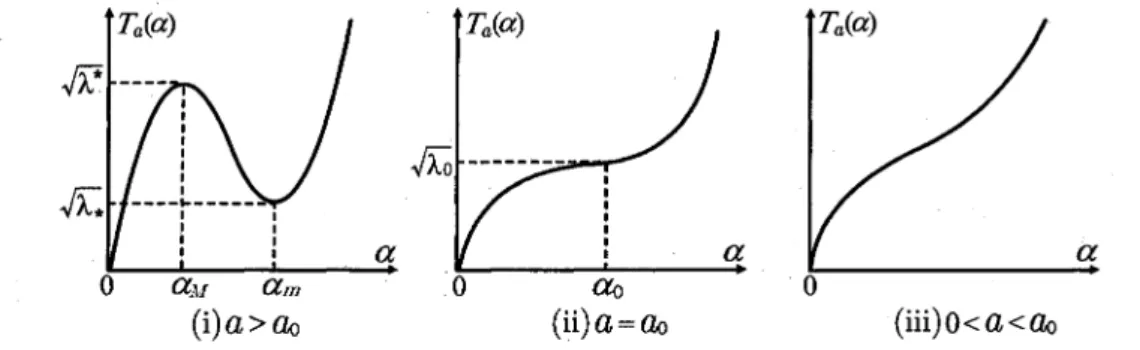
(5) 42. where. F_{a}(u)\displaystyle \equiv\int_{0}^{u}f_{a}(t)dt. So. .. positive. solutions. \Vert u\Vert_{\infty}= $\alpha$. u. of. (1.1) correspond. to. T_{a}( $\alpha$)=\sqrt{ $\lambda$}.. and. (1.1) is equivalent to studying the shape addition, proving that the bifurcation curve S_{a} is ( $\lambda$, \Vert u|\overline{|}_{\infty}) ‐plane is equivalent to proving that T_{a}( $\alpha$) has exactly two critical points, a local maximum and a local minimum, on (0, \infty) We recall that a positive solution u_{ $\lambda$} of (1.1) is degenerate if T_{a}'(\Vert u_{ $\lambda$}\Vert_{\infty}) =0 and is nondegenerate if T_{a}'(\Vert u_{ $\lambda$}\Vert_{\infty})\neq 0. Thus, studying the. of the time map \mathrm{S} ‐shaped on the. exact number of. T_{a}( $\alpha$). (0, \infty). on. ,. positive. cf.. [10].. solutions of. In. .. Figure By. Graphs. 3.1:. Theorem. 1.2,. we see. of. T_{a}( $\alpha$) (=\sqrt{ $\lambda$}). that. T_{a}( $\alpha$). 0<a\leq 4 and T_{a}( $\alpha$) has exactly. is. (0, \infty) for a \geq ã. So by above, to prove it is sufficient to prove that there exists that the following parts (M1), (M2) and For. >. a. on. (0, \infty). with. varying. a>0 , cf.. Figure. 1.1.. strictly increasing and has no critical points on (0, \infty) for points, a local maximum and a local minimum, on Theorem 2.1(i), (ii) and (iii) which solves Conjecture 1,1,. two critical. ,. (M1) (See Figure 3.1(\mathrm{i}). ). (iii)0 <a<a_{0}. (ii) a=a_{0}. (i) a>a_{0}. a. number a_{0} \approx 4.069. on. a_{0} ,. satisfying. 4< a_{0} < ã. 4.107 such. \approx. (M3) hold, respectively: (0, \infty) T_{a}( $\alpha$) ,. has. exactly. two critical. points,. a. 10‐. $\alpha$_{m}(a) (> $\alpha$_{M}(a)) satisfying $\lambda$^{*} \infty, 0, \displaystyle \lim_{ $\alpha$\rightar ow\infty}T_{a}( $\alpha$) T_{a}^{2}($\alpha$_{M}(a)) $\lambda$_{*} T_{a}^{2}($\alpha$_{m}(a)) In addition, \displaystyle \lim_{ $\alpha$\rightar ow 0+}T_{a}( $\alpha$) \displaystyle \lim_{a\rightarrow\infty}$\alpha$_{m}(a)=$\alpha$_{\infty} and \displaystyle \lim_{a\rightarrow\infty}$\alpha$_{M}(a)=\infty where $\alpha$_{\infty} is defined in (1.8). cal maximum at =. some. $\alpha$_{M}(a). and. =. ,. a. local minimum at. some. ,. =. .. =. ,. (M2) (See Figure 3.1(ii).). a_{0}, T_{a_{0} ( $\alpha$) is a strictly increasing function on (0, \infty) and has some $\alpha$_{0} on (0, \infty) Moreover, T_{a_{0} '($\alpha$_{0}) =0 and T_{a_{0} '( $\alpha$) > 0 for point In addition, \displaystyle \lim_{ $\alpha$\rightarrow 0+}T_{a_{0} ( $\alpha$)=0 and \displaystyle \lim_{ $\alpha$\rightar ow\infty}T_{a_{0} ( $\alpha$)=\infty, $\alpha$\in(0, \infty)\backslash \{$\alpha$_{0}\}. exactly. one. For. a. critical. =. at. .. .. (M3) (See Figure 3.1(iii).) For 0 < a < a_{0}, T_{a}( $\alpha$) is a strictly increasing function and has no critical points on (0, \infty) Moreover, T_{a}'( $\alpha$)>0 on (0, \infty) In addition, \displaystyle \lim_{ $\alpha$\rightarrow 0+}T_{a}( $\alpha$)=0 and \displaystyle \lim_{ $\alpha$\rightarrow\infty}T_{a}( $\alpha$)=\infty. .. To prove parts. (\mathrm{M}1)-(\mathrm{M}3). .. ,. we. need the. Lemma 3.1. Consider. (1.1). With a>0. Lemma 3.2. Consider. (1.1). with a>0. .. .. following. Then. Lemmas 3.1−3.3.. \displaystyle \lim_{ $\alpha$\rightar ow_{\backslash }0+}T_{a}( $\alpha$)=0. The set $\Omega$ detined. and. \displaystyle \lim_{ $\alpha$\rightarrow\infty}T_{a}( $\alpha$)=\infty.. by. $\Omega$=\left\{ begin{ar y}{l a>0\cdotT_{a}($\alpha$)has\mathrm{e}\mathrm{x}actl_{\mathrm{J}^r}t_{W}o\mathrm{c}\mathrm{}\mathrm{i}tc\^{a}lpo\mathrm{i}\mathrm{n}ts$\alpha$_{M}(a)<$\alpha$_{m}(a)\ Ol1(0,\infty)alo\mathrm{c}\mathrm{a}l\mathrm{ }\mathrm{a}Xi\mathrm{ }uma\mathrm{n}\mathrm{d}alo\mathrm{c}\mathrm{a}l\mathrm{ }\mathrm{j}ni\mathrm{ }\mathrm{u}\mathrm{ } \end{ar y}\right\}.
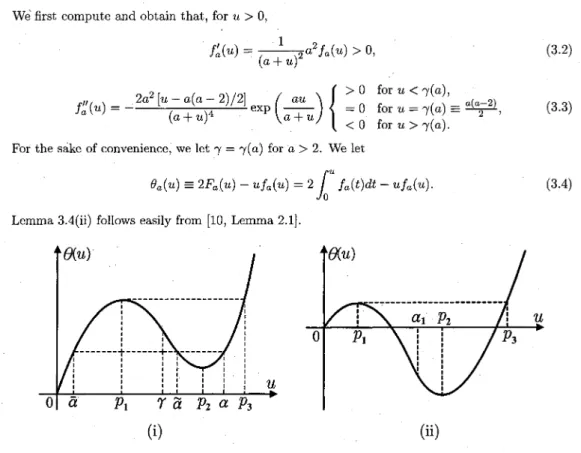
(6) 43. is nonempty, open and connected. where ã is defined in (1.4). Lemma 3.3. Consider. (i). (ii). For. (1.1). with. Moreover, $\Omega$= (a_{0}, \infty). 4<a\leq a_{0}. .. The. for. following. some. number a_{0}. assertions. (i)-(\mathrm{i}i). (\approx 4.069). \in. ( 4, ã). hold:. 4<a<a_{0}, T_{a}'( $\alpha$)>0 for $\alpha$>0.. T_{a_{0} '( $\alpha$). T_{a0}'($\alpha$_{0}). For a=a_{0} , there exists $\alpha$_{0} \in( $\gamma$(a_{0}), $\kappa$(a_{0})) such that =0 and >0 for $\alpha$>0 and $\alpha$\neq$\alpha$_{0} , Where $\kappa$(a_{0}) is defined in Lemma 3.5 stated below. Moreover, 4<a_{0}< ã \approx 4.107.. First of. all, Lemma. 3.1 follows. easily. from. [17,. Theorems 2.6 and. 2.9].. Before. proving. Lemmas. 3.2 and 3.3, we need to investigate some properties of T_{a}( $\alpha$) on (0, \infty) In fact, we apply the next Lemmas 3.5−3.7 and 3.12 to prove Lemma 3.2, and apply Lemma 3.2 and the next Lemmas 3.5−3.7, .. 3.11, 3.14 and 3.16 to prove Lemma Next, we divide this section into. 3.3. three subsections.. 3.1. Basic functions estimates. wè first compute and obtain that, for u>0,. f_{a}'(u)=\displaystyle \frac{1}{(a+u)^{2} a^{2}f_{a}(u)>0. (3.2). ,. f_{a}' (u)=-\displaystyle \frac{2a^{2}[u-a(a-2)/2]}{(a+u)^{4} \exp(\frac{au}{a+u}) \left{begin{ar y}l >0\mathr {f}\mathr {o}\mathr {}u<$\gam $(a),\ =0\mathr {f}\mathr {o}\mathr {}u=$\gam $(a)\equivfrac{(-2)}{ ,\ <0\mathr {f}\mathr {o}\mathr {}u>$\gam $(a). \end{ar y}\ight.. For the sake of. convenience,. we. let. $\gamma$= $\gamma$(a). for a>2. .. We let. $\theta$_{a}(u)\displaystyle \equiv 2F_{a}(u)-uf_{a}(u)=2\int_{0}^{u}f_{a}(t)dt-uf_{a}(u) Lemma. 3.4(ii). follows. easily. from. [10,. Lemma. 3.2:. Graphs. (3.4). .. 2.1].. (i) Figure. (ii) of. $\theta$_{a}(u). on. (3.3). [0, \infty ). (i) $\theta$_{a}(p_{2}(a))\geq 0 (ii) $\theta$_{a}(p_{2}(a)) .. <0..
(7) 44. Lemma 3.4. Consider. (1.1). with a>4. Define. .. positive. numbers. p_{1}(a)\displaystyle \equiv\frac{a(a-2)-a\sqrt{a(a-4)} {2}<p_{2}(a)\equiv\frac{a(a-2)+a\sqrt{a(a-4)} {2}. (3.5). .. Then. 0<p_{1}(a)< $\gamma$(a)=\displaystyle \frac{a(a-2)}{2}<p_{2}(a) and the. assertions. following. (i)-(ii). (3.6). ,. hold:. (i) (See Figure 3.2.) $\theta$_{a}(0)=0, \displaystyle \lim_{u\rightarrow\infty}$\theta$_{a}(u)=\infty. ,. and. $\thea$_{a}'(u)\left\{ begin{ar y}{l >0\mathrm{f}\mathrm{o}\mathrm{}u\in(0,p_{1}(a)\cup( _{2}(a),\infty),\ =0foru\in {p_1}(a),p_{2}(a)\}, <0foru\in(p_{1}(a),p_{2}(a) . \end{ar y}\right. Furthermore, there exists a unique number p3 (a)>p_{2}(a) addition, p_{3}(a)<12 for 4<a\leq\tilde{a}\approx 4.107.. such that. (3.7). $\theta$_{a}(p_{3}(a))=$\theta$_{a}(p_{1}(a)). .. In. (ii) (See Figure 3.2(i). ) For 4<a\displaystyle \leq\frac{417}{100} and $\alpha$\in[ $\gamma$(a) ,p3 (a) ), $\theta$_{a}(u) >0 for u>0 and there exist two numbers \overline{$\alpha$} \in (0,p_{1}(a)) and \tilde{ $\alpha$}\in (p_{1}(a),p_{2}(a)] such that $\theta$_{a}(\overline{ $\alpha$}) =$\theta$_{a}(\tilde{ $\alpha$}) =$\theta$_{a}( $\alpha$) (Notes that we choose \tilde{ $\alpha$}= $\alpha$ if $\alpha$\in[ $\gamma$(a),p_{2}(a)]. ) .. Proof of Lemma 3.4. Since Lemma prove Lemma. 3.4(i).. It is easy to. see. 3.4(ii) follows easily from [10, Lemma 2.1], it is sufficient to (3.6) holds for a>4 Secondly, we compute and observe. that. .. that. $\theta$_{a}'(u) = f_{a}(u)-uf_{a}'(u) =. Then. easily. we. simply. from. [3,. \displaystle\frac{[u^2}-a( 2)u+a^{2}]{(a+u)^{2}f_{a}(u)\left\{ begin{ar y}{l >0\mathrm{f}\mathrm{o}\mathrm{}u\in(0,p_{1}(a)\cup( _{2}(a),\infty),\ =0\mathrm{f}\mathrm{o}\mathrm{}u\in {p_1}(a),p_{2}(a)\}, <0\mathrm{f}\mathrm{o}\mathrm{}u\in(p_{1}(a),p_{2}(a) . \end{ar y}\right.. p_{3}(a)<12 for 4<a\leq\~{a} in part (i) because the remainder parts follow 482, lines 29−30] and [12, p. 228]. Since \tilde{a} (\approx 4.107) <4.108= \displaystyle \frac{1027}{250} by (1.4), it. prove that. p.. is sufficient to prove that p3 (a)<12 for 4<a<. \displaystyle\frac{1027}{250}. .. Clearly,. p_{2}'(a)=\displaystyle \frac{(a-1)\sqrt{a^{2}-4a}+a(a-3)}{\sqrt{a^{2}-4a}}>0 So. we see. (3.8). for a>4. (3.9). .. that. p_{1}(a) <p_{2}(a). <p_{2}. (\displaystyle\frac{1027}{250}) =\displaystyle \frac{3081\sqrt{3081} {1250 0}+\frac{5412 9}{1250 0} (\approx 5.698). <12 for 4<a<. \displayst le\frac{1027}{250}. .. (3.10). We assert that. $\theta$_{a}(12)-$\theta$_{a}(p_{3}(a)) So. by (3.8), p_{3}(a)<12 Next9. we. for 4<a<. prove assertion. (3.11).. \displaystyle\frac{1027}{250}. .. It. >0. implies. for that. 4<a<\displaystyle \frac{1027}{250} p_{3}(a)<12. (3.11). .. for 4 <. a. \leq ã.. We observe that. \displaystyle\frac{$\alpha$^{3}f_{a}($\alpha$)}{(a+$\alpha$)^{2}-\frac{u^{3}f_{a}(u)}{(a+u)^{2}=\int_{u}^{$\alpha$}[\frac{d}{dt}\frac{t^{3}f_{a}(t)}{(a+t)^{2}] dt=\displaystyle \int_{u}^{ $\alpha$}\frac{[t^{2}+a(a+4)t+3a^{2}]t^{2}f_{a}(t)}{(a+t)^{4} dt. .. (3.12).
(8) 45. Since. t^{2}-16t-16. obtain. that, for. 0\leq t\leq 12 and by Lemma 3.4(i), (3.10) and (3.12),. < 0 for. ,. we. 4<a<\displaystyle \frac{1027}{250},. compute and. \displaystyle \frac{\partial}{\partial a}[$\theta$_{a}(12)-$\theta$_{a}(p_{1}(a) ] = \frac{\partial}{\partial a}$\theta$_{a}(12)- \frac{\partial}{\partial a}$\theta$_{a}(u)|_{u=p_{1}(a)} = 2\displaystyle \int_{p_{1}(a)}^{12}\frac{t^{2}f_{a}(t)}{(a+t)^{2} dt+\frac{p_{1}^{3}(a)f_{a}(p_{1}(a) }{[a+p_{1}(a)]^{2} -\frac{(12)^{3}f_{a}(12)}{(a+12)^{2} \displaystyle \int_{p_{1}(a)}^{12}\frac{t^{2}f_{a}(t)}{(a+t)^{4} (t^{2}-a^{2}t-a^{2})dt < \displaystyle \int_{p_{1}(a)}^{12}\frac{t^{2}f_{a}(t)}{(a+t)^{4} (t^{2}-16t-16)dt<0 (since. =. a>4 ). .. So. by (3.4), (3.8). and. (3.10),. we. compute and obtain that, for. (3.13). 4<a<\displaystyle \frac{1027}{250},. $\theta$_{a}(12)-$\theta$_{a}(p_{1}(a)). = \displaystyle \int_{p_{1}(a)}^{12}$\theta$_{a}'(u)du = \displaystyle \int_{\mathrm{P}1(a)}^{12}\frac{[u^{2}-a(a-2)u+a^{2}] {(a+u)^{2} f_{a}(u)du. \displaystyle \geq f_{a}(p_{2}(a) \{\int_{p_{1}(a)}^{p_{2}(a)}\frac{u^{2}-a(a-2)u+a^{2} {(a+u)^{2} du+\int_{p_{2}(a)}^{12}\frac{[u^{2}-a(a-2)u+a^{2}] {(a+u)^{2} du\}. = f_{a}(p_{2}(a) \displaystyle \int_{p_{1}(a)}^{12}\frac{u^{2}-a(a-2)u+a^{2} {(a+t)^{2} du=\frac{f_{a}(p_{2}(a) }{(a+12)[a+p_{1}(a)]}$\Phi$_{a}. (3.14). ,. where. $\Phi$_{a} \equiv [12-p_{1}(a)]\{a^{3}+a^{2}+[12+p_{1}(a)]a+12p_{1}(a)\}. +a^{2}(a+12)[a+p_{1}(a)]\displaystyle \ln(\frac{a+p_{1}(a)}{a+12}) Since. $\Phi$_{\frac{1027}{250}. (\approx 73.2). by (3.13). >0 , and. and. (3.14),. we see. that, for. .. 4<a<\displaystyle \frac{1027}{250},. \displaystyle \overline{250} (p_{1} (\frac{1027}{250}). $\theta$_{a}(12)-$\theta$_{a}(p_{3}(a)) = $\theta$_{a}(12)-$\theta$_{a}(p_{1}(a))\geq$\theta$_{\frac{1027}{250}}(12)-$\theta$_{1027}. \displaystyle\geq\frac{f_\frac{1027}{250}(p_{2}(\frac{1027}{250}) {(\frac{1027}{250}+12)[\frac{1027}{250}+p_{1}(\frac{1027}{250})]$\Phi$_{\frac{1027}{250} >0. So assertion. (3.11). holds. The. Lemma 3.5. Consider. (i). There exists. a. (1.1). proof. of Lemma 3.4 is. with a>4. continuous function. .. Then the. complete.. following. $\kappa$(a)\in( $\gamma$, \infty). of. \blacksquare. assertions. a on. ( 4, \infty). (i)-(ii). hold:. such that. G_{a}(u)\displayst le\ quiv-\int_{0}^{u}t^{2}$\thea$_{a}'(t)d\left\{ begin{ar y}{l >0\mathrm{f}\mathrm{o}\mathrm{}0<u $\kap a$( ),\ =0foru=$\kap a$( ),\ <0foru>g(a). \end{ar y}\right. Furthermore, $\kappa$(a). is. a. strictly increasing function. of a. on. (4,. \displayst le\frac{417}{10 } ]. and. $\kappa$(a). (3.15) <8 for4. <a\displaystyle \leq\frac{417}{100}..
(9) 46. (ii). There exists. a. Furthermore,. strictly decreasing,. $\rho$(a)\in(0, $\kappa$(a) ]. continuous function. H_{a}(u)\displayst le\ quiv\nt_{0}^{u}t$\heta$_{a}'(t)d\left\{ begin{ar y}{l >0\mathrm{f}\mathrm{o}\mathrm{}0<u $\rho$(a),\ =0foru=$\rho$(a),\ <0for $\rho$(a)<u p_{2}(a). \end{ar y}\right. $\gamma$< $\rho$(a)= $\kappa$(a)=p_{2}(a) $\gamma$< $\rho$(a)< $\kappa$(a) <p_{2}(a). for. proof. We prove assertion (i). Clearly, compute and find that, for a>4,. Stepl.. into the next. G_{a}(0)=0. .. =. (3.17). ã,. (3.18). for a=a^{*} ,. p_{1}(a)< $\rho$(a)< $\gamma$< $\kappa$(a) <p_{2}(a) Proof of Lemma 3.5. We divide this. a. (3.16). for \~{a}<a<a^{*} ,. $\gamma$= $\rho$(a) < $\kappa$(a)<p_{2}(a). we. of a\geq\~{a} such that. Steps. Since. (3.19). for a>a^{*}. (3.20). .. 1‐2.. \displaystyle \lim_{u\rightarrow\infty}f_{a}(u)=\exp(a). and. by (3.3),. G_{a}'(u)=- ^{2}$\thea$_{a}'(u)= ^{3}f_{a}'(u)\left\{ begin{ar y}{l >0\mathrm{f}\mathrm{o}\mathrm{}0<u $\gam a$,\ =0\mathrm{f}\mathrm{o}\mathrm{}u=$\gam a$,\ <0\mathrm{f}\mathrm{o}\mathrm{}u>$\gam a$, \end{ar y}\right. \displaystyle \lim_{u\rightar ow\infty}G_{a}(u) = \lim_{u\rightar ow\infty}[\int_{0}^{ $\gamma$}t^{3}f_{a}'(t)dt+\int_{ $\gamma$}^{u}t^{3}f_{a}'(t)dt] <$\gamma$^{3}\lim_{u\rightar ow\infty}\int_{0}^{u}f_{a}'(t)dt = $\gamma$^{3}[\displaystyle \lim_{u\rightar ow\infty}f_{a}'(u)-f_{a}'(0)] =$\gamma$^{3} [\lim_{u\rightar ow\infty}\frac{a^{2}f_{a}(u)}{(a+u)^{2} -f_{a}'(0)] = -$\gamma$^{3}f_{a}'(0)<0.. So for any a>4 , there exists. [ $\kappa$(a)]^{3}f_{a}''( $\kappa$(a))<0. of. a on. ( 4, \infty). .. In. by (3.3), addition, it. a. unique number $\kappa$(a)> $\gamma$ such that (3.15) holds. Since G_{a}'( $\kappa$(a))= by the Implicit Function Theorem, $\kappa$(a) is a continuous function. and. is easy to observe that. $\gamma$'(a)=a-1>0. \displaystyle \frac{\partial}{\partial t}\frac{t^{2}f_{a}(t)}{(a+t)^{3} =\frac{[-t^{2}+(a^{2}+a)t+2a^{2}]tf_{a}(t)}{(a+t)^{5} >0 Thus. 0< $\gamma$(a)< $\gamma$(5)=7.5<8. for. 4<a\displaystyle \leq\frac{417}{100}. .. Then. we. for a>4 , and. for 0\leq t\leq 8 and a>4.. compute that. G_{a}(8) = -\displaystyle \int_{0}^{8}t^{2}$\theta$_{a}' (t)dt=\int_{0}^{8}t^{3}f_{a}' (t)dt=2a^{2}\int_{0}^{8} [\frac{t^{2}f_{a}(t)}{(a+t)^{3} (\frac{ $\gamma$ t- ^{2} {a+t})]dt \displaystyle\leq\frac{2a^{2}$\gam a$^{2}f_{a}($\gam a$)}{(a+$\gam a$)^{3} [\int_{0}^{$\gam a$}(\frac{$\gam a$t- ^{2} {a+t})dt+\int_{$\gam a$}^{8}(\frac{$\gam a$t- ^{2} {a+t})dt] = \displaystyle \frac{2a^{2}$\gam a$^{2}f_{a}( $\gam a$)}{(a+ $\gam a$)^{3} \int_{0}^{8}(\frac{ $\gam a$ t- ^{2} {a+t})dt=\frac{a^{5}$\gam a$^{2}f_{a}( $\gam a$)}{(a+ $\gam a$)^{3} [\frac{8a^{2}-64}{a^{3} +\ln(\frac{a}{a+8})] =\displayst le\frac{ ^5}$\gam a$^{2}f_{a}($\gam a$)}{(a+$\gam a$)^{3}$\Psi$_{a} ,. where. $\Psi$_{a}\equiv. (8a^{2}-64)/a^{3}+\ln(a/(a+8. Since. \displaystyle \frac{d}{da}$\Psi$_{a}=\frac{64(-a^{2}+3a+24)}{a^{4}(a+8)}>0 4<a\displaystyle \leq\frac{417}{10 }, for. (3.21).
(10) 47. we see. that. (\approx-0.03). $\Psi$_{a}\leq$\Psi$_{\frac{417}{100}}. implies $\kappa$(a)<8 In addition, by (3.3), that. for. \displayst le\frac{\partial}{\partial }\mathrm{u}^{3}f_{a}'(u). <0 for 4<a\leq. 4<a\displaystyle \leq\frac{417}{100}. we. So. .. compute and find that, for. by (3.21), G_{a}(8) <0. 4<a\displaystyle \leq\frac{417}{100}. for 4<a\leq. It. and 0\leq u\leq 8,. 0.. =\displaystyle \int_{0}^{ $\kappa$(a_{2})}t^{3}f_{a_{1} ' (t)dt< \displaystyle \int_{0}^{ $\kappa$(a)}2t^{3}f_{a2}' (t)dt=G_{a}2( $\kappa$(a_{2}). \displaystyle\frac{417}{10 },. a\displaystyle \in(4, \frac{417}{100}].. 2. We prove assertion. a(a+\sqrt{a^{2}+4})/2. and a>4. .. (ii). So. \displayst le\frac{417}{10 }. .. Therefore, $\kappa$(a). It is easy to observe that. Clearly, H_{a}(0)=0 By .. Lemma. is. a. strictly increasing. t^{2}-a^{2}t-a^{2}<0. for. (3.23),. we. .. 0\leq t\leq p_{2}(a)<. 3.4(i),. we see. for. 0<u\leq p_{2}(a). and a>4. (3.22). .. that, for a>4,. H_{a}'(u)= $\thea$_{}'(u)\left\{ begin{ar y}{l >0\mathrm{f}\mathrm{o}\mathrm{}u\in(0,p_{1}(a)\cup( _{2}(u),\infty),\ =0\mathrm{f}\mathrm{o}\mathrm{}u\in {p_1}(a),p_{2}(a)\}, <0\mathrm{f}\mathrm{o}\mathrm{}u\in(p_{1}(a),p_{2}(a) . \end{ar y}\right. and. =0 It. function. further observe that. we. \displaystyle \frac{\partial}{\partial a}H_{a}(u)=\int_{0}^{u}(t^{2}-a^{2}t-a^{2})\frac{t^{3}f_{a}(t)}{(a+t)^{4} dt<0. by (3.22). .. \displaystyle \frac{u^{3}af_{a}(u)}{(a+u)^{6} [(-4-2a)u^{3}+(a^{3}+2a^{2}-6a)u^{2}+4a^{3}u+2a^{3}] \displaystyle \geq \frac{u^{3}af_{a}(u)}{(a+u)^{6} [(-4-2\times\frac{417}{100})u^{3}+(4^{3}+2\times 4^{2}-6\times\frac{417}{100})u^{2}+4\times 4^{3}u+2\times 4^{3}] = \displaystyle \frac{u^{3}af_{a}(u)}{50(a+u)^{6} [2u(309u+800)(8-u)+u^{3}+205u^{2}+6400]. So for 4 <a_{1} < a_{2} \leq G_{a_{1}}( $\kappa$(a_{2})) follows that $\kappa$(a_{1}) < $\kappa$(a_{2}) for 4<a_{1} <a_{2} \leq of. So. \displayst le\frac{417}{10 }. =. >. Step. \displayst le\frac{417}{10 }. (3.23). find that. \displaystyle \frac{\partial}{\partial a}H_{a}(p_{2}(a) = \frac{\partial}{\partial a}H_{a}(u)|_{u=p_{2}(a)}+H_{a}'(p_{2}(a) p_{2}'(a)=_{J} \frac{\partial}{\partial a}H_{a}(u)|_{u=p2(a)} <0. (3.24). .. H_{a}(p_{2}(a))=0 for a=\tilde{a} by (1.4), and by (3.24), we observe that H(p_{2}(a)) <0 for a > ã. So by (3.23), there exists a unique number $\rho$(a) \in (p_{1}(a),p_{2}(a) ] such that (3.16) holds. Furthermore, $\rho$(a)=p_{2}(a) for a=\~{a} and p_{1}(a) < $\rho$(a)<p_{2}(a) for a > ã. In addition, by integration by parts, we Since. have. H_{a}(u)=\displaystyle \frac{1}{2}[u^{2}$\theta$_{a}'(u)+G_{a}(u)] By (3.23). and. (3.25). .. (3.25),.. G_{a}($\rho$(a) =-[$\rho$(a)]^{2}$\theta$_{a}'($\rho$(a) \left\{ begin{ar ay}{l =0\mathrm{f}\mathrm{o}\mathrm{r}a=\~{a},\ >0\mathrm{f}\mathrm{o}\mathrm{r}a>\~{a}, \end{ar ay}\right. G_{a}(p_{2}(a) =2H_{a}(p_{2}(a) \left\{ begin{ar ay}{l =0\mathrm{f}\mathrm{o}\mathrm{r}a=\~{a},\ <0\mathrm{f}\mathrm{o}\mathrm{r}a>\~{a}. \end{ar ay}\right. By (3.15), we see that $\rho$(a) =p_{2}(a) $\kappa$(a) for a=\~{a} and $\rho$(a) $\gamma$'(a) >0 for a>4 and by (3:6), (3.22) and (3.23), we find that =. <. $\kappa$(a) <p_{2}(a). for. a. >\~{a}. Since. ,. \displaystyle\frac{\partial}{\partial }H_{a}($\gam a$)= \displaystyle \frac{\partial}{\partial a}H_{a}(u)|_{u= $\gam a$}+H_{a}'( $\gam a$)$\gam a$'(a)< \displaystyle \frac{\partial}{\partial a}H_{a}(u)|_{u= $\gam a$}<0. for a>4. .. (3.26).
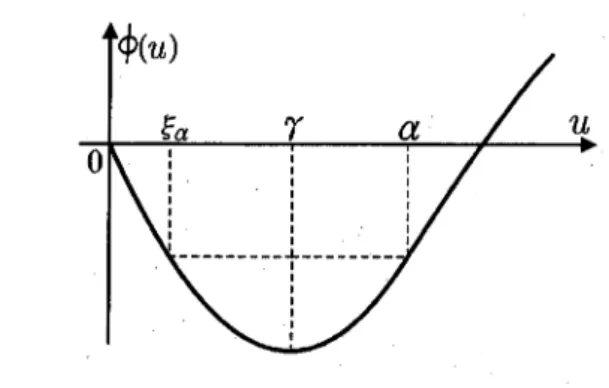
(11) 48. So. we. observe that. H_{a}( $\gamma$). is. $\rho$(a)= $\gamma$. strictly decreasing. a. a^{*}=\displaystyle \inf\{a>4:H_{a}( $\gamma$) <0\}. Thus. .. for a=a^{*} , and. H_{a}( $\gamma$)=0. continuous function of a>4. for a=a^{*} and. H_{a}( $\gamma$)<0. .. By (1.3),. for a>a^{*}. .. we see. that. It follows that. $\rho$(a) < $\gamma$ for a>a^{*} Thus, by above discussion, (3.17)-(3.20) hold. Next, strictly $\rho$(a) decreasing function of a\geq\overline{a} Let numbers a_{2} >a_{1} \geq\overline{a} be given. Then $\rho$(a_{1})\leq p_{2}(a_{1}) <p_{2}(a_{2}) by (3.9). So by (3.22), we observe that H_{a_{2}}( $\rho$(a_{1})) <H_{a_{1}}( $\rho$(a_{1}))=0. It follows that $\rho$(a_{2})< $\rho$(a_{1}) It implies that $\rho$(a) is strictly decreasing for a \geq ã. Finally, the proof of the fact that $\rho$(a) is a continuous function of a\geq\~{a} is omitted. The proof of Lemma 3.5 is complete. \blacksquare we. prove that. is. .. a. .. .. 3.2. Estimates of. For. T_{a}( $\alpha$). (3.1),. in. T_{a} and its derivatives. we. compute that. T_{a}'($\alpha$)=\displaystyle\frac{1}{2\sqrt{2}$\alpha$}\int_{0}^{$\alpha$}\frac{$\theta$_{a}($\alpha$)-$\theta$_{a}(u)}{[F_{a}($\alpha$)-F_{a}(u)]^{3/2}du where. $\theta$_{a}(u). (3.3).. And the. is defined. proof. by (3.4).. Lemma 3.6. Consider. (i). The next Lemma. of next Lemma. (1.1). 3.6(ii). For any fixed. with fixed a>0. $\alpha$>0, T_{a}'( $\alpha$). (1.1). Lemma 3.7. Consider. is. a. .. The. following. increasing. With a>4. T_{a}'($\alpha$)+\displaystyle\frac{2}{$\alpha$}T_{a}^{l}($\alpha$). By (3.27),. T_{a}( $\alpha$). or. .. we. Lemma. 3.2]. and. omit it. hold:. is. strictly increasing. of a>0.. Then for. $\alpha$\geq $\kappa$(a). .. compute that. \displaystyle\frac{1}{2\sqrt{2}$\alpha$^{2} \int_{0}^{$\alpha$}\frac{\frac{3}{2}[$\theta$_{a}($\alpha$)-$\theta$_{a}(u)]^{2}+[F_{a}($\alpha$)-F_{a}(u)][$\phi$_{a}($\alpha$)-$\phi$_{a}(u)]}{[F_{a}($\alpha$)-F_{a}(u)]^{5/2} du. =. $\phi$_{a}(u)\equiv u$\theta$_{a}'(u)-$\theta$_{a}(u) $\phi$_{a}(0)=0. (0, $\gamma$],. we. (i)-(ii). assertions. on. \displaystyle\geq\frac{1}{2\sqrt{2}$\alpha$^{2}\int_{0}^{$\alpha$}\frac{$\phi$_{a}($\alpha$)-$\phi$_{a}(u)}{[F_{a}($\alpha$)-F_{a}(u)]^{3/2}du where. easily from [17,. continuously differentiable function. T_{a}'( $\alpha$)+\displaystyle \frac{2}{ $\alpha$}T_{a}'( $\alpha$)>0 Proof of Lemma 3.7.. follows. is easy but tedious and hence. For any fixed a>4 , either T_{a}( $\alpha$) is strictly and then strictly decreasing on (0, $\gamma$].. (ii). 3.6(i). (3.27). for 0< $\alpha$<\infty ,. see. ,. [12, (3.12)].. We obtain. (3.28). ,. that, by (3.3),. $\phi$_{a}'(u)=$\thea$_{}'(u)=-^{2}f_{a'(u)\left\{ begin{ar y}{l <0\mathrm{f}\mathrm{o}\mathrm{}0<u $\gam a$,\ =0\mathrm{f}\mathrm{o}\mathrm{}u=$\gam a$,\ >0\mathrm{f}\mathrm{o}\mathrm{}u>$\gam a$. \end{ar y}\right.. and. (3.29). $\kappa$(a) > $\gamma$ for a > 4 by Lemma 3.5(i). We fix $\alpha$ \geq $\kappa$(a) If $\phi$_{a}( $\alpha$) \geq 0 by (3.29), $\phi$_{a}( $\alpha$)-$\phi$_{a}(u) >0 for 0<u< $\alpha$ and hence T_{a}' ( $\alpha$)+\displaystyle \frac{2}{ $\alpha$}T_{a}'( $\alpha$) >0 by (3.28). While if $\phi$_{a}( $\alpha$) <0 since $\alpha$\geq $\kappa$(a) > $\gamma$ there exists $\xi$_{ $\alpha$} \in (0, $\gamma$) such that $\phi$_{a}($\xi$_{ $\alpha$}) =$\phi$_{a}( $\alpha$) See Figure 3.3. So by [12, (3.15)] and Lemma 3.5(i),. We note that we see. .. that. ,. ,. ,. ,. .. T_{a}'( $\alpha$)+\displaystyle \frac{2}{ $\alpha$}T_{a}'( $\alpha$)> \frac{-1}{2\sqrt{2}$\alpha$^{2}[F_{a}( $\alpha$)-F_{a}($\xi$_{ $\alpha$})]^{3/2} \int_{0}^{ $\alpha$}u^{3}f_{a}'(u)du\geq 0. The. proof. of Lemma 3.7 is. complete.. \blacksquare.
(12) 49. Figure. 3.3: The. Lemma 3.8. Consider. $\rho$(a)<3. (1.1). graph. of. $\phi$_{a}(u). with a\geq \overline{a}. .. with. Then. for a\geq 6.. Proof of Lemma 3.8. Let $\alpha$\in. [ $\rho$(a),p_{2}(a)]. be. $\phi$_{a}( $\alpha$)<0. T_{a}'( $\alpha$). <. given. By. 0 for. 3.5(ii),. we. obtain that. and. $\alpha$> $\gamma$>$\xi$_{ $\alpha$}>0.. $\rho$(a). \leq. \leq p_{2}(a). $\alpha$. Lemmas 3.4 and. 0<\overline{ $\alpha$}<p_{1}(a) < $\rho$(a)\leq $\alpha$\leq p_{2}(a) Moreover, $\theta$_{a}( $\alpha$)-$\theta$_{a}(u)>0 for 0<u<\overline{ $\alpha$}. and. 3.5(ii),. .. In. we. particular,. observe that. for a\geq\overline{a}.. $\theta$_{a}( $\alpha$)-$\theta$_{a}(u)<0. for \overline{ $\alpha$}<u< $\alpha$. .. Then. by. Lemma. T_{a}'($\alpha$)=\displayst le\frac{1}2\sqrt{2}$\alpha$}\{ int_{0}^{\overline{$\alpha$}\frac{$\theta$_{a}($\alpha$)- \theta$_{a}(u)}{[F_{a}($\alpha$)-F_{a}(u)]^{3/2}du+\int_{$\alpha$}^{$\alpha$}\frac{$\theta$_{a}($\alpha$)- \theta$_{a}(u)}{[F_{a}($\alpha$)-F_{a}(u)\mathrm{J}^{3/2}du\} <\displayst le\frac{1}2\sqrt{2}$\alpha$}\{ int_{0}^{\overline{$\alpha$}\frac{$\thea$_{a}($\alpha$)- \thea$_{a}(u)}{[F_{a}($\alpha$)-F_{a}(\overline{$\alpha$})]^{3/2}du+\int_{$\alpha$}^{$\alpha$}\frac{$\thea$_{a}($\alpha$)- \thea$_{a}(u)}{[F_{a}($\alpha$)-F_{a}(\overline{$\alpha$})]^{3/2}du\} = \displaystyle \frac{1}{2\sqrt{2} $\alpha$[F_{a}( $\alpha$)-F_{a}(\overline{ $\alpha$})]^{3/2} \int_{0}^{ $\alpha$}[$\theta$_{a}( $\alpha$)-$\theta$_{a}(u)]du = \displaystyle \frac{1}{2\sqrt{2} $\alpha$[F_{a}( $\alpha$)-F_{a}(\overline{ $\alpha$})]^{3/2} [ $\alpha \theta$_{a}( $\alpha$)-\int_{0}^{ $\alpha$}$\theta$_{a}(u)du] = \displaystyle \frac{1}{2\sqrt{2}$\alpha$[F_{a}( $\alpha$)-F_{a}(\overline{$\alpha$})]^{\mathrm{s}/2} \int_{0}^{$\alpha$}u$\theta$_{a}'(u)du = \displaystyle \frac{1}{2\sqrt{2} $\alpha$[F_{a}( $\alpha$)-F_{a}(\overline{ $\alpha$})]^{3/2} \int_{0}^{ $\alpha$}[uf_{a}(u)-u^{2}f_{a}'(u)]du<0.. Next,. we. prove that. $\rho$(a)<3. for a\geq 6. .. It is easy to compute and find that. p_{1}'(a)=\displaystyle \frac{(a-1)\sqrt{a^{2}-4a}-a(a-3)}{\sqrt{a^{2}-4a}}<0 So. by (3.9),. we. for a>4. (3.30). .. compute and find that. p_{2}(a)\geq p_{2}(6) (\approx 22.3) >3>p_{1}(6) (\approx 1.6) >p_{1}(a). for a\geq 6. .. (3.31).
(13) 50. By. Lemma. 3.4(i). and. (3.31),. u$\thea$_{}'(u)\left{\begin{ar y}{l >0\mathrm{f}\ athrm{o}\mathrm{}0<up_{1}(a),\ =0\mathrm{f}\ athrm{o}\mathrm{}u=p_{1}(a),\ <0\mathrm{f}\ athrm{o}\mathrm{}p_1}(a)<u3. \end{ar y}\right.. (3.32). We compute that. \displaystyle \int\frac{u(a+u)^{2}-a^{2}u^{2} {(a+u)^{2} du=\frac{u^{2} {2}-a^{2}u+\frac{a^{4} {a+u}+2a^{3}\ln(a+u) By (3.2). and. (3.31)-(3.33). ,. we. .. (3.33). compute and observe that, for a\geq 6,. H_{a}(3) = \displaystyle \int_{0}^{3}u$\theta$_{a}'(u)du=\int_{0}^{p_{1}(a)}u$\theta$_{a}'(u)du+\int_{p_{1}(a)}^{3}u$\theta$_{a}'(u)du. \displaystyle \leq f_{a}(p_{1}(a) [\int_{0}^{p_{1}(a)}\frac{u(a+u)^{2}-a^{2}u^{2} {(a+u)^{2} du+\int_{p_{1}(a)}^{3}\frac{u(a+u)^{2}-a^{2}u^{2} {(a+u)^{2} du]. = f_{a}(p_{1}(a) \displaystyle \int_{0}^{3}\frac{u(a+u)^{2}-a^{2}u^{2} {(a+u)^{2} du=\frac{f_{a}(p_{1}(a) }{8a^{3}(a+3)^{2} $\Lambda$_{a}. (3.34). ,. where. $\Lambda$_{a}\displaystyle \equiv\frac{-12a^{3}-18a^{2}+9a+27}{4a^{3}(a+3)}-\ln(\frac{a}{a+3}). We find that. $\Lambda$_{6}=-\displaystyle \frac{13}{32}-\ln\frac{2}{3} (\approx-7.85\times 10^{-4})<0,. \displaystyle \lim_{a\rightarrow\infty}$\Lambda$_{a}=0. ,. .. and. $\Lambda$'(a)=\displaystyle \frac{27}{4a^{4}(a+3)^{2} (a^{2}-6a-9) \left {\begin{ar y}{l <0\mathr {f}\mathr {o}\mathr {}6\leqa<3+ \sqrt{2},\ =0\mathr {f}\mathr {o}\mathr {}a=3+ \sqrt{2},\ >0\mathr {f}\mathr {o}\mathr {}a>3+ \sqrt{2}. \end{ar y}\ight. So. by (3.34),. which. implies. H_{a}(3)\displaystyle \leq\frac{f_{a}(p_{1}(a) }{8a^{3}(a+3)^{2} $\Lambda$_{a}<0 that. $\rho$(a). Lemma 3.9. Consider. for. a\geq 6,. <3 for a\geq 6 The proof of Lemma 3.8 is .. (1.1). with a>0. .. complete.. \blacksquare. Then. $\alpha$ f_{a}( $\alpha$)-uf_{a}(u)\leq M_{a}(u, $\alpha$)[F_{a}( $\alpha$)-F_{a}(u)]. for. 0\leq u\leq $\alpha$,. where. M_{a}(u, $\alpha$)\equiv satisfies. M_{a}(u, $\alpha$)\displaystyle \leq 1+\frac{a}{4}. for. Proof of Lemma 3.9 Since. \left{bgin{ary}l 1+\neg(a+$\lpha$)^{2}$\alph$&for0\lequ $\alph$\eqa,\ 1+frac{}4&\mathr{f}\mathr{o}\mathr{}0\lequ a<$\lpha$,\ 1+neg(a+u)^{2}&otherwis \end{ary}\ight.. u\geq 0 and $\alpha$\geq 0. we. compute that, for any a>0,. \displaystle\frac{\partil}{\partilu}\frac{^2}u{(a+u)^{2}=\frac{^2}(a-u)}{(a+u)^{3}\left\{ begin{ar y}{l >0\mathrm{i}\mathrm{f}0<u a,\ =0\mathrm{i}\mathrm{f}u=a,\ <0\mathrm{i}\mathrm{f}a>u, \end{ar y}\right.. (3.35).
(14) 51. we see. that. M_{a}(u, $\alpha$)\displaystyle \leq 1+\frac{a^{2}\times a}{(a+a)^{2} =1+\frac{a}{4}. We let. for u\geq 0 and $\alpha$\geq 0.. W_{a}(u, $\alpha$)\equiv M_{a}(u, $\alpha$)[F_{a}( $\alpha$)-F_{a}(u)]-[ $\alpha$ f_{a}( $\alpha$)-uf_{a}(u)] To. complete. the. it is sufficient to prove that. proof,. W_{1}(u, $\alpha$) \geq. for u\geq 0.. 0 for 0 \leq u \leq. $\alpha$. and. a. > 0. We. .. compute and obtain that. \displaystyle\frac{\partial}{\partialu}W_{a}(u, $\alpha$). = [\displaystyle \frac{\partial}{\partial u}M_{a}(u, $\alpha$)] [F_{a}( $\alpha$)-F_{a}(u)]+ [1+\frac{a^{2}u}{(a+u)^{2} -M_{a}(u, $\alpha$)]f_{a}(u). \left{bginary}{l [1+\neg(au)^{2}-M_a(u,$\lpha)]f_{}(u=[\neg- (a^{2}+$\alph a$)]f_{}(u<0\mathr{i}\mathr{f}0\lequ<$\alph eqa,\ {[}1+\neg(au)^{2}-M_a(u,$\lpha)]f_{}(u=[\frac{^2}u(a+)^{2}-\frac{}4]f_a(u)<0\mathr{i}\mathr{f}0\lequ a<$\lpha,(3.6)\ {[}frac\ptial}{\prtialu}M_{(u,$\alph)][F_{a}($\lpha)-F_{}(u)]=\nega^{2}(-u)a+[F_{a}($\lpha)-F_{}(u)]<0\mathr{i}\mathr{f}0<au$\lpha. \end{ary}\ight.. =. W_{a}( $\alpha$, $\alpha$) =0 and by (3.36), we see that W_{a}(u, $\alpha$) \geq 0 complete. \blacksquare The proof of the following Lemma 3.10 is rather lengthy,. Since. for 0\leq u\leq $\alpha$. .. The. proof. of Lemma. 3.9 is. Lemma 3.10. Consider. (1.1). with 4 <. Lemma 3.11. Consider. (1.1). with 4<a<a^{*}. < ã.. a. Then Then. .. and hence it is. [ $\alpha$ T_{a}''( $\alpha$)]'>0. for. [ $\alpha$ T_{a}''( $\alpha$)]'>0. given. in. [11].. $\gamma$(a)\leq $\alpha$\leq $\kappa$(a)= $\eta$(a). for. $\gam a$(a)\leq$\alpha$\leq$\eta$(a)\equiv\left\{ begin{ar y}{l $\kap a$(a)\mathrm{f}\mathrm{o}\mathrm{r}4<a \~{a},\ $\rho$(a)\mathrm{f}\mathrm{o}\mathrm{r}a\geq\~{a}. \end{ar y}\right. Moreover,. one. of the. following. assertions. (\mathrm{a})-(c). (a) T_{a}'( $\alpha$). is. a. (b) T_{a}'( $\alpha$). is. a. strictly decreasing. function of. (c) T_{a}'( $\alpha$). is. a. strictly decreasing. and then. strictly increasing function. of. .. (3.37). holds:. $\alpha$ on. $\alpha$ on. [ $\gamma$(a), $\eta$(a)]. [ $\gamma$(a), $\eta$(a)].. strictly increasing function. of. $\alpha$ on. [ $\gamma$(a), $\eta$(a)].. By [10, Lemma 2.6], we obtain that [ $\alpha$ T_{a}''( $\alpha$)]'>0 for $\gamma$(a) \leq $\alpha$\leq $\rho$(a) By Lemma 3.10, we see that [ $\alpha$ T_{a}' ( $\alpha$)]' > 0 for $\gamma$(a) \leq $\alpha$ \leq $\eta$(a) and 4 < a <\~{a}. So [ $\alpha$ T_{a}' ( $\alpha$)]' > 0 for $\gamma$(a) \leq $\alpha$\leq $\eta$(a) and 4 < a < a^{*} By Lemma 3.5, we see that $\gamma$(a) < $\eta$(a) for 4< a < a^{*} Since $\alpha$ T_{a}' ( $\alpha$) is a strictly increasing function of $\alpha$ \in [ $\gamma$(a), $\eta$(a)] for 4<a<a^{*} we observe that there are three possible cases: Proof of Lemma 3.11.. $\eta$(a). and 4 < \tilde{a}\leq. a. < a^{*}. =. .. .. .. ,. Case 1. T_{a}''( $\alpha$)>0. for. Case 2. T_{a}''( $\alpha$)<0. for $\alpha$\in. Case 3. T_{a}' ( $\alpha$) < 0 for ( $\gamma$(a); $\eta$(a)) .. $\alpha$\in( $\gamma$(a), $\eta$(a)].. $\alpha$. [ $\gamma$(a), $\eta$(a) ).. \in. [ $\gamma$(a). ,. $\alpha$. T_{a}' ( $\alpha$). > 0. for. $\alpha$. \in. ($\alpha$', $\eta$(a) ],. and. T_{a}''($\alpha$'). =. 0 for. some. $\alpha$'. \in.
(15) 52. So if Case 1. (Case. 2 and Case 3. respectively) holds,. then assertion. (a) ((b). and. (c) respectively). holds. The. proof. Remark 1.. of Lemma 3.11 is. By (3.37). complete.. and Lemma. Lemma 3.12. Consider. (1.1). 3.5,. \blacksquare. $\eta$ r\mathrm{e} see. with a>4. .. The. that. $\eta$(a). following. is. a. continuous function of a>4.. (\mathrm{i})-(ii). assertions. hold:. (i). <$\omega$(a)\equiv\left\{ begin{ar ay}{l} 12&\mathrm{i}\mathrm{f}4<a 6,\ 3&i\mathrm{f}a\geq6. \end{ar ay}\right.. $\eta$(a) (ii) \partial T_{a}'( $\alpha$)/\partial a<0. 0< $\alpha$\leq $\omega$(a). for. By (3.9), Lemmas. Proof of Lemma 3.12.. $\eta$(a)=. So. $\eta$(a) < $\omega$(a). ,. .. 3.5 and. 3.8,. we see. that. \left{bginary}{l $\kap ()<812=$\omega$()&\mathr{f}\mathr{o}\mathr{}4<a\~{}, $\rho(a)leqp_{2}(a)<p_{2}(a^*)<12=$\omega$()&\mathr{f}\mathr{o}\mathr{}\~aleq<a^{*},\ $rho(a)\leq$gam $()<\gam $(6)=12$\omega$()&\mathr{f}\mathr{o}\mathr{}^*\leqa<6,\ $rho(a)<3=$\omega$()&\mathr{f}\mathr{o}\mathr{}\geq6. \nd{ary}\ight.. and hence assertion. (i). (3.38). holds.. We compute that. \displaystyle\frac{\partial}{\partiala}T_{a}'($\alpha$)=\frac{1}{2\sqrt{2}$\alpha$}\int_{0}^{a}\frac{N_{a}(u,$\alpha$)}{[F_{a}($\alpha$)-F_{a}(u)]^{3/2} du, where. N_{a}(u, $\alpha$) \displaystyle \equiv [F_{a}( $\alpha$)-F_{a}(u)] [\frac{u^{3}f_{a}(u)}{(a+u)^{2} -\frac{$\alpha$^{3}f_{a}( $\alpha$)}{(a+ $\alpha$)^{2} -\int_{u}^{ $\alpha$}\frac{t^{2}f_{a}(t)}{(a+t)^{2} dt] +\displaystyle \frac{3}{2}[ $\alpha$ f_{a}( $\alpha$)-uf_{a}(u)]\int_{u}^{ $\alpha$}\frac{t^{2}f_{a}(t)}{(a+t)^{2} dt. (3.39). .. By (3.12), (3.39). and Lemma. \displaystyle\frac{N_{a}(u,$\alpha$)}{[$\alpha$f_{a}($\alpha$)-uf_{a}(u)]} Thus,. 3.9,. we. obtain that. \displaystyle \frac{3}{2}\int_{u}^{ $\alpha$}\frac{t^{2}f_{a}(t)}{(a+t)^{2} dt-\frac{1}{M_{a}(u, $\alpha$)}\int_{u}^{ $\alpha$}\frac{[2t^{2}+a(a+6)t+4a^{2}]t^{2}f_{a}(t)}{(a+t)^{4} dt. \leq. \equiv N_{a,1}(u, $\alpha$). to prove assertion. (ii),. (3.40). .. it is sufficient to prove the next parts. (a). For. 4<a<6, N_{a,1}(u, $\alpha$) <0 for 0<u< $\alpha$\leq 12.. (b). For. a\geq 6,. N_{a,1}(u, $\alpha$). (a). and. (b):. <0 for 0<u< $\alpha$\leq 3.. (I) We prove part (a). Assume that 4 < a < 6 By Lemma 3.9, (a+4)/4 for 0\leq u\leq $\alpha$ We compute and find that, for 4<a<6, .. we. have that. M_{a}(u, $\alpha$) \leq. .. (3a-4)12^{2}-2a(a-12)12+a^{2}(3a-20)=-(12-a)[3a^{2}+8(6-a)] <0..
(16) 53. It follows that. (3.40),. we. (3a-4)t^{2}-2a(a-12)t+a^{2}(3a-20). <. 0 for 0\leq t\leq 12 and 4<a<6. .. So. by. that, for 0\leq u< $\alpha$\leq 12 and 4<a<6,. obtain. N_{a,1}(u, $\alpha$) \displaystyle \leq \frac{3}{2}\int_{u}^{ $\alpha$}\frac{t^{2}f_{a}(t)}{(a+t)^{2} dt-\frac{4}{a+4}\int_{u}^{ $\alpha$}\frac{[2t^{2}+a(a+6)t+4a^{2}]t^{2}f_{a}(t)}{(a+t)^{4} dt = \displaystyle \int_{u}^{ $\alpha$}\frac{t^{2}f_{a}(t)}{2(a+4)(a+t)^{4} [(3a-4)t^{2}-2a(a-12)t+a^{2}(3a-20)]dt<0. So part. (II). (a). holds.. We prove part. (b).. Assume that a\geq 6. .. Since a>3\geq $\alpha$>0 and. by. Lemma. 3.9,. we. observe. that. \displaystyle\frac{1}{M_{a}(u,$\alpha$)}=\frac{(a+$\alpha$)^{2} {(a+$\alpha$)^{2}+a^{2}$\alpha$} So. by (3.40),. for 0 〈. 〈. u. $\alpha$.. obtain that. we. N_{a,1}(u, $\alpha$)=\displaystyle \int_{u}^{ $\alpha$}\frac{t^{2}f_{ $\sigma$}(t)}{(a+t)^{2} N_{a,2}(t, $\alpha$)dt. (3.41). ,. where. N_{a,2}(t, $\alpha$)\displaystyle \equiv\frac{3}{2}-\frac{(a+ $\alpha$)^{2} {(a+ $\alpha$)^{2}+a^{2} $\alpha$} [\frac{2t^{2}+a(a+6)t+4a^{2} {(a+t)^{2} ].. We compute and observe. that, for a>6. and. 0\leq t\leq 3,. \displaystyle \frac{\partial}{\partial t}N_{a,2}(t, $\alpha$) = \frac{a(a+ $\alpha$)^{2} {[(a+ $\alpha$)^{2}+a^{2} $\alpha$](a+t)^{3} [(a+2)t-a^{2}+2a] \displaystyle \leq \frac{a(a+ $\alpha$)^{2} {[(a+ $\alpha$)^{2}+a^{2} $\alpha$](a+t)^{3} [(a+2) \times 3-a^{2}+2a] =\displaystyle\frac{a( +$\alpha$)^{2}(a+1)(6-a)}{[(a+$\alpha$)^{2}+a^{2}$\alpha$](a+t)^{3} <0. So. N_{a,2}(t, $\alpha$). is. a. strictly decreasing function of t\in[0 3 ] ,. for a\geq 6. N_{a,2}($\alpha$, $\alpha$)=\displaystyle\frac{($\alpha$-5)a^{2}-6a$\alpha-\alpha$^{2} {2(a+$\alpha$)^{2}+2a^{2}$\alpha$}<0 we see. that either. N_{a,2}(t, $\alpha$)<0 N_{a,2}(t, $\alpha$)=. So. by (3.41),. we. further. either. see. for 0<t\leq $\alpha$ ,. for. .. Since. 0< $\alpha$\leq 3,. or. \left{begin{ary}l >0\mathr{i}\mathr{f}0<tr_{1},\ =0\mathr{i}\mathr{f}t=r_1},\ <0\mathr{i}\mathr{f}_2<t\leq$alph$ \end{ary}\ight.. for. some. r_{1}\in(0, $\alpha$). .. that, for 0<u< $\alpha$\leq 3,. \displaystyle \frac{\partial}{\partial u}N_{a,1}(u, $\alpha$)>0. or. \displaytle\frac{\partil}{\partilu}N_{a,1}(u $\alph$)\left{\begin{ar y}{l <0\mathrm{i}\ athrm{f}0<tr_{1},\ =0\mathrm{i}\ athrm{f}t=r_{1},\ >0\mathrm{i}\ athrm{f}_2<t\leq$\alph$. \end{ar y}\right.. (3.42).
(17) 54. addition, a\geq 6,. since. In. 3$\alpha$^{2}-8 $\alpha$-5. 0 for 0< $\alpha$\leq 3 , and. <. by (3.41),. compute and find that, for. we. \displaystyle\frac{\partial}{\partial$\alpha$}[\frac{2(a+$\alpha$)^{2}+2a^{2}$\alpha$}{(a+$\alpha$)^{2}+3a^{2}$\alpha$}N_{a,1}(0, $\alpha$)]=\frac{$\alpha$^{2}f_{a}($\alpha$)}{[(a+$\alpha$)^{2}+3a^{2}$\alpha$]^{2}(a+$\alpha$)^{2}[(3$\alpha$^{2}-8$\alpha$-5)a^{4} -16($\alpha$^{2}+ $\alpha$)a^{3}-(8 $\alpha$+18)$\alpha$^{2}a^{2}-8$\alpha$^{3}a-$\alpha$^{4}]. 0.. <. It follows that. \displaystyle\frac{2(a+$\alpha$)^{2}+2a^{2}$\alpha$}{(a+$\alpha$)^{2}+3a^{2}$\alpha$}N_{a,1}(0, $\alpha$)< \displaystyle\frac{2(a+$\alpha$)^{2}+2a^{2}$\alpha$}{(a+$\alpha$)^{2}+3a^{2}$\alpha$}N_{a,1}(0, $\alpha$)_{$\alpha$=0}=0 Thus, N_{a,1}(0, $\alpha$). <. 0 for 0 <. $\alpha$. \leq 3. .. Clearly, N_{a,1}( $\alpha$, $\alpha$). =. 0. So. .. 0\leq u<a and 0< $\alpha$\leq 3 So part (b) holds. The proof of Lemma 3.12 is complete. \blacksquare. for 0< $\alpha$\leq 3.. by (3.42), N_{a,1}(u, $\alpha$). <. 0 for. .. 3.3. Statements and. Lemma 3.13. Consider. (i) T_{a}( $\alpha$) (ii) T_{a}( $\alpha$). is. a. has. of main lemmas. proofs. (1.1). With fixed a>4 Either .. strictly increasing function. exactly. one. on. (0, \infty). local maximum and. local maximum and. local minimum. a. on. (i) (0, \infty). of the. following assertions (i)-(ii) holds:. .. exactly. Proof of Lemma 3.13. Assume that assertion a. one. one. local minimum. does not hold. Then. by. on. (0, \infty). Lemma. .. 3.1, T_{a}( $\alpha$) has. .. T_{a}( $\alpha$) has two local maxima at some $\alpha$_{M_{1} < $\alpha$_{M_{2} Then there exists $\alpha$_{m} \in T_{a}($\alpha$_{m}) is a local minimum value. If 4 < a < ã, and by Lemmas 3.5(ii) and 3.6−3.8, we observe that $\gamma$(a)\leq$\alpha$_{m}<$\alpha$_{M_{2}} < $\kappa$(a)= $\eta$(a) It is a contradiction by Lemma 3.11. If \~{a}\leq a<a^{*} and by Lemmas 3.5(ii) and 3.6−3.8, we observe that $\gamma$(a)\leq$\alpha$_{m}<$\alpha$_{M_{2}} < $\rho$(a)= $\eta$(a) It is a contradiction by Lemma 3.11. If a\geq a^{*} and by Lemmas 3.5(ii), 3.7 and 3.8 we observe that $\alpha$_{m}<$\alpha$_{M_{2}} \leq $\gamma$(a) It is a contradiction by Lemma 3.6(i). So by above discussions, T_{a}( $\alpha$) has exactly one local maximum on (0, \infty) In addition, if T_{a}( $\alpha$) has two local minima at some $\alpha$_{m_{1} <$\alpha$_{m}2 then by Lemma 3.1, T_{a}( $\alpha$) has two local maxima at some $\alpha$_{M_{1} \in (0, $\alpha$_{m_{1}}) and $\alpha$_{M_{2} \in ($\alpha$_{m_{1} , $\alpha$_{m}2) It is a contradiction. So T_{a}( $\alpha$) has exactly one local minimum on (0, \infty) Assume that. ($\alpha$_{M_{1} , $\alpha$_{M_{2} ). .. such that. .. .. ,. ,. ,. .. .. ,. .. .. The. proof. of Lemma 3.13 is. Lemma 3.14. Consider. (i) T_{a}( $\alpha$) is (0, \infty). a. (1.1). \blacksquare. complete.. With a>4 Either .. strictly increasing. function. on. one. (0, \infty). of the and. following. T_{a}( $\alpha$). two assertions holds:. has at most oñe critical. point. on. .. (ii) T_{a}( $\alpha$) some. has. exactly. two critical. $\alpha$_{m}>$\alpha$_{M} oii. Proof of Lemma 3.14.. (a) T_{a}( $\alpha$). is. a. (0, \infty) By. points,. a. local maximum at. some. $\alpha$_{M} and. a. local minimum at. .. Lemma. strictly increasing. 3.13,. function. either on. of the. one. (0, \infty). .. following. two cases holds:.
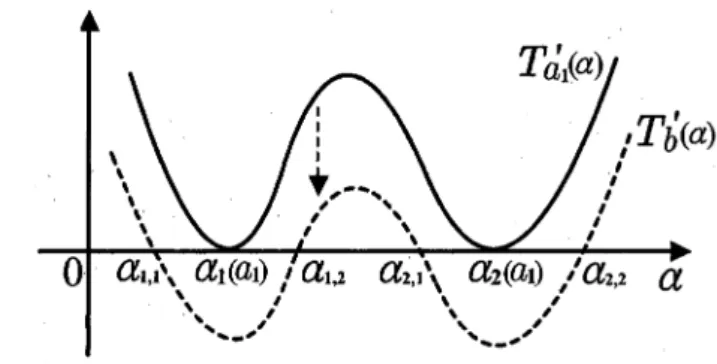
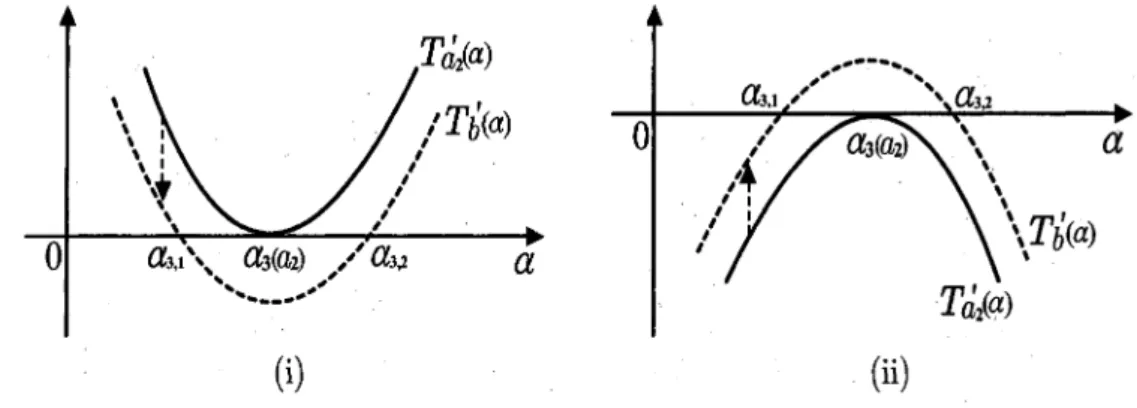
(18) 55. Figure. 3.4:. Graphs. (b) T_{a}( $\alpha$) has exactly one $\alpha$_{m} (>$\alpha$_{M}) on (0, \infty). T_{a_{1} '( $\alpha$). of. T_{b}' ( $\alpha$). and. local maximum at. with b<a_{1}. $\alpha$_{M} and. some. sufficiently. exactly. one. close to a_{1}.. local minimum at. some. .. (I). We prove assertion. points $\alpha$_{1}(a_{1}) <$\alpha$_{2}(a_{1}). on. (i) under Case (a). We (0, \infty) We obtain that. fix a_{1} >4. .. Assume that. T_{a_{1} ' ( $\alpha$_{1} (ai)) =T_{a_{1}}' ( $\alpha$_{2} (ai)) =T_{a_{1}}'' ( $\alpha$_{1} (a1)) =T_{a_{1}}'' ( $\alpha$_{2} (a1)) So. by. Lemmas 3.7 and. continuities of. 3.8,. $\eta$(a) $\omega$(a). we. and. ,. observe that. p_{2}(a). ,. we. b\in(a_{1}- $\delta$, a_{1}). be. has two critical. given. By. =0. (3.43). .. 0<$\alpha$_{1}(a_{1}) <$\alpha$_{2}(a_{1}) < $\eta$(a_{1}) < $\omega$(a_{1}) By (3.38) .. and. observe that. 0<$\alpha$_{1}(a_{1}) <$\alpha$_{2}(a_{1})< Let. T_{a_{1} ( $\alpha$). .. Lemma. \displaystyle \min a\in[a_{1}- $\delta$,a_{1}]. 3.12, (3.43). T_{b}'($\alpha$_{1}(a_{1}))<T_{a_{1}}'($\alpha$_{1}(a_{1}))=0. and. \{ $\omega$(a)\} and. for. (3.44),. some. $\delta$>0. (3.44). .. observe that. we. T_{b}'($\alpha$_{2}(a_{1}))<T_{a_{1}}'($\alpha$_{2}(a_{1}))=0. (3.45). .. addition, we assume that there exists an open interval I such that T_{a}'( $\alpha$)\equiv 0 on I It implies that T_{a}''( $\alpha$)=T_{a}'' ( $\alpha$) =0 on I It is a contradiction by Lemmas 3.6−3.8 and 3.11. So there exist three numbers $\beta$_{1} \in ( 0, $\alpha$_{1} (a1)), $\beta$_{2}\in ( $\alpha$_{1} (a1), $\alpha$_{2}(a_{1}) ) and $\beta$_{3} \in($\alpha$_{2}(a_{1}), $\eta$(a_{1})) such that T_{a_{1} '($\beta$_{i}) >0 for i=1 2, 3. So by Lemma 3.6(ii) and (3.45), we choose b<a_{1} sufficiently close to a_{1} such that T_{b}'( $\alpha$) In. .. .. ,. has four. positive. zeros. $\alpha$_{1,1}, $\alpha$_{1,2}, $\alpha$_{2,1}, $\alpha$_{2,2}. satisfying. $\alpha$_{1,1} <$\alpha$_{1}(a_{1})<$\alpha$_{1,2}<$\alpha$_{2,1} <$\alpha$_{2}(a_{1})<$\alpha$_{2,2}. See. Figure 3.4. Furthermore, T_{b}($\alpha$_{1,1}) and T_{b}($\alpha$_{2,1}). T_{b}($\alpha$_{2_{:}2}). are. local minimum values. It is. (a). (II) We prove assertion (ii) under point $\alpha$_{3}(a_{2}) on (0, \infty) distinct from. a. are. contradiction. local maximum. by. values, and T_{b}($\alpha$_{1,2}) and Therefore, assertion (i). Lemma 3.13.. holds under Case. ,. By. Lemmas 3.7 and. 3.8,. we. Case. obtain that. 0<$\alpha$_{3}(a_{2})<. (b).. We fix a_{2} >4 Assume that T_{a_{2} ( $\alpha$) has a critical It follows that T_{a_{2} ' ( $\alpha$_{3} (a2)) =T_{a_{2}}''($\alpha$_{3}(a_{2}))=0.. $\alpha$_{M} and $\alpha$_{m}. .. .. 0<$\alpha$_{3}(a_{2})< $\eta$(a_{2})< $\omega$(a_{2}) Similarly, .. \displaystyle \min. a\in[a- $\delta$,a+ $\delta$]. \{ $\omega$(a)\}. for. some. $\delta$>0.. we. have that.
(19) 56. So. by. Lemma. Similarly, by. T_{b}( $\alpha$) $\alpha$_{rn}. .. 3.12,. we. Lemma. observe that. T_{b}'($\alpha$_{3}(a_{2})) <T_{a_{2}}' ( $\alpha$_{3} (a2)). =0 for a_{2}- $\delta$<b<a_{2} ,. T_{b}'($\alpha$_{3}(a_{2})) >T_{a_{2}}' ( $\alpha$_{3} (a2)). =0. 3.6(ii), (3.46). (3.47),. and. for. a_{2}<b<a_{2}+ $\delta$. there exists. b>0. (3.46) (3.47). .. suflirciently. close to a_{2} such that. has two local extrema at $\alpha$_{3,1} \in(0, $\alpha$_{3}(a_{2})) and $\alpha$ 3,2\in( $\alpha$ 3(a_{2}), $\eta$(a_{2})) , distinct from $\alpha$_{M} and See Figure 3.5. It is a contradiction by Lemma 3.13. Therefore, assertion (ii) holds under. (i) Figure. 3.5: Local. (ii) of. graphs. T_{a_{2} '( $\alpha$). and. T_{b}'( $\alpha$). for. $\alpha$ near. (i) T_{a_{2} ' ( $\alpha$_{3} (a2)) \geq 0 (ii) T_{a_{2} ' ( $\alpha$_{3} (a2)) \leq 0.. $\alpha$_{3}(a_{2}). ànd b>0. sufficiently. close to a_{2}.. .. Case. (b). proof. The. We. are. in. of Lemma 3.14 is a. position. Proof of Lemma 3.2.. complete.. \blacksquare. to prove Lemma 3.2. By Theorem. by applying Lemmas 3.5(i), 3.6(ii), 3.14, we obtain that. $\Omega$=\left{\begin{ar y}{l a>0:T_{a}($\lpha$)\mathr{}\mathr{a}\mthr{s}\mathr{e}\mathr{x}\mathr{a}\mthr{c}\mathr{}\mathr{l}\mathr{y}\mathr{}\mathr{w}\mathr{o}\mathr{c}\mathr{}\mathr{i}\mathr{}\mathr{i}\mathr{c}\mathr{a}\mthr{l}\mathr{p}\mathr{o}\mathr{i}\mathr{n}\mathr{}\mathr{s}\ mathr{o}\mathr{n}(0,\infty)\mathr{a}\mthr{l}\mathr{o}\mathr{c}\mathr{a}\mthr{l}\max thrm{i}\athrm{}\mathr{u}\mathr{m}\athrm{a}\ thrm{n}\athrm{d}\athrm{a}\ thrm{l}\athrm{o}\athrm{c}\athrm{a}\ thrm{l}\in mathr{i}\mathr{m}\athrm{u}\athrm{} \end{ar y}\ight} =. 3.7 and 3.12.. 1.2 and Lemma. { a>4:T_{a}'( $\alpha$)<0. for. some. $\alpha$\in(0, \infty) }.. (3.48). (I) It is obvious that $\Omega$ is nonempty because [ã, \infty ) \subset $\Omega$ by [12, Theorem 2.2] and Lemma 3.14. (II) We show that $\Omega$ is open. If b\in $\Omega$ then T_{b}'( $\beta$) <0\mathrm{f}\mathrm{o} $\iota$ some $\beta$\in(0, \infty) By Lemma 3.6(ii), we observe that T_{a}'( $\beta$)<0 for a belonging to some open neighborhood of b So $\Omega$ is open. (III) We then show that $\Omega$ is connected. First, we see that [ã, \infty ) \subset $\Omega$ by [12, Theorem 2.2(\mathrm{i}) ]. Suppose to the contrary that the set $\Omega$\cap(4 ã] is not connected, then there exist positive numbers a_{1} and a_{2} satisfying 4<a_{1} < a_{2} <\~{a} such that a_{1} \in $\Omega$ and a_{2} \not\in $\Omega$ Hence T_{a}'2( $\alpha$) \geq 0 on (0, \infty) by Lemma 3.14 and (3.48). Since ã (\approx 4.166) < \displayst le\frac{417}{10 } by (1.4), and by Lemma 3.5(i), we have that $\kappa$(a_{1}) < $\kappa$(a_{2}) <8 So by Lemma 3.12, .. ,. .. ,. .. .. T_{a_{1}}'( $\alpha$)>T_{a_{2}}'( $\alpha$)\geq 0 Since a_{1} \in $\Omega$\cap ( 4, T_{a_{1} ' ($\alpha$_{1}) \leq 0 It is .. connect.. ã) a. and. for all. by (3.49), there exists a by Lemma 3.7.. contradiction. $\alpha$\in(0, $\kappa$(a_{1}))\subseteq(0, $\kappa$(a_{2})). .. (3.49). \geq $\kappa$(a_{1}) such that T_{a_{1} '($\alpha$_{1}) =0 $\Omega$\cap(4,\overline{a}] is connected. It implies that. number $\alpha$_{1}. and. So. $\Omega$ is.
(20) 57. (IV). Since $\Omega$ is open and connect and [ã, \infty ) \subset $\Omega$ , there exists a_{0} Moreover, by numerical simulation, we find that a_{0}\approx 4.069. The proof of Lemma 3.2 is complete. \blacksquare In addition to we. T_{a}( $\alpha$). with 0<a<\infty defined in. define two time‐map functions. T_{0}( $\alpha$). and. (3.1). T_{\infty}( $\alpha$). for. to. \in(4, \overline{a}). problem (1.1). such that. with. f_{a}(u)=\displaystyle \exp(\frac{au}{a+\mathrm{u} ). nonlinearities. corresponding. $\Omega$=(a0, \infty). f_{0}(u)\equiv 1. .. ,. and. f_{\infty}(u)=\exp u by. T_{0}( $\alpha$)\displaystyle \equiv\frac{1}{\sqrt{2} \int_{0}^{ $\alpha$}\frac{1}{\sqrt{ $\alpha$-u} du=\sqrt{2 $\alpha$} T_{\infty}( $\alpha$)\displaystyle \equiv\frac{1}{\sqrt{2} \int_{0}^{ $\alpha$}\frac{1}{\sqrt{e^{ $\alpha$}-e^{u} du=\frac{1}{\sqrt{2e^{ $\alpha$} \ln(2e^{ $\alpha$}-1+2\sqrt{e^{ $\alpha$}(e^{ $\alpha$}-1)}. (3.50). for $\alpha$>0 ,. (3.1) and (1.6). The following Lemma 3.15(i) determines the shape of T_{\infty}( $\alpha$) on 3.15(ii) is a basic comparison theorem for the time map formula T_{0}, T_{a} and is is a 3.15(i) obvious, cf, Theorem 1.3. In addition, for fixed u>0 since. respectively,. (0, \infty). ,. (3.51). for $\alpha$>0 ,. see. and Lemma. T_{\infty} Lemma .. \displaystyle \exp(\frac{au}{a+u}). ,. strictly increasing. function of a>0 ,. we. obtain that. f_{0}(u)=1<f_{a}(u)=\displaystyle \exp(\frac{au}{a+u}) =\displaystyle \exp(\frac{u}{1+\frac{u}{a} ) <\exp u=f_{\infty}(u) Thus Lemma. 3.15(ii). follows. by. modification of the. proofs. of. [17,. Theorems. for a>0.. 2.3−2.4];. we. omit the. proof. Lemma 3.15. Consider. \displaystyle\ln(\frac{2+$\lambda$}{$\lambda$_{\inftyhold: }) 1.187. (3.1), (3.50) and (3.51). Let $\lambda$_{\infty} \approx 0.878 and $\alpha$_{\infty} (1.7) and (1.8), respectively. The following assertions (\mathrm{i})-(ii) =. be two numbers defined in. (i) \displaystyle \lim_{ $\alpha$\rightarrow 0+}T_{\infty}( $\alpha$)=\lim_{ $\alpha$\rightarrow\infty}T_{\infty}( $\alpha$)=0 T_{\infty}'( $\alpha$)<0 on ($\alpha$_{\infty}, \infty). In. .. âdditioxi, T_{\infty}'( $\alpha$) >0. on. \approx. (0, $\alpha$_{\infty}) T_{\infty}'($\alpha$_{\infty})=0 ,. and. .. (ii). For any fixed. $\alpha$. >0 such that. T_{a}( $\alpha$). is. a. continuous, strictly decreasing function of. a. > 0.. Moreover,. \displaystyle \sqrt{2 $\alpha$}=T_{0}( $\alpha$)=\lim_{a\rightar ow 0+}T_{a}( $\alpha$)>T_{a}( $\alpha$) >\displaystyle \lim_{a\rightar ow\infty}T_{a}( $\alpha$)=T_{\infty}( $\alpha$) Throughout. this paper, for. a. maximum and the local minimum. for a>0 and a>0.. a_{0} by Lemma 3.2, let $\alpha$_{M}(a) and $\alpha$_{m}(a) denote the local points of T_{a}( $\alpha$) on (0, \infty) where $\alpha$_{M} < $\alpha$_{m} respectively. See. >. ,. ,. Figure 3.1(i). Lemma 3.16. Consider. (i) $\alpha$_{M}(a). is. (1.1). with a>a_{0}. strictly decreasing. a. .. Then the. following. assertions. and continuous function of a>a_{0}. .. (i)-(iii). hold:. Ftirthermore, $\alpha$_{M}(a) < $\omega$(a). for a>a_{0}.. (ii) $\alpha$_{m}(a) on (a_{0} (iii). is ,. a. continuous function of a>a_{0}. ã ] and. p_{2}(a) \leq$\alpha$_{m}(a). .. Ftirthermore, $\alpha$_{m}(a). is. a. strictly increasing function. for a\geq\overline{a}.. For a>a_{0},. $\alpha$_{\infty}=\displaystyle \lim_{a\rightar ow\infty}$\alpha$_{M}(a)<$\alpha$_{M}(a) <\lim_{a\rightar ow a_{0}^{+} $\alpha$_{M}(a)=\lim_{a\rightar ow a_{0}^{+} $\alpha$_{m}(a) <$\alpha$_{m}(a)<\lim_{a\rightar ow\infty}$\alpha$_{m}(a)=\infty..
(21) 58. Proof of Lemma 3.16. We divide this. proof. \mathrm{f}a_{0} 6) and and Uy Lemmas 3.7, 3.8 and 3.12, a. both. on. ,. Steps. into next. $\alpha$_{M}(\mathfrak{a})< $\omega$(a) for a>a_{0} [6, \infty ). Let a_{1} >a_{0} be given.. 1. We prove that. Step. ,. and. 1‐6.. $\alpha$_{M}(a). Since. is. strictly decreasing function of =0 and T_{a1}''($\alpha$_{M}(a_{1})) \leq 0,. a. T_{a_{1}}'($\alpha$_{M}(a_{1})). we observe that $\alpha$_{M}(a_{1}) < $\eta$(a_{1}) < $\omega$(a_{1}) Then we see that $\alpha$ M(a_{1}) < $\omega$(a_{1}) = $\omega$(a_{2}) for either a_{0} <a_{1} <a2 <6 or 6\leq a_{1} <a_{2} So by Lemma 3.12, we see that T_{a}'2 ( $\alpha$_{M} (al)) <T_{a_{1}}'($\alpha$_{M}(a_{1})) =0 for either a_{0} <a_{1} <a_{2} <6 or 6\leq a_{1} <a_{2} So by Lemma 3.14, $\alpha$_{M}(a_{2}) < $\alpha$_{M}(a_{1}) for either a_{0} < a_{1} < a_{2} < 6 or 6 \leq a_{1} < a_{2} Thus, $\alpha$_{M}(a) is a strictly decreasing function both on (a_{0},6) and [6, \infty ). Step 2. We prove that $\alpha$_{m}(a) is a strictly increasing function of a on (a_{0} ã]. By Lemma 3.4(i), we see that $\theta$_{a}( $\alpha$) >$\theta$_{a}(u) for 0 <u< $\alpha$ and $\alpha$>p_{3}(a) It follows that T_{a}'( $\alpha$) > 0 for $\alpha$ >p_{3}(a) So by (3.27). by Lemma 3.4(i), we further see that $\alpha$_{m}(a) \leq p_{3}(a) < 12 = $\omega$(a) for a \in (a_{0}, a .. .. .. .. ,. .. Assume that a0 <a_{1} <a_{2}\leq\overline{a}. By. .. $\alpha$_{m}(a_{1}) <$\alpha$_{m}(a_{2}) by. It follows that. Lemma. 3.12,. we. Lemma 3.14.. (a_{0} ã].. observe that. Thus, $\alpha$_{m}(a). is. T_{a}'2($\alpha$_{m}(a_{1})) <T_{a_{1}}'($\alpha$_{m}(a_{1}))=0. stric. a. ly increasing. function. on. ,. Step. 3. We prove that. \displaystyle \lim_{a\rightar ow a_{0}^{+} $\alpha$_{M}(a)\leq\lim_{a\rightar ow a_{0}^{+} $\alpha$_{m}(a). $\alpha$_{\infty}=\displaystyle \lim_{a\rightar ow\infty}$\alpha$_{M}(a)<$\alpha$_{M}(a). and. <\displaystyle \lim_{a\rightar ow a_{0}^{+} $\alpha$_{M}(a)\leq$\alpha$_{m}(a). for a>a_{0}. (3.52). .. $\alpha$_{M}(a) < $\omega$(a) \leq 12 for a > a_{0} and by Step 1, we see that \displaystyle \lim_{a\rightar ow a_{0}^{+} $\alpha$_{M}(a) \displaystyle \lim_{a\rightar ow\infty}$\alpha$_{M}(a) both exist. Suppose to the contrary that \displaystyle \lim_{a\rightar ow\infty}$\alpha$_{M}(a)\neq$\alpha$_{\infty} Then we have cases. Case 1: \displaystyle \lim_{a\rightarrow\infty}$\alpha$_{M}(a)<$\alpha$_{\infty} and Case 2: \displaystyle \lim_{a\rightarrow\infty}$\alpha$_{M}(a)>$\alpha$_{\infty}. Assume that Case 1 holds. Then $\alpha$_{M}(a_{1}) <$\alpha$_{\infty} for some a_{1} >6 by Step 1. We let Since 0 <. ,. .. and two. $\delta$\displaystyle \equiv\frac{1}{2}\min\{$\alpha$_{\infty}-$\alpha$_{M}(\mathrm{a}1), $\alpha$_{m}(a_{1})-$\alpha$_{M}(\mathrm{a}1)\}. Clearly, 6>0. We let $\alpha$\in. .. ( $\alpha$_{M} (a1), $\alpha$_{M}(a_{1})+ $\delta$). be. given.. Then. $\alpha$_{M}(a_{1})< $\alpha$<$\alpha$_{M}(a_{1})+ $\delta$<$\alpha$_{m}(a_{1}). ,. $\alpha$_{M}(a_{1})< $\alpha$<$\alpha$_{M}(a_{1})+ $\delta$<$\alpha$_{\infty} (\approx 1.187) < $\omega$(a) So. by Lemma 3.15, 3.12, we find that. we. have that. T_{a_{1} '( $\alpha$). < 0 and. T_{\infty}'( $\alpha$). >. 0. .. for a>a_{1}. Then. (3.53). .. by (3.53), Lemmas. 3.6 and. 0<T_{\infty}'( $\alpha$)=\displaystyle \lim_{a\rightar ow\infty}T_{a}'( $\alpha$) <T_{a_{1} '( $\alpha$)<0, which is. a. contradiction.. Assume that Case 2 holds. We let. $\beta$\in ($\alpha$_{\infty}, \displaystyle \lim_{a\rightar ow\infty^{ $\alpha$}M}(a). T_{a}'( $\beta$) > 0 and T_{\infty}'( $\beta$) 0>T_{\infty}'( $\beta$)=\displaystyle \lim_{a\rightarrow\infty}T_{a}'( $\beta$)\geq 0 which is a 3.15,. we. see. that. ,. Thus, by. 3.4(i), 0< $\alpha$\leq p_{1}(a) we see. and. by. above. discussions,. 0 for. a. >. 6. .. be. given. By Step. So by Lemma. 1 and Lemma. 3.6(ii). we. find that. contradiction.. In addition, by Lemma $\alpha$_{\infty} \mathrm{h}\mathrm{m}_{a\rightar ow\infty}$\alpha$_{M}(a) It follows that T_{a}'( $\alpha$) >0 for and a>4 <u< $\alpha$\leq p_{1}(a) $\alpha$_{M}(a) >p_{1}(a) for a>a_{0} Since a_{0} <4.08 by Lemma 3.2,. obtain that. for 0. and a>4. Lemma. we. $\theta$_{a}( $\alpha$) >$\theta$_{a}(u) by (3.27). So 3.15 and (3.30), we observe. that. <. =. .. .. .. that. \displaystyle \lim_{a\rightar ow a_{0}^{+} $\alpha$_{M}(a)\geq p_{1}(a_{0})\geq p_{1}(4.08)=\frac{2652}{625}-\frac{102}{625}\sqrt{51} (\ap rox 3.078)>$\omega$_{6}>$\alpha$_{M}(6) \displaystyle \lim_{a\rightar ow 6-}$\alpha$_{M}(a) \geq p_{1}(6)=12-6\sqrt{3} , (\approx 1.608) >$\alpha$_{\infty} (\approx 1.187). .. ,. (3.54) (3.55).
(22) 59. Since. \displaystyle \lim_{a\rightarrow\infty}$\alpha$_{M}(a)=$\alpha$_{\infty}. ,. and by. Step 1, (3.54). and. (3.55),. we. further observe that. $\alpha$_{\infty}=\displaystyle \lim_{a\rightar ow\infty}$\alpha$_{M}(a)<$\alpha$_{M}(a) <\lim_{a\rightar ow a_{0}^{+} $\alpha$_{M}(a) \mathrm{f}\mathrm{o} $\iota$ a>a_{0}. Next, that. prove that. we. $\alpha$_{M}(a)\leq $\eta$(a). \displaystyle \lim_{a\rightar ow a_{0}^{+} $\alpha$_{M}(a). for a>a_{0}. .. \leq. by (3.9). So. $\alpha$_{m}(a). for. a. > a_{0}. By Lemmas 3.7 and 3.8,. .. and Lemmas 3.5 and. 3.8,. we. for. \displaystyle \lim_{a\rightar ow a_{0}^{+} $\alpha$_{M}(a)\leq $\eta$(a_{0})= $\kappa$(a_{0})\leq $\kappa$(\overline{a})=p_{2}(\tilde{a})<p_{2}(a)<$\alpha$_{m}(a) Assume that there exists a_{2} \in. a_{3}\in(a_{0}, a_{2}) Lemma. we. a. ,. observe that. contradiction. So. by (3.56), \mathrm{h}\mathrm{m}_{a\rightar ow a_{0} $\alpha$_{M}(a) \leq$\alpha$_{m}(a). tion, by Step 2 and (3.52), we Step 4. We prove that $\alpha$_{M}. see. that. \displaystyle \lim_{a\rightar ow a_{0}^{+} $\alpha$_{m}(a). (a_{0}, \infty)\rightarrow. :. $\alpha$_{m}:(a_{0}, \infty)\rightarrow. for a>a_{0} So .. exists and. ($\alpha$_{\infty},\displayst le\lim_{a\rightarowa_{0}^{+}$\alpha$_{M}(a) (\displaystyle\lim_{a\rightar owa_{0}^{+}$\alpha$_{m}(a),\infty). is. is. =0,. ,. [6, \infty). .. To prove assertion. (i),. it is sufficient to. $\alpha$_{M}(6)_{\backslash }\displaystyle \geq\lim_{a\rightar ow 6-}$\alpha$_{M}(a) Suppose exists $\delta$>0 such that $\alpha$_{M}(6)>$\alpha$_{M}(a). tbat. see. there. .. to. (3.52). holds. In addi‐. \displaystyle \lim_{a\rightar ow a_{0}^{+} $\alpha$_{M}(a)\leq\lim_{a\rightar ow a_{0}^{+} $\alpha$_{m}(a). .. (3.57). surjective,. (3.58). surjective.. proofs of (3.57) are (3.58) are omitted. Step 5. We prove assertions (i) and (ii). By Step 1 and (3.57), we a > a_{0} and $\alpha$_{M}(a) is a strictly decreasing and continuous function. The. for. (3.56). \geq ã.. .. ,. 0=T_{a}'2 ( $\alpha$_{m} (a2)) <T_{a_{2}}' ( $\alpha$_{M} (a3)) <T_{a_{3}}' ( $\alpha$_{M} (a3)) which is. a. ( a_{0} ã) such that $\alpha$_{rn}(a_{2}) < \displaystyle \lim_{a\rightar ow a_{0}^{+} $\alpha$_{M}(a) Then there exists $\alpha$_{m}(a_{2})<$\alpha$_{M} (a3). Since $\alpha$_{m}(a_{2})<$\alpha$_{M}(\mathrm{a}_{3}) < $\omega$(a) for a_{3}\leq a\leq a_{2} and by. such that. 3.12,. obtain. we. observe that. $\alpha$_{M}(a) < $\omega$(a) on (a_{0},6) and prove that $\alpha$_{M}(6)=\displaystyle \lim_{a\rightarrow 6-}$\alpha$_{M}(a) By (3.57), we the contrary that $\alpha$_{M}(6) > \displaystyle \lim_{a\rightarrow 6-}$\alpha$_{M}(a) Then have that. of. a. both. .. .. for. 6- $\delta$\leq a<6 Furthermore, .. $\alpha$_{M}(a) <$\alpha$_{M}(6) <$\omega$_{6}=3< $\omega$(a). for 6- $\delta$\leq a<6. (3.59). .. By (3.59) and. Lemma 3.12, we further see that T_{6}'($\alpha$_{M}(a)) <T_{a}'($\alpha$_{M}(a)) =0 for 6- $\delta$\leq a<6 It $\alpha$_{M}(6)<$\alpha$_{M}(a) for 6- $\delta$\leq a<6 It is a contradiction. Thus \displaystyle \lim_{a\rightarrow 6-}$\alpha$_{M}(a)=$\alpha$_{M}(6) It implies that $\alpha$_{M}(a) is a strictly decreasing and continuous function of a on (a_{0}, \infty) Thus assertion (i) holds. By Step 2 and (3.58), $\alpha$_{m}(a) is a continuous function on (a_{0}, a By Lemmas 3.2, 3.5(ii) and .. follows that. .. .. .. 3.8,. we see. that. $\alpha$_{M}(a) < $\rho$(a)\leq $\kappa$(a) \leq p_{2}(a)<$\alpha$_{m}(a) So. we. further. see. that. T_{a}'( $\alpha$). has. a. unique. zero. $\alpha$_{m}(a). \lceil p_{2}(a). on. for ,. \infty. a. ). T_{a}' ($\alpha$_{m}(a) =T_{a}' ($\alpha$_{m}(a) +\displaystyle \frac{2}{$\alpha$_{m}(a)}T_{a}'($\alpha$_{m}(a) >0 by. Lemma 3.7. Then. It follows that holds.. $\alpha$_{m}(a). by is. the a. Implicit Function Theorem, $\alpha$_{m}(a). continuous function. on. (a_{0}, \infty). .. Thus. is. a. (3.60). \geq ã.. for a\geq\tilde{a} and for a\geq\overline{a} continuous function. by Step. 2 and. (3.60). on. [ã, \infty ). (ii). assertion.
(23) 60. (iii). By (3.52),. 6. We prove assertion. Step. it is sufficient to prove that. \displaystyle \lim_{a\rightar ow a_{0}^{+} $\alpha$_{M}(a)=\lim_{a\rightar ow a_{0}^{+} $\alpha$_{m}(a) <$\alpha$_{m}(a)<\displaystyle \lim_{a\rightar ow\infty}$\alpha$_{rn}(a)=\infty By [12,. Theorem. 2.2],. we see. p_{1}(a)<. for a>a_{0}. that. \displaystyle \Vert u_{ $\lambda$}*\Vert_{\infty}< $\gamma$(a)=\frac{a(a-2)}{2}<p_{2}(a)< \Vertu_{$\lambda$_{*}\Vert_{\infty}. for. a_{\mathrm{c} \geq a^{*}. (1.3): So we observe that \displaystyle \lim_{a\rightar ow\infty}$\alpha$_{m}(a) \displaystyle \geq\lim_{a\rightarrow\infty}p_{2}(a) $\alpha$_{m}(a)<\displaystyle \lim_{a\rightarrow\infty}$\alpha$_{m}(a)=\infty for a>a_{0}.. where a^{*} is defined in that. For the sake of. 3, $\alpha$^{+} \leq. $\alpha$^{-}. $\beta$\in($\alpha$^{+}, $\alpha$. convenience,. Suppose to Otherwise,. By (3.52),. and 3.11.. we. let $\alpha$^{+}. we. \displaystyle \equiv\lim_{a\rightar ow a_{0}^{+} $\alpha$_{M}(a). implies. The We. (3.62). ,. =. \infty. It follows. .. \displaystyle \equiv\lim_{a\rightar ow a_{\mathrm{O} ^{+} $\alpha$_{m}(a) T_{a_{0} '( $\beta$). .. by. .. 0. >. By Step. fo.r. Lemmas. some. 3.6, 3.7. find that. for a_{0}<a\leq\overline{a},. T_{a}'( $\beta$) <0<T_{a_{0}}'( $\beta$) for a_{0} < a \leq ã. It is a contradiction by (3.61) holds. It implies that assertion (iii) holds.. that. $\alpha$^{+}=$\alpha$^{-} Then .. and $\alpha$^{-}. the contrary that $\alpha$^{+} < $\alpha$^{-} Then we assert that T_{a_{0}}'( $\alpha$)=0 for all $\alpha$\in($\alpha$^{+}, $\alpha$^{-}) It is a contradiction. $\alpha$_{M}(a)<$\alpha$^{+}< $\beta$<$\alpha$^{-} <$\alpha$_{m}(a) which. (3.61). .. proof of Lemma 3.16 is complete. \blacksquare in a position to prove Lemma 3.3 by applying. are. Lemmas. Lemma. 3.2, 3.5−3.7, 3.11,. 3.6(ii).. So. 3.14 and 3.16.. $\kappa$(a) < 8 < $\omega$(a) for 4 < a \leq a_{0} by Lemma 3.5(i), we see that T_{a}'( $\alpha$) >T_{a_{0}}'( $\alpha$) \geq 0 for 0 < $\alpha$\leq $\kappa$(a) and 4<a< a_{0} Suppose to the contrary that there exists 0 So by Lemma 3.7, T_{a}''($\beta$_{a}) > 0 It implies $\beta$_{a} > $\kappa$(a) for some a \in (4, a_{0}) such that T_{a}'($\beta$_{a}) that T_{a}( $\alpha$) has a local minimum point at $\beta$_{a} > $\kappa$(a) It is a contradiction by Lemma 3.2. Thus, T_{a}'( $\alpha$)>0 for $\alpha$>0 and 4<a<a_{0} So assertion (i) holds. Next, we prove assertion (ii) of Lemma 3.3. By Lemma 3.16(iii), we obtain that $\alpha$_{M}(a)<$\alpha$_{0}< $\alpha$_{m}(a) for a > a_{0} where $\alpha$_{0} \equiv \displaystyle \lim_{a\rightar ow a_{0}^{+} $\alpha$_{M}(a) \displaystyle \lim_{a\rightar ow a_{0}^{+} $\alpha$_{m}(a) It follows that T_{a}'($\alpha$_{0}) < 0 for a > a0 Lemma 0 and 0 Moreover, T_{a0}'($\alpha$_{0}) \leq by 3.6(ii). By Lemmas 3.2 and 3.14, T_{a_{0} '( $\alpha$ 0) for assert that if > 0 We < $\alpha$\in < \leq $\al p ha$_{ 0 } $\al p ha$_{ 0 } Indeed, $\gamma$(a_{0}) $\kappa$(a_{0}) $\gamma$(a_{0}) and (0, \infty)\backslash \{$\alpha$_{0}\} T_{a0}'( $\alpha$) by Lemma 3.16(\mathrm{i})-(\mathrm{i}\mathrm{i}) then there exists a>a_{0} such that $\alpha$_{M}(a) < $\alpha$_{0} <$\alpha$_{m}(a) < $\gamma$(a_{0}) It is a contradiction by Lemma 3.6(i). So $\gamma$(a_{0}) \leq$\alpha$_{0} Since T_{a0}'($\alpha$_{0}) =T_{a0}''($\alpha$_{0}) and by Lemma 3.7, we find that $\alpha$_{0}< $\kappa$(a_{0}) So $\gamma$(a_{\mathrm{D} ) \leq$\alpha$_{0}< $\kappa$(a_{0}) Proof of Lemma 3.3.. Since. .. =. .. .. .. .. =. .. =. .. .. ,. .. .. ,. .. .. The. proof. of Lemma 3.3 is. ,. .. complete.. \blacksquare. 4. Proof of The Main Result Proof of Theorem 2.1. As mentioned in Section. 3,. to prove Theorem. 2.1(i), (ii). and. (iii),. it is. sufficient to prove that there exists a number a_{0} \approx 4.069 satisfying 4<a_{0} < ã \approx 4.107 such that parts (M1), (M2) and (M3) hold, respectively. Notice that ordering properties of positive solutions. 2.1(i) can be obtained easily. We have that part (M1) holds immediately by 3.1, 3.2 and 3.16(iii); part (M2) holds immediately by Lemmas 3.1 and 3.3(ii); and part (M3) holds immediately by Lemmas 3.1 and 3.3(i). Furthermore, by numerical simulation, we find. of. (1.1). in Theorem. Lemmas. that a_{0}\approx 4.069. The proof of Theorem 2.1 is. complete.. \blacksquare.
図

+3
関連したドキュメント
In this paper we consider a class of symbols of infinite order and develop a global calculus for the related pseudodifferential operators in the functional frame of the
In [12] we have already analyzed the effect of a small non-autonomous perturbation on an autonomous system exhibiting an AH bifurcation: we mainly used the methods of [32], and
The theory of generalized ordinary differential equations enables one to inves- tigate ordinary differential, difference and impulsive equations from the unified standpoint...
For arbitrary 1 < p < ∞ , but again in the starlike case, we obtain a global convergence proof for a particular analytical trial free boundary method for the
In this paper we are interested in the solvability of a mixed type Monge-Amp`ere equation, a homology equation appearing in a normal form theory of singular vector fields and the
Transirico, “Second order elliptic equations in weighted Sobolev spaces on unbounded domains,” Rendiconti della Accademia Nazionale delle Scienze detta dei XL.. Memorie di
Applying the representation theory of the supergroupGL(m | n) and the supergroup analogue of Schur-Weyl Duality it becomes straightforward to calculate the combinatorial effect
In this work, our main purpose is to establish, via minimax methods, new versions of Rolle's Theorem, providing further sufficient conditions to ensure global
